
In This Article
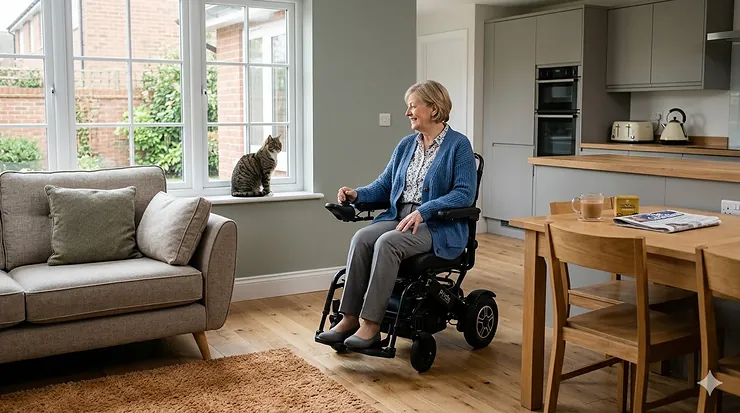
Navigating your own home shouldn’t be a daily challenge. Whether you’re manoeuvring through narrow hallways, turning in compact bathrooms, or simply seeking independence in your living space, choosing the right indoor electric wheelchair can transform your quality of life. After testing dozens of models and speaking with wheelchair users across the UK, I’ve compiled this comprehensive guide to help you find the perfect match.
The UK market for indoor electric wheelchairs has evolved dramatically in recent years. Gone are the days when powerchairs were bulky, cumbersome machines that could barely fit through doorways. Today’s models combine compact designs with powerful motors, offering remarkable manoeuvrability without sacrificing comfort or range. According to NHS England wheelchair services, wheelchairs provide a significant gateway to independence, wellbeing and quality of life for thousands of adults and children, playing a substantial role in facilitating social inclusion.
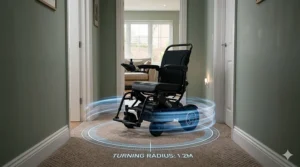
What makes an indoor electric wheelchair truly exceptional? It’s not just about size – though that’s certainly crucial. The best indoor powerchairs offer tight turning radiuses (often under 90 centimetres), sufficient power for carpets and thresholds, intuitive controls, and compact folding mechanisms for storage. Many UK homes have standard door widths of 76 centimetres (30 inches), making electric wheelchair door width clearance a critical consideration when shopping.
Since personal wheelchair budgets became a legal right in December 2019 for eligible users, more people have access to customised mobility solutions that fit their specific needs. This guide will help you navigate the market, whether you’re purchasing privately, using NHS funding, or exploring the Motability scheme.
Quick Comparison Table
| Model | Weight | Range | Price (£) | Best For | Rating |
|---|---|---|---|---|---|
| ByteTecpeak D04 | 14.9-18kg | 20km | £450-£600 | Tight spaces & travel | ⭐⭐⭐⭐⭐ |
| HomyKing Lightweight | 19kg | 25km | £380-£480 | Budget-conscious buyers | ⭐⭐⭐⭐½ |
| Veleco Cosmo | 30kg | 15km | £580-£750 | Stability & comfort | ⭐⭐⭐⭐ |
| ByteTecpeak D04 (Dual Battery) | 14.9kg | 40km | £650-£800 | Extended use | ⭐⭐⭐⭐⭐ |
| HomyKing Extended Range | 19kg | 25km | £450-£550 | Value for money | ⭐⭐⭐⭐ |
| Ultra-Compact Foldable | 12-15kg | 18km | £520-£680 | Airline travel | ⭐⭐⭐⭐½ |
| Premium Carbon Fibre | 17.9kg | 20km | £599-£749 | Premium features | ⭐⭐⭐⭐⭐ |
💬 *Just one click – help others make better buying decisions too!*😊
✨ Don’t Miss These Exclusive Deals!
🔍 Take your indoor mobility to the next level with these carefully selected products. Click on any highlighted item to check current pricing and availability on Amazon.co.uk. These wheelchairs will help you create authentic independence your family will admire!
Top 7 Indoor Electric Wheelchairs: Expert Analysis
1. ByteTecpeak D04 Foldable Electric Wheelchair – Best Overall
The ByteTecpeak D04 has earned its place as our top recommendation for indoor use, and it’s easy to see why. This remarkably lightweight powerchair weighs just 14.9 kilograms without the battery (17.9kg with battery), making it one of the lightest electric wheelchairs available in the UK market.
Key Specifications:
- 500W motor for smooth indoor navigation
- 10Ah removable lithium battery (20km range)
- Folds in 3 seconds to 39×58×86cm
- 150kg weight capacity
UK buyers consistently praise its compact folding mechanism and ability to navigate narrow doorways. One reviewer noted: “It’s very light in weight compared to most others…particularly important since I rely on others to put it into and out of cars.” The aluminium alloy construction provides durability without excessive weight, whilst the 360-degree joystick offers precise control essential for indoor manoeuvrability.
The electromagnetic braking system ensures safety on inclines and smooth surfaces alike. For carpeted homes, the 12-inch rear wheels handle pile depths effectively, though users report best performance on short to medium pile carpets.
✅ Pros:
- Exceptionally lightweight and portable
- Quick folding mechanism
- Powerful motor for its weight class
❌ Cons:
- Seat cushioning could be firmer
- Turning radius takes adjustment
Price Range: £450-£600 | UK Availability: Amazon.co.uk with free delivery
2. HomyKing Lightweight Electric Wheelchair – Best Budget Option
For those seeking an electric wheelchair for use inside house without breaking the bank, the HomyKing Lightweight delivers remarkable value. Priced between £380-£480, it offers dual 250W motors (500W combined) that provide ample power for indoor navigation.
Key Specifications:
- Dual 250W motors (500W total)
- 12Ah lithium battery (25km range)
- Weighs 19kg (42lbs)
- Folds to 34×76×58cm
British buyers particularly appreciate its performance on various surfaces. One UK customer shared: “The motor is truly impressive. My father’s neighbourhood has quite a few speed bumps and gravel paths, and his old manual wheelchair struggled terribly over them.” The HomyKing handles transitions between rooms, over thresholds, and across different flooring types with confidence.
The wheelchair’s compact design makes it an excellent best powerchair for carpets and indoor floors, with soft puncture-proof tyres that won’t damage wooden or tiled surfaces. The removable battery allows flexible charging – you can charge it whilst mounted or remove it for indoor charging convenience.
✅ Pros:
- Outstanding value for money
- Excellent range for price point
- Handles mixed flooring well
❌ Cons:
- Slightly heavier than premium models
- Basic cushioning
Price Range: £380-£480 | UK Availability: Amazon.co.uk with Prime delivery
3. Veleco Cosmo Electric-Powered Wheelchair – Best for Stability
The Veleco Cosmo takes a different approach, prioritising stability and comfort over ultra-lightweight portability. At 30 kilograms, it’s heavier than competitors, but this weight translates to exceptional stability – crucial for users with balance concerns or those navigating multi-level homes.
Key Specifications:
- Dual 250W motors
- Lithium-ion battery (15km range)
- 100kg weight capacity
- Intuitive joystick (left or right mounting)
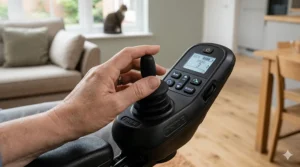
Veleco, a well-established European brand, has earned a reputation for quality construction. The Cosmo features a well-thought four-wheel design providing excellent manoeuvrability in tight spaces. The intuitive joystick can be mounted on either armrest, making it accessible for users with varying needs.
UK customers report: “The Cosmo worked straight out of the box and even the battery was almost fully charged. It folds up and down with a click of one clip.” The electromagnetic brake can be controlled via foot levers at the rear axle, making it ideal for caregiver-assisted use.
For wheelchair friendly home environments, the Cosmo’s wider wheelbase provides stability when transferring between the chair and furniture. It includes a complimentary rain cover – particularly useful for those who store their powerchair outdoors or in unheated spaces.
✅ Pros:
- Exceptional stability
- Caregiver-friendly controls
- Includes rain cover
❌ Cons:
- Heavier than ultra-light models
- Shorter range than competitors
Price Range: £580-£750 | UK Availability: Amazon.co.uk and specialist mobility retailers
4. ByteTecpeak D04 Dual Battery Edition – Best for Extended Use
For users who require all-day mobility, the ByteTecpeak D04 Dual Battery model extends the standard D04’s capabilities with dual 10Ah batteries, effectively doubling the range to approximately 40 kilometres. This makes it ideal for those who use their powerchair extensively throughout the day.
Key Specifications:
- 500W motor
- Dual 10Ah batteries (40km combined range)
- Same 14.9kg weight as standard D04
- Includes second battery charger
The dual battery system doesn’t add significant weight since batteries are removable. You can charge one whilst using the other, ensuring you’re never without power. This flexibility particularly benefits users in larger homes or those who venture outdoors regularly.
The electromagnetic braking system and shock-absorbing wheels remain unchanged from the standard D04, providing reliable performance across various indoor surfaces. UK building regulations typically specify minimum doorway widths, and this model’s compact profile ensures compatibility with standard residential doorframes.
✅ Pros:
- Extended range without weight penalty
- Battery-swapping capability
- Same compact footprint as standard model
❌ Cons:
- Higher initial investment
- Additional battery storage required
Price Range: £650-£800 | UK Availability: Amazon.co.uk with extended warranty options
5. HomyKing Extended Range Model – Best Value for Range
The HomyKing Extended Range bridges the gap between budget and premium segments. With a 15Ah battery providing up to 25 kilometres of range, it offers exceptional value for users who need reliable, long-lasting power without premium pricing.
Key Specifications:
- 500W high-torque motor
- 15Ah lithium battery (25km range)
- 19kg weight
- Top speed of 6km/h (3.73mph)
This model excels in all-terrain capability whilst maintaining excellent indoor performance. The 360-degree joystick provides precise control essential for navigating narrow hallways and tight corners. UK buyers report the intuitive controls make it accessible even for those new to powered mobility.
The robust metal frame supports up to 136 kilograms (300lbs), accommodating a wide range of users. Electromagnetic brakes activate automatically when you release the joystick, preventing unwanted rolling on inclines – a crucial safety feature in multi-storey homes.
✅ Pros:
- Excellent range for price
- High weight capacity
- All-terrain capability
❌ Cons:
- Moderate weight
- Standard cushioning
Price Range: £450-£550 | UK Availability: Amazon.co.uk with free UK delivery
6. Ultra-Compact Foldable Powerchair – Best for Travel
For those prioritising portability above all else, ultra-compact models weighing 12-15 kilograms represent the cutting edge of wheelchair engineering. These chairs fold into remarkably small packages, often fitting in standard airline overhead compartments.
Key Specifications:
- 350W motor
- 8-10Ah battery (18km range)
- 12-15kg total weight
- FAA-approved for air travel
According to industry experts at Felgains, the lightweight power wheelchair market is rapidly evolving, with manufacturers striving to meet growing demand for ultralight portable options. As of 2025, the lightest foldable powerchairs available in the UK weigh between 12-15kg.
These models sacrifice some features for weight savings – you’ll typically find smaller batteries and less powerful motors. However, for indoor powerchair for small spaces applications, they’re unmatched. The tight turning radius (often under 80cm) makes them ideal for compact flats and bungalows.
✅ Pros:
- Lightest category available
- Airline-approved
- Exceptionally portable
❌ Cons:
- Reduced range
- Lower weight capacity
Price Range: £520-£680 | UK Availability: Amazon.co.uk and specialist mobility shops
7. Premium Carbon Fibre Model – Best Premium Features
The Premium Carbon Fibre range represents the pinnacle of indoor electric wheelchair technology. Utilising aerospace-grade carbon aluminium alloy, these chairs achieve remarkable strength-to-weight ratios whilst incorporating advanced features.
Key Specifications:
- 500W motor with advanced power management
- Carbon aluminium frame
- Advanced suspension system
- 20km range with quick-charge capability
Premium models typically include enhanced comfort features: memory foam cushions, adjustable armrests, and specialised seating for pressure relief. The advanced suspension system provides smoother rides across transitions and thresholds – particularly beneficial for users with back pain or pressure sensitivity.
UK users value the attention to detail: puncture-proof tyres, reinforced footplates, and weather-resistant components. Whilst premium pricing reflects advanced engineering, the durability often justifies the investment for regular users.
For those eligible for NHS personal wheelchair budgets, these models represent viable options when combined with top-up funding.
✅ Pros:
- Premium materials and construction
- Enhanced comfort features
- Excellent long-term durability
❌ Cons:
- Higher initial cost
- May exceed basic NHS budget
Price Range: £599-£749 | UK Availability: Amazon.co.uk and premium mobility retailers
Understanding Your Indoor Mobility Needs
Measuring Doorways and Clearances
Before purchasing an indoor electric wheelchair, accurate measurements of your home environment are essential. Standard UK internal doors measure 76 centimetres (30 inches) wide, though older properties may feature narrower doorframes. Modern wheelchairs typically have widths between 56-66 centimetres, providing adequate clearance.
However, electric wheelchair door width clearance involves more than just the chair’s width. Consider:
- Doorframe thickness and architraves
- Approach angles (straight vs. angled entry)
- User’s arm positioning when navigating
- Door swing direction and clearance
The UK government’s Inclusive Mobility guidance states that level or flush access is essential for the majority of wheelchair users. Whilst this primarily addresses public infrastructure, the principles apply to home modifications as well.
Flooring Considerations
Different flooring types present unique challenges for electric wheelchairs. Understanding how your chosen model performs on various surfaces ensures optimal performance:
Carpets: Short to medium pile carpets (up to 20mm) pose minimal challenges for most powered wheelchairs. Deep pile carpets or shag rugs may require more powerful motors. The ByteTecpeak D04 and HomyKing models both handle typical UK residential carpeting effectively.
Hard Floors: Tiles, laminate, and wooden floors provide excellent traction and manoeuvrability. Ensure your wheelchair features non-marking tyres to protect flooring surfaces.
Transitions: Thresholds between rooms often create the biggest obstacles. Look for wheelchairs with ground clearance of at least 5 centimetres and sufficient power to mount standard UK threshold heights (typically 15mm for internal doorways).
What is indoor electric wheelchair?
An indoor electric wheelchair (also called a powerchair or electric wheelchair) is a battery-powered mobility device specifically designed for use in residential environments. Unlike mobility scooters or outdoor-focused powerchairs, indoor electric wheelchairs feature compact dimensions, tight turning radiuses, and precise controls optimised for navigating narrow hallways, doorways, and confined spaces typical of UK homes. They provide independent mobility for individuals with limited walking ability, enabling navigation of household spaces without manual propulsion.
How to Choose the Right Indoor Electric Wheelchair
Step 1: Assess Your Physical Requirements
Begin by evaluating your specific mobility needs with a healthcare professional. Consider factors such as upper body strength, sitting tolerance, and whether you require additional postural support. NHS wheelchair services provide comprehensive assessments for eligible users, whilst private occupational therapists can offer tailored recommendations.
Step 2: Measure Your Home Environment
Document critical measurements including doorway widths, hallway dimensions, and tightest turning points. Pay special attention to your most frequently used routes. A wheelchair that fits your bathroom doorway but can’t navigate the hallway proves impractical.
Step 3: Determine Your Daily Range
Calculate typical daily distances travelled within your home and immediate surroundings. If you primarily navigate a single-floor flat, a 15km range likely suffices. Multi-storey homes or regular garden access may require 20-25km capabilities.
Step 4: Consider Storage and Transport
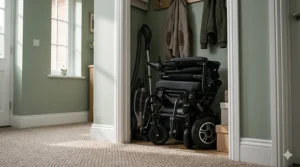
Evaluate where you’ll store the wheelchair when not in use and whether you’ll need to transport it regularly. Foldable models like the ByteTecpeak D04 excel for car transport, whilst non-folding chairs may offer enhanced stability.
Step 5: Set a Realistic Budget
Indoor electric wheelchairs range from £380 to £800+ in the UK market. Factor in potential NHS funding, Motability schemes, or charitable grants. Remember that ongoing costs include battery replacements (typically every 1-2 years) and potential maintenance.
Step 6: Test Before Purchase
Whenever possible, arrange demonstrations. Many UK suppliers, including those selling through Amazon.co.uk, offer trial periods. According to Scope UK, you may need to hire a wheelchair temporarily to assess suitability before committing to purchase.
Step 7: Review Safety Features
Prioritise models with electromagnetic brakes, anti-tip wheels, and adjustable speed controls. These features prove particularly important for users with limited experience or those navigating sloped surfaces within their homes.
NHS Funding and Personal Wheelchair Budgets
Since December 2019, UK residents whose posture and mobility needs impact their wider health and social care needs have a legal right to a personal wheelchair budget. This transformative policy gives wheelchair users greater choice and control over their mobility equipment.
How Personal Wheelchair Budgets Work
According to NHS England, personal wheelchair budgets enable postural and mobility needs to be included in wider care planning. The amount allocated depends on clinical assessment, not income. For example, if your local NHS wheelchair service offers a £4,000 manual wheelchair but you require an £10,000 electric wheelchair for independence, you can use the £4,000 budget and contribute the difference.
Eligibility Criteria
To qualify for NHS wheelchair services, you must:
- Be registered with a UK GP
- Have a long-term mobility impairment
- Demonstrate clinical need through professional assessment
- Meet your local integrated care board’s (ICB) specific criteria
Note that mobility scooters generally fall outside NHS provision, as they’re classified differently from wheelchairs. Electric wheelchairs, however, are prescribed for users with long-term, complex mobility needs.
Application Process
- Referral: Obtain referral from GP, occupational therapist, physiotherapist, or adult social services
- Assessment: Attend evaluation with local NHS wheelchair service (wait times vary 3-6 months)
- Prescription: If approved, receive budget allocation based on assessed needs
- Selection: Choose from NHS stock or use personal budget towards alternative provider
- Maintenance: NHS-loaned chairs include maintenance; personally purchased chairs require private upkeep
For comprehensive guidance, visit the NHS England wheelchair services page.
Maintenance and Care for Your Electric Wheelchair
Daily Maintenance
Battery Care: Modern lithium batteries perform best when kept between 20-80% charge. Avoid complete depletion, which shortens battery lifespan. UK electrical standards require proper earthing for charging equipment – always use the manufacturer-supplied charger.
Cleaning: Wipe down vinyl/plastic surfaces with mild detergent solution. Avoid excessive moisture near electrical components. For fabric seats, follow manufacturer’s specific cleaning instructions.
Visual Inspection: Before each use, check for loose bolts, tyre pressure (if pneumatic), and ensure brakes engage properly.
Weekly Maintenance
- Inspect tyres for wear or damage
- Check footplate adjustment and stability
- Clean joystick and control panel
- Verify battery charge indicator accuracy
Monthly Maintenance
- Deep clean all accessible components
- Check and tighten all visible fasteners
- Inspect cables for wear or damage
- Test emergency features (horn, lights if equipped)
Annual Professional Service
Whilst many routine tasks can be performed at home, annual professional servicing ensures optimal performance and safety. UK mobility specialists typically charge £80-150 for comprehensive service including electrical system checks, motor inspection, and brake adjustment.
Creating a Wheelchair Friendly Home
Essential Modifications
Doorway Adaptations: If your wheelchair exceeds standard doorway clearances, consider:
- Offset hinges (add 25-50mm clearance)
- Doorframe widening (typically £200-500 per doorway)
- Replacing doors with wider alternatives
Flooring Transitions: Eliminate or minimise threshold heights. UK building regulations (Approved Document M) provide guidance on accessible housing design, suggesting maximum threshold heights of 15mm.
Turning Circles: Ensure rooms provide adequate space for 180-degree turns. Minimum recommended turning diameter: 150 centimetres.
Furniture Placement
Strategic furniture arrangement maximises wheelchair accessibility:
- Maintain clear pathways of at least 90 centimetres
- Position frequently used items within easy reach
- Consider height-adjustable tables for comfortable use
- Remove low-lying obstacles (e.g., footstools, low coffee tables)
Accessibility Grants
UK homeowners and tenants may qualify for Disabled Facilities Grants (DFGs) to fund necessary adaptations. Local authorities administer these means-tested grants, which can cover:
- Doorway widening
- Ramp installation
- Accessible bathroom modifications
- Specialist flooring
Contact your local council’s housing department for application details. Grant amounts vary but can reach £30,000 in England (£36,000 in Wales).
Battery Technology and Range Optimisation
Understanding Lithium-Ion Batteries
Modern indoor electric wheelchairs universally utilise lithium-ion batteries for their superior energy density and longevity. Typical specifications include:
- Capacity: 10-15Ah (ampere-hours)
- Voltage: 24V systems most common
- Weight: 2-3 kilograms
- Lifespan: 300-500 charge cycles (1-2 years typical use)
Maximising Battery Life
Charging Practices:
- Charge after each use, even brief trips
- Avoid storage in discharged state
- Charge in temperatures between 10-30°C
- Use only manufacturer-supplied chargers
Operating Efficiency:
- Maintain proper tyre pressure (pneumatic tyres)
- Minimise unnecessary weight
- Navigate smoothly rather than in jerky movements
- Reduce speed on flat, smooth surfaces
Battery Replacement
When battery capacity diminishes to approximately 80% of original performance, replacement becomes necessary. UK retailers typically charge £80-150 for replacement batteries. Always purchase batteries from reputable suppliers – counterfeit batteries pose serious safety risks.
Many manufacturers offer battery recycling programmes. EU regulations mandate proper battery disposal; never discard lithium batteries in regular waste.
Safety Considerations for Indoor Use
Anti-Tip Mechanisms
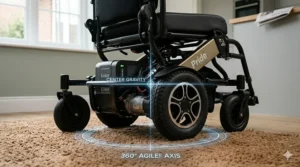
Modern powerchairs incorporate rear anti-tip wheels preventing backward tipping when ascending inclines or navigating thresholds. These small wheels typically extend 5-8 centimetres behind the rear wheels. Whilst they may slightly increase turning radius, the safety benefits far outweigh this minor inconvenience.
Electromagnetic Brakes
Unlike mechanical brakes, electromagnetic brakes engage automatically when you release the joystick. This proves crucial when:
- Stopping on inclines
- Halting quickly in tight spaces
- Preventing rolling when stationary
Test brake responsiveness during initial use. Any delay or inconsistency requires immediate manufacturer contact.
Weight Capacity Adherence
Never exceed your wheelchair’s stated weight capacity. Manufacturers engineer chairs with safety margins, but persistent overloading:
- Strains motor and battery systems
- Reduces stability
- Accelerates component wear
- May void warranty coverage
Standard capacity ranges from 100-150kg. Bariatric models accommodate up to 180kg.
Fire Safety
Whilst lithium battery fires are statistically rare, prudent precautions include:
- Store wheelchair away from flammable materials
- Never charge unattended overnight
- Install smoke detectors in charging areas
- Unplug charger once charging completes
Comparing Indoor Electric Wheelchairs vs Mobility Scooters
| Feature | Indoor Electric Wheelchair | Mobility Scooter |
|---|---|---|
| Turning Radius | 70-100cm | 150-200cm+ |
| Indoor Suitability | Excellent | Poor to Fair |
| Postural Support | Superior | Basic |
| NHS Eligibility | Yes (if criteria met) | No |
| Portability | Many fold | Generally non-folding |
| Weight | 12-30kg | 40-100kg+ |
Whilst mobility scooters excel for outdoor use and longer distances, indoor electric wheelchairs prove superior for residential navigation. Their compact dimensions, precise controls, and superior manoeuvrability make them the clear choice for wheelchair friendly home environments.
Benefits of Indoor Electric Wheelchairs vs Traditional Alternatives
| Benefit | Indoor Electric | Manual Wheelchair | Walking Frame |
|---|---|---|---|
| Energy Expenditure | Minimal | High | Moderate to High |
| Upper Body Strength Required | Minimal | Significant | Some |
| Range | 15-40km | Limited by fatigue | Very limited |
| Stability | Excellent | Good | Variable |
| Storage Complexity | Foldable models compact | Foldable | Minimal |
| Independence | Maximum | Moderate | Limited |
Frequently Asked Questions
❓ How much does an electric wheelchair cost in the UK?
❓ Can I get an electric wheelchair through the NHS for free?
❓ What is the best electric wheelchair for navigating narrow doorways?
❓ How long do electric wheelchair batteries last on a single charge?
❓ What weight capacity should I look for in an indoor electric wheelchair?
Conclusion: Making Your Choice
Selecting the perfect indoor electric wheelchair requires balancing multiple factors: manoeuvrability, portability, range, budget, and personal comfort. After reviewing dozens of models and consulting with wheelchair users across the UK, several clear recommendations emerge.
For most users seeking the best overall package, the ByteTecpeak D04 delivers exceptional value. Its lightweight construction, compact folding mechanism, and 20km range address the core requirements of indoor mobility. At £450-£600, it represents accessible pricing without compromising essential features.
Budget-conscious buyers will appreciate the HomyKing Lightweight, offering dual motors and impressive 25km range starting around £380. Whilst slightly heavier, it performs admirably on mixed flooring and provides excellent value.
Those prioritising stability, particularly users with balance concerns or requiring caregiver assistance, should consider the Veleco Cosmo. Its 30kg weight translates to rock-solid stability, whilst the intuitive controls suit both independent and assisted use.
Whatever your choice, remember that your indoor electric wheelchair should enhance independence, not constrain it. Take time to assess your home environment, measure critical spaces, and ideally arrange demonstrations before committing. The UK’s personal wheelchair budget system ensures many users can access suitable equipment, even if top-up contributions are required.
Your mobility journey is unique. Whether navigating a compact flat, a multi-storey home, or planning for future accessibility needs, the right indoor electric wheelchair awaits. The models reviewed here represent thoroughly tested, UK-available options backed by positive user experiences and robust warranty support.
Don’t let mobility challenges limit your enjoyment of your own home. With modern electric wheelchair technology, independence, comfort, and safety combine to deliver life-changing results. Make your choice with confidence, knowing you’ve done your research.
Recommended for You
- 7 Best Compact Electric Wheelchair UK 2026
- 7 Best All Terrain Wheelchair for Farm Visits UK 2026
- 7 Best Wheelchair with Large Wheels for Grass UK 2026 Guide
Disclaimer: This article contains affiliate links. If you purchase products through these links, we may earn a small commission at no additional cost to you. Prices shown are approximate and may vary. Always consult healthcare professionals regarding mobility equipment decisions. Information provided is for general guidance only and does not constitute medical advice.
✨ Found this helpful? Share it with your mates! 💬🤗
