
In This Article
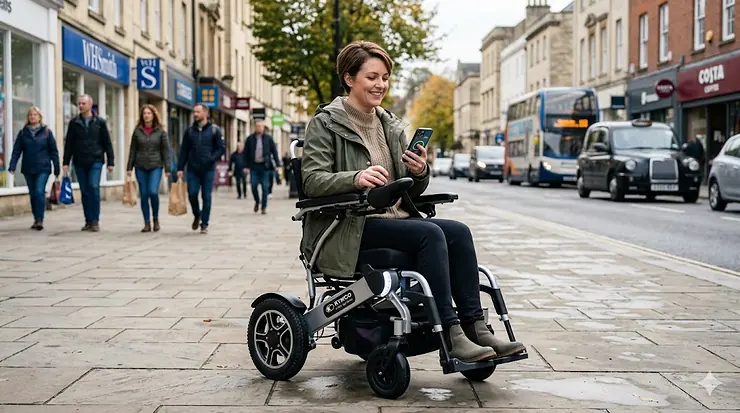
The concept of controlling your powerchair with a smartphone might sound like something from a science fiction film, but in 2026, it’s rapidly becoming standard equipment. An app controlled electric wheelchair transforms how users interact with their mobility device, offering features that simply weren’t possible with traditional joystick-only systems — from remote positioning and battery diagnostics to one-tap folding mechanisms and mileage tracking.
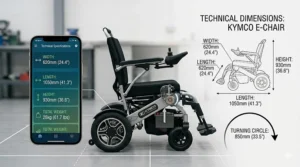
What most UK buyers overlook is that app connectivity isn’t just about convenience; it’s fundamentally reshaping wheelchair independence. Imagine summoning your powerchair from across a car park when you’ve forgotten where you left it, or checking your battery percentage from your living room before heading out for the day. These aren’t gimmicks — they’re practical solutions to real-world frustrations that wheelchair users face daily in British conditions.
The UK market has seen a surge in smartphone-controlled powerchairs over the past two years, with Amazon.co.uk now stocking dozens of models featuring iOS and Android compatibility. Prices typically range from around £400 for basic foldable models with limited app features, up to £2,000-£4,000 for premium powerchairs with comprehensive diagnostics and remote control capabilities. Worth noting: many of these are UKCA-certified and designed to handle our distinctly British weather — something that matters rather more than manufacturers’ marketing materials often acknowledge.
Quick Comparison Table: Top App Controlled Powerchairs
| Model | App Features | Battery Range | Weight | Price Range (GBP) | Best For |
|---|---|---|---|---|---|
| AtKits Intelligent Wheelchair | Remote fold/unfold, battery display | Up to 48 km | 32 kg | £800-£1,200 | Tech-savvy users |
| ByteTecpeak D04 | Diagnostics, mileage tracking | 20 km | 18.6 kg | £500-£700 | Travel & portability |
| Etech Ultra-Light Carer Control | Bluetooth remote, carer assist | 24 km | 28 kg | £1,200-£1,500 | Shared control needs |
| Robooter E30 | Full app control, remote driving | 25 km | 27 kg | £1,800-£2,200 | Premium features |
| Rexhan Foldable Power Chair | Remote control, auto-fold | 20 km | 19 kg | £600-£900 | Budget-conscious |
| ByteTecpeak D06 | Battery monitoring, speed control | 22 km | 18 kg | £550-£750 | Lightweight priority |
| Motion Healthcare LiNX | MyLiNX app, fault diagnostics | 30 km | 35 kg | £2,500-£4,000 | Professional-grade |
From the comparison above, the ByteTecpeak D04 offers exceptional value under £700 for travellers prioritising portability, whilst the Motion Healthcare LiNX justifies its premium price with comprehensive diagnostics that could save hundreds in service calls. Budget buyers should note that models under £600 often sacrifice battery range — a trade-off that becomes painfully apparent on damp British mornings when you’d rather not run out of charge halfway across a Tesco car park.
💬 Just one click — help others make better buying decisions too!😊
Top 7 App Controlled Electric Wheelchairs: Expert Analysis
1. AtKits Intelligent Electric Wheelchair — The All-Rounder
The AtKits Intelligent Wheelchair represents precisely what modern UK powerchair users have been requesting: genuine smartphone control without the astronomical price tag. This model delivers full automatic folding via your mobile app, which sounds marginally gimmicky until you’re trying to collapse a traditional powerchair in the rain outside a train station with shopping bags in hand.
The dual 200W motors (400W total) provide surprisingly robust hill-climbing capability — genuinely useful for those tackling the steep gradients in cities like Bristol, Edinburgh, or Sheffield. The 24V 12Ah lithium battery offers approximately 45-50 km range under ideal conditions, though in typical British weather with frequent stops, expect closer to 35-40 km. The aircraft-grade aluminium frame keeps total weight to 32 kg, which remains manageable for boot loading, though you’ll still want assistance if you’re doing this daily.
Customer feedback from UK buyers consistently highlights the app’s reliability — connections rarely drop, and the fold/unfold function responds within 2-3 seconds of button press. The 150 kg weight capacity accommodates most users comfortably, and the 18-inch seat width provides ample room without making indoor navigation awkward in narrower British doorways.
✅ Genuine app-controlled auto-folding
✅ Suitable for UK terrain (cobbles, gravel, grass)
✅ Respectable 45+ km range
❌ No rain mentioned in specifications (check weatherproofing)
❌ Replacement parts availability unclear in UK
Price range: Around £800-£1,200 on Amazon.co.uk
Verdict: Ideal for tech-comfortable users who want reliable smartphone control without spending premium prices. The app features actually work as advertised, which isn’t always guaranteed at this price point.
2. ByteTecpeak D04 Foldable Electric Wheelchair — The Travel Champion
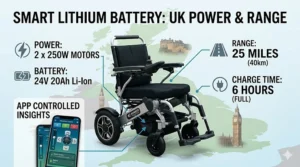
For frequent travellers navigating Britain’s rail network or squeezing into compact cars, the ByteTecpeak D04 solves the fundamental problem of powerchair portability. At just 18.6 kg, this is genuinely light enough for most adults to lift solo — transformative if you’re loading it multiple times daily or rely on assistance from family members who aren’t particularly strong.
The 500W motor punches above its weight class, handling inclines up to 12 degrees without the speed reduction you’d expect from lighter models. The 20 km range is modest but honest — ByteTecpeak doesn’t oversell capacity the way some manufacturers do. In practical British conditions (varied terrain, regular stops, occasional drizzle), you’ll reliably get 16-18 km, which covers most local errands and short commutes.
The app functionality centres on diagnostics and monitoring rather than remote driving, which actually makes rather more sense for most users. You get real-time battery percentage, mileage tracking, and maintenance reminders — the practical information you actually need, without the complexity of full remote control that most people wouldn’t use anyway. UK customers praise the electromagnetic braking system, which engages instantly when you release the joystick — crucial for safety on slopes and particularly reassuring in wet conditions.
✅ Exceptionally lightweight (18.6 kg)
✅ Honest range claims that match real-world performance
✅ Three-second folding mechanism
❌ Shorter range than heavier models
❌ Smaller battery (10Ah vs 12-20Ah competitors)
Price range: £500-£700 on Amazon.co.uk
Verdict: Perfect for users prioritising portability and honest specifications over maximum range. If your journeys are typically under 15 km and you value being able to lift the chair yourself, this is your best option under £700.
3. Etech Ultra-Light Instant Folding Carer Controlled — The Shared Control Specialist
The Etech Ultra-Light Carer Controlled addresses a specific but substantial UK market segment: users who need occasional assistance but primarily operate independently. The dual-control system — joystick for the user, Bluetooth remote for carers — provides flexibility that traditional single-control chairs simply can’t match.
The rear-mounting joystick option allows carers to operate the chair from behind, whilst the Bluetooth remote control enables positioning the chair remotely when needed. This proves invaluable in tight British living spaces — terraced houses, narrow hallways, compact gardens — where manoeuvring a powerchair manually is awkward at best. UK buyers particularly appreciate being able to summon the chair from its storage location without having to physically push it through doorways.
The 350W dual motors (700W total) deliver confident outdoor performance across varied British terrain. The 12-inch rear-wheel drive system handles gravel paths, grass, and light mud without struggling — important given how often UK pavements degrade into muddy edges during our lengthy wet seasons. Maximum speed of 6.4 km/h (4 mph) keeps it legal for pavement use as a Class 2 vehicle, requiring no DVLA registration.
✅ UKCA certified (meeting British safety standards)
✅ Dual control options (user and carer)
✅ Instant folding mechanism (2-3 seconds)
❌ Higher price point (£1,200-£1,500)
❌ Heavier than single-control alternatives (28 kg)
Price range: £1,200-£1,500
Verdict: Worth the premium for users who need occasional carer assistance but want to maintain independence. The UKCA certification provides peace of mind that it meets current UK safety standards.
4. Robooter E30 Foldable Powerchair — The Premium Smart Solution
Moving into premium territory, the Robooter E30 represents what app-controlled powerchairs can achieve when manufacturers prioritise the technology rather than treating it as an afterthought. The mobile app remote control allows genuine driving from your smartphone — not just positioning, but actual navigation over distance.
Before dismissing this as unnecessary: consider arriving at a restaurant car park in typical British drizzle, realising your powerchair is stored at the far end whilst you’re near the entrance. Being able to drive it to your location means you’re not soaked before you’ve even gone inside. The app also provides one-tap fold/unfold, mileage tracking, battery display, and mode switching — comprehensive functionality that justifies the higher price.
The underseat storage basket is genuinely substantial, accommodating a week’s shopping from your local Tesco Express or Sainsbury’s Local without requiring you to hang bags from armrests (which affects manoeuvrability and looks precarious). The luxury seating includes proper ergonomic support — not the thin padding many budget models call “comfort” — making extended use considerably more pleasant during British weather when you’d rather not be outdoors but have errands to run.
UK availability through specialist mobility retailers like Seacroft Mobility means you get proper UK warranty support and service — significant given that app-connected devices occasionally need firmware updates or troubleshooting.
✅ Full smartphone driving capability
✅ Substantial storage capacity
✅ UK retailer support network
❌ Premium pricing (£1,800-£2,200)
❌ Learning curve for full app features
Price range: £1,800-£2,200
Verdict: Justified premium for users who value comprehensive smart features and reliable UK support. The remote driving genuinely solves practical problems rather than just adding technological complexity.
5. Rexhan Foldable Power Chair — The Budget Smart Option
The Rexhan Foldable Power Chair occupies the crucial middle ground between basic manual powerchairs and premium app-controlled models. At £600-£900, it provides smartphone functionality without requiring you to spend over £1,000 — important for users purchasing privately rather than through NHS funding.
The remote control and auto-fold features work reliably, though the app interface feels less polished than premium alternatives. It functions perfectly well; you simply don’t get the sleek user experience of more expensive systems. For most users, this matters not at all — the chair folds when you press the button, and that’s what counts.
The dual 200W brushless motors provide adequate power for typical UK use. They won’t impress anyone tackling serious hills, but for relatively flat urban areas and gentle inclines, performance is perfectly acceptable. The 20 km removable lithium battery gives honest range — expect 16-18 km in real-world British conditions with varied terrain and frequent stops.
The 19 kg weight strikes a reasonable compromise between portability and stability. Light enough that most adults can manage loading it, substantial enough that it doesn’t feel flimsy or unstable on uneven British pavements. The aluminium frame includes electromagnetic brakes and suspension — essential safety features that some budget models omit.
✅ Genuine app features under £900
✅ Electromagnetic braking system
✅ Front suspension for comfort
❌ Basic app interface (functional but not elegant)
❌ Limited customer reviews on Amazon.co.uk
Price range: £600-£900 on Amazon.co.uk
Verdict: Solid choice for budget-conscious buyers who want smartphone functionality without compromising on safety features. The interface isn’t beautiful, but the chair does everything it claims to do.
6. ByteTecpeak D06 Ultra Lightweight — The Ultra-Portable Option
The ByteTecpeak D06 pushes portability even further than its D04 sibling, dropping to 18 kg whilst maintaining 500W motor power and app connectivity. This weight reduction comes primarily from aggressive frame engineering — the aluminium-magnesium alloy construction achieves strength without bulk.
The 12Ah lithium battery provides approximately 22 km range, positioning it between the D04’s 20 km and more substantial models offering 30+ km. For most UK users making local journeys — to the shops, visiting friends, attending appointments — 22 km comfortably covers daily requirements with margin for error. The battery is removable and airline-approved, making this genuinely travel-friendly for UK users taking holidays abroad or visiting family in other regions.
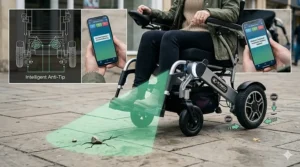
The app provides battery monitoring and speed control, focusing on practical functionality rather than elaborate features. You can check battery percentage before heading out (avoiding the dreaded mid-journey power loss), adjust speed limits for different environments, and monitor overall battery health. These aren’t glamorous features, but they’re enormously useful in daily life.
UK customers highlight the three-second unfolding mechanism as particularly well-designed. Many foldable powerchairs require awkward two-handed manipulation or involve catching fingers in hinges. The ByteTecpeak simply extends cleanly when you lift the handle — the sort of thoughtful engineering that becomes apparent only after using inferior designs.
✅ Lightest weight with full motor power (18 kg)
✅ Removable airline-approved battery
✅ Thoughtful unfolding mechanism
❌ Mid-range battery capacity (22 km)
❌ Less substantial frame than heavier models
Price range: £550-£750 on Amazon.co.uk
Verdict: Best choice for users who frequently transport their powerchair and prioritise weight above all else. The 18 kg weight makes solo loading practical for most adults.
7. Invacare LiNX System Powerchair — The Professional Solution
Moving into professional-grade territory, the Invacare LiNX system represents what happens when a established UK mobility manufacturer builds app connectivity properly from the ground up. Unlike consumer models where smartphone control feels retrofitted, LiNX integrates the MyLiNX app as a core component of the powerchair system.
The app provides clear battery life information, fault code diagnostics, and insight into overall powerchair health. Users can communicate chair issues directly to their service provider through the app, eliminating the frustration of trying to describe technical problems over the phone. For users relying on their powerchair daily — for work, education, or essential independence — this diagnostic capability can identify developing issues before they cause complete failure.
The REM400 touch screen remote requires minimal force to operate, with configurable sensitivity settings accommodating users with varying physical abilities. The built-in Bluetooth connects to multiple devices simultaneously — computers, laptops, tablets, smartphones — and includes mouse mover and switch control functionality. This transforms the powerchair into an access hub for digital devices, enabling users to control their computer or smartphone using the same interface they use for mobility.
UK service network through Invacare’s established dealer network means you get professional support, not just email customer service. When something goes wrong (and with any complex device, something eventually will), having access to trained technicians who know your specific powerchair model proves invaluable.
✅ Professional-grade diagnostics and fault reporting
✅ Multi-device Bluetooth connectivity
✅ Established UK service network
❌ Premium pricing (£2,500-£4,000)
❌ Requires professional fitting and setup
Price range: £2,500-£4,000 (depending on configuration)
Verdict: Justified investment for users requiring their powerchair for work or education, or those with complex access needs. The diagnostic capability and UK service support provide peace of mind that budget models can’t match.
Understanding App Features: What Actually Matters in British Conditions
The marketing materials for app-controlled powerchairs often emphasise technological sophistication without explaining what these features mean in practical daily use. Let me translate the jargon into actual British scenarios.
Remote Control vs Remote Positioning
Remote positioning means you can move the chair short distances using your smartphone — summoning it from storage, repositioning it beside your car, nudging it forward when you’ve parked awkwardly. This proves genuinely useful in cramped British living spaces where manually pushing a powerchair through narrow hallways is awkward.
Remote control means you can actually drive the chair over distance from your phone — across a car park, through a garden, from one room to another. This sounds extravagant until you consider arriving somewhere in torrential British rain. Being able to position your chair precisely at the entrance rather than manually wheeling it through puddles suddenly seems rather sensible.
Most UK users find remote positioning sufficient for daily needs. Full remote control is brilliant when you need it, but if that’s twice a year, the premium pricing becomes harder to justify.
Battery Diagnostics: Beyond Percentage Display
Basic models show battery percentage — useful, but not the full story. Advanced app systems monitor battery health over time, predicting when capacity is degrading and warning you before the battery fails completely. Given that replacement lithium batteries typically cost £150-£400, advance warning helps you budget rather than facing an emergency expense.
The LiNX system takes this further, providing fault codes when electrical issues arise. Rather than your powerchair simply stopping with no indication why, you get specific error messages you can communicate to service technicians. This dramatically reduces diagnostic time (saving money if you’re paying privately) and prevents the frustration of describing intermittent problems.
One-Tap Folding: Why It Actually Matters
You might dismiss remote folding as lazy — until you’ve attempted to collapse a traditional powerchair in a tight space whilst juggling shopping bags or rushing to catch a train. The difference between pressing a phone button and performing a multi-step manual folding sequence is the difference between manageable and stressful.
In practice, one-tap folding means you can initiate the process before you’ve even reached your car, so the chair is ready to load immediately. When you’re standing in a British car park in the rain, those fifteen seconds matter rather more than you’d expect.
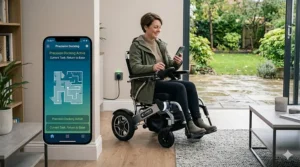
Real-World Scenarios: Matching Powerchairs to British Lifestyles
Urban Commuter Profile: London, Manchester, Birmingham
Scenario: Daily commutes using mixed transport (bus, train, pavement), navigating narrow pavements, kerbs, and occasional cobbles. Storage in a compact flat with limited space.
Best Match: ByteTecpeak D04 — The 18.6 kg weight makes it practical for frequent transport loading, whilst the 20 km range comfortably covers typical urban journeys. The compact fold fits into limited flat storage, and the diagnostics app helps you avoid being stranded mid-commute with battery issues.
Why not premium models? Urban commuters primarily need reliability and portability. The D04’s honest specifications and lightweight design solve the actual daily challenges without paying for remote driving features you’d rarely use in crowded city environments.
Suburban Family Profile: Semi-Detached in Reading, Milton Keynes, or Nottingham
Scenario: Local shopping trips, visiting friends, trips to GP surgery. Occasional longer journeys but primarily 5-15 km radius. Stored in garage or conservatory, loaded into family car for days out.
Best Match: Rexhan Foldable Power Chair — The £600-£900 price point fits typical family budgets without requiring significant financial commitment. The app features provide modern convenience (remote positioning helps in the garage, battery monitoring prevents mid-shopping power loss), whilst the 19 kg weight means most family members can manage loading.
Why not ultra-light models? Suburban users don’t transport their powerchair multiple times daily. The slightly heavier frame provides better stability on varied terrain (pavements, grass, gravel drives) common in suburban environments.
Rural User Profile: Village in Yorkshire, Cornwall, or Scottish Borders
Scenario: Longer journeys between destinations, rougher terrain (unmade tracks, grass verges, variable surface quality), exposure to British weather (rain, wind, mud).
Best Match: AtKits Intelligent Wheelchair or Etech Carer Control — The 45+ km range handles longer distances between rural destinations, whilst dual 200W+ motors provide confident performance on rough terrain. The suspension systems cope with poorly maintained rural roads and paths.
Why not compact models? Rural users need range and robust construction more than extreme portability. The additional weight and larger batteries deliver reliability when you’re miles from home and alternative transport options are limited.
Practical Wet Weather Performance: The Reality British Manufacturers Avoid Mentioning
Virtually every powerchair listing includes the phrase “Do not use in heavy rain” buried somewhere in the specifications. This presents a rather obvious problem for British users, given that our weather frequently involves exactly that.
In practice, most modern app-controlled powerchairs tolerate light rain and drizzle without immediate issues. The electronics are sufficiently sealed to handle typical British dampness. However, prolonged exposure to heavy rain or leaving the chair outdoors in sustained wet conditions will eventually cause problems — corroded connections, moisture in the joystick assembly, or premature battery degradation.
The app connectivity actually helps here. Models with battery diagnostics alert you to moisture-related issues before they cause complete failure. If you notice battery health declining more rapidly than expected, or fault codes appearing after wet weather use, you can address the problem whilst it’s still minor rather than waiting for catastrophic failure.
Practical recommendations for British weather use:
Keep a compact waterproof cover in the underseat storage. When caught in unexpected rain, covering the joystick and control electronics prevents most moisture damage. These cost £15-£30 on Amazon.co.uk and weigh almost nothing.
Store the powerchair indoors overnight, even if you have a shed or garage. British dampness is relentless; leaving electronics in unheated outbuildings accelerates corrosion.
Remove the battery and store it indoors during prolonged periods of non-use. Lithium batteries particularly dislike British damp and cold. Room temperature storage dramatically extends battery lifespan.
After wet weather use, wipe down electrical connections and the joystick assembly with a dry cloth. This takes thirty seconds and prevents cumulative moisture buildup.
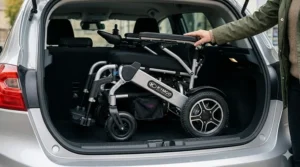
UK Regulations Update: What Changed in 2026
The Department for Transport launched a comprehensive consultation in January 2026 to modernise powered mobility device regulations that hadn’t been substantially updated since 1988. Whilst final changes won’t be implemented until late 2026 or 2027, the consultation signals significant upcoming modifications affecting app-controlled powerchairs.
Current Regulations (Still in Effect May 2026)
Class 2 Devices (pavement use): Maximum 6.4 km/h (4 mph), no DVLA registration required, pavement use only (crossing roads when necessary).
Class 3 Devices (road capable): Maximum 12.8 km/h (8 mph) on roads, 6.4 km/h on pavements, DVLA registration required, must have lights, indicators, horn, and mirrors.
Weight Limits: The current 150 kg maximum limit excludes many modern powerchairs designed for larger users or featuring substantial batteries and advanced electronics. This is explicitly acknowledged in the consultation as outdated.
Expected Changes (Pending Consultation Results)
Revised weight limits accommodating modern powerchair designs and battery technology. The current 150 kg limit forces many contemporary models into legal grey areas.
Updated speed classifications potentially allowing Class 2 devices slightly higher speeds whilst maintaining safety requirements.
Modern terminology replacing outdated terms like “invalid carriage” with language reflecting current understanding of disability and mobility.
Clarification of smart features: The consultation acknowledges that app connectivity and remote control capabilities weren’t contemplated by 1988 legislation. Expect specific guidance on remote driving features and safety requirements for smartphone-controlled movement.
What This Means for Buyers Now
Purchasing an app-controlled powerchair in May 2026 is perfectly safe. The consultation is about modernising regulations to accommodate existing technology, not restricting current use. However, choose models from established manufacturers who can provide firmware updates if new requirements emerge.
UKCA certification (which replaced CE marking post-Brexit) indicates the powerchair meets current British safety standards. Prioritise UKCA-marked models to ensure compliance as regulations evolve.
App Reliability: iOS vs Android Compatibility
Most manufacturers claim compatibility with both iOS and Android, but the user experience often differs substantially between platforms. From UK customer feedback across multiple app-controlled models:
iOS Users Report:
More stable connections with fewer unexpected disconnections. Apple’s stricter Bluetooth implementation appears to create more reliable pairing.
Faster app updates. Manufacturers typically release iOS versions first, then Android versions weeks later.
Better interface design on average. Developers often prioritise iOS interface refinement.
Android Users Report:
Wider device compatibility. iOS apps occasionally require recent iPhone models; Android apps typically support older devices.
More flexibility in customisation. Android’s permissions system allows more granular control over app behaviour.
Occasional pairing issues with budget Android phones using older Bluetooth versions.
Practical Recommendation
Test the app with your specific device before committing to purchase. Most UK mobility retailers and Amazon.co.uk offer returns within 30 days, giving you time to verify reliable connectivity with your particular smartphone model.
If you’re buying a new phone specifically for powerchair control, recent mid-range models (£300-£500) provide perfectly adequate Bluetooth and processing power. You don’t need flagship devices for this application.
Long-Term Cost Analysis: Total UK Ownership Over Five Years
The purchase price represents only part of the total cost. Let me break down realistic five-year ownership costs for typical UK users.
Budget Model (£500-£700): ByteTecpeak D04
Purchase: £600
Battery replacement (years 3-4): £200-£300
Tyre replacement (year 3): £80-£120
Annual maintenance: £50-£100 × 5 = £250-£500
Potential repairs (conservatively): £150-£300
Five-year total: £1,280-£2,020
Annual average: £256-£404
Mid-Range Model (£800-£1,500): AtKits/Rexhan
Purchase: £1,000
Battery replacement (years 3-4): £250-£350
Tyre replacement (year 3): £100-£150
Annual maintenance: £75-£125 × 5 = £375-£625
Potential repairs: £200-£400
Five-year total: £1,925-£2,525
Annual average: £385-£505
Premium Model (£1,800-£4,000): Robooter/LiNX
Purchase: £2,500
Battery replacement (years 4-5): £300-£500
Tyre replacement (year 4): £120-£180
Annual service (professional): £150-£200 × 5 = £750-£1,000
Repairs (UK service network): £300-£600
Five-year total: £3,970-£4,780
Annual average: £794-£956
Value Assessment
Budget models deliver lowest total cost but require more frequent minor repairs and have shorter useful lifespans (typically 4-6 years vs 7-10 years for premium).
Mid-range models offer the sweet spot for most UK users: reasonable purchase price, acceptable longevity, manageable ongoing costs.
Premium models justify their cost for users requiring their powerchair daily for work, education, or essential independence. The UK service network and diagnostic capabilities reduce downtime, which has enormous value if the powerchair is essential rather than supplementary.
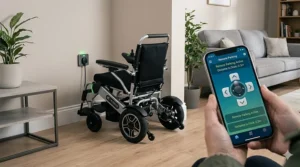
Frequently Asked Questions
❓ Are app controlled electric wheelchairs legal on UK pavements and roads?
❓ Can I use my app controlled powerchair in British rain and wet weather?
❓ How reliable is Bluetooth connectivity for powerchair control in 2026?
❓ What happens if my smartphone battery dies whilst using app-controlled features?
❓ Are replacement batteries and parts available in the UK for app-controlled models?
Conclusion: Finding Your Ideal App Controlled Powerchair in 2026
The app-controlled electric wheelchair market in 2026 offers genuinely transformative technology at price points ranging from affordable (£500-£700) to premium (£2,500-£4,000). The key is matching features to your actual daily requirements rather than being seduced by technological sophistication you won’t use.
For most UK buyers, the mid-range options — ByteTecpeak D04, Rexhan Foldable, or AtKits Intelligent — deliver the best balance of useful app features, reliable performance, and manageable cost. These provide smartphone connectivity that solves practical problems (battery monitoring, remote positioning, one-tap folding) without the complexity and expense of full remote driving systems.
Users requiring professional-grade reliability should look towards the Invacare LiNX system, where the premium pricing delivers comprehensive diagnostics, UK service support, and the peace of mind that comes from established manufacturer backing. For frequent travellers prioritising portability above all else, the ByteTecpeak D06‘s 18 kg weight makes solo transport genuinely practical.
The smart mobility revolution has arrived in Britain, and unlike many technological trends, this one actually solves real problems rather than creating new ones. An app-controlled powerchair won’t transform your life overnight, but it will eliminate dozens of small daily frustrations — and that accumulates to rather significant quality of life improvement over months and years.
✨ Don’t Miss These Exclusive Deals!
🔍 Take your mobility independence to the next level with these carefully selected products. Click on any highlighted item to check current pricing and availability on Amazon.co.uk. These picks will help you find exactly what you need!
Recommended for You
- 7 Best Smart Electric Wheelchairs UK 2026: Tech-Enhanced Mobility
- 7 Best Powered Standing Frames UK 2026
- 7 Best Sit to Stand Electric Wheelchairs UK 2026
Disclaimer: This article contains affiliate links. As an Amazon Associate, I earn from qualifying purchases. If you purchase products through these links, we may earn a small commission at no additional cost to you.
✨ Found this helpful? Share it with your mates! 💬🤗
