
In This Article
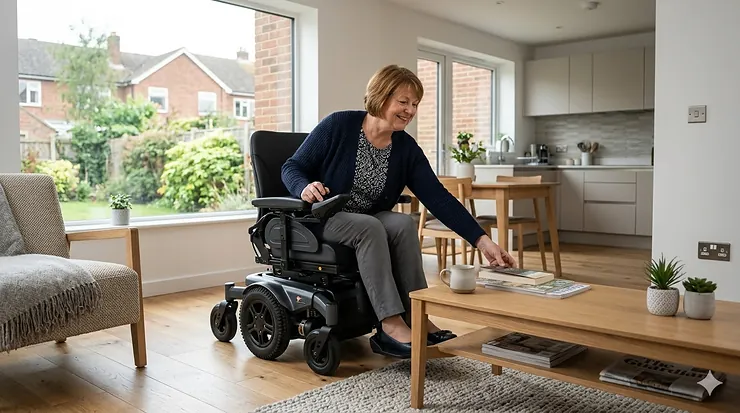
A mid wheel drive powerchair is an electric wheelchair where the main drive wheels sit directly beneath the user’s centre of gravity, providing exceptional manoeuvrability and the tightest turning radius of any powerchair configuration. Unlike front wheel or rear wheel drive models, mid wheel drive powerchairs feature six wheels — two central drive wheels with caster wheels positioned at both the front and rear, creating superior stability and indoor performance.
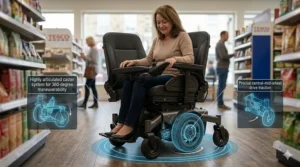
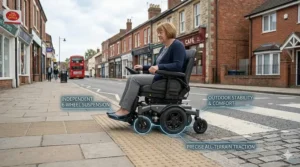
The beauty of this design lies in its intuitive handling. When you turn a mid wheel drive powerchair, the rotation axis aligns with your body’s midline, mirroring natural walking movements. This makes them incredibly easy to learn, particularly for first-time powerchair users. According to the UK’s Highway Code, most powerchairs fall under Class 2 vehicles (4mph maximum on pavements) or Class 3 (8mph maximum on roads), and mid wheel drive models excel in both environments when properly configured.
The positioning of drive wheels directly under the user means that weight distribution is optimal, providing better traction on inclines and excellent control in tight spaces. Whether you’re navigating narrow hallways at home, manoeuvring through crowded shops, or tackling outdoor terrain, a mid wheel drive powerchair offers unmatched versatility. With typical turning circles as small as 1,120mm, these chairs can literally turn on the spot — something that’s impossible with front or rear wheel drive configurations.
Quick Comparison Table: Top Mid Wheel Drive Powerchairs UK
| Model | Price Range (£) | Turning Circle | Max Speed | Range | Best For |
|---|---|---|---|---|---|
| Drive DeVilbiss Titan AXS | £1,950 | Compact | 4mph | 19 miles | Budget-conscious buyers |
| Quickie Q300 M Mini | £4,620-£7,494 | 1,120mm | 4mph | 22 miles | Tight indoor spaces |
| Permobil M3 Corpus | £7,194-£9,216 | 1,100mm | 6mph | 25 miles | Premium features |
| Rascal Ryley Seat Lift | £6,000-£8,000 | Compact | 4mph | 18 miles | Seat elevation needs |
| Quantum Q6 Edge | £8,000-£10,000 | Small | 6mph | 20 miles | Advanced technology |
| Invacare TDX SP2 | £7,500-£9,500 | 1,150mm | 6mph | 24 miles | Outdoor performance |
| Sunrise Salsa M2 | £5,500-£7,200 | 1,180mm | 4mph | 21 miles | Value for features |
💬 Just one click – help others make better buying decisions too! 😊
Top 7 Mid Wheel Drive Powerchairs: Expert Analysis
1. Drive DeVilbiss Titan AXS Mid Wheel Drive Powerchair
The Drive DeVilbiss Titan AXS is an excellent entry-level option for those seeking a reliable mid wheel drive powerchair without breaking the bank. Available on Amazon.co.uk and specialist mobility retailers, this chair offers remarkable value at approximately £1,950.
Key Specifications:
- Maximum speed: 4mph (6.4km/h)
- Range: Up to 19 miles (30.5km) on full charge
- Weight capacity: 136kg (21 stone)
- Six puncture-proof wheels with mid-wheel drive configuration
The Titan AXS comes equipped with a dynamic LiNX programmable controller featuring Bluetooth electronics, making it one of the most technologically advanced chairs in its price bracket. The height-adjustable seat with reclining backrest and swivel functionality ensures comfort during extended use, whilst the removable headrest and adjustable armrests allow for personalisation.
UK buyers particularly praise its compact design and agile handling. One verified purchaser noted: “Brilliant for getting around my small flat — turns on a sixpence and the battery lasts all day.” The chair’s freewheel mode allows easy manual pushing when needed, and the inclusion of a seatbelt adds an extra safety dimension.
✅ Pros:
- Excellent value for money
- Programmable Bluetooth controller
- Puncture-proof tyres reduce maintenance
❌ Cons:
- Basic suspension compared to premium models
- Limited customisation options
2. Quickie Q300 M Mini Powerchair
The Quickie Q300 M Mini holds the title of the UK’s most popular powerchair for good reason. With a base width of just 520mm and a turning circle of only 1,120mm, it’s the narrowest TRUE mid wheel drive powerchair available. Prices range from £4,620 to £7,494 depending on configuration and VAT relief eligibility.
Key Specifications:
- Turning diameter: 1,120mm (44 inches)
- Maximum range: 22-24 miles with 56Ah batteries
- Maximum speed: 4mph (6km/h)
- Weight: From 103kg including batteries
What sets the Q300 M Mini apart is its patented all-wheel suspension that cushions every wheel independently, delivering exceptional comfort over rough terrain. The 355mm (14-inch) drive wheels enable the chair to climb kerbs up to 100mm (4 inches) high, whilst super-strong 4-pole motors provide reliable power through challenging outdoor conditions.
According to Sunrise Medical, the manufacturer, the Q300 M Mini’s TRUE mid wheel drive technology means the drive wheels are perfectly aligned with the chair’s centre, providing optimal traction and the most compact turning circle possible. UK users consistently rate this feature highly for navigating supermarket aisles and home corridors.
One satisfied customer shared: “Love it because I can get it round my house easily. I also love the custom colours you can choose. This is my best purchase by far.”
✅ Pros:
- Tightest turning radius on the market
- Excellent outdoor capability despite compact size
- Highly customisable with over 1 million combinations
❌ Cons:
- Higher price point
- Requires professional assessment for optimal configuration
3. Permobil M3 Corpus Powerchair
The Permobil M3 Corpus represents the pinnacle of mid wheel drive powerchair engineering. Priced between £7,194 and £9,216 (with potential VAT relief), this premium chair justifies its cost through industry-leading features and exceptional build quality.
Key Specifications:
- Maximum speed: 10km/h (6mph)
- Range: Up to 25 miles with enhanced battery system
- Turning in corridor: 1,100mm
- Weight capacity: 150kg
The M3 Corpus features Permobil’s innovative FlexLink suspension system, which provides full suspension at ANY seat height, seating position, or driving speed. This unique capability means you never sacrifice comfort for function — whether you’re elevated 300mm off the ground or reclining fully flat. The chair’s ActiveHeight technology allows you to drive at speeds up to 5km/h whilst fully elevated, a feature unmatched by competitors.
What truly distinguishes the M3 Corpus is its seating system. The chair offers market-leading 50 degrees of tilt-in-space, power recline to 180 degrees (genuinely flat), and the exclusive ActiveReach function that combines seat elevation with up to 20 degrees of forward tilt. This allows users to reach beyond obstructions into high cabinets or assist with transfers in ways other chairs simply cannot.
The Permobil VoltPro charger and enhanced battery work together to deliver 25% greater driving distance compared to previous models, with improved charging times and extended battery life. Powerful LED lights front and rear ensure visibility in low-light conditions.
✅ Pros:
- Full suspension maintained at all seating positions
- Unique ActiveReach forward tilt technology
- 25% increased range with new battery system
❌ Cons:
- Premium pricing
- Complex features may overwhelm basic users
4. Rascal Ryley Seat Lift Powerchair
The Rascal Ryley fills a specific niche beautifully — users who need substantial seat elevation combined with mid wheel drive manoeuvrability. Typically priced around £6,000-£8,000, this chair offers a 7.5-inch (190mm) column seat lift that raises the seat to a maximum height of 75cm.
Key Specifications:
- Maximum speed: 4mph (6.4km/h)
- Seat lift: 7.5 inches (190mm)
- Full suspension system
- Dual-density puncture-resistant drive wheels
The standout feature is undoubtedly the powered seat lift, which operates smoothly even whilst stationary or moving. This elevated seating position dramatically improves your reach to higher surfaces and transforms social interactions by bringing you eye-to-eye with standing friends and family. One user commented: “Being able to reach kitchen cupboards independently has given me back so much dignity.”
The Ryley’s full suspension system absorbs bumps and uneven terrain effectively, reducing strain and enhancing comfort during extended use. The mid wheel drive design provides the expected tight turning radius, whilst dual-density drive wheels offer maximum comfort and peace of mind across various terrains.
Optional upgrades include swing-away legrests, elevating legrests, and attendant control, allowing the chair to grow with changing needs.
✅ Pros:
- Substantial seat elevation (190mm)
- Full suspension for comfort
- Puncture-resistant wheels
❌ Cons:
- Seat lift adds weight and complexity
- Slightly reduced range compared to competitors
5. Quantum Q6 Edge 2.0 Powerchair
The Quantum Q6 Edge 2.0 brings American engineering prowess to the UK market, offering a compelling blend of performance, style, and technological sophistication. Expect to invest £8,000-£10,000 for this high-performance chair.
Key Specifications:
- Maximum speed: 10km/h (6mph)
- Advanced ATX suspension
- Optional iLevel seat elevation
- Bluetooth-enabled controls with smartphone connectivity
Quantum’s Mid-Wheel 6 design with Active-Trac Suspension solves a persistent problem with mid wheel drive chairs: casters getting stuck on obstacles and suspending the drive wheels. The Active-Trac system responds dynamically to terrain, ensuring drive wheels maintain contact with the ground even when traversing challenging obstacles.
The optional iLevel technology elevates you up to 305mm (12 inches) whilst maintaining full suspension, allowing face-to-face conversations and improved access to work surfaces. The chair’s LED lighting system enhances visibility, whilst USB charging ports keep your devices powered throughout the day.
Bluetooth connectivity through the Q-Logic 3 controller allows you to adjust settings, monitor battery status, and even control your smartphone hands-free. This technological integration represents the future of powerchair design.
✅ Pros:
- Advanced Active-Trac suspension
- Comprehensive technology integration
- Stylish, contemporary design
❌ Cons:
- High purchase price
- Some features require technical knowledge
6. Invacare TDX SP2 Powerchair
The Invacare TDX SP2 targets users who prioritise outdoor performance without sacrificing indoor manoeuvrability. Priced at £7,500-£9,500, this chair strikes an excellent balance between capability and comfort.
Key Specifications:
- Turning radius: 1,150mm
- Maximum speed: 6mph (9.6km/h)
- Range: Up to 24 miles
- SureStep technology for improved outdoor handling
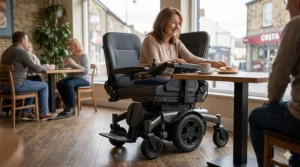
Invacare’s SureStep technology represents a significant advancement in mid wheel drive suspension design. The system actively maintains drive wheel contact with the ground when climbing obstacles, dramatically improving outdoor capability. This means you can confidently tackle kerbs, uneven pavements, and rough terrain that would challenge lesser chairs.
The TDX SP2 features Invacare’s LiNX control system with Bluetooth connectivity, allowing programmable driving profiles for different environments. Switch between an indoor profile with reduced speed and heightened sensitivity, and an outdoor profile with maximum performance and stability.
The chair accommodates a wide range of seating systems and can be configured with power tilt, recline, and elevating legrests. Build quality is exceptional, with Invacare’s reputation for durability evident throughout.
✅ Pros:
- Excellent outdoor performance with SureStep
- Programmable driving profiles
- Robust build quality
❌ Cons:
- Slightly larger turning radius than some competitors
- Limited colour options
7. Sunrise Salsa M2 Mid Wheel Drive Powerchair
The Sunrise Salsa M2 offers exceptional value in the mid-range segment, typically priced between £5,500 and £7,200. This predecessor to the Q300 M Mini maintains many of its successor’s strengths whilst offering a more accessible price point.
Key Specifications:
- Turning circle: 1,180mm
- Maximum speed: 4mph (6.4km/h)
- Range: Up to 21 miles
- All-wheel independent suspension
The Salsa M2 delivers impressive indoor manoeuvrability with its compact 1,180mm turning circle, whilst all-wheel independent suspension ensures a comfortable ride across varied terrain. The 330mm (13-inch) drive wheels provide good obstacle climbing capability up to 70mm kerbs.
Sunrise Medical’s VR2 controller offers intuitive operation with clear displays and responsive joystick control. The chair supports various seating configurations, from basic sling seats to fully customisable specialist seating systems.
UK mobility specialists often recommend the Salsa M2 for users seeking proven technology without the premium pricing of newer models. One occupational therapist noted: “The Salsa M2 remains one of our most recommended chairs because it simply works reliably day after day.”
✅ Pros:
- Excellent price-to-performance ratio
- Proven reliability
- Good dealer support network across UK
❌ Cons:
- Less advanced than newer models
- Heavier than ultra-compact alternatives
Understanding Mid Wheel Drive vs Front Wheel Drive Powerchair
The choice between mid wheel drive vs front wheel drive powerchair configurations significantly impacts your daily experience. Each design philosophy offers distinct advantages tailored to different mobility needs and environments.
Mid Wheel Drive Advantages
Mid wheel drive powerchairs position the drive wheels directly beneath your centre of gravity. This central placement creates the tightest possible turning radius — typically 1,100-1,200mm compared to 1,400-1,600mm for front wheel drive models. When you turn a mid wheel drive powerchair, you rotate around your body’s midpoint, creating an intuitive, natural feel that mirrors walking movements.
The six-wheel configuration (two drive wheels, two front casters, two rear casters) provides exceptional stability on inclines and ramps. With weight distributed evenly across six ground contact points, mid wheel drive chairs handle side slopes confidently without the tipping concerns associated with four-wheel designs.
Front Wheel Drive Characteristics
Front wheel drive powerchairs position large drive wheels at the front with smaller casters at the rear, creating a four-wheel design. This configuration excels at obstacle climbing because the drive wheels encounter obstacles first and can pull the entire chair up and over. Front wheel models typically handle larger kerbs (up to 150mm) compared to mid wheel alternatives.
The front-heavy weight distribution provides excellent traction on inclines, with drive wheels pushing down as you climb. This makes front wheel drive powerchairs particularly effective on outdoor terrain with significant grade changes. However, the larger turning radius (approximately 1,400-1,600mm) can prove challenging in confined indoor spaces.
Turning Radius Comparison
The difference becomes apparent in real-world scenarios. A mid wheel drive powerchair with a 1,120mm turning radius can execute a 360-degree turn within a standard domestic lift. Front wheel drive models require additional clearance, potentially necessitating multiple-point turns in the same space.
When shopping in supermarkets, mid wheel drive users can navigate aisles with confidence, knowing they can turn around within the aisle width if needed. Front wheel drive users must plan routes more carefully, potentially traversing longer distances to find suitable turning spaces.
Indoor vs Outdoor Performance
Mid wheel drive powerchairs dominate indoor environments. Their tight turning capabilities, intuitive handling, and compact dimensions make them ideal for homes, offices, shops, and public buildings. Modern suspension systems have dramatically improved outdoor capability, with chairs like the Quickie Q300 M Mini and Permobil M3 Corpus delivering excellent performance across mixed terrain.
Front wheel drive powerchairs traditionally excel outdoors, particularly on uneven surfaces, hills, and rough terrain. The pulling motion of front drive wheels combined with superior obstacle climbing makes them the choice for users prioritising outdoor adventures. However, this comes at the cost of indoor manoeuvrability.
According to research published by Permobil, mid wheel drive technology has advanced significantly in recent years, narrowing the outdoor performance gap whilst maintaining the indoor advantages that made the configuration popular.
Centre of Gravity Wheelchair: Why It Matters
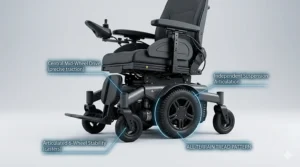
The centre of gravity wheelchair concept fundamentally influences how a powerchair handles, responds to terrain, and provides stability. Understanding this principle helps explain why mid wheel drive powerchairs behave differently from their front or rear wheel drive counterparts.
Physics of Centre of Gravity
Your centre of gravity represents the point where your body’s weight distributes equally in all directions. For wheelchair users, this typically sits slightly forward of the hip joint. Mid wheel drive powerchairs position the drive wheels directly beneath this point, creating optimal weight distribution over the powered wheels.
This alignment delivers several practical advantages. When accelerating, braking, or climbing inclines, the weight remains centred over the drive wheels, maximising traction. The chair responds predictably to joystick inputs because forces act through the centre of rotation rather than at an offset.
Stability on Slopes
The six-wheel mid wheel drive configuration excels on side slopes and cross-cambers. With casters at both front and rear, the chair maintains four ground contact points even when one set of casters lifts due to uneven terrain. This prevents the unsettling sensation of the chair tilting excessively when traversing slopes.
Front and rear wheel drive powerchairs, with only four wheels, can feel less secure on significant side slopes. The chair may lean noticeably as weight shifts towards the lower side, potentially causing anxiety for users sensitive to tipping sensations.
Impact on Turning
When a mid wheel drive powerchair turns, it pivots around the drive wheels positioned at your centre of gravity. This creates the sensation of your body remaining stationary whilst the chair rotates beneath you. Rear casters sweep through a wider arc than front casters, but this occurs behind you, outside your direct line of sight.
Front wheel drive chairs pivot around the front drive wheels, positioned ahead of your centre of gravity. This means your body swings through an arc as you turn, requiring more spatial awareness to avoid obstacles. The learning curve can be steeper for new users unfamiliar with compensating for this “fishtailing” effect.
Weight Transfer During Acceleration
Centre of gravity positioning affects how chairs handle acceleration and braking. Mid wheel drive chairs maintain stable weight distribution during these transitions because forces act through the centre point. You accelerate smoothly without the front-lifting sensation sometimes experienced in rear wheel drive models, or the rear-lightness of front wheel drive chairs.
This stability proves particularly important for users with reduced core strength or trunk control. The predictable handling reduces the physical demands of maintaining posture during normal driving operations.
Mid Wheel Drive Powerchair Tight Turning: Technical Excellence
The mid wheel drive powerchair tight turning capability represents one of the configuration’s most celebrated advantages. This manoeuvrability transforms daily life for users navigating space-constrained environments.
The 360-Degree Turn
A true mid wheel drive powerchair can execute a complete 360-degree rotation within its own footprint. The Quickie Q300 M Mini, with its 1,120mm turning circle, requires only 1.12 metres of clear space to turn completely around. For context, a standard UK wheelchair-accessible toilet cubicle measures 1,500mm × 2,000mm, providing ample room for mid wheel drive powerchairs to manoeuvre comfortably.
This tight turning radius emerges from the drive wheels’ central positioning. When you turn the joystick fully left or right, one drive wheel rotates forward whilst the other rotates backward at equal speeds. The chair pivots around the point midway between the drive wheels — directly beneath your centre of gravity.
Real-World Applications
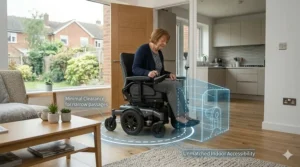
Consider navigating a typical UK terraced house. Hallways often measure 900-1,000mm wide, with doorways at 800mm. A mid wheel drive powerchair’s narrow base (typically 520-600mm) passes through doorways easily, and the tight turning radius allows users to turn into rooms without requiring extensive clear space.
Kitchen accessibility improves dramatically. Users can position themselves parallel to counters, turn to access different work zones, and navigate around kitchen islands that would prove challenging in front or rear wheel drive chairs. One user shared: “I can finally use my kitchen independently. The tight turns mean I don’t need someone to constantly move things out of my way.”
Caster Swing and Turning Precision
The physics of caster behaviour during turns explains why mid wheel drive chairs turn so tightly whilst maintaining stability. As the chair begins rotating, front and rear casters swivel to align with the turning direction. Because casters are equidistant from the drive wheels, they track circular paths of equal radius, maintaining balanced support throughout the turn.
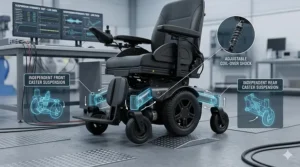
Advanced suspension systems like those on the Permobil M3 Corpus allow casters to maintain ground contact even during rapid direction changes. Independent caster suspension ensures that uneven floors don’t compromise stability mid-turn — a significant safety advantage in older buildings with settled or worn flooring.
Practical Turning Techniques
Mastering tight turns requires understanding a few key techniques. When approaching corners in narrow corridors, start your turn slightly before reaching the corner to allow the chair’s rear to swing through safely. The rear casters extend behind your body, so visualise the chair’s full length rather than just your seated position.
For extremely tight spaces, consider using multi-point turns. Stop halfway through the rotation, reverse slightly to adjust position, then complete the turn. This technique works brilliantly in confined bathrooms or when manoeuvring between furniture pieces.
Powerchair Drive Configuration: Making the Right Choice
Selecting the appropriate powerchair drive configuration requires careful consideration of your lifestyle, environment, and mobility goals. Each configuration — rear wheel drive, mid wheel drive, and front wheel drive — offers distinct performance characteristics suited to different user profiles.
Assessing Your Primary Environment
Your main usage environment profoundly influences the optimal drive configuration. Users spending 80% or more of their time indoors typically benefit most from mid wheel drive powerchairs. The tight turning radius, intuitive handling, and compact dimensions align perfectly with navigating homes, offices, shops, and public buildings.
Conversely, users prioritising outdoor activities — countryside walks, beach visits, or off-road adventures — may find front wheel drive models more suitable. The superior obstacle climbing capability and traction on uneven surfaces outweigh the indoor manoeuvrability trade-offs for these applications.
According to a study referenced by Quantum Rehab, approximately 65% of powerchair users in the UK identify indoor use as their primary concern, explaining mid wheel drive’s popularity in the British market.
Physical Considerations
Your physical capabilities influence which configuration feels most natural. Mid wheel drive chairs require minimal upper body strength because the intuitive turning mechanics reduce the need for compensatory movements. The chair responds directly to joystick inputs without requiring you to anticipate or counter-steer.
Front wheel drive chairs demand greater spatial awareness and some upper body strength. The “fishtailing” effect during turns means you must account for your body sweeping through an arc, which can challenge users with limited trunk control or cognitive processing difficulties.
Rear wheel drive models, now less common, provide the most stable “straight-line” tracking but require the largest turning radius. They may suit users with tremors or reduced fine motor control who benefit from the configuration’s inherent directional stability.
Terrain Analysis
Map out your typical routes and identify challenging terrain features. Note kerb heights, surface changes, inclines, and obstacle types. Mid wheel drive powerchairs with modern suspension systems handle kerbs up to 70-100mm effectively, sufficient for most UK urban environments where standard kerbs measure 100mm according to government building regulations.
If your routes regularly include 150mm+ kerbs, unpaved trails, or significant off-road sections, front wheel drive models’ superior obstacle climbing may prove essential. The Drive DeVilbiss Cobra GT, whilst front wheel drive rather than mid wheel, climbs obstacles up to 150mm — double the capability of many mid wheel alternatives.
Growth and Adaptability
Consider future needs when selecting drive configuration. Mid wheel drive powerchairs generally offer the broadest range of seating adaptations and power positioning options. The Permobil M3 Corpus, for example, accommodates five power seating functions whilst maintaining mid wheel drive’s manoeuvrability advantages.
This adaptability matters as mobility needs evolve. A chair that accommodates future seating requirements, postural support additions, or mounting of assistive technology represents a better long-term investment than one optimised solely for current needs.
Indoor Outdoor Powerchair Comparison: Dual-Environment Excellence
The indoor outdoor powerchair comparison highlights how modern mid wheel drive models bridge previously distinct categories. Twenty years ago, users often chose between indoor-focused chairs with excellent manoeuvrability but limited outdoor capability, or outdoor-optimised chairs sacrificing tight turns for rough-terrain performance. Today’s mid wheel drive powerchairs increasingly deliver both.
Suspension Technology Revolution
Advanced suspension systems transformed mid wheel drive outdoor capability. Traditional mid wheel designs struggled with “high centring” — a phenomenon where front casters climb an obstacle whilst rear casters remain grounded, suspending drive wheels without traction. Early users experienced frustration getting stuck on seemingly minor obstacles.
Modern solutions like Permobil’s FlexLink suspension, Quantum’s Active-Trac, and Sunrise Medical’s all-wheel independent suspension maintain drive wheel contact across dramatically varied terrain. These systems respond dynamically, allowing individual wheels to move independently whilst ensuring at least one drive wheel maintains ground contact.
Surface Transition Handling
The six-wheel mid wheel drive configuration provides advantages when transitioning between surfaces. Moving from pavement to grass, or from indoor flooring to outdoor paving, involves momentary traction changes that can jolt four-wheel designs. Mid wheel drive chairs distribute these forces across six contact points, smoothing the transition.
The Quickie Q300 M Mini demonstrates this capability admirably. Users report confidently transitioning from indoor exhibition hall floors to outdoor paving at venues, something previously requiring cautious deceleration and careful joystick control to avoid jarring stops or unwanted directional changes.
Weather Considerations
UK weather demands powerchair designs that handle wet conditions safely. Mid wheel drive chairs’ six-wheel layout provides redundancy — if front casters encounter a slippery patch, rear casters and drive wheels maintain traction. This configuration proves inherently more stable than four-wheel alternatives in rain or snow.
However, proper tyre selection matters significantly. Puncture-proof solid tyres fitted to many powerchairs sacrifice some wet-weather grip compared to pneumatic alternatives. The Drive DeVilbiss Titan AXS includes solid tyres for maintenance-free operation, though users in areas with frequent rain might consider pneumatic upgrades for improved traction.
Battery Range and Terrain
Outdoor use typically consumes more battery power than indoor operation. Climbing kerbs, navigating grass, and travelling at maximum speed all drain batteries faster than smooth, flat, indoor surfaces at moderate speeds. Mid wheel drive powerchairs’ typical 19-25 mile ranges accommodate most UK users’ daily requirements, including a safety margin for unexpected detours.
The Permobil M3 Corpus’s 25-mile range with VoltPro battery technology represents the upper end of mid wheel drive capability, sufficient for extended outdoor excursions without range anxiety. More budget-conscious options like the Titan AXS (19 miles) suit users whose daily travel remains within predictable patterns.
Legal Compliance for UK Roads
When using powerchairs outdoors on UK roads, compliance with Highway Code regulations becomes essential. Class 2 powerchairs (4mph maximum) may travel on pavements and cross roads but shouldn’t travel on roads except where no pavement exists. Class 3 powerchairs (8mph maximum) may use roads but must reduce to 4mph on pavements.
Most mid wheel drive powerchairs reviewed here classify as Class 2 vehicles, designed primarily for pavement and indoor use. This classification requires no registration with the DVLA, no driving licence, and no insurance (though insurance remains advisable). Users can operate these chairs on pavements and in pedestrian areas, travelling at up to 4mph.

Choosing Your Mid Wheel Drive Powerchair: Expert Guidance
Selecting the right mid wheel drive powerchair requires balancing numerous factors including budget, features, environment, and future needs. This structured approach helps navigate the decision-making process confidently.
Step 1: Define Your Budget Range
Mid wheel drive powerchairs span enormous price ranges, from approximately £1,950 for the Drive DeVilbiss Titan AXS to £10,000+ for fully-specified premium models. Establish your budget ceiling early, remembering that VAT exemption (available to those with qualifying long-term medical conditions) reduces costs by 20%.
Consider that many powerchair users qualify for NHS wheelchair services or Access to Work funding that may cover all or part of the cost. Contact your local wheelchair service or occupational therapy department to explore funding options before committing to private purchase.
Step 2: Arrange Professional Assessment
Never purchase a powerchair without professional assessment by a qualified occupational therapist or specialist wheelchair assessor. These professionals evaluate your specific needs, measure you accurately, and recommend configurations optimal for your circumstances. Most major UK mobility retailers offer free home assessments.
Assessment typically includes measuring your seated dimensions, evaluating transfer requirements, assessing cognitive abilities for safe operation, and observing you driving various chair models. This process typically takes 60-90 minutes and provides invaluable guidance.
Step 3: Test Multiple Models
Insist on test-driving at least three different mid wheel drive models before deciding. Sales literature and specifications provide limited insight compared to actually operating chairs in environments resembling your daily usage. Many retailers arrange extended home trials lasting several days to a week.
During trials, test each chair in your actual home environment. Can it navigate your hallways? Turn in your bathroom? Fit under your dining table? Traverse your entrance threshold? These practical questions outweigh any feature list.
Step 4: Prioritise Must-Have Features
Distinguish between essential features and nice-to-have upgrades. Essential features might include specific seat dimensions, particular joystick types for users with limited dexterity, or suspension systems for users sensitive to vibration. Nice-to-have features could include customisable colours, USB charging ports, or advanced lighting systems.
Creating this hierarchy prevents sales pressure towards unnecessarily expensive specifications whilst ensuring critical needs receive priority within your budget.
Step 5: Evaluate After-Sales Support
The quality of after-sales support dramatically affects long-term satisfaction. Research each retailer’s service reputation, including servicing availability, response times for repairs, and loan chair provision during servicing. UK mobility retailers vary enormously in support quality.
Ask potential suppliers direct questions: What’s your typical repair turnaround time? Do you provide loan chairs during repairs? How quickly can you supply replacement parts? Where’s your nearest service centre? Unsatisfactory answers should prompt searching elsewhere.
Common Mid Wheel Drive Powerchair Misconceptions
Several persistent misconceptions about mid wheel drive powerchairs lead some users to overlook this excellent configuration. Understanding the reality behind these myths helps make informed decisions.
Myth 1: “Mid Wheel Drive Powerchairs Can’t Handle Outdoor Terrain”
This outdated belief stems from early mid wheel drive models produced in the 1990s and early 2000s. Those chairs struggled outdoors due to primitive suspension systems that allowed drive wheels to lose ground contact easily. The “high centring” problem became synonymous with mid wheel drive, deterring potential users.
Modern mid wheel drive powerchairs bear little resemblance to those early models. Advanced suspension systems from manufacturers like Permobil, Sunrise Medical, and Quantum maintain drive wheel contact across dramatically varied terrain. The Quickie Q300 M Mini climbs 100mm kerbs confidently, whilst the Permobil M3 Corpus handles rough outdoor surfaces that would challenge even front wheel drive competitors.
Myth 2: “Six Wheels Create a Bumpy Ride”
Critics argue that six-wheel mid wheel drive configurations transmit more vibration to users because impacts affect each of six wheels sequentially rather than just four wheels. Whilst this concern had validity with rigid-frame mid wheel chairs lacking suspension, modern designs incorporate sophisticated damping systems.
The Permobil M3 Corpus’s FlexLink suspension exemplifies current technology. Each wheel features independent suspension with carefully tuned spring rates and damping coefficients. Rather than feeling three distinct bumps as front casters, drive wheels, and rear casters cross an obstacle, users experience a smoothed, integrated sensation.
Myth 3: “Mid Wheel Drive Requires More Physical Strength”
Some sources incorrectly suggest mid wheel drive powerchairs demand greater upper body strength for operation compared to rear wheel drive alternatives. This misunderstanding likely arises from confusing powerchair operation with manual wheelchair propulsion.
All powerchairs, regardless of drive configuration, use joystick controls requiring minimal physical force. Mid wheel drive chairs’ intuitive turning mechanics actually reduce physical demands because users needn’t compensate for fishtailing or execute multiple-point turns in confined spaces. The reduced mental workload translates to less physical tension and fatigue.
Myth 4: “Mid Wheel Drives Are Only for Indoor Use”
Marketing materials historically positioned mid wheel drive chairs as “indoor” models whilst promoting front and rear wheel drives for “outdoor” use. This artificial categorisation persists despite mid wheel technology’s outdoor capability now matching or exceeding alternatives in many scenarios.
The Permobil M3 Corpus achieves 25-mile ranges on outdoor terrain, climbs significant inclines confidently, and handles rough surfaces with aplomb. Unless your specific requirements include extreme off-road capability (rocky trails, deep mud, thick vegetation), modern mid wheel drive chairs excel outdoors whilst retaining unmatched indoor manoeuvrability.
Maintenance and Care for Your Mid Wheel Drive Powerchair
Proper maintenance maximises your mid wheel drive powerchair’s lifespan, reliability, and safety. Following these guidelines ensures your chair remains in optimal condition for years.
Daily Checks
Before each use, conduct quick visual inspections. Check tyre pressures if using pneumatic tyres (solid tyres require no pressure maintenance). Inspect casters for debris lodged in wheels or bearings — small stones, dirt, or fibres can impede rotation, affecting handling and battery efficiency.
Test joystick responsiveness by powering on the chair and checking that gentle joystick movements produce corresponding chair movements. Verify that the battery charge indicator shows sufficient capacity for your planned journey, with at least 25% reserve for unexpected detours.
Weekly Maintenance
Clean your chair weekly using a damp cloth and mild detergent. Avoid pressure washers or excessive water that could penetrate electrical components. Pay particular attention to caster wheels and drive wheels, removing accumulated debris that affects performance.
Check all adjustment points — seat height, armrest positions, legrest angles — ensuring they remain properly secured. Vibration during normal use can gradually loosen adjustment mechanisms, potentially creating safety hazards if unaddressed.
Monthly Servicing
Once monthly, conduct more thorough inspections. Check electrical connections for corrosion or looseness, particularly around the battery compartment. Inspect upholstery for wear or damage that could worsen if ignored.
Test all safety features including horn, lights (if fitted), and emergency shut-off. Verify that the seatbelt remains securely anchored and functions properly. Check that armrests lock firmly in position and don’t wobble excessively.
Annual Professional Service
Arrange annual professional servicing through your powerchair supplier or a qualified technician. Professional servicing includes detailed inspection of electrical systems, motor function testing, bearing lubrication, brake adjustment, and comprehensive safety checks that require specialised equipment.
Many UK powerchair suppliers offer service contracts bundling annual servicing with breakdown coverage and loan chair provision. These contracts typically cost £150-£300 annually but provide peace of mind and potentially reduce long-term costs by catching problems early.
Battery Care
Battery maintenance significantly affects your powerchair’s reliability and range. Charge batteries overnight whenever charge drops below 50%, avoiding deep discharges that reduce battery lifespan. Modern batteries don’t require complete discharge before recharging — the “memory effect” doesn’t affect sealed lead-acid or lithium batteries used in contemporary powerchairs.
If storing your powerchair unused for extended periods, charge batteries fully before storage, then recharge monthly to prevent damage from self-discharge. Batteries left discharged for weeks or months may suffer permanent capacity loss requiring expensive replacement.
Frequently Asked Questions
❓ What is the tightest turning circle available on a mid wheel drive powerchair in the UK?
❓ How much does a mid wheel drive powerchair cost in the UK?
❓ Can mid wheel drive powerchairs handle UK pavements and outdoor terrain?
❓ Do I need a driving licence to operate a mid wheel drive powerchair in the UK?
❓ What is the difference between mid wheel drive and front wheel drive powerchairs for indoor use?
Conclusion: Finding Your Perfect Mid Wheel Drive Match
Selecting the ideal mid wheel drive powerchair represents one of the most important equipment decisions you’ll make. The right chair transforms daily life, restoring independence, enabling social participation, and providing the freedom to navigate your world confidently.
Throughout this comprehensive guide, we’ve explored seven exceptional mid wheel drive powerchairs available in the UK market during 2026, each offering distinct advantages for different user profiles. The budget-friendly Drive DeVilbiss Titan AXS proves that excellent value doesn’t require premium pricing, whilst the Quickie Q300 M Mini’s record-breaking turning circle and the Permobil M3 Corpus’s technological sophistication demonstrate what’s possible at higher investment levels.
The evolution of mid wheel drive technology has been remarkable. Modern suspension systems, enhanced battery technology, and thoughtful engineering have eliminated historical limitations whilst preserving the configuration’s core advantages: unmatched manoeuvrability, intuitive handling, and exceptional indoor performance. Today’s mid wheel drive powerchairs handle outdoor terrain confidently, offering genuinely versatile indoor/outdoor capability.
Remember that specifications and features matter far less than how a chair performs in your specific environment for your unique needs. Arrange professional assessment, test multiple models extensively, and prioritise the features that genuinely improve your daily life. The “best” powerchair differs for each person — your perfect match considers your home layout, typical routes, physical capabilities, and lifestyle aspirations.
The UK market offers unprecedented choice in 2026, with manufacturers competing vigorously to deliver better performance, comfort, and value. This competitive environment benefits consumers through continuous innovation and improving affordability. Whether your budget stretches to £2,000 or £10,000, outstanding mid wheel drive options exist.
Take time with your decision. A powerchair typically serves users for 5-7 years, making it a significant long-term investment in your independence and quality of life. The effort invested in thorough research, professional guidance, and careful testing pays dividends through years of reliable service from a chair perfectly matched to your needs.
Your mobility journey deserves equipment that empowers rather than constrains. Mid wheel drive powerchairs, with their tight turning capabilities, stable handling, and versatile performance, offer that empowerment to thousands of satisfied UK users. Join them in discovering how the right powerchair transforms “can’t” into “can.”
✨ Don’t Miss These Exclusive Deals!
🔍 Take your mobility to the next level with these carefully selected mid wheel drive powerchairs. Click on any highlighted item to check current pricing and availability on Amazon.co.uk. These chairs will help you achieve independence and freedom your family will celebrate!
Recommended for You
- 7 Best Narrow Electric Wheelchairs for UK Doorways 2026
- 7 Best Indoor Electric Wheelchairs UK 2026
- 7 Best Compact Electric Wheelchair UK 2026
Disclaimer: This article contains affiliate links. If you purchase products through these links, we may earn a small commission at no additional cost to you. Prices shown are approximate and may vary. Always consult qualified healthcare professionals before purchasing mobility equipment.
✨ Found this helpful? Share it with your mates! 💬🤗
