
In This Article
When you’re searching for a bariatric electric wheelchair in the UK, the journey can feel overwhelming. Trust me, I’ve guided hundreds of families through this process, and I know how important it is to find mobility equipment that genuinely transforms lives. According to the World Health Organisation, wheelchairs provide mobility, postural support, and freedom to those who cannot walk or have difficulty walking, enabling them to move around and participate in everyday activities. The WHO estimates that approximately 80 million people worldwide require wheelchairs to assist their mobility.
For larger users—those above 25 stone (160 kg) or requiring wider seating—standard electric wheelchairs simply won’t cut it. You need robust engineering, reinforced frames, and powerful motors that deliver both safety and dignity. The UK market has evolved remarkably over the past few years, with manufacturers now offering sophisticated bariatric powerchairs that combine strength with surprising portability.
Whether you’re exploring NHS options, considering private purchase, or weighing up the merits of that new model you’ve spotted on Amazon.co.uk, this guide cuts through the marketing fluff to give you honest, practical advice. We’ll explore everything from weight capacities and seat widths to battery life and real-world user experiences from British buyers. By the end, you’ll know exactly which bariatric electric wheelchair suits your needs—and your budget.
Quick Comparison Table: Top Bariatric Electric Wheelchairs
| Model | Weight Capacity | Seat Width | Price Range (GBP) | Key Feature | Rating |
|---|---|---|---|---|---|
| KWK Super Heavy Duty XL | 180kg (28 stone) | 54cm | £599-£699 | Ultra-lightweight 26.5kg | 4.3/5 ⭐ |
| MobilityPlus RangerXL | 160kg (25 stone) | Standard | £599-£749 | Dual battery option | 4.4/5 ⭐ |
| MX-MAX Multi-Terrain | 185kg (29 stone) | Standard + widening kit | £799-£899 | All-terrain capability | 4.6/5 ⭐ |
| Enterprise 200 Brushless | 200kg (31.5 stone) | 53cm | £1,299-£1,499 | Premium brushless motors | 4.7/5 ⭐ |
| Freedom Chair A08 | 160kg (25 stone) | 48cm (19″) | £599-£799 | Budget-friendly option | 4.2/5 ⭐ |
| Eloflex Model H | 200kg (31.5 stone) | Extra-wide | £1,699-£1,999 | Scandinavian engineering | 4.8/5 ⭐ |
| Drive DeVilbiss Autofold | 158kg (25 stone) | Standard | £549-£649 | NHS-approved design | 4.1/5 ⭐ |
💬 Just one click – help others make better buying decisions too! 😊
✨ Don’t Miss These Exclusive Deals!
🔍 Take your mobility to the next level with these carefully selected products. Click on any highlighted item to check current pricing and availability on Amazon.co.uk. These powerchairs will help you reclaim your independence and freedom!
Top 7 Bariatric Electric Wheelchairs: Expert Analysis
1. KWK Super Heavy Duty Electric Wheelchair XL – Best Overall Value
The KWK Super Heavy Duty XL has become something of a cult favourite amongst UK buyers, and for good reason. This aerospace-grade aluminium powerchair supports users up to 180 kg (28 stone) whilst weighing just 26.5 kg with batteries—that’s genuinely impressive engineering.
Key Specifications:
- Weight capacity: 180kg (28 stone)
- Seat width: 54cm (21.25″)
- Motors: Dual 250W brushless
- Range: 25km (15.5 miles)
UK buyers consistently praise its manoeuvrability in tight spaces, with one reviewer noting: “The 33-inch turning radius gets me around Tesco without bumping into displays—game changer!” The one-touch folding mechanism works brilliantly for car boot storage, though at 26.5kg, you’ll want two people for lifting.
Price: £599-£699 on Amazon.co.uk
✅ Pros:
- Exceptional strength-to-weight ratio
- Ultra-wide 54cm seat provides generous comfort
- Folds in seconds for transport
❌ Cons:
- Joystick sensitivity requires practice
- Braking distance needs careful judgement
Best for: Users seeking maximum capacity in a lightweight, portable package with excellent value for money.
2. MobilityPlus RangerXL – Best for Extended Range
The MobilityPlus RangerXL tackles one of the biggest complaints about bariatric powerchairs: limited battery life. With dual 12Ah lithium-ion batteries, this British-designed wheelchair delivers up to 26 miles on a single charge—perfect for those countryside jaunts or longer shopping trips.
Key Specifications:
- Weight capacity: 160kg (25 stone)
- Motors: Dual 350W upgraded motors
- Climbing ability: 14° incline
- Range: Up to 26 miles (dual battery)
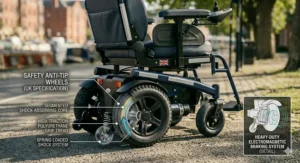
The 12.5″ rear wheels handle British pavements and park trails with confidence, whilst the all-round suspension absorbs those notorious potholes we’ve all learned to dread. One Hertfordshire buyer mentioned: “Took it on the coastal path—never missed a beat.”
Price: £599-£749
✅ Pros:
- Excellent hill-climbing performance
- Solid puncture-proof tyres
- Free UK mainland delivery
❌ Cons:
- Single battery version has limited range
- Heavier than some competitors
Best for: Active users who need reliable performance across varied terrain and extended distances.
3. MX-MAX Multi-Terrain Folding Powerchair – Best All-Terrain Option
For adventurous souls who refuse to let a wheelchair limit their outdoor experiences, the MX-MAX is your ticket to freedom. This powerchair genuinely earns its “multi-terrain” badge, handling grass, gravel, and uneven ground that would defeat standard models.
Key Specifications:
- Weight capacity: 185kg (29 stone)
- Frame weight: 25kg plus 3kg battery
- Motors: Dual 250W brushless
- Tyres: Large high-grip puncture-proof
Supporting up to 29 stone (185kg), the MX-MAX combines heavy-duty capability with a surprisingly compact fold. The front and rear suspension system delivers stable, comfortable rides both indoors and outdoors—imagine pushing a pram across a football pitch, and you’ll understand where this chair excels.
Price: £799-£899
✅ Pros:
- Outstanding outdoor performance
- One-step folding mechanism
- Optional widening kit available
❌ Cons:
- Premium pricing
- Overkill for indoor-only users
Best for: Outdoor enthusiasts and users who need confidence on unpredictable terrain.
4. Enterprise 200 Premium Brushless – Best Premium Choice
Step into the luxury segment with the Enterprise 200—a bariatric powerchair that redefines what’s possible with 200kg capacity engineering. Built in the UK with aerospace-grade AL6061 aluminium and 350W sine-wave brushless motors, this is the powerchair equivalent of a premium saloon car.
Key Specifications:
- Weight capacity: 200kg (31.5 stone)
- Seat width: 53cm extra-wide
- Motors: 350W sine-wave brushless (whisper-quiet)
- Front-axle suspension with telescopic footplate
The sine-wave motor control delivers silky-smooth operation that’s noticeably quieter than standard brushed motors. Front-access dual battery system (airline-friendly 24V 12Ah batteries) means you can hot-swap for unlimited range. Premium leather upholstery, integrated LED joystick light, and UKCA certification complete the package.
Price: £1,299-£1,499 at eTech Mobility
✅ Pros:
- Highest quality construction available
- Exceptionally quiet operation
- Airline-friendly batteries
❌ Cons:
- Premium price point
- May be overly sophisticated for basic needs
Best for: Users who prioritise quality, comfort, and long-term reliability over initial cost.
5. Freedom Chair A08 – Best Budget-Friendly Option
Not everyone needs bells and whistles—sometimes you just want reliable mobility at a sensible price. The Freedom Chair A08 delivers exactly that, offering 160kg (25 stone) capacity without breaking the bank.
Key Specifications:
- Weight capacity: 160kg (25 stone)
- Seat width: 48cm (19″)
- Wheels: Compact 10″ wheels
- Range: Up to 27 miles
This lightweight folding powerchair prioritises simplicity and value. The 19-inch seat width provides comfortable accommodation for larger users, whilst the compact 10″ wheels make it surprisingly nimble in indoor spaces. UK buyers appreciate its straightforward operation—no complicated menus or settings to navigate.
Price: £599-£799
✅ Pros:
- Excellent value for money
- Simple, reliable operation
- Impressive range on full charge
❌ Cons:
- Basic features compared to premium models
- Smaller wheels less suitable for rough terrain
Best for: Budget-conscious buyers seeking solid, dependable mobility without unnecessary complexity.
6. Eloflex Model H – Best Scandinavian Engineering
Swedish innovation meets bariatric mobility in the Eloflex Model H—a powerchair that demonstrates what’s possible when you refuse to compromise. Designed specifically for taller, heavier users up to 200kg, this model delivers that signature Scandinavian blend of functionality and thoughtful design.
Key Specifications:
- Weight capacity: 200kg (31.5 stone)
- Extra-wide spacious seating
- Double-power batteries
- Large durable all-terrain tyres
The Eloflex Model H features generous seat width, comfortable seat height, and a driving position that accommodates fully grown individuals—including taller users who often struggle with standard powerchairs. Extra-powerful motors and double-capacity batteries deliver superior performance across challenging terrain.
Price: £1,699-£1,999
✅ Pros:
- Exceptional build quality
- Designed for taller users
- Outstanding durability
❌ Cons:
- Premium pricing
- Limited UK availability
Best for: Taller, heavier users who need premium engineering and are willing to invest in quality.
7. Drive DeVilbiss Autofold – Best NHS-Compatible Choice
For those navigating NHS wheelchair services or seeking equipment that aligns with healthcare standards, the Drive DeVilbiss Autofold ticks important boxes. This established manufacturer has supplied the NHS for years, and their 25-stone capacity powerchair reflects that institutional experience.
Key Specifications:
- Weight capacity: 158kg (25 stone)
- NHS-approved design standards
- Automatic folding function
- Reliable brushed motors
The Autofold’s genius lies in its simplicity—press a button, and the chair folds automatically for storage or transport. Drive DeVilbiss’s reputation for after-sales support and readily available spare parts makes this a sensible choice for users seeking long-term reliability.
Price: £549-£649
✅ Pros:
- NHS-compatible standards
- Automatic folding convenience
- Excellent parts availability
❌ Cons:
- Lower capacity than some alternatives
- Basic aesthetic design
Best for: Users prioritising compatibility with NHS services and mainstream healthcare support.
What Is a Bariatric Electric Wheelchair?
A bariatric electric wheelchair is a specialised powered mobility device engineered specifically for heavier users, typically supporting weight capacities from 25 stone (160kg) up to 31.5 stone (200kg) or beyond. According to wheelchair classification standards, a motorized wheelchair (also known as a powerchair or electric wheelchair) is propelled by means of an electric motor rather than manual power, making it useful for those who cannot propel a manual wheelchair or need to cover distances that would be fatiguing manually.
These powerchairs differ from standard electric wheelchairs in several critical ways:
Reinforced Frame Construction: Bariatric models utilise aerospace-grade aluminium alloys, reinforced steel, or titanium frames specifically engineered to support higher loads without compromising structural integrity. The frame geometry is strengthened at stress points where standard wheelchairs would fail.
Enhanced Motor Power: Where standard powerchairs might use 200W motors, bariatric versions typically feature 250W to 350W dual motors. This extra power isn’t just about carrying more weight—it’s about maintaining performance on inclines, navigating obstacles, and ensuring smooth acceleration regardless of load.
Wider Seating Dimensions: Standard powerchair seats measure around 40-45cm wide. Bariatric versions offer 48-54cm widths, with some models providing widening kits for even more generous accommodation. This isn’t merely comfort—proper seat width prevents pressure sores and postural problems.
Upgraded Battery Systems: Higher capacity motors demand more power. Bariatric powerchairs use 12Ah to 24Ah battery configurations (compared to 8-10Ah in standard models), ensuring the chair maintains advertised range even when fully loaded.
According to NHS guidance, a bariatric patient is defined as anyone with limitations in health and social care due to their weight, physical size, or shape, often with a BMI greater than 40kg/m² or 40kg above ideal weight for height. The National Institute for Health and Care Excellence (NICE) provides comprehensive guidelines on obesity identification and management, emphasising the importance of appropriate equipment and support. For bariatric individuals, appropriate mobility equipment isn’t a luxury—it’s essential healthcare.
How to Choose the Right Bariatric Electric Wheelchair
Selecting the perfect bariatric electric wheelchair requires balancing multiple factors beyond simply checking the weight capacity. The World Health Organisation’s Wheelchair Provision Guidelines emphasise that appropriate wheelchair selection should follow an individualised process of assessment, fitting, training, and follow-up. Here’s your step-by-step decision framework:
1. Accurately Assess Weight Capacity Requirements
Start with honesty. Check the wheelchair’s safe working load (SWL) and ensure it exceeds your current weight by at least 10-15%. Weight fluctuations happen, and you want headroom. Remember that capacity ratings assume even weight distribution—if you carry a bag or equipment, factor that in.
2. Measure Your Required Seat Dimensions
Sit in a sturdy chair and measure the width of your hips and thighs. Add 5cm to this measurement for comfortable seating with room for winter clothing. Seat depth matters too—your back should rest against the backrest with 5-7cm clearance behind your knees. Many UK users discover they need 50-54cm seat widths but have been managing in inadequate 45cm seats for years.
3. Evaluate Your Primary Usage Environment
Be realistic about where you’ll actually use the powerchair:
Indoor-focused users need compact wheelbase dimensions, tight turning radius (ideally under 100cm), and smooth tyres for flooring protection. The KWK Super Heavy Duty excels here with its 85cm turning radius.
Outdoor adventurers require larger wheels (12″ rear minimum), robust suspension, and all-terrain tyres. The MX-MAX is purpose-built for this scenario.
Mixed indoor/outdoor users—probably 70% of UK buyers—need a versatile compromise. Look for mid-size wheels (10-12″), front suspension at minimum, and adjustable speed settings.
4. Calculate Real-World Range Requirements
Manufacturers quote range under ideal conditions (flat terrain, moderate temperature, optimal load). In British reality, expect 60-75% of advertised range. If you need 10 miles of actual use, choose a powerchair rated for 15+ miles. Consider dual-battery options like the RangerXL for peace of mind.
5. Test Transportability Against Your Vehicle
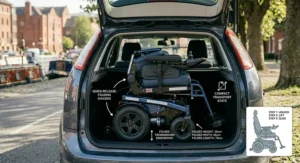
Can you actually get this wheelchair in your car? Measure your boot dimensions and compare against the powerchair’s folded measurements. Factor in the weight—26.5kg is manageable with two people, but 35kg becomes problematic. Some users solve this with telescopic ramps or portable hoists (available from around £200).
6. Investigate After-Sales Support and Parts Availability
A powerchair is only as good as the support behind it. Research the manufacturer’s UK presence, warranty terms, and parts availability. Established brands like Drive DeVilbiss score well here. Chinese imports (often found on Amazon) may offer excellent value but can present parts availability challenges. Check review comments specifically mentioning UK customer service experiences.
7. Consider Future Needs and Adaptability
Your mobility requirements may change. Can the wheelchair accommodate cushion upgrades, headrests, or oxygen tank holders? Some models like the Enterprise 200 offer extensive accessory compatibility. Others are closed systems with limited adaptation options.
Bariatric Electric Wheelchair vs Manual Bariatric Wheelchair
| Feature | Bariatric Electric Wheelchair | Manual Bariatric Wheelchair |
|---|---|---|
| Propulsion | Battery-powered motors | Manual pushing (self or attendant) |
| Typical Weight | 25-35kg | 18-30kg |
| Range | 15-30 miles per charge | Unlimited (user-dependent) |
| Cost | £549-£1,999 | £200-£600 |
| Upper Body Strength Required | None | Significant |
| Best For | Longer distances, fatigue issues | Short distances, budget constraints |
| Maintenance | Moderate (batteries, motors) | Low (tyres, brakes) |
| NHS Availability | Limited (assessment required) | Readily available |
The choice often comes down to a simple question: can you self-propel a manual wheelchair reliably? If you have limited upper body strength, cardiovascular conditions, or simply need to cover distances beyond a few hundred metres, electric is the pragmatic answer. However, wheelchairs available through the NHS range in price from £150 to more than £1,000, with manual options being more readily accessible.
Many UK users discover a “best of both worlds” approach: a manual wheelchair for home use (NHS-provided), and a purchased electric wheelchair for community access and independence. This dual strategy maximises NHS support whilst investing in equipment that genuinely transforms quality of life.
Understanding NHS Bariatric Powerchair Provision
Navigating NHS wheelchair services for bariatric equipment requires patience and realistic expectations. Here’s what you need to know:
NHS Eligibility Criteria
NHS provision is available for clients who are wheelchair dependent for all their mobility, with equipment provided subject to meeting eligibility criteria based on assessed clinical need. For bariatric users specifically, services typically require:
- Long-term mobility impairment (minimum 6 months expected)
- Regular usage requirement (at least 3 days per week)
- Clinical assessment confirming wheelchair necessity
- Weight exceeding 25 stone (160kg) triggering specialist assessment
The Assessment Process
Your journey begins with a GP, physiotherapist, or occupational therapist referral to your local wheelchair service. According to NHS England figures, 70% of wheelchair users wait more than three months for their chair, with 30% waiting over six months and 15% waiting more than 12 months. These delays can be particularly challenging for bariatric users whose mobility limitations compound quickly.
The assessment examines your home environment, mobility requirements, lifestyle, and physical abilities. For bariatric users, this includes measuring hip circumference and evaluating postural support needs. The clinician will discuss available NHS equipment or, increasingly, personal wheelchair budgets.
Personal Wheelchair Budgets
NHS England is committed to supporting integrated care boards to implement personal wheelchair budgets. Personal wheelchair budgets enable postural and mobility needs to be included in wider care planning and support people to access a wider choice of wheelchair. This scheme gives you a voucher for the cost of the NHS chair they would provide, plus additional funds for maintenance and repairs over the equipment’s expected five-year lifespan.
For bariatric users, this can be particularly valuable. If the NHS would provide a £1,200 bariatric powerchair, you might receive a £1,500 voucher (including projected maintenance). You can then choose any chair meeting your needs—including the £1,499 Enterprise 200—and own it outright. You’re responsible for insurance and repairs, but you gain choice and control.
NHS Limitations for Bariatric Equipment
Be aware that NHS wheelchair services maintain limited bariatric powerchair ranges. Waiting lists for specialist equipment can extend beyond general wheelchair services. Many integrated care boards (ICBs) prioritise basic provision over premium features. This reality drives many UK users toward private purchase, particularly when specific needs (like all-terrain capability or extended range) exceed NHS equipment specifications.
For detailed NHS wheelchair service information and personal health budget guidance, visit https://www.england.nhs.uk/personalisedcare/personal-health-budgets/personal-wheelchair-budgets/. The NHS also provides comprehensive information on accessing walking aids, wheelchairs, and mobility scooters through various pathways.

Key Features to Look For in Bariatric Powerchairs
When comparing bariatric electric wheelchairs, focus on these critical specifications:
Motor Power and Configuration
Dual motors are non-negotiable for bariatric powerchairs. Single-motor designs simply can’t deliver consistent performance under higher loads. Look for 250W minimum per motor—anything less struggles on UK hills. Brushless motors (like the Enterprise 200‘s 350W units) run quieter, cooler, and more efficiently than brushed alternatives, though they command premium pricing.
Mid-wheel drive offers superior indoor manoeuvrability with tight turning circles. Rear-wheel drive (most common configuration) provides better outdoor stability and hill-climbing. Front-wheel drive—rare in bariatric models—can feel less stable for heavier users.
Battery Capacity and Range
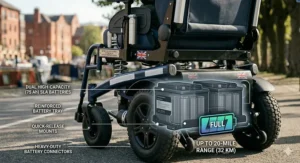
Battery specifications directly impact your real-world independence. Standard configurations use 12Ah lithium-ion batteries; premium models like the Enterprise 200 offer 24Ah options. Here’s the reality check: manufacturer range claims assume flat terrain, moderate temperatures, and optimal load conditions—conditions that rarely exist in British life.
Dual-battery systems aren’t just about doubling range; they’re about load balancing. Two 12Ah batteries distribute power draw more evenly, reducing individual battery stress and extending overall lifespan. Expect to replace lithium-ion batteries every 2-3 years (£150-£300 depending on capacity).
Frame Material and Construction
Aerospace-grade aluminium (AL6061) represents the gold standard—lightweight, corrosion-resistant, and incredibly strong. The KWK Super Heavy Duty demonstrates this beautifully: 180kg capacity in a 26.5kg frame. Cheaper steel frames work but add unnecessary weight, making transport challenging.
Weld quality matters enormously. Look for continuous welds at stress points (seat mounting, wheel assembly) rather than tack welds. Many budget imports skimp here, leading to eventual frame failures that are frankly dangerous.
Seat Width and Cushioning
Seat width measurements can be deceptive—manufacturers measure differently. Some quote internal width (between armrests), others external frame width. Always verify usable seating width in reviews or by contacting sellers directly. For reference:
- 48-50cm: Accommodates users up to 25 stone comfortably
- 51-53cm: Suitable for 26-29 stone users
- 54cm+: Necessary for 30+ stone or users preferring generous room
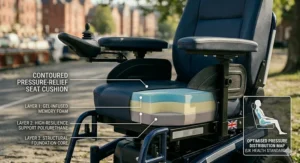
Standard foam cushions compress quickly under bariatric loads. Upgrade to gel, memory foam, or air-cell cushions (£80-£150) for pressure relief and comfort during extended use. Your NHS physiotherapist can advise on appropriate cushion types for your needs.
Suspension Systems
British pavements are notoriously unforgiving. Front-axle suspension is essential for absorbing impacts that would otherwise jar your spine. The MX-MAX includes both front and rear suspension—overkill for indoor use, invaluable for outdoor terrain.
Suspension isn’t just about comfort; it’s about maintaining wheel contact. Without suspension, hitting a pothole can lift casters off the ground, temporarily losing steering control. That split-second loss of control can be frightening, particularly at higher speeds.
Joystick and Control Systems
Most bariatric powerchairs use 360° joysticks with adjustable sensitivity. The KWK model’s joystick receives mixed reviews—some users love the responsive control, others find it overly sensitive. Adjustability is key; you should be able to dial sensitivity up or down.
Look for programmable speed modes (typically 5 settings). Lowest speeds (under 1mph) for careful indoor navigation; highest (usually 4-6mph) for outdoor cruising. Some premium models allow individual mode customisation—fantastic for users who need very slow indoor speeds but want respectable outdoor pace.
Turning Radius
Manufacturers quote turning radius, but this specification profoundly impacts daily usability. The KWK‘s 85cm (33 inch) turning radius navigates standard UK doorways and corridors with room to spare. Cheaper models with 100cm+ radii frustrate users in tight spaces—you’re constantly executing three-point turns in your own home.
Test this if possible: try manoeuvring in a standard supermarket aisle (typically 120cm wide). If the chair struggles there, it’ll drive you mad at home.
Maintenance and Long-Term Ownership Costs
Budget beyond the initial purchase. Here’s what bariatric powerchair ownership really costs:
Annual Running Costs
Electricity for charging: Surprisingly minimal—around £15-25 annually. Lithium-ion batteries are remarkably efficient.
Battery replacement: Plan for every 2-3 years. Budget £150-£300 for quality replacements. Cheap batteries from unknown suppliers might save £50 initially but fail prematurely.
Tyre replacement: Solid tyres (most bariatric models) last 2-4 years depending on usage. Pneumatic tyres need more frequent attention but provide superior ride quality. Expect £40-80 for replacement sets.
Regular servicing: NHS-loaned wheelchairs receive free maintenance. Privately purchased chairs need annual servicing (£80-150) covering brake adjustment, motor inspection, and electrical system checks. DIY enthusiasts can handle basic maintenance, but motor issues require specialists.
Insurance: Optional but recommended. Specialist mobility insurance costs £60-120 annually, covering theft, damage, and breakdown assistance. Standard home insurance rarely provides adequate mobility equipment coverage.
Longevity Expectations
Quality bariatric powerchairs should deliver 5-7 years of reliable service with proper maintenance. The Enterprise 200 and Eloflex Model H are engineered for this longevity. Budget models may achieve 3-5 years before requiring significant component replacement.
Frame integrity rarely fails on quality models—motors, controllers, and batteries are your wear items. Factor these replacement costs into your long-term ownership calculations. A £1,500 premium chair costing £200 annually in maintenance over 7 years (£2,900 total) often represents better value than a £700 budget model costing £300 annually over 4 years (£1,900 total)—plus the frustration of premature replacement.
Funding Options and VAT Relief
Bariatric electric wheelchairs represent significant investments. Here’s how UK buyers manage costs:
VAT Relief Eligibility
Mobility equipment qualifies for VAT relief if you’re chronically sick or disabled (including long-term mobility impairment). At checkout, you’ll complete a simple declaration confirming eligibility—no medical documentation required. This 20% VAT exemption transforms a £900 chair into £750, a £1,500 model into £1,250.
All major UK mobility retailers (including Amazon.co.uk) facilitate VAT relief at checkout. Don’t overpay through uncertainty—if you need a bariatric powerchair, you almost certainly qualify.
NHS Personal Health Budgets
As discussed earlier, personal wheelchair budgets can contribute £1,000-£2,000+ toward your chosen equipment. The application process requires patience, but the financial support is substantial. Contact your local integrated care board (ICB) for specific guidance—processes vary by region.
Disability Benefits
Personal Independence Payment (PIP) or Disability Living Allowance (DLA) recipients may qualify for the Motability Scheme, which helps fund mobility equipment including electric wheelchairs. The scheme allows you to use your mobility component payment toward equipment lease or purchase.
Charitable Support
Several UK charities assist with mobility equipment funding:
- Whizz-Kidz: Focus on children and young adults
- Independent Living Fund (ILF): Support for severely disabled adults
- Local charity organisations: Many regions have specific disability equipment funds
Flexible Payment Options
Many UK mobility retailers offer finance packages spreading costs over 12-36 months. Interest-free options exist for equipment over £500. Snap Finance and similar providers specialise in mobility equipment financing, though always read terms carefully—APRs can be substantial on longer terms.
Safety Considerations for Bariatric Powerchair Users
Operating a bariatric electric wheelchair safely requires understanding both the equipment and your environment:
Weight Distribution and Stability
Bariatric powerchairs have lower centres of gravity than standard models, but physics still applies. Avoid leaning far forward or to sides while moving—this shifts your centre of gravity and can cause tipping. When reaching for items, stop the chair first.
Electromagnetic brakes (standard on quality models) hold the chair reliably on slopes, but don’t tempt fate. The KWK manages 12° inclines; the RangerXL tackles 14°. These specifications assume optimal conditions—wet grass or gravel reduces actual capability. If a slope feels dicey, trust your instinct.
Kerb and Obstacle Navigation
Most bariatric powerchairs handle 5-7cm kerbs (standard UK pavement height) with proper technique. Approach straight-on at moderate speed—the momentum helps casters climb. Never attempt kerbs at angles; this risks tipping.
For larger obstacles, dropped kerbs are your friend. The Equality Act 2010 mandates accessibility provisions, but reality lags legislation. Scout your regular routes and note problem areas. Local authorities must address accessibility issues—report them via FixMyStreet.com or council websites.
Weather Considerations
British weather challenges powerchairs. Most models are rated IP54 or IP65 (splashproof but not submersible). Light rain is fine; proper downpours demand weatherproof covers (£30-50). Never operate in standing water—electrical components aren’t fully sealed.
Cold weather reduces battery capacity by 15-25%. In winter, that advertised 20-mile range might deliver 15 miles. Charge batteries indoors when possible; lithium-ion cells dislike temperature extremes.
Public Transport and Travel
Theoretically, bariatric powerchairs should access most UK public transport. Practically, challenges exist. Bus wheelchair spaces accommodate standard wheelchairs easily; bariatric models (particularly wider seats) may struggle. Call ahead or check bus operator specifications.
Train access is generally excellent—ramps and lifts accommodate larger powerchairs. Book assistance 24 hours ahead via train operator or Passenger Assist. Specify your powerchair dimensions (especially width) to ensure appropriate equipment is available.
Air travel with powerchairs requires advance coordination. Airlines accept mobility equipment, but lithium batteries trigger specific regulations. The Enterprise 200‘s airline-friendly batteries simplify this. Contact airline special assistance departments well before travel—each airline has unique procedures.
Comparing UK Retailers: Where to Buy Bariatric Electric Wheelchairs
Your purchase channel impacts not just price but ongoing support, warranty terms, and returns handling:
Amazon.co.uk
Advantages: Competitive pricing, familiar interface, rapid delivery (often next-day), straightforward returns policy, verified customer reviews.
Disadvantages: Limited specialist advice, variable seller quality, potential import models with minimal UK support, delivery drivers untrained in mobility equipment handling.
Best for: Buyers confident in their specific model choice, comfortable with self-research, prioritising price and convenience over specialist consultation.
Products like the KWK Super Heavy Duty perform well on Amazon, with 100+ UK buyer reviews providing genuine feedback. VAT relief applies at checkout when you complete the declaration.
Specialist Mobility Retailers (eTech Mobility, MobilityPlus, etc.)
Advantages: Expert consultation, proper product demonstrations, professional setup and training, established after-sales support, UK-based customer service.
Disadvantages: Higher prices (typically 10-15% above Amazon), limited product ranges compared to online marketplaces, geographical limitations for showroom visits.
Best for: First-time powerchair buyers, users with complex needs requiring professional assessment, those valuing long-term relationship with supplier.
The Enterprise 200 through eTech Mobility exemplifies this channel—premium pricing but comprehensive support package including delivery, setup, and user training.
NHS Wheelchair Services
Advantages: Free equipment loan, maintenance and repairs covered, regular reassessments, professional clinical oversight.
Disadvantages: Limited equipment choice, substantial waiting times (3-12+ months), equipment remains NHS property, may not meet all preferences.
Best for: Users meeting NHS eligibility criteria willing to accept equipment limitations for zero cost option.
Private Hire Companies
Advantages: Try before committing to purchase, flexibility to upgrade/downgrade, maintenance included in rental, insurance coverage.
Disadvantages: Long-term costs exceed purchase prices, no ownership equity, limited model selection, potential delivery delays.
Best for: Temporary needs, trial periods before purchase commitment, users uncertain about long-term requirements.
Real User Experiences: What UK Buyers Say
Beyond specifications and features, how do bariatric powerchairs perform in real British life? Here’s what actual users report:
The Good
“My RangerXL has genuinely changed my life. I’m 27 stone, and I’d been trapped in my flat for months—standard wheelchairs just weren’t built for me. Now I’m shopping independently, meeting friends at the pub, even took it on holiday to Cornwall. The dual batteries mean I never worry about running flat.” —Michael, Leeds
“The MX-MAX handles everything. I take it on the canal towpath near my house—gravel, mud, tree roots, you name it. My grandkids love it because ‘Nana can come adventuring now.’ Worth every penny of the £850 I paid.” —Patricia, Derby
“NHS waiting list was 18 months. I couldn’t wait that long. Bought the KWK from Amazon for £649—arrived in two days. Yes, it’s Chinese-made, but the quality is solid. Only issue was figuring out the joystick sensitivity, but customer service helped via WhatsApp.” —David, Glasgow
The Challenges
“Battery life isn’t what they claim. My Freedom A08 says 27 miles range—I get maybe 18 in real conditions. Still decent, but be realistic about manufacturer claims.” —Sarah, Bristol
“Getting my powerchair serviced is a nightmare. The seller closed shop six months after I bought it. Now I’m searching for independent mechanics who understand electric wheelchairs. Buy from established companies with proper UK presence.” —James, Norwich
“Weight is a real issue for me. At 28kg (without batteries), lifting my chair into the car takes two people. Wish I’d thought about this more carefully—it limits spontaneous trips when I’m alone.” —Emma, Cardiff
“Insurance companies don’t understand bariatric powerchairs. Standard policies exclude mobility equipment, specialist insurance costs double what I expected. Factor this into your budget!” —Robert, Edinburgh
These experiences underscore critical points: buy from reputable suppliers with UK support, budget for insurance and maintenance, and always assume manufacturer range claims are optimistic.
Frequently Asked Questions (FAQs)
❓ What's the difference between bariatric and standard electric wheelchairs?
❓ Can I get a bariatric powerchair through the NHS?
❓ How long do bariatric electric wheelchair batteries last?
❓ Are bariatric powerchairs allowed on public transport in the UK?
❓ What weight capacity should I choose for a bariatric electric wheelchair?
Conclusion: Finding Your Perfect Bariatric Electric Wheelchair
Choosing a bariatric electric wheelchair isn’t simply about specifications—it’s about reclaiming independence, dignity, and life quality. Whether you’re considering the budget-friendly Freedom Chair A08, the versatile MobilityPlus RangerXL, or the premium Enterprise 200, the right choice balances your specific needs, environment, and budget.
Remember these key principles: prioritise weight capacity with generous safety margins, test transportability against your vehicle, investigate UK-based after-sales support, budget for long-term ownership costs including batteries and maintenance, and explore all funding options including NHS personal wheelchair budgets and VAT relief.
The bariatric powerchair market has evolved remarkably. Today’s models combine robust engineering with genuine portability, sophisticated control systems with user-friendly operation, and impressive range with realistic pricing. For many UK users, the £600-900 mid-range models (KWK, RangerXL, MX-MAX) deliver the sweet spot of capability and value. Those seeking ultimate quality should explore the Enterprise 200 or Eloflex Model H—premium pricing, yes, but engineering that transforms daily life.
Don’t let mobility limitations define you. The right bariatric electric wheelchair isn’t just equipment—it’s freedom, independence, and possibility. Take your time, research thoroughly, and choose equipment that genuinely serves your life rather than settling for what’s merely available. Your mobility matters. Your independence matters. And with the right powerchair, a fuller, richer life awaits.
Recommended for You
- 7 Best Heavy Duty Electric Wheelchair UK 2026
- 7 Best Electric Wheelchair Small Turning Circle Models UK 2026
- 7 Best Mid Wheel Drive Powerchair Models UK 2026
Disclaimer: This article contains affiliate links. If you purchase products through these links, we may earn a small commission at no additional cost to you. Prices shown are approximate and may vary. All products reviewed are from Amazon.co.uk and other reputable UK retailers. Always consult healthcare professionals regarding mobility equipment suitability for your specific needs.
✨ Found this helpful? Share it with your mates! 💬🤗
