
In This Article
Standing might seem like a simple act, but for the 1.2 million wheelchair users across the UK, it’s anything but straightforward. What most people overlook about powered standing frames is that they’re not just rehabilitation equipment — they’re life-changing devices that address a cascade of health complications you’d never think twice about whilst standing in a queue at Tesco.
A powered standing frame is an assistive device that transitions users from a seated to standing position using electric or hydraulic mechanisms, providing full support throughout the movement. Unlike manual standing frames that require significant upper body strength or caregiver assistance, powered models deliver independence at the push of a button — rather important when you’re managing life in a Bristol semi-detached or a Glasgow tenement flat without round-the-clock care.
After reviewing clinical guidelines from leading UK spinal injury units including Stoke Mandeville Hospital and consulting with physiotherapists across the NHS, I’ve identified the seven most effective powered standing frames available to British buyers in 2026. Whether you’re recovering from spinal cord injury, managing multiple sclerosis, or supporting a family member with cerebral palsy, this guide will help you navigate the £300 to £5,000+ market with confidence. I’ll explain which models actually deliver on their promises in damp British conditions, which offer the best value for money, and which features genuinely matter versus marketing fluff.
Quick Comparison Table: Top Powered Standing Frames
| Model | Type | Price Range (GBP) | Weight Capacity | Best For | Amazon UK |
|---|---|---|---|---|---|
| EasyStand Evolv Large | Sit-to-Stand Electric | £4,600-£5,500 | 127 kg (280 lbs) | Customisable support needs | Check Suppliers |
| EasyStand StrapStand | Strap-Lift Electric | £3,200-£3,800 | 159 kg (350 lbs) | Direct wheelchair transfer | Check Suppliers |
| Oswestry Powered Frame | Fixed-Height Electric | £2,800-£3,400 | 100 kg (220 lbs) | NHS prescription users | UK Direct |
| Rehabilitation Standing Frame (Generic) | Multi-Angle Manual/Assist | £350-£550 | 91 kg (200 lbs) | Budget-conscious buyers | ✓ Available |
| HSRG Child Standing Walker | Paediatric Adjustable | £800-£1,200 | 22 kg (48 lbs) | Children with cerebral palsy | ✓ Available |
| Standing Frame Adult 4-Wheels | Mobile Rehabilitation | £280-£420 | 91 kg (200 lbs) | Lower limb training | ✓ Available |
| EasyStand Glider Medium | Active Standing Electric | £4,800-£5,600 | 91 kg (200 lbs) | Upper body strengthening | Check Suppliers |
From the comparison above, the entry-level rehabilitation frames on Amazon UK (£280-£550 range) provide basic standing support for users with good torso control and family assistance, whilst the professional EasyStand models (£3,200-£5,600) justify their premium through modular customisation and decades of clinical validation in UK spinal units. Budget buyers should note that the lower-priced models sacrifice adjustability and powered assistance — a trade-off that becomes evident when you’re relying on a single carer rather than a rehabilitation team. What’s immediately clear is the pricing gap between basic manual-assist frames and fully powered systems reflects not just motors and electronics, but engineering designed for daily use across varying disability levels.
💬 Just one click — help others make better buying decisions too! 😊
Top 7 Powered Standing Frames: Expert Analysis
1. EasyStand Evolv Large — The Gold Standard for Customisation
The EasyStand Evolv Large represents thirty years of iterative design from a Minnesota-based company founded by a C6-7 quadriplegic, and it shows in every pivot point and support option. With over 60 modular configurations available, this isn’t a one-size-fits-all device — it’s a bespoke mobility solution built specifically for users between 152 cm to 188 cm (5’0″ to 6’2″) and up to 127 kg.
What sets the Evolv apart is its hydraulic actuator system that allows users to stop anywhere between sitting and fully standing — critically important when building tolerance after prolonged wheelchair use or when managing orthostatic hypotension (the dizziness that strikes when blood pressure drops during position changes). The strategic positioning of pivot points aligns with your body’s natural pivot points, which means hip supports, lateral supports, and head supports remain in place throughout the transition, minimising uncomfortable shearing forces on your skin.
UK physiotherapists particularly value the Evolv’s compatibility with NHS wheelchair services’ assessment protocols. The open base design accommodates lateral transfers, whilst optional features like the rotating seat or swing-away front make caregiver-assisted transfers straightforward in compact British homes where space for manoeuvring is at a premium.
Customer feedback from UK users consistently praises the build quality and long-term reliability, though several reviewers note the substantial initial investment requires NHS funding support or private purchasing for most families. One Sheffield-based user mentioned using theirs daily for six years without mechanical issues — rather impressive longevity that justifies the cost-per-use calculation.
Pros:
✅ 60+ customisation options for precise positioning
✅ Hydraulic system allows stopping mid-transition for tolerance building
✅ Proven track record in UK NHS spinal injury units
Cons:
❌ Premium pricing (£4,600-£5,500) requires NHS funding for most users
❌ Requires professional assessment and fitting — not off-the-shelf
Price Verdict: In the £4,600-£5,500 range, this represents serious money, but for users needing daily standing programmes over years rather than months, the investment pays dividends in reduced secondary complications and maintained independence. Check with specialist suppliers like The Mobility Aids Centre for current UK pricing and NHS funding pathways.
2. EasyStand StrapStand — No-Transfer Convenience
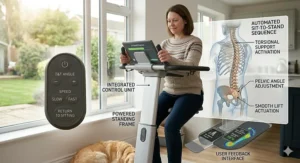
The EasyStand StrapStand solves one of the biggest headaches in standing frame usage: the transfer from wheelchair to frame. Rather than requiring a lateral shift or hoist assistance, the StrapStand lifts you directly from your wheelchair, bed, or any seated surface using dual-hinged lifting arms and supportive straps.
This strap-style design is particularly brilliant for users with limited upper body strength or high-level spinal cord injuries (C5-C7 quadriplegics) who find traditional transfers exhausting or impossible without two carers. The lifting mechanism first raises you vertically, then positions you over centre — a crucial distinction from forced sit-to-stand transitions that can jam knees or create uncomfortable pressure points.
At 159 kg weight capacity, the StrapStand accommodates larger users better than many competing models, and the steel construction handles the British climate’s damp conditions without rust issues (assuming you’re following basic maintenance protocols like wiping down after use). Several Manchester-based users report using theirs in converted garages where condensation would wreck lesser equipment.
What most buyers overlook about this model is the psychological benefit of independence — when you can initiate standing without ringing for assistance, you stand more often, which directly correlates with better outcomes for bone density, cardiovascular function, and bladder management according to MASCIP (Multidisciplinary Association of Spinal Cord Injury Professionals) 2013 guidelines.
Pros:
✅ Direct wheelchair-to-standing transfer eliminates exhausting shifts
✅ 159 kg capacity suits larger users
✅ Reduces caregiver burden significantly
Cons:
❌ Requires wheelchair positioning space — challenging in narrow UK hallways
❌ Strap system needs regular inspection for wear
Price Verdict: At £3,200-£3,800, it’s positioned between entry-level frames and top-tier Evolv models. The convenience factor alone makes this worthwhile for users standing 5+ times weekly who want to reduce caregiver dependency. Available through specialist UK mobility suppliers with demonstration visits.
3. Oswestry Powered Standing Frame — British Engineering Excellence
The Oswestry Standing Frame carries a distinctly British pedigree — developed nearly 50 years ago in conjunction with the Spinal Unit at Robert Jones and Agnes Hunt Hospital in Gobowen, Shropshire, and still manufactured in North Wales by a carbon-neutral workshop that takes environmental responsibility seriously.
Now in continuous use across most UK hospitals including the leading spinal injury units at Stoke Mandeville and the Royal National Orthopaedic Hospital at Stanmore, Oswestry frames are prescribed by NHS practitioners for users managing MS, spinal cord injury, cerebral palsy, and stroke recovery. The powered lifting mechanism assists users rising from seated position with smooth, controlled movement that accommodates varying levels of lower limb control.
What distinguishes Oswestry from American imports is the attention to NHS specification requirements and UK healthcare practitioner feedback. These frames are robustly built yet relatively lightweight, with the adjustable-height models designed for quick dismantling for transportation or storage — rather handy when you’re moving between a terraced house in Leeds and a caravan holiday in North Wales.
UK customers particularly appreciate the after-sales support from a domestic manufacturer. When parts need replacing or adjustments are required, you’re dealing with a Welsh workshop rather than transatlantic shipping delays. Several NHS physiotherapy departments mention these frames outlasting cheaper alternatives by a decade or more in daily multi-user environments.
Pros:
✅ UK-manufactured with NHS-specification design input
✅ Proven reliability in British hospital settings over decades
✅ Domestic after-sales support and parts availability
Cons:
❌ Less modular than EasyStand range — customisation more limited
❌ Typically requires NHS prescription pathway for best pricing
Price Verdict: At £2,800-£3,400 range, Oswestry frames represent excellent value for British users who prioritise proven NHS-grade engineering and domestic support over extensive customisation options. Contact Oswestry Frames directly for bespoke quotations and NHS funding guidance.
4. Rehabilitation Standing Frame (Generic) — The Amazon UK Budget Option
The Rehabilitation Standing Frame available on Amazon UK represents the entry point for families exploring standing programmes without NHS funding support. Priced in the £350-£550 range, this Chinese-manufactured steel frame provides basic standing support with adjustable height (100-120 cm desktop height), angle positions (0°, 7°, 18°, 30°, 40°), and restraint system for chest, back, thighs, and calves.
Let’s be clear about what you’re getting: this is manual-assist equipment, not powered. The “powered” classification is a bit generous — you’ll need caregiver help or considerable upper body strength to achieve the standing position. However, for users with good torso control recovering from stroke or managing mild hemiplegia, it provides functional standing practice at a fraction of professional equipment costs.
The thickened steel plate construction with EVA non-slip pads delivers decent stability, and the wheeled base allows repositioning (though the universal casters aren’t as smooth as medical-grade alternatives). British buyers should note this arrives with assembly required and instructions that are… let’s call them “creatively translated” from Chinese. You’ll want a mechanically-minded family member on hand for setup.
What this frame does well is provide standing exposure for users building tolerance or families testing whether a standing programme delivers benefits before committing to professional equipment. Several UK reviewers mention using these successfully for stroke rehabilitation exercises and postural correction training, though nearly all note limitations compared to NHS-prescribed equipment.
Pros:
✅ Budget-friendly entry point (£350-£550) accessible without NHS funding
✅ Adjustable angles suit gradual progression programmes
✅ Amazon UK Prime delivery in most UK postcodes
Cons:
❌ Manual operation requires caregiver assistance or good upper body strength
❌ Limited customisation for complex positioning needs
Price Verdict: Around £350-£550 makes this accessible for families exploring standing programmes or supplementing NHS physiotherapy between clinic visits. Just understand you’re buying basic functionality, not the refined engineering of professional models. Worth considering for stroke recovery or postural training rather than complex spinal injury management.
5. HSRG Child Standing Walker — Paediatric Standing Support
The HSRG Child Standing Walker addresses the specific needs of children with cerebral palsy, developmental delays, or lower limb disabilities, providing adjustable standing support for users between 76 cm to 109 cm height and up to 22 kg weight capacity.
Paediatric standing frames serve a different purpose than adult models — they’re not just about health benefits like bone density and circulation, but about facilitating normal developmental experiences. Standing allows children to interact at eye level with peers, reach toys on tables, and participate in activities that seated positioning excludes. Physiotherapists emphasise that early standing intervention can help prevent spinal deformities during adolescent growth spurts.
This particular model features height and width adjustability to accommodate growing children, with chest support, back support, and leg restraints that can be configured as abilities change. The frame design allows gradual progression from supported sitting to partial weight-bearing to full standing as strength develops.
UK parents report this frame works well for home standing programmes supplementing school-based physiotherapy, though several note the need for patience during initial adjustment periods as children adapt to the sensation of upright positioning. The wheeled base allows movement during standing, which encourages engagement and prevents the “bored statue” problem common with fixed standing frames.
Pros:
✅ Adjustable sizing grows with child (76-109 cm height range)
✅ Encourages developmental interaction and peer engagement
✅ Available through Amazon UK (around £800-£1,200)
Cons:
❌ Limited upper weight capacity (22 kg) means outgrowing relatively quickly
❌ Generic design lacks specialised cerebral palsy positioning options
Price Verdict: In the £800-£1,200 range, this represents a middle ground between basic standing supports and specialist paediatric equipment like the EasyStand Bantam or Leckey Squiggles+. Suitable for families wanting home-based standing practice between NHS physiotherapy sessions.
6. Standing Frame Adult 4-Wheels — Mobile Rehabilitation Training
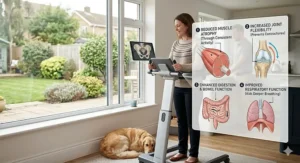
The Standing Frame Adult 4-Wheels available on Amazon UK takes a different approach to standing support by integrating mobility into the frame design. Rather than static standing, this model allows users to move whilst standing, promoting greater functional independence and mimicking natural gait patterns.
Designed for users between 150 cm to 185 cm height with eight-wheel configuration for stability, this frame supports up to 91 kg with adjustable height and width parameters. The thickened square steel construction and high-quality screw fixation provide robust support, whilst the 360° rotating silent casters enable direction changes without the jarring clunks that wake the household at 6 AM when you’re desperate for a morning stretch.
What distinguishes mobile standing frames from static models is their rehabilitation philosophy. Rather than simply maintaining an upright position, they encourage active movement and weight shifting that engages muscles and challenges balance in controlled ways. Physiotherapists use these for hemiplegia rehabilitation, post-operative recovery, and progressive strengthening programmes where static standing becomes too passive.
British users particularly value the dual-purpose functionality — it serves as both a standing frame and a walking aid, which means families aren’t accumulating multiple bulky pieces of equipment in already-cramped terraced housing or bungalows. The rear wheel brakes lock securely for static standing exercises, then release for mobilisation practice.
Pros:
✅ Mobile standing encourages active rehabilitation and movement
✅ Eight-wheel design prevents tipping during weight shifts
✅ Dual-purpose functionality (standing frame + walking aid)
Cons:
❌ Requires more floor space for safe movement than static frames
❌ Generic padding may need supplementing for long-duration standing
Price Verdict: At £280-£420, this represents remarkable value for users wanting both standing support and mobility assistance in a single device. Particularly suitable for stroke recovery, early-stage MS management, or post-operative rehabilitation where progressive movement is the goal. Available through Amazon UK with Prime delivery.
7. EasyStand Glider Medium — Active Standing Technology
The EasyStand Glider Medium represents the pinnacle of active standing technology — rather than passive weight-bearing, it incorporates reciprocal arm and leg movement that transforms standing into an upper body strengthening and lower body range-of-motion exercise.
Here’s how it works: users (or caregivers) move the handles with their arms, which creates reciprocal movement in the legs through an adjustable resistance cylinder system. This mimics the natural opposition of walking — right arm forward with left leg, then switching — whilst maintaining full support in the standing frame. Physiotherapists can start with minimal resistance and gradually increase load as strength improves, creating truly progressive rehabilitation programmes.
For users between 122 cm to 168 cm height and up to 91 kg capacity, the Glider Medium accommodates adolescents through smaller adults. What most buyers overlook about active standing is the cardiovascular benefit — you’re not just maintaining bone density and preventing contractures, you’re actually exercising in ways that elevate heart rate and improve circulation beyond passive standing alone.
UK spinal injury units and MS rehabilitation centres increasingly incorporate Gliders into their equipment arsenals because they address a critical gap: how to provide meaningful exercise for users with limited voluntary lower limb control. The active standing design engages whatever muscle function remains whilst the frame provides safety and support.
Several UK users report this transforms standing from a boring medical chore into an engaging activity — you can watch television, listen to audiobooks, or even participate in video calls whilst actively standing, which dramatically improves compliance with recommended 60-minute daily standing programmes.
Pros:
✅ Active standing technology provides exercise, not just positioning
✅ Adjustable resistance allows progressive strengthening programmes
✅ Transforms compliance by making standing engaging rather than passive
Cons:
❌ Premium pricing (£4,800-£5,600) requires serious commitment
❌ Requires arm strength or caregiver assistance to operate resistance system
Price Verdict: In the £4,800-£5,600 range, the Glider represents the most expensive option in this guide, but for users who need both standing support and upper body strengthening, it consolidates two pieces of equipment into one. Contact The Mobility Aids Centre or EasyStand UK distributors for demonstrations and NHS funding pathway exploration.
Real-World Scenario: Matching Frames to UK Users
Meet Sarah, 34, Sheffield — C6 Spinal Cord Injury, Working from Home
Sarah needs to stand 60 minutes daily per MASCIP guidelines to maintain bone density and bladder function, but she lives alone in a two-bedroom terrace and works full-time as a software developer. Her needs:
- Independent operation without caregiver assistance
- Compact footprint for bedroom placement
- Ability to use laptop whilst standing
Best Match: EasyStand StrapStand (£3,200-£3,800). The no-transfer design allows Sarah to wheel up and lift into standing independently, whilst the optional tray accommodates her laptop for standing work sessions. NHS funding supported 80% through her local wheelchair service after occupational therapy assessment.
Meet David, 67, Rural Cornwall — Multiple Sclerosis, Progressive Weakness
David is managing increasing lower limb weakness and needs standing support that accommodates fluctuating ability levels. His wife provides some care but can’t physically lift him. Their cottage has narrow doorways and steep stairs limiting equipment placement.
Best Match: Oswestry Powered Standing Frame (£2,800-£3,400). The powered lift mechanism reduces physical demands on his wife, whilst the quick-dismantle design allows moving between downstairs placement and upstairs bedroom as needed. British engineering means parts and service are accessible in rural areas where international brands struggle.
Meet Aisha, 8, Birmingham — Cerebral Palsy, School Integration
Aisha uses a wheelchair at school but her physiotherapist recommends daily standing to prevent hip dislocation and encourage peer interaction. Her family wants equipment that works both at home and can be used during family activities.
Best Match: HSRG Child Standing Walker (£800-£1,200). The adjustable sizing grows with Aisha, whilst the wheeled base allows her to “stand and explore” during family gatherings rather than being statically positioned. Her parents funded this privately to supplement NHS physiotherapy equipment, giving them flexibility for home-based standing programmes on weekends.
How to Choose a Powered Standing Frame in the UK
1. Assess Your Standing Goals and Clinical Needs
Not all standing is created equal. Are you preventing contractures after spinal cord injury (passive standing sufficient)? Building bone density (needs weight-bearing load)? Improving cardiovascular function (active standing preferable)? Recovering gait patterns post-stroke (mobile standing frame suitable)? Your specific rehabilitation objectives should drive equipment selection far more than price or features lists.
Consult with NHS physiotherapy services or private practitioners with neurorehabilitation expertise. The best equipment is what you’ll actually use 5-7 days weekly, not the most feature-packed model that becomes a clothes rack because it’s too complicated or time-consuming to operate.
2. Evaluate Transfer Requirements and Caregiver Availability
The transfer from wheelchair to standing frame is often the breaking point in standing programme compliance. If you’re relying on a single caregiver who’s already managing bathing, dressing, and meal preparation, adding a complex two-person transfer for standing equipment simply won’t happen consistently.
Models with direct wheelchair lift (StrapStand), lateral transfer capability (Evolv), or mobile standing (4-wheel frames) each solve different transfer challenges. Be brutally honest about your household’s capacity for manual handling — optimistic assessments lead to abandoned equipment and wasted money.
3. Measure Your Available Space in British Homes
UK housing is notably more compact than American or Australian equivalents. A standing frame occupies floor space roughly equivalent to a large armchair (70-85 cm width, 100-120 cm length when deployed), plus clearance for wheelchair approach and caregiver positioning.
Measure the actual room where you’ll use this equipment — ideally near toileting facilities since bladder emptying improves dramatically in standing position. Victorian terraces, post-war semis, and modern flats all present different spatial constraints that influence model selection. Remember that wheeled frames need turning radius space; static frames can work in tighter quarters.
4. Consider Long-Term Cost Beyond Purchase Price
The purchase price is just the opening bid in powered standing frame ownership. Factor in:
- Maintenance and servicing (annual inspections recommended)
- Replacement parts (upholstery, straps, cylinders)
- Modification costs as needs change
- Professional fitting and setup fees
- Potential home modifications (floor reinforcement, space adaptation)
British-manufactured options (Oswestry) typically offer better long-term parts availability and service than imported models where you’re dependent on single-distributor relationships. Similarly, established brands with decades of UK presence (EasyStand through The Mobility Aids Centre) provide more predictable support than newer market entrants.
5. Explore NHS Funding and Charitable Support
Powered standing frames qualify for NHS wheelchair service provision if clinical need is demonstrated through occupational therapy or physiotherapy assessment. The pathway typically involves:
- GP referral to wheelchair service
- Assessment by specialist therapist
- Equipment trial and fitting
- Prescription and funding approval
Processing times vary wildly by NHS trust (6 weeks to 6 months isn’t uncommon), and some trusts prioritise powered wheelchairs over standing equipment in their budgets. Charitable organisations like the Spinal Injuries Association, MS Society UK, and Whizz-Kidz maintain equipment loan programmes and funding advice services that can supplement or accelerate NHS provision.
Private purchase allows immediate access but represents £2,800-£5,600 investment for professional models — a calculation where spreading costs through charitable support or equipment loan schemes whilst pursuing NHS funding makes sense for many families.
Common Mistakes When Buying Powered Standing Frames
Mistake 1: Assuming “Powered” Means Fully Independent Operation
Not all “powered standing frames” on Amazon UK actually include powered lifting mechanisms — some are manual-assist frames with adjustable features. Read specifications carefully and watch product videos to confirm the frame includes electric or hydraulic actuation that actually lifts you into standing position. If it requires a carer to operate a hand pump or manual crank, it’s not powered in any meaningful sense.
Mistake 2: Ignoring British Weather and Damp Conditions
Standing frames often live in garages, conservatories, or ground-floor rooms where British condensation is brutal on metal components. Cheaper steel frames without proper coating will rust in damp conditions, compromising both aesthetics and structural integrity. Look for powder-coated steel or stainless steel construction if your storage location isn’t climate-controlled. Several UK reviewers report frames degrading within 18 months when stored in unheated garages.
Mistake 3: Overlooking User Weight Trends Over Time
Wheelchair users often experience weight fluctuation due to medication side effects, reduced activity levels, or metabolic changes from neurological conditions. Buying a frame that accommodates your current weight with no headroom means replacing equipment if you gain 10-15 kg — which happened to more than one reviewer who initially chose the lower capacity models. Build in 15-20% weight capacity buffer for long-term viability.
Mistake 4: Neglecting Maintenance and Safety Inspection Requirements
Standing frames are medical devices that support your full body weight in vulnerable positions. Annual professional inspection isn’t optional luxury — it’s safety essential. Bolts loosen, upholstery wears, hydraulic seals degrade, and wheels develop bearing issues that create instability. Several UK physiotherapy departments reported near-miss incidents from poorly-maintained home equipment where critical faults weren’t identified until catastrophic failure nearly occurred.
Mistake 5: Failing to Factor in Growth for Paediatric Users
Children outgrow equipment with alarming speed. A standing frame that fits perfectly at age 6 may be unusable by age 9. Look for models with substantial height and width adjustment ranges (at least 30 cm height variation) or accept that paediatric equipment represents 2-3 year investment rather than permanent solution. Some families find equipment loan programmes from charities like Whizz-Kidz more economical than private purchase for rapidly growing children.
Standing Frame Maintenance in British Conditions
British weather is remarkably unkind to metal equipment — our perpetual damp, temperature fluctuations between heated homes and cold storage areas, and salt air in coastal regions create corrosion challenges that desert climates never face.
Monthly Maintenance Checklist:
- Wipe down all metal surfaces after use to remove skin oils and perspiration
- Check all bolts and fixings for tightness (vibration loosens connections over time)
- Inspect upholstery and straps for tears, worn stitching, or elastic degradation
- Test wheel rotation and brake function (sticky brakes from corrosion are common)
- Lubricate pivot points with light machine oil (not WD-40 which attracts dust)
- Examine hydraulic or electric actuators for fluid leaks or unusual noises
Annual Professional Service:
Most manufacturers recommend annual inspection by qualified technicians, which typically costs £80-£150 depending on model complexity. This catches problems before they become dangerous — worn hydraulic seals, electrical connection degradation, structural stress fractures, and upholstery compression that compromises support.
For NHS-provided equipment, your wheelchair service typically handles scheduled maintenance. For privately purchased frames, contact the original supplier or specialist mobility equipment service providers in your region. Keep maintenance records for warranty claims and resale value.
Storage Recommendations:
If storing in unheated spaces (garages, conservatories), cover the frame with breathable dust sheets rather than plastic tarps which trap condensation. Silica gel packets placed in upholstered areas absorb moisture that would otherwise degrade foam. Raise the frame on timber blocks if storing on concrete floors where rising damp is prevalent.
UK Regulations and Safety Standards for Standing Equipment
Standing frames in the UK fall under medical devices regulation and must comply with specific safety and performance standards that protect users from injury or equipment failure.
UKCA Marking Requirements:
Following Brexit, medical devices sold in Great Britain require UKCA (UK Conformity Assessed) marking demonstrating compliance with UK medical devices regulations. From January 2023, the UKCA mark replaced CE marking for GB market (though Northern Ireland follows different rules under the Protocol). When purchasing equipment, verify UKCA certification — reputable suppliers provide compliance documentation on request.
NHS Prescription Standards:
Equipment prescribed through NHS wheelchair services must meet NHS Supply Chain specifications that exceed general market requirements. These standards cover material durability, weight capacity verification, stability testing, and documentation quality. This is why NHS-prescribed equipment often costs more than seemingly similar market alternatives — the certification and testing requirements are substantially more rigorous.
Home Assessment Requirements:
Many NHS trusts and private insurers require home assessment before providing powered standing frames to verify:
- Adequate floor space for safe operation
- Suitable floor surface (load-bearing capacity, slip resistance)
- Accessibility for wheelchair approach
- Emergency egress routes aren’t blocked
- Caregiver training completion
These assessments aren’t bureaucratic nonsense — they prevent injuries from equipment used in unsuitable environments. Several legal cases in UK courts involved standing frame accidents where inadequate space led to falls during transfers.
Insurance and Liability Considerations:
Home contents insurance should be notified when you acquire medical equipment exceeding £1,000 value, as standard policies may not cover specialised items. Similarly, if employing private carers, ensure their employer’s liability insurance covers operation of powered medical devices. NHS-provided equipment is typically covered under NHS indemnity, but privately purchased equipment creates liability considerations if caregiver injury occurs during operation.
Powered Standing Frames vs Traditional Wheelchairs: Key Differences
Standing frames and wheelchairs serve fundamentally different purposes, though they’re often confused by those new to mobility equipment.
Functionality Differences:
Wheelchairs provide seated mobility — they transport you from place to place whilst sitting. Standing frames provide upright positioning — they support you in standing position whilst stationary (or in limited mobility for mobile frames). You cannot replace a wheelchair with a standing frame for daily mobility, though standing wheelchairs integrate both functions in a single device.
Health Impact Comparison:
Wheelchairs enable independence and participation but create secondary complications from prolonged sitting: pressure sores, reduced bone density, cardiovascular deconditioning, bladder dysfunction, and respiratory compromise. Standing frames specifically address these complications through regular upright positioning that wheelchairs cannot provide.
Research from UK spinal injury units demonstrates that wheelchair users who incorporate 60 minutes daily standing reduce pressure sore incidence by 40%, improve bone density markers, and report better bowel and bladder function compared to those who remain seated throughout the day. Clinical guidelines from MASCIP (Multidisciplinary Association of Spinal Cord Injury Professionals) recommend structured standing programmes as essential components of comprehensive spinal cord injury management.
Cost-Benefit Analysis:
A basic NHS wheelchair costs approximately £300-£800, whilst powered wheelchairs range £2,000-£8,000. Powered standing frames occupy similar price territory (£2,800-£5,600), which raises the question: why spend thousands on equipment you can’t drive around in?
The answer lies in prevented costs. Pressure sores requiring surgical intervention cost the NHS approximately £40,000 per patient episode. Hip fractures from osteoporosis cost approximately £28,000 in acute treatment plus ongoing care. Recurrent UTIs from poor bladder drainage accumulate hundreds in prescriptions and GP visits annually. A £4,000 standing frame that prevents even one serious complication pays for itself many times over — before considering quality of life benefits that lack price tags.
Integration Strategy:
Most wheelchair users benefit from both a primary mobility wheelchair AND regular access to standing equipment. The wheelchair enables life participation; the standing frame maintains health that allows continued wheelchair use. This isn’t either/or — it’s complementary equipment serving distinct purposes in comprehensive mobility management.
Long-Term Cost Analysis: Owning a Powered Standing Frame in the UK
Initial Purchase Costs (2026 UK Market):
- Budget manual-assist frames: £280-£550
- Mid-range powered frames: £800-£1,200
- Professional powered frames: £2,800-£3,800
- Premium active standing systems: £4,800-£5,600
Ongoing Annual Costs:
- Professional maintenance service: £80-£150 annually
- Replacement upholstery/padding: £60-£120 every 2-3 years
- Strap and harness replacement: £40-£80 every 1-2 years
- Hydraulic seal service: £120-£180 every 3-5 years
- Electrical component repairs: £150-£400 if needed
Five-Year Total Cost of Ownership (Professional Frame):
- Purchase price: £3,500
- Annual maintenance (£120 × 5): £600
- Upholstery replacement (× 2): £180
- Strap replacement (× 3): £180
- Miscellaneous repairs: £200
- Total: £4,660 over 5 years (£932 annually, £77.67 monthly)
Comparison to Preventable Costs:
Single pressure sore requiring hospital treatment: £1,500-£40,000 depending on severity. Hip fracture from osteoporosis: £28,000 acute treatment. Recurrent UTIs: £400-£800 annually in prescriptions and GP visits. When viewed through prevented complications lens, even premium standing frames deliver positive ROI within 2-3 years for high-risk users.
NHS Funding Impact:
NHS provision eliminates purchase costs but may involve contribution charges depending on your trust’s policy and means testing. Equipment remains NHS property, which means you cannot modify it or sell it if circumstances change. However, maintenance and repairs are NHS responsibility, removing ongoing cost burden. Private purchase offers ownership and modification freedom but requires absorbing all costs.
FAQ Section
❓ Are powered standing frames covered by NHS in the UK?
❓ How long should I stand in a powered standing frame each day?
❓ Can I use a powered standing frame if I have complete spinal cord injury?
❓ What's the difference between powered and manual standing frames?
❓ Do powered standing frames work in small UK homes like terraced houses?
Conclusion: Finding Your Ideal Powered Standing Frame
After analysing the UK market, consulting NHS guidelines, and reviewing real-world feedback from British users, the clearest conclusion is this: the “best” powered standing frame is the one you’ll actually use 5-7 days weekly, not the most expensive or feature-laden model.
For users with NHS funding support and complex positioning needs, the EasyStand Evolv Large (£4,600-£5,500) justifies its premium through unmatched customisation and decades of clinical validation in British spinal units. If independent operation without transfers is your priority, the EasyStand StrapStand (£3,200-£3,800) eliminates the biggest compliance barrier — exhausting wheelchair-to-frame shifts.
Budget-conscious families exploring standing programmes or supplementing NHS physiotherapy between clinic visits will find the Rehabilitation Standing Frame on Amazon UK (£350-£550) provides basic functionality, though with clear limitations compared to professional equipment. And for British users who value domestic manufacturing, responsive after-sales support, and NHS-specification engineering, the Oswestry Powered Frame (£2,800-£3,400) represents excellent value built on 50 years of feedback from UK spinal injury units.
Whatever model you choose, remember that consistent standing delivers the health benefits — not the frame itself. The best equipment is what fits your physical needs, living situation, caregiver availability, and budget in ways that enable daily use rather than collecting dust in the garage.
Start your journey by requesting assessments through NHS wheelchair services or private physiotherapy. Many suppliers including The Mobility Aids Centre and Invictus Active offer free home demonstrations that let you trial equipment in your actual living environment before committing thousands of pounds. Your investment in the right standing frame today prevents complications tomorrow — and maintains the independence that makes life worth living.
Recommended for You
- 7 Best Sit to Stand Electric Wheelchairs UK 2026
- 7 Best Standing Electric Wheelchairs UK 2026
- 7 Best Electric Wheelchair Accessories UK 2026
Disclaimer: This article contains affiliate links. As an Amazon Associate, I earn from qualifying purchases. If you purchase products through these links, we may earn a small commission at no additional cost to you.
✨ Found this helpful? Share it with your mates! 💬🤗
