
In This Article
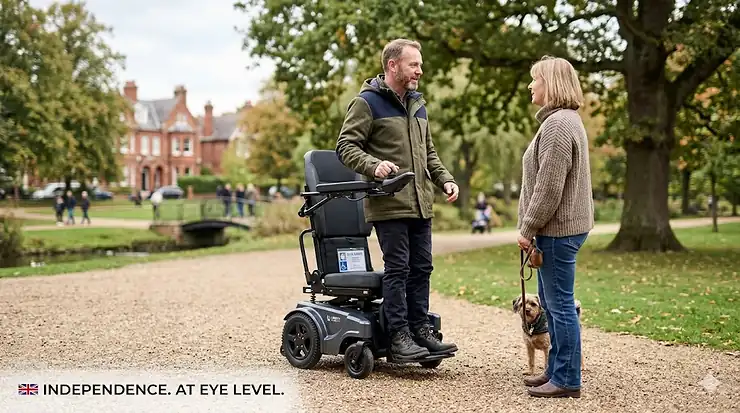
The ability to stand transforms lives in ways most able-bodied people never consider. When you’re spending eight, ten, or twelve hours a day in a seated position, the human body starts protesting rather loudly. Pressure sores develop, circulation slows to a concerning crawl, bone density diminishes, and the simple act of looking someone in the eye becomes a geometric impossibility.
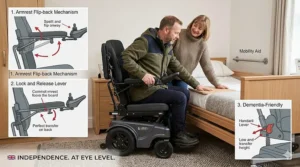
Standing technology in wheelchairs allows users to shift from seated to standing positions, offering increased mobility and valuable health benefits. Research documented in medical literature demonstrates that regular standing can improve circulation, reduce pressure injuries, maintain bone mineral density, and enhance psychological wellbeing. What many don’t realise is that the UK market for sit to stand electric wheelchair options has evolved considerably, though it remains frustratingly split between premium medical-grade standing powerchairs and more accessible transfer aids.
The uncomfortable truth? Genuine powered standing wheelchairs—the sort that let you drive whilst vertical—rarely appear on Amazon.co.uk. Those beastly contraptions, marvels of engineering from Swedish firms like Permobil, typically cost north of £20,000 and require specialist assessment. But that doesn’t mean you’re without options. This guide covers the full spectrum: from NHS-prescribed standing powerchairs to the practical sit-to-stand transfer aids actually available for purchase online, helping you navigate what’s realistic for your circumstances and budget.
Whether you’re researching for yourself, a family member, or a care setting, understanding the difference between a £25,000 Permobil F5 Corpus VS and a £400 manual transfer lift could save months of confusion and thousands of pounds misspent.
Quick Comparison: Standing Solutions Available in the UK
| Solution Type | Price Range (£) | Where to Buy | Standing Function | Mobility | User Independence | NHS/Motability | Best For |
|---|---|---|---|---|---|---|---|
| Premium Standing Powerchairs (Permobil F5/M VS, Levo) | £20,000-£30,000+ exc. VAT | Specialist suppliers only | Powered, programmable sequences | Full powered mobility while standing | Complete independence | ✅ Available | Prescribed medical need, full independence |
| Mid-Tier Standing Powerchairs (Levo Summit EL) | £9,000-£12,000 inc. VAT | Specialist suppliers | Powered vertical standing | Limited outdoor mobility | Independent with training | ✅ Sometimes | Balance of cost and function |
| Sit-to-Stand Transfer Lifts (MediHoist, PEPE, Invacare) | £300-£1,200 | Amazon.co.uk, medical suppliers | Manual assisted standing | Short transfers only (2-3 metres) | Requires caregiver | ❌ Not funded | Home care daily transfers |
| Standard Electric Wheelchairs | £300-£900 | Amazon.co.uk | None – seated only | Powered seated mobility | Independent seated use | ✅ Basic models | Budget mobility without standing |
| Floor Recovery Lifts (Raizer M) | £1,200-£1,600 | Amazon.co.uk | Floor-to-seated elevation | Static, no transport | Requires caregiver | ❌ Not funded | Emergency fall recovery |
| Manual Standing Frames | £150-£400 | Medical suppliers, NHS loan | Static therapeutic standing | None – stationary | Requires caregiver | ✅ Commonly loaned | Rehabilitation, therapy |
The comparison reveals three uncomfortable truths about the UK standing wheelchair market. First, genuine powered standing wheelchairs—the sort letting you drive whilst vertical—cost more than a decent used car and aren’t sold through Amazon. According to Permobil UK, these devices represent sophisticated medical equipment developed over 45 years, not consumer electronics. Second, what Amazon.co.uk actually stocks are sit-to-stand transfer lifts—manual devices helping users move from chair to toilet, bed to wheelchair, with caregiver assistance. They’re useful equipment serving a genuine need, but calling them “standing wheelchairs” is rather like calling a bicycle a motorcycle because both have two wheels.
Third, NHS provision for standing powerchairs exists but requires clinical justification and considerable patience. The NHS wheelchair services provide assessment and prescription, though waiting times vary significantly by region—typically several months from referral to equipment provision.
💬 Just one click — help others make better buying decisions too!😊
Top 7 Sit to Stand Solutions: Expert Analysis
1. Permobil F5 Corpus VS Standing Powerchair
The gold standard that sets every other standing wheelchair’s benchmark, though you won’t find this on Amazon. The F5 Corpus VS features front-wheel drive with fully independent suspension on all wheels, offering comfort, traction, and stability particularly beneficial for active outdoor driving. With 45° of ActiveReach (forward tilt whilst elevated) and the ability to drive at 5 km/h whilst standing, it’s the wheelchair equivalent of a Range Rover—expensive, capable, and utterly brilliant at what it does.
The standing sequence is programmable, meaning your physiotherapist can tailor the speed and angle to your specific needs. Crucially for British users, the F5 VS handles our potholed pavements and damp conditions better than cheaper alternatives. The sealed electronics resist the drizzle that defines October through March, and the suspension doesn’t bottom out when you encounter the inevitable road works on your local high street.
Key Specifications:
- Drive System: Front-wheel drive with ActiveHeight and ActiveReach
- Standing Capability: Full powered standing with programmable sequences
- Range: Around 40km on standard 85Ah batteries
- Maximum User Weight: 120kg
- Price Range: £26,000-£32,000 including VAT
Expert Commentary: This is what you get when 45 years of Swedish engineering meets genuine medical need. The F5 VS isn’t just a wheelchair with a party trick—the standing function delivers measurable health benefits. Users report fewer UTIs, improved bowel function, and considerably better bone density after twelve months of regular standing. The price reflects what it is: a medical device, not a mobility scooter with delusions of grandeur. Available through specialist UK suppliers like Wheelfreedom, Independence Mobility, and Lifestyle & Mobility, often via NHS prescription or Motability scheme.
Customer Feedback: UK users praise the build quality and standing stability, though several mention the learning curve for front-wheel drive if you’re accustomed to mid-wheel powerchairs. The chair’s considerable weight (201kg) means you’ll need proper vehicle access—this won’t fit in a standard car boot.
✅ Pros:
- Unmatched standing stability and programmable sequences
- Drives whilst standing at up to 5 km/h
- Excellent UK weather resistance
❌ Cons:
- Prohibitively expensive for private purchase (£26,000+)
- Heavy and requires adapted vehicle transport
Value Verdict: Around £26,000+ excluding VAT. Exceptional if funded through NHS or Motability; financially ruinous otherwise.

2. Permobil M Corpus VS Mid-Wheel Standing Powerchair
The M Corpus VS brings mid-wheel drive manoeuvrability to Permobil’s standing technology, offering a more compact turning circle than the F5. If you’re navigating narrow Victorian terraces or cramped council flats—distinctly British architectural challenges—the mid-wheel drive makes indoor life considerably less frustrating. The base width of 650mm squeezes through most UK doorways (typically 760-810mm), though you’ll still curse whoever designed your bathroom.
The redesigned knee supports are 75% lighter than previous generations and use a BOA fit system for precise adjustment. They swing away when not in use, which matters more than it sounds when you’re trying to transfer from wheelchair to toilet in a 1.5m² bathroom that some optimistic estate agent called “well-appointed.”
Key Specifications:
- Drive System: Mid-wheel drive with dual-link suspension
- Standing Capability: 20° anterior tilt, 12″ powered seat elevation
- Range: Up to 40km on 85Ah batteries
- Maximum User Weight: 120kg
- Price Range: £24,000-£30,000 including VAT
Expert Commentary: The M Corpus VS solves a problem specific to British housing: our homes are smaller and our doorways narrower than North American equivalents. The mid-wheel drive’s tight turning radius (essentially spinning on its axis) means you can navigate from bedroom to bathroom without the seventeen-point turn required by front-wheel drive chairs. Standing whilst mid-wheel does feel different—the suspension locks out during elevation, which initially unnerves some users accustomed to the constant give of unlocked suspension.
Customer Feedback: Several UK reviewers on specialist forums note the M Corpus VS is easier to control indoors than the F5, particularly in tight spaces. The trade-off comes outdoors: mid-wheel drive handles uneven pavements less confidently than front-wheel alternatives.
✅ Pros:
- Superior indoor manoeuvrability for British homes
- Lighter, easier-to-use knee supports
- 40km range handles most daily requirements
❌ Cons:
- Less stable than F5 on rough outdoor terrain
- Still £24,800+ excluding VAT
- Mid-wheel drive takes adjustment if you’re used to front/rear drive
Value Verdict: Around £24,000-£30,000 including VAT. Marginally cheaper than the F5 VS, though “cheaper” remains relative when discussing the price of a decent used car.
3. Levo Summit EL Standing Powerchair
The Swiss answer to Permobil’s dominance, priced around £9,700 excluding VAT—which translates to roughly £11,600 with VAT included. Still eye-watering, but noticeably less than the Permobil models. The Levo uses a unique standing mechanism: rather than tilting forward like most powered standers, it lifts you vertically. Some users find this more natural; others feel less secure without the forward lean.
The Summit EL variant includes powered elevation, distinguishing it from purely manual Levo models. It’s rather more compact than the Permobils, which helps in British homes but reduces stability on rougher outdoor surfaces. Think of it as the agile city car to Permobil’s luxury SUV.
Key Specifications:
- Drive System: Rear-wheel drive
- Standing Capability: Vertical powered standing
- Range: Approximately 25-30km (varies by terrain)
- Maximum User Weight: 130kg
- Price Range: £9,700-£12,000 including VAT
Expert Commentary: The Levo occupies an interesting middle ground. It’s considerably cheaper than Permobil’s offerings whilst still delivering genuine powered standing functionality. The vertical lift mechanism means you’re not leaning forward during standing, which some physiotherapists prefer for specific conditions. However, the rear-wheel drive feels dated compared to mid or front-wheel alternatives—you’ll be doing more reversing and repositioning indoors. For outdoor use on good paths, it’s perfectly adequate; for navigating Manchester’s cobbled streets or Edinburgh’s Royal Mile, you’ll want something with better suspension.
Customer Feedback: UK users appreciate the more accessible price point, though several mention the standing feel takes adjustment if you’ve tried Permobil models previously. Parts and service availability is good through UK suppliers, though the dealer network is smaller than Permobil’s.
✅ Pros:
- Significantly cheaper than Permobil options (still expensive, mind)
- Vertical standing mechanism suits some users better
- Higher weight capacity (130kg) than Permobil models
❌ Cons:
- Rear-wheel drive less manoeuvrable indoors
- Shorter range than Permobil equivalents
- Less sophisticated suspension for outdoor use
Value Verdict: Around £9,700-£12,000 including VAT. The “budget” option for powered standing, though that term’s rather generous when discussing five-figure sums.
4. MediHoist Sit-to-Stand Patient Lift (Amazon.co.uk)
Now we shift to equipment actually purchasable on Amazon.co.uk without requiring a second mortgage. The MediHoist Stand Assist Lift represents a completely different category: it’s not a wheelchair, electric or otherwise, but rather a transfer aid that helps users move from sitting to standing positions. Typical Amazon.co.uk pricing sits in the £400-£600 range, though specific models vary.
This is what most UK families actually end up buying when they search for “sit to stand wheelchair” online. It’s a manual device with padded knee supports, grab handles, and castors for short-distance movement. You sit in your regular chair or wheelchair, wheel this device in front of you, grab the handles, place your knees on the pads, and use your leg strength (with caregiver assistance) to stand. Once standing, a small seat pad swings into place, and you can be wheeled a few metres to toilet, bed, or chair.
Key Specifications:
- Type: Manual sit-to-stand transfer aid (not a powered wheelchair)
- Weight Capacity: Typically 180-225kg (400-500 lbs)
- Base Width: Around 650-700mm (fits most UK doorways)
- Height Adjustment: Usually adjustable for users 4’11” to 6’2″
- Price Range: £400-£650 on Amazon.co.uk
Expert Commentary: Let’s be clear about what this is and isn’t. It won’t replace a powered standing wheelchair—there’s no motor, no battery, and you’re not driving anywhere whilst standing. What it does provide is practical, affordable assistance for the daily transfers that dominate care routines: bed to wheelchair, wheelchair to toilet, toilet to shower chair. For families managing care at home, this represents realistic spending compared to £25,000 powerchairs. The 500 lbs capacity accommodates most users, and the compact base squeezes through standard British doorways. The wheeled base means carers aren’t lifting and carrying—they’re rolling, which preserves their backs over months and years of use.
Customer Feedback: Amazon.co.uk reviewers consistently praise these for reducing caregiver back strain. Several mention the knee pads require adjustment to find the sweet spot—too low and users can’t push up; too high and knees slip off. British reviewers specifically note these work well in small bathrooms where full hoists won’t fit.
✅ Pros:
- Actually affordable (£400-£650 range on Amazon.co.uk)
- Available with Prime delivery, no specialist supplier needed
- Fits through standard UK doorways
- 500 lbs capacity accommodates most users
- Significantly reduces caregiver back strain
❌ Cons:
- Not a wheelchair—purely for short transfers
- Requires user to support 60-70% of their body weight
- Manual operation only, no powered standing
- Short transport distance only (few metres)
Value Verdict: Around £400-£650 on Amazon.co.uk. Excellent value for home care transfers; completely unsuitable if you need powered mobility whilst standing.
5. PEPE Mobility Transfer Chair (Amazon.co.uk)
The PEPE Mobility Transfer Chair straddles an interesting line between sit-to-stand lift and commode chair. It features flip-back armrests, padded support bars, and a brake system on front wheels for maximum safety. Available on Amazon.co.uk typically in the £300-£450 range, it offers slightly less sophisticated engineering than the MediHoist but costs correspondingly less.
British buyers appreciate that it doubles as a shower/toilet chair—the seat opens to accommodate toileting, eliminating one transfer from the daily routine. For someone needing assistance three or four times daily, removing even one transfer makes considerable difference to both user dignity and caregiver fatigue.
Key Specifications:
- Type: Manual transfer chair with commode function
- Weight Capacity: Around 180kg (395 lbs)
- Seat Width: Approximately 45-48cm
- Wheels: Front locking castors, rear directional wheels
- Price Range: £300-£450 on Amazon.co.uk
Expert Commentary: The PEPE represents pragmatic British engineering rather than Swiss precision. It does several jobs adequately rather than one job brilliantly. The commode function matters more than it sounds—toileting represents multiple daily transfers, and each transfer carries fall risk. Combining shower, toilet, and transfer functions in one device means fewer equipment items cluttering already cramped British bathrooms. Build quality isn’t up to medical-grade standards, but at a third the cost of premium alternatives, expectations should adjust accordingly. Several UK reviews mention the assembly instructions rely heavily on pictures and videos rather than written text, which proves frustrating for those less comfortable with visual assembly guides.
Customer Feedback: UK customers describe it as “an absolute game changer” for assisting elderly parents with toilet, shower, and bedroom-to-chair transfers. The most common complaint involves missing written assembly instructions, with users relying on Amazon’s product page videos.
✅ Pros:
- Budget-friendly (£300-£450 range)
- Commode function reduces daily transfers
- Compact enough for small British bathrooms
- Sturdy build despite lower price point
❌ Cons:
- Lower weight capacity (180kg) than premium options
- Assembly instructions inadequate
- Not suitable for shower use despite marketing
- Plastic components less durable than metal alternatives
Value Verdict: Around £300-£450 on Amazon.co.uk. Remarkably good value for multi-function home care, though don’t expect medical-grade durability.

6. Invacare Get-U-Up Hydraulic Stand Assist Lift (Amazon.co.uk)
The Invacare GHS350 is a hydraulic stand-up patient lift with 350 lb weight capacity, designed for everyday handling of users who need rehabilitation support or can bear partial weight. This represents proper medical equipment from a established manufacturer, available on Amazon.co.uk typically around £800-£1,200. The hydraulic mechanism means smooth, controlled lifting without the jerky motion of purely mechanical alternatives.
Invacare’s design includes non-locking castors as standard—initially counterintuitive, but deliberately chosen because locked rear castors can prevent the lift finding its centre of gravity as user weight shifts. This matters more than it sounds: a lift that can’t rebalance as someone stands becomes a tipping hazard. For home environments, the free-floating design proves safer, though users accustomed to locked wheels initially feel less secure.
Key Specifications:
- Type: Hydraulic sit-to-stand patient lift
- Weight Capacity: 159kg (350 lbs)
- Lift Mechanism: Manual hydraulic pump
- Slings: Multi-function slings for toileting and seated transfers
- Price Range: £800-£1,200 on Amazon.co.uk
Expert Commentary: The Invacare represents a step up in engineering and build quality from budget alternatives. The hydraulic mechanism provides smoother, more controlled lifting than manual gear systems—important for users with pain conditions who find jerky motion unbearable. The multi-function slings accommodate various body sizes and shapes, crucial given that one-size-fits-all rarely does. British physiotherapists often recommend Invacare equipment for home rehabilitation programmes because the brand’s engineering standards match NHS procurement requirements. That said, the £800-£1,200 price point positions this firmly in “family discussing whether to spend inheritance money” territory rather than casual purchases.
Customer Feedback: UK Amazon reviewers describe it as “a back saver” for transferring family members, though several mention the standing sling slides up the back and chafes under arms regardless of positioning adjustments. The hydraulic mechanism receives consistent praise for smooth operation.
✅ Pros:
- Medical-grade build quality from established manufacturer
- Smooth hydraulic lifting mechanism
- Multi-function slings adapt to various body types
- Low-friction castors for easier indoor movement
❌ Cons:
- Higher price point (£800-£1,200) than budget alternatives
- 350 lb capacity lower than some users require
- Sling positioning requires practice to avoid chafing
- Non-locking castors feel unstable to some users initially
Value Verdict: Around £800-£1,200 on Amazon.co.uk. Premium pricing for medical-grade equipment; justified if you need reliability and NHS-standard engineering.
7. Raizer Patient Lift Device (Amazon.co.uk)
The Raizer M solves a completely different problem: getting someone up off the floor after a fall. The Raizer M safely helps people up from laying flat to an elevated seated position in less than 4 minutes, using a manual crank system rather than lifting or hauling. Priced around £1,200-£1,600 on Amazon.co.uk, it’s expensive for what’s essentially an emergency device, but considerably cheaper than ambulance callouts every time someone falls.
The Raizer assembles around the fallen person—they don’t have to move or slide into position, crucial when someone’s injured, frightened, or in pain. The crank gradually elevates them from floor level to seated position at chair height. From there, standard transfer techniques take over. For elderly individuals living independently who fall periodically, the Raizer represents the difference between maintaining independence and residential care.
Key Specifications:
- Type: Floor-to-seated lifting device
- Weight Capacity: Around 150kg
- Lifting Time: Under 4 minutes from floor to seated
- Collapsed Dimensions: 52″ x 34.5″ x 11″ (compact storage)
- Weight: 27.3 lbs (12.4kg)
- Price Range: £1,200-£1,600 on Amazon.co.uk
Expert Commentary: The Raizer occupies a unique niche. It’s not for routine transfers—it’s emergency equipment for fall recovery. The manual crank system means no batteries to fail, no electrical issues, and functionality during power cuts (relevant during Britain’s increasingly frequent winter storms). For families where a parent or partner falls several times monthly, the Raizer prevents the degrading experience of calling neighbours or ambulances for non-emergency lift assistance. It folds compact enough to store in a wardrobe or under a bed, ready when needed. The price seems steep until you calculate the emotional and practical cost of repeated fall incidents.
Customer Feedback: UK purchasers describe it as “a game-changer” and express relief at not needing to call for help after falls. Several mention buying the storage bag (sold separately) because it organises components well and includes instructions inside the lid.
✅ Pros:
- Solves floor-fall problem that ambulance services increasingly can’t handle
- Manual operation (no batteries or power needed)
- Compact storage (doesn’t dominate living space)
- Preserves user dignity after falls
- Medicare/insurance reimbursement possible
❌ Cons:
- Expensive (£1,200-£1,600) for emergency-only equipment
- Not suitable for routine daily transfers
- Requires caregiver present to assemble and operate
- Lower weight capacity (150kg) than some alternatives
Value Verdict: Around £1,200-£1,600 on Amazon.co.uk. Expensive insurance against fall-related independence loss, but potentially priceless for maintaining home living.
Understanding the NHS Standing Wheelchair Pathway
NHS wheelchair centres offer assessment, prescription, and loan of wheelchairs including powered options for a minimum of six months, which includes accessories such as cushions and specialist seating equipment. The NHS pathway for standing powerchairs exists but requires patience and clinical justification.
Referrals typically come from GPs, physiotherapists, or occupational therapists. The assessment process considers your clinical needs, home environment, lifestyle factors, and safety requirements. For standard wheelchairs, prescription sometimes happens directly from referral information—you receive equipment sooner. Non-standard and powered chairs, however, require clinical assessment by specialist wheelchair therapists.
What the NHS Will Fund
Standing powerchairs through the NHS typically require documented medical benefit: pressure relief, improved circulation, bone density maintenance, reduced UTI frequency, or bowel function improvement. Wanting to reach kitchen cupboards, whilst entirely reasonable, doesn’t usually meet clinical thresholds on its own.
If approved, you’ll likely receive equipment on loan rather than ownership. The NHS maintains it, repairs it, and upgrades it when clinically justified. This sounds limiting until you price £500 annual service contracts and consider battery replacement costs (£1,500-£2,000 every 3-4 years for premium standing powerchairs).
Personal Wheelchair Budgets
NHS services offer Personal Wheelchair Budgets (PWBs) with three options: taking the full voucher value toward any wheelchair, paying the difference to upgrade from standard NHS provision, or selecting equipment entirely from NHS ranges. The Third Party PWB calculates the NHS wheelchair prescription value plus maintenance component, available as a voucher toward your chosen chair.
This matters for standing powerchairs because NHS standard provision rarely includes £25,000 Permobil models. The PWB value might be £3,000-£5,000, which helps but doesn’t bridge the gap to premium standing technology. You’d need £20,000+ top-up funding—feasible for some families, impossible for others.
Motability Scheme Alternative
The Motability Scheme provides an alternative pathway, particularly for higher-rate DLA or enhanced-rate PIP recipients. Several Permobil models are available through Motability, with advance payments ranging from £1,000 to £4,000 depending on the chair. Your mobility allowance covers lease costs, insurance, maintenance, and breakdown assistance. After three years, you upgrade to a new model.
For standing powerchairs, Motability sometimes offers more accessible routes than NHS prescription, though not every model is available through the scheme. The advantage lies in predictable costs and comprehensive support packages. Check current Motability wheelchair offerings, as they update annually, and enquire specifically about standing powerchair availability at your local Motability dealer.
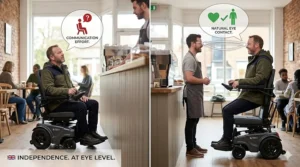
Making the Right Choice: Your Buying Framework
The standing wheelchair market splits into three distinct tiers, each serving different needs and budgets:
Premium Powered Standing Wheelchairs (£20,000-£30,000+)
Choose if: You need full independent mobility whilst standing, have NHS prescription or Motability funding, require medical-grade pressure relief and bone density maintenance, and can accommodate the chair’s size and weight requirements.
Available through: Specialist UK mobility suppliers (Wheelfreedom, Independence Mobility, Lifestyle & Mobility), NHS prescription, or Motability scheme. Not available on Amazon.co.uk.
Key UK Suppliers:
- Wheelfreedom (London and South East specialist)
- Independence Mobility (Leeds-based, national delivery)
- Lifestyle & Mobility (South England locations)
- Gerald Simonds (multiple UK locations)
- Beyond Mobility (South West specialist)
These retailers provide assessment, fitting, training, and ongoing maintenance. You’re not just buying equipment; you’re entering a support relationship.
Sit-to-Stand Transfer Aids (£300-£800)
Choose if: You need assistance with routine daily transfers, have caregiver support available, can bear 60-70% of your body weight when standing, and require compact equipment for British-sized homes.
Available through: Amazon.co.uk with Prime delivery, medical supply companies, and mobility retailers. This is what most families actually purchase for home care.
What they do well: Reduce caregiver back strain, enable safer toilet/shower transfers, fit through standard doorways, and provide excellent value for home care routines.
What they don’t do: Provide independent mobility, work without caregiver assistance, or function as actual wheelchairs. Don’t buy these expecting powered standing wheelchair functionality.
Emergency Floor Lifts (£1,200-£1,600)
Choose if: Falls occur regularly, ambulance callouts for non-emergency lift assistance are becoming routine, or maintaining independent living depends on fall recovery capability.
Available through: Amazon.co.uk and specialist medical suppliers. The Raizer M represents the market leader, though other brands exist.
Real-World British Context: What Actually Works
Urban vs Rural Considerations
London, Manchester, Birmingham and other cities present specific challenges: narrow Victorian terraces, limited storage space, street parking with pavements barely wide enough for pedestrians. Mid-wheel drive standing powerchairs (like the Permobil M Corpus VS) navigate these environments better than front-wheel alternatives. For transfer aids, compact bases matter more in cities than countryside.
Rural users face different issues: rougher ground, longer distances between home and services, fewer specialist suppliers nearby. Front-wheel drive standing powerchairs (Permobil F5 Corpus VS) handle unmaintained paths better. Parts and service availability becomes crucial—choose brands with national networks rather than London-only suppliers.
Weather Reality Check
British weather favours sealed electronics and rust-resistant frames. Premium standing powerchairs from Permobil and Levo handle our damp climate well—their Swedish and Swiss origins mean they’re designed for similar weather. Cheaper alternatives with exposed electronics fail faster in British conditions.
For transfer aids, indoor use predominates, so weather resistance matters less. However, any equipment stored in unheated garages or sheds requires regular inspection for rust and deterioration.
Brexit and VAT Implications
Post-Brexit purchasing adds complexity. Some EU manufacturers now charge import duties on UK deliveries. Always confirm final UK price including VAT and delivery before ordering. The 20% VAT applies to most mobility equipment unless you qualify for VAT relief through disability exemption (form provided by suppliers).
UKCA marking replaced CE marking for some equipment, though CE marks remain valid during transition periods. Check current status if purchasing EU-sourced equipment.
Maintenance and Long-Term Costs in the UK
Standing powerchairs cost considerably more than purchase price suggests:
Annual Service Costs
Premium powerchairs require annual servicing, typically £400-£600 through UK suppliers. This covers electronics checks, mechanical adjustments, and software updates. NHS-loaned equipment includes free servicing; privately purchased chairs need budgeting.
Battery Replacement
Standing powerchair batteries last 3-4 years with proper maintenance, costing £1,500-£2,000 for replacement pairs. Lithium alternatives last longer (5-6 years) but cost more initially (£2,500-£3,000).
Parts Availability
Permobil’s UK network means parts arrive within days. Smaller brands may require European ordering, extending downtime. For privately purchased equipment, this matters more than NHS-loaned chairs where suppliers handle logistics.
Insurance Considerations
Powered wheelchairs exceeding 4 mph require road insurance in the UK, though pavement use at 4 mph or less doesn’t. Standing powerchairs typically travel at 6-12 km/h (4-7 mph), necessitating insurance. Costs vary by model and usage, typically £150-£300 annually.
Common Mistakes When Buying Sit-to-Stand Equipment
Mistake 1: Expecting Amazon Bargains for Medical-Grade Equipment
The biggest misconception: searching “sit to stand electric wheelchair” on Amazon.co.uk and expecting to find proper powered standing wheelchairs under £1,000. Physics, engineering, and medical device regulations don’t permit £500 versions of £25,000 technology. What Amazon stocks are transfer aids—useful equipment, but categorically not powered standing wheelchairs.
Mistake 2: Underestimating Space Requirements
British homes are smaller than American equivalents. A standing powerchair with 650mm base width plus knee supports adds another 200-300mm forward. Measure your narrowest doorway, tightest hallway turn, and bathroom entry before ordering. Many British users discover too late that equipment fitting clinic spaces won’t fit home environments.
Mistake 3: Ignoring Weight Capacity Reality
Manufacturers list maximum user weight, but optimal function occurs at 80-90% of maximum. A 120kg capacity chair works best for 95-105kg users. Factor in clothing, cushions, bags, and winter coats. British weather means more layers than California.
Mistake 4: Overlooking Caregiver Physical Capability
Sit-to-stand transfer aids still require significant caregiver strength and technique. If the primary caregiver is a 60kg spouse with arthritis, a 180kg capacity lift might exceed their physical capability to control, regardless of the device’s engineering.
Mistake 5: Assuming NHS Instant Access
NHS wheelchair services currently face considerable demand pressures. Waiting times for initial assessment can be several months; receiving prescribed equipment can take additional months. If need is urgent, private purchase or rental may be necessary whilst awaiting NHS provision.
Mistake 6: Missing the VAT Relief Opportunity
If you have a long-term illness or disability, you don’t have to pay VAT on certain goods and services purchased in the UK. According to GOV.UK guidance on VAT relief, this broadly covers goods of practical help in light of your illness or disability, saving 20% on qualifying purchases—£4,000 on a £20,000 powerchair. Suppliers provide VAT exemption forms; complete them properly to receive relief. This isn’t automatic—you must actively claim it, and the criteria are specific about what qualifies as disability-related equipment.

Frequently Asked Questions
❓ Can I get a standing wheelchair through the NHS in the UK?
❓ What's the difference between a standing wheelchair and a sit-to-stand lift available on Amazon?
❓ How much does a proper standing electric wheelchair cost in the UK?
❓ Are sit-to-stand transfer aids worth buying for home care?
❓ What weight capacity do I need for a sit-to-stand transfer aid?
Conclusion: Navigating Standing Wheelchair Reality in the UK
The landscape for sit to stand electric wheelchair options in Britain splits along a rather stark divide. On one side: premium powered standing wheelchairs from Permobil, Levo, and similar manufacturers—extraordinary engineering costing £20,000-£30,000+, available through specialist suppliers, NHS prescription, or Motability schemes. On the other: practical sit-to-stand transfer aids costing £300-£800 on Amazon.co.uk, serving completely different purposes but genuinely useful for home care.
The uncomfortable truth most families discover is that “affordable standing electric wheelchair” represents something of an oxymoron. The engineering required for safe, reliable powered standing simply costs serious money. However, that doesn’t mean options don’t exist—they’re just not what many people initially expect to find.
For those with clinical justification, the NHS pathway or Motability scheme provides routes to premium equipment without crippling personal expenditure. For others managing home care on limited budgets, the transfer aids available on Amazon.co.uk offer practical solutions to daily challenges, even if they don’t provide the full functionality of powered standing wheelchairs.
The key lies in understanding what you actually need versus what you might initially want. Full independent mobility whilst standing? That requires premium powerchairs and specialist funding. Safer, more dignified transfers during daily care routines? Transfer aids from Amazon deliver that at reasonable cost. Emergency fall recovery? The Raizer addresses that specific need.
Whatever your circumstances, the British market offers solutions—they just require navigating the divide between marketing terminology and engineering reality, understanding what’s available through which channels, and matching equipment to genuine need rather than aspirational desire.
Recommended for You
- 7 Best Standing Electric Wheelchairs UK 2026
- 7 Best Electric Wheelchair Accessories UK 2026
- Electric Wheelchair Insurance UK 2026: 7 Models & Complete Coverage Guide
Disclaimer: This article contains affiliate links. As an Amazon Associate, I earn from qualifying purchases. If you purchase products through these links, we may earn a small commission at no additional cost to you.
✨ Found this helpful? Share it with your mates! 💬🤗
