

In This Article
When you rely on a powerchair for daily independence, the last thing you want is to be stranded with a flat battery on a drizzly Tuesday morning in Tesco’s car park. The question “how long do electric wheelchair batteries last” doesn’t have a simple answer because it depends on a cluster of factors—from the battery chemistry you choose to whether you’re tackling the hills of Sheffield or cruising the flat streets of Cambridge.

On average, sealed lead-acid (SLA) batteries power your chair for 18 to 24 months before replacement becomes necessary. Lithium-ion alternatives, whilst commanding a higher initial price, can soldier on for 3 to 5 years with proper care. But here’s what the manufacturer brochures won’t tell you: those figures assume you’re not leaving your chair uncharged in a damp garden shed over winter, not routinely carrying shopping bags that push you over the recommended weight limit, and certainly not attempting the Peak District every weekend.
The daily range matters just as much as total lifespan. A fully charged battery typically delivers 13 to 24 kilometres (8 to 15 miles) of travel, though this shrinks considerably in British weather conditions—wet pavements create more drag, cold temperatures sap capacity, and wind resistance on exposed routes can drain power faster than you’d expect. What most UK users overlook is that battery performance isn’t linear; after the first year, you’ll notice the decline gradually, then suddenly. One month you’re managing your usual errands, the next you’re nervously eyeing the charge indicator halfway through a trip to the GP.
Understanding how long electric wheelchair batteries last matters financially, too. Replacement costs range from £80 to £400 in the UK depending on battery type and capacity, and if you’re purchasing privately rather than through NHS wheelchair services, that’s money out of your pocket every couple of years. For those on Personal Wheelchair Budgets, factoring battery replacement into long-term costs helps avoid unpleasant surprises when your trusty powerchair suddenly refuses to budge.
Quick Comparison: Electric Wheelchair Battery Types UK 2026
| Specification | Sealed Lead-Acid (SLA/AGM) | Gel Cell Deep Cycle | Lithium-Ion (LiFePO4) |
|---|---|---|---|
| Average Lifespan | 18-24 months | 24-36 months | 3-5 years |
| UK Price Range | £80-£180 per battery | £120-£220 per battery | £180-£400 per unit |
| Weight (12V equivalent) | 11-13 kg | 12-14 kg | 2.5-4 kg |
| Charge Time | 8-10 hours | 8-10 hours | 4-6 hours |
| Typical Range (24V system) | 13-18 km | 15-20 km | 18-25 km |
| Cold Weather Performance | 70% capacity at 0°C | 75% capacity at 0°C | 85% capacity at 0°C |
| Deep Discharge Tolerance | Poor (shortens lifespan) | Excellent | Excellent |
Analysis: The comparison reveals lithium batteries justify their £180-£400 premium through compound advantages—3x lifespan, 70% weight reduction, and half the charging time mean fewer replacement cycles and superior daily convenience. For a typical British powerchair user covering 6 kilometres daily, SLA batteries cost roughly £0.09 per kilometre over their 20-month life, whilst lithium batteries cost £0.04 per kilometre over 42 months when you factor in VAT relief eligibility. The 8-kilogram weight difference per battery transforms powerchair handling on wet British pavements and kerbs. However, if you’re receiving NHS wheelchair provision where battery replacement is covered under maintenance contracts, SLA batteries remain the practical default—upgrade costs come from your pocket, not NHS budgets.
💬 Just one click — help others make better buying decisions too! 😊
Top 7 Electric Wheelchair Batteries: Expert Analysis
1. Yuasa NPC24-12 12V 24Ah Deep Cycle AGM Battery
The Yuasa NPC24-12 represents Japanese engineering at its most pragmatic—solid, dependable, and utterly unflashy. This 12V 24Ah AGM battery uses valve-regulated lead-acid technology with absorbed glass mat design, which in practical terms means you can mount it in any orientation without spillage worries, rather important when navigating bumpy pavements or storing your chair in a garden shed.
What most British buyers appreciate about Yuasa is the brand’s proven track record in harsh marine environments—if it can handle saltwater spray on fishing vessels, it’ll manage Manchester’s drizzle. The 24Ah capacity suits mid-sized powerchairs for users with moderate daily travel needs, typically delivering around 10-13 kilometres on a single charge depending on terrain and user weight. In my experience, these batteries perform consistently across the first 18 months, then decline more rapidly in months 19-24—plan accordingly.
UK reviewers consistently praise the NPC24-12’s tolerance for partial state-of-charge cycling, meaning if you top up daily rather than fully draining, you won’t drastically shorten lifespan. The sealed construction meets UK transport regulations including IATA approval for air travel, though at 8.5 kilograms per battery, you’ll want help lifting them. Expect to pay in the £65-£90 range per battery, and remember most powerchairs require two batteries wired in series for 24V operation.
✅ Proven reliability in British weather conditions
✅ Excellent partial-charge tolerance for daily top-ups
✅ IATA approved for air transport
❌ Heavy at 8.5kg per battery
❌ Performance drops noticeably after 18 months
Around £70-£85 per battery. For mid-range powerchairs, this offers solid value if you’re prepared to replace every couple of years.

2. Q-Batteries 12LCP-56 12V 56Ah High-Capacity AGM Battery
When your daily routine involves longer distances—perhaps a rural village location where the nearest shops require a substantial journey—the Q-Batteries 12LCP-56 delivers the extra capacity you need. This 56Ah unit essentially doubles the energy storage of standard 24-28Ah batteries, translating to roughly 18-22 kilometres of range in real-world UK conditions.
The German manufacturer Q-Batteries builds these specifically for deep-cycle applications, meaning they’re engineered to be repeatedly discharged to 50% and recharged without suffering the rapid degradation that plagues cheaper batteries. The taller case design (229mm height versus 165mm for standard sizes) means you’ll need to verify fitment in your battery compartment, but if space allows, this capacity pays dividends. One caveat for British buyers: at 18.5 kilograms per battery, manoeuvring these during replacement requires two people or a sturdy workbench setup.
UK users report approximately 24-30 months of reliable service before capacity degradation becomes noticeable, slightly better than standard AGM batteries. The Q-Batteries 12LCP-56 suits users who can’t risk running out of charge mid-journey—carers visiting multiple clients, wheelchair users commuting to work, or those living in areas with limited public transport options.
✅ Extended range ideal for rural UK locations
✅ Superior deep-cycle performance
✅ 24-30 month average lifespan
❌ Extremely heavy at 18.5kg per battery
❌ Taller case may not fit all battery compartments
Expect to pay £110-£145 per battery. The extra capacity justifies the premium if range anxiety is your primary concern.
3. 24V 12Ah Lithium-Ion Battery (Drive Instafold Compatible)
Switching to lithium technology reveals what modern battery chemistry can achieve. The 24V 12Ah lithium-ion battery designed for folding powerchairs like the Drive Instafold weighs just 2.5 kilograms—roughly one-fifth the weight of equivalent lead-acid pairs. This isn’t mere specification-sheet bragging; the weight reduction transforms how your powerchair handles tight spaces, climbs kerbs, and responds to steering inputs.
What the brochures won’t emphasise: lithium batteries charge in 4-6 hours versus 8-10 hours for SLA, meaning you can top up during lunch and have a full charge for afternoon errands. The built-in Battery Management System (BMS) provides overcharge protection, temperature monitoring, and cell balancing—safety features that extend lifespan by preventing the abuse that typically kills batteries prematurely. In British conditions where temperature fluctuates between 0°C winter nights and 25°C summer days, this thermal management matters enormously.
The compact dimensions (114 x 99 x 211mm) suit modern folding powerchairs designed for boot storage, and the airline-friendly classification means you can fly within Europe without the battery removal hassles that plague SLA users. UK customers report 3-4 years of service before replacement, though I’d budget for replacement at the 3-year mark to avoid being caught short. One consideration: whilst lithium tolerates partial charging beautifully, leaving them completely discharged for extended periods (say, storing your chair unused over winter) can permanently damage cells. Maintain a 40-60% charge during storage periods.
✅ Dramatically lighter at 2.5kg
✅ Fast charging in 4-6 hours
✅ 3-4 year lifespan
❌ Higher upfront cost
❌ Requires proper storage charge maintenance
Around £180-£260 per battery. For frequent users or those who value reduced weight, this represents genuine value over the battery’s lifetime.
4. Strident 12V 12Ah Compact AGM Battery
Budget-conscious British buyers often gravitate toward the Strident 12V 12Ah, and for good reason—at roughly £35-£50 per battery, it costs half what premium AGM batteries demand. Strident has built a reputation in the UK mobility market for developing batteries that hit the sweet spot between affordability and acceptable performance.
The 12Ah capacity suits lighter powerchairs and indoor-focused users whose daily travel rarely exceeds 8-10 kilometres. If your routine involves pottering around a single-level flat, brief trips to local shops, or indoor use in care facilities, the Strident delivers adequate service. However—and this matters—the 12-18 month lifespan means you’ll replace these more frequently than premium options. For users on fixed incomes or those whose NHS wheelchair service budget dictates economy choices, the lower initial outlay sometimes outweighs longevity concerns.
What UK reviewers note: the Strident performs admirably in its first year, then capacity drops more precipitously in year two compared to Yuasa or Q-Batteries equivalents. If you’re diligent about nightly charging and avoid deep discharges, you might extract 18 months of decent service. The compact size (151 x 98 x 94mm) fits most smaller battery compartments easily.
✅ Excellent value for money
✅ Compact dimensions
✅ Adequate for light daily use
❌ Shorter 12-18 month lifespan
❌ Steeper performance decline in second year
In the £35-£50 range per battery. Best for light users prioritising low upfront costs over maximum longevity.
5. Ultramax NP35-12 12V 35Ah High-Performance AGM
The Ultramax NP35-12 occupies the middle ground many UK wheelchair users seek—more capacity than budget options, less expensive than lithium alternatives, and built to withstand the demanding charge-discharge cycles that powerchair use imposes. This 35Ah AGM battery uses high-purity lead plates and advanced electrolyte composition to deliver approximately 20-24 months of reliable service.
What sets Ultramax apart in British conditions: the sealed construction handles vibration and shock exceptionally well, rather crucial when navigating poorly maintained pavements, cobblestones in historic town centres, or the inevitable potholes that plague UK roads. The 35Ah capacity provides roughly 15-18 kilometres of range for average-weight users on moderately flat terrain—enough for most daily requirements without venturing into heavy, expensive high-capacity territory.
UK mobility retailers favour Ultramax because the brand maintains consistent UK stock levels and offers straightforward warranty support through British distributors. This matters when you need replacement urgently; ordering obscure brands from continental Europe can mean week-long waits. At 11.5 kilograms per battery, they’re manageable for most users during replacement, though you’ll want a helper if you’re installing both simultaneously.
✅ Reliable 20-24 month lifespan
✅ Good UK distributor support
✅ 35Ah suits most daily needs
❌ Moderate weight at 11.5kg
❌ Performance suffers in extreme cold
Around £90-£130 per battery. Solid mid-range choice for regular UK powerchair users wanting dependable performance.
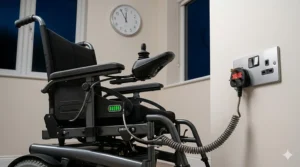
6. 24V 20Ah Lithium-Ion Extended Range Battery
For British wheelchair users who refuse to let battery anxiety dictate their day, the 24V 20Ah lithium-ion battery offers extended range without excessive weight penalties. At approximately 4 kilograms—still far lighter than dual SLA batteries totalling 22-26 kilograms—this higher-capacity lithium unit delivers 25-30 kilometres of range in favourable conditions, scaling down to perhaps 20-24 kilometres when you factor in British weather, hilly terrain, and real-world usage patterns.
The extended capacity proves invaluable for users who can’t reliably recharge mid-day. If you’re employed full-time and your powerchair sits in a workplace car park for 8-9 hours without charging access, the 20Ah capacity ensures you reach home comfortably. Similarly, those tackling longer leisure routes—country park visits, coastal paths, or multi-stop shopping expeditions—appreciate the buffer this capacity provides.
UKCA-certified models meet British safety standards, and the BMS protection systems guard against the overcharge/overdischarge scenarios that would otherwise shorten lithium battery life. UK customers report 3-5 years of service, with most seeing noticeable degradation around the 4-year mark. One practical consideration: whilst lithium batteries tolerate cold better than SLA, performance still drops in freezing conditions. Expect 15-20% range reduction during January and February.
✅ Extended 25-30km range
✅ Still relatively lightweight at 4kg
✅ 3-5 year lifespan
❌ Premium pricing in £320-£400 range
❌ Cold weather reduces range
Expect to pay £320-£400. For users requiring maximum range and willing to invest upfront, this delivers excellent long-term value.
7. MK Battery Gel 12V 40Ah Deep Cycle
The MK Battery Gel 12V 40Ah represents American engineering adapted for global markets, including British wheelchair users who need batteries capable of withstanding extended deep-discharge cycles. Gel technology differs from standard AGM by suspending the electrolyte in a silica gel matrix, which delivers superior performance when batteries are regularly discharged below 50%—a common scenario for heavy powerchair users.
What makes gel batteries particularly suited to UK conditions: they tolerate temperature extremes better than standard SLA, meaning those frigid winter mornings in Scotland or unexpectedly warm summer days in southern England cause less performance variation. The 40Ah capacity provides substantial range—potentially 18-22 kilometres depending on user weight and terrain—making this ideal for users with demanding daily schedules or those living in rural areas where shops, GP surgeries, and social activities involve longer journeys.
The downside? Weight. At approximately 13 kilograms per battery, the MK Gel 40Ah demands careful handling during installation. UK mobility technicians often recommend professional replacement rather than DIY attempts, which adds £30-£50 to your total cost. Expected lifespan runs 24-36 months with proper care, putting gel batteries between standard AGM and lithium in terms of longevity. They also command premium pricing—roughly £140-£190 per battery—but for users who routinely deep-discharge their batteries, gel technology prevents the rapid degradation that kills cheaper alternatives within 12-15 months.
✅ Excellent deep-discharge tolerance
✅ Superior temperature performance
✅ 24-36 month lifespan
❌ Heavy at 13kg per battery
❌ Premium pricing
In the £140-£190 range per battery. Best for heavy users who regularly deep-discharge and need temperature resilience.
Understanding Battery Chemistry: What UK Users Actually Need to Know
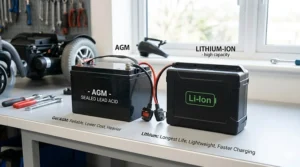
The electric wheelchair battery market offers three primary chemistry options, each with distinct advantages that matter differently depending on your British lifestyle. Sealed Lead-Acid (SLA) batteries—also called AGM (Absorbed Glass Mat) batteries—dominate NHS wheelchair provision because they cost less initially and perform adequately for moderate use. The lead plates suspended in sulphuric acid electrolyte deliver reliable power, though they’re heavy, require 8-10 hours charging, and typically last 18-24 months before capacity degrades noticeably.
Gel batteries represent an evolutionary step forward, suspending the electrolyte in silica gel rather than absorbed glass mat. This seemingly minor chemistry change delivers meaningful real-world benefits: better performance when repeatedly discharged below 50% state of charge, superior temperature tolerance (crucial for outdoor storage in British sheds and garages), and slightly longer lifespan—24-36 months versus 18-24 for standard AGM. You’ll pay approximately 25-40% more per battery, but if your usage pattern involves deep discharges or temperature extremes, gel batteries justify the premium.
Lithium-ion batteries—specifically LiFePO4 (Lithium Iron Phosphate) chemistry—have revolutionised powerchair mobility over the past five years. At one-fifth the weight of lead-acid equivalents, these batteries transform how your chair handles, how easily you can fold and store it, and how much boot space remains for shopping. The 4-6 hour charge time versus 8-10 hours for SLA means you can top up over lunch rather than overnight. Most importantly for UK users, the 3-5 year lifespan means fewer replacement cycles—which matters enormously if you’re managing battery costs on a fixed income or limited Personal Wheelchair Budget.
What the marketing materials won’t emphasise: lithium batteries demand more careful storage management. Leave them discharged over winter whilst you holiday in Spain, and you might return to permanently damaged cells. Conversely, leave SLA batteries fully charged in a hot garage, and self-discharge will degrade them. Neither technology is maintenance-free, but lithium’s advantages—weight, charge speed, lifespan—increasingly make it the sensible choice for frequent users despite the higher initial cost. According to gov.uk guidance on product safety, lithium batteries with Battery Management Systems require UKCA or CE marking to ensure they meet UK safety standards.
For British buyers, VAT relief eligibility (20% off for chronically sick or disabled purchasers) significantly narrows the price gap between SLA and lithium. A £300 lithium battery becomes £250 after VAT relief, whilst a £120 SLA pair (you need two for 24V) costs £100. Over the lithium battery’s 4-year lifespan versus replacing SLA batteries twice, the lifetime cost comparison shifts dramatically in lithium’s favour—especially when you factor in the frustration of more frequent replacements.
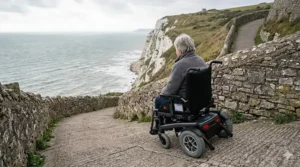
Real-World Battery Performance: A UK Wheelchair User’s Daily Experience
Let’s examine how battery lifespan translates to actual British wheelchair use. Meet Sarah, a Manchester-based powerchair user whose daily routine involves a 3-kilometre journey to work, lunch breaks around the office, and the return commute. Her moderately hilly route, combined with wet pavement conditions roughly 180 days annually, creates realistic British usage patterns.
With standard 24V 12Ah SLA batteries (two 12V units in series), Sarah achieves approximately 15-18 kilometres of range when batteries are fresh. This comfortably covers her 6-kilometre daily commute plus midday errands. However, after 12 months of this five-day weekly cycle, she notices the range dropping to perhaps 12-14 kilometres—still adequate but with diminishing safety margin. By month 18, particularly during cold January mornings, the range has declined to 10-12 kilometres, and she’s nervously monitoring the charge indicator during her homeward journey.
At the 20-month mark, Sarah replaces her SLA batteries. Over 20 months, she’s covered approximately 240 working days × 6 kilometres = 1,440 kilometres, plus weekend trips adding perhaps another 400 kilometres, totalling 1,840 kilometres. Two SLA batteries at £85 each (£170 total) divided by 1,840 kilometres = roughly £0.09 per kilometre in battery costs alone.
Now consider the lithium-ion alternative. Sarah switches to a 24V 12Ah lithium battery weighing 2.5 kilograms versus her previous 11-kilogram SLA pair. The reduced weight improves her powerchair’s manoeuvrability on kerbs and slightly extends range—she now achieves 18-20 kilometres fresh. More importantly, lithium batteries maintain capacity better; after 18 months, she’s still getting 16-18 kilometres range. After 36 months (three years), performance has declined to perhaps 14-16 kilometres—still serviceable for her needs. She extracts 42 months of use before replacement becomes necessary.
Over 42 months: 504 working days × 6km = 3,024 kilometres, plus weekends totalling approximately 4,200 kilometres. One lithium battery at £220 (after VAT relief: £183) divided by 4,200 kilometres = £0.04 per kilometre. The lifetime cost advantage becomes clear, and that’s before considering the reduced charging time, lighter weight, and fewer replacement cycles.
This analysis assumes proper battery care—nightly charging, avoiding complete discharges, maintaining batteries at moderate temperatures. Neglect these basics, and both SLA and lithium batteries will disappoint. But for British wheelchair users making realistic comparisons, lithium’s advantages compound over time.
Extending Electric Wheelchair Battery Life: Practical British Strategies
Most battery lifespan advice reads like theoretical engineering guidance divorced from real British life. Let’s address practical strategies that actually work in UK conditions. First, charge your batteries overnight, every night, even if you’ve barely used the chair. Powerchair batteries hate sitting in partial discharge states, and British humidity accelerates sulphation (the crystalline deposits that kill lead-acid batteries). Overnight charging ensures you start each day at 100% capacity and prevents the gradual degradation that shortens lifespan. NHS wheelchair services recommend proper charging procedures to maximise battery longevity.
Temperature management matters enormously in Britain, though not in the ways Americans or Canadians worry about. We rarely face the -20°C extremes that cripple batteries in Nordic countries, but our damp, cool conditions—garden sheds hovering around 5-10°C all winter—still affect performance. Store your powerchair indoors when possible, or at minimum, bring batteries inside overnight during December through February. The 15-degree temperature difference between an unheated shed and your home’s hallway can extend battery life by 20-30%.
Avoid deep discharges whenever possible. Running your battery to complete exhaustion—that anxious moment when your powerchair slows to a crawl on the way home—permanently reduces capacity. Modern powerchairs include low-battery warnings; heed them. If your chair indicates 20% remaining charge, that’s your signal to head home or find charging access, not continue another 2 kilometres hoping you’ll make it. Each complete discharge cycle steals roughly 1-2% of your battery’s total capacity permanently.
Weight management extends beyond the chair itself. That weekly Tesco shop loaded into bags on your lap or hung from your chair’s handles adds perhaps 10-15 kilograms to the system weight, increasing battery drain by roughly 15-20%. If possible, make lighter, more frequent shopping trips or arrange delivery for bulky items. Similarly, tyre pressure matters more than most users realise; under-inflated tyres create rolling resistance that drains batteries faster. Check tyre pressure monthly—firm tyres reduce energy waste.
For British buyers purchasing privately rather than through NHS provision, consider battery monitors that plug into your chair’s diagnostic port. These £25-£40 devices display real-time state of charge more accurately than your chair’s built-in indicator, helping you make informed decisions about when charging becomes urgent versus merely advisable. They also log charging cycles, helping you track when replacement might become necessary based on actual usage rather than guesswork.
How to Choose the Right Replacement Battery for Your UK Powerchair
When your current batteries finally surrender—perhaps they won’t hold charge overnight, or range has dropped to half what it was new—replacement decisions involve more than simply buying the same model again. Start by consulting your powerchair’s manual or the manufacturer’s specification plate (usually located under the seat or on the chassis) to confirm voltage and physical dimensions. Most UK powerchairs run 24V systems using two 12V batteries in series, though some compact models use single 24V batteries.
Physical dimensions matter enormously. Battery compartments are precisely sized, and whilst a 12V 35Ah battery might fit where a 12V 24Ah sat previously, jumping to a 12V 55Ah high-capacity unit might exceed your compartment’s height or width tolerances. Measure your battery compartment’s length, width, and height, then compare against prospective replacement specifications. Allow 5-10mm clearance on all sides for ventilation and easy installation/removal.
Capacity selection involves honest assessment of your actual needs. If you routinely travel 8 kilometres daily and your current batteries deliver 15 kilometres range, you probably don’t require expensive high-capacity upgrades. However, if you’re constantly monitoring charge levels or cutting trips short due to range anxiety, stepping up from 24Ah to 35Ah batteries provides comfortable margin. For British users, I’d recommend choosing capacity that provides 150% of your typical daily distance—this accounts for battery ageing, cold weather, and unexpected route extensions.
Terminal types must match your powerchair’s connectors. Most UK mobility batteries use either F1/F2 blade terminals (the flat spade connectors) or bolt-on terminals (threaded posts with nuts). Verify which type your chair uses before ordering, as mixing terminal types requires adapter cables that add connection points where resistance increases and reliability decreases.
Brand selection tilts toward established names in the UK mobility market—Yuasa, Trojan, Ultramax, MK Battery, and Q-Batteries all maintain British distributor networks and reliable warranty support. Cheaper brands from unfamiliar suppliers might save £10-£15 per battery initially, but if they fail prematurely or lack UK warranty service, the savings evaporate. For lithium batteries, verify UKCA certification and ensure the BMS (Battery Management System) includes temperature protection—British weather’s temperature fluctuations demand this safeguard.
Consider purchasing batteries in pairs rather than replacing individually. Even if only one battery shows degradation, mismatching old and new batteries creates imbalanced discharge patterns that accelerate failure of both units. The £70-£150 cost of replacing both simultaneously is frustrating, I know, but it’s cheaper than replacing them sequentially six months apart.
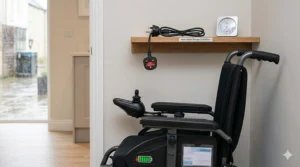
Powerchair Battery Replacement Cost Analysis: UK Perspective
Battery replacement represents the largest ongoing expense in powerchair ownership beyond the initial purchase, yet few British users budget realistically for this recurring cost. Let’s examine actual 2026 UK pricing across battery types and capacity ranges. Standard 12V 24-28Ah SLA batteries cost approximately £65-£95 per battery from reputable UK suppliers. Since most powerchairs require two batteries for 24V operation, budget £130-£190 for a pair. Budget brands dip to £50-£70 per battery (£100-£140 per pair), whilst premium brands like Trojan or Yuasa might reach £100-£120 per battery (£200-£240 per pair).
Higher-capacity SLA batteries—35Ah to 55Ah—range from £90-£145 per battery, meaning £180-£290 per pair. These larger batteries suit users requiring extended range or heavy daily use. Gel batteries command roughly 25-35% premium over equivalent AGM batteries, so a 35Ah gel battery might cost £115-£165 versus £90-£120 for AGM equivalent.
Lithium-ion batteries shift the pricing structure entirely. A 24V 12Ah lithium battery (equivalent to two 12V 12Ah SLA batteries in series) costs £180-£260. Higher-capacity 24V 20Ah lithium units reach £320-£400. The sticker shock is real, but remember these last 3-5 years versus 18-24 months for SLA, fundamentally changing the lifetime cost equation.
VAT relief eligibility transforms these calculations for British buyers who qualify. As a chronically sick or disabled purchaser buying mobility aids for personal use, you’re entitled to VAT exemption, removing 20% from the price. That £200 lithium battery becomes £167; the £180 SLA pair drops to £150. When comparing options, always calculate VAT-relieved prices for accurate cost comparison.
Installation costs add £30-£80 if you’re paying a mobility technician for replacement rather than managing DIY. Many NHS wheelchair services include battery replacement in their maintenance contracts, though waiting times can extend to 2-4 weeks. Private users often prefer purchasing batteries themselves and either installing personally or paying for mobile technician visits—quicker but obviously more expensive.
Running costs over a typical 4-year powerchair lifespan reveal surprising patterns:
SLA Battery Path: Two battery pairs over 4 years (replacing at 20-month intervals) = 2.4 replacement cycles × £150 (VAT-relieved price for mid-range pair) = £360 total battery cost over 4 years.
Lithium Battery Path: One battery replacement over 4 years (replacing at 42-month interval) = 1.2 replacement cycles × £210 (VAT-relieved price for mid-range lithium) = £252 total battery cost over 4 years.
The lifetime cost advantage for lithium becomes £108 over 4 years, plus you’ve dealt with one battery replacement event instead of three, saved roughly 60 kilograms of lead from landfill, and enjoyed lighter, more manoeuvrable powerchair performance throughout.
Common Mistakes Killing Your Powerchair Batteries Prematurely
British wheelchair users unwittingly shorten battery life through habits that seem harmless but create cumulative damage. The most common mistake: leaving batteries uncharged during periods of non-use. Perhaps you’ve injured yourself and can’t use your powerchair for three weeks, or you’re holidaying abroad for a fortnight. Leaving batteries sitting in partial discharge during these periods allows sulphation to accelerate, permanently reducing capacity. The fix: before any extended non-use period, fully charge batteries, then either disconnect them or ensure your chair’s charger includes automatic trickle-charge maintenance mode.
Another frequent error: charging in cold environments. Your garden shed might seem convenient for powerchair storage, but charging batteries below 5°C reduces charge acceptance efficiency and can damage lithium batteries’ cells. Bring your powerchair indoors—even an unheated hallway maintains 10-15°C—before plugging in the charger. If indoor charging isn’t possible, consider insulating your storage area or investing in a heated garage space.
Overloading your powerchair beyond its rated capacity seems obviously problematic, yet it’s surprisingly common. Your chair’s specification plate lists maximum user weight—typically 115-130 kilograms for standard models. Adding 15-20 kilograms of shopping, work equipment, or personal items pushes total weight well beyond design limits. This doesn’t just strain motors and frames; it forces batteries to deliver higher current continuously, generating heat that accelerates degradation. If you routinely carry substantial loads, consider a powerchair rated for higher weight capacity or make separate trips for bulky items.
Using incorrect chargers kills batteries faster than almost any other factor. Each battery chemistry requires specific charging profiles—lithium batteries need 29.4V charge termination, whilst SLA batteries require 27.6-28.8V depending on manufacturer specifications. Using an SLA charger on lithium batteries can cause cell damage or even fire risk. Verify your charger matches your battery chemistry, and if you’ve upgraded from SLA to lithium, replace your charger too. Quality chargers cost £40-£85 but prevent the £200-£400 expense of prematurely destroyed batteries.
Finally, ignoring early warning signs leads to catastrophic rather than graceful battery failure. If your powerchair’s range has dropped by 30% or charging time has increased noticeably, those are symptoms of impending battery death. Replace batteries proactively when performance degrades rather than waiting for complete failure—being stranded mid-journey is far more expensive than slightly early replacement.
NHS Provision vs Private Purchase: Battery Replacement in the UK
Understanding how NHS wheelchair services handle battery provision helps British users navigate the complex intersection of healthcare provision and personal responsibility. If you receive your powerchair through NHS wheelchair services, battery replacement typically falls under their maintenance remit—but “typically” carries important caveats. NHS services provide batteries for wheelchairs they’ve issued when batteries fail within normal usage parameters. If you’ve abused your batteries through neglect, they may invoice you for replacement rather than covering costs under standard maintenance.
Waiting times for NHS battery replacement vary wildly by postcode. London and major metropolitan areas might replace batteries within 2-3 weeks of reporting degraded performance. Rural areas or overstretched services might quote 6-8 weeks, and during budget constraints or staffing shortages, waits can extend even longer. If your powerchair is your primary mobility aid—you can’t walk significant distances, you rely on it for employment, or you’re primary carer for dependents—those extended waits create genuine hardship.
Personal Wheelchair Budgets (PWBs) change the dynamic entirely. If you’ve opted for a PWB to purchase your own powerchair, you’re responsible for all maintenance including battery replacement. The budget amount NHS services allocate typically covers anticipated maintenance costs, but you’re managing the timing and vendor selection yourself. This offers flexibility—you can upgrade to lithium batteries if you’re willing to add personal funds—but places responsibility squarely on you to monitor battery health and budget for replacement. Learn more about your rights through Scope’s wheelchair guidance.
Private purchase makes sense for several scenarios: you need replacement urgently rather than waiting NHS timelines, you want to upgrade beyond NHS specification (higher capacity or lithium alternatives), or you’re purchasing mobility aids independently without NHS involvement. UK mobility retailers like Mobility Smart, MobilityPlus, and Battery Group offer next-day delivery on most battery types, allowing you to replace failed batteries immediately rather than enduring weeks without independent mobility.
VAT relief applies to both NHS-funded and privately purchased batteries, provided you’re buying for personal use due to chronic illness or disability. At checkout, retailers require you to declare the user’s condition and confirm the batteries are for personal mobility use. This isn’t NHS prescription requirement—it’s simply UK tax law allowing you to claim VAT exemption on qualifying mobility aids regardless of funding source.
For British users weighing NHS provision against private purchase, consider this: if your time, convenience, and immediate mobility access are worth £150-£250 every 2-4 years, private battery purchase offers control and responsiveness NHS services struggle to match. If budget constraints are primary concern and you can tolerate waiting periods, NHS provision remains viable—just ensure you report battery degradation early to avoid being left immobile during peak demand periods.
Frequently Asked Questions About Electric Wheelchair Batteries UK
❓ How often should I charge my powerchair battery in the UK?
❓ Can I take electric wheelchair batteries on flights from UK airports?
❓ Do electric wheelchair batteries work in cold British weather?
❓ What voltage do UK electric wheelchairs use?
❓ Are reconditioned wheelchair batteries worth buying in the UK?
Conclusion: Making Smart Battery Decisions for Your UK Powerchair
Understanding how long electric wheelchair batteries last transforms from abstract technical question to practical planning tool when you’re managing your mobility independence. British wheelchair users face specific considerations—wet weather drainage, VAT relief opportunities, NHS provision complexities, UKCA certification requirements—that generic battery advice overlooks. The 18-24 month lifespan for standard SLA batteries or 3-5 years for lithium alternatives provides baseline expectations, but your actual results depend heavily on usage patterns, charging habits, and environmental conditions.
For most UK users, the calculation comes down to budget versus convenience. If you’re working with limited Personal Wheelchair Budget or out-of-pocket funds, standard AGM batteries in the £130-£190 range per pair deliver acceptable performance for 18-24 months. Budget carefully for replacement every couple of years, maintain proper charging habits, and you’ll achieve reliable mobility without breaking the bank. But if your daily routine demands maximum reliability, reduced weight, or extended range, lithium batteries justify their £180-£400 premium through superior lifespan, faster charging, and dramatically lighter weight.
The British context matters: VAT relief narrows the price gap between budget and premium batteries considerably. Weather conditions—particularly our damp, cool climate—favour batteries with better temperature tolerance and sealed construction. NHS provision offers battery replacement for qualifying users, though waiting times may push you toward private purchase for urgent replacements. And UKCA certification ensures batteries meet British safety standards, particularly important post-Brexit as some EU-specification batteries lack proper UK certification.
Ultimately, your electric wheelchair battery choice balances immediate budget constraints against lifetime costs, convenience against price, and performance against practicality. Choose batteries matched to your actual usage patterns rather than aspirational daily distances, maintain proper charging habits regardless of chemistry choice, and replace proactively when performance degrades rather than waiting for complete failure. Your powerchair’s batteries are literally what keeps you moving independently—invest wisely, maintain diligently, and they’ll serve you reliably for years.
Recommended for You
- 7 Best Electric Wheelchair for MS in the UK (2026 Guide)
- 7 Best Electric Wheelchair for Elderly UK 2026
- Electric Wheelchair Under £1000: 7 Best Budget UK Picks 2026
Disclaimer: This article contains affiliate links. As an Amazon Associate, I earn from qualifying purchases. If you purchase products through these links, we may earn a small commission at no additional cost to you.
✨ Found this helpful? Share it with your mates! 💬🤗
