
In This Article
Your back deserves better than a saggy vinyl sling. If you or someone you care for spends a significant portion of the day in a wheelchair, you already know the creeping discomfort that starts somewhere around the lumbar region and spreads outward like a slow, unwelcome tide. The best back cushion for wheelchair users isn’t a luxury — it’s, arguably, one of the most clinically important accessories a wheelchair user can own.
A quality back cushion does several things at once: it fills the gap between the user’s lumbar curve and the flat or hammocked backrest, encourages thoracic alignment, reduces the pressure that leads to muscle fatigue, and — crucially — lowers the risk of pressure sores, a serious concern highlighted by the NHS for anyone with limited mobility. The right cushion can quite literally transform the experience of being seated for four, six, or eight hours a day.
In this guide, we’ve reviewed 7 real products currently available on Amazon.co.uk, testing them across a range of user needs: from everyday manual wheelchair users seeking basic lumbar relief to full-time powered chair occupants who need clinical-grade postural support. We’ve focused specifically on back cushions — the kind that sit behind you, not beneath you — though several of our picks work brilliantly as a combined system. All prices are noted as ranges in GBP, because Amazon prices shift like British weather: frequently and without warning.
Whether you’re shopping for yourself, for a parent, or on behalf of a patient, this guide will help you find the best back cushion for wheelchair users that actually does what it promises.
Quick Comparison: Top 7 Back Cushions for Wheelchair Users
| Product | Type | Best For | Price Range (GBP) | Amazon.co.uk |
|---|---|---|---|---|
| Drive Medical Extreme Comfort Wheelchair Back Cushion | Dedicated wheelchair backrest | Clinical/full-time users | £30–£55 | ✅ Available |
| Supportiback® Posture Therapy Lumbar Support | Memory foam lumbar | Posture correction, daily use | £25–£40 | ✅ Available |
| Everlasting Comfort Memory Foam Lumbar Pillow | Memory foam lumbar | Long sitting hours, versatility | £20–£35 | ✅ Available |
| FORTEM Coccyx & Lumbar Support Set | Memory foam combo | Budget buyers, dual-use | £25–£45 | ✅ Available |
| Aidapt Memory Foam Vinyl Wheelchair Cushion | Wipe-clean memory foam | Hygiene-conscious/carers | £20–£35 | ✅ Available |
| Kongming 2-in-1 Seat & Lumbar Cushion | Memory foam combo | Value seekers, occasional use | £20–£35 | ✅ Available |
| Quarry Easylife NHS Back Support Cushion | Structured foam backrest | NHS-standard, scoliosis support | £60–£90 | ✅ Available |
From the table above, the Drive Medical and Quarry Easylife stand apart as the dedicated wheelchair-specific options, offering structural board backing that generic lumbar cushions simply cannot match. For users who spend fewer than four hours a day seated, the Everlasting Comfort or FORTEM set represents excellent value in the £25–£45 range. Full-time wheelchair occupants, however, should give serious thought to the higher end of this list — the additional cost is trivial against the long-term clinical benefit.
💬 Just one click — help others make better buying decisions too! 😊
✨ Don’t Miss These Exclusive Deals!
🔍 Take your seating comfort to the next level with these carefully selected products. Click on any highlighted item to check current pricing and availability on Amazon.co.uk. These picks will help you find exactly the right support for your back.
Top 7 Back Cushions for Wheelchair Users: Expert Analysis
1. Drive Medical Extreme Comfort Wheelchair Back Cushion with Lumbar Support
This is the product that most closely resembles what occupational therapists actually prescribe. Drive Medical is a well-regarded medical equipment brand, and their Extreme Comfort Wheelchair Back Cushion is purpose-built for wheelchair use — a detail that sounds obvious but sets it leagues apart from repurposed office lumbar pillows.
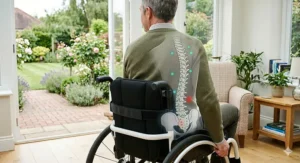
The cushion features a durable Masonite stabilisation board attached to the rear, which prevents the dreaded “hammocking” effect common in sling-back wheelchairs. If you’ve ever watched a standard wheelchair back sag inward under body weight, you’ll understand why this matters enormously. That hammocking posture — pelvis tilted back, lumbar spine flattened, thoracic spine rounding forward — is the exact mechanism that creates chronic back pain, pressure ulcers, and respiratory restriction in long-term wheelchair users. The firm foam core distributes load across a wider surface area while the integrated lumbar bulge gently encourages the natural S-curve of the spine. A sealed inner liner protects the foam from moisture — and given that British care environments involve a fair amount of cleaning and accidental spills, that’s a practical feature worth celebrating.
Customer reviews on Amazon.co.uk are broadly positive, with several users noting it works particularly well for managing lower back pain during long sitting sessions. A few reviews mention that sizing requires careful attention — measure your wheelchair’s backrest width before ordering, as an ill-fitted cushion achieves the opposite of its goal.
✅ Genuinely wheelchair-specific design with stabilisation board
✅ Integrated lumbar support encourages spinal S-curve
✅ Sealed liner for moisture resistance — practical in care settings
❌ Sizing must be carefully matched to wheelchair width
❌ Heavier than generic foam alternatives
Price range: around £30–£55 | Best for: full-time wheelchair users, clinical environments, those with diagnosed lumbar conditions.
2. Supportiback® Posture Therapy Lumbar Support Cushion
Developed with input from 20 physicians, the Supportiback® has earned a devoted following on Amazon UK — and its 6,000+ reviews with a 4.3/5 rating speaks for itself. This is a lumbar pillow rather than a dedicated wheelchair backrest, but for part-time wheelchair users who also sit at desks or in car seats, its versatility is a genuine selling point.
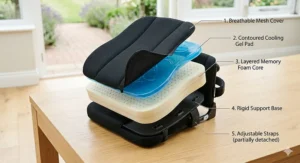
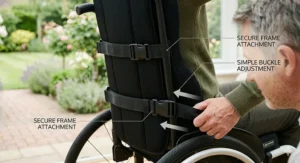
The cushion uses heat-responsive memory foam with fast rebound technology — meaning it adapts to your specific back contours rather than imposing a one-size-fits-all shape. This matters because lumbar curves vary significantly between individuals; a rigid support that works beautifully for one person can create a pressure point for another. The breathable mesh cover includes a moisture-wicking coating, which keeps things comfortable during the longer sitting sessions that wheelchair users inevitably endure. Double adjustable straps fit most standard wheelchair backrests up to approximately 80 cm wide. The spec sheet claims pressure relief across upper, middle, and lower back — and in practice, users confirm it does shift the load distribution in a way you feel almost immediately.
For UK buyers, it’s worth noting this product ships from Amazon’s UK fulfilment centres and is Prime-eligible, so next-day delivery is straightforward. It’s not an NHS-grade device, but for everyday comfort and posture correction without a clinical referral, it punches well above its price.
✅ 6,000+ UK reviews, physician-developed design
✅ Heat-responsive memory foam adapts to individual back curvature
✅ Breathable and moisture-wicking — sensible for all-day use
❌ Not designed exclusively for wheelchairs; may need repositioning during the day
❌ Softer than clinical options — not ideal for severe postural needs
Price range: £25–£40 | Best for: part-time wheelchair users, those also using office chairs and car seats, posture correction without clinical intervention.
3. Everlasting Comfort Memory Foam Lumbar Support Pillow
The Everlasting Comfort Lumbar Pillow has developed something of a cult following in the UK mobility community, and it’s not hard to see why. Premium high-density memory foam, dual adjustable straps, and a removable, washable mesh cover at a price that sits comfortably under £35 — for users who need reliable daily support without breaking the budget, this is a remarkably strong option.
What makes this cushion worth highlighting beyond its price is the foam quality. Budget memory foam often collapses within a few months of daily use, losing its supportive properties precisely when you need them most. Everlasting Comfort uses a denser foam formulation that resists the flattening-over-time problem, which is something UK buyers should particularly watch for when comparing cheaper alternatives. The adjustable straps fit chairs up to 80 cm back width and keep the cushion from sliding during transfers or when the wheelchair is being manoeuvred over uneven pavement — which, as anyone navigating a British high street well knows, is essentially every pavement everywhere. A range of additional accessories are available from Everlasting Comfort on Amazon.co.uk, making it easy to build a complete comfort system around this cushion.
UK customer feedback highlights the cover’s ease of washing — a practical consideration in any care environment. The general consensus is that it’s soft but well-padded, offering good value for money for less complex seating needs.
✅ High-density foam resists long-term compression
✅ Dual straps keep cushion secure during wheelchair manoeuvring
✅ Washable mesh cover — practical for regular cleaning
❌ Softer feel may not suit users requiring firm postural correction
❌ Less effective for users with complex spinal deformities
Price range: £20–£35 | Best for: budget-conscious buyers, users with mild-to-moderate lumbar discomfort, multi-purpose use across wheelchair, car, and home seating.
4. FORTEM Seat Cushion & Lumbar Support Set
With over 28,000 reviews on Amazon.co.uk at a 4.7-star average, the FORTEM combo set is perhaps the platform’s single most trusted combined seating solution in this category. It bundles a U-shaped coccyx seat cushion with a contoured lumbar back pillow — and while this guide focuses on back cushions, the bundled approach here deserves attention because for many wheelchair users, back pain and tailbone discomfort are inextricably linked.
The lumbar component uses pure memory foam shaped to follow the natural spinal curve, with an ergonomic profile that specifically targets the L3-L5 region where most wheelchair-related lower back pain originates. The seat cushion’s U-shaped cutout relieves pressure on the coccyx, reducing the forward tilt that causes the lower back to round. Together, they create a seating system that addresses the biomechanics of wheelchair posture more holistically than a back cushion alone. Both components come with removable, washable covers — the mesh breathes well, which is relevant for users in warmer indoor environments or those who experience discomfort with heat build-up during long sitting sessions.
The adjustable elastic straps are strong and relatively easy to manage for carers or users with limited hand dexterity. One genuine consideration for UK buyers: the product is shipped from Amazon Fulfillment centres in the UK and is typically Prime-eligible, making delivery fast and returns straightforward under the Consumer Contracts Regulations (14-day cooling-off period applies).
✅ 28,000+ reviews, 4.7-star average — genuinely trusted by UK buyers
✅ Bundled approach addresses both back and tailbone simultaneously
✅ Washable covers and adjustable straps
❌ Combined set may be unnecessary for users who only need back support
❌ Memory foam softness may feel insufficient for users with high postural needs
Price range: £25–£45 | Best for: users experiencing both lower back and tailbone discomfort, value-seekers, carers managing multiple comfort needs at once.
5. Aidapt Memory Foam Soft Touch Vinyl Wheelchair Cushion
Aidapt is a British mobility brand with strong distribution across Amazon.co.uk and mainstream UK mobility retailers — and that familiarity with British users’ needs shows in this product’s design. The Soft Touch Vinyl Covered Wheelchair Cushion uses a full-support memory foam core encased in a wipe-clean vinyl outer, which might sound unglamorous until you consider how often wheelchair cushions need cleaning in real-world care environments.
The vinyl cover isn’t the scratchy, crinkly stuff of 1990s hospital wards — it’s a soft-touch formulation that feels considerably more comfortable than it looks. More importantly, it wipes down instantly with a damp cloth, resists odours, and doesn’t require trips to the washing machine. For users with incontinence concerns, carers managing multiple clients, or anyone in a care home environment, this practical design advantage genuinely matters. The memory foam beneath provides good all-day support for the lower-to-mid back, with fixing straps that secure the cushion to standard wheelchair frames.
Aidapt confirm the product complies with UK Fire Safety Regulations 1988, which is a specific legislative requirement for foam products in British healthcare settings — a compliance detail that similar-looking products from overseas often lack. If you’re purchasing for a care home or NHS environment, this certification alone makes Aidapt worth serious consideration.
✅ British brand, UK Fire Safety Regulations 1988 compliant
✅ Wipe-clean vinyl cover — ideal for care environments
✅ Full memory foam support, multiple uses across chairs and scooters
❌ Vinyl cover less breathable than mesh alternatives — can feel warm in summer
❌ Basic lumbar support; not suitable for complex postural needs
Price range: £20–£35 | Best for: care home environments, users with hygiene needs, carers wanting easy-clean solutions, NHS procurement.
6. Kongming 2-in-1 Seat Cushion & Lumbar Support Cushion
The Kongming 2-in-1 is a newer entrant to Amazon.co.uk, but it’s carved out a respectable niche among wheelchair users who want an ergonomically considered combo without paying a premium. The lumbar component features a ‘W’-shaped design that follows the natural curvature of the sacrum and lumbar spine rather than applying uniform pressure across the entire lower back — and that biomechanical nuance genuinely separates it from flatter, less considered designs.
Memory foam quality here is solid for the price, though not quite at the density of the Everlasting Comfort or Supportiback®. Where the Kongming wins points is in its breathable mesh construction — air circulates freely through the cover, making it more comfortable during extended sitting sessions than vinyl or tightly woven alternatives. The outer layer has excellent sweat-wicking properties, which is a polite way of saying it handles the reality of long days in a wheelchair far more graciously than it might first appear. Both the seat cushion and lumbar support can be used independently, which adds flexibility: if you only need back support on some days, the seat cushion isn’t wasted.
For wheelchair users who are trialling cushion support for the first time, the Kongming offers a low-risk entry point — the price is accessible, the design is considered, and if it’s not quite right, the 14-day return window under UK Consumer Contracts Regulations means there’s little financial downside to trying it.
✅ W-shaped lumbar design follows sacral and lumbar curvature
✅ Breathable mesh, excellent sweat management
✅ Independent use of both components adds flexibility
❌ Memory foam density lower than premium alternatives
❌ Relatively new product — smaller UK review base than competitors
Price range: £20–£35 | Best for: first-time buyers, occasional wheelchair users, those wanting breathable design at an accessible price.
7. Quarry Easylife NHS Back Support Cushion
At the upper end of this list — both in price and in clinical credibility — sits the Quarry Easylife NHS Back Support Cushion. Designed to NHS specification, this is a structured foam backrest built to support users with more complex postural needs: scoliosis, kyphosis, post-surgical spinal conditions, and significant core weakness. At dimensions of approximately H63 cm × D30 cm × W40–60 cm, it’s a substantial piece of equipment that wraps around the torso rather than sitting behind it, providing lateral as well as posterior support.
The structured foam construction offers a firmness that memory foam cannot match — it pushes gently but consistently into the back to encourage alignment between the body and spine, rather than moulding passively to whatever shape the user’s posture has adopted (which, after years in a wheelchair, may itself be problematic). The royal blue cover is durable, easy to spot-clean, and — critically — designed to meet the hygiene standards of NHS procurement. This is a product you’d find in a hospital ward or community rehabilitation setting, not because it’s necessarily the most comfortable option on this list, but because it does the serious clinical work that comfort-focused products can’t.
For UK buyers with complex needs, it’s worth noting that an occupational therapist (OT) assessment may be available free through your local NHS trust — the NHS Wheelchair Service can often advise on, and in some cases supply, clinical-grade back support. The Quarry Easylife represents the self-funded equivalent of that clinical recommendation.
✅ NHS-specification design, clinical-grade postural support
✅ Lateral and posterior support — suitable for scoliosis and kyphosis
✅ Robust construction for institutional use
❌ Considerable investment for casual or part-time wheelchair users
❌ Firm construction may feel harsh to users accustomed to softer cushions
Price range: £60–£90 | Best for: full-time wheelchair users with complex postural needs, post-surgical recovery, NHS-equivalent procurement for home use.
Full Specification Comparison: Top 7 Back Cushions
| Product | Material | Cover Type | Fixings | UK Fire Safety | Approx. Weight |
|---|---|---|---|---|---|
| Drive Medical Extreme Comfort | Foam + Masonite board | Removable fabric | Velcro/straps | Confirmed | ~700g |
| Supportiback® | Memory foam | Breathable mesh | Dual straps | Standard | ~450g |
| Everlasting Comfort | High-density memory foam | Washable mesh | Dual straps | Standard | ~600g |
| FORTEM Set | Memory foam (x2) | Washable mesh | Elastic straps | Standard | ~900g |
| Aidapt Vinyl | Memory foam | Wipe-clean vinyl | Fixing straps | ✅ UK 1988 Reg | ~550g |
| Kongming 2-in-1 | Memory foam | Breathable mesh | Elastic straps | Standard | ~800g |
| Quarry Easylife NHS | Structured foam | Durable fabric | Wrap-around | ✅ NHS spec | ~1.5kg |
The material column tells the most important story here. Products with structured foam or Masonite board backing are genuinely different devices from those using standard memory foam — they’re stiffer by design because they need to resist the body’s tendency to compress them into ineffectiveness over hours of sitting. Memory foam cushions, conversely, prioritise comfort and conformity, which makes them excellent for mild-to-moderate support needs. Neither is universally superior; the right choice depends entirely on the user’s postural profile and daily usage pattern.
How to Choose the Best Back Cushion for Wheelchair Users in the UK: A Step-by-Step Guide
Choosing correctly matters more than it might first appear. A cushion that’s too soft provides false reassurance; one that’s too firm creates new pressure points. Here’s how to navigate the decision sensibly.
1. Assess daily usage time. Under two hours a day? Most memory foam options will serve you well. Four or more hours? You need something with meaningful structural integrity — look at the Drive Medical or Quarry Easylife options.
2. Identify your specific back region. Lower back (lumbar) pain responds well to L-shaped or contoured lumbar cushions. Mid-back (thoracic) and full-back issues need something taller, like the Quarry Easylife, that addresses a greater surface area.
3. Check your wheelchair’s backrest width. This is the step most UK buyers skip, then regret. Measure the inside width of your wheelchair backrest before ordering. A 40 cm cushion in a 50 cm-wide backrest will shift, slide, and ultimately defeat itself.
4. Consider your cover requirements. In care environments, wipe-clean vinyl wins every time. For private home users, breathable mesh covers are more comfortable and the trade-off in hygiene maintenance is entirely manageable.
5. Factor in transfer frequency. If you transfer in and out of the wheelchair multiple times daily, cushion attachment mechanisms matter. Velcro tabs, elastic loops, and board-backed designs each behave differently during transfers — test before committing.
6. Consult an OT if in doubt. The NHS Wheelchair Service and occupational therapists can assess postural needs formally and, in many cases, recommend or supply clinical equipment. This service is free to eligible patients and should be the first port of call for anyone with complex needs.
7. Think about British winters. Vinyl covers get cold. In an unheated hallway or when being transported in a vehicle during a January morning, a cold vinyl backrest is genuinely unpleasant. Fabric and mesh covers are far more agreeable in the British climate — a small detail with a disproportionate impact on daily comfort.
Real-World Scenarios: Which Back Cushion Fits Your Life?
Profile 1: Margaret, 71, Leeds — Recovering from spinal surgery, 4–6 hours daily in wheelchair
Margaret needs something that provides consistent, medically appropriate support without requiring constant readjustment. Her back shape has changed post-surgery, and a soft, conforming cushion risks encouraging the very posture her surgeon wants her to avoid. Recommendation: Quarry Easylife NHS Back Support Cushion. The structured foam maintains its corrective shape regardless of how long she sits; the wrap-around design provides lateral support that prevents the trunk-lean common in post-surgical recovery. At £60–£90, it’s an investment — but for Margaret, the clinical benefit outweighs a comparison with budget alternatives.
Profile 2: Jamie, 34, Bristol — Part-time manual wheelchair user, desk job, back pain
Jamie splits his day between his wheelchair and an office chair, and his lower back aches by mid-afternoon in both. He doesn’t need a clinical device; he needs a cushion that transitions effortlessly between environments.
Recommendation: Supportiback® Posture Therapy Lumbar Support Cushion. Its adjustable straps work on wheelchair backrests and office chairs alike, the breathable mesh suits indoor environments year-round, and the physician-developed design addresses the lumbar curve specifically. At £25–£40, it’s an easy decision.
Profile 3: Priya, 58, Birmingham — Full-time powered wheelchair user, NHS carer visits twice daily
Priya’s carer needs to clean the cushion quickly and efficiently during visits. Hygiene and ease of maintenance aren’t just preferences here — they’re functional requirements.
Recommendation: Aidapt Memory Foam Vinyl Wheelchair Cushion. The wipe-clean vinyl cover handles disinfectant without degrading, the UK Fire Safety compliance satisfies any NHS or CQC inspection, and the memory foam provides reliable daily comfort. The price point keeps it accessible for a product that will see daily, intensive use.
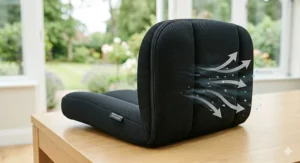
Common Mistakes When Buying a Back Cushion for a Wheelchair — And How to Avoid Them
Buying a seat cushion instead of a back cushion. This is astonishingly common. Seat cushions go beneath you; back cushions go behind you. They address different problems. If your pain is in the lower back and the cushion you’re considering sits on the seat of the chair, it will help your tailbone — not your lumbar spine. Check product descriptions carefully before purchasing.
Ignoring UK-specific compliance. Foam products in UK care homes and NHS settings must comply with The Furniture and Furnishings (Fire Safety) Regulations 1988, as updated. The Aidapt cushion explicitly confirms this compliance. Generic overseas imports on Amazon.co.uk may not — and for institutional buyers, this matters legally.
Assuming one size fits all wheelchairs. Standard manual wheelchairs in the UK typically have 40 cm–46 cm seat widths, but powered chairs, sports chairs, and paediatric chairs vary considerably. Always check your wheelchair’s interior backrest width before selecting a cushion — the product pages on Amazon.co.uk typically list compatible dimensions.
Choosing by softness alone. It’s a natural instinct — softer feels more comfortable, right? In reality, a cushion that’s too soft allows your lumbar spine to sink into it unchecked, which means you’re sitting on foam rather than being supported by it. Clinical guidance from Versus Arthritis consistently emphasises that the correct firmness for back support is often counter-intuitively firmer than patients expect.
Neglecting the cover material for the British climate. Vinyl covers retain cold in winter and warmth in summer. If the wheelchair is used outdoors or in poorly heated environments — terraced houses, older care homes, community transport — fabric or mesh covers provide meaningfully better comfort year-round.
Long-Term Care and Maintenance in the UK
A back cushion is only as effective as its current condition. Memory foam that has compressed permanently, covers that have developed bacteria, and cushions that have shifted out of position are all actively counterproductive — they create the illusion of support without the substance.
Monthly maintenance checklist:
- Remove and wash fabric/mesh covers at 40°C (check label — some are 30°C)
- Wipe vinyl covers with a mild antibacterial solution; avoid harsh solvents that degrade the surface
- Check all straps and fixings for wear; elastic straps lose tension over time and may need replacement
- Inspect foam for permanent compression — press the cushion in the centre and release; it should return to full height within 5 seconds
- Recheck cushion positioning relative to the lumbar curve; it migrates more than you’d expect over weeks of daily use
Memory foam typically has a useful support life of 18–24 months with daily use before it begins losing its structural properties. Structured foam products like the Drive Medical or Quarry Easylife last longer, but should still be inspected annually. Replacement covers are available for most products on Amazon.co.uk separately, which extends the cushion’s usable life considerably.
In Britain’s damp autumn and winter months, foam cushions stored in garages or car boots absorb moisture over time. Store indoors when not in use, and allow foam to air fully after any cleaning before replacing covers.
Back Cushion for Wheelchair Users vs. Standard Lumbar Pillows: What’s Actually Different?
It’s a fair question. Walk into any British supermarket’s homeware section and you’ll find generic lumbar pillows for under £15. Why not just use one of those?
The honest answer is: for occasional, light use, you can. But the differences become meaningful quickly.
| Feature | Wheelchair-Specific Back Cushion | Generic Lumbar Pillow |
|---|---|---|
| Backrest fixings | Designed for wheelchair frames | Basic elastic or none |
| Hammocking prevention | Stabilisation board option | None |
| Positioning accuracy | Designed for seated posture | Designed for upright/standing posture |
| Hygiene compliance | UK Fire Safety, care-grade options | Consumer use only |
| Durability | Daily use, institutional grade | Occasional home use |
| Price range (GBP) | £20–£90 | £10–£25 |
The key insight here is positioning. When you’re seated in a wheelchair, your pelvis is in a different position than when standing or perching on a kitchen chair. The lumbar curve flattens in wheelchair users precisely because the pelvis tends to rotate posteriorly under bodyweight. A cushion designed for standing lumbar support applies its pressure in the wrong place entirely. Wheelchair-specific designs account for the seated pelvic angle — and that biomechanical precision is what you’re paying for.
For full-time wheelchair users, a proper wheelchair back cushion isn’t a luxury add-on. According to guidance from Occupational Therapy for Wheelchair Seating (NHS England), appropriate seating support is a clinical necessity, not an optional comfort upgrade.
Wheelchair Back Cushions for Specific UK Audiences
For Elderly Users in Care Homes
Prioritise wipe-clean covers (Aidapt), UK Fire Safety compliance, and ease of fitting for carers. Avoid products with complex strap systems that require significant manual dexterity to adjust. The Drive Medical and Aidapt options are both well-suited to this context.
For Active Adults Using Manual Wheelchairs
Lightweight, secure attachment, and breathable covers matter most here. The Supportiback® and Everlasting Comfort both perform well for active users who transfer frequently and need a cushion that stays put during physical activity without adding bulk.
For Children and Young People
Sizing becomes the primary concern. Most products in this guide are sized for adults — for paediatric needs, direct consultation with a paediatric occupational therapist is strongly recommended before purchasing from general retail. The NHS Wheelchair Service may be better placed to supply correctly sized equipment.
For Post-Surgical Recovery
Structured foam with lateral support (Quarry Easylife) is the appropriate choice for users recovering from spinal, hip, or pelvic surgery. Always confirm any purchasing decision with your surgical team or physiotherapist before use.
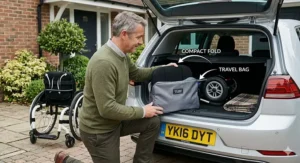
FAQ: Best Back Cushion for Wheelchair Users in the UK
❓ What is the best back cushion for wheelchair users with lower back pain?
❓ Can I get a wheelchair back cushion on the NHS in the UK?
❓ Are wheelchair back cushions available with next-day delivery on Amazon.co.uk?
❓ How do I clean a wheelchair back cushion safely in the UK?
❓ What size back cushion do I need for a standard UK wheelchair?
Conclusion
Sitting comfortably in a wheelchair for hours on end isn’t a given — it’s something you engineer. The best back cushion for wheelchair users in the UK in 2026 depends almost entirely on who’s using it and how: a part-time user with mild lumbar ache has fundamentally different needs from a full-time occupant with post-surgical spinal changes or a progressive condition affecting trunk control.
What this guide has tried to demonstrate is that price correlates reasonably well with clinical sophistication in this category. The budget options — Kongming, Everlasting Comfort, FORTEM — are genuinely good products for what they are. The premium options — Quarry Easylife, Drive Medical — do meaningfully different work. The mistake to avoid is putting a budget product in a clinical role, or spending clinical-grade money on occasional-use comfort.
Our overall recommendation for most UK buyers: if you’re unsure, start with the Supportiback® or Everlasting Comfort, use it consistently for two weeks, and take note of whether the discomfort shifts or resolves. If it doesn’t, the Quarry Easylife or a formal OT assessment is your next step. Your back will tell you what it needs — the trick is listening before the situation becomes urgent.
✨ Don’t Miss These Exclusive Deals!
🔍 Ready to find the right back cushion? Click any highlighted product name to check current pricing and availability on Amazon.co.uk. Small investment, significant difference.
Recommended for You
- Best Bariatric Wheelchair Cushion UK 2026: 7 Top Picks
- Best Wedge Cushion for Wheelchair UK 2026: 7 Top Picks
- Best Coccyx Wheelchair Cushion UK 2026: 7 Expert Picks for Real Tailbone Relief
Disclaimer: This article contains affiliate links. As an Amazon Associate, I earn from qualifying purchases. If you purchase products through these links, we may earn a small commission at no additional cost to you.
✨ Found this helpful? Share it with your mates! 💬🤗
