
In This Article
An airline approved mobility scooter battery is a rechargeable pack that meets airline and dangerous-goods rules for passenger travel. In practice that means a removable lithium-ion pack, clearly labelled, with a watt hour rating of 300Wh or less. Your airline always has the final say, whatever the sticker claims.
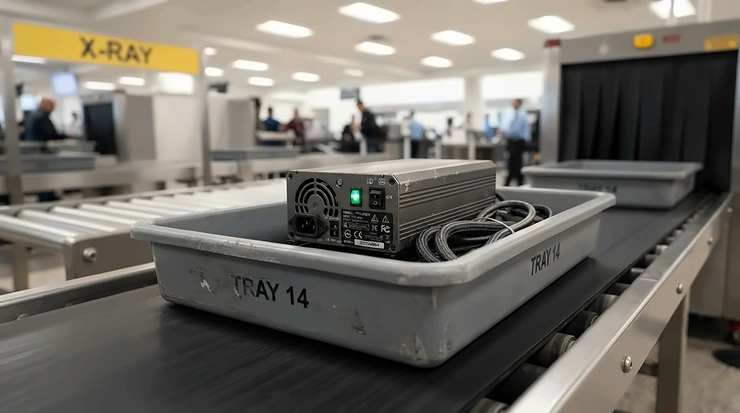
Here’s the awkward truth. Your scooter can be perfect, light as a feather and folding in twelve seconds, and still get stopped at the gate over a battery label. The battery is the single most scrutinised part of the whole kit. Lithium-ion packs pack a lot of energy into a small case, which is why regulators treat them with respect.
The good news is that the maths is simple. Most airlines allow one lithium pack of up to 300Wh, or two spares of up to 160Wh each, carried in the cabin. Once you know your numbers, the whole thing stops feeling like a lottery.
This guide compares seven real packs and scooters, then walks through the rules, the paperwork and the traps that catch people out. Where independent review data was too thin to quote, the article says so rather than papering over it.
Quick Comparison: Airline Approved Mobility Scooter Battery Options at a Glance
| Product | Rating (V × Ah) | Approx. Wh | Price range | Best For |
|---|---|---|---|---|
| TGA Minimo 24V 11.5Ah Spare Battery | 24V × 11.5Ah | ≈276Wh | mid-£300s (check current price) | Maximum range under the cap |
| TGA Minimo / Minimo Plus & Pride Quest 10.05Ah Battery | 24V × 10.05Ah | ≈241Wh | £300–£400 range | Safe headroom, dual-brand fit |
| Essential Aids Lithilite Airline Safe Pack | 24V × 10.4Ah | ≈250Wh | around £300 | Lithilite, Airscape and Alumina owners |
| Instafold 24V 10Ah Lithium Battery | 24V × 10Ah | ≈240Wh | around £300 | Budget swap battery |
| Essential Aids Autofold 10Ah Lithium-Ion Battery | 25.9V × 10Ah | ≈259Wh | £400–£600 range | Autofold family owners |
| mLite 9.9Ah Removable Battery Pack | 9.9Ah (voltage to verify) | ≈238Wh if 24V | mid-£300s | mLite owners |
| Welzo FreeFold X 16KG Scooter | 24V × 6.6Ah | ≈158Wh | under £1,000 | Complete lightweight kit |
Looking at the table, the Instafold 10Ah battery and the Lithilite pack are the budget-friendly spares. Both sit around £300 and carry a comfortable margin under the 300Wh ceiling. The TGA Minimo 11.5Ah pack buys the most range, but at 276Wh it leaves the least room for a label dispute. The FreeFold X is the odd one out, because it’s a whole scooter whose battery sits under 160Wh.
💬 Just one click — help others make better buying decisions too!😊
Top 7 Airline Approved Mobility Scooter Battery Picks: Expert Analysis
1. TGA Minimo 24V 11.5Ah Spare Battery — biggest pack that still clears 300Wh
This is the heavyweight of the compliant bunch. At 276Wh it slips under the ceiling with only a sliver of room to spare.
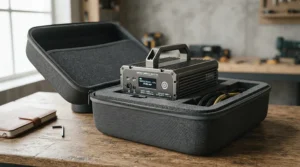
The pack is rated 24V 11.5Ah, which matches the 276Wh the retailer lists. It’s designed for the TGA Minimo Plus 3 and Minimo Plus 4. TGA claims up to ten miles per charge, which at 4mph is a few unhurried hours around a resort. It arrives in a durable case and supports off-board charging, so it can recharge on a hotel desk while the scooter sits folded in a corner.
Based on the spec comparison, this suits the traveller who wants maximum single-pack range and is happy to stay legal as one spare under the 300Wh route. The catch is headroom. Just 24Wh separates this pack from the limit, so a mislabelled or worn sticker matters more here than with smaller packs. Airlines also differ on whether a removed battery counts as a spare, so run the sums for your carrier first.
Independent review data for this specific listing was thin at the time of research, so no sentiment is quoted. One flag: the listing title says 10.5Ah while the specification says 11.5Ah. Clear that up with the seller before ordering.
Pros:
- ✅ Highest capacity here that is still under 300Wh
- ✅ Supplied in a protective carry case
- ✅ Suitable for off-board charging
Cons:
- ❌ Very little headroom under the limit
- ❌ Fits TGA Minimo Plus models only
Price: expect the mid-£300s, based on its 13.4Ah sibling, so check the current price. Verdict: good value if range matters more than margin for error.
2. TGA Minimo / Minimo Plus & Pride Quest 24V 10.05Ah Battery — one pack, two brands
Here’s the sensible middle child. It fits both the TGA Minimo and Minimo Plus and the Pride Quest, which widens your options if you ever change scooters.
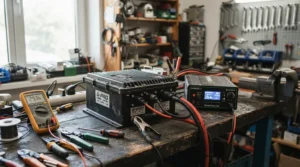
Multiply 24V by 10.05Ah and you get roughly 241Wh, which leaves nearly 60Wh of breathing room. That margin makes the maths trivially easy at the gate. The retailer says the rating is designed to comply with typical airline limits and also says the pack is “under 330Wh”. Treat that second phrase as a loose ceiling rather than a measurement. A figure of 330 is above the 300Wh cap most airlines quote, so always rely on the printed label, not the marketing line.
On paper, this pack suits anyone who prizes simplicity over squeezing out extra miles. You give up about 35Wh compared with the 11.5Ah pack, which is a small price for a much safer margin. It’s also a calmer purchase if you’re nervous about the airline battery declaration.
I couldn’t verify enough independent reviews for this exact listing, so none are quoted. Check the retailer’s feedback and the seller’s returns policy before buying.
Pros:
- ✅ Around 59Wh of headroom under 300Wh
- ✅ Fits both TGA Minimo and Pride Quest
- ✅ Simple, label-friendly capacity
Cons:
- ❌ Vague “under 330Wh” marketing wording
- ❌ Shorter range than larger packs
Price: roughly £300–£400 depending on VAT relief. Verdict: strong value for stress-free flying.
3. Essential Aids Airline Safe Battery Pack (Lithilite, Airscape, Alumina) — compact, swap-ready backup
If you already own one of these three scooters, this pack is the obvious sibling. The seller pitches it as the way to keep one battery charging while the other runs.
The listing gives 24V lithium-ion and 10.4Ah, with about nine miles of range. That multiplies out to roughly 250Wh, although the page doesn’t print a Wh figure, so that number is my calculation. It supports charging both on and off the scooter, which matters more than it sounds. On a trip, an off-board charge means the scooter doesn’t need to sit next to a socket.
The honest analysis is that this is a convenience buy rather than a bargain. You’re paying for model-specific fit, a case the scooter accepts, and a seller that labels the pack “airline friendly”. That’s retailer language, not an airline certificate, so keep your own paperwork.
On reviews, the retailer displays a 4.8 Trustpilot score for the shop overall and a large shop-wide review count. That says something about service but nothing specific about this pack’s longevity.
Pros:
- ✅ About 50Wh of margin under 300Wh
- ✅ On- and off-board charging
- ✅ Light enough for easy handling
Cons:
- ❌ No Wh figure printed on the listing
- ❌ Compatible with three scooter families only
Price: around £300, comfortably under £400. Verdict: fair value for owners.
4. Instafold 24V 10Ah Lithium Battery — the budget swap battery
Cheap and cheerful, in the best sense. This one is a model-specific backup for Instafold owners.
The maths is wonderfully tidy: 24V × 10Ah = 240Wh. That’s 60Wh under the cap, which gives you generous room for an airline that reads labels strictly. Charge it at the hotel, swap it in, and the scooter keeps rolling. The seller positions it as either a replacement or a ready-to-swap backup.
What most buyers overlook is the spare battery limit. If your scooter’s installed pack is also around 240Wh, you can carry this one spare under the single-300Wh route. A second spare of the same size would fall outside the two-at-160Wh route, so one spare is your ceiling.
Independent review data for this exact battery was too thin to quote. The retailer’s page showed a high rating for a related 10Ah pack, but that’s a small retailer-hosted sample, not an independent measure.
Pros:
- ✅ 240Wh leaves a 60Wh safety margin
- ✅ Simple swap-and-go design
- ✅ Among the cheapest here
Cons:
- ❌ Only fits Instafold scooters
- ❌ Ten-mile-class range at best
Price: around £300, recently shown as a reduced price. Verdict: the best entry-level value on this list.
5. Essential Aids Autofold 10Ah Lithium-Ion Battery — one pack for a whole scooter family
This is the Swiss army knife of the batch. It’s listed for Manual Fold Plus, Autofold and Autofold Elite scooters, and also compatible with the Manual Fold, Flex Suspension and AeroCarbon.
It’s rated 25.9V × 10Ah, which gives about 259Wh. Range is listed at 9.3 miles (15km), with an 8–10 hour recharge. That recharge time deserves attention. It’s an overnight job, so a trip with a long day out needs a second pack, which is exactly where the spare battery limit starts to matter.
Based on the spec comparison, you’re paying more per watt-hour here than with the Lithilite or Instafold packs. Roughly £1.65 per Wh against about £1.20, going by listed prices at the time of research. The premium buys compatibility with a wider range of scooters, not extra capacity.
The retailer’s page displayed a perfect rating for the pack, but it’s a retailer-hosted sample of unknown size, so weigh it lightly.
Pros:
- ✅ Fits many scooters in one family
- ✅ 259Wh clears the 300Wh limit
- ✅ Listed range of 9.3 miles
Cons:
- ❌ Highest price per Wh in this list
- ❌ Slow 8–10 hour recharge
Price: roughly £400–£600 range. Verdict: worthwhile mainly if you own a compatible scooter.
6. mLite 9.9Ah Removable Battery Pack — a full pack, case and all
Short and sweet. This is the factory-style spare for the mLite scooter.
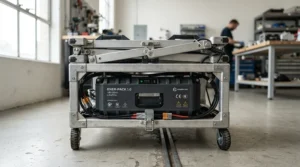
The listing describes the pack as a full battery pack and case with the lithium cell matrix assembled inside. The page I saw didn’t state the voltage. If it’s the common 24V, 9.9Ah works out at roughly 238Wh, comfortably under 300Wh. But that “if” is the point: don’t assume. Look for the printed V and Ah on the actual label.
The practical angle is that a complete, case-protected pack is easier to carry through a security lane than a bare cell block. Inside the cabin, a rigid case helps with the requirement to protect terminals from short circuit.
For buyers, the honest take is that the mLite is a niche scooter, so this pack is only for owners. Reviews specific to this pack weren’t verifiable, so none are quoted.
Pros:
- ✅ Complete pack with case
- ✅ Likely well under 300Wh
- ✅ Direct manufacturer-style fit
Cons:
- ❌ Voltage not shown on listing
- ❌ Useful only to mLite owners
Price: mid-£300s. Verdict: fair for owners, irrelevant for everyone else.
7. Welzo FreeFold X 16KG Foldable Mobility Scooter — battery under 160Wh
This is the wildcard: a whole scooter rather than a spare pack. Its trick is the battery size.
Welzo lists a removable 24V 6.6Ah lithium battery, about 158Wh, with a 270W brushless motor, 16kg net weight, a claimed 30km range and a five-year warranty. The magic number is 158. Because it sits under 160Wh, one pack counts toward the two-spares-at-160Wh route. Two 158Wh packs gives you roughly 316Wh of travel energy while staying within the rules.
Be sceptical of the headline figures. The source is Welzo’s own guide, which ranks its own scooter first and shows a steep “RRP discount” that reads like marketing. A claimed 30km from 158Wh also looks generous next to the 10-mile claims on 240–276Wh TGA packs. Real-world range will depend on rider weight and terrain.
No independent review data was found, so this section relies on specs alone.
Pros:
- ✅ Pack under 160Wh enables two-spare carrying
- ✅ 16kg is easy to lift
- ✅ Long warranty claimed by the seller
Cons:
- ❌ Range claims come from the seller’s own guide
- ❌ A whole scooter, so far costlier than a spare pack
Price: under £1,000 at the time of research. Verdict: promising, but verify the claims before paying.
Top 7 Compared: Which Pack Clears the Spare Battery Limit?
| Pack size | Calculation | Approx. Wh | Single-spare route (≤300Wh) | Two-spare route (≤160Wh each) | Best For |
|---|---|---|---|---|---|
| 6.6Ah at 24V (FreeFold X) | 24 × 6.6 | ≈158 | ✅ | ✅ | Doubling up on spares |
| 9.9–10.4Ah at 24V (mLite 9.9Ah pack, Lithilite pack, Instafold 10Ah battery) | 24 × 10 | ≈238–250 | ✅ | ❌ | A comfortable single spare |
| 10Ah at 25.9V (Autofold 10Ah battery) | 25.9 × 10 | ≈259 | ✅ | ❌ | Autofold owners |
| 11.5Ah at 24V (TGA Minimo 11.5Ah pack) | 24 × 11.5 | ≈276 | ✅ (tight) | ❌ | Max range, little margin |
| 13.4Ah at 24V (TGA 13.4Ah spare) | 24 × 13.4 | ≈322 | ❌ | ❌ | Not flight-friendly |
| 14.5Ah at 24V (TGA long-range option) | 24 × 14.5 | ≈348 | ❌ | ❌ | Ground use only |
| 20.8Ah at 24V (Pride GoGo Mg2 upgrade pack) | 24 × 20.8 | ≈499 | ❌ | ❌ | Not flight-friendly |
The pattern is clear. Packs in the 240–280Wh zone work as a single spare, and only the 158Wh pack opens up the two-spare route. The larger “long range” options listed for some scooters (13.4Ah, 14.5Ah and 20.8Ah) all land above 300Wh, so they’re fine for the high street and hopeless for the departure gate. Note that the retailer sells the Pride 20.8Ah pack as an upgrade while pointing out that the standard 10Ah pack is the one for flying. That’s honest of them, and a useful clue.
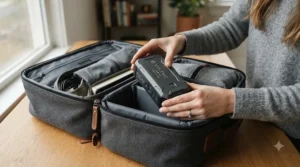
Watt Hour Rating: How to Work Out Yours Before You Fly
The watt hour rating is the number that decides almost everything. A watt-hour measures the energy a battery stores, and aviation rules are written in Wh, not amp-hours.
The formula is one line: volts × amp-hours = watt-hours. A 24V 12Ah pack is 288Wh. A 24V 15Ah pack is 360Wh and will be refused. A 24V 11Ah pack, at 264Wh, will be fine. If the label already prints Wh, use that number.
Why does this trip people up? Because retailers love to shout about Ah, the big flattering figure, while quietly leaving Wh off the page. Ah alone tells you nothing without the voltage. A 10Ah pack at 48V is 480Wh, twice what a 10Ah pack at 24V carries.
Three habits make the watt hour rating painless:
- Photograph the label. Voltage, amp-hours and any printed Wh figure in one clear shot.
- Calculate it yourself. Don’t trust “airline approved” if the Wh isn’t shown.
- Leave headroom. A pack at 240–260Wh is easier to defend than one at 299Wh.
A quick example of why this matters: at least one UK retailer lists a folding-scooter pack at 310.8Wh next to an “approved for travel on airlines” claim. That figure sits above the 300Wh cap most airlines quote. Whether a particular airline would accept it is a question for the airline, not the shop. Treat the watt hour rating on the label as your evidence, and the sales copy as a pleasant bit of background.
How to Choose an Airline Approved Mobility Scooter Battery
Choosing well is mostly a matter of working through the right questions in the right order.
- Check the chemistry. Rechargeable lithium-ion is the norm. Lithium-metal (non-rechargeable) batteries are forbidden in mobility devices.
- Find the watt hour rating. Aim for 300Wh or less, and ideally under 260Wh for margin.
- Confirm it’s removable. A pack you can lift out is far simpler at the gate than a built-in one.
- Match your scooter. Most spares are model-specific. A pack that doesn’t fit is just an expensive paperweight.
- Count your spares. Decide whether you’ll use the single-300Wh route or the two-at-160Wh route.
- Look for test evidence. UN38.3 test documentation matters, and airlines can refuse altered or unclear labels.
- Ask the airline early. UK and EU rules ask you to notify them at least 48 hours ahead.
Step 6 deserves a moment. Some airlines state that a modified or replaced battery must still meet UN38.3 test requirements and that batteries with altered or unclear labels won’t be accepted. So a bargain unbranded pack with a peeling sticker is false economy, however keen the price.
Lithium Scooter Battery for Flying: What the Rules Actually Say
A lithium scooter battery for flying is treated more generously than the lithium batteries in your phone or camera. That’s deliberate, because mobility equipment is a lifeline rather than a luxury.
The UK Civil Aviation Authority’s guidance on mobility equipment confirms that you can bring up to two mobility items free of charge. If equipment is damaged, the airport must provide a temporary alternative, though it may not be like-for-like. The battery rules sit alongside that, and UK airlines follow CAA Safety Notice SN-2012/003 on electric mobility aids.
The headline numbers repeat across many airlines and regulators: one spare up to 300Wh, or two spares up to 160Wh each. Spare lithium batteries travel in the cabin, never the hold. Terminals must be protected from short circuit.
Where it gets interesting is the installed battery. Some airlines allow it to stay fitted if it’s securely attached, with the circuits isolated. Others, including Ryanair, treat a removed operating battery as a spare. Hong Kong’s guidance, by contrast, allows a removed pack up to 300Wh plus your spares. The rules overlap, but they’re not identical.
Built-in packs aren’t exempt either. Non-removable lithium batteries are not bound by the same 300Wh limit, but they still need airline approval and may be restricted. So whichever lithium scooter battery for flying you choose, the sensible route is a removable one that you can show, photograph and carry.
Non Spillable Scooter Battery for Air Travel: Lithium vs Sealed Lead Acid
Not every scooter is lithium. Plenty of travel scooters still run sealed lead-acid (SLA), gel or AGM packs, and a non spillable scooter battery for air travel follows a different rulebook.
Non-spillable batteries are those that can’t leak when tipped. Under the international rules airlines reference, they need to meet ICAO Special Provision A67 and Packing Instruction 872. Practically, that means the mobility aid should be switched off with its wheels in free motion. Spillable (wet) batteries are a different story, as they must stay upright and are often refused.
| Feature | Lithium-ion | Non-spillable SLA/gel/AGM |
|---|---|---|
| Weight | Much lighter | Much heavier |
| Watt hour rating limit | Usually 300Wh cap | Not capped the same way |
| Charge time | Often 3–10 hours | Often longer |
| Gate scrutiny | Higher | Lower |
| Best For | Frequent flyers who lift the pack | Heavy scooters flown rarely |
The table reveals a classic trade-off. A non spillable scooter battery for air travel is usually the easier sell at security. But it can weigh several times as much as a lithium pack, which hurts if you need to lift the scooter into a car boot or hold. Lithium wins on weight and portability, while SLA wins on administrative simplicity. If you rarely fly and rarely lift your scooter, a non spillable scooter battery for air travel may be the lower-stress choice.
Spare Battery Limit: How Many Can You Carry?
The spare battery limit is where holidays are won and lost. Get it wrong and you may be handing over a pack at the check-in desk.
The rule for most airlines is one spare lithium battery up to 300Wh, or two spares of up to 160Wh each. The spare battery limit applies to cabin baggage only. Spare lithium packs don’t go in the hold under the guidance this article reviewed.
Three practical points deserve attention.
Count the installed pack. Some carriers treat the battery you remove as one of your spares. Under that reading, a 276Wh pack removed from the scooter uses up your single 300Wh allowance. Others let you carry the removed pack plus the spares. Your airline’s policy decides.
Protect the terminals. Spares should be shielded against short circuit, for example with insulating tape or a purpose-made pouch, and protected from damage.
Mind the combination. A pack of 241Wh plus a second pack of 241Wh doesn’t pass, since two spares need to be at or under 160Wh each. Two 158Wh packs, as with the FreeFold X, do pass.
In plain terms, the spare battery limit rewards forward planning. Decide on your battery strategy before you choose your scooter, not after.

Airline Battery Declaration: A Step-by-Step Practical Guide
The airline battery declaration is the bit of admin that turns a vague “should be fine” into a confirmed booking. Treat it as a checklist, not a chore.
Step 1: Notify early. UK and EU rules ask you to tell the airline at least 48 hours before travel that you’ll be bringing mobility equipment. Don’t wait for the last day.
Step 2: Give the specifics. Airlines typically want the battery type, whether it’s removable, the volts, amp-hours and watt hour rating, and how the circuits are isolated against accidental activation. They must also inform the pilot in command where the equipment and any removed lithium batteries are.
Step 3: Gather paperwork. Some UK retailers advise carrying the UN38.3 test summary and a photo of the battery label. If the airline asks, you can show it in seconds rather than rummaging through luggage.
Step 4: Prepare the scooter. Disable the motor, set the wheels to free motion, tape or cover exposed terminals, and remove the pack to carry it in the cabin if required.
Step 5: Re-confirm at check-in. Carry a printed copy of your airline battery declaration confirmation. Airline desks, ground handlers and security staff don’t always share notes.
The CAA’s general baggage guidance lists powered wheelchairs and mobility aids among the items with special rules, and is worth a skim before you travel. A tidy airline battery declaration won’t guarantee smooth sailing, but it removes most of the excuses.
💬 Found a battery you like? Check the current price and the exact V × Ah label on the listing before you commit!
Real-World Scenarios: Matching Batteries to Travellers
Specs are abstract. Real trips aren’t. Here are three profiles, each matched to a pack with reasoning.
The sun-seeking retiree. Picture a couple flying to Spain twice a year with a TGA Minimo Plus. They want a full day out without a mid-afternoon charge, so the TGA Minimo 11.5Ah pack at 276Wh makes sense as a single spare. The trade-off is headroom, so they should calculate with their airline whether the installed pack counts as the spare.
The budget-conscious weekender. A shorter trip, tighter budget, and an Instafold already in the hall cupboard. The Instafold 10Ah battery at 240Wh around £300 is the straightforward answer. One spare, 60Wh of margin, no drama.
The tech-savvy traveller who wants doubling-up. Someone buying a scooter now and flying often. The FreeFold X with its 158Wh pack lets them carry two spares under the 160Wh route, in principle doubling range without breaking rules. They should still confirm the figures independently, because the claims come from the seller.
Frequency matters here too. If you fly twice a year, paying a premium for the Autofold 10Ah battery purely for compatibility is a considered choice. If you fly monthly, a lighter, cheaper spare you can swap quickly starts to look sensible.
Common Mistakes When Buying an Airline Approved Mobility Scooter Battery
Most mistakes come from trusting words over numbers. Here are the ones to avoid.
- Believing the sticker. “Airline approved” or “airline friendly” is retailer language. No shop can certify a pack for every carrier, so verify with your own airline.
- Confusing Ah with Wh. A big Ah figure on a 24V pack can still clear the limit, while the same Ah on a 48V pack won’t. Always do the multiplication.
- Buying the long-range upgrade. The 13.4Ah, 14.5Ah and 20.8Ah packs listed by UK retailers all land above 300Wh. Great for the park, useless on a plane.
- Ignoring odd label wording. A listing that says “under 330Wh” is not a rating. Ask for the exact number.
- Choosing an unlabelled generic pack. Without clear labelling and UN38.3 evidence, you risk refusal.
- Packing spares in the hold. Spare lithium packs are cabin-only.
- Forgetting to notify. The 48-hour rule exists for a reason.
An airline approved mobility scooter battery is only as good as the evidence you can show at the desk. Keep the label clean, the paperwork tidy and the numbers honest.
Long-Term Cost & Maintenance for a Lithium Scooter Battery
A cheap spare can become an expensive habit if it dies early. Think in cost per watt-hour and cost per year, not just sticker price.
Based on listed prices at the time of research, the Lithilite pack works out at roughly £1.20 per Wh, while the Autofold 10Ah battery is nearer £1.65 per Wh. That gap is about £110 over the life of a pack, which might buy a lot of airport coffee.
Lifespan varies with chemistry, climate and habits, and many lithium packs are rated for several hundred full charge cycles. Check the manufacturer’s figure rather than assuming. Two habits help most:
- Store at a moderate charge. Avoid leaving a pack fully empty or fully charged for months.
- Keep it cool and dry. Heat is lithium’s enemy, so don’t leave a pack in a hot car boot.
Travel adds its own care. Use a rigid case or pouch, tape the terminals, and inspect for swelling, cracks or heat before each flight. A pack that looks damaged shouldn’t fly. If your battery’s capacity has dropped noticeably after a year or two, factor in a replacement of around £300–£450 at today’s prices. Compared with the cost of a replacement scooter, that’s modest, but it’s worth budgeting for.

FAQ
❓ Can I use any replacement pack as an airline approved mobility scooter battery?
❓ How far does a 24V 10Ah lithium pack take you?
❓ Do I have to remove the battery before flying with a mobility scooter?
❓ Is a 24V 12Ah lithium battery allowed on a plane?
❓ Can an airline still refuse a pack that's under 300Wh?
Conclusion
Choosing an airline approved mobility scooter battery isn’t mysterious once you’ve done the sums. Multiply volts by amp-hours, keep the result at or under 300Wh, prefer a removable pack, and file your paperwork before you fly.
Among the options reviewed, the Instafold 10Ah battery and Lithilite pack stand out for budget-friendly spares with healthy margin. The TGA 10.05Ah pack is the calm, sensible all-rounder for TGA and Pride Quest owners. The TGA Minimo 11.5Ah pack gives the most range under the cap, at the cost of headroom. The Autofold 10Ah battery and mLite 9.9Ah pack are owner-specific purchases. And the FreeFold X, at about 158Wh, is the only option on the list that opens up the two-spares route, though its claims deserve independent checking.
Whichever you pick, keep three things in your hand luggage: the label photograph, your confirmed notification, and a rigid pouch for the spare. Do that, and the gate becomes a formality rather than a gamble.
Recommended for You
- Mobility Scooter For Cruise Ship Travel: 7 Best Picks (2026)
- Scooter For Caravan And Motorhome Trips: 7 Best Picks (2026)
- Travel Scooter That Fits On A Train: 7 Proven Picks (2026)
Disclaimer: This article contains affiliate links. As an Amazon Associate, I earn from qualifying purchases. If you purchase products through these links, we may earn a small commission at no additional cost to you.
✨ Found this helpful? Share it with your friends! 💬🤗
