
In This Article
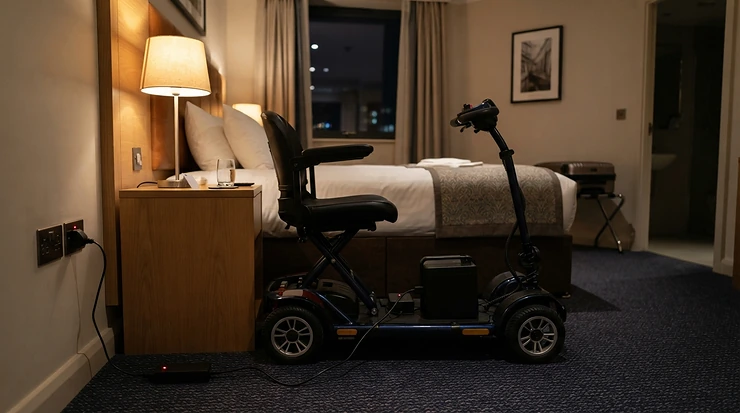
A mobility scooter for cruise ship travel is a lightweight, folding, battery-powered scooter built to fit through a cabin door, store inside your stateroom, and satisfy both cruise-line and airline battery rules. In the UK that almost always means a Class 2, 4mph pavement model.
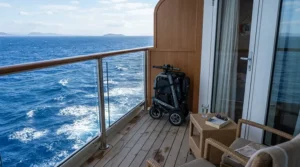
Here’s the twist: the best scooter on land is often the worst one at sea. A ship is a floating hotel of fire doors, narrow corridors and cabins designed around a bed, not a four-wheeled vehicle. Choosing a mobility scooter for cruise ship travel is therefore less about top speed and more about three awkward numbers: width, weight and watt-hours.
This guide compares seven real, UK-available folding models. Then it does what spec sheets rarely do and ties them to cabin door width, tender port access and luggage allowance rules. Everything here comes from manufacturer specifications, retailer listings, official cruise-line and regulator guidance, and the small amount of genuine independent review feedback that exists. I haven’t hands-on tested any of these scooters, so expect reasoning rather than invented anecdotes.
One housekeeping point first. Under GOV.UK’s scooter classes, a Class 2 scooter tops out at 4mph and is meant for pavements and pedestrian areas. Every model below sits in that class, which keeps the legal side simple. The cruise line’s own policy sits on top of the law, though, and it can overrule your plans. That is why a compact scooter for cruise cabins isn’t a luxury; it’s the entry ticket. Prices are ranges only, so check current price and stock before you buy.
Quick Comparison: 7 Cruise-Ready Folding Scooters at a Glance
| Scooter | Weight (as listed) | Width (as listed) | Range (as listed) | Best For |
|---|---|---|---|---|
| eFOLDi Lite | ~15kg without battery | ~55cm | Up to 10 miles | Lifting it yourself, flying |
| Monarch Air Plus | ~15.7kg without battery and armrest | Slim (original Monarch Air: ~43cm) | Up to 7.5 miles | Tight doorways, short days ashore |
| Monarch Smarti | ~27.3kg with battery | ~46cm | Up to 9–10 miles | Limited grip, push-button folding |
| TGA Minimo Plus 4 | ~28–30kg with battery | ~54–55cm | ~10 miles (11.5Ah pack) | Balanced all-rounder |
| Drive Flex Plus | ~19.8kg | ~54.5cm | ~9.3 miles | Budget-conscious cruisers |
| Drive Flex Auto | ~27.5kg with battery | ~62cm | Up to 13 miles (one listing) | Remote folding on a budget |
| Luggie Elite | ~23.4kg without battery | ~45–53cm (varies by version) | Up to ~13 miles | Heavier riders (to ~138kg) |
Reading across the table, eFOLDi Lite and Monarch Air Plus win on lifting weight. That matters if a partner will be hauling the scooter in and out of coaches, car boots and aircraft holds. Monarch Smarti and Drive Flex Auto are the push-button folders, a real advantage when grip or balance is the problem, though both are heavier for it. At 62cm, Drive Flex Auto is also the widest here, exactly the kind of figure that can turn a standard cabin into an accessible-cabin booking.
Budget buyers should note that Drive Flex Plus gives up remote folding in exchange for the lowest price band on the list, while Luggie Elite is the pick when rider weight, not lifting weight, drives the decision. TGA Minimo Plus 4 sits in the middle on every measure. That is often the sensible place to be when you’re buying a mobility scooter for cruise ship travel and don’t yet know which constraint will bite hardest.
A caution on the data: listings sometimes disagree, and manufacturers revise models between generations. Treat these as planning figures, and get the supplier to confirm folded dimensions and weight in writing before you pass them to your cruise line. That paperwork, not the brochure, is what port staff will check.
💬 Just one click — help others make better buying decisions too!😊
Top 7 Mobility Scooters for Cruise Ship Travel: Expert Analysis
Each pick is judged on what matters at sea: width, weight, battery rules and how easily it folds. Top speed is irrelevant because every model here is capped at 4mph. Prices are ranges only, so check current price and availability on the retailer page.
1. eFOLDi Lite — lightest lift, suitcase-style fold
The headline feature is weight. The eFOLDi Lite uses a magnesium alloy frame, and listings put it at roughly 15kg without the battery, light enough for one person to lift into a car boot without a grimace.
It folds to about 70 × 55 × 37cm and can be wheeled behind you like a suitcase, which helps on long terminal walks. Top speed is 4mph, the lithium pack is 10Ah for a listed range of up to 10 miles, and the user limit is around 19 stone (120kg). The three-wheel layout and a listed turning radius of about 100cm mean it needs more room to pivot than a four-wheeler, so allow for that when parking it in a cabin.
Based on the spec comparison, this is a strong mobility scooter for cruise ship travel if you’re a light-to-mid-weight rider who will fly and must move the scooter unaided. The trade-off is that 120kg ceiling, the lowest on this list, plus a 55cm width that may still push you towards an accessible cabin on lines that insist.
Verified customer feedback was thin on the UK retailer pages I checked, so the spec sheet, not star ratings, is the evidence here.
Pros:
- ✅ Around 15kg without the battery
- ✅ Wheels along like a suitcase when folded
- ✅ Manufacturer describes the pack as airline compliant
Cons:
- ❌ Lowest user-weight limit here (about 120kg)
- ❌ Premium price band
Expect roughly £2,600–£3,100 depending on VAT relief: premium money, justified only if low lifting weight tops your list.

2. Monarch Air Plus — slim magnesium frame for tight doorways
The Monarch Air Plus succeeds the original Monarch Air, which was billed as the world’s lightest four-wheel folding scooter. It keeps the magnesium alloy frame and wheels that made that claim possible.
Listings give about 15.7kg without battery and armrest, a 7.5-mile range, 4mph top speed, a 150W motor and a user limit of 19 stone (about 124kg). The original Monarch Air measured just 43cm wide, so confirm the Plus’s width with your supplier. The slim-frame philosophy is the point, because a narrower scooter has a better chance of clearing a cabin door width with room to spare.
My read: this is the pick if a compact scooter for cruise cabins must also be easy to lift and fly with. The catch is range. Seven and a half miles suits a flat quayside shuffle but will be tested by a hilly Mediterranean stop, and a 150W motor favours gentle gradients.
I found no customer reviews on the retailer listings I checked, so there’s no verified owner sentiment to summarise yet.
Pros:
- ✅ Among the lightest four-wheel folders listed
- ✅ Slim design suits tighter doorways
- ✅ Stable four-wheel layout with a 19-stone limit
Cons:
- ❌ Shortest listed range on this list (7.5 miles)
- ❌ Modest 150W motor for hills
Roughly £1,900–£2,700 depending on retailer and VAT relief; fair value for the weight you save.
3. Monarch Smarti — push-button remote folding
Press a button on the remote and the scooter folds itself, a genuinely useful trick when gripping, bending or lifting is the problem. The Monarch Smarti does exactly that, and one UK retailer quotes a fold time of around 12 seconds.
Listings give 4mph, up to 9–10 miles, a 136kg (21-stone) capacity, rear suspension, solid puncture-proof tyres and a width of about 46cm. Weight is quoted at 27.3kg with the battery, though Motability’s reviewer cited 24kg. One UK retailer lists the pack as non-detachable, while a US supplier quotes a weight “without battery”. Confirm that before flying, because airlines often care.
Here’s what the spec sheet won’t tell you: auto-folding changes who can use the scooter independently. For riders with arthritis or limited balance, swapping manual latches for a button is the difference between freedom and asking for help at every gangway. The cost is weight, so it suits car-to-port cruisers more than fly-cruisers.
Motability’s independent reviewer Ian Cook praised the key-fob folding, the compact folded size and the telescopic tiller. Trustpilot feedback on the manufacturer is mixed, with some reports of slow engineer call-outs, including one about the fold mechanism.
Pros:
- ✅ Remote folding at the touch of a button
- ✅ Rear suspension should soften quayside cobbles
- ✅ Generous 136kg (21-stone) capacity
Cons:
- ❌ Heavier than manual-fold rivals
- ❌ Battery detachability unclear across listings
Roughly £2,300–£2,800, a premium that pays for the fold system.
4. TGA Minimo Plus 4 — the balanced all-rounder
The TGA Minimo Plus 4 folds in a single movement, and the only part you need to remove is the lightweight battery, so there’s nothing loose to lose between car park and cabin.
It’s a four-wheeler at 4mph with a 115kg (18-stone) limit, about 54–55cm wide, folding to roughly 84 × 54 × 45cm and weighing around 28–30kg with the battery. Retailers list an 11.5Ah pack for about 10 miles and a 14.5Ah pack for up to around 15. Assuming the 24V pack retailers list, 11.5Ah works out at roughly 276Wh, under the common 300Wh airline cap. The 14.5Ah pack is about 348Wh, which would breach it. One spec choice turns a range upgrade into a flight problem.
That makes it the sensible middle path: sturdy enough for daily use at home, compact enough for a cabin, and flexible if you choose the right battery. As a folding scooter for cruise holidays, it’s the one I’d put on most shortlists, with 18 stone as the limit to watch.
Motability’s independent reviewer praised the delta-bar tiller and the compact, manoeuvrable design. A separate retailer sample of two reviews for the original TGA Minimo averaged 4.0 stars, far too small to lean on.
Pros:
- ✅ Folds in one movement; only the battery comes off
- ✅ 11.5Ah option sits under the 300Wh cap
- ✅ Delta-bar tiller praised for control
Cons:
- ❌ 115kg limit is lower than Monarch Smarti or Luggie Elite
- ❌ Long-range pack likely too big for flights
Roughly £1,900–£2,400; strong value for a proven design.
5. Drive Flex Plus — lightest budget manual folder
Drive’s Manual Fold+ update, sold as the Drive Flex Plus, trims roughly 3kg from the original Drive Flex. That’s why it’s the lightest budget-friendly folder in this round-up.
Listings give 19.8kg, a 125kg (19.7-stone) limit, a 9.3-mile range and a 25.2V 10Ah lithium pack, about 252Wh, comfortably below the 300Wh cap. It’s roughly 54.5cm wide and folds to about 41 × 67 × 54.5cm. Ground clearance is only about 4cm, which matters because P&O warns of raised door thresholds throughout its ships, especially onto open decks.
On paper, this delivers most of what a mobility scooter for cruise ship travel needs at the lowest entry price: light, airline-friendly and boot-sized. The honest caveats are the manual fold, which needs some grip and balance, and the low clearance, which asks for slow, square-on approaches at thresholds.
I couldn’t find a meaningful pool of verified reviews. The review sections on the UK retailer pages I checked were empty, so the case rests on specs.
Pros:
- ✅ Under 20kg is easy to lift
- ✅ 252Wh pack clears the 300Wh cap
- ✅ Compact folded footprint
Cons:
- ❌ Only about 4cm ground clearance
- ❌ Manual fold needs some dexterity
Around the £1,100–£1,700 range; the best value on the list for occasional cruisers.
6. Drive Flex Auto — remote fold, bigger frame
The Drive Flex Auto takes the Drive Flex platform and adds one-touch remote folding, bringing the Monarch Smarti‘s best trick to a lower price band.
Listings give 27.5kg in total (about 25.5kg plus a 2kg battery), a 125kg limit, an unfolded size of 96 × 62 × 88cm and a folded size of 44 × 62 × 64cm. One UK retailer lists the battery as an airline-friendly 252Wh pack. Range claims vary, from up to 13 miles on one listing to 8–9 miles elsewhere in the Drive Flex family, so plan around nine miles.
The 62cm width is the number to stress-test. It’s the widest scooter here, so against a standard cabin it’s the likeliest to require an accessible cabin, which can wipe out the saving. If your cabin is confirmed, the remote fold is a real advantage for anyone who struggles with latches. It’s also a sound folding scooter for cruise holidays when the car boot, not the aircraft hold, does the carrying.
Again, I couldn’t verify a meaningful owner-review pool, so treat the specs as the evidence.
Pros:
- ✅ One-touch remote folding
- ✅ Listed 252Wh battery sits under the airline cap
- ✅ 125kg (19.7-stone) capacity
Cons:
- ❌ Widest scooter on the list at 62cm
- ❌ Range figures differ between listings
Roughly £1,800–£2,200; good value if the width isn’t a problem.
7. Luggie Elite — capacity and clearance for heavier riders
The Luggie Elite earns its place on capacity. Listings give up to about 138kg (21.8 stone), the highest ceiling here, with a bigger motor than the entry-level Luggie and a wider, deeper seat.
It weighs about 23.4kg without the roughly 2kg battery, folds in three steps, and offers extendable handlebars and armrests. Front ground clearance is listed around 8.9cm, range up to about 13 miles, and the pack is 10.5Ah with an optional 16.5Ah upgrade. That upgrade almost certainly crosses the 300Wh line, so check the label before you fly.
For heavier riders the choice is narrow, and this is the one that pairs a high weight limit with a travel fold. Better clearance also helps with the raised thresholds P&O flags, and a mobility scooter for cruise ship travel that copes with lips and ramps is less stressful at every gangway. The trade-off is lifting weight: at over 23kg it’s heavier than the featherweights.
I found no verified UK review pool for it, so lean on the specs and consider a trial hire. UK hire listings advertise it from roughly £250–£300 for a two-week minimum.
Pros:
- ✅ Highest weight limit on the list
- ✅ About 8.9cm front ground clearance
- ✅ Three-step fold with extendable tiller
Cons:
- ❌ Heavier than the lightest folders
- ❌ Larger battery option unlikely to be flight-friendly
Check current price; hiring first is a cheap way to test fit before buying.
How to Choose a Mobility Scooter for Cruise Ship Travel
Choose by working backwards from the cabin. Confirm the cruise line’s policy, measure the folded scooter against the cabin door, check the battery against airline limits, then match weight, range and fold style to the person who will use and lift it.
- Read the cruise line’s policy first. P&O Cruises says you must declare a powered device at booking and supply its folded dimensions. Depending on size, you may need a fully accessible cabin. Other lines differ, so ask for the policy in writing.
- Measure the folded width. Compare the narrowest point of the folded scooter against the cabin door width, not the brochure’s headline figure.
- Check lifting weight, and who lifts. A 15kg scooter and a 28kg scooter are different holidays for whoever hauls them through a terminal.
- Do the battery maths. Volts × amp-hours = watt-hours. Airlines commonly cap mobility batteries at 300Wh, so a 24V 11.5Ah pack (about 276Wh) passes while a 24V 14.5Ah pack (about 348Wh) doesn’t.
- Match range to port days. Ten miles covers most flat quaysides, but hilly stops and long terminals eat it quickly.
- Pick a fold style you can operate alone. Manual folders are lighter; remote folders suit weaker hands.
- Price it properly. Compare buying, VAT relief and hire against how often you’ll cruise.
Work through those in order and the shortlist usually shrinks to two or three scooters before price even enters the room.
Cabin Door Width: The Number That Decides Everything
Cabin door width is the figure brochures rarely lead with, yet it quietly decides what comes aboard. One US mobility retailer’s cruise guide says standard stateroom doors often measure around 21–24 inches (roughly 53–61cm). Accessibility guides generally treat 32 inches (about 81cm) as the target for accessible cabins. A cruise forum poster also reported that a door which doesn’t open flush against the wall costs about two inches of usable clearance, so measure the gap you can actually drive through.
Now compare the listed widths: roughly 46cm for Monarch Smarti, up to about 55cm for eFOLDi Lite and TGA Minimo Plus 4, and about 62cm for Drive Flex Auto. On pure geometry, the narrower models clear a 53cm opening with room to spare while the widest probably doesn’t.
Geometry isn’t the whole story, though. P&O Cruises warns that cabin doors can be narrower than you’re used to, and its accessible-cabins page covers cabin door width by ship. Its mobility policy also says you may need a fully accessible cabin depending on the device’s size. In other words, policy can reject a scooter that physics would allow. Ask for the cabin door width in writing for your exact cabin number.
Thresholds count too. One accessibility guide notes that even two-inch lips at balcony doors can block scooter access. That’s why ground clearance, about 8.9cm on Luggie Elite but only around 4cm on Drive Flex Plus, deserves a second look.
Compact Scooter for Cruise Cabins: Storage, Charging and Evacuation Rules
A compact scooter for cruise cabins must satisfy rules that have nothing to do with performance. According to P&O Cruises’ own mobility aids page, you must tell the line about a powered device at booking or as soon as the need is known. A late declaration is only possible subject to availability. Evacuation chair assistance is mandatory for guests who use a powered mobility device, full- or part-time. Undeclared devices can’t be taken on board, and with no storage for refused equipment that can mean being denied boarding altogether.
The line also says no mobility device may be left unattended in a public area, including corridors and outside cabins. So the scooter lives inside your stateroom, folded, clear of the escape route and within reach of a socket. P&O has a dedicated section on charging and power supply, so read it before you pack the charger. Lines take lithium battery safety seriously, and trade press has reported a scooter fire scare aboard a P&O ship. Use only the manufacturer’s charger and never charge a damaged pack.
Treat the folded footprint as the real spec. A scooter folding to roughly 84 × 54 × 45cm, like TGA Minimo Plus 4, or to about 41 × 67 × 54.5cm, like Drive Flex Plus, can tuck beside a wardrobe. A bulkier fold eats the floor space you need to get round the bed. When shopping for a compact scooter for cruise cabins, judge the fold, not just the frame.
Folding Scooter for Cruise Holidays: Manual Fold vs Auto-Fold
The right folding scooter for cruise holidays depends less on engineering than on the hands operating it. Manual folders, namely Drive Flex Plus, TGA Minimo Plus 4, Luggie Elite, Monarch Air Plus and eFOLDi Lite, rely on levers and latches you work yourself. They’re lighter because there’s no folding motor, and usually cheaper. Remote folders such as Monarch Smarti and Drive Flex Auto fold at the push of a button.
| Fold style | How it works | Trade-off | Best For |
|---|---|---|---|
| Manual fold | Latches and levers, seconds once learned | Needs some grip and balance | Drive Flex Plus, TGA Minimo Plus 4, Luggie Elite: lighter, cheaper carrying |
| Remote auto-fold | Key-fob button does the folding | Heavier; more to go wrong | Monarch Smarti, Drive Flex Auto: riders with limited hand strength |
| Fold-and-wheel | Folded unit rolls like a case | Small wheels on rough ground | eFOLDi Lite: long terminal walks |
The table shows the real trade-off: auto-fold buys independence at the price of weight and complexity. If arthritis or reduced balance makes manual latches a daily battle, that independence is worth far more than a few kilos. If you’re a fit rider whose partner lifts, a manual fold keeps lifting weight and cost down. Either way, rehearse the fold until it’s second nature; a folding scooter for cruise holidays is only as quick as its owner is practised.
Tender Port Access: Going Ashore When the Ship Can’t Dock
Tender port access is where good cruise plans most often come unstuck. At a tender port the ship anchors offshore and passengers transfer to a smaller boat via a gangway that moves with the swell. Accessibility guides cite Santorini and Kotor as classic examples. The step across the gap is the problem. MSC says guests must be fit and mobile enough to embark and disembark tenders without assistance. Celebrity’s position, as relayed by one cruise-planning site, is that powered scooters can’t use tenders unless the boat has roll-on capability.
Cruiser reports are mixed. Some describe crews lifting a folded scooter across once the rider could step aboard unaided, while others describe outright refusals. Several forum posts note that tendering is ultimately at the captain’s discretion on the day. One blogger who sailed P&O’s Iona with a scooter reported that none of the excursion coaches would take one either.
So plan for the worst case. Check the itinerary for tender stops before booking, ask the line in writing how it handles scooters at each one, and consider a manual folding wheelchair as a backup. Manufacturers argue a folded scooter is treated more like luggage. A light model like eFOLDi Lite or Monarch Air Plus is certainly easier to hand across, but no line guarantees it. The safest tender port access strategy is a docked-port itinerary.
Luggage Allowance: Cruise Ships, Flights and Scooter Batteries
Luggage allowance rules come in layers, so work from the smallest limit outward. On cruise-only sailings, P&O Cruises allows as many bags as fit in your cabin, provided each weighs no more than 23kg. Norwegian Cruise Line limits guests to two checked pieces of 22kg each. On fly-cruises the airline’s luggage allowance applies instead, and P&O’s help centre says hold allowances usually run between 20kg and 23kg per person.
The good news is that mobility equipment normally sits outside that arithmetic. The UK Civil Aviation Authority’s assisted-travel pages cover your rights, and UK mobility specialists summarising the guidance say airlines carry up to two pieces of mobility equipment free of charge, without eating into your luggage allowance. Notify the airline well ahead (at least 48 hours is commonly cited) and supply dimensions, weight and battery details.
Batteries are where it gets technical. Airlines commonly cap lithium mobility batteries at 300Wh, and many want the pack removed and carried in the cabin. The Drive Flex Plus pack (25.2V × 10Ah ≈ 252Wh) clears that, while a 14.5Ah TGA Minimo Plus 4 pack on a 24V system (≈348Wh) wouldn’t. Each airline sets its own rules, so get the answer in writing and keep the battery in your hand luggage.

Own Scooter vs Hire vs Folding Wheelchair: Which Option Wins?
Buying isn’t the only route. P&O’s help centre says it has no mobility aids for hire on board and points guests to an independent hire firm, and wheelchairs can’t be hired on its ships. Hiring from an outside firm and having the scooter waiting can suit a one-off cruise.
| Option | Cabin fit | Typical cost | Best For |
|---|---|---|---|
| Own folding scooter | Must be declared; size may trigger an accessible-cabin requirement | Roughly £1,100–£3,100 up front | Frequent cruisers who also use it at home |
| Hired scooter | Same declaration rules; confirm dimensions | Hire listings start around £250–£300 for a two-week minimum | One-off or occasional cruises |
| Manual folding wheelchair | P&O standard cabins: folded no more than 50cm wide, 100cm long, 23kg | Low | Tender-heavy itineraries, short distances |
Hire wins on cost for occasional cruisers, while ownership wins on convenience and familiarity. Wheelchairs win at tender ports, where a light folded chair is easiest to pass across. One P&O rule is worth knowing: attaching a powered add-on to a wheelchair makes it a powered mobility device, even if you only use it ashore.
Long-Term Cost: Buying, VAT Relief and Hire
Sticker prices depend on VAT. GOV.UK’s VAT relief guidance says you won’t pay VAT on a Class 2 scooter designed not to exceed 4mph and intended for pavement use, if you’re eligible. Broadly, that means a long-term condition with a substantial effect on daily life. Many UK specialist sites show VAT-relief prices by default, so a listing that looks 20% cheaper may simply be ex-VAT.
| Scooter | Typical UK price band (check current price) | Value verdict | Best For |
|---|---|---|---|
| eFOLDi Lite | £2,600–£3,100 | Premium; pays off on weight | Frequent flyers lifting alone |
| Monarch Air Plus | £1,900–£2,700 | Fair for the weight saving | Slim-door cabins |
| Monarch Smarti | £2,300–£2,800 | You pay for the fold system | Limited grip strength |
| TGA Minimo Plus 4 | £1,900–£2,400 | Strong all-round value | First-time buyers |
| Drive Flex Plus | £1,100–£1,700 | Best entry price | Budget buyers |
| Drive Flex Auto | £1,800–£2,200 | Good price for remote fold | Remote fold on a budget |
| Luggie Elite | Check current price; hire from ~£250–£300 | Value rises for heavier riders | Heavier riders |
Do the cost-per-use maths. At roughly £2,000, a scooter used only for cruising breaks even against a £250–£300 hire after seven or eight trips, and sooner if it also does the weekly shop. Replacement lithium packs are advertised from around £350 for some folding models, so budget for one eventually.
Your 30-Day Cruise Scooter Prep Plan
- At booking: declare the scooter, ask which cabin categories are approved, and request the cabin door width in writing.
- Six weeks out: measure the folded dimensions, weigh the scooter, photograph the battery label and calculate watt-hours. Send the figures to the cruise line.
- Four weeks out: notify your airline if flying (earlier than the 48-hour minimum is wiser) and book airport assistance. Check your luggage allowance for each flight segment.
- Two weeks out: service the scooter, check the battery’s health, and practise folding until it takes under a minute.
- Pack day: take the charger and spare key, plus a card listing dimensions, weight and battery specs. Label the scooter with your name and mobile, remove loose baskets and cushions, and photograph it from every angle for any damage claim.
- Day one aboard: walk the route from cabin to dining room and lifts before the crowds, noting threshold lips, and park the scooter inside the cabin overnight.
The classic first-month mistakes are leaving the battery flat, skipping fold practice, and discovering the cabin door width on embarkation day. This plan removes all three.
Real-World Scenarios: Three Cruisers, Three Scooters
The charter-flight couple. Budget £2,000–£2,700, one Caribbean fly-cruise a year, a rider around 12 stone and a partner doing the lifting. Weight and flight-readiness lead, so Monarch Air Plus or eFOLDi Lite fit, once the cabin type is confirmed.
The Southampton driver. Three cruises a year, travelling by car, arthritic hands. A remote-fold model like Monarch Smarti (roughly £2,300–£2,800) removes the latch-wrestling, and a car boot absorbs the extra weight that flights would punish.
The 19-stone rider. About 120kg rules out TGA Minimo Plus 4 (115kg limit) and leaves eFOLDi Lite no margin. Luggie Elite (around 138kg) or Monarch Smarti (136kg) fit. Docked-port itineraries and an accessible cabin are the realistic plan, because tender port access is the likeliest barrier.
The first-timer on a budget. One cruise, under £1,200. Drive Flex Plus is the cheapest route to a mobility scooter for cruise ship travel, while a two-week hire is the lowest-risk way to learn whether a scooter earns its place at all.
Problem → Solution: Five Common Cruise Scooter Headaches
- The scooter fits the doorway but not the cabin category. Ask for approved cabin types before booking. If the line requires an accessible cabin, price that in rather than gambling on the narrowest scooter.
- The long-range battery is over the flight limit. Choose a pack under 300Wh for flying, like the 11.5Ah TGA Minimo Plus 4 option, or hire at your destination.
- Raised thresholds onto open decks. P&O warns about raised door thresholds throughout its ships. Approach square-on and slowly, and favour higher clearance, as on Luggie Elite, over speed.
- Tender day with no tender port access for scooters. Pre-book a docked-port excursion or carry a folding manual wheelchair as a fallback.
- A flat battery halfway along a long quay. Plan loops rather than one-way routes, and treat listed range as a best-case maximum, not a daily promise.

FAQ
❓ Can I take my own mobility scooter for cruise ship travel from a UK port?
❓ What size scooter fits a cruise cabin door?
❓ Does a scooter count towards my luggage allowance on a fly-cruise?
❓ Is hiring a mobility scooter for cruise ship travel cheaper than buying?
❓ Can I use a scooter at tender ports?
Conclusion
Choosing a mobility scooter for cruise ship travel is really a game of three numbers, width, weight and watt-hours, played against a fourth: the cruise line’s policy. Line those four up and the rest is comfortable.
If lifting weight rules your decision, eFOLDi Lite and Monarch Air Plus lead. If hands and balance are the constraint, Monarch Smarti and Drive Flex Auto fold themselves. TGA Minimo Plus 4 is the balanced all-rounder, Drive Flex Plus is the budget entry, and Luggie Elite is the one for heavier riders and raised thresholds.
Whichever you shortlist, remember that cabin door width, tender port access and your luggage allowance aren’t afterthoughts. They’re the rules your scooter must live by. Declare it early, get dimensions confirmed in writing, check the battery against the 300Wh limit and rehearse the fold. A folding scooter for cruise holidays that fits your cabin and your flight turns a ship from a maze into a playground, and a compact scooter for cruise cabins keeps the evening routine painless too.
Recommended for You
- Scooter For Caravan And Motorhome Trips: 7 Best Picks (2026)
- Travel Scooter That Fits On A Train: 7 Proven Picks (2026)
- Auto Folding Scooter For Arthritic Hands: 7 Best Picks (2026)
Disclaimer: This article contains affiliate links. As an Amazon Associate, I earn from qualifying purchases. If you purchase products through these links, we may earn a small commission at no additional cost to you.
✨ Found this helpful? Share it with your friends! 💬🤗
