

In This Article
Picture this. You wheel yourself up to the kitchen table in your terraced house in Leeds, ready for a proper Sunday dinner — and your armrests refuse to cooperate. They jut out at the front, blocking you from getting within a reasonable distance of your plate, your laptop, or the counter. You’re not sitting at the table. You’re hovering somewhere near the county of Worcestershire, arms at an awkward stretch, dignity quietly departing.
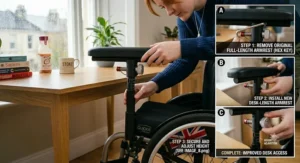
This is, in its understated British way, deeply frustrating. And it’s entirely preventable.
Desk length armrests for wheelchairs are the solution most wheelchair users either haven’t been told about or were given the wrong version of. A desk length armrest wheelchair accessory is, simply put, a shorter arm pad — typically around 25–26 cm (10 inches) long — that doesn’t extend all the way to the front of the wheelchair frame. Unlike full-length arms that run the full 35–38 cm (14 inches), the cut-back design leaves open space at the front, letting you roll flush up to a table, desk, or worktop. For anyone who spends time working, eating, studying, or crafting, this seemingly minor difference changes everything.
In the UK, where desk heights typically sit around 73–76 cm and our homes lean compact, a few extra centimetres of clearance is not a luxury. It’s genuinely life-changing. This guide covers seven real products available on Amazon.co.uk, along with everything you need to know before you buy — from tube fitting and hole spacing to material choices and replacement tips for NHS-issued chairs.
Quick Comparison: Desk Length vs Full Length Wheelchair Armrests
| Feature | Desk Length (~25 cm / 10″) | Full Length (~35 cm / 14″) |
|---|---|---|
| Table clearance | ✅ Excellent | ❌ Limited |
| Arm support surface | Moderate | Full forearm coverage |
| Best for | Active users, desk workers | Users needing postural support |
| Transfer ease | ✅ Easier (less obstruction) | Moderate |
| Typical price range (Amazon.co.uk) | Under £15 – around £35 | Under £15 – around £40 |
| Compatible with NHS-style chairs | Most models | Most models |
| Works for kitchen/dining use | ✅ Yes | ❌ Often problematic |
The table tells a clear story: desk length arms win decisively on independence and access to everyday spaces. Full-length arms offer better continuous forearm support — useful if upper body strength is limited. But for most people who use a desk, eat meals at a table, or work on a laptop, the cut-back design is the more practical choice. And as we’ll explore below, you don’t have to sacrifice comfort to get it.
💬 Just one click — help others make better buying decisions too! 😊
✨ Don’t Miss These Exclusive Deals!
🔍 Take your wheelchair setup to the next level with these carefully selected products. Click on any highlighted item to check current pricing and availability on Amazon.co.uk. These picks will help you find exactly what you need!
Top 7 Desk Length Armrests Wheelchair Accessories: Expert Analysis
1. Urathon 12″ Polyurethane Replacement Armrest Pads for NHS Style Wheelchairs
The headline feature here is in the name itself: NHS style. If you or your family member uses a standard NHS-issued transit or self-propelled wheelchair — and millions of people in the UK do — this is the replacement pad that’s most likely to drop straight in. No head-scratching over hole spacings. No measuring twice and ordering wrong once.
Each pad measures approximately 30 cm (12 inches) long, sitting in comfortable middle ground between classic desk length and full length, and is made from polyurethane foam rather than the vinyl-covered chipboard-density stuff that tends to come standard. Polyurethane matters here: it’s more durable, resists compression over time, and wipes clean without cracking — important when you consider the British habit of spilling tea on everything. The black foam construction is firm yet comfortable, and UK reviewers consistently note how closely it mirrors the original NHS-issued pad in feel and fit.
What most buyers overlook is that this is a pair — you get both left and right sides, which sounds obvious but isn’t always the case with cheaper listings. For carers replacing worn pads on a chair that’s been in daily use for years, this is rather good value.
✅ Designed specifically for NHS-style wheelchairs
✅ Durable polyurethane foam, resistant to cracking
✅ Sold as a pair — no need for a second order
❌ Slightly longer than true desk length — may limit table clearance on some chairs
❌ No hardware included (check your existing screws)
Price range: under £20 on Amazon.co.uk. For NHS chair owners, this is the pragmatic first choice.

2. Sammons Preston Universal Replacement Arm Pad for Wheelchair (Desk Length)
Sammons Preston has been in the rehabilitation accessories market for over 50 years — and that institutional credibility shows in the engineering. The desk-length variant of this armrest pad measures approximately 23–25 cm, making it one of the more precisely sized options for genuine desk clearance. The pad is padded, vinyl-covered, and ships with installation hardware, which matters because losing two M5 screws in a British kitchen drawer is a rite of passage no one needs.
The real strength here is the universal hole spacing design, covering standard 84 mm and 140 mm fixings — this covers the vast majority of manual wheelchairs sold in the UK, from standard NHS transit chairs to imported self-propelling models. Occupational therapists and physios regularly recommend this brand, and it shows up on Amazon.co.uk with UK warehouse stock, meaning Prime members can get it next day.
In practice, this pad is best suited to someone who works from home and needs to roll directly up to a standard UK desk of around 73 cm height without obstruction. The vinyl surface is easy to wipe down — relevant for anyone using the chair during meals or in a care setting.
✅ Trusted rehabilitation brand with professional credentials
✅ Hardware included, universal hole spacing
✅ Prime-eligible on Amazon.co.uk
❌ Sold as a single pad — you’ll need two for both sides
❌ Vinyl may feel firm compared to memory foam alternatives
Price range: under £25 per pad. A reliable, no-nonsense option for those who want quality without faff.
3. CALFOVERA 2PCS Universal PU Leather Wheelchair Armrest Pads (26×5.5 cm Desk Length Variant)
The CALFOVERA pads punch slightly above their price point — and the PU leather finish is the reason why. Where vinyl-covered foam starts looking tired and cracked after a few months of daily use (especially with the moisture that inevitably creeps into British homes in November), PU leather holds its appearance considerably better. The 26 cm desk-length variant sits right at the sweet spot for table clearance without sacrificing too much forearm coverage.
These come with screws and a foam interior that’s soft but not so plush it collapses under any meaningful arm weight. The ergonomic curvature means the elbow naturally finds a comfortable rest position without needing to adjust posture. For someone spending six or more hours a day in their wheelchair — working, studying, or watching questionable television — that matters more than any spec sheet can convey.
UK reviewers note the installation is genuinely straightforward: a Phillips-head screwdriver, ten minutes, and you’re done. The PU leather also responds well to damp cloth cleaning, which in this climate is not a trivial consideration.
✅ PU leather resists wear and cracking better than standard vinyl
✅ Screws included, practical ergonomic shape
✅ Good value pair pricing
❌ Less precise fit than brand-specific options
❌ Foam may compress slightly over time with heavy use
Price range: under £25 for the pair. Excellent mid-range value, particularly for everyday home use.
4. Vive Wheelchair Armrest Cover Pair (Memory Foam Sheepskin — Black or Off-White)
This one is slightly different in category but absolutely worth including: rather than a hard replacement armrest, the Vive covers are wrap-around pads that attach over your existing desk arm tube with velcro straps. If your underlying armrest structure is sound but the pad itself has worn through — a classic situation with NHS chairs that have been in service for two or more years — this is the faster, cheaper fix.
The memory foam core moulds to the elbow within a few minutes of sitting, which sounds like marketing hyperbole until you’ve actually used one. For anyone with elbow pressure sores, sensitive skin, or conditions like rheumatoid arthritis where hard surfaces become genuinely painful, this is a meaningful upgrade. The sheepskin-effect fabric is soft, breathable, and more importantly washable — which is the detail carers and community nurses particularly appreciate.
On the clearance question: because these are overlay pads rather than structural replacements, they don’t alter the table clearance of your existing desk arms. They’re comfort upgrades, not geometry changes. If you’ve already got desk length arms, these pads make them significantly more comfortable. According to the NHS’s guidance on pressure ulcer prevention, proper cushioning and regular repositioning are central to preventing skin breakdown — and the right armrest pad is a genuine part of that picture.
✅ No screws or tools required — fits over existing arms
✅ Memory foam adapts to individual elbow shape
✅ Machine-washable cover
❌ Won’t fix table clearance issues — that needs a structural arm change
❌ Velcro straps can shift with vigorous propulsion
Price range: around £20–£30 for the pair. Best as a comfort addition once you’ve already sorted the correct arm length.
5. PEPLAYTAL Wheelchair Armrest Pads, 2 Pcs Universal (25×5×3.5 cm Desk Length)
Compact, honest, and surprisingly durable — the PEPLAYTAL pads are what you’d call a workhorse option. At 25 cm long and approximately 5 cm wide, these sit squarely in desk length territory and are marketed as fitting most standard manual wheelchairs. The sponge fill is reasonably dense, the waterproof surface is straightforward to clean, and the universal hole spacing (covering standard 84 mm and 140 mm fixings) means they’re genuinely likely to fit your chair without a measuring drama.
What distinguishes this pair from the budget end of the market is the waterproofing. In the UK — where a wheelchair may be used in a care home dining room, a wet hospital corridor, or simply in a kitchen while someone makes a cup of tea — wipeable, waterproof surfaces are genuinely practical rather than a selling point. Vinyl cracks, fabric absorbs spillages; waterproof sponge surfaces avoid both problems.
These are best suited to buyers on a tighter budget who need a functional desk length replacement without frills. They won’t outshine the Sammons Preston or CALFOVERA in longevity, but for a spare set or a budget-conscious carer, they represent solid value.
✅ Waterproof surface — practical for care settings
✅ Pair included at a competitive price
✅ Universal hole spacing for most manual wheelchairs
❌ Sponge fill may compress faster than polyurethane alternatives
❌ Finish is utilitarian rather than premium
Price range: under £15 for the pair. The sensible budget pick.
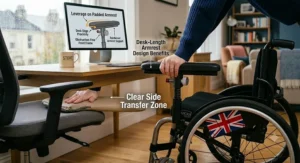
6. Universal Replacement Wheelchair Arm Rests — 10-1/4″ / 26 cm with 5-1/2″ Hole Spacing (Pair)
This listing — available from multiple sellers on Amazon.co.uk — is worth knowing about because it targets the most common hole spacing found on entry-level and mid-range manual wheelchairs sold in the UK. The 5-1/2″ (approximately 140 mm) hole spacing covers the vast majority of standard transit and self-propelled chairs from brands like Drive Medical, Roma, and similar manufacturers widely available through UK mobility retailers and NHS prescription pathways.
The pads are vinyl-covered foam at the classic 26 cm desk length, firm enough for daily arm-resting without any unwanted give, and come with screws. They’re not glamorous — this is the replacement part you order because you need it to work, not because you want to write home about the materials. And they reliably do work, which is more than can be said for several cheaper alternatives where hole alignment turns out to be optimistic at best.
For anyone who’s received a wheelchair through an NHS wheelchair service and needs a like-for-like pad replacement without involving their local wheelchair service again, this is the low-fuss solution. Worth measuring your existing hole spacing before purchasing — a ruler and two minutes will save a return trip.
✅ Covers the most common UK manual wheelchair hole spacing
✅ True desk length at 26 cm — genuine table clearance
✅ Affordable pair with hardware included
❌ Vinyl look is functional but not refined
❌ Confirm hole spacing matches — not all wheelchairs are standard
Price range: under £15 for the pair. Pure practicality.
7. NICENEEDED 2PCS Vinyl Arm Pads with Screws — Universal Full Length (Desk Arm Version)
NICENEEDED’s arm pads appear in multiple lengths on Amazon.co.uk — and their desk-length configuration is worth specifically seeking out. The construction is heavier-duty than the typical budget pad: reinforced vinyl, denser foam, and screws that actually hold rather than stripping on first install. UK customers have noted they’re particularly well-suited to chairs that see daily heavy use — care home environments, busy family households, or wheelchair users who are out and about in all weathers.
The desk arm tube fitting on these is designed with the cut-back geometry that allows genuine proximity to surfaces. And here’s the thing most listings don’t say plainly: the cut-back design doesn’t just help at desks. It helps in kitchens (standard UK worktop height is around 90 cm), at dining tables, at reception counters, and in GP waiting rooms where the fixed seating often forces a wheelchair user to park at a distance. The quality of everyday interactions changes when you can actually position yourself properly in a space. Research in occupational therapy literature consistently links proper seating and positioning equipment to independence, participation, and psychological wellbeing — and the right armrest is part of that equation.
✅ Heavy-duty construction suits intensive daily use
✅ Quality screws that hold on installation
✅ True desk length cut-back for genuine table clearance
❌ Slightly bulkier than comparable options
❌ Less padding than memory foam alternatives
Price range: under £20 for the pair. The most durable pick for heavy-use environments.
✨ Enjoying this guide?
🔍Check out our full range of wheelchair accessories on Amazon.co.uk!
How to Replace Desk Length Armrests Yourself (UK Practical Guide)
Replacing desk length wheelchair armrests is one of those jobs that sounds fiddly and turns out to be genuinely simple. Here’s how to do it without drama.
Step 1: Measure your existing hole spacing. Flip your current arm pad upside down and measure the distance between the two mounting holes. Common spacings are 84 mm, 140 mm, and 172 mm. Write this down. This single measurement will determine compatibility with almost every replacement option on Amazon.co.uk.
Step 2: Check your armrest tube diameter. If you’re replacing a full structural arm (not just the pad), you’ll need to know your tube diameter — typically 19 mm or 22 mm on standard UK manual chairs. NHS-issued chairs are almost always 19 mm.
Step 3: Remove the old pad. Two Phillips-head screws hold most arm pads in place. On some older NHS chairs, these may be under a plastic side panel — just lever it gently with a flathead. Don’t overtighten the screws on the new pad or you’ll strip the plastic base.
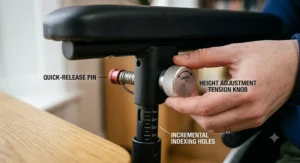
Step 4: Test the table clearance. Once fitted, roll up to your usual desk or dining table. Your elbow should rest naturally on the pad without forcing your shoulders up or forward. If you’re hunching, the arm height needs adjusting — most desk-length arms in the UK are height-adjustable via a push-pin mechanism.
Step 5: Clean regularly. Vinyl and PU leather wipe down easily with a damp cloth. Avoid alcohol-based cleaners on PU leather — mild soap and water is sufficient. In damp British conditions, dry the pad after outdoor use to prevent the foam absorbing moisture through any surface cracks.
The whole process takes about 15 minutes and requires only a Phillips screwdriver. For NHS-issued chairs under an active wheelchair service agreement, check whether replacement parts should be sourced through your local wheelchair service first — some NHS trusts provide them free of charge.
Real-World Scenarios: Who Actually Needs Desk Length Armrests?
Profile 1: Margaret, 72, retired teacher in Bristol. Margaret uses a self-propelled wheelchair following a hip replacement. She works on her laptop each morning at a standard 73 cm kitchen table and attends a weekly watercolour class. Full-length arms were leaving her 15 cm away from her work. Switching to desk length pads — specifically the Urathon NHS-style pair — let her pull flush to the table. She’s now at her desk rather than near it.
Profile 2: Jamie, 34, software developer in Manchester. Jamie uses a manual wheelchair full-time and works from home. His standing desk is height-adjusted to 75 cm when seated. The CALFOVERA PU leather desk length pads were chosen specifically for durability under daily keyboard use, where forearm friction against vinyl causes premature wear. The ergonomic curvature also reduced the shoulder fatigue he’d been getting after long working sessions.
Profile 3: A care home in Edinburgh. The facility manages a fleet of transit wheelchairs for residents who use communal dining tables at 72 cm height. They’ve standardised on PEPLAYTAL waterproof desk-length pads for easy replacement and cleaning. The desk length design means all residents can be positioned properly at meals rather than being parked at an awkward angle — which the occupational therapist notes has noticeably improved engagement and independence at mealtimes.
Three very different situations. The same simple fix.
Full Length vs Desk Length Wheelchair Armrest: What the Spec Sheet Won’t Tell You
On paper, the choice between full length vs desk length wheelchair armrest looks like a trade-off: longer equals more support, shorter equals more access. In reality, it’s slightly more nuanced than that — and getting it wrong costs you more than comfort.
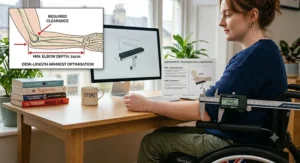
Full-length arms run approximately 35–38 cm from the back of the seat to the front. They give continuous forearm support, which is genuinely important if a wheelchair user has reduced trunk control, uses the arms for weight-shifting, or requires the full surface for repositioning. If someone regularly pushes up against their arms to shift position or stand, a full-length arm gives them a more forward grip point. Removing that forward section — which is what a desk arm does — moves that grip point backwards, which can make push-to-stand harder. For wheelchair users who are still doing some standing transfers, this is worth discussing with an occupational therapist before switching.
Desk length arms, by contrast, end roughly three-quarters of the way along the seat — leaving the front 8–10 cm of space open. This is the cut-back armrest design that defines the category. The shorter desk length pad, approximately 25 cm (10″), allows the user to pull up closer to a desk or table, but has less support surface than a full-length option at approximately 35 cm (14″). That trade-off is worth making for active users, working-age wheelchair users, or anyone whose daily life involves sitting at standard surfaces — which, given how UK homes are designed, is most people.
The hidden consideration: desk length arms are also generally easier to navigate through doorways and tight spaces. In a typical UK terraced house with a 76 cm internal door, every centimetre of chair width saved is meaningful.
| Scenario | Better Choice |
|---|---|
| Working at desk/laptop daily | Desk length |
| Eating meals at dining table | Desk length |
| Limited trunk control, needs full arm support | Full length |
| Transfers without full assistance | Full length (consult OT) |
| NHS standard chair replacement pad | NHS-specific (Urathon) or universal desk length |
| Active user, tight spaces | Desk length |
The comparison above shows that for most independent or semi-independent wheelchair users in UK home environments, desk length wins on practicality. Full length remains the clinical choice for users with complex postural or stability needs — and in that case, the decision really should involve a clinical professional rather than an Amazon search.
How to Choose the Right Desk Length Armrests for Your Wheelchair in the UK
1. Measure before you order. Every wasted return begins with skipped measurement. The two key numbers: the distance between your mounting holes (usually 84 mm, 140 mm, or 172 mm) and the current pad length. Note both before opening any browser.
2. Identify your chair’s origin. NHS-issued chairs often have slightly different tube dimensions and hole spacings compared to chairs purchased privately or imported from European manufacturers. If your chair came through an NHS wheelchair service, look for pads specifically marketed as NHS-compatible — the Urathon listing is the clearest example on Amazon.co.uk.
3. Decide on material based on use pattern. Daily users doing eight or more hours will find PU leather holds up better than standard vinyl. Carers who need to clean pads regularly should prioritise waterproof surfaces. Anyone with elbow sensitivity or skin conditions should consider memory foam overlay options over hard replacement pads.
4. Check for height adjustability if needed. Many desk arm tube fittings in the UK are height-adjustable via a push-pin mechanism — but the pad replacement doesn’t change this. If your chair’s arm height isn’t right, that’s a separate adjustment on the tube, not the pad.
5. Don’t conflate pad replacement with full arm replacement. Replacing the foam pad (the bit your arm actually rests on) is different from replacing the structural arm tube and fitting. If the arm itself is damaged, bent, or doesn’t adjust properly, a new pad won’t fix that. The structural arm is a separate part and often needs to go through your wheelchair service if NHS-issued.
6. Consider comfort alongside clearance. The best desk length armrest wheelchair setup isn’t just the shortest arm that clears your table — it’s the one that keeps your shoulders level, your elbows supported, and your posture upright for hours at a time. If in doubt, Disability Rights UK offers guidance on accessing equipment assessments through local authorities and NHS community teams.
Common Mistakes UK Buyers Make with Wheelchair Armrest Pads
Ordering without measuring hole spacing. This is the single most common cause of returns. Hole spacing on wheelchair armrests is not standardised across manufacturers. Measure. Every time.
Confusing pad length with arm clearance. A 14-inch (35 cm) pad on a desk-arm tube will still provide desk clearance because the tube determines clearance, not the pad length. However, on a full-arm tube, a shorter pad won’t retroactively create clearance — the obstruction is the tube, not the pad.
Buying US-spec listings on Amazon.co.uk. Some listings on Amazon.co.uk are fulfilled from UK warehouses but describe products in inches and reference American wheelchair brands. Always check the actual measurements in centimetres and verify the product ships from the UK (not cross-Atlantic) if delivery time matters.
Ignoring the armrest height after replacing the pad. A new pad of different thickness will subtly change your effective arm height. After replacement, check that your shoulders sit level and your elbows aren’t forced up or down. Adjust the arm tube height if needed before assuming the pad is wrong.
Replacing pads when the real issue is arm tube damage. If the arm wobbles, doesn’t hold position, or has been physically bent, a new pad is a plaster over a structural problem. NHS wheelchair service users should report arm damage and request a repair assessment.
UK Regulations, Accessibility Standards & What You Need to Know
Wheelchair armrests in the UK don’t require specific UKCA marking as standalone replacement parts — they fall under general product safety requirements rather than medical device regulation, provided they’re sold as accessories rather than prescribed medical equipment. However, if a wheelchair was issued through an NHS wheelchair service under a prescription, modifications — including arm pad replacements — should ideally be checked against the original prescription to ensure no clinical recommendations are overridden.
The Equality Act 2010 requires public buildings to provide reasonable adjustments for disabled people, but the Act doesn’t specify individual equipment requirements. What it does mean in practice is that businesses, schools, and public services should not be creating environments that prevent proper wheelchair positioning at standard surfaces — which is precisely where desk length arms come in.
For wheelchair users who receive Disability Living Allowance (DLA) or Personal Independence Payment (PIP), wheelchair equipment and accessories may be eligible for VAT relief under Group 12 of Schedule 8 to the VAT Act 1994. This applies to eligible disabled people purchasing equipment for their own use — which could mean the prices on Amazon.co.uk for these products can be purchased VAT-free. It’s worth noting when ordering online: Amazon.co.uk allows VAT exemption claims at checkout for eligible items.
Post-Brexit, some EU-manufactured wheelchair accessories may carry slightly adjusted UK pricing due to import arrangements, but the consumer protections remain robust — including the 14-day cooling-off period under the Consumer Contracts Regulations and the rights under the Consumer Rights Act 2015 if a product proves faulty.
FAQ: Desk Length Armrests Wheelchair
❓ What is the standard length of a desk arm wheelchair armrest in the UK?
❓ Will a desk length armrest fit my NHS wheelchair?
❓ Can I buy wheelchair armrest pads with VAT relief on Amazon.co.uk?
❓ What's the difference between a desk arm pad and a desk arm tube fitting?
❓ How do I know if my wheelchair needs desk length arms or full length arms?
Conclusion: A Small Change with a Large Impact
The right desk length armrests wheelchair setup isn’t a complicated decision once you understand what you’re actually buying. It’s about closing the gap — literally — between you and the world you’re trying to participate in. Whether you’re a working-age wheelchair user in a Manchester flat trying to use a desk properly, a retired person in Bristol who just wants to eat comfortably at their own dining table, or a carer managing a fleet of NHS chairs in a care setting, the answer is largely the same: shorter arm, greater access, better day.
The seven products above cover every realistic UK use case, from budget-conscious waterproof options to professional-grade rehabilitation brand pads. Take two minutes to measure your hole spacing before ordering, check your tube diameter if you’re unsure, and don’t overlook the VAT relief option if you’re eligible. Comfort, independence, and a proper seat at the table — sometimes it really is as simple as the right 25-centimetre pad.
✨ Found a product that works for you?
🔍 Click on any highlighted product name to check current pricing, availability, and Prime delivery options on Amazon.co.uk. All picks were researched and verified for UK availability in 2026.
Recommended for You
- Adjustable Height Armrests Wheelchair: 7 Best UK Picks for 2026
- 7 Best Wheelchair Armrest Pads UK 2026: Comfort Without the Ouch
- Tension Adjustable Wheelchair Back: 7 Best UK Picks (2026)
Disclaimer: This article contains affiliate links. As an Amazon Associate, I earn from qualifying purchases. If you purchase products through these links, we may earn a small commission at no additional cost to you.
✨ Found this helpful? Share it with your mates! 💬🤗
