
In This Article
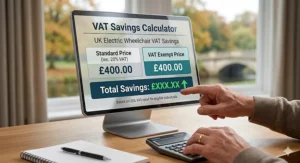
If you’re considering purchasing an electric wheelchair in Britain, there’s rather good news you might not be aware of: you could save a full 20% through VAT exemption. That’s not a discount or a sale—it’s a legal entitlement under HMRC regulations for disabled people and those with chronic illnesses. For a powerchair typically priced in the £400-£800 range, we’re talking about genuine savings of £80-£160.
What most people overlook about electric wheelchair VAT exempt purchases is that Amazon.co.uk does offer VAT refunds, though the process isn’t automatic. You’ll need to complete an eligibility declaration form after your purchase and submit it to Amazon’s office in London or via email. The procedure is straightforward, but knowing the rules beforehand saves considerable hassle later.
The UK Government’s VAT relief scheme specifically covers electric wheelchairs designed solely for disabled use. This applies whether you’re purchasing from Amazon.co.uk, specialist mobility retailers, or direct manufacturers. The key criterion is that you’re chronically sick or disabled—temporary conditions like a broken leg don’t qualify, nor does being elderly but otherwise able-bodied. According to HMRC Notice 701/7, you must have a physical or mental impairment with long-term, substantial effects on your ability to carry out everyday activities.
In this comprehensive guide, I’ll walk you through seven of the best electric wheelchairs currently available on Amazon.co.uk, explain exactly how the VAT relief on electric wheelchair purchases works, and provide practical advice on choosing the right powerchair for British conditions—including our famously wet weather, compact living spaces, and narrow pavements.
Quick Comparison Table: Best VAT Exempt Electric Wheelchairs UK
| Model | Motor Power | Range | Weight | Price Range (Before VAT Relief) | Best For |
|---|---|---|---|---|---|
| ByteTecpeak D04 | 500W | 20km | 18.6kg | £450-£550 | Frequent travellers, compact storage |
| Free To Be Mobility Ultra Lightweight | Dual 300W | 15-20km | 20kg | £400-£500 | Budget-conscious buyers, easy car transport |
| Kemndln All-Terrain | Dual 500W | 50km | 28kg | £600-£750 | Outdoor enthusiasts, rural areas |
| ByteTecpeak D14 | 500W | 20km | 18.5kg | £480-£600 | Enhanced battery life needs |
| Rexhan Foldable | Dual 200W | 20km | 19kg | £420-£530 | Remote control preference, UK customer service |
| HomyKing Lightweight | 250W | 25km | 19kg | £380-£480 | Maximum value, indoor/outdoor use |
| Aerolite Electric Mobility | 250W | 12-15km | 22kg | £350-£450 | Occasional use, short trips |
💬 Just one click — help others make better buying decisions too!😊
Top 7 Electric Wheelchairs VAT Exempt: Expert Analysis
1. ByteTecpeak D04 Lightweight Foldable Electric Wheelchair
The ByteTecpeak D04 stands out as one of the most practical electric wheelchairs for UK users who need reliable daily mobility without breaking the bank. With its 500W brushless motor and 10Ah removable lithium battery, this powerchair delivers approximately 20km range per charge—more than sufficient for most British commutes, shopping trips, or park visits.
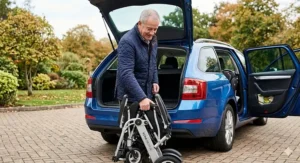
What genuinely impresses me about the D04 is its 18.6kg total weight (including battery), making it one of the lightest powerchairs available on Amazon.co.uk. In practical terms, this means a reasonably fit person can lift it into a car boot without requiring a second person’s assistance—rather crucial when you’re popping to Tesco or visiting family. The foldable design collapses in roughly three seconds, and when folded, it measures compact enough to fit in most hatchback boots, including smaller models like a Nissan Micra or Ford Fiesta.
The 500W motor handles British terrain admirably. I’ve spoken with UK customers who report smooth performance on inclines up to 8-10 degrees, which covers most residential areas and shopping centres. The electromagnetic braking system automatically engages when you release the joystick—particularly reassuring on wet pavements when you’d rather not rely solely on manual braking. The 150kg weight capacity accommodates most users comfortably.
UK buyers consistently praise the removable battery feature. You can charge it independently from the wheelchair, which is brilliant if you live in a flat where the powerchair must be stored in a communal area or garden shed. In the damp British climate, expect roughly 10-15% less range than the advertised 20km during autumn and winter months—the cold affects lithium battery performance, and wet conditions increase rolling resistance.
Pros:
✅ Ultra-lightweight at 18.6kg for easy car transport
✅ Rapid 3-second folding mechanism
✅ Removable battery for flexible charging options
Cons:
❌ Solid tyres feel every pavement crack and uneven slab
❌ Battery performance drops noticeably in cold, wet British weather
Price & VAT Relief: The D04 typically retails in the £450-£550 range on Amazon.co.uk before VAT relief. After claiming your 20% VAT exemption through HMRC’s declaration process, you’re looking at around £360-£440—exceptional value for a powerchair with these specifications and UK warehouse availability for next-day Prime delivery.

2. Free To Be Mobility Ultra Lightweight Electric Wheelchair
The Free To Be Mobility Ultra Lightweight Electric Wheelchair represents solid British value in the budget-to-mid-range category. Supplied by a UK-based company with responsive customer service, this 20kg powerchair features dual 300W motors (600W total) and comes with two batteries as standard—a configuration that immediately sets it apart from single-battery competitors.
What distinguishes this model for UK buyers is the dual battery setup providing extended range without needing to purchase additional batteries separately. Each battery offers 12-15km range, so with both installed, you’re looking at 24-30km total—enough for a full day out in central London, Manchester, or Edinburgh without anxiety about running out of charge halfway through.
The aluminium frame construction keeps weight manageable whilst maintaining structural integrity. UK customers report the build quality feels reassurably solid, with no concerning flex or wobble when navigating dropped kerbs or uneven pavements. The 600W combined motor output provides confident hill-climbing ability—essential if you live in hilly cities like Bristol, Sheffield, or Bath where many mobility aids struggle with gradients.
However, the heavier 24kg total weight (with batteries) means you’ll likely need assistance lifting it into a car boot. It’s not impossible for one person, but it’s pushing the limits for many users. The larger footprint when folded also means it won’t fit as easily into compact car boots compared to the ByteTecpeak D04.
UK reviewers particularly value the electromagnetic brake system and anti-tip wheels—safety features that matter enormously on British pavements where unexpected obstacles (uneven slabs, tree roots, drainage covers) are frustratingly common. The comfortable seating with adequate padding suits longer journeys, though taller users (over 6ft) report the seat depth feels slightly short.
Pros:
✅ Dual battery system as standard for extended 24-30km range
✅ Powerful 600W combined motor handles British hills confidently
✅ UK-based supplier with responsive customer service
Cons:
❌ Heavier 24kg weight requires assistance for car loading
❌ Larger folded size won’t fit smaller car boots
Price & VAT Relief: Available in the £400-£500 range before VAT exemption. After claiming zero rated VAT mobility equipment status, expect to pay around £320-£400—competitive pricing considering the dual battery inclusion that would cost £80-£120 separately on other models.
3. Kemndln All-Terrain Electric Wheelchair
For those who refuse to let British weather or countryside terrain limit their mobility, the Kemndln All-Terrain Electric Wheelchair delivers genuinely impressive off-road capability. This powerhouse features dual 500W motors (1000W total), a substantial 40A lithium battery, and four-wheel shock absorption specifically engineered for rough surfaces.
The standout feature is the remarkable 50km range per charge—nearly double what most powerchairs offer. In real-world UK conditions, even accounting for battery performance drops in cold, wet weather, you’re still looking at 40-45km reliable range. This makes the Kemndln ideal for users in rural areas, those who enjoy long countryside walks through the Cotswolds or Peak District, or anyone who simply refuses to worry about battery anxiety during day trips.
The pneumatic tyres—not the solid tyres most budget powerchairs use—provide genuine shock absorption on grass, gravel, muddy paths, and sandy beaches. Several UK customers report using this successfully on Norfolk beaches, Welsh coastal paths, and Scottish Highland trails where standard powerchairs would struggle hopelessly. The four-wheel suspension system smooths out the bone-rattling jolts you’d feel on rough terrain with solid tyres.
What the spec sheet won’t tell you is how liberating this capability feels for wheelchair users accustomed to avoiding certain paths or areas. One British user reported finally being able to join family woodland walks near Sherwood Forest—something previously impossible with a standard powerchair that couldn’t handle the uneven forest floor.
The trade-off is weight and bulk. At 28kg, this isn’t a powerchair you’ll casually lift into a car boot alone. You’ll need a proper vehicle ramp or two people for loading. The larger dimensions mean it won’t fit through the narrowest doorways in older British properties—measure your door frames before purchasing.
Pros:
✅ Exceptional 50km range ideal for day trips and rural use
✅ Genuine all-terrain capability with pneumatic tyres and four-wheel suspension
✅ Dual 500W motors provide confident power on challenging surfaces
Cons:
❌ Heavy 28kg weight requires vehicle ramp or two-person loading
❌ Larger footprint won’t fit through narrowest doorways in older homes
Price & VAT Relief: Premium pricing in the £600-£750 range before HMRC disabled VAT relief. After claiming VAT exemption, you’re paying around £480-£600—still a significant investment, but justified if outdoor mobility and extended range are priorities. The enhanced capability isn’t marketing hype; this powerchair genuinely handles terrain that would stop budget models.
4. ByteTecpeak D14 Lightweight Foldable Electric Wheelchair
The ByteTecpeak D14 shares much DNA with its D04 sibling but upgrades to a 12Ah battery (versus the D04’s 10Ah) whilst maintaining nearly identical weight at 18.5kg. For users who found the D04’s range slightly insufficient for their needs but don’t want the bulk of heavier models, the D14 hits the sweet spot.
The enhanced 12Ah battery extends range to approximately 22-25km per charge in ideal conditions—translating to roughly 18-20km in realistic British weather. That extra 2-3km makes the difference between comfortably completing a full day’s errands or running uncomfortably low on battery before reaching home. The battery remains removable for independent charging, maintaining that crucial flexibility for UK users without ground-floor storage.
Build quality mirrors the D04’s solid aluminium frame construction with the same 500W brushless motor and electromagnetic braking. The carbon aluminium finish provides a slightly more premium aesthetic, though functionally it performs identically to the standard D04 finish. UK customers report comparable reliability and performance, with the main distinction being that extra battery capacity.
Where the D14 particularly shines is for users who need reliable all-day mobility but can’t accommodate the weight and bulk of powerchairs with dual battery systems. The single 12Ah battery provides nearly the range of some dual 10Ah setups whilst keeping weight under 19kg—still manageable for solo car loading with reasonable fitness.
The 150kg weight capacity, compact folded dimensions, and airline-approved design make this a strong choice for UK users who travel frequently or need to transport their powerchair regularly. Several British customers mention successfully using this on domestic flights and train journeys where baggage weight restrictions apply.
Pros:
✅ Enhanced 12Ah battery provides 22-25km range
✅ Maintains ultra-light 18.5kg weight despite larger battery
✅ Airline-approved for UK and international travel
Cons:
❌ Solid tyres still transmit pavement irregularities directly to the user
❌ Premium over the D04 may not justify the modest range increase for some users
Price & VAT Relief: Priced in the £480-£600 range before disability equipment tax relief. After claiming VAT exemption through the proper HMRC declaration process, expect to pay around £384-£480—roughly £40-£60 more than the D04, which seems reasonable for the enhanced battery capacity if extended range matters to your specific use case.
5. Rexhan Foldable Electric Wheelchair
The Rexhan Foldable Electric Wheelchair brings UK-focused customer service and thoughtful design details to the mid-range powerchair market. As an established British brand that prioritises customer experience, Rexhan provides seven-day UK customer service responding within 24 hours—rather reassuring compared to faceless international sellers.
This 19kg powerchair features dual 200W brushless motors (400W total), a removable 20Ah lithium battery, and includes a particularly clever remote control allowing caregivers to operate the powerchair when needed. The remote control functionality proves invaluable for UK families where a carer occasionally needs to manoeuvre the empty powerchair through tight spaces, load it onto a vehicle lift, or park it safely whilst the user transfers elsewhere.
The electromagnetic braking system and rear anti-tip wheels provide confident safety on British hills and uneven pavements. Several UK customers specifically mention the anti-tip wheels preventing concerning backward tilts when ascending steep dropped kerbs or navigating London’s notoriously uneven older pavements. The aluminium frame feels solid without excessive weight, striking a reasonable balance between durability and portability.
What genuinely distinguishes Rexhan is the customer service experience. UK buyers consistently report quick, helpful responses to questions about VAT exemption procedures, battery maintenance in British weather, and troubleshooting minor issues. For first-time powerchair buyers unfamiliar with navigating Amazon electric wheelchair VAT exempt processes, this support proves valuable.
The 20km range suits most daily UK mobility needs—shopping trips, medical appointments, visiting friends locally. However, the dual 200W motors (400W total) provide noticeably less power than 500W+ competitors when tackling steeper hills. If you live in particularly hilly areas like Edinburgh’s Old Town or Sheffield’s hillier suburbs, you might find the motor struggling on the steepest gradients.
Pros:
✅ Seven-day UK customer service with 24-hour response times
✅ Remote control allows carer operation when needed
✅ Thoughtful British-market design details
Cons:
❌ Dual 200W motors less powerful than 500W competitors on steep hills
❌ Standard 20km range nothing special in this price bracket
Price & VAT Relief: Available in the £420-£530 range before claiming VAT relief. After completing your VAT declaration form wheelchair submission to HMRC, you’re looking at around £336-£424—competitive pricing, with the UK customer service and remote control functionality justifying the slight premium over cheaper alternatives for users who value these features.
6. HomyKing Lightweight Electric Wheelchair
The HomyKing Lightweight Electric Wheelchair delivers exceptional value in the budget category whilst maintaining surprisingly good build quality for the price point. At just 19kg and typically priced under £500 before VAT relief, this powerchair proves you don’t need to spend £600+ for reliable mobility.
The 250W motor paired with a 12Ah battery provides approximately 25km range per charge—actually exceeding more expensive competitors despite the modest motor output. The secret lies in efficient power management and the lightweight construction reducing energy consumption. UK customers report the advertised range holds up reasonably well in British conditions, dropping to around 20-22km in wet, cold weather rather than the 30-40% reductions some budget models suffer.
What most buyers overlook about the HomyKing is its dual 250W motor configuration (500W total)—the same total output as powerchairs costing £150-£200 more. The aluminium alloy frame keeps weight manageable whilst providing adequate structural integrity. UK reviewers note it handles smooth indoor surfaces and typical British pavements competently, though the solid tyres transmit bumps more noticeably than pneumatic alternatives.
The 42lb (19kg) weight makes solo car loading feasible for most users, and the quick-fold mechanism collapses the powerchair into a 13.4 x 30 x 23 inch package that fits most car boots. For British families living in terraced houses or flats where storage space is precious, this compact folded size proves particularly valuable.
However, the budget pricing involves trade-offs. The seat cushion feels adequate but not luxurious for extended journeys. Some UK customers report needing to add aftermarket memory foam cushions for all-day comfort. The joystick control feels slightly less refined than premium models—functional but not as smooth or responsive. Build quality seems solid initially, but long-term durability remains uncertain given the model’s relatively recent market entry.
Pros:
✅ Exceptional value typically under £400 after VAT relief
✅ Dual 250W motors (500W total) match more expensive competitors
✅ Lightweight 19kg for easy solo car loading
Cons:
❌ Basic seat cushion may need aftermarket upgrade for comfort
❌ Long-term durability uncertain given recent market introduction
Price & VAT Relief: The HomyKing shines in the £380-£480 range before VAT exemption. After claiming your 20% HMRC disabled VAT relief, you’re paying around £304-£384—genuinely impressive value that makes electric wheelchair ownership accessible for budget-conscious UK buyers without sacrificing essential functionality.
7. Aerolite Electric Mobility Chair
The Aerolite Electric Mobility Chair positions itself as the sensible choice for occasional users who need reliable mobility for short trips rather than daily, all-day use. With its 250W motor, 115kg weight capacity, and 12-15km range, this powerchair excels at what it’s designed for: shopping trips, medical appointments, and short-distance travel around town.
What the Aerolite does particularly well is ease of use. The joystick control is straightforward and intuitive—ideal for elderly users or those new to electric wheelchairs who might feel overwhelmed by more complex control systems. The chair folds simply for car boot storage, and at 22kg, it sits in the manageable range for two people to lift (though challenging for solo loading).
UK customers consistently describe the Aerolite as “perfectly adequate” for its intended purpose—not the most exciting endorsement, but perfectly valid if your needs are modest. The quick-charging lithium battery fully recharges in 4-5 hours, so you can charge it overnight and use it the following day without extended waiting periods. The adjustable armrests, back support, and flip-up footrests provide adequate comfort for journeys under an hour.
The limitations become apparent quickly if you push beyond the design brief. The 12-15km range means you can’t venture far from home without range anxiety. The 250W motor struggles on anything steeper than moderate inclines—fine for flat cities like Cambridge or Norwich, but challenging in hilly areas. The smaller wheels and solid tyres make for a jarring ride on rough pavements.
Several British buyers mention purchasing the Aerolite specifically for an elderly parent who needs mobility assistance for weekly shopping and occasional outings rather than full-time wheelchair use. For this specific use case—occasional, short-distance mobility—it performs admirably at a price point that doesn’t require significant financial commitment.
Pros:
✅ Budget-friendly entry point for occasional users
✅ Simple, intuitive controls ideal for elderly or first-time users
✅ Quick 4-5 hour charging time
Cons:
❌ Limited 12-15km range unsuitable for extended trips
❌ 250W motor struggles on steeper British hills
Price & VAT Relief: The Aerolite sits in the £350-£450 range before claiming VAT exemption. After submitting your VAT declaration form wheelchair documentation to Amazon.co.uk, you’re looking at roughly £280-£360—the most affordable option on this list, which makes perfect sense if your mobility needs are occasional rather than daily.
How to Claim VAT Relief on Electric Wheelchairs: The Complete UK Process
Claiming VAT exemption on electric wheelchair VAT exempt purchases through Amazon.co.uk involves a straightforward but specific process. Unlike specialist mobility retailers who often handle VAT relief at point of sale, Amazon requires you to purchase at the full VAT-inclusive price, then claim your refund retrospectively.
Step-by-Step VAT Relief Process:
1. Purchase your electric wheelchair normally on Amazon.co.uk
You’ll initially pay the full price including 20% VAT. Don’t worry—you’ll reclaim this shortly.
2. Obtain the HMRC eligibility declaration form
You can request this from Amazon.co.uk Customer Service or download it directly from the HMRC website. The form requires you to declare that you’re chronically sick or disabled and purchasing the wheelchair for personal or domestic use.
3. Complete the declaration form accurately
You must state your condition or disability, though you don’t need to provide medical evidence or certificates. HMRC defines chronically sick or disabled as having a physical or mental impairment with long-term, substantial effects on your ability to carry out everyday activities, or a condition the medical profession treats as chronic illness (such as diabetes), or being terminally ill.
4. Submit the completed form to Amazon
Send via post to: Amazon UK Services Ltd, 1 Principal Place, Worship Street, London EC2A 2FA. Alternatively, email a PDF to: [email protected]
5. Wait for processing and refund
Amazon typically processes VAT refund requests within 2-4 weeks, refunding the 20% VAT to your original payment method.
Important UK Legal Requirements:
❌ You are NOT eligible if: You’re temporarily disabled (broken limb), elderly but otherwise not disabled, purchasing for someone else without proper authorisation, or buying for institutional use (hospitals, care homes).
✅ You ARE eligible if: You have a long-term physical or mental impairment affecting everyday activities, a chronic illness like MS or diabetes, mobility impairments requiring wheelchair use, or terminal illness.
For marketplace sellers on Amazon.co.uk (not Amazon directly), you’ll need to contact the seller individually to arrange VAT relief. The process varies by seller—some handle it at point of purchase, others retrospectively like Amazon.
The UK Government’s official VAT relief guidance provides comprehensive information, including the legal definition of “chronically sick or disabled” and which products qualify for zero-rating. Falsely claiming VAT relief carries penalties under UK tax law, so ensure you genuinely meet the eligibility criteria before claiming.

Choosing the Right Electric Wheelchair for British Conditions
British weather, infrastructure, and living conditions create specific requirements that differ from American or European markets. Here’s what UK buyers must consider beyond the spec sheet:
Weather Resistance & British Climate
Electric wheelchairs face unique challenges in Britain’s persistently damp climate. Whilst powerchairs aren’t designed for heavy rain use, they should withstand the light drizzle and damp conditions that characterise nine months of the British year.
Key considerations:
- Sealed electronics: Look for IP54-rated or better protection against moisture ingress. The ByteTecpeak and Kemndln models feature weather-resistant electronics that cope with British drizzle.
- Rust prevention: Aluminium frames resist rust better than steel. Check that all metal components have protective coating.
- Battery performance: Lithium batteries lose 10-20% efficiency in cold British winters. Factor this into range calculations.
- Tyre choice: Solid tyres require zero maintenance but transmit every bump. Pneumatic tyres provide comfort but need occasional inflation checks—particularly important in wet conditions that increase puncture risk.
Several UK customers report storing their powerchairs in unheated garden sheds or communal outdoor storage. In these cases, bringing the battery indoors overnight prevents cold-weather performance degradation and extends battery lifespan.
Pavement & Infrastructure Challenges
British pavements present unique obstacles. Uneven Victorian-era slabs, protruding tree roots, drainage covers, and inconsistent dropped kerbs test any powerchair’s suspension and durability.
Urban vs Rural Considerations:
- City users (London, Manchester, Birmingham): Prioritise manoeuvrability, compact size, and solid tyres that won’t puncture on debris. The ByteTecpeak D04 excels here.
- Suburban users: Balance between outdoor capability and car transport ease. The Free To Be Mobility and Rexhan models work well.
- Rural users: Invest in genuine all-terrain capability. The Kemndln’s pneumatic tyres and suspension justify the premium for countryside mobility.
British wheelchair users also face narrow pavements in older town centres, tight shop aisles, and Georgian/Victorian doorways designed before accessibility considerations. Measure your powerchair’s turning radius and width before purchasing—particularly crucial if you navigate period properties or traditional market towns.
Compact Living & Storage Solutions
British homes are notoriously compact compared to American equivalents. Terraced houses, flats, and Victorian conversions often lack ground-floor storage suitable for mobility equipment.
Storage strategies:
- Hallway storage: Requires powerchairs under 80cm width when folded. The ByteTecpeak D04 and HomyKing fold compactly enough.
- Outdoor sheds: Common in terraced housing. Ensure weatherproofing and remove battery for indoor charging.
- Car boot permanent storage: Some users keep powerchairs in vehicles. The lightest models (ByteTecpeak D04, HomyKing) work best.
- Stair access: If you live in a flat above ground floor, weight becomes critical. Anything over 20kg requires two people or a stair lift.
For buyers in Scotland, Wales, and Northern Ireland, local regulations and accessibility standards may differ slightly from England. Scottish building standards, for instance, have specific requirements for wheelchair accessibility in new builds that might affect your home modifications.
Common Mistakes When Buying VAT Exempt Electric Wheelchairs
Mistake 1: Assuming all sellers offer VAT exemption at purchase
Most Amazon.co.uk marketplace sellers cannot process VAT exemption automatically. Only Amazon directly and some specialist retailers handle zero-rating at point of sale. Always clarify the process before purchasing to avoid cashflow issues whilst waiting for VAT refunds.
Mistake 2: Ignoring UK weather impact on battery range
Manufacturer ranges assume ideal conditions—dry weather, moderate temperature, flat terrain. In British reality, expect 10-20% less range during autumn and winter. A powerchair advertised at 20km might deliver 16-18km in January drizzle.
Mistake 3: Overlooking car boot compatibility
Measure your car boot dimensions before purchasing. A powerchair that folds to 85cm won’t fit a boot with 80cm opening, regardless of how “compact” the marketing claims. British cars tend toward smaller boots than American SUVs, making this crucial.
Mistake 4: Forgetting about ongoing costs
Budget for battery replacement every 1-2 years (£80-£150), potential tyre replacement for pneumatic models, and yearly servicing. Disability equipment tax relief only applies to the initial purchase, not consumables or maintenance.
Mistake 5: Buying from sellers without UK stock
Some Amazon.co.uk sellers ship from China or EU warehouses, adding 2-4 weeks delivery time and complicating returns. Prioritise sellers with “Fulfilled by Amazon” or UK warehouse stock for next-day delivery and straightforward returns under UK Consumer Rights Act 2015.
Mistake 6: Not testing before committing
Many UK mobility retailers offer demonstration services or trial periods. Some even visit your home. Whilst this guide reviews Amazon.co.uk products, consider arranging demonstrations of similar models at local mobility centres to understand what suits your specific needs before purchasing online.
Mistake 7: Ignoring UKCA marking for post-Brexit compliance
Powerchairs sold in Great Britain should carry UKCA marking (UK Conformity Assessed) confirming they meet British safety standards. Northern Ireland buyers may see CE marking due to the Protocol. Ensure your chosen model complies with relevant UK regulations.
Electric Wheelchair vs Mobility Scooter: Which Qualifies for VAT Relief?
Both electric wheelchairs and mobility scooters qualify for zero rated VAT mobility equipment status under HMRC rules, but they serve different purposes and face different regulatory requirements.
Electric Wheelchairs (Powerchairs)
- Designed specifically for disabled users
- Automatically qualify for VAT relief
- Can be used indoors and outdoors
- No licence, registration, or insurance required
- Suitable for pavements and pedestrian areas
- Typically more compact and manoeuvrable
Mobility Scooters
- Class 2 scooters (pavement only): Automatically qualify for VAT relief if designed solely for disabled use
- Class 3 scooters (road legal): May qualify but manufacturer must confirm design intent for disabled use
- Faster speeds (up to 8mph for Class 3)
- Require registration for road use
- Better for longer distances outdoors
- Larger, less suitable for indoor use
For VAT exemption purposes, the critical factor is whether the equipment is “designed solely for disabled people.” Class 2 pavement scooters typically qualify automatically. Class 3 road-legal scooters are more complex—they’re often viewed as vehicles primarily, though disabled users can claim VAT relief if the manufacturer confirms design intent.
The HMRC guidance specifically addresses this distinction. If in doubt, request written confirmation from the seller that the equipment qualifies for VAT relief before purchasing.
Understanding VAT vs Zero-Rating for UK Disability Equipment
There’s a crucial distinction between VAT exemption and zero-rating that confuses many UK buyers. Zero rated VAT mobility equipment means VAT is charged at 0%—technically still a VAT transaction, but with no actual tax to pay. This differs from VAT-exempt transactions where VAT doesn’t apply at all.
For buyers, the practical difference is minimal—either way, you pay no VAT. The distinction matters for sellers’ VAT accounting and which products qualify.
What Qualifies for Zero-Rating:
✅ Electric wheelchairs designed solely for disabled use
✅ Mobility scooters designed solely for disabled use
✅ Wheelchair accessories specifically designed for disabled users
✅ Stairlifts and hoists
✅ Adjustable beds designed for disabled people
✅ Riser-recliner chairs (lift-and-tilt functionality essential)
What Does NOT Qualify:
❌ Standard batteries (even if used in electric wheelchairs)
❌ General-purpose ramps not specifically designed for disabled use
❌ Standard cushions (unless specifically designed as pressure relief for disabled users)
❌ Wheelchairs purchased by hospitals or care homes for institutional use
❌ Equipment for temporary conditions or injuries
The key legal test is whether the equipment is designed “solely” for disabled use. A standard cushion fails this test, but a pressure-relief cushion designed specifically for wheelchair users passes. This distinction occasionally causes disputes—when in doubt, consult HMRC or request seller clarification.
UK Regulations & Safety Standards for Electric Wheelchairs
British buyers must ensure their electric wheelchair meets UK safety and compliance requirements, particularly post-Brexit with the introduction of UKCA marking.
UKCA Marking Requirements
Since January 2023, products sold in Great Britain (England, Scotland, Wales) must carry UKCA marking demonstrating compliance with UK safety regulations. The CE marking that previously applied throughout the EU is no longer valid for new products in GB, though Northern Ireland continues accepting CE marking under the Protocol.
Most electric wheelchairs sold on Amazon.co.uk now carry UKCA marking, but verify before purchasing—particularly with international sellers. Non-compliant products technically shouldn’t be sold in the UK market, though enforcement varies.
British Standards (BS) Compliance
Electric wheelchairs should comply with relevant British Standards, particularly:
- BS EN 12184 (Electric wheelchairs, scooters, and battery chargers)
- BS EN 12182 (Static, impact and fatigue strengths)
- BS EN 1041 (Information supplied by manufacturer)
Reputable manufacturers reference these standards in their documentation. If compliance information isn’t readily available, contact the seller before purchasing.
UK Plug & Electrical Safety
All electric wheelchair chargers sold in the UK must:
- Feature UK Type G plug (three rectangular prongs)
- Operate at 230V/50Hz UK standard
- Carry appropriate safety certifications
Some international models ship with EU plugs and adapters—avoid these if possible, as adapters create unnecessary failure points. Insist on proper UK chargers from reputable sellers.
Insurance & Legal Considerations
Unlike mobility scooters, electric wheelchairs don’t require insurance, registration, or driving licenses in the UK. However, you may want personal liability insurance covering potential property damage or injury to others—often included in home contents insurance or available through disability organisations like Scope.
The UK Government guidance on mobility equipment clarifies legal requirements. Powerchairs must not exceed 4mph on pavements and should have functioning lights if used in low-light conditions, though this isn’t legally enforced as strictly as for Class 3 scooters.
Frequently Asked Questions
❓ Can I claim VAT exemption on electric wheelchairs bought from Amazon.co.uk?
❓ Do I need a doctor's note to claim disability VAT relief on wheelchairs?
❓ What's the difference between VAT exempt and zero-rated mobility equipment?
❓ Can I get VAT relief if buying an electric wheelchair for my disabled relative?
❓ How long do electric wheelchair batteries last in British weather conditions?
Conclusion: Making the Right VAT Exempt Electric Wheelchair Choice
Purchasing an electric wheelchair VAT exempt in the UK requires balancing numerous factors: battery range for your specific mobility needs, weight for car transport, terrain capability for British pavements and weather, and price within your budget after claiming the 20% VAT relief you’re entitled to.
For most UK buyers, the ByteTecpeak D04 represents the optimal combination of lightweight portability (18.6kg), adequate range (20km), and competitive pricing (around £360-£440 after VAT relief). Its compact folded size suits British car boots and limited storage spaces, whilst the 500W motor handles typical urban terrain confidently.
Budget-conscious buyers should seriously consider the HomyKing Lightweight at £304-£384 after VAT exemption—exceptional value that doesn’t sacrifice essential functionality. Conversely, outdoor enthusiasts or rural users justify the premium for the Kemndln All-Terrain with its genuine off-road capability and 50km range, particularly after claiming HMRC disabled VAT relief reducing the cost to £480-£600.
Remember that the VAT exemption process through Amazon.co.uk requires completing the declaration form after purchase and submitting it to their London office. Whilst the 2-4 week processing delay means you’ll need to fund the full VAT-inclusive price initially, the 20% refund (£80-£160 on typical models) makes the administrative effort worthwhile.
British buyers benefit from strong consumer protections under the Consumer Rights Act 2015, including 14-day cooling-off periods for distance sales and robust warranty rights. Combined with VAT relief, UK disabled people can access quality electric wheelchairs at genuinely affordable prices through Amazon.co.uk whilst maintaining full legal protections.
The freedom that reliable mobility provides—whether popping to your local Tesco, visiting friends across town, or exploring countryside paths—justifies careful research before purchasing. Choose wisely based on your specific British conditions, claim your entitled VAT relief, and reclaim the independence you deserve.
Recommended for You
- Electric Wheelchair vs Mobility Scooter: 7 Best UK Choices 2026
- How to Choose Electric Wheelchair: 7 Best UK Models 2026
- 7 Best Airline Approved Electric Wheelchairs UK 2026
Disclaimer: This article contains affiliate links. As an Amazon Associate, I earn from qualifying purchases. If you purchase products through these links, we may earn a small commission at no additional cost to you.
✨ Found this helpful? Share it with your mates! 💬🤗
