

In This Article
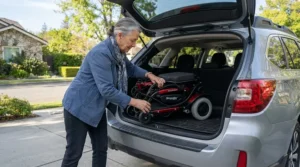
Picture the scene. The pitch is booked, the awning is up, the kettle’s on, and the nearest shower block is a quarter of a mile away across a field that has recently been rained on. If your legs tire quickly, a scooter for caravan and motorhome trips turns that field from a barrier into a pleasant stroll. Choosing the right scooter for caravan and motorhome trips is far fiddlier than choosing one for the high street, though.
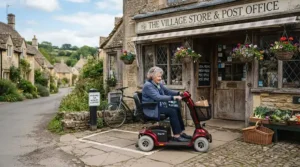
Here’s why. A touring scooter has to pass three tests that pavement scooters never face. It must get into (or onto) your vehicle without wrecking your back. It must stay put on the road, which depends on proper tie down points. And it must roll across soft grass without bellying out. Most buyers fixate on range and top speed. The specs that decide whether a holiday goes smoothly are duller: the heaviest single component, ground clearance, and what your vehicle can legally carry.
This guide compares seven real models, from a 16kg featherweight to a 150kg class 3 heavyweight. It also tackles the questions listings skip. Is a mobility scooter carrier for motorhome use sensible? How much can a tow bar carrier really take? How does ground clearance for grass change your shortlist?
One legal note first. Under GOV.UK’s rules on scooter classes, class 2 scooters top out at 4mph. Class 3 models reach 8mph and need DVLA registration. Neither may use cycle lanes. Prices below are ranges, so always check current price.
Quick Comparison: Seven Scooters for Caravan and Motorhome Trips at a Glance
Before the deep dives, here is the whole field on one screen. The two columns I’d weigh hardest are “heaviest piece” and “listed ground clearance”. Between them they decide whether a scooter for caravan and motorhome trips is a pleasure or a punishment on arrival day. Figures come from manufacturer and UK retailer listings at the time of research. Where retailers disagreed, the table says so rather than picking a winner.
| Scooter | Type | Heaviest piece (listed) | Listed ground clearance | Best For |
|---|---|---|---|---|
| Travelscoot Deluxe | Ultralight folder | Around 14kg | Not clearly published | Solo lifting, tiny storage spaces |
| Rascal Vippi | Five-piece dismantler | Around 15kg | Listings disagree (about 3.5-10cm) | Budget-minded couples on firm sites |
| Pride GoGo Elite Traveller 2.0 | Quick-release dismantler | Around 14-16kg | 34mm | Tarmac and hardcore pitches |
| TGA Minimo Plus 4 | One-movement folder | Folds as one unit | About 70mm | Hatchback boots, campervan lockers |
| Freerider Mayfair 4 | Mid-size dismantler | Around 24kg | About 55-100mm (varies by listing) | Comfort on bumpy site roads |
| Rascal Vista DX | Six-part dismantler | Around 25kg | About 60-75mm | Long days out, big range |
| Pride Colt Executive | Class 3, not lifted in parts | Around 117kg chassis | About 89-133mm (varies by listing) | Motorhome garages and rough turf |
Look at the pattern and it’s plain: every extra 10kg of comfort costs you in lifting and in tie down points planning. The Travelscoot Deluxe and Rascal Vippi win on carrying. The Rascal Vista DX and Freerider Mayfair 4 win on ride and range. The Pride Colt Executive is the only model here with real grass credentials, at the price of needing a ramp or a garage. Several ground clearance figures also conflict between sellers, which is a reminder that “listed” is not the same as “measured”.
💬 Just one click — help others make better buying decisions too!😊
Top 7 Scooters for Caravan and Motorhome Trips: Expert Analysis
Here are seven machines, ordered roughly from budget to premium. Each verdict rests on published specs and retailer listings, not on personal road-testing. Where independent review data was too thin to summarise honestly, I’ve said so. Listing availability varies by seller, so check current price and stock before you commit.
1. Rascal Vippi — five-piece takedown without the premium price
The Rascal Vippi earns its place by doing one thing brilliantly. It breaks into five parts, and Rascal’s own spec sheet puts the heaviest at around 15kg. For a scooter for caravan and motorhome trips, that’s the headline.
You get a 4mph class 2 machine rated for around 130kg (20.5 stone). It has 12V/14Ah batteries and solid, puncture-proof tyres. Fifteen kilos is roughly a large suitcase, so lifting it into a boot or up a motorhome step is realistic for most adults. The solid tyres mean no mid-holiday flats, though they ride harder than air-filled rubber.
Here’s the wrinkle. Retailers disagree on ground clearance: one lists roughly 10cm, another about 3.5cm. That gap matters, because ground clearance for grass separates a scooter that glides over a pitch from one that beaches itself on a tussock. Ask the seller to confirm before ordering.
Based on the spec comparison, the Rascal Vippi suits couples who tour hard-standing sites and want the lightest sensible dismantling scooter without huge range. Treat soft grass as a fair-weather-only proposition for the Rascal Vippi.
Independent review data for this exact model was too thin at the time of research to summarise reliably, so read the latest buyer feedback on amazon.co.uk before you buy.
Pros:
- ✅ Five-piece takedown, heaviest part around 15kg
- ✅ Solid tyres mean no punctures
- ✅ Usually cheaper than mid-size rivals
Cons:
- ❌ Ground clearance listings contradict each other
- ❌ Modest 14Ah batteries limit range
Expect around £1,000-£1,700 depending on VAT relief and seller. It’s decent value if easy lifting is your priority.
2. Pride GoGo Elite Traveller 2.0 — tight turning circle, quick one-hand takedown
Pride’s headline claim for the Pride GoGo Elite Traveller 2.0 is a 37-inch (940mm) turning radius. That lets a four-wheeler pivot like a three-wheeler, which is handy between guy ropes and gas bottles.
On paper it weighs about 37.7kg without batteries. The heaviest piece, the front section, is listed at roughly 14-16kg depending on the retailer. It’s rated to 136kg (21st 6lb), reaches 4.23mph and ships with 2 x 12Ah batteries, with 17Ah optional. In practice that means easy loading and sensible range for site-to-shower-block pottering, but not a day-tripper unless you upgrade the batteries.
The catch for grass is stark. Listed ground clearance is 34mm, a touch over an inch. Combine that with solid tyres and you get an excellent hard-standing performer that will struggle with ruts, soft turf and the lip of a ramp. The spec sheet won’t say it outright, but the numbers imply that a Rascal Vista DX would clear humps that the Pride GoGo Elite Traveller 2.0 will graze.
So who is it for? Caravanners with tarmac or hardcore site roads and a modest boot, who value manoeuvrability over rough-ground ability.
Retailer listings highlight the quick disassembly and seven colour choices. I couldn’t verify a meaningful body of independent reviews, so don’t treat the marketing copy as consensus.
Pros:
- ✅ Compact 37-inch turning radius
- ✅ Quick one-hand takedown per retailers
- ✅ Up to 136kg user weight
Cons:
- ❌ Only 34mm listed ground clearance
- ❌ Standard 12Ah batteries limit range
Budget around £800-£1,500 depending on battery and seller. It’s good value on tarmac and poor value on turf.
3. TGA Minimo Plus 4 — folds in one movement, higher clearance than most folders
Most folders sacrifice ground clearance for portability. The TGA Minimo Plus 4 pushes back with 9-inch rear alloys and a listed 70mm of clearance.
It’s a class 2, 4mph scooter with a 270W motor and a 24V 14.5Ah lithium pack weighing just 3kg. Stated range is around 10 miles and capacity is 115kg (18 stone). Folded, it measures roughly 86 x 55 x 46cm. That’s small enough for many hatchback boots and, crucially, the narrow locker of a campervan. Weights vary across the Minimo family, with listings clustering around 25-30kg, so confirm the exact variant. One dealer’s “Minimo Plus 4” listing quotes a far heavier build.
What this means in practice is that the TGA Minimo Plus 4 solves the problem of boot space rather than lifting weight. If your tow car is a hatchback and your caravan’s front locker is full of hitch kit, a folding scooter for campsite holidays like this one fits where a dismantler won’t. The pneumatic tyres add comfort and clearance but bring puncture risk, so carry a repair kit.
The listings I found lean on marketing awards rather than verifiable independent reviews, so I can’t summarise buyer sentiment honestly.
Pros:
- ✅ Folds in a single simple movement
- ✅ About 70mm listed clearance
- ✅ Lightweight lithium pack, airline approved
Cons:
- ❌ Range of around 10 miles is limiting
- ❌ Pneumatic tyres can puncture
Expect around £2,000-£2,700 depending on VAT relief. That is fair for a premium folder, though dearer than dismantling rivals.
4. Rascal Vista DX — 34.5-mile range in a mid-size dismantler
If your pitch is half a mile from the clubhouse, range matters. The Rascal Vista DX claims up to 34.5 miles from its 50Ah battery option, roughly three times what the smaller travel scooters manage.
It dismantles into six sections, with the heaviest around 25kg. Total weight is quoted at roughly 76-87kg depending on the listing. It carries up to 140kg (22 stone) at 4mph and has solid puncture-proof tyres, a captain’s seat with swivel and slide, and off-board charging. Translation: 25kg is a proper two-hand lift, so budget for a ramp or a second person. The payoff is comfort and the confidence to roam a whole site and the nearest village in one go. Clearance listings run from about 60mm to 75mm, which is fine for kerbs and marginal for ruts.
Based on the spec comparison, the Rascal Vista DX suits motorhomers and caravanners with an SUV-sized tow-car boot who want proper scooter comfort rather than a travel toy. Anyone loading a hatchback should measure first, because 87kg across six pieces still needs space.
Retailer pages display testimonials praising boot fit and pavement comfort, but I couldn’t verify independent review volume.
Pros:
- ✅ Up to 34.5 miles of listed range
- ✅ Comfortable captain’s seat with swivel
- ✅ Off-board battery charging
Cons:
- ❌ Heaviest part is around 25kg
- ❌ Marginal clearance on rutted turf
Expect around £1,500-£2,700 depending on VAT relief. It’s strong value for the range.
5. Freerider Mayfair 4 — big 10-inch pneumatic tyres for a calmer ride
Large air-filled wheels are the cheapest suspension in the business, and the Freerider Mayfair 4 has 10-inch ones.
It’s a class 2, 4mph, 24V machine with 35Ah lead-acid batteries and a listed range of up to about 25km (15.5 miles). One retailer lists total weight at roughly 78kg, with the heaviest part around 24kg. User capacity is around 21 stone. Ground clearance is where it gets murky. One seller says 100mm, another 85mm, and a version listing says 5.5cm. In practice, pneumatic tyres of this size will roll over twigs, cables and site-road ruts far more gracefully than small solid wheels. Just confirm which version you’re buying.
Here’s what to weigh. At around 78kg it’s a two-person job in a hatchback, so the Freerider Mayfair 4 is better matched to a motorhome with a garage, a rear rack or a ramp. Where scooter weight sits within the vehicle’s payload matters as much as the spec sheet.
Sellers describe it as a long-standing best-seller. That’s a retailer claim, not independent evidence, and I couldn’t verify a robust pool of buyer reviews.
Pros:
- ✅ Large 10-inch air tyres soak up bumps
- ✅ Heaviest part around 24kg
- ✅ Comfortable capacity of roughly 21 stone
Cons:
- ❌ Ground clearance listings conflict
- ❌ Around 78kg total is heavy for casual lifting
Expect around £2,000-£2,700. It’s reasonable for ride comfort, but not the lightest way to travel.
6. Travelscoot Deluxe — ultralight at about 16kg
At roughly 16kg all-in, the Travelscoot Deluxe is the featherweight of this list.
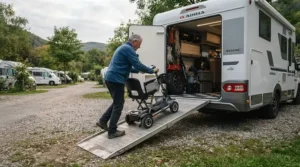
It has an aluminium folding frame and a listed capacity of 145kg. The heaviest component is around 14kg, and range is about 16km (10 miles). One UK directory lists it at around 96cm long and 60cm wide. What that means: one adult can lift it into a hatchback, slide it into a locker or stow it under a bed, and you could conceivably carry it up an awkward step. A motorhome owner on a UK forum called it the lightest on the market. An older comparison thread notes it lacks a reverse gear, so check whether the current version still does. I couldn’t find a clearly published ground clearance figure, so test it on grass before relying on it.
The Travelscoot Deluxe is the pick when payload or storage is the binding constraint. Think small campervan, under-3.5-tonne motorhome without a garage, or any setup where every kilo counts. If your main worry is wet turf, look at models with published clearance instead.
Independent review data was too sparse for me to summarise fairly, so read current feedback before paying a premium.
Pros:
- ✅ About 16kg total, heaviest piece around 14kg
- ✅ Listed capacity of 145kg
- ✅ Folds into a compact, bag-style package
Cons:
- ❌ Expensive for 10 miles of range
- ❌ No clearly published ground clearance
Expect prices from the low-£3,000s. That is only justified if weight is your overriding constraint.
7. Pride Colt Executive — class 3 power with full suspension
This one is the odd man out. The Pride Colt Executive is an 8mph class 3 machine that you simply don’t lift anywhere.
The chassis weighs around 117kg without batteries, and the two 100Ah batteries add roughly 27.5kg each. Retailers quote around 150kg in total. It has 13-inch low-profile pneumatic tyres, front and rear suspension and a user capacity of 181kg (28.5 stone). Ground clearance is listed at 133mm (5.25 inches) by some UK retailers and 89mm at the motor by another. Range listings run from about 26 to 32 miles or more. One seller describes it as capable on gravel paths and grassy fields, and the numbers support that.
In practice the Pride Colt Executive will out-climb every other scooter here on grass. But its chassis isn’t designed to be lifted in parts, so you need a motorhome garage, a ramp-and-hoist or a trailer. A standard tow bar carrier won’t cope: 150kg exceeds most noseweight ratings, and even a chassis-mounted rack rated around 145kg is too light. As a class 3 scooter it also needs DVLA registration.
Independent review data was too thin to summarise, so lean on the specs and ask the dealer for a demonstration.
Pros:
- ✅ Full suspension and 13-inch tyres
- ✅ Best listed ground clearance on this list
- ✅ Up to 181kg user weight and long range
Cons:
- ❌ Around 150kg total needs a ramp or garage
- ❌ Heavy overhang load on a motorhome rear
Expect roughly £2,700-£4,300 depending on VAT status and seller. It offers value only if your vehicle can legitimately carry it.
Side-by-Side Specs and Price Ranges
| Scooter | Class and speed | Weight / heaviest piece | Listed clearance | Listed range | Price range | Best For |
|---|---|---|---|---|---|---|
| Rascal Vippi | Class 2, 4mph | About 52.5kg with batteries / around 15kg | About 3.5-10cm (conflicting) | Not verified | Around £1,000-£1,700 | Firm sites, easy lifting |
| Pride GoGo Elite Traveller 2.0 | Class 2, 4.23mph | About 37.7kg without batteries / around 14-16kg | 34mm | Battery-dependent (2 x 12Ah standard) | Around £800-£1,500 | Tarmac pitches |
| TGA Minimo Plus 4 | Class 2, 4mph | Roughly 25-30kg (check variant) / folds as one | About 70mm | About 10 miles | Around £2,000-£2,700 | Boot-space-limited tourers |
| Rascal Vista DX | Class 2, 4mph | About 76-87kg / around 25kg | About 60-75mm | Up to 34.5 miles | Around £1,500-£2,700 | Long days out |
| Freerider Mayfair 4 | Class 2, 4mph | About 78kg / around 24kg | About 55-100mm (conflicting) | Up to around 15.5 miles | Around £2,000-£2,700 | Comfort on bumpy tracks |
| Travelscoot Deluxe | Class 2, 4mph | About 16kg / around 14kg | Not clearly published | About 10 miles | From the low-£3,000s | Payload-limited vans |
| Pride Colt Executive | Class 3, 8mph | About 117kg chassis (around 150kg total) / chassis not liftable | About 89-133mm (conflicting) | About 26-32+ miles | Around £2,700-£4,300 | Garage-equipped motorhomes |
I’ve left out star ratings deliberately: verifiable independent review volume was too thin to quote fairly. Read the latest buyer feedback on each listing yourself.
Reading the table, the Rascal Vista DX delivers the best range per pound, but its 25kg heaviest piece demands a ramp or a strong helper. If lifting is the problem, the Rascal Vippi and Pride GoGo Elite Traveller 2.0 cost far less than the Travelscoot Deluxe for similar carryability, as long as your pitches are firm. Only the Pride Colt Executive is built for rough turf, and it effectively demands a motorhome with a garage.
How to Load and Secure Your Scooter for Caravan and Motorhome Trips
A sound scooter in a badly loaded vehicle is a hazard. This is the practical routine I’d follow, based on how the manufacturers’ takedown systems and touring-club loading advice fit together.
- Weigh first. Check your payload and axle limits before you buy accessories. The Caravan and Motorhome Club’s guide to loading your leisure vehicle correctly explains why axle limits matter as much as total weight, and warns that loading too much at the rear can unsettle handling.
- Dismantle properly. Remove the battery and seat, and fold the tiller where the design allows. A Rascal Vista DX or Freerider Mayfair 4 loads far more easily with the heavy battery pieces lifted separately.
- Load heavy pieces low and forward. Keep the weight as close to the vehicle’s centre as practical.
- Use the scooter’s own tie down points. Not every model has dedicated anchors, so ask the seller. Use four ratchet straps (two front, two rear), crossed where possible, and keep them clear of wiring and controls.
- Chock, then check. Stop after the first ten miles and re-tension every strap.
- Charge sensibly at the pitch. Use off-board charging where available, and follow the manufacturer’s guidance on lithium batteries.
- First-30-days maintenance. Check pneumatic tyre pressures on a TGA Minimo Plus 4 or Freerider Mayfair 4, wipe mud from the chassis and test the brakes before each trip.
The common mistake is relying on the scooter’s weight and brakes to hold it still. They won’t. Straps attached to proper tie down points do that job.

Real-World Scenarios: Three Touring Setups, Three Scooters
Specs only mean something in context. These are illustrative profiles, not reports of anyone’s holiday.
The caravanner with an estate car. Imagine a couple who tour a twin-axle caravan behind an SUV, favouring club sites with hardcore roads. Their budget is around £1,500-£2,000. Their tow bar is busy with the caravan, so a tow bar carrier is out. A dismantling scooter in the boot is the answer, and the Rascal Vista DX fits well if one of them can lift 25kg. If neither can, the Rascal Vippi at 15kg per piece is the safer call.
The A-class motorhomer with a garage. Imagine a 7.5-metre motorhome with a rear garage, regular rough-pitch stays and a user who wants real range. Here the Pride Colt Executive makes sense. A ramp loads it, tie down points inside the garage hold it, and its suspension handles turf. This owner must weigh the rear axle first, because 150kg sits well behind the wheels.
The compact campervan tourer. Imagine a high-top campervan with no garage, a payload that is already tight, and a user who can lift 15kg but not 25kg. The Travelscoot Deluxe or TGA Minimo Plus 4 wins on storage. Test ground clearance for grass before relying on either, because neither is a rough-terrain machine.
✨ Ready to Find Your Perfect Match?
🔍 Take your touring to the next level with these carefully compared options. Click any highlighted product name to check current pricing and availability. Whatever you choose, you’ll be glad you planned the lifting before the holiday!
What Is a Scooter for Caravan and Motorhome Trips?
A scooter for caravan and motorhome trips is a class 2 or class 3 mobility scooter chosen for touring life. It’s light or compact enough to lift, dismantle or fold into a tow car, locker or garage. It’s secure enough to strap down on the road, and tough enough to cross a grass pitch.
Most scooters fall into two broad styles. Folding models (the TGA Minimo Plus 4, the Travelscoot Deluxe) collapse as one unit and suit tight storage. Dismantling models (the Rascal Vippi, Pride GoGo Elite Traveller 2.0, Rascal Vista DX, Freerider Mayfair 4) come apart into pieces that are individually lighter but need more reassembly time.
The class matters too. Class 2 scooters cap at 4mph, can’t use the road except to cross it, and don’t need DVLA registration. Class 3 models reach 8mph, are road-legal, and must be registered. On a campsite you’ll mostly use site roads and pavements at walking pace anyway, so class 3’s extra speed matters less than its extra suspension and clearance.
The key point is that a good touring scooter is not just a good town scooter. A model that is perfect on pavements may be wrong for a mud-brown pitch in October, which is why this guide weights clearance and carryability so heavily.
How to Choose a Scooter for Caravan and Motorhome Trips
Work through these steps in order. Each one narrows the field before price becomes relevant.
- Check your vehicle’s payload and axle limits. A scooter that eats your spare payload is a scooter you can’t legally carry.
- Decide how it will travel. Tow-car boot, motorhome garage, rear rack or tow bar carrier each rules out different models.
- Find the heaviest piece. If you can’t lift it comfortably, the scooter fails, however good the range.
- Check ground clearance for grass. Treat sub-50mm figures with suspicion on soft pitches, and look for pneumatic or larger tyres.
- Match range to your sites. A mile of shower-block pottering needs far less than a village day trip.
- Confirm the tie down points. Ask whether the model has dedicated anchors for straps.
- Check the class and rules. Class 3 means DVLA registration, and neither class may use cycle lanes.
Mobility Scooter Carrier for Motorhome Owners: Tow Bar Carrier, Rack or Garage?
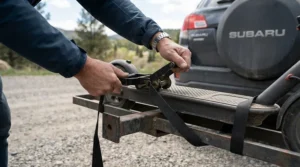
Carrying the scooter outside the vehicle sounds easy until you do the sums. A mobility scooter carrier for motorhome use hangs weight behind the rear axle, where it has a magnified effect. The Caravan Guard article on loading a motorhome correctly notes that this multiplier approaches two in long-overhang motorhomes. A 100kg load on a rack can therefore push the rear axle closer to 200kg. Owner forums include reports of prohibition notices after overweight rear axles, so weigh your van before fitting anything.
If you tow a caravan, remember the tow ball is already occupied. A tow bar carrier is mostly a motorhome (or caravan-free car) solution. Caravanners should plan on a dismantling scooter in the boot. Whichever carrier you consider, check the tow bar’s noseweight rating and your vehicle’s rules on lights and number plates, because a loaded carrier can obscure both.
| Carrier option | Capacity cited | Best For | Watch out |
|---|---|---|---|
| Tow bar carrier (platform) | Example UK platform: 75kg load, 12.5kg own weight | Lighter scooters like the Travelscoot Deluxe | Noseweight limits, lights, plates |
| Chassis-mounted rack | Example rack rated around 145kg per owner forums | Mid-size scooters like the Freerider Mayfair 4 | Often over £2,000 new; rear axle load |
| Garage with ramp | Limited by garage floor rating | Heavy models like the Pride Colt Executive | Needs a motorhome with a garage |
| Dismantle and stow inside | Limited by payload | Rascal Vippi, Pride GoGo Elite Traveller 2.0 | Floor space and loading effort |
The table makes the trade-off clear. A tow bar carrier is cheap and flexible but limited by noseweight, a chassis rack handles heavier scooters but costs a lot, and a garage is simplest if your motorhome has one. Whatever you choose, calculate rear axle load before you buy, not after.
Ground Clearance for Grass: What the Numbers Mean on a Wet Pitch
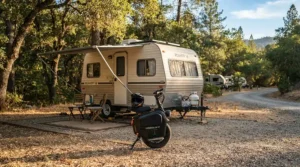
Ground clearance is measured at the lowest point, usually the motor or transaxle, not the average underside. That matters because a 34mm figure on a Pride GoGo Elite Traveller 2.0 describes its worst point, which is exactly where a rut or tussock will strike.
As a rough guide from the figures in this article, models listed under 50mm (the Pride GoGo Elite Traveller 2.0, and a low listing for the Rascal Vippi) are best on firm ground. The 60-100mm group (TGA Minimo Plus 4, Rascal Vista DX, Freerider Mayfair 4) copes with dry turf and gentle lumps. At the top sits the Pride Colt Executive, with up to about 133mm listed and full suspension.
Tyres matter too. Larger pneumatic wheels, like those on the Freerider Mayfair 4, roll over bumps instead of stopping dead. Solid tyres never puncture but transmit every jolt.
Practical tips:
- Ask the campsite about its ground in wet weather before you book.
- Carry a couple of track mats if you expect soft grass.
- Avoid turning sharply on wet turf, which tears it up.
- Confirm clearance with the seller, because listings often disagree.
A good rule is to subtract a margin from any listed figure. If a model is listed at 70mm but your pitch is rutted by tractor tyres, it won’t be enough.
Folding Scooter for Campsite Holidays: When Folding Beats Dismantling
A folding scooter for campsite holidays is the right call when storage space, not lifting weight, is your constraint. The TGA Minimo Plus 4 collapses in one movement and the Travelscoot Deluxe folds into a compact package, so both slot into places a dismantler can’t. The cost is range and, often, price.
Dismantling models offer more comfort and range but need you to handle several pieces each time. For frequent short pitch moves, a folder wins. For long stays with occasional big outings, a dismantler like the Rascal Vista DX is usually the better deal.
| Option | Upfront cost | Grass performance | Transport effort | Best For |
|---|---|---|---|---|
| Own scooter (e.g. Rascal Vista DX) | Around £1,500-£2,700 | Marginal to fair | Moderate to high | Frequent touring |
| Own folder (e.g. TGA Minimo Plus 4) | Around £2,000-£2,700 | Fair on dry turf | Low | Small vehicles, boot-limited |
| Hire at destination | Some hire models listed from the low-£20s per week | Unknown until you see it | None | Occasional holidays |
| Manual wheelchair | Lowest | Poor | Moderate | Short outings with a pusher |
If you holiday only once or twice a year, hire may beat buying, though availability and grass suitability vary. If you tour monthly, owning a Rascal Vista DX or TGA Minimo Plus 4 pays back quickly in convenience and guaranteed availability.
Payload, Safety and Legal Checks Before You Travel
Before any trip, confirm three things: weight, class and cover.
On weight, the Camping and Caravanning Club’s page on motorhome road safety and payload notes that police roadside checks find many motorhomes overloaded, and that heavy rear loading can overload the rear axle. A scooter counts towards both. Weigh your van loaded as you’ll travel, including water, passengers and the scooter, and compare it with the plated limits.
On class, remember the rules: class 3 scooters need DVLA registration and none can use cycle lanes. A Pride Colt Executive is therefore a registered road vehicle, while a Rascal Vippi isn’t.
On cover, check whether your motorhome or caravan insurance covers a scooter being carried, and whether separate scooter cover is worthwhile. Policies differ, so ask your insurer before the trip rather than after an incident.
Finally, check site rules. Some campsites restrict where scooters can go or how they’re charged, so a quick call avoids surprises on arrival.
FAQ
❓ What is the best scooter for caravan and motorhome trips on grass?
❓ Can a tow bar carrier hold a mobility scooter on a motorhome?
❓ How many tie down points does a scooter need?
❓ Do I need to register a scooter for caravan and motorhome trips?
❓ How much does a folding scooter for campsite holidays cost?
Conclusion: Match the Scooter to the Vehicle First
The best scooter for caravan and motorhome trips isn’t the fastest or the most luxurious. It’s the one your vehicle can carry, you can lift, and your pitches can tolerate. That’s why the heaviest piece, ground clearance for grass and tie down points deserve more attention than top speed.
If you want the lightest sensible dismantler for firm sites, the Rascal Vippi or Pride GoGo Elite Traveller 2.0 deserve a look. If boot space is the constraint, the TGA Minimo Plus 4 or Travelscoot Deluxe fold into spaces dismantlers can’t. For comfort and range on long pitches, the Rascal Vista DX and Freerider Mayfair 4 are the better bet. For rough turf in a motorhome with a garage, the Pride Colt Executive stands alone, provided your rear axle can take it.
Whichever way you lean, weigh your vehicle, confirm ground clearance with the seller, and plan your carrier before you buy. Do that and a scooter for caravan and motorhome trips becomes what it should be: a quiet ticket to every corner of the site.
Recommended for You
- Travel Scooter That Fits On A Train: 7 Proven Picks (2026)
- Auto Folding Scooter For Arthritic Hands: 7 Best Picks (2026)
- Lightweight Scooter For Lifting Into A Hatchback: 7 Best (2026)
Disclaimer: This article contains affiliate links. As an Amazon Associate, I earn from qualifying purchases. If you purchase products through these links, we may earn a small commission at no additional cost to you.
✨ Found this helpful? Share it with your friends! 💬🤗
