
In This Article
What is a travel scooter that fits on a train?
A travel scooter that fits on a train is a compact Class 2 mobility scooter small enough for UK operators’ size limits, usually 700mm wide by 1200mm long and 300kg combined with its rider. Alternatively, it is light and foldable enough to travel in the luggage area as ordinary baggage.
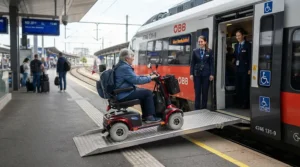
Picture the platform on a Monday morning. The ramp is out, the queue is moving, and your scooter is either a perfect fit or an expensive lesson in millimetres. That gap is why a travel scooter that fits on a train deserves more homework than most gadgets.
The good news is that most operators will carry a mobility scooter for train journeys if it stays inside the standard envelope. GOV.UK’s guidance on scooter classes points you towards Class 2: a 4mph ceiling, built for pavements and pedestrian areas. Class 3 road models must be registered with the DVLA, and they tend to be bigger.
The bad news is that the rules aren’t uniform. Each operator sets its own policy. Some want a permit, and a few carry only folded scooters as luggage.
This guide untangles it. You’ll get seven real models with specs translated into plain English, plus a straight look at wheelchair space dimensions, carriage aisle width and ramp boarding. There’s also a section on choosing a compact scooter for public transport beyond the rails.
A note on method: every figure comes from manufacturer and retailer listings and operator guidance published at the time of research. I haven’t tested these scooters, so the analysis is spec-led reasoning, not hands-on reviewing. Prices are ranges only, so check current price on each listing.
Quick Comparison: Seven Compact Scooters at a Glance
Here’s the lay of the land before we go deep. Weights vary between retailer listings, so treat them as guide figures.
| Scooter | Total weight | Fold style | Best For |
|---|---|---|---|
| Motion Healthcare mLite | about 17.8–19.9kg | Manual | Flattest, narrowest fold |
| Monarch Air | 14.75kg without battery | Manual | Riders who must lift it themselves |
| TGA Minimo Autofold | roughly 27–32kg | Powered | Tight turns in busy carriages |
| Monarch Smarti Plus | about 27.3kg | Remote powered | Slim frame and comfort |
| Drive DeVilbiss Flex AutoFold | about 27.25kg | Remote powered | Sturdy build, 125kg capacity |
| Drive Flex Plus Manual Fold | 19.8kg | Manual | Budget-conscious lightweight pick |
| Freerider Luggie Standard | about 23kg without batteries | Manual, suitcase-style | Rolling it like luggage |
Looking at the table, the Monarch Air is the clear winner if lifting is your bottleneck. The Drive Flex Plus Manual Fold undercuts most rivals on weight and price. The powered-fold trio, the TGA Minimo Autofold, Monarch Smarti Plus and Drive DeVilbiss Flex AutoFold, carry roughly 7–13kg more than the lightest manual models. In exchange you get a fold that needs no bending and little strength. On a busy platform, that trade can be worth every kilo.
💬 Just one click — help others make better buying decisions too!😊
The 7 Best Picks: Expert Analysis of Each Travel Scooter That Fits on a Train
Each entry translates the spec sheet into platform reality. I summarise buyer sentiment only where I could verify it. Where I couldn’t, I say so instead of inventing it.
1. Motion Healthcare mLite — shallowest fold in this round-up
Folded height is the number that matters on a train, and the Motion Healthcare mLite collapses to about 65cm by 42cm by just 28cm, according to its brochure.
Total weight is 17.8–19.9kg depending on the listing, with the battery around 2kg. Unfolded, it measures roughly 85cm by 42cm. That sits comfortably inside the 700mm by 1200mm rail envelope. It is also narrow enough for the 560mm width that Trainline’s accessibility guide attributes to ScotRail. In practice, you aren’t shoulder-checking every seat-back on the way down the aisle.
On the spec comparison, this suits riders who prize a flat, stowable package over cushioning. The seat is only about 34cm wide. Listings also quote a turning radius near 132cm, wider than the 900mm figure Transport for Wales publishes. Where a turning limit is enforced, plan to fold it and travel with it as luggage.
I couldn’t verify a meaningful pool of independent buyer reviews for this model. Specialist retailers show only a handful of ratings, so read recent feedback on the listing before committing.
Pros:
- ✅ Folds to just 28cm high
- ✅ Narrow 42cm frame
- ✅ Detachable battery of about 2kg
Cons:
- ❌ Wide listed turning radius
- ❌ Compact 34cm seat suits slimmer riders
Price: around £1,200–£2,500 depending on seller and promotion, so check current price. It is good value if weight and bulk are your main enemies.
2. Monarch Air — lightest frame here at 14.75kg
Built from magnesium alloy, the Monarch Air weighs just 14.75kg without its battery and seat cushion. Retailers and the maker bill it as the lightest four-wheeled scooter around.
Unfolded, it measures about 102cm by 43cm. A 10Ah lithium battery delivers 6–7.5 miles depending on the listing, and the motor is a 120W brushless unit. User capacity is 125kg (19.5 stone), and ground clearance is listed at 85mm. That clearance helps with ramp lips and platform humps. Six miles is plenty for a station-to-destination hop but thin for a full day out. An optional 20Ah battery is listed at around 20 miles.
If you hoist your scooter into a car boot before the rail leg, the weight saving is a genuine back-saver. One caution: the turning radius is listed at 36.5 inches (about 927mm). That is just above the 900mm figure Transport for Wales quotes, so it’s a near miss, not a clean pass.
Independent reviews were thin at the time of research, so I can’t responsibly summarise buyer sentiment. Check the most recent comments on the listing.
Pros:
- ✅ Lightest frame in this comparison
- ✅ 85mm ground clearance for ramp lips
- ✅ Optional 20Ah battery extends range
Cons:
- ❌ Modest 6–7.5 mile standard range
- ❌ Premium price for a short range
Price: roughly £2,000–£2,400, so check current price. It is worth it only if lifting is your genuine limit.
3. TGA Minimo Autofold — powered fold with an 820mm turning radius
TGA built the TGA Minimo Autofold on the Minimo family’s tighter front-wheel layout, and the maths shows up in its listed 820mm turning radius.
It folds with a powered mechanism, triggered by a fob or foot pedal depending on the listing. Folded, it measures about 75cm by 48.5cm by 45cm. Overall size is 96cm by 53cm. Weight is quoted between roughly 27kg and 32kg, and capacity is 115kg (18 stone). Range is about 10 miles.
An 820mm turning radius slips under the 900mm Transport for Wales figure. For mobility scooter for train journeys with crowded carriages, that is the most useful number on this page. Powered folding also means you never bend down on a crowded platform.
I found no verifiable independent review pool. Retailer pages carry very few ratings, so treat sentiment as unverified.
Pros:
- ✅ 820mm turning radius beats the 900mm benchmark
- ✅ Powered fold, no bending needed
- ✅ Narrow 53cm overall width
Cons:
- ❌ Heavier than manual-fold rivals
- ❌ Air-filled tyres can puncture
Price: roughly £2,000–£2,500, so check current price. It is good value for tight-turning confidence.
4. Monarch Smarti Plus — slim 45cm frame with rear suspension
Retailers describe the Monarch Smarti Plus as one of the few auto-folding scooters with rear suspension. Its slim stance suits aisles.
Unfolded, it measures about 101.5cm by 45cm. Folded, it shrinks to roughly 48cm by 45cm by 69cm. Total weight is about 27.3kg including battery, capacity is 136kg (21 stone), and range is about 9 miles. The airline-friendly 24V 10Ah lithium battery suits travel. Folding is remote controlled.
That fold is narrow but tall. At 69cm high, it may not slot into a shallow rack, so plan on the wheelchair bay or the end-of-carriage luggage area. The earlier Smarti listing also quotes a 55-inch (about 1.4m) turning radius. Expect to fold rather than manoeuvre on tighter operators.
Verified independent reviews weren’t available at the time of research, so I won’t summarise sentiment.
Pros:
- ✅ Slim 45cm frame
- ✅ Rear suspension and remote fold
- ✅ 136kg (21 stone) capacity
Cons:
- ❌ Tall 69cm folded height
- ❌ Wide listed turning radius
Price: listings span from the low £1,000s for discounted stock to around £2,800, so check current price. Value is strong if you find it at the lower end.
5. Drive DeVilbiss Flex AutoFold — remote fold plus 125kg capacity
The Drive DeVilbiss Flex AutoFold is the sturdy one. It folds by remote in roughly 12 seconds, according to retailer listings, and carries up to 125kg (19.7 stone).
Unfolded, it measures 96cm by 62cm by 88cm. Folded, it measures about 44cm by 62cm by 64cm. Weight is about 27.25kg, and solid puncture-proof tyres plus anti-tip rear wheels are standard. Range is listed at 9.3 miles on a 10Ah battery, though some listings claim up to 13. A 62cm width is the widest here. It clears the 700mm national envelope easily, but it exceeds the 560mm ScotRail figure Trainline quotes. On narrow-limit routes, fold it and treat it as luggage.
For riders who value robustness and higher capacity, that trade-off is sensible. Solid tyres also mean no puncture anxiety at a rural station.
I couldn’t verify independent buyer reviews at scale, so check recent listing feedback.
Pros:
- ✅ Remote fold in around 12 seconds
- ✅ Solid, puncture-proof tyres
- ✅ 125kg (19.7 stone) capacity
Cons:
- ❌ Widest frame at 62cm
- ❌ Heavy to lift at about 27kg
Price: roughly £1,700–£2,400, so check current price. The value verdict is good for heavier riders and long-term durability.
6. Drive Flex Plus Manual Fold — best value lightweight option
Weighing only 19.8kg, the Drive Flex Plus Manual Fold is about 7kg lighter than its auto-fold sibling, the Drive DeVilbiss Flex AutoFold, according to the listings.
Unfolded, it measures about 98cm by 54.5cm by 93cm, and it folds to roughly 41cm by 54.5cm by 67cm. Capacity is 125kg, range is 9.3 miles, and the seat is about 42cm by 38cm. At 54.5cm wide, it squeaks under the 560mm limit Trainline attributes to ScotRail. Ground clearance on the Flex family is listed at 40mm, though, so take ramp lips gently and square-on.
Manual folding means bending and lifting, but you save weight and money. It suits budget-conscious riders with decent hand strength.
Independent review data wasn’t available for me to summarise, so treat sentiment as unverified and read the latest feedback.
Pros:
- ✅ Just 19.8kg overall
- ✅ 125kg (19.7 stone) capacity
- ✅ Narrow enough for tight-limit routes
Cons:
- ❌ Low 40mm ground clearance
- ❌ Manual fold needs bending
Price: roughly £1,100–£1,700, so check current price. It is the value pick here.
7. Freerider Luggie Standard — luggage-style fold
The Freerider Luggie Standard earns its place with a suitcase-style fold. UK dealer listings quote a folded size of about 66cm by 45cm by 39.5cm.
Weight is about 23kg without batteries, and unfolded length is around 99cm. Width is listed between roughly 45cm and 50cm. Maximum user weight is 113kg (18 stone). Range is up to about 18km (11 miles) on the base battery, and the Motability listing quotes 16 miles with a 16.5Ah battery. Which? lists Luggie among the travel scooters it has tested, though results sit behind its member paywall.
The folded footprint, just 39.5cm deep, is the neatest here. But 23kg is heavier than the Monarch Air (14.75kg) and the Motion Healthcare mLite (about 18kg), and its user capacity is the lowest of the seven.
I couldn’t verify a large independent review pool, so read the newest listing feedback.
Pros:
- ✅ Neat 39.5cm-deep folded footprint
- ✅ Range extends with larger battery
- ✅ Established name and Which? testing
Cons:
- ❌ Lowest user capacity at 113kg
- ❌ Heavier than the lightest manual models
Price: UK pricing varied too much across listings for me to quote a reliable range, so check current price. The value verdict depends on which battery you pick.
Rail-Limit Cheat Sheet: All Seven Side by Side
| Scooter | Unfolded (L × W) | Folded (L × W × H) | Range | Price range | Best For |
|---|---|---|---|---|---|
| Motion Healthcare mLite | 85 × 42cm | 65 × 42 × 28cm | up to 9 miles | £1,200–£2,500 | Lowest folded height |
| Monarch Air | 102 × 43cm | about 44 × 46 × 65cm | 6–7.5 miles | £2,000–£2,400 | Lightest lift |
| TGA Minimo Autofold | 96 × 53cm | 75 × 48.5 × 45cm | about 10 miles | £2,000–£2,500 | Sharp turning |
| Monarch Smarti Plus | 101.5 × 45cm | 48 × 45 × 69cm | about 9 miles | £1,100–£2,800 | Narrow frame |
| Drive DeVilbiss Flex AutoFold | 96 × 62cm | 44 × 62 × 64cm | 9.3–13 miles | £1,700–£2,400 | Sturdy build |
| Drive Flex Plus Manual Fold | 98 × 54.5cm | 41 × 54.5 × 67cm | about 9.3 miles | £1,100–£1,700 | Budget value |
| Freerider Luggie Standard | 99 × 45–50cm | 39.5 × 45 × 66cm | up to 11 miles | check current price | Suitcase-style fold |
Every scooter here clears 700mm by 1200mm with room to spare. The tougher filter is the strictest local limit. As listed, the Drive DeVilbiss Flex AutoFold is the only one wider than the 560mm ScotRail width Trainline quotes, so confirm with ScotRail before travel. And width alone isn’t the full story. The Monarch Air is narrow but sits close to the 1040mm length figure at about 102cm.
✨ Ready to Find Your Perfect Fit?
🔍 Take your journey planning to the next level with these carefully compared scooters. Click on any highlighted product name to check current pricing and availability. These picks will help you travel with confidence and independence!
How to Choose a Travel Scooter That Fits on a Train
Start with three numbers: width under 700mm, length (footplates included) under 1200mm, and combined weight under 300kg. Then work through these seven steps.
- Measure the whole package. Operators count length including footplates, so a protruding tiller or basket matters. Use the narrowest limit on your route, not the national headline.
- Add your own weight. The 300kg ceiling covers scooter plus rider, mainly because of ramp strength.
- Decide whether you’ll ride on or fold. East Midlands Railway allows foldable scooters as luggage, but riding on usually needs a reserved space.
- Check turning radius. Transport for Wales publishes 900mm. A compact scooter for public transport with a generous turning circle can still struggle.
- Find the heaviest single piece. Which? notes that on dismantling scooters the tiller is often the heaviest part, so try lifting before you buy.
- Confirm the battery is airline-friendly, and charge fully before leaving. CrossCountry says scooters can’t be charged onboard because of a voltage difference.
- Check permits and book assistance. Some operators, such as East Midlands Railway and Island Line, require a scooter permit before boarding.
Ticking those seven boxes turns a risky purchase into a predictable one.
Wheelchair Space Dimensions: What the Rules Say
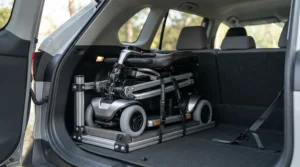
This is where wheelchair space dimensions stop being abstract. Rail vehicle accessibility rules, from the original 1998 regulations to the 2010 regulations for non-interoperable systems, require a wheelchair space at least 1300mm long and 750mm wide. A restraining fitting at one end must be at least 700mm wide.
Now do the arithmetic. Operators accept vehicles up to 1200mm by 700mm, so that space leaves roughly 100mm of length and 50mm of width to spare. That’s not a parking bay, it’s a snug hug. A tiller sticking out, a basket or a hanging bag can quietly eat your margin.
Boarding hardware adds more constraints. Power-operated ramps must be at least 800mm wide, and lift platforms at least 750mm by 1200mm. Width therefore has to survive the doorway, the ramp and the space, and the weakest link decides your fate.
Older trains complicate things further. Trainline’s guide says some can only take a width of 550mm, while another source puts the older-train limit at 670mm. The sources disagree, so check wheelchair space dimensions with your operator for your specific train.
Treat the figures as a budget. Pick a scooter at least 100mm narrower than the limit, and your journey gets calmer.
Carriage Aisle Width: Why Turning Radius Beats Tape-Measure Maths
Here’s the awkward truth about carriage aisle width: there is no single published figure to shop against. Operators publish limits for the vehicle itself and leave the carriage to do the rest.
The clue is in what they do publish. Transport for Wales lists a 900mm turning radius, and Southern’s wheelchair and scooter guide quotes a 1500mm turning limit. Greater Anglia warns that even the smallest scooters generally need a larger turning circle than a wheelchair. Business Traveller reported in 2016 that Govia Thameslink defended a scooter ban by citing narrow doorways and too little room to turn.
So treat carriage aisle width as a turning problem, not a squeeze. A tiller-steered scooter sweeps a wider arc than a joystick-driven chair. A slim 43cm scooter with a big turning circle can be harder to park in a bay than a wider one that pivots tightly.
Put that to work with three checks:
- Measure your scooter at its widest point, armrests included.
- Find the listed turning radius and compare it with 900mm.
- If it’s higher, plan to fold and board as luggage, or transfer to a seat.
Transport Focus advises that you may have to transfer to a fixed seat, so be ready for that. Carriage aisle width rewards preparation more than optimism.
Ramp Boarding: A Step-by-Step Guide for Scooter Users
Ramp boarding is where a good scooter and a good plan pay off. Operators’ safety guidance is surprisingly consistent.
- Book assistance. Passenger Assist gets staff and the ramp ready, and they can alert your destination station. Aim for at least 24 hours’ notice.
- Check your settings. Southeastern says Class 3 scooters must be set to pedestrian mode at 4mph maximum. Southern asks for no more than 3mph in stations, so keep to walking pace.
- Unload your bags. Shopping hung on a tiller or seat can tip you backwards on a ramp, so remove it first.
- Approach square-on and keep moving. Southeastern warns against pausing or looking behind on the ramp, because it shifts your centre of gravity.
- Respect the weight limit. Ramps typically carry 300kg combined, and exceeding it risks safety and refusal.
- Park, brake, switch off. Where you’re able, transfer to a seat; several operators advise it.
- Prepare to alight. The platform side can change, so be ready to relocate.
Ramp boarding goes smoothly when you’ve rehearsed it. Practise tight approach angles at home with your own Drive Flex Plus Manual Fold, mLite or whichever model you choose. Low ground clearance, such as the 25mm listed for the mLite, makes that rehearsal especially worthwhile.
Real-World Scenarios: Which Scooter for Which Journey?
These are illustrative profiles, not case studies of real buyers. They show how the specs translate to journeys.
The weekly coast-trip couple. They have a budget near £2,000, mixed stations, and no lifting strength. The Drive DeVilbiss Flex AutoFold or Monarch Smarti Plus suits them. The remote fold means nobody strains, and the Smarti Plus adds rear suspension for rougher pavements. They should reserve space in advance, then fold at the platform if the carriage is tight.
The airport-and-rail hopper. Heathrow Express asks for scooters to be folded where possible, according to Trainline’s guide. That makes the Monarch Air or Motion Healthcare mLite natural fits, because they fold small and carry airline-friendly lithium batteries. For this traveller, lifting weight matters more than ride comfort.
The budget-conscious weekender. They have £1,100–£1,700 to spend and go through narrow-limit routes. The Drive Flex Plus Manual Fold is the logical pick. At 54.5cm wide, it passes the 560mm figure, and 19.8kg is liftable for most.
Each scenario starts with one question: do you ride on or fold? Answer that first, and the shortlist writes itself.
Compact Scooter for Public Transport: Beyond the Train
Buying a compact scooter for public transport means planning for more than platforms. These problems come up most often, with fixes.
- Buses. The Department for Transport’s guidance for mobility scooter users refers to Class 2 scooters on low-floor buses adapted for wheelchairs. It also says scooters can’t be carried on coaches fitted with wheelchair lifts. Check the operator first.
- Taxis. Ask the local firm whether its vehicles suit your scooter before booking.
- Permits. Some rail operators require a permit, so apply before travel, not at the barrier.
- Class 3 modes. Switch to pedestrian mode and keep to 4mph on platforms.
- Charging. Don’t plan on onboard charging; CrossCountry says it can’t be done.
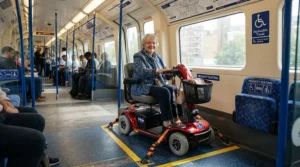
A compact scooter for public transport also benefits from foldability. Southeastern states that folding scooters storable as luggage can be carried on any type of train. That’s why the manual-fold Monarch Air and mLite make strong travel companions.
Mobility Scooter for Train Journeys vs Alternatives
Is a folding scooter always the best mobility scooter for train journeys? Not necessarily. Here’s how the options compare. Widths come from Mobility World’s guidance.
| Option | Typical width | Train friendliness | Best For |
|---|---|---|---|
| Folding travel scooter | 50–60cm | Excellent; can fold as luggage | Frequent rail and car travel |
| Compact power wheelchair | 55–65cm | Very good; tight turning | Narrow carriages and doorways |
| Class 2 pavement scooter | 55–68cm | Good, but bulkier | Local trips, rarely by rail |
| Class 3 road scooter | 60–72cm | Limited; often too big | Road use, not trains |
The pattern is clear. Folding scooters win on portability, but powerchairs often turn more tightly. If your trains are older and your carriages cramped, ask whether a compact power wheelchair fits your life better. If you value a sit-and-steer feel and need car-boot travel, a TGA Minimo Autofold or Monarch Smarti Plus does the job. Large Class 3 road scooters rarely make good rail companions.
Features That Actually Matter (And Those That Don’t)
Spec sheets love shouting. Here’s what deserves your attention.
Matters:
- Folded dimensions and heaviest piece. These decide whether you can stow and lift it.
- Turning radius. It decides whether you can steer into a bay.
- Anti-tip wheels and a freewheel/brake release. Transport for Wales lists these as requirements.
- Airline-friendly battery. This keeps you flexible on longer trips.
- Ground clearance. It matters for ramp lips, and the figures range from 25mm on the mLite to 85mm on the Monarch Air.
Doesn’t matter much:
- Top speed. Class 2 is capped at 4mph, and stations ask for walking pace anyway.
- Headline range beyond your day. Nine miles covers most station-to-door trips.
- Accessories you’ll never use. A basket is nice, but it can add width and snag in a carriage.
Strip away the marketing, and a good travel scooter that fits on a train is a modest, well-proportioned machine. It folds small, turns well and weighs what you can handle.
Long-Term Cost & Maintenance
Buying is only part of the cost. Ask about the battery, servicing and insurance too. Which? covers insurance, registration and storage in its mobility scooter guidance.
| Budget band | Examples | What you gain | Trade-off |
|---|---|---|---|
| Around £1,100–£1,700 | Drive Flex Plus Manual Fold | Light, narrow, affordable | Manual fold, low clearance |
| Around £1,200–£2,500 | Motion Healthcare mLite | Flat fold, compact | Narrow seat, wide turn |
| Around £1,700–£2,500 | Drive DeVilbiss Flex AutoFold, TGA Minimo Autofold | Powered or remote fold | Heavier frames |
| Around £2,000–£2,800 | Monarch Air, Monarch Smarti Plus | Lightest lift, or suspension | Premium pricing |
If you travel only occasionally, there are alternatives. One UK hire firm lists the Smarti at roughly £16–£19 a week. Motability Scheme listings show weekly rentals in the low-to-high £20s for some models, though eligibility rules apply. Many specialist dealers also advertise VAT relief for eligible disabled customers, so compare like with like before judging headline prices.
On value, the Drive Flex Plus Manual Fold stands out for the budget-minded. Hire is a sensible trial for anyone unsure about regular rail use. Whichever route you pick, check current price on each listing. Over several years, a scooter you can actually lift and fold is worth more than one that stays at home.
FAQ
❓ Which folding mobility scooter is best for train travel?
❓ Do I need to book Passenger Assist for a mobility scooter?
❓ Can I charge a mobility scooter battery on a train?
❓ Can a Class 3 scooter go on a train?
❓ How much does a lightweight folding mobility scooter cost in the UK?
Conclusion
Finding a travel scooter that fits on a train comes down to three questions. Will it fit the strictest local limit, can you fold or lift it comfortably, and does it turn tightly enough for carriage aisle width and the wheelchair bay?
For most riders, the shortlist is simple. Choose the Monarch Air when lifting is your limit, and the Drive Flex Plus Manual Fold when budget is. The Motion Healthcare mLite wins on the flattest fold. Powered folding favours the TGA Minimo Autofold for tight turns, the Monarch Smarti Plus for a slim frame, or the sturdy Drive DeVilbiss Flex AutoFold. The Freerider Luggie Standard completes the set with its suitcase-style fold.
Remember the basics too. Respect the 700mm by 1200mm and 300kg envelope, check your operator’s permit and booking rules, and practise ramp boarding before the big day. Verify the stricter local figures, because rules change and operators differ.
Do that, and your next journey becomes a plan instead of a gamble.
✨ Ready to Travel Freely?
🚆 Compare these scooters, check current pricing and availability by clicking any highlighted product name, and take the first step towards stress-free rail travel!
Recommended for You
- Auto Folding Scooter For Arthritic Hands: 7 Best Picks (2026)
- Lightweight Scooter For Lifting Into A Hatchback: 7 Best (2026)
- Folding Mobility Scooter For Small Car Boot: 7 Best Picks (2026)
Disclaimer: This article contains affiliate links. As an Amazon Associate, I earn from qualifying purchases. If you purchase products through these links, we may earn a small commission at no additional cost to you.
✨ Found this helpful? Share it with your friends! 💬🤗
