

In This Article
Picture a cafe at 11am on a Saturday. Chairs jut out at odd angles, a pushchair is parked near the till, and the gap to the counter is about as wide as a corgi. A four-wheel scooter turns that gap into a seven-point negotiation. A three wheel scooter with tight turning circle simply glides round it.
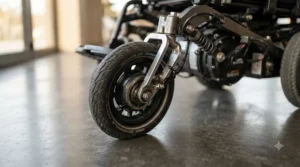
That’s the whole pitch, and it’s geometry rather than magic. One steered front wheel lets the scooter pivot in less floor space than a four-wheeler with two fixed-width front tyres. Mobility World’s UK guide to turning circles suggests most homes suit a scooter with a turning circle under 100cm. It also notes that compact boot scooters often beat that mark, while Class 3 road scooters can need 130cm to 160cm or more.
So which models actually deliver? This guide compares seven real scooters sold in the UK in 2026. Five are genuine three-wheelers. Two are four-wheel alternatives that turn like three-wheelers, and they’re flagged openly so nobody feels short-changed. There’s no claim of hands-on testing here. You get spec-led analysis, honest review sentiment where it can be verified, and a frank look at where manufacturers’ turning figures don’t quite line up.
Prices are ranges only and change often, so check the current price and availability before you buy.
Quick Comparison: Seven Scooters at a Glance
| Scooter | Layout | Weight (as published) | Best For |
|---|---|---|---|
| MobilityPlus+ Stealth T3 | 3-wheel, folding | 15.5kg frame (no battery) | Small boots, short shop and cafe trips |
| MobilityPlus+ Triumph | 3-wheel, splits into 4 | Heaviest piece 13.1kg | Budget buyers wanting a basket and swivel seat |
| WHILL R 3-Wheel | 3-wheel, dismantles | 52.2kg total | Mixed pavement, kerbs and tight interiors |
| TGA Breeze Midi 3 | 3-wheel, Class 3 | 110kg total | Road-legal range with compact handling |
| Pride Maxima 3 | 3-wheel, heavy duty | 83kg without batteries | Higher user weights, longer outings |
| Pride GoGo Elite Traveller 2.0 | 4-wheel, tight-turn tech | 37.7kg total | Four-wheel stability with a three-wheel feel |
| Drive Dual-Wheel Auto Fold | Twin front wheel, auto-fold | 20kg base | Remote-fold convenience |
Weight tells two different stories here. The Stealth T3 and Triumph are the only models a single person could plausibly lift into a car boot without a ramp. The Maxima 3 and Breeze Midi 3 are “delivered and left at home” machines. Choose by where the scooter will live as much as where it will roam.
💬 Just one click — help others make better buying decisions too!😊
Top 7 Three Wheel Scooters with Tight Turning Circle: Expert Analysis
1. MobilityPlus+ Stealth T3 — featherweight folder at 15.5kg
Weight is the headline: roughly 15.5kg for the frame without the battery. That’s the difference between “I can load this myself” and “I’ll wait for someone to help”.
At 94.6cm long and 50.5cm wide, it’s short and slim enough for narrow shop aisles. A 270W brushless motor drives it up to 4mph, with a stated range of 10 miles from a 24V 10.4Ah lithium battery (249.6Wh, the figure airlines care about). Solid 6-inch front and 8-inch rear tyres can’t puncture. They also pass every paving flaw straight to your spine, and the 3.5-inch ground clearance and 9° stated climbing ability mark this as a smooth-surface machine.
Based on the spec comparison, it suits people doing short, flat shop-and-cafe runs who need to fold it into a small boot. The retailer says only that the three-wheel layout turns more tightly than its four-wheel sibling, so ask for a measured figure.
On reviews, the retailer publishes company-wide satisfaction figures, but a product-level review pool for this new model couldn’t be verified. Treat long-term durability as unproven.
Pros:
- ✅ Very light frame, easy for one person to lift
- ✅ Folds to 30 × 50 × 74cm
- ✅ Height-adjustable tiller and variable speed knob
Cons:
- ❌ Solid tyres give a firm, buzzy ride
- ❌ Ten-mile range limits all-day outings
Expect to pay around £700-£750 at the retailer checked. Stock showed as sold out during research, so check availability first. For the weight and fold, the value is solid.

2. MobilityPlus+ Triumph — splits into four light sections
The party piece is how it comes apart. It dismantles in seconds into four sections, and the heaviest (the rear) weighs 13.1kg, so nothing in the boot is a back-breaker.
It manages 3.7mph and a stated 12.4 miles, which is slightly slower but further than the Stealth T3. The single central front wheel means no axle across the footwell, so you get more leg room than a four-wheeler offers. Add a swivel seat, flip-up armrests and an angle-adjustable tiller, and it becomes a friendlier machine to get on and off. A detachable front basket carries the shopping, and the battery charges off-board, so you can leave the scooter in the car and take the battery indoors.
On paper, the tortoise-and-hare speed dial on the tiller panel is the sleeper feature. Dial down to the tortoise inside a shop and the single front wheel becomes much less twitchy. The maker says it passes comfortably through standard doorways. The total assembled weight wasn’t stated in the sources checked, so confirm it if you’ll be pushing it up ramps.
I couldn’t verify product-level customer reviews, so durability claims stay unverified.
Pros:
- ✅ Four lightweight sections for easy boot loading
- ✅ Basket and swivel seat included
- ✅ Off-board battery charging
Cons:
- ❌ 3.7mph top speed feels leisurely outdoors
- ❌ Total assembled weight not clearly published
Around £550 at the retailer checked, which is excellent value if the basket and swivel seat matter to you.
3. WHILL R 3-Wheel — front wheel rotates to a right angle
This is the most engineered answer to the turning question. TGA says the front wheel rotates to a right angle, made possible by a dual-motor system, and the scooter automatically adjusts speed during turns.
At 110cm long and 63.5cm wide, it’s bigger than the folders. In return you get capable suspension, a 5.5cm ground clearance, and a 147kg (23 stone) capacity. Kerbs, grass and gravel are within its brief, up to a stated 12 miles at 4mph from a 25.3V 10.6Ah lithium battery. A smartphone app handles locking and speed settings, and it’s approved for air travel. Warranty runs three years on the product and one on the battery.
What the spec sheet won’t tell you is how the turning compares in a real cafe. No measured turning circle appears on the page checked, only “class leading”. The 52.2kg total weight also means it’s a scooter you dismantle for the boot rather than a grab-and-go folder, and piece weights weren’t listed.
I couldn’t verify product-level UK reviews for this model.
Pros:
- ✅ Suspension handles kerbs and rougher surfaces
- ✅ Three-year product warranty
- ✅ Automatic speed reduction in turns
Cons:
- ❌ Premium price for a 4mph Class 2 scooter
- ❌ Turning figure not published
Expect around £3,000 with VAT relief. Motability finance is available from roughly £33 a week. It’s a premium price, justified mainly if you need that capability.
4. TGA Breeze Midi 3 — road-legal compact with 8mph option
Few three-wheelers can claim Class 3 status. This one does, with a high/low speed switch giving 4mph on the pavement and 8mph on the road.
It’s built for range and comfort rather than tight corners alone. A 24V 950W motor and two 12V 50Ah batteries give a stated 25 miles, or 35 with the long-range option. All-round suspension and 32cm pneumatic tyres smooth the ride, and the seat rotates for easy transfers. It’s 130cm long without the rear box (158cm with it), 63cm wide and weighs 110kg. Maximum user weight is 135kg (21 stone).
Here’s the catch for tight-turn hunters. Those dimensions make it the longest here bar the Maxima 3, and no turning figure is given on the page checked. “Compact” means compact for a Class 3, not compact like the folders. It earns its place for outdoor-first users who also pop into larger shops.
Real sentiment is thin but positive. Two customer reviews on TGA’s page, both dated 2019, describe it as easy to drive and mention long-lasting batteries and solid reliability. That’s a tiny, old sample.
Pros:
- ✅ Road-legal with a pavement-speed switch
- ✅ Full suspension and large pneumatic tyres
- ✅ Three-year product warranty
Cons:
- ❌ At 110kg, strictly a home-based scooter
- ❌ Long body limits indoor agility
Around £3,700-£3,900 with VAT relief. It’s good value if you’d otherwise buy a larger Class 3.
5. Pride Maxima 3 — 35-stone capacity on three wheels
Heavy-duty usually means huge, and huge usually means wide turns. The Maxima 3 keeps a three-wheel layout and still supports up to 226.75kg (35 stone 10lb).
Its dimensions are 120.6cm long and 68.6cm wide, and it weighs 83kg without batteries (two 50Ah units at roughly 17kg each). Pride quotes a 127.5cm (49-inch) turning figure, a ground clearance of 6.3cm and solid tyres around 26.5cm across. A delta tiller is described as allowing one-hand operation, and the seat is a 53.3cm-wide high-back swivel.
Two cautions. First, UK listings show both 4mph and 6mph variants. Confirm the exact class and configuration with the seller. Second, that 127.5cm figure is the “radius” Pride publishes, and a retailer listing elsewhere gives a 264cm turning circle diameter for a Maxima 3. The two are consistent, but it means this isn’t a boot-scooter-style tight turner. It’s a tight turner for its size.
I couldn’t verify UK product-level reviews for this scooter.
Pros:
- ✅ Exceptional weight capacity for a three-wheeler
- ✅ Large seat with swivel and high back
- ✅ Delta tiller allows one-hand operation
Cons:
- ❌ 83kg before batteries, so no lifting
- ❌ Not suited to narrow cafe interiors
Roughly £2,900-£3,100 ex-VAT range, with retailer discounts appearing periodically. It’s decent value if capacity is your priority.

6. Pride GoGo Elite Traveller 2.0 — four-wheel stability, 94cm turn
Included as an honest alternative: this is a four-wheel scooter. Pride’s patented turning technology (labelled I-Turn, iTurn or EZ-Turn depending on the listing) is what earns it a spot in a guide about tight turning. Pride says it’s 15% tighter than the previous GoGo Elite.
UK listings give a 94cm (37-inch) turning figure, 103.6cm length, 49.4cm width and a 4mph top speed. Capacity is 21 stone 6lb (about 136kg) at 37.7kg total weight. Ground clearance is a lowly 3.4cm. It comes apart into light pieces for the boot.
Here’s the catch on the numbers. Retailers label that 94cm as “turning circle”, while Pride’s North American material calls the equivalent 37 inches a “turning radius”. Those can’t both be true, because a true 94cm circle would be implausibly small for a 104cm-long scooter. Ask the seller how it was measured.
Retailer pages I viewed showed no customer reviews yet, so there’s no sentiment to report.
Pros:
- ✅ Four-wheel stability with tight turning
- ✅ Narrow 49.4cm width
- ✅ Disassembles for the boot
Cons:
- ❌ Only 3.4cm ground clearance
- ❌ Turning figure labelled inconsistently
Around £1,300-£1,600 across retailers. The value case: tight manoeuvring without three-wheel stability trade-offs.
7. Drive Dual-Wheel Auto Fold — remote-folds in under 20 seconds
Another honest alternative: twin front wheels rather than one. The retailer says it folds or unfolds by remote control in under 20 seconds. The dual front wheel adds stability while keeping manoeuvrability, and speed drops automatically in turns.
The quoted turning radius is 78cm (31 inches). Base weight is 20kg, maximum user weight is 115kg (18 stone), and the rated slope is 6°. Ground clearance is only 2.5cm in the centre, so thresholds and kerbs need care. It also has automatic electromagnetic brakes.
For cafe visits, the remote fold is the real draw. Fold it, stand it by your table, and it stays out of the way. Range, speed and total weight weren’t confirmed in the sources checked, so verify them before ordering.
I couldn’t verify product-level reviews, and I couldn’t confirm a current UK price, so check the retailer’s listing.
Pros:
- ✅ Remote fold under 20 seconds
- ✅ Auto speed reduction in turns
- ✅ Light 20kg base weight
Cons:
- ❌ Only 2.5cm ground clearance
- ❌ Lower 115kg user weight limit
Price not verified at the time of research. Check the current price before deciding.
Spec Comparison: What the Published Numbers Say
| Scooter | Published turning figure | Length | Max user weight | Range |
|---|---|---|---|---|
| MobilityPlus+ Stealth T3 | Not published | 94.6cm | 120kg | 10 miles |
| MobilityPlus+ Triumph | Not published | Not checked | Not checked | 12.4 miles |
| WHILL R 3-Wheel | Not published | 110cm | 147kg | Up to 12 miles |
| TGA Breeze Midi 3 | Not published | 130cm (no rear box) | 135kg | 25-35 miles |
| Pride Maxima 3 | 127.5cm (quoted) | 120.6cm | 226.75kg | Varies by listing |
| Pride GoGo Elite Traveller 2.0 | 94cm (quoted) | 103.6cm | About 136kg | Not checked |
| Drive Dual-Wheel Auto Fold | 78cm radius (quoted) | Not checked | 115kg | Not checked |
Four of the five true three-wheelers publish no measured turning figure in the sources I checked. The two numbers on the table that do exist come from the four-wheel-style alternatives and the heavy-duty Maxima 3. Don’t take “tighter than a four-wheeler” at face value. Ask for the number, and ask how it was measured.
✨ Ready to compare current options?
🔍 Click any highlighted product name above to check current pricing and availability. A few minutes of comparison could save you a lot of awkward reversing!
What Is a Three Wheel Scooter with Tight Turning Circle?
A three wheel scooter with tight turning circle is a mobility scooter that uses one steered front wheel and two rear wheels, letting it turn in a much smaller circle than most four-wheel models. Typically lighter and more compact, it suits shops, cafes, hallways and lifts, where floor space, not speed, is the real constraint.
Terminology trips people up, so here’s the key distinction. A turning circle is the diameter of the full arc a scooter needs to turn round. A turning radius is half that. Mobility World gives a handy rule of thumb: a scooter with an 85cm turning circle needs roughly 95-100cm of clear floor, and one with 120cm needs 130-135cm.
Mobility World also puts typical Class 2 pavement scooters between 95cm and 130cm. Power wheelchairs, by contrast, can turn in 60-90cm. That’s why a good three-wheeler sits in a sweet spot: far tighter than a Class 3, though not quite a powerchair.

How to Choose a Three Wheel Scooter with Tight Turning Circle
- Measure your tightest space first. Doorways, shop aisles, a lift. Add 10cm to the scooter’s turning figure to see if it fits.
- Ask which number you’re being quoted. Radius or circle? If the retailer can’t say, assume nothing.
- Check the heaviest piece, not just the total. A 52kg scooter that dismantles can still be easier than a 25kg one that doesn’t.
- Test the tiller steering. Height and angle adjustment matter, and so does a speed dial you can reach without looking.
- Match the tyres to your routes. Solid tyres never puncture but rattle on cobbles; pneumatics soften the ride and need pressure checks.
- Be realistic about range. Ten miles sounds fine until you add a detour and a cold battery.
- Book a demonstration. A three-minute figure-of-eight beats ten pages of specs.
Manoeuvrable Three Wheel Scooter for Shops: What to Look For
A manoeuvrable three wheel scooter for shops needs a short body, a gentle throttle, and somewhere to put the shopping. That’s a surprisingly rare trio.
Start with the aisle test. If your local supermarket’s aisles are about a metre wide, a scooter needing 95-100cm of clear circular floor is already a squeeze. That points towards compact folders like the Stealth T3, whose 94.6cm length helps, though its turning figure isn’t published.
Speed control matters more than top speed. The Triumph‘s tortoise-and-hare dial and the Stealth T3‘s variable speed knob let you creep through displays, and the WHILL R slows itself in turns. The Stealth T3 also lacks a reverse beep, which some find peaceful and others find alarming for bystanders. Neither is universally better; just reverse slowly.
Storage is the last piece. The Triumph‘s detachable front basket is the most shop-friendly feature in this guide, whereas the Stealth T3 offers under-seat storage. If you shop big, basket space beats extra range.
Small Turning Radius Scooter for Cafes: Chairs, Tables and Toilets
A small turning radius scooter for cafes has a harder job than one for shops. The aisles are narrower, there are chairs in motion, and you’ll want somewhere to park once you’ve sat down.
Folding changes the equation. The Stealth T3 folds in seconds to 30 × 50 × 74cm, and the Drive Dual-Wheel Auto Fold folds by remote in under 20 seconds. That means you can transfer to a cafe chair and stand the scooter against a wall instead of blocking the walkway. The Triumph‘s swivel seat and flip-up armrests ease transfers too.
Larger machines like the Maxima 3 and Breeze Midi 3 are impressive outdoors, but their 120cm-plus bodies are awkward between tables. Think of them as pavement cruisers that wait outside.
One practical note: cafes set their own access policies, so a quick phone call about space and any storage options saves awkwardness at the door.
Tiller Steering, Wheelbase Length and Front Wheel Pivot Explained
Three bits of jargon explain most of the difference between scooters that glide and scooters that grind.
Tiller Steering
Tiller steering means the handlebar assembly turns the front wheel directly. On three-wheelers that single wheel responds to small inputs, which is lovely at 1mph and twitchy at 4mph. Look for adjustability: the Stealth T3 has a height-adjustable tiller, the Triumph an angle-adjustable one, and the Maxima 3 a delta tiller said to allow one-hand operation.
Wheelbase Length
Wheelbase length is the distance between front and rear axles, and a shorter one generally allows a tighter turn. It’s rarely printed on UK spec sheets, so overall length is a rough proxy: Stealth T3 94.6cm, GoGo Elite Traveller 2.0 103.6cm, WHILL R 110cm, Maxima 3 120.6cm, Breeze Midi 3 about 130cm without its rear box. Shorter bodies pay for agility with stability on slopes, which is why the Stealth T3 quotes only a 9° climb.
Front Wheel Pivot
Front wheel pivot is how far the steered wheel can swing. The WHILL R rotates its front wheel to a right angle, backed by dual motors, which on paper allows the smallest possible turn. Pride’s tight-turn system gets the GoGo Elite Traveller 2.0 to 94cm quoted without dropping a wheel. Either way, don’t buy the pivot, buy the measured number.
Three Wheel vs Four Wheel Scooters: A Written Comparison
Wikipedia’s overview of mobility scooters summarises the standard view: three-wheelers are lightweight with a great turning radius, and four-wheelers are more stable, often with better battery life and capacity. That’s a fair headline, but our seven models complicate it. The Maxima 3 is a three-wheeler with a 35-stone capacity, and the WHILL R is a three-wheeler priced like a premium four-wheeler.
| Feature | Three-wheel | Four-wheel |
|---|---|---|
| Turning | Usually tighter | Usually wider, unless tight-turn tech is fitted |
| Weight | Often lighter | Often heavier |
| Foot space | More, with a single central front wheel | Less, with an axle across the footwell |
| Stability | Good on flat ground | Better on slopes and rough surfaces |
| Best For | Shops, cafes, hallways | Mixed terrain, longer outings |
Looking at the table, three wheels win on agility and foot room, and four wheels win on stability. Tight-turn tech such as the GoGo Elite Traveller 2.0‘s narrows that gap. If your journeys are flat and indoor-heavy, the three-wheeler is the natural pick; if you regularly meet slopes or cobbles, favour four.

Common Mistakes When Buying a Three Wheel Scooter with Tight Turning Circle
The biggest mistake is trusting an unlabelled number. We’ve seen above that the GoGo Elite Traveller 2.0‘s 94cm appears as both “circle” and “radius”, and that most three-wheelers publish nothing at all. Mobility World advises always verifying the exact turning circle in the specification sheet before purchasing, which is sensible.
Second, ignoring the heaviest piece. A scooter that dismantles into 13.1kg sections is a different proposition from one with an 83kg body.
Third, assuming three wheels equals all-terrain. Solid tyres and 2.5-3.5cm of ground clearance, as on several models here, mean kerb-edge care.
Fourth, skipping independent advice. Which?’s mobility scooter guide lists tested Class 2 and Class 3 models from brands such as CareCo, Monarch and Pride, although detailed results sit behind membership.
Finally, forgetting running costs. Batteries wear out, and the Stealth T3 retailer’s extended warranty excludes batteries after the first twelve months. Budget for replacement.
UK Rules for Class 2 and Class 3 Scooters: What the Law Says
GOV.UK’s classes guidance makes the framework simple. A scooter is usually Class 2 at 4mph or less, and Class 3 at a maximum of 8mph. Both can use pavements, other pedestrian areas and cycle tracks, but neither can use cycle lanes. Class 3 scooters may also use the road, and must be registered with the DVLA.
On pavements the maximum speed is 4mph for everyone, and you must make way for pedestrians. That’s why the Breeze Midi 3‘s speed switch matters: it lets one machine behave as both classes. You don’t need a driving licence, though Class 3 road use brings extra rules, including a minimum user age.
Two practical extras. VAT relief is often available if you meet the government’s criteria for chronic sickness or disability, and retailers such as MobilityPlus and TGA apply it at checkout. For flying, check the battery’s watt-hour rating: the Stealth T3‘s is 249.6Wh, and you should confirm airline approval before booking.
How to Set Up and Master Tight Turns in Your First 30 Days
Week one is about setup. Adjust the tiller height or angle so your wrists stay relaxed, set the speed dial to its lowest practical setting, and learn where the brake and reverse controls live without looking.
Week two is about practice. Find a quiet car park and drive figure-of-eights around two bollards. Because the single front wheel responds directly to the tiller, smooth, small inputs beat big yanks. Repeat at slightly higher speeds only once the slow version feels boring.
Week three, rehearse real situations: a doorway approach, a reverse out of a gap, a turn beside a table. Straighten the front wheel before reversing.
Week four, build routines. Charge the battery after outings, keep it away from heat, and check tyres, brakes and lights regularly. Follow your manual’s advice, especially on lithium batteries.
Avoid three early errors: cornering at full speed, parking across a doorway, and leaving the battery flat for weeks.
Real-World Scenarios: Matching Scooters to Three Buyers
The weekly high-street regular. She does a mile-round trip to shops and a cafe twice a week and has a small hatchback. Budget under £800, flat pavements, 4mph. The Stealth T3 or the Triumph fits. The Stealth T3 folds smaller; the Triumph adds a basket and swivel seat.
The narrow-hallway home user. His terraced house has tight doors, and he mixes pavement, kerbs and a little gravel. Budget around £3,000 with VAT relief, or a Motability plan. The WHILL R offers suspension and a front wheel pivot, while the GoGo Elite Traveller 2.0 is a cheaper four-wheel option if gravel isn’t on his route.
The long-distance heavier rider. He needs capacity above 30 stone for regular outings. The Maxima 3 fits that capacity, and the Breeze Midi 3 suits those who want road-legal range with a 135kg limit. Both live at home rather than in the boot.
FAQs About Three Wheel Scooter with Tight Turning Circle
❓ What is the smallest turning circle on a mobility scooter?
❓ Are three wheel scooters less stable than four wheel scooters?
❓ Can I take a three wheel scooter into shops and cafes?
❓ Do I need a licence or registration for a three wheel scooter?
❓ Is a lightweight folding three wheel scooter good for travel?
Conclusion: Choosing Your Three Wheel Scooter with Tight Turning Circle
The honest summary is that tight turning is a trade-off, and the right answer depends on where you’ll live and roam. For lift-it-yourself portability, the Stealth T3 and Triumph are the stand-outs, with the Triumph adding a basket and swivel seat at an even lower price. For terrain capability with a clever front wheel pivot, the WHILL R is the premium choice. For road-legal range, the Breeze Midi 3, and for heavy-duty capacity, the Maxima 3. If you’d rather have four wheels, the GoGo Elite Traveller 2.0 and the Drive Dual-Wheel Auto Fold both narrow the turning gap.
Whichever you choose, demand a measured turning figure, ask how it was measured, and test it in a space like your own. Three wheels are no guarantee of a tight turn, but they give you the best chance of one.
Recommended for You
- Airline Approved Mobility Scooter Battery: 7 Safe Picks (2026)
- Mobility Scooter For Cruise Ship Travel: 7 Best Picks (2026)
- Scooter For Caravan And Motorhome Trips: 7 Best Picks (2026)
Disclaimer: This article contains affiliate links. As an Amazon Associate, I earn from qualifying purchases. If you purchase products through these links, we may earn a small commission at no additional cost to you.
✨ Found this helpful? Share it with your friends! 💬🤗
