
In This Article
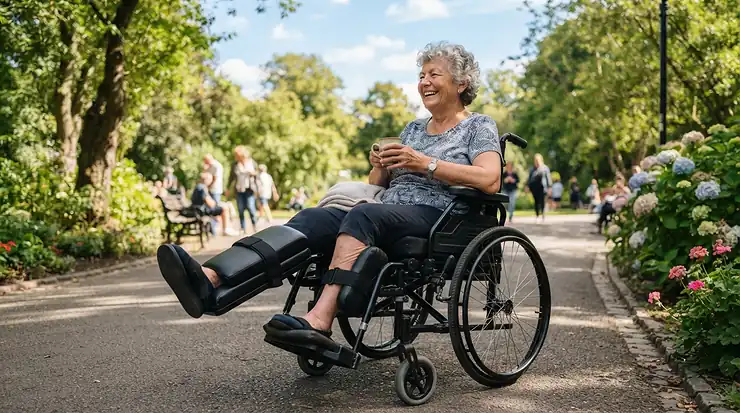
Nobody warns you about the dangling. After a below-knee amputation, the first few weeks in a wheelchair bring a daft but serious problem: the residual limb has nothing to rest on. A standard footplate is no use to it. Left to hang, the limb swells, aches and, over time, the knee can stiffen into a bent position that makes walking with a prosthesis much harder.
That is where amputee wheelchair leg supports earn their keep. Hospital teams call them stump boards, and they cradle the limb in a straight, supported, comfortable position. Clinical guidance in the Royal Marsden Manual says residual limb support boards are required for below-knee amputees sitting out in a wheelchair. They help prevent knee flexion contractures, and letting the limb dangle early after surgery risks more swelling.
This guide is for people searching for leg rests for post-surgery wheelchair users, and for the relatives and carers helping them. I’ll compare seven real products, explain stump support positioning in plain English, and cover what makes post-amputation comfort better or worse. I’ll also look at how rehabilitation seating fits into the bigger recovery picture.
One honest caveat first. I haven’t used any of these products, and I haven’t invented reviews. Several are supplied mainly through clinical and mobility retailers, so check whether a current amazon.co.uk listing exists. Always agree any purchase with your occupational therapist or wheelchair service first.
Quick Comparison Table: Amputee Wheelchair Leg Supports at a Glance
| Product | Type | Best For | Indicative Price Range* |
|---|---|---|---|
| Sunrise Medical Breezy Basix/Q200 Stump Support | Footrest-replacement pad | Breezy Basix or Q200 users | Around £40-£90 |
| Drive Aluminium Amputee Support (XS2/SD2) | Quick-release frame and pad | Drive XS2/SD2 owners | Around £55-£80 |
| Invacare Wheelchair Amputee Hinged Support (TAG2294000) | Hinged positioning aid | Budget-conscious buyers | Under £50 |
| Proactive Medical Universal Wheelchair Stump Support | Universal attachment | Mixed or older wheelchair fleets | Varies by seller |
| Drive Medical Limb Support | Padded calf/limb rest | Drive Medical chairs, elevation | Under £60 |
| AliMed Unpadded Amputee Support Surface | Seat board plus foam stump pad | Clinics and custom cushion setups | Several hundred pounds |
| AliMed Cushioned Stump Support | Memory foam pad only | Replacements and add-ons | Check current price |
*Indicative ranges at the time of research; prices vary by seller and change often.
Looking at the table, the Invacare Wheelchair Amputee Hinged Support (TAG2294000) and Drive Medical Limb Support sit at the budget end. The Sunrise Medical Breezy Basix/Q200 Stump Support and Drive Aluminium Amputee Support (XS2/SD2) cost more because they’re built around specific chair frames. The AliMed Unpadded Amputee Support Surface is the premium, clinic-led option.
💬 Just one click — help others make better buying decisions too!😊
Top 7 Amputee Wheelchair Leg Supports: Expert Analysis
1. Sunrise Medical Breezy Basix/Q200 Stump Support — best for padded, contoured comfort
The standout here is the contoured cushion. It replaces the standard footrest rather than bolting on beside it, so the residual limb sits in a shaped, padded cradle.
Height and angle are both adjustable, which matters because residual limbs change shape quickly in the first months. The frame attaches securely to compatible models and comes off when you don’t need it. Supplier descriptions claim it helps reduce strain on the hip and lower back, though that comes from the seller, not independent testing.
Based on the specs, this suits anyone already using a Breezy Basix wheelchair or Q200 powerchair, particularly where a therapist wants angle fine-tuned. The compatibility limit is the catch. If you use another chair, it’s a non-starter.
I couldn’t find enough verifiable customer reviews to summarise honestly. Treat any star rating you see with caution until you’ve read the actual comments.
Pros:
- ✅ Padded, contoured cushion protects skin
- ✅ Height and angle both adjustable
- ✅ Removable when not needed
Cons:
- ❌ Only fits Breezy Basix and Q200 models
- ❌ Few independent reviews to check
Price: around £40-£90, depending on supplier. Good value if you own the matching chair.
2. Drive Aluminium Amputee Support (XS2/SD2) — best quick-release for easy transfers
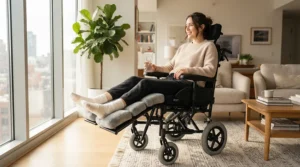
Quick release is the headline, and it’s more useful than it sounds. Transfers (bed to chair, chair to car) are the riskiest moments of a wheelchair day, and a support that swings clear or comes off in seconds removes one obstacle.
It’s designed for the Drive XS2 and SD2 wheelchairs, with adjustable height and length plus a flip-up support pad. The SD2 is an aluminium self-propel chair with an added double cross brace, and UK mobility retailers stock it. That suggests a reasonable pool of owners.
On paper, the flip-up pad suits people who move between the board and a normal seated position several times daily. The length adjustment matters because stump length varies enormously between individuals.
Verifiable reviews were thin when I researched this. One overseas retailer listed it as out of stock, so check UK availability before planning around it.
Pros:
- ✅ Quick release speeds up transfers
- ✅ Height and length adjustable
- ✅ Flip-up pad adds flexibility
Cons:
- ❌ Limited to XS2 and SD2 chairs
- ❌ Stock can be patchy
Price: around £55-£80. Fair for an aluminium, adjustable build.
3. Invacare Wheelchair Amputee Hinged Support (TAG2294000) — best budget hinged positioning
Hinged design is the hook. Instead of a fixed board, it lets you alter leg position smoothly, which helps when your comfort needs shift across a long day.
The listing describes it for home or clinical use, aimed at maintaining alignment and reducing strain during long sits. That’s the right goal, but the listing gives little technical detail on dimensions or fitting range. So, before buying, confirm it fits your frame and your stump length.
My analytical take: this is a sensible first purchase for someone short on cash who needs something workable while the NHS supply is delayed. It’s less suitable as a long-term, clinician-prescribed solution because detail is sparse.
Verifiable reviews were limited. I’d rather say that plainly than imply a consensus.
Pros:
- ✅ Hinge allows easy position changes
- ✅ Suitable for home or clinical use
- ✅ Among the cheapest options here
Cons:
- ❌ Sparse published specifications
- ❌ Fit to your chair needs checking
Price: under £50. Strong value if it fits, but verify compatibility first.
4. Proactive Medical Universal Wheelchair Stump Support — best for universal fit
“Universal” is both the pitch and the risk. It attaches to a range of wheelchairs, which helps if you have an older or unbranded chair that brand-specific supports won’t fit.
The listing references HCPCS code E0959, which is a US reimbursement code. It tells you what category the item sits in for American insurers, but it isn’t a UK quality mark. Don’t read it as a UKCA or CE-style assurance.
Universal fits generally involve compromises, in my analysis. They can sit slightly differently on each frame, so check stability and height with a therapist rather than trusting the box.
I couldn’t verify a meaningful body of user reviews, and UK pricing was inconsistent between sellers, so compare listings carefully.
Pros:
- ✅ Designed to suit many wheelchair types
- ✅ Purpose-built for residual limb support
- ✅ Useful where brand-specific options don’t exist
Cons:
- ❌ Universal fit can need adaptation
- ❌ US coding isn’t a UK standard
Price: varies widely by seller; check current price. Value depends on how well it fits your chair.
5. Drive Medical Limb Support — best for simple padded elevation
This is the plainest product on the list: a padded calf support intended to elevate a limb. The listing says it attaches to a long list of Drive Medical models, including the Blue Streak, Silver Sport, Chrome Sport, Sentra, Cruiser III, Cirrus IV and Viper, without complicated tools.
Here’s the honest bit. It’s described as a general limb or leg support, not as a purpose-built stump board. For a below-knee amputee, the support needs to hold the residual limb straight and fully supported. So ask your OT whether a calf-style pad does that job for your limb length.
Listings on a US marketplace showed ratings of around four out of five stars, but those reviews relate to a US listing and I couldn’t confirm what buyers actually reported. Treat that as a loose indicator only.
Pros:
- ✅ Padded and easy to attach
- ✅ Compatible with many Drive chairs
- ✅ Low entry cost
Cons:
- ❌ Not specifically a stump board
- ❌ Limited adjustment detail published
Price: under £60. Cheap, but suitability needs professional checking.
6. AliMed Unpadded Amputee Support Surface — best for custom cushion setups
The big idea: you choose your own therapeutic seat cushion. The surface is a sturdy wooden seat, 1½ inches high, with a slow-recovery 2-inch memory foam stump support attached. The weight-bearing area measures 6¾ by 10 inches, and the stump support base runs about 23½ inches long.
Those numbers matter. A 10-inch support length suits a shorter residual limb best, and the memory foam helps spread pressure. Pairing it with a pressure-relieving cushion is sensible, because the Royal Marsden Manual stresses a suitable pressure-relieving cushion for lower-limb amputees.
The catch is access. AliMed lists it for clinical purchasers only, as non-returnable and oversized freight, so a private UK buyer is unlikely to find it on amazon.co.uk. Think of it as a model to discuss with a clinic.
Pros:
- ✅ Lets you choose your own cushion
- ✅ Memory foam spreads pressure well
- ✅ Solid, wooden seating surface
Cons:
- ❌ Clinical purchasers only
- ❌ Non-returnable, oversized freight
Price: several hundred pounds if imported. Premium cost, premium specification.
7. AliMed Cushioned Stump Support — best for refreshing a worn pad
Sometimes the board is fine and the pad isn’t. This is the 2-inch slow-recovery memory foam stump support sold on its own, intended for the AliMed surface above.
Memory foam compresses over months of use, and residual limbs are unforgiving about pressure. Swapping a flattened pad restores the original cushioning without replacing the whole assembly. That’s the practical case for buying parts.
Its limitation is compatibility. It’s made for the AliMed surface, so don’t expect it to fit another manufacturer’s frame without adaptation. Like its parent product, it’s aimed at clinical buyers, which narrows retail availability.
I found no verifiable consumer reviews for it, so I can’t summarise buyer sentiment.
Pros:
- ✅ Replaces a worn pad cheaply
- ✅ Slow-recovery memory foam
- ✅ Keeps the rest of the frame in use
Cons:
- ❌ Fits the AliMed surface only
- ❌ Limited consumer availability
Price: check current price. Worth it only if you already own the matching surface.
Top 7 Spec and Evidence Comparison
| Product | Adjustability | Removal | Review Evidence Found | Best For |
|---|---|---|---|---|
| Sunrise Medical Breezy Basix/Q200 Stump Support | Height and angle | Easy | Limited | Matching Sunrise chairs |
| Drive Aluminium Amputee Support (XS2/SD2) | Height and length | Quick release | Limited | Frequent transfers |
| Invacare Wheelchair Amputee Hinged Support (TAG2294000) | Hinged | Not stated | Limited | Tight budgets |
| Proactive Medical Universal Wheelchair Stump Support | Not stated | Not stated | None found | Non-standard chairs |
| Drive Medical Limb Support | Attachment-based | Tool-free attach | Loose US ratings | Basic elevation |
| AliMed Unpadded Amputee Support Surface | Cushion choice | Not stated | None found | Clinic-led setups |
| AliMed Cushioned Stump Support | None (pad) | Replaceable | None found | Pad replacement |
The table highlights an uncomfortable truth: independent review evidence is thin across this whole category. That makes professional fitting more important than any star rating. If you want adjustment and quick transfers, the Drive Aluminium Amputee Support (XS2/SD2) and Sunrise Medical Breezy Basix/Q200 Stump Support are the more fully specified options.
What Are Amputee Wheelchair Leg Supports?
Amputee wheelchair leg supports are padded boards or rests that carry the weight of a residual limb when someone sits in a wheelchair. They replace or supplement the standard footplate, which a shortened leg can’t use. Their job is to keep the knee extended, support the limb fully, and reduce swelling and discomfort.
In UK hospitals, the Guy’s and St Thomas’ leg amputation recovery guidance explains that people with a below-knee or through-knee amputation have a stump board fitted to the wheelchair. An occupational therapist helps position the limb on it. The same guidance advises against propping the stump on pillows, as that can stiffen the knee.

How to Choose Amputee Wheelchair Leg Supports
- Confirm your amputation level. Below-knee, through-knee and above-knee amputations need different positioning, so let your physio decide what suits yours.
- Check wheelchair compatibility. Brand-specific supports only fit certain frames. A universal model trades precision for flexibility.
- Prioritise adjustability. Residual limbs change shape during healing, so look for height, angle and length adjustment.
- Look for fast removal. Transfers and folding the chair are easier if the support swings away or clips off quickly.
- Inspect the padding. Memory foam spreads pressure, but it flattens over time, so check that it can be replaced.
- Think about stability. Extra weight at the front changes how a wheelchair balances, so ask about anti-tippers.
- Involve your clinician. Check the purchase with your OT or wheelchair service before spending.
Stump Support Positioning: Setting It Up Properly
Good stump support positioning is mostly about three things: straightness, support and avoidance of pressure on the wound.
Start straight. For a below-knee amputation, the knee should rest fully extended on the board. The Lincolnshire NHS physiotherapy guidance says to avoid sitting for long periods with the knee bent, and to use the board or a stool rather than a pillow.
Support the whole limb. The pad should carry the full length of the residual limb, not just the end. Pressure concentrated on the distal end, over the wound, is a common cause of pain after transfers.
Check the height. The board should hold the limb level with the seat, not sloping downwards. Downward slopes encourage swelling.
Review regularly. Swelling reduces over weeks, so a setting that fitted on day five may be wrong by week five. Book a review rather than assuming the first set-up lasts.
Leg Rests for Post-Surgery Wheelchair Users: What Changes in the First Weeks
Leg rests for post-surgery wheelchair users need to cope with a limb that is tender, swollen and still changing. Early on, you may be wearing a bandage or compression sock, and movement can feel frightening.
The Royal Marsden Manual notes that fear of movement, pressure on the end of the residual limb and a dependent, unsupported limb all contribute to pain after transfers. Its advice is to support the limb throughout any change of position and to have analgesia sorted beforehand. That means a leg rest that clips on easily and doesn’t wobble is more than a convenience.
In practice, I’d weigh three things. First, can a carer fit and remove it safely without lifting the limb awkwardly? Second, does the padding stay soft enough for a sensitive wound? Third, will it still work when swelling goes down? A model with adjustable height, like the Sunrise Medical Breezy Basix/Q200 Stump Support, tends to cope better with that moving target.
Post-Amputation Comfort: Pressure, Swelling and Seat Cushions
Post-amputation comfort doesn’t come from the leg support alone. The seat beneath you matters just as much.
Sitting shifts weight onto the buttocks and thighs. Without a foot to share the load, more of it lands on the pelvis, so a pressure-relieving cushion becomes essential, not optional. This is why the AliMed Unpadded Amputee Support Surface lets you choose your own cushion.
Swelling is the other big factor. Keeping the limb supported and level helps, as does following your team’s advice on compression. Pain in the residual limb after sitting for a while can signal poor positioning, so mention it at your next review.
Skin checks are worth building into the routine. Look for redness that doesn’t fade, blisters and sore spots where the pad touches. Catching those early costs minutes; treating a pressure sore costs weeks.
Rehabilitation Seating: Making the Wheelchair Work for Recovery
Rehabilitation seating means a set-up that supports recovery rather than merely transporting you. The wheelchair is where many people spend most of their day, so the position matters for muscles and joints.
A well-fitted support keeps the hip and knee in a position that protects range of movement. That matters because the Lincolnshire guidance says preventing the hip and knee from staying flexed is a central aim after below-knee amputation. Physio exercises done at the edge of a bed or seated in the chair can also build strength while you’re waiting for a prosthesis.
Think about the chair too. Anti-tippers, a suitable cushion and a frame that handles a front-weighted support all contribute. A support that suits a lightweight transit chair may not suit a self-propel model like the SD2, so match the two.
✨ Don’t Miss These Options!
🔍 Take your recovery set-up to the next level with the supports above. Click on any highlighted product to check current pricing and availability, and chat with your therapist before you buy!
Real-World Scenarios: Matching Supports to People
Scenario 1: A retired teacher, below-knee amputation, using a Drive SD2 at home. She transfers between sofa and chair several times a day and her daughter helps. The quick-release Drive Aluminium Amputee Support (XS2/SD2) fits the frame and makes each transfer simpler. Budget: moderate.
Scenario 2: A carer on a tight budget, needing something while he waits for NHS supply. He needs a stopgap for a few weeks. The Invacare Wheelchair Amputee Hinged Support (TAG2294000) is the cheapest verified option here, provided it fits his chair. Budget: low.
Scenario 3: A clinic equipping a rehabilitation ward. The team wants adjustable, cleanable, replaceable parts and a cushion of their choice. The AliMed Unpadded Amputee Support Surface and spare AliMed Cushioned Stump Support pads suit that approach. Budget: higher, supplied through clinical channels.
In each case, the best product is the one that fits the chair and the person. Cost and brand come second.
Problem and Solution Guide
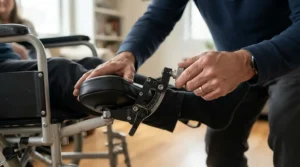
Problem: the support makes folding the chair impossible. Choose a removable design, such as the Sunrise Medical Breezy Basix/Q200 Stump Support, or one that detaches quickly. The REMAP charity case describes a volunteer-built support for a woman with an above-knee amputation who travelled often. It slid under the seat on a hooked rod and lifted off into a bag so her electric chair could fold.
Problem: the pad flattens and hurts. Replace it. An AliMed Cushioned Stump Support pad can be swapped without changing the frame.
Problem: the chair feels unsteady. Front-weighted supports shift the balance. Ask about anti-tippers and a lower speed until you’re confident.
Problem: your limb swells in the afternoon. Check height and support length, and mention it to your physio.
Problem: nothing fits my odd chair. Consider the Proactive Medical Universal Wheelchair Stump Support, or ask a charity like REMAP about a bespoke solution.
Safety, Regulations and Getting NHS Wheelchair Support
Safety comes first, and it starts with fitting. The British Red Cross’s stump board guidance explains that a board can alter the wheelchair’s centre of gravity and make it less stable. Their service fits boards before loan and gives specific warnings about use and speed. If a board makes the chair feel wobbly, slow down and ask for a review.
On regulation, look for UKCA or CE marking on mobility products sold in the UK, and be wary of listings with no manufacturer information. A US code such as E0959 won’t reassure you here.
NHS wheelchair services can assess and supply equipment, and some charities offer short-term loans. Because a stump board is clinically important, a prescription route is often smarter than guessing. If you buy privately, tell your therapist what you’ve chosen so they can check the fit.
Common Mistakes When Buying Amputee Wheelchair Leg Supports
Buying before assessment. A model that suits one amputation level can be wrong for another.
Assuming “universal” means “fits anything”. It means “fits many things, imperfectly”.
Using pillows as a shortcut. Guidance from the NHS trusts quoted above warns against pillows under the knee after a below-knee amputation, because they encourage stiffness.
Ignoring the cushion. The support and the seat work as a pair.
Chasing the lowest price. A bargain that doesn’t fit is the most expensive option.
Forgetting future changes. Prosthetic fitting will change your needs, so pick equipment that adapts or can be removed.
Benefits of Dedicated Supports vs Traditional Alternatives
| Option | Support Quality | Adjustability | Cost | Best For |
|---|---|---|---|---|
| Sunrise Medical Breezy Basix/Q200 Stump Support | High, contoured | High | Moderate | Matching chairs |
| Drive Medical Limb Support | Moderate | Basic | Low | Simple elevation |
| Pillows or cushions | Low, unstable | None | Very low | Not recommended |
| Standard footplate | None for the limb | None | Included | Not suitable |
| Bespoke or charity-built | Tailored | Custom | Varies | Unusual chairs |
Dedicated supports clearly beat pillows, which can encourage knee stiffness, and standard footplates, which can’t hold the limb at all. A budget option like the Drive Medical Limb Support is a step up from improvisation but not a clinical fix. Bespoke builds suit unusual situations, as the REMAP example shows.
Long-Term Cost and Maintenance
A leg support is a small outlay set against the cost of complications. Spending a modest amount on a well-fitting board is sensible if it reduces swelling, pain and contracture risk.
Maintenance is simple. Wipe pads with a mild cleaner, check straps and fixings for wear, and look for cracks in boards. Memory foam compresses over time, so replace pads when they stop springing back. That’s the case for a spare AliMed Cushioned Stump Support pad.
Plan for change. Once a prosthesis is fitted, you may need the support less often, and a removable model such as the Drive Aluminium Amputee Support (XS2/SD2) is easier to retire. Overall cost of ownership depends more on fit and durability than on the sticker price.
Frequently Asked Questions
❓ Do I need amputee wheelchair leg supports after a below-knee amputation?
❓ Can I use a pillow instead of a stump board?
❓ Where can I buy a wheelchair stump support in the UK?
❓ Will a stump board make my wheelchair unstable?
❓ How do I stop my residual limb swelling in a wheelchair?
Conclusion
Choosing among amputee wheelchair leg supports comes down to fit, adjustability and professional advice. The Sunrise Medical Breezy Basix/Q200 Stump Support and Drive Aluminium Amputee Support (XS2/SD2) are the best-specified options for matching chairs. The Invacare Wheelchair Amputee Hinged Support (TAG2294000) and Drive Medical Limb Support serve tighter budgets. The Proactive Medical Universal Wheelchair Stump Support suits awkward chairs. The AliMed Unpadded Amputee Support Surface and AliMed Cushioned Stump Support are clinical-grade choices for therapy-led set-ups.
What ties it together is how little independent review evidence exists, so your therapist’s eye matters more than any star rating. Get stump support positioning right early, protect post-amputation comfort with a proper cushion, and treat rehabilitation seating as part of recovery. Check availability and current prices before you buy.
✨ Ready to Find Your Fit!
🔍 Take your comfort and recovery to the next level with these carefully selected supports. Click on any highlighted product to check current pricing and availability, and talk to your therapist so your set-up works for you!
Recommended for You
- Buy Wheelchair Calf Pads: 7 Best Picks For UK Users (2026)
- Elevating Leg Rests For Circulation: 7 Best UK Picks (2026)
- Elevating Leg Rests Vs Standard Leg Rests: 7 Proven Picks (2026)
Disclaimer: This article contains affiliate links. As an Amazon Associate, I earn from qualifying purchases. If you purchase products through these links, we may earn a small commission at no additional cost to you.
✨ Found this helpful? Share it with your friends! 💬🤗
