
In This Article
Wheelchair leg rests are the footplate-and-calf-support assemblies that carry the weight of your lower legs while you’re seated. They come as fixed, swing-away or elevating designs, and they decide how your hips, knees and ankles sit for hours at a time. Get them right and you barely notice them. Get them wrong and you’ll notice nothing else.

Nobody browses for wheelchair leg rests for fun. You’re here because a pair has gone missing, a hospital discharge has dropped a new chair in the hallway, or someone you love keeps saying their feet “feel wrong” by mid-afternoon. Fair enough. But sitting still isn’t neutral. The NHS lists sitting or standing in the same position for too long among the common causes of swollen ankles, feet and legs, and its self-care advice includes raising the legs when you can (NHS guidance on swollen ankles, feet and legs). Elevating options are one practical way to do that without leaving the chair.
This guide covers seven real options, from universal elevating leg rests that rescue a lost-pair emergency to brand-matched sets for specific chairs. It keeps coming back to three questions. Will it fit (leg support compatibility)? Will it hold the right angle (adjustable angle brackets)? And will it help posture and comfort rather than quietly working against them?
One honest note first. I haven’t tested any of these products and won’t pretend otherwise. Everything here is built from manufacturer specifications, UK health guidance and the themes that recur in buyer reviews. Where I couldn’t verify something, I say so. Many of these models come from North American catalogues, so UK stock, part numbers and Amazon UK availability vary. Match your chair before you click.
Wheelchair Leg Rests at a Glance: Quick Comparison Table
Short on time? This snapshot lines up all seven picks by type, fit and typical price band, so you can narrow the field before reading the detail.
| Product | Type | Fits (per listing) | Price band | Best For |
|---|---|---|---|---|
| ReyjiuMed Universal Elevating Leg Rests | Universal, elevating | Most standard, transport and reclining chairs (not heavy-duty or bariatric) | £35–£55 | Budget replacement of a lost or damaged pair |
| Drive Medical LK3JELR | Swing-away, elevating | Named Drive models (Blue Streak, Silver Sport, Cruiser III/X4, Polyfly) | £45–£95 | Owners of those Drive chairs |
| Drive Medical Articulating Elevating Legrests | Articulating, elevating | Most standard manual chairs | £70–£120 | Frequent elevation, longer legs |
| Invacare T94HCP | Swing-away, hemi spacing | Invacare Tracer and 9000 series (not Topaz) | £110–£160 | Invacare owners wanting tool-free length changes |
| Invacare Hemi SmartLeg | Articulating, auto-lengthening | Tracer and 9000 series (variant-dependent) | £130–£190 | Taller users who elevate often |
| Quickie Life R Elevating Legrests | OEM elevating, single or pair | Quickie Life R | Via dealer quote | Exact-match fit on that chair |
| Aidapt Beaumont Leg Rest | Off-chair stool, 385–535 mm | Any chair or sofa | Under £60 | Home use beside a wheelchair |
Price bands are indicative. Where UK prices weren’t visible I’ve converted from overseas listings, so check the current price on the day.
Looking at the table, the ReyjiuMed Universal Elevating Leg Rests are the obvious rescue pick when a pair has vanished, but “universal” only helps if your hanger brackets match. Owners of the listed Drive chairs get more certainty from the Drive Medical LK3JELR. Taller users should look hard at the articulating designs, Drive Medical Articulating Elevating Legrests and Invacare Hemi SmartLeg, because length is the complaint buyers raise most. The Aidapt Beaumont Leg Rest isn’t a like-for-like substitute at all. It earns its place as the home companion to an on-chair pair.
💬 Just one click — help others make better buying decisions too!😊
Top 7 Wheelchair Leg Rests: Expert Analysis
Here’s each option in turn. I’ve translated every spec into what it means in daily use, and where review data exists I’ve summarised the themes buyers repeat.
1. ReyjiuMed Universal Elevating Leg Rests — budget-friendly universal replacement
The pitch is rescue. This is a universal pair for people whose originals have gone missing or snapped. The listing describes padded calf pads and composite footplates. It says the design is functionally consistent with the Drive LK3JELR and Invacare T94 sets, and suitable for most standard manual, transport and reclining chairs. It also states plainly that heavy-duty and bariatric chairs are out, which is refreshingly honest.
What does that mean in practice? “Consistent in function and structure” isn’t the same as “guaranteed to bolt on”. The deciding factor is the spacing of your hanger brackets, so measure first. My read: it’s a sensible choice for a mainstream chair where original parts are discontinued or the repair quote is silly, and a poor choice for anything non-standard.
On reviews, an overseas Amazon listing I found showed roughly 4.0 stars from 58 ratings. I couldn’t verify a UK-specific tally, so treat that as a loose signal, not a verdict.
Pros:
- ✅ Low cost for a full padded pair
- ✅ Padded calf pads included
- ✅ Aimed at standard, transport and reclining chairs
Cons:
- ❌ Not suitable for heavy-duty or bariatric chairs
- ❌ “Consistent with” fit claims still need checking
Expect roughly £35–£55 at the time of research; check current price. As a stopgap that undercuts branded sets, the value case is strong if the fit holds.
2. Drive Medical LK3JELR — fits the popular Drive range
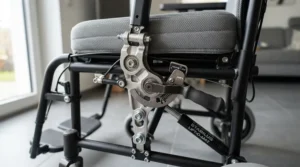
The standout here is certainty. The LK3JELR is a swing-away elevating pair that Drive lists for several of its own chairs: Blue Streak, Silver Sport 1, 2 and Reclining, Cruiser III, Cruiser X4 and Polyfly. The frame is chrome with a textured non-skid plastic footplate. Swing-away simply means the rest pivots clear of the footprint, which makes transfers noticeably safer than clambering over fixed plates.
Retailer listings quote a load limit around 113 kg (250 lb), so check that against your own weight and your chair’s limit. If you own one of the named chairs, this is arguably the lowest-drama route, because you’re buying the part the chair was designed around.
Reviews on a retailer page carrying Amazon-sourced feedback are mixed in an instructive way. Buyers praise the fit on Drive chairs and a smooth, quiet raising mechanism. The recurring complaint is length: some taller users find the rests about an inch too short. One reviewer who bought a pair for a temporary broken leg called them fine for a few months. Another noted that a very small user could slip between the two calf pads.
Pros:
- ✅ Matched to named Drive wheelchair models
- ✅ Swing-away action eases transfers
- ✅ Reviewers describe a smooth, quiet elevating mechanism
Cons:
- ❌ Length falls short for some taller users
- ❌ Gap between calf pads can worry carers of very small users
Price runs roughly £45–£95 depending on seller; check current price. Good value on a compatible Drive chair, questionable value if your legs are long.
3. Drive Medical Articulating Elevating Legrests — lengthen as they lift
The hook is geometry. A standard elevating rest pivots at the hanger bracket, not at your knee, so as it rises the footplate can end up too far from, or too close to, where your foot wants to be. Articulating designs compensate by extending. This Drive pair lists an adjustable range of 15 to 19.75 inches. My reading is that this is the span within which the rest’s length can be tuned, but confirm that against the live listing.
Why does that matter? Because the usual complaint with fixed-length elevating leg rests is a heel dragging or a knee being pulled straight. An articulating pair is meant to ease that. The listing promotes circulation and reduced leg fatigue on extended sitting, which is plausible reasoning but worth treating as marketing language rather than clinical evidence.
I couldn’t verify review data for this specific pair, so I won’t invent a sentiment summary. Look at the buyer feedback on the live listing, particularly any mention of footplate drop or wobble at full extension.
Pros:
- ✅ Wider length range than fixed elevating rests
- ✅ Designed for most standard manual wheelchairs
- ✅ Articulation helps leg and rest stay aligned
Cons:
- ❌ More moving parts to inspect and maintain
- ❌ No verifiable review data found
Likely in the £70–£120 bracket, but UK pricing wasn’t confirmed; check current price. Worth the premium if you elevate frequently or sit tall.
4. Invacare T94HCP — tool-free length adjustment on a trusted frame
The standout is the front-rigging design: tool-free attachment and length adjustment. The T94HCP pairs swing-away hemi-spaced elevating rests with composite footplates and padded calf pads. The hinge brackets are spaced 1.5 inches apart, and Invacare lists the set as compatible with Tracer and 9000 series chairs, excluding the 9000 Topaz.
In practical terms, tool-free adjustment is the difference between fixing a fit problem on the spot and hunting for a spanner. Hemi spacing is the wider, more common standard, which is why other manufacturers benchmark against this code. Note that Tracer and 9000 are North American model lines. If your chair is a UK Invacare, such as the Action range, don’t assume interchangeability. Check part numbers with the supplier.
I couldn’t verify buyer reviews for this exact code, so there’s no review summary here.
Pros:
- ✅ Tool-free fitting and length adjustment
- ✅ Composite footplates with padded calf pads
- ✅ Swing-away design for easier transfers
Cons:
- ❌ Compatibility limited to named Invacare series
- ❌ Dearer than universal alternatives
An MSRP near the equivalent of £110–£160 suggests that bracket at the time of research; check current price. Strong value for Invacare owners who want a like-for-like replacement, and poor value for everyone else.
5. Invacare Hemi SmartLeg — auto-lengthening articulating design
The standout feature is self-adjusting length. According to the listing I found, one variant (AHL4A) is aimed at taller users and lengthens automatically as it elevates. It carries padded calf pads and is listed for Tracer and 9000 series chairs, again excluding the Topaz. A second variant is described as suiting average-height users on a wider range of standard chairs.
Here’s what the spec sheet won’t tell you. Automatic lengthening removes the fiddly step of re-adjusting every time you change angle, which matters if you elevate and lower several times a day. It also means the footplate position stays more consistent as the leg moves. That’s exactly the sort of detail that decides whether you keep using the feature or abandon it after a week.
The information comes from a third-party reseller page, so I’d verify the variant codes with a UK supplier before ordering. No verifiable review data turned up.
Pros:
- ✅ Lengthens automatically as it elevates
- ✅ Padded calf pads for longer sitting sessions
- ✅ Variant aimed squarely at taller users
Cons:
- ❌ Variant fit limited to named Invacare series
- ❌ Highest price band here, with thin review data
Roughly £130–£190 at the time of research; check current price. Justifiable only if you elevate often and length has been your sticking point.

6. Quickie Life R Elevating Legrests — OEM-matched, orderable by side
The hook is precision. Sunrise Medical lists these elevating legrests for the Quickie Life R, and they can be ordered as a single or a pair, with separate option codes for the left (050009) and right (050010). The listing also tells buyers to check compatibility carefully before ordering, which is the right instinct.
Single-side ordering is the underrated feature. If someone needs only one leg raised, say after an injury or surgery, a pair is wasted money and clutter. Because this is a manufacturer part rather than a universal one, you also remove most of the guesswork around hanger fit. The trade-off is flexibility: it only belongs on its intended chair.
No verifiable consumer reviews turned up, which is typical for dealer-supplied accessories. Availability through Amazon UK may be limited, so it’s worth confirming with a supplier first.
Pros:
- ✅ Engineered for the Quickie Life R
- ✅ Left or right available separately
- ✅ Suits single-leg elevation needs
Cons:
- ❌ Useless on other wheelchair makes and models
- ❌ Likely dealer-supplied, so availability varies
Price is typically quoted by dealers; check current price. Excellent value when exact fit matters more than shaving pounds.
7. Aidapt Beaumont Leg Rest — off-chair elevation for home
The twist: it isn’t mounted on a wheelchair at all. This is a height-adjustable leg stool (385–535 mm) with an epoxy-coated metal frame, anti-slip rubber feet and a fire-retardant, easy-clean vinyl top with heat-sealed seams.
Why include it? Because many wheelchair users spend part of the day in an armchair or on a sofa, where raising the legs is easiest and the chair’s own rests are out of the picture. It also costs far less than a premium on-chair set. It can’t help when you’re being pushed to an appointment, of course. Think of it as the partner to an on-chair pair, not a substitute.
A product-data page showed 4.4 out of 5 stars across 865 reviews and a number one rank in Amazon UK’s wheelchair and mobility scooter foot and leg rests category when captured. Rankings shift, so verify live. One buyer said they needed one quickly after a sudden medical issue.
Pros:
- ✅ Wide height range for different seats
- ✅ Anti-slip feet and wipe-clean vinyl
- ✅ Strong review volume on Amazon UK
Cons:
- ❌ Doesn’t attach to or travel with the wheelchair
- ❌ Takes up floor space at home
Typically in the budget bracket, likely under £60; check current price. Great value as a home companion.
How to Fit and Set Up Wheelchair Leg Rests: A Practical Guide
Amazon listings tell you what a product is. They rarely tell you how to live with it. Here’s the routine I’d follow with any new pair.
Before you start
- Identify your chair’s make and model from its label.
- Measure the spacing between the hanger brackets (examples quoted in listings include 1⅜ and 1½ inches) with a ruler or callipers.
- Measure from the back of the knee to the heel in the shoes you normally wear.
Fitting
- Put the brakes on, on a level floor, with nobody seated.
- Attach each rest at the hanger and listen for the latch to click home.
- Set the footplate height so the thighs stay supported along the cushion rather than being lifted off it. Ask a therapist for your target position.
- Test the swing-away action empty. It should move freely and lock firmly.
Your first 30 days
- Re-check fasteners after the first week; new hardware settles.
- Wipe down weekly, and look at the calf pads and heel loops monthly.
- Don’t leave legs raised for hours without breaks. Vary position.
- Watch for pinch points when folding the chair.
The most common early mistake is setting both rests too short “just to see”, then forgetting. A footplate that’s a couple of centimetres out can quietly tilt the pelvis and shift weight onto the heels.

Real-World Scenarios: Which Wheelchair Leg Rests Suit Which User?
Specs make more sense with a face attached. Here are three profiles, each with budget, environment and frequency of use.
The short-term recovery. Say you’re recovering from a broken ankle on a loaned Drive chair, budget £50–£100, using it a few hours a day for about three months. The Drive Medical LK3JELR is the logical fit because it’s built around that chair, and one reviewer’s “good enough for a few months” comment matches this timeline. If only one leg needs elevating and the chair is a Quickie Life R, the single-sided ordering on the Quickie Life R Elevating Legrests saves money.
The tall daily user. Picture someone around 190 cm in a standard chair, elevating several times a day, with a mid-range budget. Length complaints dominate reviews of fixed-length rests, so articulating options like the Drive Medical Articulating Elevating Legrests or the Invacare Hemi SmartLeg deserve the shortlist. The self-lengthening design suits the person who doesn’t want to keep re-tuning.
The carer on a tight budget. A daughter caring for a slight, elderly mother who rarely elevates needs minimal fuss. The ReyjiuMed Universal Elevating Leg Rests keep costs down, but check the gap between calf pads, since reviewers of similar designs flag slipping risk for very small users. Pair it with the Aidapt Beaumont Leg Rest at home so raising the legs becomes part of the armchair routine, not a wheelchair chore.
How to Choose Wheelchair Leg Rests: 7 Steps That Actually Matter
- Start with your chair, not the leg rest. Note the make, model and year. If it was issued through NHS wheelchair services, speak to them first. In England these services are regionally run, and your GP’s address decides which one you’re referred to (Spinal Injuries Association guide to getting a wheelchair).
- Decide what you need the rest to do. Elevate, swing away for transfers, or both?
- Measure lower-leg length. The knee-to-heel measurement is what separates comfortable from “an inch too short”.
- Confirm hanger and bracket compatibility. More on this in the next section.
- Check weight limits. Look at both the leg rest and your chair’s rating.
- Inspect the details. Calf pad design, footplate material and heel loops matter more over months than headline specs.
- Ask a professional if there’s a medical reason. Circulation, swelling or surgery justify a therapist’s input, not just a shopping basket.
Leg Support Compatibility: Matching Leg Rests to Your Chair
Leg support compatibility is where most purchases quietly go wrong. Listings use phrases such as “compatible with most wheelchairs”, which is optimistic marketing. In reality three things decide fit: the hanger bracket spacing, the style of the chair’s mounting (swing-away versus fixed), and the specific series.
The listings I reviewed show how fine-grained this gets. One Karman listing cites a footrest pin gap of 1⅜ inches. Invacare cites 1.5-inch hinge-bracket spacing. Drive lists exact chair names. A few millimetres can mean a rest that won’t seat, or one that rattles.
Brand-labelled listings can help. A Healthline Trading pair on a UK marketplace states compatibility with Healthline, Drive and Invacare chairs, though it showed no ratings, so there’s nothing to summarise.
Practical rules:
- Match the model name where a manufacturer lists one.
- Treat “universal” as “probably, after measuring”.
- Order left and right deliberately where parts are side-specific.
- Keep receipts and returns terms handy in case the fit is wrong.
If the chair is a prescribed NHS one, confirm that fitting third-party parts won’t cause problems with servicing or responsibility.
Universal Elevating Leg Rests vs Brand-Specific Options
Universal elevating leg rests promise freedom: one product, many chairs. Brand-specific sets promise certainty. Which wins depends on how much you value the last 10% of confidence.
| Factor | Universal elevating leg rests | Brand-specific sets |
|---|---|---|
| Fit certainty | Good on mainstream chairs, patchy elsewhere | High on the named chair |
| Price | Usually lower | Usually higher |
| Adjustability | Varies, often basic | Often better matched |
| Availability | Wide | Dealer-dependent |
| Best For | ReyjiuMed Universal Elevating Leg Rests | Invacare T94HCP, Quickie Life R Elevating Legrests |
The table makes the trade-off visible: universals buy you price and availability, while brand-specific sets buy you peace of mind. If your chair is a popular model and the original parts are discontinued, the ReyjiuMed Universal Elevating Leg Rests make sense. If your chair is niche or you can’t afford a return, spending more on Invacare T94HCP-style certainty is usually cheaper than a second purchase.
Elevating Leg Rests vs the Alternatives
Elevating rests aren’t the only way to support your legs. Fixed footplates are simple and rugged. Swing-away non-elevating rests ease transfers. A stool handles home use.
| Option | Strength | Weakness | Best For |
|---|---|---|---|
| Fixed footplates | Simple, light | No elevation | Active everyday use |
| Swing-away, non-elevating | Easier transfers | No elevation | Frequent transfers |
| Elevating on-chair | Elevation anywhere | Heavier, longer | Drive Medical LK3JELR users |
| Off-chair stool | Cheap, comfortable at home | Not portable | Aidapt Beaumont Leg Rest |
Reading across, if you rarely need your legs raised, fixed footplates stay lighter and simpler to manoeuvre. If you elevate daily, on-chair elevating rests are the only option that works wherever you are. And for the long evening in front of the television, the Aidapt Beaumont Leg Rest gives you the benefit at a fraction of the cost.
Adjustable Angle Brackets: What They Do and Why They Matter
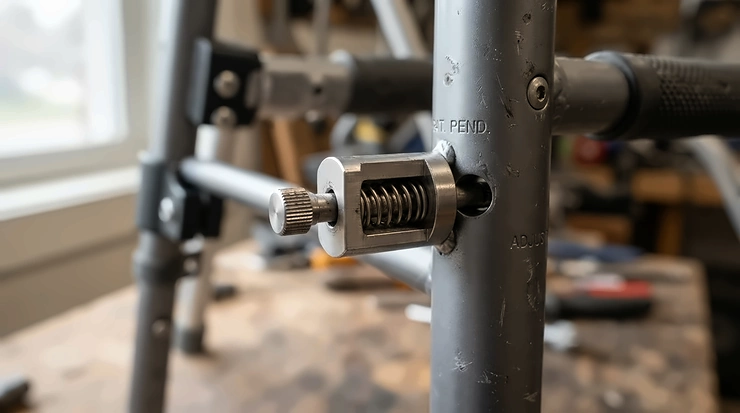
Adjustable angle brackets are the quiet heroes of elevating rests. They’re the pivot hardware that lets you move from nearly vertical to nearly horizontal, and then hold that angle under the weight of a leg. Cheap hardware slips, and slipping means constant re-adjustment or a leg sliding down.
Manufacturers describe the ability to set the angle “at almost any desired angle”, while older patents describe calf clamps with a cam surface to set the height. The common thread is a locking mechanism, and the type of lock matters. Look for brackets that hold position without you babysitting them, and test them with the leg’s actual weight rather than empty.
Two practical checks apply. First, make sure the adjustment is genuinely tool-free if you’ll change angle daily, as with the Invacare T94HCP, whose listing emphasises tool-free length adjustment. Second, remember that angle and length interact: raise a standard rest and the footplate position shifts, which is exactly the problem the Drive Medical Articulating Elevating Legrests and Invacare Hemi SmartLeg try to solve.
When shopping, ask whether adjustable angle brackets lock positively, whether they wear over time, and whether replacement parts exist.

Posture and Comfort: What Good Leg Support Actually Changes
Posture and comfort aren’t luxuries; they’re how a chair either works with your body or against it. Leg rests influence the pelvis, knees and feet more than people expect. If footplates sit too high, thighs can lift off the cushion and pressure shifts to the seat bones. If they sit too low, feet dangle and hamstrings pull. And with elevating rests, a straight knee can tilt the pelvis backwards in some users, which is why a therapist’s view is worth having.
Elevation helps the legs, but it doesn’t replace moving. NHS wheelchair-service guidance, for instance, advises shifting position to relieve pressure every 15–30 minutes by leaning or rolling (Wirral Community NHS pressure ulcer booklet for wheelchair users). A comfortable leg rest can tempt you to stay put longer, so build movement into the day regardless.
Practical pointers:
- Check where the weight sits after ten minutes, not ten seconds.
- Make sure heels aren’t pressing hard against the footplate.
- Use padded calf supports so the lower leg isn’t resting on a hard edge.
- Rotate between raised and lowered positions through the day.
If swelling, pain or skin changes appear, don’t troubleshoot alone. Ask a clinician.
Long-Term Cost and Maintenance
Price on the day tells half the story. A £50 pair that lasts three years costs less per year than a £150 pair that lasts four, but only if it keeps fitting and working. Think in terms of cost per month of reliable use, plus the cost of getting it wrong.
Recurring costs are small but real: replacement calf pads, heel loops, footplate surfaces and fasteners. Universal pairs may have limited spare-part support, while manufacturer sets often have dedicated parts. That’s a quiet advantage of brand-matched options such as the Quickie Life R Elevating Legrests and the Invacare T94HCP.
A simple maintenance routine protects your investment:
- Wipe vinyl and plastic weekly with mild cleaner.
- Check pivots, latches and bolts monthly.
- Look for cracks, rust or pad splits every few months.
- Replace worn pads before they cause pressure points.
And remember value isn’t only money. For a short-term recovery, a cheap pair that works for three months is the better buy than a premium set you’ll never fully use.
Safety, Regulations and NHS Wheelchair Services
In Great Britain, wheelchairs and their accessories are medical devices, so look for UKCA or CE marking and a clear UK or EU supplier address. If a listing offers neither, ask before buying.
If your chair came through the NHS, remember the service sits behind it. NHS England publishes a non-mandatory model specification for wheelchair and postural services that integrated care boards can use when commissioning (NHS England model service specification). Local eligibility rules vary, so contact your own service about modifications, repairs and personal wheelchair budgets.
Know the red flags too. NHS advice says to seek urgent help if you have swelling in just one leg with no obvious cause, if the swollen area is red or hot, or if you have diabetes and your feet, ankles or legs are swollen. Raising the legs is supportive, not a treatment, and shouldn’t delay medical advice.
FAQ
❓ Do wheelchair leg rests come in different lengths?
❓ Are elevating wheelchair leg rests good for swollen legs?
❓ Can I buy a single wheelchair leg rest instead of a pair?
❓ How much do wheelchair leg rests cost in the UK?
❓ Can I fit leg rests from a different brand to my wheelchair?
Conclusion
Wheelchair leg rests rarely get the attention they deserve until something goes wrong. The right pair supports your legs, steadies your posture and protects your comfort through a long day, and the wrong pair gradually erodes all three.
Here’s the short version. If you need an affordable rescue for a mainstream chair, start with the ReyjiuMed Universal Elevating Leg Rests. If you own a named Drive chair, the Drive Medical LK3JELR gives the most certainty. Taller or frequent elevators should compare the Drive Medical Articulating Elevating Legrests and Invacare Hemi SmartLeg. Invacare owners wanting a like-for-like replacement should look at the Invacare T94HCP, and Quickie owners at the Quickie Life R Elevating Legrests. For evenings at home, the Aidapt Beaumont Leg Rest is a smart companion.
Whatever you choose, measure twice. Check hanger spacing, lower-leg length and weight limits, and be honest about how long you’ll use them. Where there’s a medical reason for elevating the legs, involve your GP, therapist or NHS wheelchair service. A few minutes of checking now beats a returned parcel later.
✨ Don’t Miss These Exclusive Deals!
🔍 Take your seating setup to the next level with these carefully selected options. Click any highlighted product name to check current pricing and availability. These picks will help you create a more comfortable, supported day for the person you care for!
Recommended for You
- Footplates For Wide Wheelchairs: 7 Best Picks For UK Users (2026)
- Buy Folding Wheelchair Footplates: 7 Proven Picks For UK Users (2026)
- Large Footplates For Bariatric Wheelchairs: 7 Proven Picks (2026)
Disclaimer: This article contains affiliate links. As an Amazon Associate, I earn from qualifying purchases. If you purchase products through these links, we may earn a small commission at no additional cost to you.
✨ Found this helpful? Share it with your friends! 💬🤗
