
In This Article
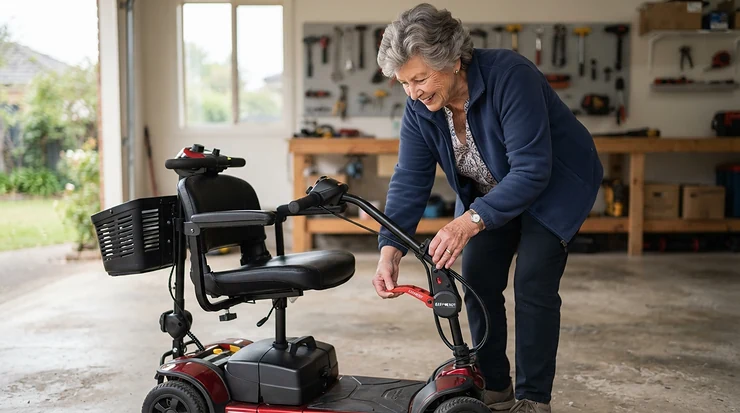
A boot scooter for people with limited upper body strength is a 4mph pavement scooter that splits into light pieces or folds small enough for a car boot. It has a low heaviest component weight and a detachable battery pack, so loading it never depends on strong arms, shoulders or grip.

Here’s the awkward truth most brochures skip. “Lightweight” is a marketing word, while “heaviest piece” is a number. A scooter weighing 27kg in total sounds svelte until you realise you’re expected to hoist all 27kg in one go, wrists bent, over the lip of the boot. For anyone living with arthritis, MS, a shoulder injury, weak grip or plain fatigue, that single lift can decide between independence and a scooter gathering dust in the hallway. If you’re shopping for a boot scooter for people with limited upper body strength, that lift is the real test.
So this guide flips the usual question. Instead of asking which scooter is lightest overall, it asks which one demands the least from your upper body, piece by piece. Most models here are class 2 scooters, meaning a 4mph limit and pavement use, as the government’s mobility vehicle guidance explains. We compared seven real UK-sold models on what matters far more than top speed: the weight of the heaviest piece, how easily the battery comes off, and whether the seat lifts out.
Prices below are ranges, because they shift constantly and VAT relief may reduce them if you have a qualifying long-term condition. Availability also varies between specialist retailers and online marketplaces, so check current availability before you commit. Where independent reviews were thin, I’ve said so rather than papering over the gap.
Quick Comparison: Which Boot Scooter Asks the Least of Your Arms?
Before the deep dive, here’s the cheat sheet. Models are sorted by heaviest piece, lightest first, because that’s the metric your shoulders will feel. Weights come from UK retailer specification sheets at the time of research and can vary slightly by configuration.
| Scooter | Heaviest piece | Battery pack | Best For |
|---|---|---|---|
| Motion Healthcare Alumina | about 10kg | 4kg | Suspension plus a very light heaviest piece |
| Motion Healthcare Evolite | 10kg | 3kg | Tight budgets and the lightest battery |
| Pride Apex Alumalite | 11.2kg | not listed | Mid-range budgets with Pride’s dealer network |
| Motion Healthcare Airium | 13kg | 7kg | Comfort and range if you can manage 13kg |
| Pride Apex Lite | 15kg | about 9kg each | Lowest price if a helper does the lifting |
| TGA Minimo Plus 4 | about 22kg (no seat or battery) | 3kg | Quick release seat and a stable four-wheel stance |
| Monarch Smarti | about 24kg (no battery) | included in 27.3kg total | Remote auto-fold, ideally paired with a car hoist |
Looking at the comparison above, the Motion Healthcare Alumina and Motion Healthcare Evolite are the only two that keep every piece at or around 10kg, the clearest dividing line for weak arms. The Pride Apex Alumalite sits close behind at 11.2kg. At the other end, the TGA Minimo Plus 4 and Monarch Smarti swap disassembly for folding, which means one heavier lift: manageable with a car hoist, risky without one.
💬 Just one click — help others make better buying decisions too!😊
Top 7 Picks: Expert Analysis of Each Boot Scooter for People with Limited Upper Body Strength
Every entry follows the same logic: what the specs mean for your arms, who the scooter suits, what real-world feedback exists, and what it costs.
1. Pride Apex Lite — cheapest route into five-piece disassembly
The big idea here is brutal simplicity: a scooter that breaks into five pieces, so nothing needs wrestling into a fold.
Per retailer specifications, the front section is the heaviest piece at around 15kg. The frame totals roughly 36.9kg without batteries, and each 12Ah battery weighs about 9kg. In practice, 15kg is a heavy suitcase held at arm’s length, and nine kilos per battery is far from the featherweight lithium packs elsewhere in this list. Range with two 12Ah batteries is quoted at about 8 miles, though some listings suggest up to 10.
Here’s what to weigh: the Pride Apex Lite suits someone who can manage a two-handed 15kg lift, or who has a helper for the front section. For genuinely weak arms, it’s the most demanding scooter in this guide on the lifting front, though also the cheapest. I couldn’t locate a sizeable pool of independent customer reviews at the time of research. The “one-hand disassembly” claim is therefore best treated as a manufacturer claim to test at a demo.
Pros:
- ✅ Five pieces, so no folding frame to force
- ✅ High user weight limit of 131kg or more
- ✅ Lowest price of the seven
Cons:
- ❌ 15kg front section is a heavy single lift
- ❌ Two 9kg battery packs add real strain
Expect around £1,200-£1,500, depending on VAT relief. It’s good value only if somebody else handles the lifting.
2. Motion Healthcare Evolite — 10kg heaviest piece at an entry price
The Motion Healthcare Evolite proves you don’t need to spend premium money to get a sensible heaviest component weight.
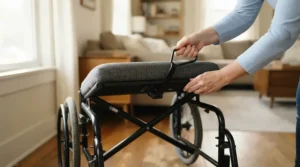
It splits into five pieces, with the heaviest weighing 10kg and the lithium battery just 3kg. Total weight is about 35kg, powered by a 250W motor on 8-inch wheels. Ten kilos is a full 10-litre bucket of water; 3kg is a large bag of potatoes. Both are manageable for many people with reduced grip, particularly because the pieces are small enough to carry close to the body.
Based on the spec comparison, this is the most sensible starting point for an easy to lift boot scooter for weak arms on a budget. The trade-offs are a 115kg (18 stone) user limit, lower than several rivals, and smaller wheels, which usually mean a firmer ride on broken paving. I couldn’t verify a robust independent review pool for this model, so the lifting figures come from the retailer’s specification sheet, not from owner feedback. Ask for a demo on your own pavements.
Pros:
- ✅ Heaviest piece is just 10kg
- ✅ 3kg battery is easy to carry
- ✅ 250W motor with aluminium chassis
Cons:
- ❌ 115kg limit is lower than most rivals here
- ❌ Smaller 8-inch wheels suit smooth paths best
Expect around £1,300-£1,900 depending on retailer and VAT status. Strong value for its lifting profile.
3. Motion Healthcare Alumina — suspension without crossing the 10kg line
Most light scooters economise on ride comfort. The Motion Healthcare Alumina doesn’t.
The heaviest piece weighs about 10kg, the battery 4kg, and the whole scooter around 33kg. It adds full suspension, super-soft tyres, a lithium battery quoted at up to 15 miles, and a 21-stone (135kg) user limit. Suspension matters more than it sounds: on a bumpy pavement, a harsh ride means gripping the tiller harder, and a harder grip is exactly what tired hands don’t need.
Here’s what to weigh: the Motion Healthcare Alumina costs about £400 more than the Motion Healthcare Evolite at typical prices, and buys a higher weight limit, a softer ride and a bigger range. The battery is a kilo heavier, a small penalty for the benefits. Independent reviews were not verifiable at the time of research, so treat comfort claims as promising rather than proven.
Pros:
- ✅ Heaviest piece under 10kg
- ✅ Full suspension and soft tyres
- ✅ 21-stone user capacity
Cons:
- ❌ 4kg battery is heavier than the Evolite’s
- ❌ Independent review pool is hard to verify
Expect around £1,700-£2,100. A strong all-rounder for weak arms.
4. Pride Apex Alumalite — Pride’s lightest four-wheeler at 11.2kg
If you want Pride’s dealer network without Pride’s heavier chassis, this is the one to know about.
According to the retailer listing, the heaviest piece weighs 11.2kg and the scooter weighs 28.8kg without its battery. It has an aluminium frame and airline-safe 12Ah lithium batteries. Compared with the Pride Apex Lite, that’s roughly four kilos shaved off the heaviest piece, a noticeable difference at boot height.
The catch is information: I couldn’t find a verified battery pack weight, so ask the dealer to put it in writing before purchase. The “lightest four-wheeled” description is the seller’s own claim, though the 11.2kg figure is a hard number worth checking against the manual. I also couldn’t verify a meaningful independent review pool. Analytically, this suits people who value a nationwide servicing network and can manage a piece just over 11kg.
Pros:
- ✅ Heaviest piece is only 11.2kg
- ✅ Aluminium frame with airline-safe lithium batteries
- ✅ Backed by Pride’s widespread dealer network
Cons:
- ❌ Battery weight isn’t clearly published
- ❌ Costs more than the Apex Lite
Expect around £1,800-£2,200 including VAT, less with VAT relief. Fair value if servicing convenience matters to you.
5. Monarch Smarti — remote-controlled auto-fold in one lift
The Monarch Smarti folds itself at the touch of a button on a remote, which is delightful. It also hides a catch.
It weighs 27.3kg including the battery and roughly 24kg without it, according to retailer specifications. It also has a carry handle, rear suspension, an anti-rollback system, and a quoted range of up to 9 miles. Folded, it measures about 46 x 46 x 63cm. The automatic fold removes the wrestling step, but not the lifting step: you still raise around 24kg in one piece.
Based on the spec comparison, this is a smart choice for someone whose problem is grip and folding dexterity, provided they pair it with a car hoist. Monarch’s Atlas 4 portable hoist, for example, is quoted with a 40kg lifting capacity. Reviewer sentiment on Trustpilot is polarised: some praise service and home demonstrations, while others complain about fault response and the opening and closing mechanism. One reviewer who owned both advised against the Smarti Plus in favour of the original Smarti.
Pros:
- ✅ Remote-controlled automatic folding
- ✅ Rear suspension and anti-rollback safety
- ✅ Tiny folded footprint for small boots
Cons:
- ❌ Single lift of around 24kg without a hoist
- ❌ Mixed reviews on after-sales and fold mechanism
Expect around £2,000-£2,700. Worth it with a hoist, questionable without.
6. Motion Healthcare Airium — big-scooter comfort in four pieces
Think of the Motion Healthcare Airium as a small pavement scooter that happens to come apart.
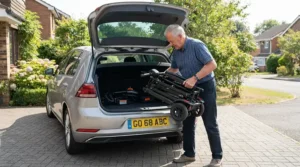
It disassembles into four pieces, the heaviest at 13kg. Per the specification, the battery weighs 7kg and the total is about 42.6kg. In return you get a 250W motor, 9-inch wheels, rear suspension, a rotating seat and a quoted range of up to 25 miles, plus a 21.4-stone limit. A rotating seat helps with transfers on and off, which matters if arm strength is limited when pushing up from a seated position.
What the headline “lightest pavement scooter” claim doesn’t tell you is that the 7kg battery is more than double the TGA and Evolite packs. Its sweet spot is longer outings for someone who can handle 13kg and 7kg lifts but wants far more range than most boot scooters offer. I couldn’t verify independent reviews for this model.
Pros:
- ✅ Up to 25 miles of quoted range
- ✅ Rotating seat eases getting on and off
- ✅ Rear suspension with large, soft tyres
Cons:
- ❌ 7kg battery is heavy for weak arms
- ❌ 13kg heaviest piece is above the 10kg sweet spot
Expect around £2,200-£2,800, with retailer pricing varying noticeably. A premium option for range, not for lightness.
7. TGA Minimo Plus 4 — the only one here with a quick release seat
For a quick release seat that visibly cuts the lift, the TGA Minimo Plus 4 stands alone in this group.
It weighs about 30kg complete, but retailer specifications put it at roughly 22kg once the 3kg battery and 5kg seat are removed. The 24V 11.5Ah battery is quoted at around 10 miles, while an optional 14.5Ah pack extends that to roughly 12.5 miles but is not airline approved. It has four wheels with a wider front stance, pneumatic tyres and a 115kg limit. Note that one directory listing quotes a 9.9kg “heaviest component”, which doesn’t match the 22kg chassis figure, so confirm weights with the dealer.
On the spec sheet it’s genuinely good for hands and arms: the battery is light, and the seat clips off. Chatter on the MS Society forum recommends the Minimo as a go-to small folder for car trips, though one poster cautions that small scooters like this suit short outings more than heavy everyday use.
Pros:
- ✅ Quick release seat drops about 5kg
- ✅ Light 3kg lithium battery
- ✅ Stable four-wheel stance with pneumatic tyres
Cons:
- ❌ Chassis is still around 22kg to lift
- ❌ Highest price range of the seven
Expect around £2,500-£3,000. A fair premium if the seat and battery removal matter to you.
Top 7 at a Glance: Specs, Price Ranges and Review Picture
Weights are as listed by retailers; some totals exclude batteries.
| Scooter | Total weight | Quoted range | Price range | Review picture | Best For |
|---|---|---|---|---|---|
| Pride Apex Lite | 36.9kg (no batteries) | about 8-10 miles | £1,200-£1,500 | No sizeable independent pool verified | Budget buyers with a helper |
| Motion Healthcare Evolite | about 35kg | check listing | £1,300-£1,900 | Not verified | Budget buyers wanting light pieces |
| Motion Healthcare Alumina | about 33kg | up to 15 miles | £1,700-£2,100 | Not verified | Ride comfort with light pieces |
| Pride Apex Alumalite | 28.8kg (no battery) | check listing | £1,800-£2,200 | Not verified | Pride servicing network |
| Monarch Smarti | 27.3kg | up to 9 miles | £2,000-£2,700 | Polarised (service, fold mechanism) | Hoist users |
| Motion Healthcare Airium | about 42.6kg | up to 25 miles | £2,200-£2,800 | Not verified | Longer outings |
| TGA Minimo Plus 4 | about 30kg | 10-12.5 miles | £2,500-£3,000 | Small positive forum chatter | Seat and battery removal |
Reading across the table, the cheapest scooters aren’t the lightest on your arms, and the priciest aren’t either. The Motion Healthcare Evolite and Motion Healthcare Alumina deliver the best heaviest-piece figures for a mid-priced outlay. Meanwhile, the Monarch Smarti and TGA Minimo Plus 4 justify their premium mainly through folding convenience and seat or battery design, not through a lighter single lift.
✨ Don’t Miss These Top Picks!
🔍 Take your boot scooter search to the next level with these carefully selected models. Click on any highlighted item to check current pricing and availability. These scooters could help you reclaim authentic, strain-free independence you’ll love!
How to Choose a boot scooter for people with limited upper body strength
Here’s the short version, in order. Each step comes with the reasoning behind it.
- Find your honest lifting limit. Work out the heaviest weight you can raise to boot height twice without pain. That number, not a brochure’s “lightweight” claim, is your ceiling.
- Shop by heaviest piece, not total weight. A 33kg scooter in 10kg chunks is easier than a 27kg scooter in one piece.
- Check the battery detaches, and weigh it. Packs range from about 3kg to 9kg, a huge difference for tired arms.
- Ask if the seat is truly quick release. A seat that “folds” isn’t the same as one that lifts off, and its weight matters too.
- Decide between disassembling and folding. Disassembly means several small lifts; folding means one big one.
- Match wheels and suspension to your pavements. A harsh ride forces a tighter grip.
- Demo it, and have the dealer weigh the pieces. Never rely on printed weights alone.
The charity Arthritis UK’s joint protection advice recommends spreading weight across larger joints and reducing the weight of what you lift. In scooter terms, that points to smaller pieces carried close to the body. A boot scooter with removable lightweight parts fits that principle better than a single heavy folder.
Heaviest Component Weight: The Number Brochures Bury
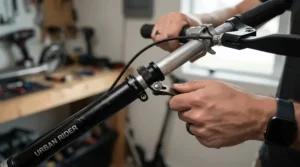
Total weight is the figure every listing shouts. Heaviest component weight is the one that decides whether you can actually load the thing. Think of it as the bouncer at your boot: the single piece that has to get past the lip.
On that measure, the Motion Healthcare Alumina (about 10kg) and Motion Healthcare Evolite (10kg) lead, and 10kg is roughly a full 10-litre bucket of water. The Pride Apex Alumalite follows at 11.2kg, the Motion Healthcare Airium at 13kg and the Pride Apex Lite at 15kg. The folders sit apart: the TGA Minimo Plus 4 is about 22kg once the battery and seat are removed, while the Monarch Smarti is roughly 24kg without its battery, so its heaviest piece is effectively the entire scooter.
Two cautions apply. First, as noted earlier, one listing’s 9.9kg claim for the TGA Minimo Plus 4 doesn’t square with retailer spec sheets, so get the weight in writing. Second, a Trustpilot reviewer of Monarch’s Genie model alleged that the advertised 16.85kg understated the 19kg printed in the owner’s manual. That’s one reviewer’s claim, not established fact, but it makes the point: have the dealer weigh the pieces.
A practical rule: pick a scooter whose heaviest piece sits well below the heaviest thing you currently lift to boot height without pain. If that’s a 5kg bag of potatoes, even 10kg is too much, and a hoist becomes the sensible route.
Detachable Battery Pack: Why It Matters More Than You’d Think
A detachable battery pack does two jobs. It slashes the weight of the main lift, and it lets you charge indoors, so the scooter can stay in the boot or hallway. TGA’s listings, for instance, describe removing the pack for charging while the scooter stays put.
Battery weight by model
The spread is dramatic. The Motion Healthcare Evolite carries a 3kg pack and the TGA Minimo Plus 4 about 3kg. The Motion Healthcare Alumina has a 4kg pack. The Motion Healthcare Airium weighs in at 7kg, and the Pride Apex Lite uses 12Ah packs at roughly 9kg each. For a weak grip, carrying 3kg on one forearm is a different proposition from carrying 9kg in a hand.
Airline and range trade-offs
Bigger batteries buy range but cost weight. The TGA Minimo Plus 4‘s 11.5Ah pack is described as airline friendly, while the optional 14.5Ah pack isn’t airline approved, so check with your airline before flying. As a rule, a detachable battery pack under 4kg is the sweet spot for limited strength, while anything above 7kg should make you ask whether a hoist is the better answer.
Quick Release Seat and Other Removable Lightweight Parts
A boot scooter with removable lightweight parts works on a simple principle: the more weight you can unclip, the less you lift in one go. The seat is the obvious candidate, since it’s often the second-heaviest item after the chassis.
Among the seven, the TGA Minimo Plus 4 is the only model whose listings explicitly advertise a quick release seat. It weighs about 5kg, and removing it drops the chassis to roughly 22kg. Retailer specifications for the Pride Apex Lite and Pride Apex Rapid put the standard seat at around 10.4kg, double the TGA’s. So “removable” and “lightweight” aren’t the same promise.
Other detachables matter more than they sound. The Pride Apex Lite has a removable front basket, which saves lugging shopping from scooter to front door. Meanwhile the Pride Apex Rapid‘s wraparound delta tiller is described as easier to control for people with limited dexterity, useful when grip, not lifting, is your bottleneck.
At a demo, ask three questions. Does the quick release seat come off one-handed? Can it be lifted without twisting your wrist? And what does it actually weigh?
Easy to Lift Boot Scooter for Weak Arms: Disassembling vs Folding vs Hoist
An easy to lift boot scooter for weak arms isn’t one product category; it’s three different strategies. Disassembling scooters break into several small lifts. Folding scooters keep one big lift but remove the fuss. Hoists remove manual lifting entirely.
| Approach | Heaviest single lift | Arm effort | Best For |
|---|---|---|---|
| Disassembling, e.g. Motion Healthcare Evolite | about 10kg | Several small lifts | Weak arms that can still manage about 10kg |
| Folding, e.g. TGA Minimo Plus 4 | about 22kg (no seat or battery) | One heavy lift | Stronger core, shorter reach |
| Auto-fold, e.g. Monarch Smarti | about 24kg (no battery) | One heavy lift, no folding effort | Poor grip, with a hoist |
| Folder plus Monarch Atlas 4 hoist | none manual | Minimal | Anyone who can’t lift about 10kg |
The table makes one thing plain: automatic folding solves the folding problem, not the lifting problem. If your limit is around 10kg, a disassembling scooter like the Motion Healthcare Evolite is the honest answer. If it’s below that, pairing a folder such as the Monarch Smarti with the Monarch Atlas 4, quoted at a 40kg lifting capacity, is the only route that removes the lift altogether.
Common Mistakes When Buying a Boot Scooter with Limited Strength
Buyers tend to trip over the same few pitfalls. Spotting them early saves money and sore shoulders.
- Judging by total weight. A 33kg scooter in 10kg pieces beats a 27kg scooter in one.
- Forgetting the battery. Two 9kg packs on the Pride Apex Lite change the lifting picture entirely.
- Trusting printed weights. Ask the dealer to weigh each piece.
- Ignoring boot lip height. Lifting 10kg over a high lip is harder than lifting it off the ground.
- Skipping the demo. Test the clips, levers and seat release with your own hands.
- Buying for ride, not lift. The Pride Apex Rapid has appealing all-round suspension, but its front section is 16.6kg and its battery about 12kg per the retailer spec, making it a poor fit for weak arms.
Safety, Rules and Compliance: What Boot Scooter Owners Should Know
Class 2 vs class 3
Nearly every scooter in this guide is class 2: pavement use, a 4mph limit. Class 3 scooters can reach 8mph on the road but must be registered with the DVLA. You don’t need a driving licence for either. The official Highway Code rules for powered wheelchairs and mobility scooters set out the 4mph pavement limit, and say class 2 users should use the pavement when one is available.
Insurance and airline travel
Insurance isn’t a legal requirement, but police safety advice recommends at least third-party cover for any mobility scooter, mainly for theft, fire and accident protection. If you plan to fly, battery rules apply. The TGA Minimo Plus 4‘s 11.5Ah pack is described as airline friendly, while its 14.5Ah pack isn’t, so always confirm with the airline in advance.
Before buying, consider an assessment from an occupational therapist or a mobility centre. They can match a scooter to your strength, posture and home, which no specification sheet can.
Long-Term Cost & Battery Maintenance: Price vs Value
Upfront price isn’t the full story. Lithium packs cost more initially but weigh far less than traditional lead-acid batteries, which is why they dominate this class. Eventually a battery will need replacing, so ask the dealer for the current replacement price and warranty terms before you buy.
| Tier | Models | Price range | Value verdict | Best For |
|---|---|---|---|---|
| Budget | Pride Apex Lite, Motion Healthcare Evolite | £1,200-£1,900 | Evolite wins on lifting, Apex Lite on price | Tight budgets |
| Mid-range | Motion Healthcare Alumina, Pride Apex Alumalite | £1,700-£2,200 | Best balance of weight and comfort | Most weak-arm buyers |
| Premium | Monarch Smarti, Motion Healthcare Airium, TGA Minimo Plus 4 | £2,000-£3,000 | Pay for features, not lighter lifting | Range, seat design, auto-fold |
Looking at the table above, the mid-range tier offers the strongest value for weak arms, because the lightest heaviest pieces sit there. A £600 gap over five years works out at roughly £2.30 a week, a modest price for avoiding daily strain. If you have a qualifying long-term condition, VAT relief can reduce prices by around a fifth at many UK retailers, though eligibility depends on your circumstances.
How to Load Your Scooter Without Straining Your Arms: A Practical Guide
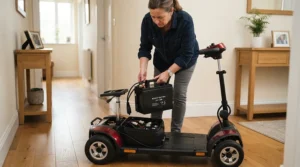
Even the lightest scooter punishes bad technique. NHS hand therapy guidance on joint protection for hand and finger arthritis stresses using two hands, avoiding tight gripping and spreading load across larger joints.
- Park with room to spare. Open the tailgate fully and clear the boot lip before touching anything.
- Remove the battery first. Carry it across both forearms, close to your body.
- Unclip the seat and basket. On the TGA Minimo Plus 4, that’s about 5kg off the chassis lift.
- Lift the heaviest piece while fresh. Use two hands, bend your knees and keep it close.
- Slide, don’t lift. A low-friction mat or boot protector lets you push pieces in rather than raise them.
- Charge indoors. Bring the battery inside rather than carrying the scooter.
Check pneumatic tyre pressure monthly on models like the TGA Minimo Plus 4, and keep clips and levers clean so they release smoothly. A stiff clip forces a harder grip, which defeats the point.
Real-World Scenarios: Matching Scooters to Real Strength Limits
If you have arthritis in both hands and a budget around £1,500
You need small, light pieces and minimal gripping. The Motion Healthcare Evolite (10kg heaviest piece, 3kg battery) fits best. Step up to the Motion Healthcare Alumina if pavements near you are bumpy.
If MS fatigue makes your strength unpredictable
Some days you can lift 10kg; others you can’t. A folder with a hoist, such as the Monarch Smarti with the Monarch Atlas 4, means no manual lifting on bad days.
If you want a lighter chassis and an easy seat
The TGA Minimo Plus 4‘s quick release seat and 3kg battery reduce the lift to around 22kg. It suits a stronger core with weaker arms, ideally with a hoist backup.
If you’ll cover 10+ miles regularly
The Motion Healthcare Airium offers up to 25 miles of quoted range, but only if you can handle 13kg and 7kg lifts.
FAQ
❓ Which easy to lift boot scooter for weak arms has the lightest parts?
❓ Can a detachable battery pack be charged indoors?
❓ Do I need a licence or insurance for a boot scooter?
❓ Is a quick release seat worth paying extra for?
❓ Can I claim VAT relief on a boot scooter?
Conclusion
Choosing a boot scooter for people with limited upper body strength comes down to one honest question: what’s the heaviest piece you’ll have to lift, and can you lift it? On published specs, the Motion Healthcare Alumina and Motion Healthcare Evolite answer that best, with heaviest pieces of about 10kg. The Pride Apex Alumalite is a credible mid-range alternative at 11.2kg.
If you value range and comfort, the Motion Healthcare Airium delivers, provided you can manage a 13kg piece and a 7kg battery. For a quick release seat, the TGA Minimo Plus 4 is the one to look at. If folding is your sticking point and you can add a hoist, the Monarch Smarti deserves a demo. The Pride Apex Lite remains the budget option, but best when someone else handles the lifting.
Above all, prioritise a boot scooter with removable lightweight parts, a detachable battery pack and a verified heaviest component weight. Ask the dealer to weigh each piece, test the quick release seat with your own hands, and don’t let a brochure do your lifting for you.
✨ Ready to Find Your Perfect Match?
🔍 Take your search to the next level with these carefully selected scooters. Click on any highlighted item to check current pricing and availability, and find the strain-free independence you deserve!
Recommended for You
- Amputee Wheelchair Leg Supports: 7 Best Picks & Honest Guide (2026)
- Buy Wheelchair Calf Pads: 7 Best Picks For UK Users (2026)
- Elevating Leg Rests For Circulation: 7 Best UK Picks (2026)
Disclaimer: This article contains affiliate links. As an Amazon Associate, I earn from qualifying purchases. If you purchase products through these links, we may earn a small commission at no additional cost to you.
✨ Found this helpful? Share it with your friends! 💬🤗
