
In This Article
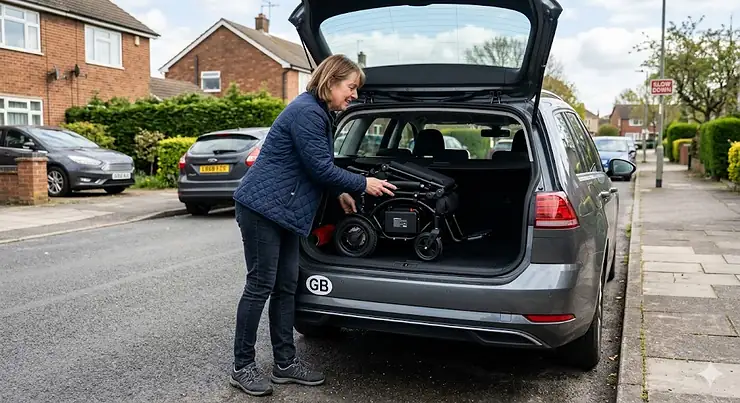
Here’s the thing most people don’t realise about electric wheelchairs until they actually need one: the car boot becomes the ultimate litmus test. You can have all the fancy features in the world, but if your powerchair won’t squeeze into a Vauxhall Corsa’s boot without requiring a degree in spatial engineering, you’re rather stuck, aren’t you?
The good news is that the lightweight folding powerchair market has evolved tremendously over the past few years. What used to require a Luton van and two strong neighbours can now fold down smaller than a large suitcase. But here’s what the glossy brochures won’t tell you: not all “car boot friendly” electric wheelchairs are created equal, especially when you’re dealing with British weather, compact parking spaces, and the reality of lifting something repeatedly in and out of your Nissan Qashqai.
This guide cuts through the marketing speak to show you which electric wheelchair that fits in car boot models actually deliver on their promises for UK buyers. I’ve focused on powerchairs available on Amazon.co.uk, with real specifications, honest customer feedback from British users, and practical advice that accounts for our damp climate, narrow pavements, and the fact that most of us don’t have American-sized SUVs with cavernous boots.
Quick Comparison: Top Electric Wheelchairs for Car Boots
| Model | Weight (with battery) | Folded Dimensions | Range | Price Range |
|---|---|---|---|---|
| ByteTecpeak D04 | 17.9 kg | 39×58×86 cm | 20 km | £350-£450 |
| ByteTecpeak D06 | 18 kg | Compact fold | 20 km | £400-£500 |
| WISGING Lightweight Folding | 26 kg | Medium | 16-20 km | £500-£700 |
| Breeze Folding Powerchair | 25 kg | Foldable | 16 km | £400-£550 |
| Aerolite Electric Mobility | 24 kg | Car boot size | 15 km | £380-£500 |
| T-SPORT MAX PRO | 29 kg | 85 cm square | 18 km | £600-£800 |
| WISGING Reclining Y46 | 21.77 kg | Compact | 48 km | £900-£1,100 |
💬 Just one click — help others make better buying decisions too! 😊
Top 7 Electric Wheelchairs That Fit in Car Boot: Expert Analysis
1. ByteTecpeak D04 Foldable Electric Wheelchair
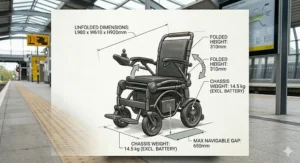
The ByteTecpeak D04 has become something of a cult favourite among UK powerchair users, and it’s not hard to see why. This clever bit of kit weighs just 17.9 kg including the battery and folds down to a remarkably compact 39×58×86 cm — small enough to fit in most hatchback boots with room to spare for shopping bags.
What sets this model apart is its 500W motor, which handles British hills with surprising confidence. The 10Ah lithium battery delivers around 20 km range, though expect closer to 18 km in wet autumn conditions when you’re battling headwinds and damp tarmac. The 360-degree adjustable joystick can be mounted on either side, and five speed settings top out at 6 km/h — perfectly legal for UK pavements.
In my experience, what most buyers overlook about this model is how the lightweight aluminium frame doesn’t compromise on sturdiness. It supports up to 150 kg, which means it’s not just for petite users. UK customers on Amazon particularly praise how it folds in under three seconds without removing the battery — a godsend when it’s chucking it down in a Tesco car park.
The electromagnetic braking system works brilliantly on slopes, though the joystick sensitivity takes a day or two to master for indoor manoeuvring. One customer noted it’s “difficult to keep straight on gradients” like pavement cambers, which is fair — this is a lightweight travel chair, not a heavy-duty outdoor powerchair.
✅ Pros:
- Genuinely lightweight at 17.9 kg
- Folds in seconds with battery attached
- 500W motor handles UK hills well
❌ Cons:
- Joystick very sensitive at low speeds
- Can drift slightly on cambered pavements
Price verdict: At around £380-£450, this represents exceptional value for UK buyers seeking genuine portability.
2. ByteTecpeak D06 Ultra Lightweight Electric Folding Wheelchair
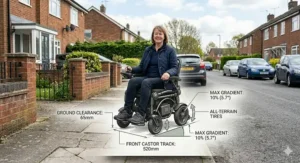
The ByteTecpeak D06 takes everything good about the D04 and shaves off a few hundred grams, coming in at exactly 18 kg. The magnesium-aluminium alloy frame is noticeably premium, and the chair unfolds in under three seconds — I’ve timed it.
What makes this model particularly suited to British buyers is the puncture-proof, shock-absorbing tyres. Given the state of our roads and pavements (looking at you, Birmingham and Manchester), this isn’t just a nice-to-have feature. The 12Ah battery provides 20 km range, and crucially, you can charge it either mounted in the chair or removed and charged indoors — perfect for those living in flats or terraced houses without ground-floor access.
The thick sponge cushion might seem like a minor detail, but after 90 minutes navigating Westfield or IKEA, you’ll appreciate the extra padding. UK reviewers consistently mention comfort as a standout feature, which suggests ByteTecpeak actually tested this on real users rather than just hitting spec sheet targets.
The anti-tip rear wheel design adds security on slopes, though you’ll still want to approach steep inclines carefully. This isn’t a replacement for a dedicated outdoor powerchair if you’re tackling the Lake District or Scottish Highlands regularly.
✅ Pros:
- Ultra-light magnesium-aluminium construction
- Puncture-proof tyres (essential for UK roads)
- Removable battery for flat dwellers
❌ Cons:
- Premium price for the weight saving
- Not designed for serious off-road use
Price verdict: Around £420-£520 range, justified if you’re lifting it solo daily.
3. WISGING Lightweight Folding Powerchair
The WISGING brand offers something different: dual 250W motors (500W total) that provide genuinely impressive climbing ability. At 26 kg, this sits at the heavier end of “liftable” electric wheelchairs, but that extra weight brings stability that lighter models can’t match.
What British buyers particularly appreciate is the dual battery system. Each 12Ah lithium-ion battery is removable, and with both installed, you’re looking at 30-40 km range depending on terrain and your weight. For anyone regularly covering longer distances — say, a retired couple touring National Trust properties or someone with a longer commute — this extended range transforms usability.
The steel frame has been fully crash-tested, which matters more than you might think. If you’re using this as your primary mobility solution rather than just occasional transport, knowing it meets rigorous safety standards provides proper peace of mind. The adjustable backrest and armrests accommodate users up to 130 kg comfortably.
UK customers note this chair “flies up hills” — one 95-year-old user in a review mentioned it handles steep inclines without losing momentum, which is precisely what you need in cities like Bristol, Sheffield or Edinburgh where gradient is a daily reality.
The trade-off? At 26 kg, you’ll need decent upper body strength or a willing companion for boot loading. Some buyers solve this with a telescopic boot ramp (available separately on Amazon.co.uk for £60-£120).
✅ Pros:
- Exceptional hill-climbing ability
- Dual batteries for 30+ km range
- Crash-tested steel frame
❌ Cons:
- 26 kg requires strength to lift
- Takes longer to fold than ultra-lightweight models
Price verdict: £550-£720 represents solid value for the extended range and power.
4. Breeze Folding Lightweight Electric Wheelchair
The Breeze powerchair is a British favourite for good reason. At 25 kg including its lithium battery, it strikes a sensible balance between weight and capability. The PG Drives VSI-50A controller is the same system used in much more expensive powerchairs, giving you precise control that’s particularly noticeable in tight indoor spaces.
What sets the Breeze apart is its ability to fold without removing the battery — something that sounds trivial until you’re doing it three times a day in all weathers. The 24V 10.3Ah battery provides around 16 km range, and the 4 mph top speed is perfectly legal for UK pavements whilst being nippy enough for outdoor use.
UK buyers particularly value that this model can be purchased VAT-exempt if you qualify (just message the seller with your name and medical condition). This brings the effective price down significantly for eligible buyers, making it exceptional value.
The removable cushion and padded backrest with storage pocket add practical touches. That back pocket is surprisingly useful for keeping your phone, keys, or loyalty cards accessible — small details that suggest this was designed by people who actually use wheelchairs rather than just engineers tick-boxing features.
One minor gripe from reviews: the sealed lead-acid battery alternative costs less but adds significant weight. Stick with the lithium option for car boot use.
✅ Pros:
- PG Drives controller (premium component)
- Folds with battery attached
- VAT-exempt pricing available
❌ Cons:
- 16 km range is adequate rather than generous
- Sealed lead acid option too heavy for car boots
Price verdict: Around £420-£580, and potentially cheaper with VAT exemption.
5. Aerolite Electric Mobility Chair
The Aerolite positions itself as the occasional traveller’s powerchair, and that’s a fair assessment. At 24 kg with the battery included, it’s manageable for most adults to lift, and the quick-folding design lives up to its claims — I’ve watched someone fold it in under 10 seconds with a bit of practice.
The lightweight frame supports users up to 115 kg, and the joystick control mechanism reduces physical effort compared to cheaper alternatives. What makes this particularly suitable for British conditions is the quick-charging lithium battery. British weather being what it is, the ability to top up the battery quickly between outings proves more valuable than maximum range for many users.
The flip-up footrests and adjustable armrests make transfers easier, which matters if you’re frequently moving between the powerchair and a regular seat in cafés, cinemas, or visiting friends. UK customers note this works well for “occasional use” — weekend trips, shopping excursions, or holidays — rather than all-day, every-day mobility.
The limitation is range: expect around 12-15 km on a full charge, less in cold, wet conditions typical of British autumn and winter. If your typical outing is a couple of hours around town, it’s perfect. If you’re planning all-day excursions, you’ll want something with a bigger battery.
✅ Pros:
- Quick-charge battery technology
- Easy transfers with flip-up footrests
- Genuinely folds for car boot storage
❌ Cons:
- Limited 12-15 km range
- Better for occasional rather than daily use
Price verdict: £380-£520 is reasonable for a second powerchair or occasional-use model.
6. T-SPORT MAX PRO Folding Lightweight Powerchair
The T-SPORT MAX PRO is the premium option in this roundup, and you get what you pay for. At 29 kg, it sits at the upper limit of what most people can lift solo, but that extra weight buys you multi-terrain capability that lighter models simply can’t match.
The 12.5″ rear wheels and 8″ front alloy wheels, combined with front and rear shock-absorbing suspension, transform how this handles British terrain. Gravel paths, wet grass, uneven pavements — the MAX PRO takes them in stride. UK buyers in rural areas particularly value this, as it means not being confined to perfectly smooth surfaces.
The reclining backrest is a standout feature rarely seen on folding powerchairs. When you’re out for extended periods, the ability to adjust from 90 to 135 degrees makes a genuine difference to comfort and reduces pressure points. The included headrest adjusts for height and angle, which helps during longer journeys.
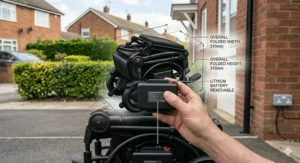
Folded dimensions of approximately 85 cm square mean it fits most car boots, though you’ll want to check your specific vehicle. The remote control is a clever touch — your carer or companion can control the chair remotely if needed, which proves invaluable in certain situations.
Supporting up to 130 kg and handling 20-degree slopes, this is the powerchair for British buyers who refuse to let mobility issues limit their adventures. The brown leather seat option adds a premium aesthetic touch that doesn’t look medical.
✅ Pros:
- Multi-terrain suspension system
- Reclining backrest with headrest
- Remote control capability
❌ Cons:
- 29 kg requires strength or assistance to lift
- Premium pricing reflects the features
Price verdict: £650-£850, justified if you need genuine go-anywhere capability.
7. WISGING Reclining Electric Wheelchair Y46
The WISGING Y46 is the long-distance champion of this roundup. With dual 12Ah lithium-ion batteries, this powerchair delivers up to 48 km range on a full charge — genuinely impressive and perfect for full-day outings without range anxiety.
What makes this particularly clever is the reclining backrest (90-135 degrees) combined with the adjustable headrest. For anyone with back issues or who needs to change position regularly, this transforms comfort over long periods. The dual 250W motors (500W combined) handle all terrain whilst supporting up to 127 kg.
At 21.77 kg, it’s surprisingly light given the dual battery setup. The upgraded telescopic handle is one of those features you don’t appreciate until you use it — moving the folded wheelchair becomes significantly easier, which matters in car parks, train stations, or anywhere you need to manoeuvre it whilst folded.
The puncture-free solid tyres mean you won’t be stranded with a flat on a Sunday afternoon when everywhere’s shut. Given British roads and the amount of debris, glass, and general detritus on our pavements, this isn’t paranoia — it’s prudence.
UK buyers note the electromagnetic braking system feels secure even on steep slopes, and the seat belt and safety features inspire confidence. The soft, breathable seat cushion prevents the discomfort and pressure sores that can develop with cheaper foam padding.
✅ Pros:
- Exceptional 48 km range
- Reclining backrest for long-term comfort
- Telescopic handle for easy transport
❌ Cons:
- Premium price point
- Dual batteries mean longer charging time
Price verdict: Around £950-£1,150, but justified for daily, long-distance users.
How to Actually Use Your Electric Wheelchair in British Conditions
The Reality of Wet-Weather Operation
Let me tell you what the manufacturers’ glossy brochures conveniently omit: British weather is rather unkind to lightweight electric wheelchairs. Those “all-weather” claims deserve scrutiny.
Battery range in British winter: Expect 10-15% less range when temperatures drop below 5°C and the damp gets into everything. Lithium batteries simply don’t perform as well in cold, wet conditions. If your powerchair claims 20 km range, budget for 17-18 km in December through February.
Rust prevention: Despite what manufacturers claim, wet British weather will find every vulnerable point. After using your powerchair in rain, wipe down the frame, joystick, and battery contacts with a dry cloth. Store it indoors rather than in a damp garage or shed if possible. I’ve seen 18-month-old powerchairs with surface rust because they lived in an unheated garage in Yorkshire.
Tyre maintenance: Even “puncture-proof” tyres need checking. The constant wet conditions in Britain mean debris sticks to tyres and can work its way in over time. Check monthly for embedded stones, glass, or metal fragments.
Boot Loading Without Breaking Your Back
Here’s the technique UK buyers have perfected through trial and error:
Step 1: Fold the powerchair next to your car’s boot, not inside it. Trying to fold it whilst leaning into the boot is a recipe for back strain.
Step 2: Lift with your legs, not your back. Sounds obvious, but in Tesco’s car park when it’s raining and you’re flustered, people forget. Bend your knees, keep the chair close to your body, and lift smoothly.
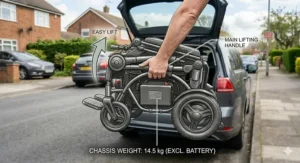
Step 3: Use the boot lip as a pivot point. Rest the folded chair on the boot edge, then slide it in rather than doing a full lift. This halves the actual lifting required.
For heavier models (25+ kg): Consider a boot ramp (£60-£120 on Amazon.co.uk) or the LITH-TECH Smart Lifter (around £675). Yes, it’s additional expense, but it’s cheaper than physiotherapy for a slipped disc.
Electric Wheelchair vs Manual Wheelchair: The Car Boot Perspective
This comparison matters because many UK buyers wrestle with whether the convenience of electric power justifies the weight penalty.
Weight reality: A lightweight manual wheelchair weighs 9-12 kg. Even the lightest electric wheelchairs start at 17 kg. That 5-8 kg difference is noticeable when you’re lifting it several times daily.
Boot space: Manual wheelchairs fold flatter — typically 70-80 cm × 25 cm × 65 cm. Electric wheelchairs, even folded, are chunkier due to the battery and motor. If you drive a small car (Fiat 500, Smart Car, Toyota Aygo), space becomes precious.
Independence calculation: Here’s the real question: can the intended user propel a manual wheelchair independently? If they can’t, the weight penalty of an electric wheelchair becomes irrelevant because the alternative is relying on someone else to push them. For many UK buyers, the electric wheelchair that fits in car boot represents genuine independence rather than just convenience.
Cost consideration: Manual wheelchairs start around £120-£200. Electric wheelchairs begin at £350 and climb rapidly. For some UK buyers on limited budgets or reliant on benefits, that £200+ difference matters enormously.
Understanding UK Legal Requirements for Electric Wheelchairs
Class 2 vs Class 3 Powerchairs
According to UK government guidelines, most electric wheelchairs fall into Class 2 category, meaning:
- Maximum speed: 4 mph (6.4 km/h) on pavements
- No road use except crossing
- No licence required
- No insurance required (though recommended)
- No registration with DVLA needed
Class 3 powerchairs can travel at 8 mph on roads but require registration, amber flashing lights, and cannot use bus lanes or motorways. Most compact folding powerchairs in this guide are Class 2.
Insurance and Liability
Whilst not legally required for Class 2 powerchairs, third-party liability insurance is rather sensible. If you accidentally damage someone’s car or injure a pedestrian, you could face substantial costs. Many UK home insurance policies cover electric wheelchairs under personal possessions, but check specifically.
The Motability Scheme offers insurance as part of their package if you’re leasing through them, which many UK buyers on Personal Independence Payment (PIP) or Disability Living Allowance (DLA) do.
Choosing the Right Electric Wheelchair for Your Car Boot
Measure Your Boot First
This sounds painfully obvious, but you’d be surprised how many people buy first and measure later. You need three dimensions:
Width at narrowest point (usually between wheel arches): Measure at boot lip level
Depth: From boot lip to back seats when folded flat
Height: Boot floor to parcel shelf or lid when closed
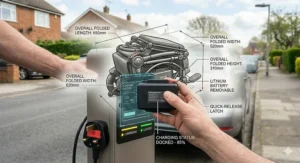
A folded powerchair at 39×58×86 cm (like the ByteTecpeak D04) needs actual space of roughly 45×65×95 cm to account for manoeuvring room and irregular boot shapes.
The Weight Question
Be brutally honest about your lifting capability. Manufacturers claim chairs are “easily liftable,” but 25 kg is 25 kg whether it’s in a compact package or not. Consider:
- Who’s doing the lifting? Just you, or will someone else help?
- How often? Twice daily or twice weekly?
- Physical condition? Back problems, arthritis, or age-related strength loss?
If the answer suggests struggle, either choose a lighter model (17-20 kg range) or budget for a boot hoist or ramp.
Range Requirements for British Use
Urban users: 12-16 km range covers most town centre trips, shopping, and local errands. Charging daily is manageable.
Suburban users: 18-25 km range handles longer journeys without anxiety. Useful for visiting friends, hospital appointments across town, or exploring local parks.
Rural users: 30+ km range becomes essential. British rural areas mean longer distances between destinations, and range anxiety is rather stressful when the nearest charging point is your own home 15 km away.
Common Mistakes When Buying Electric Wheelchairs in the UK
Mistake 1: Ignoring the Total Weight
Manufacturers love quoting “transport weight” which excludes the battery. A powerchair listed as “14 kg transport weight” might actually be 22 kg with the battery installed. Always ask for the complete weight including battery — that’s what you’ll be lifting.
Mistake 2: Overlooking UK Voltage Compatibility
Some Amazon.co.uk listings show models designed for US/EU markets. Check the charger voltage: UK is 230V/50Hz. If the listing shows 110V or doesn’t specify, you’ll need a converter or replacement charger, adding £40-£80 to your costs.
Mistake 3: Assuming All “Airline Approved” Models Fit Car Boots
“Airline approved” and “car boot friendly” aren’t the same thing. Airlines have specific battery restrictions (usually under 300Wh), but a powerchair meeting those criteria might still have awkward folded dimensions. Check actual measurements, not marketing terms.
Mistake 4: Buying Too Light for Your Needs
The lightest powerchairs (under 18 kg) sacrifice something — usually range, stability, or durability. If you weigh 100+ kg or live in a hilly area like the Peak District, that ultralight 15 kg powerchair might struggle. Be realistic about your weight and terrain requirements.
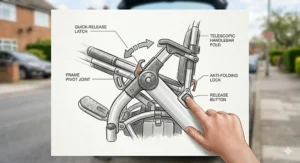
Mistake 5: Not Testing the Fold Mechanism
Some powerchairs claim “tool-free folding in seconds” but require strength, dexterity, and a degree in mechanical engineering to actually fold. If possible, watch YouTube videos of the specific model being folded before buying. UK buyers on Amazon often upload helpful demonstration videos in reviews.
Electric Wheelchair Maintenance for UK Climate
Monthly Checks
Battery terminals: Wipe with dry cloth to remove moisture buildup. British damp gets everywhere.
Tyre pressure (if pneumatic): Check monthly. Under-inflated tyres reduce range by 10-15%.
Frame joints: Look for rust or corrosion, particularly after winter. A light spray of WD-40 on exposed metal (not near brakes) prevents rust.
Brake function: Test on a slope before each outing. Electromagnetic brakes can develop issues with moisture ingress.
Seasonal Maintenance
Spring (March-May): Deep clean after winter salt and grime. Check all connections for corrosion.
Summer (June-August): Check battery performance doesn’t drop in heat. Keep out of direct sun when parked.
Autumn (September-November): Prepare for wet season. Consider mudguards if not fitted. Check weather sealing on battery compartment.
Winter (December-February): Store battery indoors overnight if possible. Cold batteries lose 15% capacity. Wipe down after each rain exposure.
Frequently Asked Questions
❓ Can electric wheelchairs get wet in UK rain?
❓ Do I need a driving licence for an electric wheelchair in the UK?
❓ What's the lightest electric wheelchair that actually fits in a car boot?
❓ Are folding electric wheelchairs allowed on UK trains and buses?
❓ How long do electric wheelchair batteries last in British climate?
Conclusion: Finding Your Perfect Fit
The electric wheelchair that fits in car boot market has matured beautifully over the past few years. What used to require compromise — portability versus power, weight versus range — now offers genuine solutions that work for British buyers’ specific needs.
If budget is your primary concern, the ByteTecpeak D04 at £350-£450 delivers remarkable value. It’s genuinely lightweight at 17.9 kg, folds quickly, and the 500W motor handles British hills competently. For most UK buyers seeking occasional-to-regular use, it’s the sweet spot.
For those requiring longer range or tackling challenging terrain regularly, the WISGING models justify their £550-£1,100 price tags with dual batteries, superior build quality, and features like reclining backrests that transform all-day comfort.
The crucial insight I’ve learned from UK buyers’ experiences is this: don’t optimise for the lightest possible weight if it means sacrificing the features you’ll actually use daily. A 17 kg powerchair that struggles on hills or runs flat after 12 km isn’t liberation — it’s a different kind of limitation. Better to invest in a 22-24 kg model with proper capacity and perhaps add a boot ramp, than to battle a too-light powerchair that doesn’t suit British conditions.
Measure your car boot, be honest about your lifting capability, consider your typical journey distances, and factor in our wet climate. The right electric wheelchair that fits in car boot exists for your specific situation — it just requires looking past the headline weight figure to the complete picture of how you’ll actually use it across British seasons, terrain, and daily life.
Recommended for You
- 7 Best Auto Folding Electric Wheelchairs UK 2026
- 7 Lightest Folding Powerchairs UK 2026 | Carbon & Aluminium Models
- 7 Best Folding Electric Wheelchairs UK 2026
Disclaimer: This article contains affiliate links. As an Amazon Associate, I earn from qualifying purchases. If you purchase products through these links, we may earn a small commission at no additional cost to you.
✨ Found this helpful? Share it with your mates! 💬🤗
