
In This Article
There’s a moment every parent knows. Your child is struggling to keep up, tiring far too quickly, missing out on the things kids are supposed to take for granted — the school trip, a walk in the park, a birthday party at soft play. You start researching. You fall down a rabbit hole of NHS waiting lists, Personal Wheelchair Budgets, occupational therapist referrals, and acronyms that seem designed to confuse rather than inform.
So let’s cut through it.
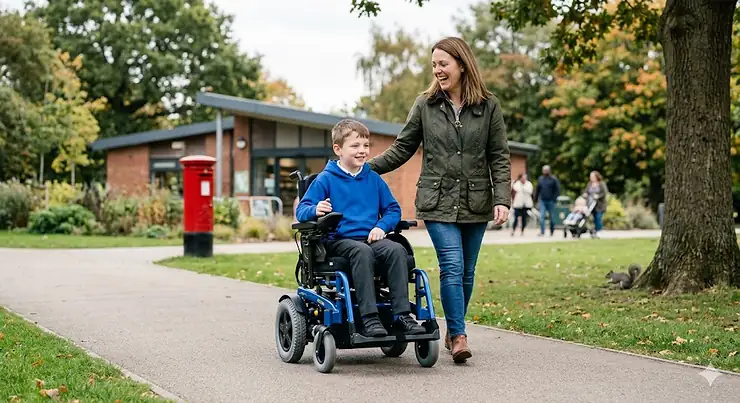
An NHS powerchair for children is a battery-powered, joystick-controlled mobility device prescribed — free of charge on long-term loan — to children with complex, long-term mobility needs who cannot walk or propel a manual wheelchair reliably. The keyword there is prescribed. It’s not something you order online. It comes at the end of an assessment process, involves occupational therapists and physiotherapists, and is managed through your local NHS Wheelchair Service (sometimes contracted out to a private provider). When it works well, the system is genuinely brilliant. When it doesn’t, it can feel like running face-first into a very polite bureaucratic wall.
This guide exists for both journeys. We’ll walk you through the full NHS referral pathway — what qualifies, what doesn’t, how long to expect to wait, and what to do when the NHS provision doesn’t fully meet your child’s needs. We’ll also look at seven products available on Amazon.co.uk that families use to supplement, bridge, or privately fund paediatric powered mobility — everything from compact children’s electric wheelchairs to power-assist accessories for manual chairs.
Whether you’re at the very start of your child’s mobility journey or you’ve been through an assessment and need something now while the paperwork catches up, there’s something here for you.
Quick Comparison: NHS vs. Private vs. Charity — Which Route Is Right for You?
| Route | Cost to Family | Wait Time | Equipment Choice | Maintenance Covered |
|---|---|---|---|---|
| NHS Standard Provision | £0 (on loan) | 3–18+ months | Limited | Yes |
| Personal Wheelchair Budget (Top-Up) | Partial payment | 3–12 months | Greater choice | Partially |
| Private Purchase (Amazon/specialist) | Full cost (£300–£5,000+) | Days to weeks | Full range | Your responsibility |
| Charity (Whizz-Kidz, Wizzybug) | £0 | Varies | Moderate | Often covered |
| Motability (DLA/PIP eligible) | Allowance-based | Several weeks | Good range | Yes |
The NHS route is clearly the most cost-effective — but only if your child meets the eligibility criteria and you can stomach the wait. The private and charity routes exist precisely because the NHS can’t always move fast enough or go far enough. Families often end up combining multiple funding sources, and knowing the full landscape makes that far easier.
💬 Just one click — help others make better buying decisions too! 😊
Top 7 Children’s Powerchair and Mobility Products on Amazon.co.uk — Expert Analysis
A brief but important note before we dive in: the highest-spec clinical paediatric powerchairs — the Quickie Zippie Salsa M2, Permobil C300, Invacare TDX SP2 — are prescribed through NHS Wheelchair Services and not sold on Amazon.co.uk. What you will find on Amazon are excellent compact electric wheelchairs, children’s manual wheelchairs (many used alongside NHS powerchairs for indoor use), and essential accessories that NHS provision doesn’t always cover. Think of this section as your guide to filling the gaps — whether you’re waiting for an NHS assessment, topping up a Personal Wheelchair Budget, or simply need a backup chair for school.
1. MobiQuip All Terrain Mini Children’s Wheelchair
The MobiQuip All Terrain Mini is something of an unsung hero in paediatric mobility — a purpose-built British children’s wheelchair that works properly on the surfaces children actually encounter, rather than the polished clinic floors everything seems to be tested on.
Weighing in at roughly 10–12 kg depending on configuration, this self-propelled attendant wheelchair features large-diameter rear wheels for genuine all-terrain performance, a contoured back support with lateral pads, and a seat width sizing suitable from around age 3 upward. The swing-away footrests and adjustable armrests mean it grows with your child across multiple years of use — a significant advantage given how quickly children outgrow standard chairs.
What’s the real-world picture? In practical terms, this is the chair you take to the school sports day when the NHS powerchair stays safely at home. It handles gravel paths, school playgrounds, and the classic British combination of wet grass and mild incline without the drama you’d expect from cheaper alternatives. UK parent reviewers consistently highlight the chair’s durability and the fact that the British weather hasn’t destroyed it after a year of daily use.
It’s not a powerchair — so for children with very limited upper-body function, you’ll need to push — but as a complement to NHS electric provision, it’s genuinely worth considering.
✅ Purpose-built for children, not a scaled-down adult model
✅ Handles British outdoor terrain credibly
✅ Adjustable to grow with your child
❌ Manual only — no powered option
❌ Limited postural support compared to clinical NHS chairs
Price range: Around £300–£450. Available on Amazon.co.uk with free delivery for Prime members.

2. Days Healthcare Escape Lite Children’s Lightweight Wheelchair
Days Healthcare is a well-established British brand with a long track record in NHS-adjacent mobility equipment, and the Escape Lite for children is one of the more sensible lightweight manual chairs on Amazon.co.uk.
The frame is aluminium, which sounds like a marketing bullet point until you realise it puts the chair at around 9 kg — light enough for most parents to lift into a car boot single-handed, which matters enormously when you’re doing the school run in the rain with a child under one arm. Seat widths start at 30 cm for younger children, with adjustable footrests and flip-back armrests to assist transfers. The upholstered seat and back offer reasonable comfort for everyday use.
In terms of who this suits: it’s the ideal transitional or backup chair for a child who uses an NHS powerchair for longer distances but needs a lightweight manual option for tight indoor spaces — inside a museum, at a family party in a narrow Victorian terrace, in the school canteen queue. It also works well for families waiting on NHS assessment, giving the child some independence now rather than in six to twelve months.
A word of caution: the postural support is adequate but not clinical. If your child has complex seating needs, discuss this with your occupational therapist before purchase — this isn’t a substitute for an NHS-assessed seating system.
✅ Lightweight aluminium frame — genuinely manageable for one adult
✅ British brand with accessible UK customer support
✅ Compact folded size — fits in most car boots
❌ Limited postural seating — not for complex needs
❌ Smaller seat sizes can sell out quickly
Price range: Around £200–£350. Available on Amazon.co.uk; Prime-eligible for next-day delivery in most UK postcodes.
3. ByteTecpeak D04 Foldable Electric Wheelchair
This one comes with a caveat, and it’s an important one: the ByteTecpeak D04 is an adult compact powerchair that happens to be among the most compact folding electric wheelchairs available on Amazon.co.uk, making it a reasonable private-purchase option for older children — typically ages 12 and upwards — who fit adult seat sizing (44 cm seat width is the standard configuration).
The D04 runs a 500W motor and a removable 10Ah lithium battery offering around 20 km of range on a single charge. In practice, that’s enough for most school-day or community use. The folding mechanism is genuinely simple — fold it, lift it, put it in a car — and the 18.6 kg total weight (battery included) is manageable for most adults. USB charging port is a nice practical touch.
Here’s what the spec sheet won’t tell you: the turning radius is tight enough for most UK home corridors and average-width doorways, but you’ll want to measure before assuming it fits everywhere. UK homes — terraced houses in particular — can have surprisingly narrow downstairs hall widths, and this chair is wider than it looks in photos.
UK reviewers describe it as solidly built for the price, though some note the joystick takes a few hours to get comfortable with for new users. Worth factoring in a settling-in period.
✅ 20 km range — practical for daily use
✅ Removable lithium battery — charges off a standard UK plug
✅ Compact fold for car boot storage
❌ Adult sizing — only suitable for older/larger children
❌ No paediatric postural support features
Price range: Around £500–£700 range. Available on Amazon.co.uk with UK stock.
4. Angel Mobility Electric Folding Lightweight Powerchair
Angel Mobility is a UK-based seller with a good presence on Amazon.co.uk, and their electric folding powerchair is one of the more sensibly specified compact chairs available without going to a specialist mobility retailer.
The aluminium frame keeps total weight at around 20 kg with battery, which is heavier than carbon-fibre alternatives but a fraction of the cost. The joystick controller is positioned for ease of use, the seat is padded adequately for everyday sessions, and the fold mechanism works without removing the battery — a small but meaningful convenience for parents managing school drop-offs. Range is typically around 15–20 km.
What makes this relevant to families navigating paediatric powered mobility is the relatively accessible price point. If you’ve been assessed for a Personal Wheelchair Budget but the voucher doesn’t stretch to the chair your child actually needs, combining that budget with a more affordable Amazon purchase (routed through your wheelchair service for approval) can bridge the gap. Check with your local NHS Wheelchair Service about PWB top-up flexibility — rules vary by region.
This chair is best suited to teenagers or adolescents who’ve outgrown clinical paediatric models, or as a family’s secondary powered option.
✅ UK seller — accessible returns and customer support
✅ No-battery-removal fold — practical for busy families
✅ Competitive price for an electric folding chair
❌ Heavier than premium alternatives
❌ Not designed with paediatric seating in mind
Price range: Around £400–£600 range. Available on Amazon.co.uk, Prime-eligible.
5. Green Power GP162 Compact Indoor/Outdoor Powerchair
Green Power’s GP162 is a front-wheel-drive compact powerchair with a UK plug and 230V compliance confirmed — always worth checking when buying from Amazon.co.uk, as some listed chairs ship from overseas warehouses with incompatible chargers.
The GP162 is notable for its tight turning circle, which makes it genuinely usable in UK-standard home environments — it handles the gap between kitchen units and the island worktop, manages the turn from hallway to living room, and doesn’t require a 3-point manoeuvre to exit the bathroom. The seat height is lower than many adult models, making it a more plausible option for younger teenagers without the posture challenges that come from sitting too high.
Dual 250W motors provide reasonable hill-climbing ability — helpful if your family lives somewhere with proper gradients (think Sheffield, Edinburgh, or anywhere in Wales, frankly). Battery range is typically quoted at around 15 km, with some real-world UK user experience suggesting closer to 12 km in cold or damp conditions. Plan conservatively for winter use.
For families who need something that works consistently indoors and for local community outings, the GP162 punches above its Amazon listing.
✅ Tight turning circle — works well in UK homes
✅ UK plug confirmed — no adaptor headaches
✅ Lower seat height — more appropriate for younger users
❌ Range reduction in British winter conditions
❌ Limited adjustability for growing children
Price range: Around £700–£900 range. Available on Amazon.co.uk.
6. Drive DeVilbiss AutoFold Powerchair
Drive DeVilbiss is one of the most recognised names in UK medical equipment — their products are used in NHS settings — and the AutoFold Powerchair is arguably their most clever piece of engineering. It folds automatically at the touch of a remote control button. No wrestling with a heavy frame in a rainy car park. No complicated dismantling. You press a button, the chair folds, you lift it in. That’s it.
The AutoFold runs brushless motors, covers up to about 12 km per charge, and folds to a genuinely compact size. At 29.8 kg total weight, it’s not light, but the remote-control fold compensates enormously — you don’t need to lift a fully-unfolded chair, just a neatly folded package.
The 44 cm seat width means this is solidly an option for older adolescents and teenagers rather than young children. It’s also worth noting that Drive DeVilbiss has a UK support network, which means warranty claims and repairs are handled domestically — a meaningful advantage over lesser-known imports when you actually need something fixed.
✅ Remote auto-fold — exceptional practical convenience
✅ Established UK brand with domestic support network
✅ Brushless motors — lower maintenance long-term
❌ 29.8 kg total weight — heavier than it sounds
❌ Adult sizing only — not for young children
Price range: Around £900–£1,200 range. Available on Amazon.co.uk; check for Prime availability.
7. Aidapt Children’s Tilt-in-Space Wheelchair Cushion & Positioning System
Hear me out — this might be the most practically useful entry on the list, particularly for families navigating NHS provision. The NHS will supply your child with a powerchair. What it often won’t supply — or will supply slowly — are the additional postural support items: pressure-relief cushions, lateral support pads, wedged seat inserts that encourage correct pelvic positioning.
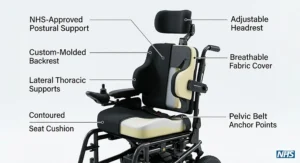
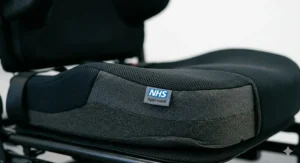
Aidapt’s children’s positioning products on Amazon.co.uk cover this gap. High-density foam seat wedges help with anterior pelvic tilt. Lateral thoracic supports assist children who need a little more trunk stability than their NHS chair’s standard backrest provides. Pressure-relief cushions are particularly relevant for children who use their powerchair for extended daily sessions — skin integrity is a genuine clinical concern that gets less attention than it deserves.
The practical value of buying these on Amazon is speed. NHS provision of secondary seating items can take months through the same assessment pathway as the chair itself. If your occupational therapist has flagged a postural need, getting a compatible accessory from Amazon.co.uk in two days can make an immediate difference to your child’s comfort and wellbeing.
✅ Addresses a genuine gap in NHS standard provision
✅ Available next-day — no waiting lists
✅ Significant impact on daily comfort and skin health
❌ Not a substitute for clinically assessed postural seating
❌ Compatibility varies — check measurements carefully
Price range: Around £30–£150 depending on item. Wide range available on Amazon.co.uk.
✨ Don’t Miss These Exclusive Deals!
🔍 Ready to take the next step? Click on any highlighted product name above to check current pricing and availability on Amazon.co.uk. These picks have been carefully selected for UK families navigating paediatric mobility — whether you’re supplementing NHS provision or buying privately.
How to Get an NHS Powerchair for Your Child: The Step-by-Step Referral Process
This is the section most parents actually need first, and it’s more navigable than it might appear.
Step 1: Get a Referral from a Healthcare Professional
You cannot self-refer to NHS Wheelchair Services. The referral must come from a registered health or social care professional — your child’s GP, a hospital consultant, a community physiotherapist, or an occupational therapist (OT) from children’s services. If your child already has a named therapist or paediatrician, start there. If not, a conversation with your GP is the right first step.
It helps to be specific in what you’re asking for. Rather than saying “my child needs a wheelchair,” come prepared with observations: how far can your child walk before becoming exhausted or distressed? Are they missing educational or social activities? Is there a specific diagnosis that affects mobility? The more clearly you can articulate the daily impact, the better.
Step 2: Attend the Assessment Appointment
Once referred, your local NHS Wheelchair Service (or their commissioned provider) will invite your child to an assessment. The wait for this appointment is typically three to six months, though it varies considerably by region — some areas manage it faster, others have backlogs running to a year or more. According to NHS England data, a significant proportion of children wait beyond the 18-week target.
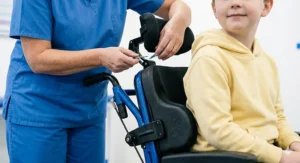
The assessment is carried out by occupational therapists, physiotherapists, and sometimes a rehabilitation engineer. They’ll observe how your child moves, take measurements, look at where the chair will be used (school, home, community), and consider the carer’s needs alongside the child’s. Bring whoever manages the child’s care day-to-day — their physical wellbeing as a carer is factored into the provision.
Step 3: Eligibility Decision and Equipment Prescription
NHS Wheelchair Services will provide a powerchair only if your child meets specific clinical criteria. Generally speaking, this means they cannot walk or reliably self-propel a manual wheelchair, and they require the chair on a daily or near-daily basis for long-term mobility needs. This is where many families hit the wall: if your child can walk short distances or sometimes manages a manual chair, the criteria for powered provision may not be met, even if a powerchair would clearly improve their quality of life.
If approved, your child will be prescribed a specific powerchair from the service’s contracted range. It remains NHS property on long-term loan; the service covers maintenance, repairs, and battery replacements.
Step 4: Explore the Personal Wheelchair Budget
If your child is eligible for a wheelchair but you’d prefer a different model — better features, more appropriate for their personality or lifestyle, or with capabilities the standard prescription doesn’t include — ask about a Personal Wheelchair Budget (PWB). The NHS Wheelchair Voucher Scheme has largely been replaced by this more flexible system, though it varies by region.
A PWB gives you a notional value equivalent to the cost of the chair the NHS would provide. You can then use that value towards a different product, topping up with your own funds. Do note: if you go down the top-up route, you take ownership and responsibility for maintenance. Weigh that trade-off carefully.
What to Do When the NHS Provision Doesn’t Cover Your Child’s Needs
This happens more than it should. NHS wheelchair services are under considerable pressure — over 75,000 young people in the UK need to use a wheelchair — and the gap between clinical need and what’s practically delivered can leave families in genuinely difficult situations.
Here’s where to turn.
Whizz-Kidz is the UK’s leading charity for young wheelchair users, supporting children and young people up to 25 years old. They provide made-to-measure powered and manual wheelchairs, free of charge, to children whose needs aren’t met by local wheelchair services. They also jointly fund with NHS services wherever possible. Apply directly on their website.
Wizzybug by Designability is a free-loan powered wheelchair specifically designed for young disabled children from 14 months old, weighing up to 20 kg. It’s particularly valuable because in the UK, NHS-funded powerchairs for children under five are rare — funding is typically not considered until a child is at least three, and often older. Wizzybug fills that early childhood window. Families self-refer via Designability’s website; the chair is loaned for as long as it’s suitable, then returned for refurbishment and reuse.
Motability Scheme provides access to powered wheelchairs for children receiving enhanced-rate PIP mobility component or higher-rate DLA mobility component. If your child is in receipt of these benefits, it’s absolutely worth exploring — Motability covers the chair, insurance, and servicing for a weekly allowance contribution.
Charitable grants are available from a range of organisations including Scope, the Family Fund, and condition-specific charities. The Muscular Dystrophy UK and Whizz Kidz partnership, for instance, recently awarded nearly £50,000 in grants to enable eight children to access wheelchairs their local services couldn’t provide.
How to Choose the Right Powerchair Supplement for Your Child in the UK
When you’re looking at products beyond what the NHS provides — whether that’s a backup chair, a private purchase, or an accessory — there are specific criteria worth working through deliberately.
- Indoor vs. outdoor use: Many NHS powerchairs are prescribed specifically for indoor use. If your child needs powered mobility outdoors too — for the school run, community access, park visits — check whether the chair in question is rated for kerbs and uneven terrain. UK pavements and paths are notoriously unforgiving, and a compact indoor powerchair that struggles with a 2 cm kerb cut is genuinely frustrating in practice.
- Seat sizing: Children’s seat widths typically run from 28–38 cm for younger children, up to adult sizing of 40–46 cm for teenagers. A chair that’s too wide creates pressure issues, poor posture, and difficulty manoeuvring through standard UK doorways (typically 80 cm for modern builds; considerably narrower in older terraced housing).
- Weight and transportability: If the chair needs to go in the car regularly, the combined weight of chair plus any battery needs to be manageable for your specific vehicle. Folded dimensions matter — a family in a Fiat 500 has different boot space than one in a Vauxhall Zafira. Measure before you order.
- Battery chemistry: Sealed lead acid batteries are heavier and can’t be removed easily on some models. Lithium batteries are lighter, removable, and better suited to regular transport — important if the chair lives partly at school, partly at home.
- UK compatibility: Confirm 230V/UK plug compatibility and that the charger is supplied with a Type G UK plug. Some Amazon listings include international chargers — always worth checking the product description or reviews.
- Maintenance access in your region: If the chair needs a repair, is there a service network in the UK? Drive DeVilbiss, for example, has domestic coverage. Some imported brands rely entirely on posting the chair to a service centre, which can leave your child without a chair for weeks.
Real Families, Real Scenarios: Matching the Right Approach to Your Situation
The Nottingham family, child aged 4 with spinal muscular atrophy. The NHS won’t fund a powerchair until age 5 in this area. The family applied for a Wizzybug through Designability — free of charge, delivered within weeks. The child gained independent mobility immediately and is developing joystick control skills ahead of the full NHS assessment next year.
The Leeds teenager, aged 14, cerebral palsy. The NHS provides a powerchair for school use. At weekends and during school holidays, the family wanted something more compact for day trips and shopping. A Drive DeVilbiss AutoFold, purchased privately via Amazon and partly offset by a charitable grant from the Family Fund, now serves as the family’s community chair. The remote fold means mum can manage it herself without assistance.
The Birmingham family waiting on an NHS assessment. Referral sent four months ago; no appointment yet. The child was struggling daily. The family bought a MobiQuip All Terrain Mini through Amazon.co.uk for immediate use — manual rather than powered, but it restored independence for school and local outings while the NHS process moved at its own pace.
Common Mistakes Families Make — and How to Avoid Them
Waiting passively for the NHS to come to you. The NHS Wheelchair Service won’t proactively chase your referral. If you haven’t heard within three months of referral, ring them. Ask for an update. Ask for an estimated date. Be politely persistent — waiting lists are real, but they move faster when families are engaged.
Underestimating the assessment. Some families arrive at the assessment expecting to receive a chair that day, and leave disappointed when it’s explained this is only the first step. Go in informed — the assessment is just the beginning of a process that typically takes several more months before equipment arrives.
Buying privately and assuming it’ll count toward NHS provision. It won’t. If you purchase a wheelchair privately, even from a specialist, you cannot retrospectively claim the cost back through NHS Wheelchair Services or Personal Wheelchair Budget. The order of operations matters: get the assessment, understand your PWB entitlement, then make purchasing decisions.
Ignoring postural needs to save money. A cheaper chair without appropriate postural support can cause or worsen spinal issues over time. This is especially important for children with conditions affecting trunk control. If your OT has flagged specific postural requirements, don’t compromise on them to save a few hundred pounds.
Forgetting to check UKCA marking. Post-Brexit, medical devices sold in Great Britain should carry UKCA marking to confirm they meet UK safety standards. Some lower-cost imports on Amazon.co.uk still carry CE marking only. For a product as safety-critical as a powered wheelchair, this matters. Check product listings carefully and contact sellers if unclear.
✨ Don’t Miss These Useful Resources
🔍 Still navigating your options? The products above are available to explore on Amazon.co.uk right now — check current pricing, reviews from UK buyers, and Prime delivery availability by clicking any highlighted name above.
Long-Term Costs and Maintenance: What No One Tells You Upfront
If your child receives an NHS-prescribed powerchair on long-term loan, the headline cost is zero. But there are running costs worth knowing about.
NHS-maintained chairs: Repairs and maintenance are covered. Battery replacements are covered. What’s typically not covered — and where families often end up spending — are the extras: rain capes (a wheelchair without rain protection in a British winter is a cold, miserable experience), specialist bags and pouches, personalisation covers, additional postural accessories, and the cost of adaptations that exceed the standard NHS prescription.
Privately purchased or Personal Wheelchair Budget chairs: You own the chair and you own the maintenance bill. A powerchair service check typically costs £80–£150 per year from a specialist mobility provider. Battery replacements on lithium-battery models run £150–£400 depending on the battery specification. Factor this into the total cost of ownership.
Education funding: For children who need a wheelchair at school, it’s worth knowing that some elements — particularly seat elevation, height adjustability, and features that assist classroom participation — can be funded through the education system rather than NHS. Your OT or physiotherapist can advise on whether a joint-funding arrangement is possible, where the NHS covers clinical provision and the school or education authority covers the access elements.
DLA and PIP: If your child isn’t already claiming Disability Living Allowance (for children under 16) or Personal Independence Payment (16+), these benefits can significantly offset the cost of equipment, adaptations, and transport. The gov.uk guide to benefits for disabled children is a good starting point.

FAQ: NHS Powerchair for Children — Answering the Searches Parents Actually Do
❓ How do I get an electric wheelchair for my child through the NHS?
❓ What is the paediatric wheelchair NHS referral process in the UK?
❓ How long does it take to get a wheelchair through NHS Wheelchair Services for a child?
❓ Can I use an NHS wheelchair voucher or Personal Wheelchair Budget for a children's powerchair?
❓ What happens if my child doesn't qualify for an NHS powerchair in the UK?
Conclusion: Independence Shouldn’t Have a Waiting List
Here’s the honest truth about NHS powerchairs for children in the UK: the system, at its best, provides life-changing independent mobility at no cost to families who are already navigating far more than their fair share of difficulty. At its worst, it’s a long, exhausting process with eligibility hurdles, regional inconsistencies, and waiting times that can stretch a child’s development in real and measurable ways.
Knowing your options — the full landscape of NHS referral, Personal Wheelchair Budget, charitable support, and the Amazon.co.uk products that can bridge the gaps — puts you in a meaningfully stronger position. You don’t have to choose between the NHS and everything else; the families who navigate this best tend to use every available route simultaneously.
Start the referral process now if you haven’t. Apply to Whizz-Kidz or Designability in parallel. Consider a manual or compact electric chair from Amazon.co.uk for immediate use. And make sure you’re claiming every benefit your child is entitled to — the paperwork is onerous, but DLA and PIP exist precisely for situations like this.
Your child’s mobility shouldn’t depend on a postcode or a waiting list. Chase every option, all at once.
✨ Take Action Today
🔍 Explore the products mentioned in this guide by clicking any highlighted name above to check current pricing and availability on Amazon.co.uk. For NHS services, charitable support, and benefits guidance, use the outbound links throughout this article.
Recommended for You
- 7 Best Junior Powerchair Options UK 2026
- Best Children’s Electric Wheelchairs UK 2026
- 7 Best Extra Wide Electric Wheelchairs UK 2026
Disclaimer: This article contains affiliate links. As an Amazon Associate, I earn from qualifying purchases. If you purchase products through these links, we may earn a small commission at no additional cost to you.
✨ Found this helpful? Share it with your mates! 💬🤗
