
In This Article
Most buyers shop for a bariatric chair by staring at the seat. Width, width, width. Meanwhile the part that holds your feet gets a single line at the bottom of the spec sheet, if it gets one at all. It also quietly absorbs a surprising share of your load every time you shift forward or transfer out. Getting large footplates for bariatric wheelchairs right is the difference between a chair you can use all afternoon and one you abandon after twenty minutes of dead toes.
What Are Large Footplates for Bariatric Wheelchairs?
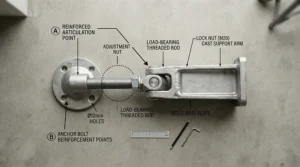
Large footplates for bariatric wheelchairs are wider, deeper and sturdier foot platforms fitted to heavy-duty wheelchairs. They carry larger feet, bulky footwear and higher loads safely, usually on swing-away or detachable footrests, so your legs stay supported, your posture stays sensible and transfers stay manageable.
Why does this matter beyond comfort? The WHO guidelines on manual wheelchair provision note that a correctly adjusted footplate takes pressure off the seat and encourages a healthier sitting posture. They add that a calf strap helps stop the foot slipping off, and that footrests need enough ground clearance to avoid catching on obstacles. Bigger plates make all three jobs harder, which is exactly why they deserve proper scrutiny.
Here’s the plan. I’ve compared seven real UK-available chairs using spec sheets, published retailer ratings and manufacturer details, then added the analysis a listing won’t give you. To be upfront, this is research, not hands-on testing. Some of these chairs are sold mainly through specialist UK mobility retailers rather than amazon.co.uk, so check availability before you plan around any listing. Prices are ranges at the time of research and may vary.
Quick Comparison: 7 Bariatric Wheelchairs at a Glance
Before the detail, here’s the whole field on one screen. Stated weight limits come from retailer and manufacturer listings, and I flag them where sources disagree.
| Chair | Seat widths | Stated max user weight | Footplate / footrest note | Chair weight | Best For |
|---|---|---|---|---|---|
| Drive DeVilbiss BTR22 | 22″ | 200 kg (31.5 st) | Height-adjustable footrests; footplate size not published | 22 kg | Budget, carer-pushed use |
| U-GO Atlas | 20–26″ | 28.5 st (181 kg); 31.5 st on 26″ | Quick-release, height-adjustable | 22.5–24 kg | Self-propelling on a budget |
| Days 238-23 XWHD | 22″ | 22 st (140 kg) | Large footplates, swing-away | 25 kg | Large footplates at a lower weight rating |
| Drive DeVilbiss Sentra EC | 20–24″ | 32 st (200 kg) | Flip-up plastic footplates | 27.5 kg | Easier transfers |
| Dash 200 HD | 20–24″ (26″ listed by some) | 31.5 st; 35 st on 26″ | Aluminium footplates; crash tested | 25.5 kg | Vehicle travel |
| Roma Medical 1473 | 22″ | About 35 st | Large footplate, swing-away | 24 kg | Strong frame, hemi-height option |
| Roma Medical 1473X | 26″ | Listed 35–50 st (verify) | Extra-wide footrests, large footplate | 26 kg | The widest seat |
Looking at the comparison above, the Drive DeVilbiss BTR22 is the sensible entry point if you’re pushed occasionally. The Days 238-23 XWHD, Roma Medical 1473 and Roma Medical 1473X are the three that name large footplates outright in their listings. Buyers should note that the Days 238-23 XWHD caps out at 22 stone, which rules it out for heavier users. Treat the “Best For” column as a starting point, because the real decision lives in the footplate and width detail below.
💬 Just one click — help others make better buying decisions too!😊
Top 7 Bariatric Wheelchairs with Large Footplates: Expert Analysis
The chairs run roughly from budget to premium. Each entry interprets the specs, then frames the review picture honestly, because several of these models have thin public review pools.
1. Drive DeVilbiss Bariatric Steel Transport Chair (BTR22) — best budget carer-pushed workhorse
This is the chair that tops Amazon UK’s results when you search for a 200 kg bariatric wheelchair, and it earns the spot by doing the basics without drama. The 22-inch (56 cm) seat sits on a steel frame with dual reinforced cross braces, rated to 200 kg (31.5 stone) and weighing 22 kg. Those cross braces matter more than the headline number, because they resist the racking that makes cheaper folding chairs wobble under load. The 12-inch solid rear wheels mean no punctures but a firmer ride, and a stepper tube helps your pusher tip you up kerbs. The listing mentions height-adjustable footrests but doesn’t publish footplate dimensions, so ask the seller for centimetres before assuming they’re generous.
Based on the specs, this suits occasional trips with a willing pusher, not self-propelling. On reviews, the Amazon listing showed roughly 4.5 out of 5 from fewer than 90 ratings at the time of research, plus an Amazon’s Choice badge for a 200 kg bariatric search. That’s encouraging, but the sample is modest and I couldn’t verify footplate-specific feedback.
Pros:
- ✅ Dual reinforced cross braces add real rigidity
- ✅ Folds to roughly 29 cm wide for boots
- ✅ Removable, reversible desk-length armrests
Cons:
- ❌ Footplate dimensions aren’t published
- ❌ Attendant-propelled, with small rear wheels
Expect around £200–£275 (check current price); for occasional carer-pushed use, that’s strong value.
2. U-GO Atlas Bariatric Steel Self-Propelled Wheelchair — widest seat choice at a budget price
Four seat widths (20, 22, 24 and 26 inches) is unusual at this price, and it lets you buy closer to your actual hips than most budget rivals allow. The frame is double cross-braced steel on 24-inch rear wheels with solid tyres. Ratings are 28.5 stone (181 kg), rising to 31.5 stone (200 kg) on the 26-inch seat only, and weight is roughly 22.5–24 kg with footrests. The quick-release footrests adjust from about 43 to 51 cm seat-to-footrest, which covers a decent spread of leg lengths. The big wheels let you push yourself, while the solid tyres trade puncture worries for a harsher ride on cobbles.
This suits someone prioritising independence indoors and on smooth pavements, and accurate width over extras. One catch is that I couldn’t confirm footplate dimensions. One retailer also quotes a lower 350 lb (159 kg) figure for the 20-inch model, so get the rating for your exact seat width confirmed in writing. A UK specialist retailer shows a 94% score from eight reviews, which is positive but a tiny pool.
Pros:
- ✅ Four seat widths from 20 to 26 inches
- ✅ Quick-release, height-adjustable footrests
- ✅ Solid tyres mean no punctures
Cons:
- ❌ Footplate size isn’t published
- ❌ Retailers quote conflicting weight limits
Indicatively £250–£400 depending on seat width and seller (I couldn’t verify a fixed figure, so check current price); good value if width choice matters.
3. Days 238-23 XWHD — large footplates named on the spec sheet
This is one of the few chairs whose own listing promises swing-away detachable footrests with large footplates. Beneath that sits a 56 cm (22-inch) seat on a double-crossbar, chrome-plated steel frame, rated to 140 kg (22 stone) and weighing 25 kg. Leg-rest adjustment runs 40–53 cm, rear wheels are 12-inch solid, and retailers describe it as crash tested for adapted vehicles. In practice, the 22-stone ceiling is lower than most chairs here, so it suits the lower end of the bariatric bracket. If that’s you, you get large footplates without paying for capacity you don’t need. The generous leg-rest range is a quiet bonus for taller users.
The trade-off is lifting. At 25 kg it’s the heaviest chair in the budget band, so check who’s loading it into the boot. I couldn’t find a verifiable review pool for this model, so rely on the spec evidence and ask about return terms.
Pros:
- ✅ Large footplates on swing-away footrests
- ✅ Double crossbar and reinforced upholstery
- ✅ Crash tested for adapted vehicles
Cons:
- ❌ 22-stone ceiling excludes heavier users
- ❌ 25 kg is heavy to lift
Around £300–£400 depending on VAT relief; fair value if the 22-stone limit covers you.
4. Drive DeVilbiss Sentra EC — flip-up footplates for easier transfers
The standout here is simple: the plastic footplates flip up, clearing the floor space in front of you. Seat widths are 20, 22 and 24 inches on a carbon steel frame with solid tyres, rated to 200 kg (32 stone) and weighing 27.5 kg. Flip-up plates matter for transfers, because you can stand, pivot or slide across without stepping over a platform, which is a genuine safety advantage in cramped bathrooms and bedrooms. Plastic keeps cost down and wipes clean easily, but as a matter of reasoning it’s also the part I’d inspect first for cracks or flex under heavy, repeated loading.
At 27.5 kg this is the heaviest chair on the list, so it favours users with a fixed home base rather than frequent car trips. I couldn’t verify a meaningful review pool, so there’s no aggregate sentiment to report either way.
Pros:
- ✅ Flip-up footplates simplify transfers
- ✅ 200 kg (32 stone) rating
- ✅ Three seat widths, up to 24 inches
Cons:
- ❌ Plastic footplates are less rigid than metal
- ❌ Heaviest chair in this comparison
I couldn’t confirm a current price. Comparable chairs suggest the mid-£300s to mid-£400s, but treat that as an expectation, not a quote, and check current price.
5. Dash 200 HD — crash tested with aluminium footplates
If you travel in wheelchair-accessible vehicles, this is the one to shortlist. The manufacturer datasheet lists aluminium footplates, a 16–20 inch leg-rest extension range, quick-release wheels and a powder-coated steel frame. Seats come in 20, 22 and 24 inches, with a 26-inch option listed by some retailers. The 200 kg (31.5 stone) rating rises to 225 kg (35 stone) on the 26-inch seat per those retailers, though one retailer FAQ quotes a lower figure, so verify it. Retailers also cite ISO 7176-19 crash testing, meaning you can stay in the chair for transport rather than transferring. Aluminium is the sturdier, flex-resistant footplate material in this lineup.
At 25.5 kg it’s mid-pack for lifting, and the quick-release wheels cut the load when you detach them. A retailer page carried a reviews heading but no verifiable reviews, so the evidence here is spec-level.
Pros:
- ✅ Crash tested to ISO 7176-19 (retailer-stated)
- ✅ Aluminium footplates resist flex
- ✅ Quick-release wheels ease loading
Cons:
- ❌ Dearer than the steel budget options
- ❌ Listings disagree on weight capacity
Around £450–£600; worthwhile if vehicle travel is regular, harder to justify if it isn’t.

6. Roma Medical 1473 — large footplates plus a hemi-height option
The listing combines detachable swing-away footrests with large footplates and dual axles for hemi-height conversion. That means you can lower the seat so a user can assist propulsion with their feet. The seat is 22 inches (56 cm between the arms), overall width is 76 cm, weight is 24 kg, and the 60 cm rear wheels are puncture proof. Seat-to-footrest adjustment spans 43–58 cm, the widest range here, so it suits both shorter and much taller legs. Capacity is listed at roughly 226 kg (500 lb), or about 35 stone, depending on the retailer. That’s a comfortable margin for most users in the 22-inch bracket.
Based on those specs, it suits someone who wants a stout frame, genuinely large footplates and the option to lower the seat. A UK specialist retailer shows a 96% score from three reviews, which is too small to treat as evidence.
Pros:
- ✅ Large footplate on swing-away footrests
- ✅ Hemi-height convertible dual axles
- ✅ Wide 43–58 cm footrest adjustment
Cons:
- ❌ Seat width is fixed at 22 inches
- ❌ Heavy to lift at 24 kg
Roughly £410–£500; solid value for a robust, well-specified frame.
7. Roma Medical 1473X — the widest frame for the widest seat
This is the chair for people for whom even 24 inches is too narrow. It has a 26-inch seat (66 cm between the arms), double cross braces, 24-inch rear wheels, and swing-away footrests described as extra wide with a large footplate. Overall width is 89 cm, and that figure needs a tape measure and a hard look at your hallway. Most standard British internal doorways won’t admit it, so plan your route before you plan your purchase. Capacity is where the homework pays off: several retailers list 50 stone (317 kg), while another lists 226 kg (35.5 stone). Ask the seller to confirm the figure for this exact model in writing.
At 26 kg it’s lighter than you’d fear for its size. Review evidence amounts to a single 100% review at one UK retailer, which is an anecdote, not a trend.
Pros:
- ✅ 26-inch seat with 66 cm between arms
- ✅ Extra-wide footrests with large footplates
- ✅ Double cross-braced frame
Cons:
- ❌ 89 cm overall width limits access
- ❌ Listed capacity varies by seller
Around £490–£590; the premium buys width almost nobody else offers.
Footplates and Fit: Side-by-Side
| Chair | Footplate detail | Footrest adjustment | Transfer-friendly feature | Best For |
|---|---|---|---|---|
| Drive DeVilbiss BTR22 | Height-adjustable; size not published | Not published | Removable reversible desk arms | Occasional pushed trips |
| U-GO Atlas | Quick-release, height-adjustable | About 43–51 cm | Removable armrests | Budget self-propelling |
| Days 238-23 XWHD | Large, swing-away | 40–53 cm | Detachable armrests | Large plates, lower weight |
| Drive DeVilbiss Sentra EC | Plastic, flip-up | Not verified | Flip-up plates | Tight-space transfers |
| Dash 200 HD | Aluminium | 16–20 in (about 41–51 cm) | Removable arms and leg rests | Vehicle travel |
| Roma Medical 1473 | Large, swing-away | 43–58 cm | Detachable desk arms | Tall users, hemi-height |
| Roma Medical 1473X | Extra-wide with large footplate | 43–58 cm | Detachable desk arms | Widest seat needs |
Reading the table, only the Roma Medical 1473 and Roma Medical 1473X combine genuinely large plates with the widest adjustment range, which suits taller users best. The Drive DeVilbiss Sentra EC wins on transfers but gives up some rigidity with its plastic plates. Meanwhile the Dash 200 HD is the metal-footplate, vehicle-travel specialist. Buyers comparing the Drive DeVilbiss BTR22 should bear in mind that unpublished footplate dimensions are a question to settle before purchase, not after.
✨ Don’t Miss These Carefully Selected Options!
🔍 Take your search for large footplates for bariatric wheelchairs to the next level. Click any highlighted product name to check current pricing and availability. The right chair will help you move with the comfort and confidence you deserve!
Fitting and Setting Up Large Footplates: A Practical Usage Guide
Here’s the practical side no listing covers: getting a chair from the box to genuinely comfortable.
First-use setup:
- Check the frame and fasteners. Confirm the cross braces, footrest hangers and any quick-release pins seat fully and lock.
- Set footrest height. With your feet flat, aim for knees at a comfortable angle with your thighs supported along the seat, not hovering above it.
- Check ground clearance. The plates should clear kerbs and door thresholds, as the WHO guidance on footrests warns.
- Fit calf straps or heel loops. These stop feet sliding off, particularly on slopes.
- Practise swing-away use. Swing the footrests aside before transfers, then lock them back before moving.
Maintenance schedule:
- Weekly: wipe plates and upholstery; check brakes.
- Monthly: check bolts, quick-release pins and footrest hangers.
- Quarterly: inspect plates for cracks, bends or worn non-slip surfaces.
First-30-day mistakes to avoid:
- Setting footrests too high, which pushes weight into the thighs.
- Setting them too low, so plates scrape or catch.
- Using the footplates as a step when standing, which is not what they’re rated for.
Real-World Scenarios: Which Chair Fits Which Life?
These profiles are illustrative, built to show the reasoning, not real individuals.
Scenario 1: The occasional hospital-appointment traveller. Budget matters, a family member pushes, and the chair lives in a car boot a few times a month. The Drive DeVilbiss BTR22 fits at roughly 22 kg and 29 cm folded width. If larger plates matter more than a high weight rating, the Days 238-23 XWHD is the alternative, provided the 22-stone limit covers the user.
Scenario 2: The daily self-propeller in a wide-doored ground-floor flat. Here you need 24-inch wheels and honest width. The U-GO Atlas gives you four seat widths on a budget. The Roma Medical 1473 costs more, but its large footplates and hemi-height axles suit someone who values footplate space and seat-height flexibility.
Scenario 3: The frequent vehicle traveller. If you regularly ride in a wheelchair-accessible vehicle or taxi, transferring each time wears you down. The Dash 200 HD, with its crash-tested design and aluminium footplates, is built for exactly that.
Scenario 4: The widest-seat user. For a 26-inch seat, the Roma Medical 1473X is the one to shortlist. Measure every doorway on your route first, since 89 cm overall is no small thing.
How to Choose Large Footplates for Bariatric Wheelchairs
- Start with an honest weight. Include clothing and bags, and pick a rating with headroom. A UK retailer suggests a couple of stone above your actual weight.
- Measure your hips seated. Seat width should be only slightly wider than you; too wide makes self-propelling awkward.
- Measure your longest foot in bulky footwear. Then ask the seller for footplate width and depth in centimetres.
- Check leg length. The footrest adjustment range must let you sit with supported thighs and comfortable knees.
- Decide who propels. 24-inch wheels let you push yourself; 12-inch wheels need a pusher.
- Compare overall width with your doorways. Allow for the whole chair, not just the seat.
- Confirm transfer features. Swing-away or flip-up plates and removable arms make daily life easier.
Bariatric Wheelchair Sizing: Getting Width, Depth and Reach Right
Bariatric wheelchair sizing is more than picking the biggest seat. A UK listing advises that seat width should sit about 2–3 cm wider than your hips, seat depth should leave a couple of fingers’ gap behind the knee, and seat height should let your feet rest flat with knees at roughly 90 degrees. Too wide a seat forces your arms to reach out when you push, so a “bigger is safer” instinct can backfire.
Now the footplate end. Seat-to-footrest ranges across the chairs here run roughly 40–53 cm on the Days 238-23 XWHD, 43–51 cm on the U-GO Atlas and 43–58 cm on the Roma Medical 1473. Mismatched reach changes your knee angle, which shifts pressure onto your thighs or leaves your feet dangling.
Finally, check overall width. Across the chairs I compared, overall width runs roughly 6–9 inches wider than the seat. The Drive DeVilbiss BTR22 measures about 71 cm on a 22-inch seat, and the Roma Medical 1473X hits 89 cm. One UK seller of a 35-stone self-propelled bariatric chair warns plainly that it won’t fit a standard door opening. Believe them.
Extra-Wide Footplate Surface: What the Extra Centimetres Actually Do
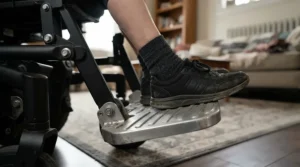
An extra-wide footplate surface isn’t a luxury; it’s about fit. Bulky or wide-fit footwear, bandaging and orthotics all demand more platform than a standard footrest offers. To put numbers on it, one generic replacement footplate on Amazon UK lists 29 × 13 cm. A UK size 12 shoe is roughly 30 cm long or more, so heels or toes would overhang before you’ve even factored in footwear width.
Why does overhang matter? It tips your foot’s contact area toward the edge, concentrating pressure and making slips more likely. A larger surface spreads the load and gives calf straps and heel loops something stable to work against.
There are trade-offs too. Bigger plates sit closer to the ground when the footrest is low, which raises the risk of catching on kerbs, which the WHO footrest guidance warns about. They can also make cramped transfers fiddly unless they swing away or flip up. That’s why the Drive DeVilbiss Sentra EC‘s flip-up design and the swing-away plates on the Roma Medical 1473 and Days 238-23 XWHD matter as much as their raw size. Whatever you choose, check the footplate’s non-slip surface and edge lip, not just its dimensions.
Weight Capacity Ratings: Reading the Small Print
Weight capacity ratings are where listings get sloppy. Quick maths: one stone is 6.35 kg, so 22 stone is about 140 kg, 28.5 stone about 181 kg, 31.5 stone about 200 kg, 35 stone about 222 kg and 50 stone about 317 kg.
Across this list the stated ratings run from 22 stone on the Days 238-23 XWHD to around 35 stone on the Roma Medical 1473. The Roma Medical 1473X is where they get murky, with retailers listing anything from 35 to 50 stone. The U-GO Atlas and Dash 200 HD show similar discrepancies between sellers. The fix is simple: ask for the rating for your exact seat width, in writing.
For context on how ratings are meant to be derived, the ISO 7176 wheelchair standards guide lists the series covering strength and fatigue testing, labelling and information disclosure. A trustworthy rating should trace back to that kind of testing, and a good seller can tell you whether it covers the footrests.
Add headroom for clothing, bags and the dynamic forces of sitting down heavily or tipping over kerbs. A chair running at its limit wears faster than one with margin.
Large Footplates for Bariatric Wheelchairs vs Standard Footrests
Is paying more for large footplates for bariatric wheelchairs worth it, compared with the standard footrests on an ordinary chair? It depends on your feet, your weight and your home.
| Factor | Bariatric chair with large footplates | Standard chair with standard footrests | Best For |
|---|---|---|---|
| Foot support area | Wider and deeper; fits bulky footwear | Compact; may overhang | Larger feet |
| Typical weight rating | Roughly 22–35+ stone in this guide | Commonly about 114–127 kg | Heavier users |
| Transfers | Swing-away or flip-up on chairs like the Drive DeVilbiss Sentra EC | Usually swing-away | Daily transfers |
| Overall width | Up to 89 cm on the Roma Medical 1473X | Narrower | Wide doorways |
| Lifting weight | Roughly 22–27.5 kg | Often around 18 kg | Boot-loading carers |
Looking at the comparison, a standard chair wins on weight and doorway access, but it simply can’t support heavier users or larger feet safely. The Days 238-23 XWHD shows the middle path, with large footplates at a lower weight rating. If your weight exceeds standard ratings, the bariatric route isn’t optional, it’s the safe choice.
Long-Term Cost, Maintenance and VAT Relief
Total cost of ownership is more than the sticker. Solid tyres remove puncture costs but eventually wear, upholstery needs replacing, and footplates are the part most likely to need a swap. Generic replacement footplates on Amazon UK run roughly £10 to £40, but fit and weight rating matter more than price.
VAT relief can cut the bill. According to GOV.UK’s guidance on VAT relief for disabled people, if you’re disabled or have a long-term illness, you shouldn’t be charged VAT on qualifying wheelchairs. That also covers repairs, maintenance, spare parts and accessories. Both you and the product must qualify, and not every seller processes relief, so confirm before ordering.
| Chair | Indicative price range | Weight rating | Value verdict | Best For |
|---|---|---|---|---|
| Drive DeVilbiss BTR22 | £200–£275 | 31.5 st | Excellent for occasional use | Budget pushing |
| U-GO Atlas | £250–£400 (indicative) | 28.5–31.5 st | Good width choice | Budget self-propelling |
| Days 238-23 XWHD | £300–£400 | 22 st | Fair if rating suffices | Large plates, lower weight |
| Drive DeVilbiss Sentra EC | Mid-range (unverified) | 32 st | Depends on price | Transfers |
| Dash 200 HD | £450–£600 | 31.5–35 st | Worth it for vehicle travel | Accessible-vehicle users |
| Roma Medical 1473 | £410–£500 | About 35 st | Strong for the spec | Tall users |
| Roma Medical 1473X | £490–£590 | Verify (35–50 st) | Premium for width | Widest seat |
Ranges are indicative, drawn from UK listings at the time of research, and may include or exclude VAT. Looking at the table, the Drive DeVilbiss BTR22 delivers the best value if its 22-inch seat suits you, while the Dash 200 HD justifies its premium only if you’ll use the crash-tested design. Budget buyers should note that the U-GO Atlas trades footplate transparency for width choice.
Common Mistakes When Buying Large Footplates for Bariatric Wheelchairs
- Trusting the seat width alone. Footplate dimensions and footrest adjustment range matter just as much.
- Ignoring overall width. A 26-inch seat becomes roughly 89 cm on the Roma Medical 1473X; measure doorways first.
- Taking one weight figure at face value. Retailers disagree on several chairs here, so get the rating confirmed for your exact model and seat width.
- Skipping the footplate question. The Drive DeVilbiss BTR22 and U-GO Atlas don’t publish footplate dimensions, so ask.
- Forgetting who lifts it. A 27.5 kg chair like the Drive DeVilbiss Sentra EC is no small thing for a carer’s back.
Safety, Standards and Getting NHS Support
Wheelchairs are medical devices, so ask the manufacturer for its conformity details (UKCA or CE marking). Crash testing, such as the ISO 7176-19 claim on the Dash 200 HD, matters only if your vehicle’s restraint system and seatbelts are correctly used, so check those too.
NHS provision varies by area. As one example, one NHS trust’s published wheelchair criteria treat 20 stone (127 kg) as the limit of a standard wheelchair. It sets separate criteria for heavy-duty and bariatric manual chairs, with a further threshold at 25 stone (160 kg). Your local service may differ, so ask your GP, district nurse or community occupational therapist about a referral.
Even if you buy privately, an assessment is worthwhile. A therapist can check posture, footrest set-up and pressure risk, which a spec sheet never will. If you’re unsure about weight limits or footplate fit, treat the assessment as part of the purchase.
FAQ
❓ How big should large footplates for bariatric wheelchairs be?
❓ Can I buy large footplates for bariatric wheelchairs separately?
❓ How do I convert a bariatric wheelchair's stone rating into kilograms?
❓ Is VAT relief available on bariatric wheelchairs?
❓ Will a bariatric wheelchair fit through my doorway?
Conclusion
Choosing large footplates for bariatric wheelchairs is a fit problem as much as a strength problem. The Drive DeVilbiss BTR22 is the sensible budget pick for occasional, carer-pushed use. The U-GO Atlas gives you width choice for self-propelling, and the Days 238-23 XWHD brings large footplates to users within its 22-stone limit. The Drive DeVilbiss Sentra EC is the transfer-friendly option, while the Dash 200 HD earns its premium for vehicle travel. For tall users or those wanting hemi-height flexibility, the Roma Medical 1473 is strong, and the Roma Medical 1473X is the one when you need the widest seat.
Whichever you choose, do four things. Get the weight rating confirmed in writing for your exact seat width, ask for footplate dimensions in centimetres, measure every doorway on your route, and check whether VAT relief applies. Remember that this guide is research, not hands-on testing, so a professional assessment is worth having.
✨ Ready to Find Your Fit?
🔍 Click any highlighted product name to check current pricing and availability, then match your measurements to the chair that suits you best. Comfort and confidence are closer than you think! ♿
Recommended for You
- Folding vs One-Piece Footplates: 7 Proven Picks For UK (2026)
- Best Wheelchair Footplates: 7 Proven UK Picks (2026)
- Footrests For Wheelchair Users With Oedema: 7 Picks (2026)
Disclaimer: This article contains affiliate links. As an Amazon Associate, I earn from qualifying purchases. If you purchase products through these links, we may earn a small commission at no additional cost to you.
✨ Found this helpful? Share it with your friends! 💬🤗
