
In This Article
Nobody daydreams about buying a footplate. It’s the part you ignore for years, right up until a crack runs across the middle, a hanger rattles over every kerb, or a foot slips off the edge at the worst possible moment. Then it becomes the only part of the chair you care about.
That’s when this guide earns its keep. The best wheelchair footplates do far more than hold your feet. They set your ankle angle, share your body weight and stop your knees drifting outwards. Choose badly and your hips will tell you by teatime. Yet the market is a maze of “universal” listings, unfamiliar brand names and near-identical photos.
So I’ve combed through what’s genuinely on amazon.co.uk in 2026, compared the published specifications and weighed the review evidence that actually exists. I’ve translated it all into plain English. You’ll find seven real products, from a budget universal wheelchair footplate replacement to an Invacare-spec elevating legrest. There’s also practical advice on footplate compatibility, standard fitting sizes and non-slip surfaces.
One honest caveat: I haven’t handled any of these products, so what follows is spec analysis and aggregated review sentiment, not lab testing. And because wheelchairs are highly customisable, from seat width to footplates and legrests, no single part suits every chair. Wherever measuring matters, I’ll say so. As an Amazon Associate I earn from qualifying purchases; the full disclaimer sits at the end.
Best Wheelchair Footplates at a Glance: Quick Comparison
| Product | Type | Price range | Rating (as seen) | Best For |
|---|---|---|---|---|
| ReyjiuMed Swing-Away Footrests (T93HEP / PH-SF) | Swing-away pair, composite plates, heel loops | From the mid-£50s | 4.6 (39 ratings) | Everyday standard chairs |
| ENCAREFOR Composite Legrests (Non-Padded) | Aluminium hangers, composite plates | £35-£40 range | 4.5 (roughly 230 ratings) | Best-value complete pair |
| Invacare T94HCP Elevating Leg Rest | Elevating, padded calf pads | Mid-£90s upwards | Not verifiable | Invacare-type chairs, raised legs |
| KOMBIUDA Universal Wheelchair Footrest Pedals | Plastic plate, about 20 × 16 cm | £16-£18 range | Not verifiable | Cheapest plate-only swap |
| OZTYSGXM Universal Elevating Legrests | Padded calf pads, sold per side | Under £30 per side | 2.5 (3) and 5.0 (5) on two variants | Replacing one side only |
| Universal Wheelchair Footplate Replacement (7/8″ Tube Mount, 2-Pack) | ABS plates, textured | Low-£20s | 3.5 (2 ratings) | Broken plates on 7/8″ tubes |
| Laroal Neoprene Footrest Covers | Non-slip cover pair | £8-£11 range | Not verifiable | Adding grip cheaply |
Looking at the comparison above, the ReyjiuMed Swing-Away Footrests (T93HEP / PH-SF) and ENCAREFOR Composite Legrests (Non-Padded) are the only two with a review pool big enough to lean on, and together they cover most standard-chair scenarios. If only a plate has cracked, the KOMBIUDA Universal Wheelchair Footrest Pedals or the Universal Wheelchair Footplate Replacement (7/8″ Tube Mount, 2-Pack) cost a fraction of a full pair, provided the tube size matches. Anyone who needs genuine calf support should look at the Invacare T94HCP Elevating Leg Rest and accept the premium for fit certainty.
💬 Just one click — help others make better buying decisions too!😊
Top 7 Best Wheelchair Footplates: Expert Analysis
Prices below are ranges observed at the time of research, so check current listings before you buy.
1. ReyjiuMed Swing-Away Footrests (T93HEP / PH-SF) — best all-round swap for standard chairs
Swing-away hangers are what separate a footrest you tolerate from one you like, because the plate pivots aside for transfers instead of forcing you to unbolt anything. The listing describes a cam-lock design for standard wheelchairs and transport chairs with hemi pin spacing of 1.46 inches (about 37 mm). It also mentions tool-free push-button length adjustment with an anti-rattle collar. In practice, that means quicker fitting and fewer rattles over paving.
The composite footplate comes with a heel loop, which stops a heel sliding backwards. That matters if ankle control is limited. Based on the spec comparison, this is the sensible default if your chair has standard hanger sockets and you want a proper pair of footrests, not a bare plate.
On sentiment, the UK listing shows a 4.6 out of 5 average from 39 ratings. That’s encouraging but a modest sample, and I couldn’t verify individual review themes.
Pros:
- ✅ Swing-away action simplifies transfers
- ✅ Tool-free length adjustment with anti-rattle collar
- ✅ Heel loop helps keep feet positioned
Cons:
- ❌ Only suits sockets with matching hemi spacing
- ❌ Pricier than a bare replacement plate
Expect to pay from the mid-£50s, which is fair for an adjustable pair, provided you check your pin spacing first.
2. ENCAREFOR Composite Legrests (Non-Padded) — best-value complete pair
The standout here is the weight of evidence: roughly 230 UK ratings averaging 4.5 out of 5, far deeper than most rivals. The listing describes aluminium construction, composite footplates, non-padded calf supports for when the legrest is raised, and feet that can rotate. In its packaging it weighs around 3.75 lb (about 1.7 kg), so it’s not a burden to handle.
Here’s what the spec sheet won’t tell you, but the available feedback hints at. One US reviewer said the pair fitted and did its job but doesn’t rise and lower, which sits awkwardly beside the word “elevating” in the title. Confirm whether elevation matters to you before ordering. The non-padded calf support keeps cost down, but anyone sitting with raised legs for long stretches will probably want padding.
The UK page I saw was fulfilled through Amazon Global Store, which flags that US imports may differ from local products. Check the returns terms.
Pros:
- ✅ Deep review pool with strong average
- ✅ Aluminium build keeps weight manageable
- ✅ Rotating footplates ease side transfers
Cons:
- ❌ No calf padding for long elevated sitting
- ❌ Elevation behaviour may not match the title
At the £35-£40 range, it’s the best value complete pair here.
3. Invacare T94HCP Elevating Leg Rest — premium manufacturer-spec choice
When a manufacturer’s own part number is on the label, you’re buying certainty rather than hope. The T94HCP pairs composite footplates with padded calf pads on an elevating hanger. Invacare’s swing-away legrest listings also describe adjustable length and tool-free installation. In practice, the calf pad spreads load across the lower leg, so a raised leg doesn’t feel like it’s dangling from the knee.
For Invacare-type chairs, and for anyone who relies on elevation, such as after surgery or with swelling, brand-matched fit beats the gamble of universal claims. One curiosity: a look-alike padded pair described as matching the T94’s structure was listed higher than this genuine article when I checked. So compare sellers before assuming “generic” means cheaper.
I couldn’t verify meaningful review data for this listing, so treat this as a spec-based recommendation, not a crowd-tested one.
Pros:
- ✅ Padded calf pads for raised-leg comfort
- ✅ Composite plates support heel-to-ball positioning
- ✅ Brand-matched fit for Invacare-type frames
Cons:
- ❌ Highest price of the seven
- ❌ Third-party stock and delivery times vary
Budget for the mid-£90s upwards. You’re paying for fit assurance, and for many users that’s money well spent.
4. KOMBIUDA Universal Wheelchair Footrest Pedals — cheapest plate-only swap
If only the plate is broken, buying a full footrest is like replacing a car because a wiper died. This listing gives dimensions of 7.87 × 6.30 × 2.36 inches (about 20 × 16 × 6 cm) and describes lightweight plastic, marketed for both wheelchairs and mobility scooters. A 20 cm length covers heel to ball for many adult feet, which is the job a plate needs to do.
Now the reality check. “Universal” here really means “universal-ish”. The plate still has to match your tube diameter and bracket, so measure first (see the fitting guide below).
I couldn’t verify meaningful reviews. Comparable plates in the same search showed one or two ratings, which tells you nothing statistically.
Pros:
- ✅ Very low cost per plate
- ✅ Lightweight plastic construction
- ✅ Suits wheelchairs and mobility scooters
Cons:
- ❌ Universal fit isn’t guaranteed
- ❌ Little verifiable review evidence
At £16-£18 it’s the cheapest sensible fix for a cracked plate, as long as the fit checks out.
5. OZTYSGXM Universal Elevating Legrests (Padded Calf Pads) — sold per side for one-leg fixes
Most pairs assume both sides have failed. This one is sold by side, with listings marked Left or Right, which is handy if only one hanger has snapped. You get padded calf pads and composite footplates, and the listing promises easy cleaning and installation on most standard wheelchairs.
The catch is the evidence. The left-side listing showed 2.5 out of 5 from three ratings, while another variant showed 5.0 from five. That’s a tiny, contradictory sample, so treat the product as unproven. Buy with a clear returns window and verify hanger spacing before you commit.
Ordering by side also invites mistakes: get left and right muddled and you’ve bought an expensive paperweight.
Pros:
- ✅ Buy only the side that broke
- ✅ Padded calf pads for elevated legs
- ✅ Listed as easy to clean
Cons:
- ❌ Tiny, conflicting review sample
- ❌ Left and right easy to confuse
Expect under £30 per side, or the high-£50s for a pair, which is a fair price if it fits, though not a bargain if it doesn’t.
6. Universal Wheelchair Footplate Replacement (7/8″ Tube Mount, 2-Pack) — best for standard 7/8″ tubes
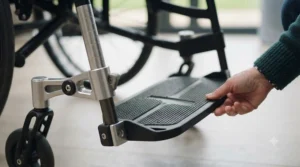
This is the workhorse of standard fitting sizes. Similar listings describe ABS plates with a 7/8 inch mounting hole, mounting width around 3.2 inches, and a plate roughly 7 inches long by 6 inches wide (about 18 × 15 cm) with a textured, non-slip surface. Some of those listings cite chairs such as the Drive Blue Streak.
Note the sourcing: those specifications come from near-identical US listings, while the UK two-piece listing I found offered less detail. Confirm the exact size on whichever page you buy from.
The trap is a 3/4 inch tube. At least one comparable listing exists specifically for 3/4 inch tubing, so measuring beats guessing. The UK listing showed 3.5 out of 5 from two ratings, which is far too few to draw conclusions.
Pros:
- ✅ Textured ABS surface for grip
- ✅ Two plates for the price of one
- ✅ 7/8 inch mount suits many folding chairs
Cons:
- ❌ Won’t suit 3/4 inch or unusual tubes
- ❌ Specs vary between near-identical listings
In the low-£20s for two, it’s a smart, cheap repair when your tube measures up.
7. Laroal Neoprene Footrest Covers — best non-slip upgrade on a budget
This isn’t a replacement at all. It’s a two-piece set of soft neoprene covers sold as non-slip footplate protector pads. Where hard plastic gets glassy with wear, neoprene adds friction and a little cushioning, which helps most if you often sit in socks or thin-soled shoes.
Here’s the honest limit: covers improve sound plates but cannot repair cracked, bent or misaligned ones. And neoprene can hold moisture, so let it dry properly between uses.
I couldn’t verify meaningful customer reviews for this listing, so this pick rests on the product’s logic, not on crowd evidence.
Pros:
- ✅ Cheapest way to add grip
- ✅ Cushions hard plastic plates
- ✅ Two-piece set covers both sides
Cons:
- ❌ Can’t repair cracked or bent plates
- ❌ Fit depends on your existing plate size
At £8-£11, it’s a low-risk experiment if slipping is your only complaint.
How to Measure and Fit Wheelchair Footplates (Step-by-Step Guide)
A ten-minute check before ordering saves a fortnight of returns. Here’s the sequence I’d follow.
- Identify your hanger type. Is it fixed, swing-away or detachable? That decides whether you need a full footrest or just a plate.
- Measure the tube. Use a tape or callipers on the tube the plate mounts to. Several universal plates quote 7/8 inch (about 22 mm), while a few quote 3/4 inch (about 19 mm).
- Check pin spacing. Swing-away footrests often reference 1.46 inch (37 mm) hemi spacing, while some Invacare parts use wider 3 1/8 inch sockets.
- Set the height. NHS wheelchair services advise that footrests should sit at a comfortable level and are height adjustable, and they suggest contacting your service if unsure.
- Test before use. Brakes on, listen for the swing-away catch to click, then wiggle the plate firmly.
For maintenance, a monthly inspection for cracks, loose bolts and worn tread is plenty. In the first 30 days, the classic mistakes are over-tightening plastic parts and skipping the height check. If your chair is on loan from an NHS wheelchair service, it’s usually worth asking them before swapping parts.
Buyer’s Decision Framework: If This Happens, Choose That
Not sure where to start? Match your situation to the right product.
- The plate is cracked but the hanger is sound and the tube is 7/8 inch: choose the Universal Wheelchair Footplate Replacement (7/8″ Tube Mount, 2-Pack) or the KOMBIUDA Universal Wheelchair Footrest Pedals, because they cost least.
- The whole footrest is damaged, or you want swing-away convenience: choose the ReyjiuMed Swing-Away Footrests (T93HEP / PH-SF), because they’re complete and adjustable.
- You want two new hangers on a modest budget: choose the ENCAREFOR Composite Legrests (Non-Padded), because of the review depth.
- You need calf support, or your chair is Invacare-made: choose the Invacare T94HCP Elevating Leg Rest, because fit certainty matters most.
- Only one side failed: choose the OZTYSGXM Universal Elevating Legrests, because you buy per side.
- The plates are fine but slippery: choose the Laroal Neoprene Footrest Covers, because it’s the cheapest grip fix.
As a priority checklist: measure first, decide repair or replace second, and pick the budget last. That order prevents the costliest mistake, which is buying a good product that doesn’t fit.
Problem → Solution Guide: Five Footplate Headaches Fixed
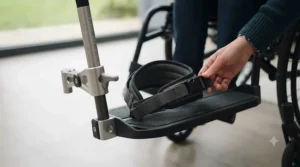
Feet keep sliding off. Look for a heel loop, as on the ReyjiuMed Swing-Away Footrests (T93HEP / PH-SF), or add grip with the Laroal Neoprene Footrest Covers. If slipping is severe, ask a therapist about positioning, not just accessories.
The footrest rattles. Loose sockets are the usual cause. The anti-rattle collar described on the ReyjiuMed Swing-Away Footrests (T93HEP / PH-SF) targets exactly this, but check hanger spacing too.
The plate feels too small. Plates around 20 cm long, like the KOMBIUDA Universal Wheelchair Footrest Pedals, cover many adult feet, but very large or very small feet may need a different plate.
Plates turn slick in the rain. Textured ABS, as on the Universal Wheelchair Footplate Replacement (7/8″ Tube Mount, 2-Pack), helps, but worn tread loses its bite, so replace when smooth.
The footrest snags on kerbs or doorways. Adjust height, then consider swing-away hangers so you can pivot the plates out of the way when transferring or manoeuvring tightly.
Every fix above starts with a measurement, not a purchase. That habit is worth more than any product on this list.
What Are the Best Wheelchair Footplates? Footplate vs Footrest vs Legrest
The best wheelchair footplates are platforms that fit your chair’s hangers exactly, support the foot from heel to ball at a comfortable ankle angle, grip in all weather and stay rigid under load. A wheelchair footplate is just one part of a wider footrest or legrest assembly.
The jargon trips people up. A footrest is a hanger plus a plate, while a legrest adds a calf pad on an elevating hanger. Physiopedia’s overview of wheelchair accessories notes that footrests can be fixed or removable. Fixed ones are less fragile, while removable ones suit tight spaces such as lifts. It also lists 90°, 70° and 60° as the most frequent platform angles.
| Option | What it does | Watch-out | Best For |
|---|---|---|---|
| Footplate only | Replaces the platform | Must match tube and bracket | Cracked plate, sound hanger |
| Footrest (hanger + plate) | Full support, often swing-away | Pin spacing must match | Worn or damaged assemblies |
| Legrest with calf pad | Elevates and supports the leg | Costs more, heavier | Swelling, recline, tilt |
| Foot sling or hammock | Hangs feet on straps | Less rigid, less positioning control | Occasional comfort only |
The table shows why the cheapest option isn’t always the smartest. Slings from around £10-£16 look tempting on listings, but they offer far less positional control than a rigid plate. If posture or pressure care matters, spend on rigid support and let a professional advise on angles.
How to Choose the Best Wheelchair Footplates: 7 Steps
- Confirm your chair type. Manual, transport or electric chairs often need different parts. Electric models frequently have dedicated footplates.
- Measure tube and spacing. Diameter and pin spacing decide compatibility before anything else.
- Decide plate or full assembly. If the hanger is sound, a plate alone is cheaper.
- Choose the material. Plates come in aluminium or plastic composite. Aluminium tends to feel stiffer, while composite is lighter and cheaper.
- Check the surface. Look for texture, striping and heel loops.
- Decide on elevation. Only pay for calf pads and elevation if you’ll use them.
- Vet the seller. Review depth, returns terms and import status matter as much as the spec.
Universal Wheelchair Footplate Replacement: Does “Universal” Really Mean Universal?
Rarely. In listing language, “universal” means “fits many”, not “fits all”. You’ll see “fits most standard wheelchairs of all brands” in the same listing that asks you to confirm your size before purchasing. That second sentence is the honest one.
What “universal” usually covers is a common tube diameter, often 7/8 inch, plus a mounting width near 3.2 inches. A chair with 3/4 inch tubing, a proprietary bracket or a dedicated electric footrest may not qualify. Amazon even lists model-specific parts, such as a replacement footplate for the FreeToBe NSDS01 electric wheelchair and replacement footrests for the Escape Lite. That’s a strong hint that many chairs need exact matches.
For any universal wheelchair footplate replacement, my rule is simple: measure, compare, and only then click. A cheap plate that doesn’t fit is the most expensive plate you can buy.
Footplate Compatibility: Matching Hangers, Brands and Pin Spacing
Footplate compatibility comes down to three checks: tube diameter, mounting width and socket spacing. Miss any one and the part won’t sit right.
Brand cross-references help, with caution. Listings often say a part has the “same functional structure” as an Invacare T94 or a Drive LK3JELR. That means look-alike, not OEM, so tolerances may differ by a millimetre or two. That’s enough to cause a wobble.
Transport chairs add another wrinkle. Some swing-away footrests specifically mention transport chairs “with hemi pin spacing”, so the phrase carries real meaning. If your chair uses wider sockets, such as the 3 1/8 inch spacing on certain Invacare parts, a standard 1.46 inch design won’t fit at all.
The practical takeaway on footplate compatibility: match by measurement first, brand second, and marketing copy last. If the seller can’t tell you the spacing, be wary.
Standard Fitting Sizes: What the Numbers Actually Mean
| Measurement | Typical value in listings | What it means | Best For |
|---|---|---|---|
| Mounting tube diameter | 7/8 in (about 22 mm); some 3/4 in (about 19 mm) | Must match the plate’s mounting hole | Universal plate swaps |
| Mounting width | About 3.2 in (about 8 cm) | Spacing of the plate’s bracket | Checking plate-to-hanger fit |
| Plate size | About 6-6.3 in wide by 7-8 in long (about 15-16 × 18-20 cm) | Heel-to-ball support for most adults | Standard adult feet |
| Hemi pin spacing | 1.46 in (37 mm) | Socket spacing on the chair | Swing-away footrests |
| Wide spacing | 3 1/8 in (about 79 mm) | Wider sockets on some Invacare parts | Chairs with wide sockets |
Many listings quote inches because they originate in US markets, so convert before comparing with your tape measure. These standard fitting sizes are the most common ones I found, not a universal rule, and your chair’s manual always wins.
The table shows that plate size is forgiving, while tube diameter and pin spacing are not. A centimetre either way on a plate is a comfort issue. A millimetre out on spacing is a fit issue.
Non-Slip Surfaces: What Actually Grips
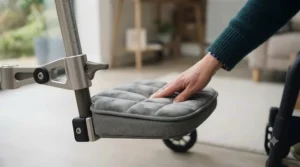
Non-slip surfaces come in four main forms on today’s listings: textured composite, striped plastic, textured aluminium alloy and neoprene covers. Each grips differently, and none lasts forever.
Texture works by channelling water and giving soles something to bite. Striped or ribbed patterns do the same job. The Laroal Neoprene Footrest Covers take a different route, adding a soft, high-friction skin. Heel loops, as on the ReyjiuMed Swing-Away Footrests (T93HEP / PH-SF), prevent backwards slipping instead.
Here’s the analysis reviewers rarely mention: non-slip surfaces only work while the texture exists. Grit, mud and wear smooth them out, so clean plates regularly and replace when the pattern fades. Also, excess grip can catch on soles during transfers, so test the plate’s behaviour with your usual footwear.
A note of caution: restraint-style shoe holders are sold alongside plates on Amazon, but they’re a clinical decision. Talk to a therapist before restricting foot movement.
Long-Term Cost & Maintenance
| Tier | Price range | Products | Best For |
|---|---|---|---|
| Budget | £8-£25 | Laroal Neoprene Footrest Covers, KOMBIUDA Universal Wheelchair Footrest Pedals, Universal Wheelchair Footplate Replacement (7/8″ Tube Mount, 2-Pack) | Quick, low-risk fixes |
| Mid-range | £28-£60 | OZTYSGXM Universal Elevating Legrests, ENCAREFOR Composite Legrests (Non-Padded), ReyjiuMed Swing-Away Footrests (T93HEP / PH-SF) | Complete pairs |
| Premium | Around £95 and up | Invacare T94HCP Elevating Leg Rest | Fit certainty, elevation |
The table shows a clear step at each tier: budget buys parts, mid-range buys assemblies, premium buys assurance. Illustratively, if a £17 plate lasted two years, that’s about £8.50 a year, while a £55 pair lasting five years is £11 a year but includes hangers and adjustment. Cost per year narrows the gap more than the sticker suggests.
Maintenance is cheap: wipe with mild soap, check bolts monthly, inspect for cracks and replace worn plates promptly.
Common Mistakes When Buying Wheelchair Footplates
The biggest error is buying on the title alone. Titles promise “universal”, “elevating” and “fits all brands”, but specifications tell the real story. Second, people overlook left-right ordering when parts are sold by side. Third, tiny review pools get treated as proof: a 5.0 from two ratings is a coin flip, not a verdict.
Other common slips:
- Ignoring import status. US imports may differ from local products, and returns can be trickier.
- Skipping the weight limit. The listing extracts I reviewed rarely stated one, so ask the seller.
- Choosing padded legrests you’ll never elevate, or skipping padding you will need.
- Forgetting height adjustment after fitting.
Avoid these five and you’ll dodge most disappointments before they start.
Safety, Regulations and VAT: What UK Buyers Should Know
Start with safety. Foot position affects pressure as well as comfort. The International Guideline on seating advises positioning feet on the ground or a footrest at an angle that matches available range of motion. It also says pressure on the heels should be relieved without loading the Achilles tendon. If you’re at risk of pressure injuries, take advice from a clinician, not just a listing.
On regulation, wheelchairs and their parts are generally treated as medical devices in the UK. In the listing extracts I reviewed, I didn’t see UKCA or CE details prominently displayed, so ask sellers about conformity and manufacturer details.
Then there’s money. HMRC’s manual on VAT relief for disabled people includes a dedicated section on parts and accessories. In broad terms, relief applies to chronically sick or disabled people buying for personal use, usually via a short eligibility declaration. Being elderly or temporarily injured doesn’t count. Check with the supplier whether they offer it, as marketplace listings may not.
FAQ
❓ How much do wheelchair footplates cost in the UK?
❓ Will a universal wheelchair footplate fit my Drive or Invacare chair?
❓ Can I buy a single wheelchair footplate instead of a pair?
❓ Are aluminium footplates better than plastic ones?
❓ How often should wheelchair footplates be replaced?
Conclusion: Choosing the Best Wheelchair Footplates for Your Chair
The best wheelchair footplates are the ones that fit first and impress second. Start with measurements, because a perfect product that doesn’t match your tube is just an expensive lesson.
For most standard chairs, the ReyjiuMed Swing-Away Footrests (T93HEP / PH-SF) are the sensible all-rounder, and the ENCAREFOR Composite Legrests (Non-Padded) are the value pick with the deepest review support. Anyone needing calf support and brand-matched fit should consider the Invacare T94HCP Elevating Leg Rest, while the OZTYSGXM Universal Elevating Legrests suit single-side replacements if you’re willing to take a chance on a thin review pool. For quick repairs, the KOMBIUDA Universal Wheelchair Footrest Pedals and the Universal Wheelchair Footplate Replacement (7/8″ Tube Mount, 2-Pack) keep costs low. And if grip is the only issue, the Laroal Neoprene Footrest Covers are a low-cost fix.
Take your time, compare specifications honestly and ask sellers the awkward questions. Your feet, hips and peace of mind will thank you.
✨ Ready to Find Your Footplates?
🔍 Click any highlighted product name to check current pricing and availability, and give your chair the support it deserves!
Recommended for You
- Footrests For Wheelchair Users With Oedema: 7 Picks (2026)
- Removable Footrests For Transport Wheelchairs: 7 Best Picks (2026)
- Elevating Footrests For Wheelchair: 7 Best UK Picks (2026)
Disclaimer: This article contains affiliate links. As an Amazon Associate, I earn from qualifying purchases. If you purchase products through these links, we may earn a small commission at no additional cost to you.
✨ Found this helpful? Share it with your friends! 💬🤗
