
In This Article
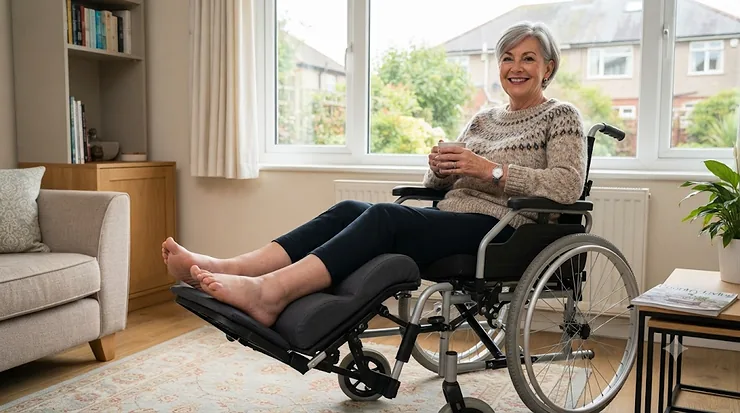
Swollen ankles have a way of making themselves known the moment you try to fold them onto a standard metal footplate. If you’ve ever watched someone wince as their foot drops onto a narrow, unforgiving strip of aluminium, you already understand why footrests for wheelchair users with oedema aren’t a nice-to-have accessory — they’re closer to essential kit. Oedema, in plain English, is fluid pooling in the tissue, usually the lower legs, causing skin that feels tight, shiny and sometimes genuinely painful to the touch. For wheelchair users, that swelling doesn’t just sit there quietly; it interacts with every hour spent in a seated position, and a footrest that’s too narrow, too hard, or set at the wrong height can quietly make things worse.
This guide exists because most product listings tell you what a footrest is made of, not what it actually does for a swollen limb. We’ve dug through real UK-available products — from budget clip-on pads to fully articulating medical footplates — and paired the specs with honest analysis of who each one genuinely suits. Some of what follows is refreshingly unglamorous: foam density, strap tension, how far a plate elevates. But these are the details that decide whether an evening in the wheelchair ends in relief or in another round of “can you just prop my foot up on something.”
As the NHS explains, swelling in the ankles, feet or legs often eases on its own but can also point to something worth flagging to a GP — so think of this article as a buying guide sitting alongside medical advice, never replacing it.
Quick Comparison Table
Before the deep dive, here’s the fast version for anyone short on time or patience — both of which tend to run low when your feet are throbbing.
| Product | Type | Price Range | Best For |
|---|---|---|---|
| Vive Wheelchair Footrest Extender | Padded elevating pad | Under £40 | Budget buyers wanting wide, soft support |
| Hermell WC2218 Padded Foot Rest | Simple padded plate | Under £30 | Minimalist, strap-on comfort layer |
| Skil-Care Side-Kick Pad (18″) | Add-on foam side padding | £30-£50 range | Retrofitting swelling comfort padding onto existing rests |
| ForconMed Elevating Legrests | Composite elevating legrest pair | £60-£90 range | Mid-range circulation-focused elevation |
| NYOrtho Foot-Rest Extender | Adjustable elevating platform | £50-£80 range | Adjustable elevation with side guards |
| Universal Liftable Leg Support (90°-180°) | Articulating adjustable footplate | £90-£130 range | Adjustable width footplates and angle control |
| Invacare Elevating Legrest | Branded composite legrest, adjustable length | £100-£160 range | Medical footrest recommendations, tool-free fitting |
Looking across the table, the pattern is fairly clear: the closer you get to genuine adjustability — angle, length, width — the higher the price climbs, and the more the product starts to resemble something an occupational therapist would actually prescribe. Budget picks like the Vive Wheelchair Footrest Extender and Hermell WC2218 Padded Foot Rest solve the “hard metal plate” problem cheaply, but they won’t elevate or articulate. If oedema is a daily, ongoing issue rather than an occasional evening annoyance, the mid-to-premium end of this table earns its extra cost.
💬 Just one click — help others make better buying decisions too!😊
Top 7 Footrests for Wheelchair Users With Oedema: Expert Analysis
We’ve grouped these across budget, mid-range and premium tiers, covering padded add-ons, elevating pairs and fully articulating footplates so there’s something here regardless of how advanced your seating setup already is.
1. Vive Wheelchair Footrest Extender — wide padded platform with safety side guards
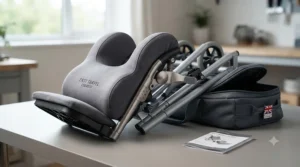
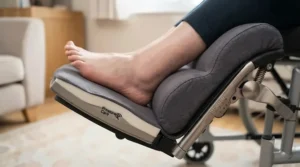
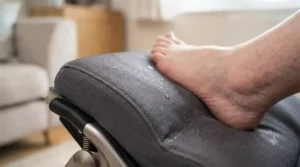
The standout here is simple: instead of two narrow metal plates, you get one continuous, cushioned surface wide enough for both feet to rest naturally, swelling and all. The high-density foam core sits under a wipe-clean, water-resistant cover, and raised side bolsters stop feet sliding off or drifting toward the wheels — a genuinely useful detail if ankle swelling has ever thrown off someone’s sense of foot placement. The design transforms the standard narrow, hard, slippery footplate into a soft, wide, secure platform, and the slightly elevated leg position is intended to help improve circulation and reduce swelling.
Based on the spec sheet, this is best suited to wheelchair users who need a straightforward comfort upgrade rather than a full elevating legrest — think post-op recovery, mild daily swelling, or simply feet that ache from hours on thin metal. It won’t lift the leg dramatically, but the width and padding alone solve a lot of the discomfort that oedema causes on a standard plate. Aggregated feedback on comfort-focused mobility pads in this category tends to highlight the difference wider padding makes versus bare metal, though we’d note that individual review verification for this specific listing was limited, so treat that as a general category pattern rather than a guaranteed outcome for this exact model.
Pros:
- ✅ Wide single-platform design fits both feet comfortably
- ✅ Raised side guards reduce slipping risk
- ✅ Wipe-clean cover suits daily, long-term use
Cons:
- ❌ Minimal elevation compared with true legrests
- ❌ Straps may need occasional retightening on some chairs
At around £30-£40, this sits comfortably within the wheelchair footrest under £40 bracket, and for that price it’s hard to argue with — it’s a sensible first upgrade before committing to pricier elevating hardware.
2. Hermell WC2218 Padded Foot Rest — no-fuss padded plate for budget upgrades
This one keeps things deliberately simple: a latex-free foam pad with a water-resistant twill cover that attaches over an existing footplate using hook-and-loop straps. It’s designed for convenient attachment, with the footrest fitting easily using hook-and-loop tape straps, which means no tools, no swapping parts, just a softer landing spot for feet that are already tender.
What most buyers overlook about a product this modest is that it solves a very specific problem — the shock and pressure of a bare metal plate — without trying to be anything more ambitious. For someone whose oedema is manageable and whose main complaint is discomfort rather than needing elevation, that’s precisely the right scope. It’s not going to rival a composite elevating legrest for genuine circulation support, but as a first line of defence against pressure and cold metal, it does its one job well. Foam-and-vinyl pads in this category generally earn praise for ease of fitting rather than dramatic swelling relief, and that honest framing matters more than inflated claims.
Pros:
- ✅ Genuinely simple, tool-free hook-and-loop fitting
- ✅ Latex-free foam suits sensitive or fragile skin
- ✅ Compact and lightweight, easy to transport or swap between chairs
Cons:
- ❌ No elevation function whatsoever
- ❌ Padding is thinner than dedicated elevating pads
Priced under £30 in most cases, this is arguably the cheapest genuine entry point among footrests for wheelchair users with oedema — a low-risk way to test whether padding alone makes a difference before spending more.
3. Skil-Care Side-Kick Pad (18″ Width) — foam-padded side panels that retrofit onto existing extenders
Rather than being a standalone footrest, this product plugs a specific gap: bare metal or plastic side edges on footrest extenders that dig into ankles already sensitive from swelling. The foam-padded vinyl side panels wrap the exposed edges, turning a functional-but-harsh extender into something genuinely comfortable to lean against.
Here’s what the spec sheet won’t tell you outright: side-panel pressure is an underrated cause of discomfort for people with oedema, because swollen ankles are often more sensitive to lateral pressure than to the weight-bearing surface underneath. Reviewers of similar side-panel accessories consistently flag exactly this — that the difference isn’t in how the foot sits, but in how the ankle brushes against the sides throughout the day. If you already own a Vive-style extender or similar and it’s technically doing its job but still causing minor irritation at the edges, this is the £30-£50 add-on that finishes the job rather than replacing it outright.
Pros:
- ✅ Targets ankle-edge pressure specifically, not just the sole
- ✅ Retrofits onto many existing footrest extenders
- ✅ Vinyl covering wipes clean easily
Cons:
- ❌ Requires a compatible extender already fitted
- ❌ Not a standalone footrest solution
Given its role as an accessory rather than a full footrest, the value verdict depends entirely on whether you already own a base unit — for that use case, it’s a cheap, targeted fix.
4. ForconMed Elevating Legrests with Padded Calf Pads — composite footplate pair with genuine elevation
This is where the article moves from “padding” to “positioning.” The composite footplate is designed for a snug, comfortable fit across different foot sizes, while the elevated design with padded calf support keeps legs comfortably raised to promote circulation and reduce swelling. Crucially, the footrest flips up and down with ease, giving users adjustable positioning throughout the day rather than locking the leg into one fixed height.
On paper this means the leg can genuinely sit above the level that encourages fluid pooling, not just rest on a slightly softer surface. Based on the spec comparison with budget padded pads, the addition of calf support is the meaningful upgrade here — it distributes weight along the lower leg rather than concentrating it at the foot, which matters considerably for anyone whose oedema extends up past the ankle. It’s compatible with most standard wheelchair frames, which widens its appeal beyond a single brand’s ecosystem.
Pros:
- ✅ Genuine elevation, not just cushioning
- ✅ Padded calf support spreads pressure along the lower leg
- ✅ Fits most standard wheelchair frames, not brand-locked
Cons:
- ❌ Installation is more involved than strap-on pads
- ❌ Bulkier profile may affect chair folding
Sitting in the £60-£90 range, this represents a genuine mid-range step up — the point where “comfort accessory” becomes “circulation-focused equipment.”
5. NYOrtho Foot-Rest Extender Elevating Pad — adjustable elevation with a quick-release strap
This elevating pad is built for a 1-3 inch adjustable foot platform height, secured easily with a quick-release strap, and sized for seat widths between 16 and 20 inches. That range matters more than it sounds — a fixed elevation height either helps or doesn’t depending on the individual, while an adjustable one lets a carer or the user fine-tune the lift as swelling fluctuates through the day, which anyone managing oedema will tell you it absolutely does.
What most buyers overlook about adjustable elevating pads generally is that swelling isn’t static — mornings and evenings can look completely different on the same pair of legs. A pad that only offers one elevation height is solving yesterday’s swelling, not today’s. The quick-release strap system also means removal for transfers is faster than fiddling with buckles, a small detail that becomes a daily quality-of-life issue for anyone transferring multiple times a day.
Pros:
- ✅ Adjustable 1-3 inch elevation range
- ✅ Quick-release strap speeds up transfers
- ✅ Sized specifically for 16-20 inch seat widths
Cons:
- ❌ Seat width range won’t suit narrower or wider chairs
- ❌ Strap-based fitting may loosen with heavy daily use
At roughly £50-£80, it sits between the padded extenders and the fully articulating footplates — a genuinely useful middle ground for adjustable width footplates shoppers who aren’t ready to commit to premium hardware yet.
6. Universal Liftable Leg Support (90°-180° Adjustable Angle) — articulating footplate with genuine angle and width control
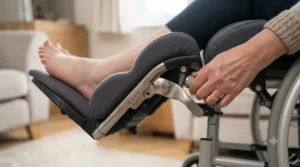
This is the most mechanically flexible option on this list. Rather than a fixed or lightly adjustable pad, it’s built around a hinge system offering a 90-to-180-degree range of motion, letting the footplate angle change from a standard seated position through to a near-horizontal elevated leg rest, rated to support up to 100kg.
Here’s what the spec sheet doesn’t spell out: that range of motion is the difference between a footrest that helps with mild swelling and one that can genuinely support someone managing more significant, chronic oedema who needs their leg raised well above hip height for extended periods. Reviewers of comparable articulating leg supports tend to note that the adjustment mechanism, while more fiddly to learn initially, becomes second nature within a few uses — and the payoff is a footplate that actually adapts to the user’s changing needs rather than the user adapting to it. This is a strong contender for anyone actively comparing adjustable width footplates against fixed alternatives.
Pros:
- ✅ Full 90°-180° angle adjustability
- ✅ High 100kg weight capacity suits a wide range of users
- ✅ Padded footplate reduces pressure at full elevation
Cons:
- ❌ More complex to adjust than simpler pads
- ❌ Higher price point than padding-only options
Expect to pay in the £90-£130 range, positioning this firmly as a premium choice — one that earns its price through genuine mechanical adaptability rather than marketing gloss.
7. Invacare Elevating Legrest with Padded Calf Pads — branded, tool-free elevating legrest built for daily medical use
Closing the list is arguably the most recognisable name in this space. The Invacare legrest combines a well-proportioned composite footplate for a snug fit across foot sizes with an elevated design and padded calf support engineered to keep legs comfortably raised, promoting circulation and reducing swelling, and the whole assembly is designed for tool-free installation with adjustable length to suit different leg sizes.
For anyone specifically searching for medical footrest recommendations, brand recognition genuinely counts here — Invacare produces equipment that NHS wheelchair services and occupational therapists routinely specify, which means parts, compatibility information and support tend to be easier to source than with generic alternatives. Based on the spec comparison against the ForconMed and NYOrtho options above, the adjustable length is the standout feature: rather than a single elevation height, the entire legrest length can be tuned to the user’s leg, which matters enormously for anyone whose swelling affects fit and comfort differently depending on how it interacts with the calf pad’s contact point.
Pros:
- ✅ Adjustable legrest length, not just footplate angle
- ✅ Tool-free installation and compatible replacement parts
- ✅ Recognised brand often specified by NHS wheelchair services
Cons:
- ❌ Premium pricing compared with generic composite legrests
- ❌ Designed primarily for Invacare-compatible frames
At around £100-£160, it’s the most expensive pick here, but for anyone treating this as a medically necessary piece of equipment rather than a comfort accessory, the fit precision and brand reliability tend to justify the outlay.
Top 7 Products: Specifications at a Glance
| Product | Adjustability | Weight Capacity | Fitting | Price Range |
|---|---|---|---|---|
| Vive Wheelchair Footrest Extender | Fixed width, minimal elevation | Not specified | Strap-on | Under £40 |
| Hermell WC2218 Padded Foot Rest | None | Not specified | Hook-and-loop | Under £30 |
| Skil-Care Side-Kick Pad | Add-on, no independent adjustment | N/A (accessory) | Retrofit onto extender | £30-£50 |
| ForconMed Elevating Legrests | Flip-up positioning | Standard chair rated | Frame-mounted | £60-£90 |
| NYOrtho Foot-Rest Extender | 1-3″ elevation range | Fits 16-20″ seat widths | Quick-release strap | £50-£80 |
| Universal Liftable Leg Support | 90°-180° angle adjustment | Up to 100kg | Frame-mounted, hinged | £90-£130 |
| Invacare Elevating Legrest | Adjustable length | Not specified | Tool-free, frame-mounted | £100-£160 |
Read across this table and a clear tier structure emerges: the top three rows solve comfort and pressure, the middle two add real elevation, and the bottom two hand control over angle, length and width back to the user. If your oedema fluctuates significantly day to day, the extra spend on genuine adjustability tends to pay for itself in avoided frustration rather than sitting as a luxury upgrade.
Practical Usage Guide: Fitting and Living With a Swelling-Friendly Footrest
Buying the right footrest is only half the job — getting the fit and daily routine right is what actually delivers the swelling relief you’re paying for.
Start by measuring twice before you buy anything. Seat width, footplate height and leg length all interact, and a footrest that’s technically compatible with your wheelchair model can still sit at the wrong angle for your specific leg length if you skip this step. Once fitted, resist the urge to set elevation to maximum immediately — ease into a raised position over a few days, since a sudden change in leg angle can itself cause discomfort even when the intention is to reduce it.
Maintenance-wise, foam padding needs a genuinely dry environment; damp foam not only smells but compresses faster, losing the cushioning that made it worth buying in the first place. Wipe vinyl and twill covers weekly rather than waiting for visible marks, and check strap tension every fortnight, because straps that loosen gradually often go unnoticed until a foot slips at an inconvenient moment. A common first-30-days mistake is treating the footrest as “set and forget” — but swelling changes daily, and the best results come from small, regular adjustments rather than one initial setup left untouched for months.
Real-World Scenarios: Who Needs Which Footrest
If you’re recovering from lower-limb surgery and only expect swelling for a few weeks, the Vive Wheelchair Footrest Extender or Hermell WC2218 Padded Foot Rest make sense — genuine relief without committing to equipment you’ll outgrow once recovery finishes.
If you’re managing chronic, daily oedema linked to a long-term condition and spend six or more hours a day in your chair, the Invacare Elevating Legrest or Universal Liftable Leg Support earn their higher price through adjustability that a temporary user simply doesn’t need.
If you’re a carer supporting someone whose swelling varies noticeably between morning and evening, the NYOrtho Foot-Rest Extender or ForconMed Elevating Legrests offer the middle ground — real elevation control without the complexity of a fully articulating hinge system.
How to Choose Footrests for Wheelchair Users With Oedema
- Confirm the swelling pattern first. Oedema — fluid buildup in the tissue — behaves very differently depending on whether it’s occasional or chronic, and that pattern should drive your budget and adjustability needs.
- Prioritise elevation over padding alone if swelling is significant. One of the easiest ways to help reduce the effects of swollen feet is to elevate the foot so that it sits higher than the heart, and padding alone can’t replicate that.
- Check seat width compatibility before ordering. Several adjustable pads, including the NYOrtho model above, only fit specific width ranges.
- Consider calf support, not just foot support. Oedema frequently extends above the ankle, and calf-padded legrests distribute pressure more evenly than foot-only plates.
- Factor in transfer frequency. Quick-release straps and swing-away designs matter far more if you transfer multiple times daily.
- Weigh brand-specific compatibility. Products like the Invacare legrest fit best with matching frames — mixing brands can complicate future part replacement.
- Don’t ignore weight capacity ratings on articulating models, particularly with hinged footplates rated for specific maximum loads.
Common Mistakes When Buying a Wheelchair Footrest for Swollen Legs
The most frequent mistake is buying padding when elevation was actually needed. A softer surface reduces pressure discomfort, but it does very little for the underlying fluid buildup that causes oedema in the first place — pressure sores are a distinct issue, caused by too much pressure on the skin and underlying tissue over time, and confusing the two problems leads people to buy the wrong product entirely. Padding solves pressure; elevation and circulation support address swelling.
A second common error is ignoring seat width compatibility, which leads to footrests that technically fit but sit at an awkward angle, undermining the comfort benefit entirely. A third is assuming higher price always means better suitability — a £130 articulating footplate is wasted money for someone whose oedema is mild and temporary, when a £30 padded extender would have done the job.
Padded Extender Footrests vs Standard Footplates
Standard metal or hard composite footplates weren’t designed with oedema in mind — they’re built for structural durability and manufacturing cost, not comfort. Padded extenders and elevating legrests exist specifically to correct for that gap, trading a small amount of chair compactness and slightly more complex fitting for genuinely improved circulation support and pressure distribution.
| Factor | Standard Footplate | Padded/Elevating Extender |
|---|---|---|
| Surface comfort | Hard, narrow | Soft, wide |
| Elevation | None | Often adjustable |
| Ankle pressure | Higher risk | Reduced with side guards |
| Best For | Users with no swelling concerns | Users managing active oedema |
The written comparison matters more than the table alone suggests: standard footplates aren’t badly designed, they’re simply designed for a different priority — durability and minimal bulk — rather than comfort for a swelling-prone limb. Once oedema enters the picture, that trade-off stops making sense, which is exactly why this entire product category exists.
What to Expect: Real-World Performance
In practice, padded extenders deliver a noticeably softer, wider landing for the foot within the first use — the difference is immediate and obvious. Elevating legrests take slightly longer to show their benefit, since circulation improvement is cumulative rather than instant; most users report the clearest difference after a few consistent days of use rather than a single session. Articulating footplates with full angle adjustment take the longest to master but offer the most precise day-to-day control once the adjustment mechanism becomes familiar.
Footrests for Specific Wheelchair Users
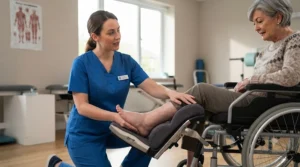
For post-surgical patients, temporary swelling usually resolves within weeks, making budget padded pads the sensible choice rather than premium articulating hardware that will sit unused once recovery is complete. For older wheelchair users managing long-term circulation issues, calf-padded elevating legrests strike a good balance between comfort and manageable daily adjustment. For anyone with diagnosed lymphoedema or a chronic vascular condition, the fully articulating, higher-capacity options tend to offer the range of motion that genuinely matched clinical positioning requires — though this is exactly the situation where involving an occupational therapist in the decision adds real value beyond what any product listing can offer.
Long-Term Cost & Maintenance
Budget padded pads typically need replacing every 12-18 months as foam compresses and covers wear, meaning the true cost-per-year of a £30 pad and a periodic replacement cycle can, surprisingly, edge close to the upfront cost of a more durable mid-range legrest. Composite elevating legrests, built from more robust materials, often last several years with only strap or pad replacements needed, which shifts the long-term value equation meaningfully in their favour despite the higher initial outlay. Articulating premium models sit at the top of both durability and cost, but their hinge mechanisms are also the most likely component to eventually need servicing or part replacement, so factor that into the total cost of ownership rather than judging purely on the sticker price.
Safety, Regulations and VAT Relief
Any footrest marketed for the UK market should carry CE or UKCA marking confirming it meets relevant safety standards for medical and mobility equipment — worth checking before purchase, particularly with generic or unbranded listings. Separately, many wheelchair users are eligible for VAT relief on mobility equipment: goods designed or adapted solely for use by disabled people, including wheelchairs and related equipment, can qualify to be purchased VAT-free, and eligible goods can also be hired or leased VAT-free. It’s always worth checking eligibility directly with the retailer at checkout rather than assuming it applies automatically, since eligibility criteria are specific and the retailer carries responsibility for confirming it.
Problem → Solution: Fixing Common Oedema Seating Issues
Problem: Feet slip off a narrow footplate throughout the day. Solution: a wide, side-guarded extender like the Vive Wheelchair Footrest Extender solves this immediately without any mechanical adjustment needed.
Problem: Swelling varies significantly between morning and evening. Solution: an adjustable elevation model such as the NYOrtho Foot-Rest Extender lets you change the height as the day progresses rather than settling for a fixed compromise.
Problem: Ankle edges rub against a footrest’s hard side panels. Solution: retrofit foam side padding like the Skil-Care Side-Kick Pad rather than replacing the whole unit.
Problem: Existing footplate offers no genuine elevation at all. Solution: upgrade to a full elevating legrest such as the ForconMed Elevating Legrests or Invacare Elevating Legrest, both built specifically for circulation support rather than pressure comfort alone.
Problem: Transfers are slowed down by fiddly buckles on padded rests. Solution: prioritise quick-release strap systems, a feature built into the NYOrtho Foot-Rest Extender specifically to speed up daily transfers.
Frequently Asked Questions
❓ Can a footrest actually reduce oedema swelling?
❓ What's the difference between a padded footrest and an elevating legrest?
❓ Are wheelchair footrests for oedema available under £40?
❓ Do I need a prescription to buy an elevating wheelchair footrest?
❓ How do I know if my footrest is the wrong width for my wheelchair?
Conclusion
Choosing footrests for wheelchair users with oedema really comes down to matching the product to the pattern of swelling you’re actually managing — temporary and mild calls for a padded extender, while chronic and significant swelling justifies the extra cost of genuine elevation and articulation. Across the seven products covered here, the honest throughline is that price tracks adjustability far more than it tracks marketing polish: the Invacare Elevating Legrest and Universal Liftable Leg Support earn their premium price tags through real mechanical flexibility, while budget options like the Vive Wheelchair Footrest Extender and Hermell WC2218 Padded Foot Rest solve a narrower, but still genuinely valuable, problem for far less money.
Whatever tier you land on, the underlying goal stays the same — get the foot off hard metal, get the leg into a position that actually supports circulation, and keep adjusting as swelling changes rather than treating any footrest as a permanent, unchangeable fixture.
Recommended for You
- Removable Footrests For Transport Wheelchairs: 7 Best Picks (2026)
- Elevating Footrests For Wheelchair: 7 Best UK Picks (2026)
- Swing-Away vs Elevating Footrests: 7 Top Picks Compared (2026)
Disclaimer: This article contains affiliate links. As an Amazon Associate, I earn from qualifying purchases. If you purchase products through these links, we may earn a small commission at no additional cost to you.
✨ Found this helpful? Share it with your friends! 💬🤗
