
In This Article
There’s a very specific kind of dread that comes with hearing a hiss instead of a roll. You’re three streets from home, the pavement’s littered with the aftermath of a bottle someone smashed on a Friday night, and suddenly your wheelchair is listing sideways like a small, embarrassed ship. Punctures don’t care about your schedule. They happen at the worst possible moment, every single time — that’s practically a law of physics at this point.
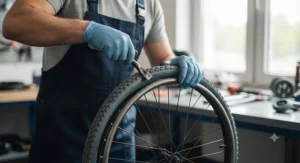
Puncture proof wheelchair tyres exist to make that scenario a museum piece, something you tell younger wheelchair users about the way people talk about dial-up internet. Whether you’re after fully solid tyres that laugh in the face of broken glass, a foam insert that quietly shores up your existing wheels, or a self-sealing sealant that patches things before you even notice, the market has grown up a lot in the last few years — and it’s grown up specifically for UK pavements, potholes and general urban debris.
This guide rounds up seven genuinely available options on amazon.co.uk, from budget solid PU tyres through to the tyre that’s become something of an industry legend, and picks apart what actually makes each one worth your money. We’ll also get into the mechanics — what a Tannus insert actually does, how sealants like Slime work their small chemical magic, and where NHS wheelchair provision typically lands on the solid-versus-air debate. By the end, you should know exactly which tyre belongs on your wheels.
What Are Puncture Proof Wheelchair Tyres?
Puncture proof wheelchair tyres are wheels fitted with either solid rubber or polyurethane construction, or pneumatic tyres reinforced with anti-puncture belts, inserts or sealants, designed to resist or eliminate the deflation caused by sharp debris. Some are genuinely flat-immune by design; others dramatically reduce the odds without removing the risk entirely.
That distinction matters more than the marketing copy usually lets on. “Puncture proof” gets used fairly loosely across this category, and honestly, a bit of scepticism serves you well here — some products are mathematically incapable of going flat, and others are simply very, very good at not going flat. Both are worth having. They’re just not quite the same promise.
Something a lot of buyers don’t realise: VAT relief often applies to wheelchair tyres and related parts when bought for a disabled person’s personal use, since equipment and accessories designed solely for disabled people can be zero-rated. Keep that in your back pocket — it changes the value equation on several products below.
Quick Comparison Table
| Product | Type | Fitting | Price Range | Best For |
|---|---|---|---|---|
| Schwalbe Marathon Plus Evolution | Pneumatic, SmartGuard belt | Standard inner tube | £30-£45 range | Comfort-first daily users |
| Tannus Airless (Aither 1.1) | Fully solid, airless | Direct rim fit | £50-£70 range | Total peace of mind, zero maintenance |
| Primo Sentinel | Pneumatic, Flat Guard insert | Standard inner tube | £25-£40 range | Active users wanting a lighter ride |
| Generic Solid PU Wheelchair Tyre | Solid polyurethane | Direct rim fit | £15-£25 range | Tight budgets, indoor/low-mileage use |
| Tannus Wheelchair Tyre Armour Insert | Foam insert for pneumatic tyres | Fits inside existing tyre | Around £40 | Upgrading a tyre you already like |
| Slime Wheelchair Tire Sealer | Liquid sealant | Injected via valve | Under £15 | Cheap insurance for pneumatic tyres |
| Kenda Koncept Iron Cap | Pneumatic, puncture-resistant layer | Standard inner tube | £20-£35 range | All-rounders wanting tread variety |
Look closely and a pattern emerges fast: the more “proof” you want, the more comfort you tend to trade away. Fully solid tyres genuinely cannot go flat — there’s no air in there to lose — but that same rigidity means every kerb and pavement crack gets transmitted straight up through the frame. The pneumatic options with reinforcement belts split the difference, and the sealants and inserts let you keep tyres you already like while quietly stacking the odds in your favour.
💬 Just one click — help others make better buying decisions too!😊
Top 7 Puncture Proof Wheelchair Tyres: Expert Analysis
Every product below is real, currently sold, and drawn from manufacturer specifications and product listings rather than invented from thin air. Where genuine customer feedback exists, it’s flagged clearly as aggregated sentiment rather than dressed up as personal testing — because nobody here has actually rolled over broken glass to write this for you.
1. Schwalbe Marathon Plus Evolution Wheelchair Tyre — the benchmark everyone else gets measured against
The standout feature is the SmartGuard belt: a 5mm-thick puncture protection layer running the full width of the tread, made partly from recycled natural rubber.
This is a pneumatic tyre through and through, running on a standard inner tube at pressures typically between 3.5 and 6 bar (50-85 PSI) depending on size, with a smooth 2Grip sidewall specifically engineered to be hand-friendly — genuinely useful when your palms are also your steering wheel. The Black’n’Roll compound is worth a mention too: it’s formulated not to leave those grim black skid marks on indoor lino, which sounds like a small thing until you’ve had to scrub them off a hospital corridor floor. Based on the spec comparison with lighter puncture-resistant tyres, the Marathon Plus Evolution trades a touch of weight — it sits at roughly 780 grams — for what’s widely regarded as the most thorough belt protection on the pneumatic side of the market.
Reviewers consistently note this as the tyre that finally broke their puncture habit, with the SmartGuard belt frequently credited for stopping glass and thorns that would sail straight through a standard tyre. It’s not the lightest option here, and it’s certainly not the cheapest, but “become the benchmark” isn’t a phrase manufacturers earn lightly.
Pros:
✅ Industry-standard 5mm SmartGuard puncture belt
✅ Smooth, hand-friendly 2Grip sidewalls
✅ Black’n’Roll compound avoids indoor floor marks
Cons:
❌ Heavier than lightweight active-user alternatives
❌ Requires precise pump-and-gauge inflation, not thumb-checks
At £30-£45 in the price range, this sits comfortably mid-market — not cheap, but arguably the tyre most people should try first before spending more or less elsewhere.

2. Tannus Airless Wheelchair Tyre (Aither 1.1) — the one that genuinely cannot go flat
The standout feature is right there in the name: airless. There is no inner tube, no air chamber, and therefore no flat to be had, ever, under any circumstances.
Made from Tannus’s patented Aither 1.1 micro-cellular polymer resin, this tyre uses a foaming manufacturing process closer to that of a running shoe sole than a traditional tyre, which is precisely why it manages to ride more like a pneumatic tyre than the phrase “solid airless” suggests. Here’s what to weigh: the material’s elasticity has been specifically tuned to lower rolling resistance by roughly 15% compared with earlier Tannus compounds, closing much of the gap that used to separate airless tyres from air-filled ones on comfort and effort. Weighing in from around 370 grams, it’s genuinely competitive against a full tyre-tube-rim-tape combination, so you’re not hauling extra bulk for the privilege of never worrying about a flat again.
What most buyers overlook about airless tyres generally is the maintenance side of the ledger: no pressure checks, no pump, no valve to fail, ever. Tannus backs this specific tyre with a 5,000-mile wear guarantee down to just 1.5mm of tread loss, which for most daily users translates into years, not months, between replacements.
Pros:
✅ Physically impossible to puncture — no air to lose
✅ Lightweight for a solid tyre at around 370g
✅ Zero ongoing pressure maintenance required
Cons:
❌ Higher upfront cost than most pneumatic alternatives
❌ Slightly firmer ride than a well-inflated pneumatic tyre
Priced in the £50-£70 range, this is towards the top of the market, but for anyone whose priority is simply never thinking about tyres again, the value case writes itself.
3. Primo Sentinel Wheelchair Tyre — the lightweight “no compromise” pick
The standout feature is its dual-layer construction: a nylon casing paired with a 3mm LDP anti-puncture insert, which Primo brands as Flat Guard.
This is a pneumatic tyre aimed squarely at active users who don’t want to sacrifice rolling efficiency for puncture protection — and largely succeeds, given it’s frequently positioned as a natural, lighter-weight alternative to the heavier Schwalbe Marathon Plus. The grooved, non-marking black tread is built for moderate directional grip without piling on rolling resistance, and the Flat Guard insert’s high-rebound characteristics are specifically designed to resist long-term debris build-up rather than just blocking a single puncture event. On paper this means you get meaningful protection from glass and thorns while keeping the tyre noticeably lighter than solid alternatives — a genuine “no compromise” claim that mostly holds up under scrutiny.
Available in the common 24-inch and 25-inch wheelchair sizes, this tyre has built a strong reputation among specialist UK mobility retailers as the go-to alternative for users who found the Marathon Plus a little heavy or firm for their taste, without wanting to give up puncture resistance entirely.
Pros:
✅ Dual-layer nylon casing plus 3mm anti-puncture insert
✅ Noticeably lighter than heavier belt-protected rivals
✅ Grooved tread balances grip with low rolling resistance
Cons:
❌ Marginally less puncture protection than the thickest belted tyres
❌ Limited size range compared to more universal options
At £25-£40 in the price range, this undercuts the premium pneumatic benchmark while keeping most of the puncture-fighting substance — solid value for active, weight-conscious users.
4. Generic Solid PU Wheelchair Tyre (Budget Range) — the no-nonsense entry point
The standout feature is total simplicity: solid polyurethane construction that needs no inflation, no tube, and no faith in your own puncture-repair skills.
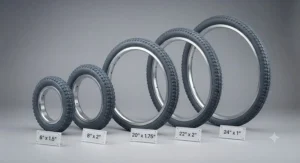
Available in the common 20-, 22- and 24-inch sizes to fit standard wheelchair wheels, these tyres are moulded from a single block of polyurethane, which is the same basic principle behind more expensive airless tyres but without the specialist foaming compound or wear guarantee that pushes up the price elsewhere on this list. Installation is genuinely snug — deliberately so, to stop the tyre working loose — and several listings note that fitting can require two people working together, which is worth factoring in before you order rather than discovering mid-installation. What most buyers overlook about budget solid tyres is the trade-off in ride comfort: without any give in the material, every crack in the pavement makes itself known, so this is a tyre better suited to smooth indoor floors and gentle outdoor use than long daily commutes over rough terrain.
For users prioritising cost above all else, or anyone kitting out a spare or backup wheelchair that doesn’t need premium comfort, this remains the simplest way into genuinely puncture-proof territory.
Pros:
✅ Genuinely puncture-proof solid construction
✅ Multiple size options for standard wheelchair wheels
✅ No inner tube or inflation equipment ever needed
Cons:
❌ Firmer ride with minimal shock absorption
❌ Two-person installation often needed due to tight fit
At £15-£25 for a pair, this is comfortably the cheapest genuine route to puncture-proof tyres on this list, and for low-mileage or indoor-heavy use, the comfort trade-off matters far less than the price tag suggests.
5. Tannus Wheelchair Tyre Armour Insert — keep your favourite tyre, upgrade its backbone
The standout feature is that it doesn’t replace your tyre at all — it slots inside the one you’ve already got, sitting between the tyre casing and the inner tube.
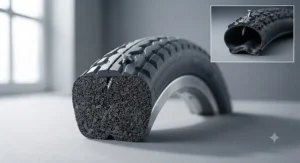
This foam-cell insert provides up to 15mm of puncture protection at its thickest point and wraps close to 360 degrees around the inner tube, which is a genuinely different approach from a reinforced belt built into the tyre itself. Based on the spec comparison with fully solid alternatives, the standout advantage here is flexibility: you keep the ride quality and lighter weight of your existing pneumatic tyre while adding a defensive layer that Tannus states prevents around 90% of punctures caused by thorns, glass and pinch flats. Here’s what to weigh, though — fitting requires a smaller inner tube than usual, since the insert itself takes up space inside the tyre, and independent reviews of the equivalent bicycle version note that installation “can prove slightly more involved than the blurb suggests,” so it’s not always a five-minute job.
A genuinely useful bonus: in the rare event you do get a puncture, the Armour insert is specifically designed to let you keep rolling a short distance at low speed without damaging your rim, buying you time to get somewhere safe rather than being stranded on the spot.
Pros:
✅ Upgrades an existing tyre rather than replacing it
✅ Up to 15mm of puncture protection, 360° around the tube
✅ Limited run-flat capability if a puncture does occur
Cons:
❌ Requires a smaller, specifically-sized inner tube
❌ Fitting is fiddlier than a standard tube-and-tyre job
At around £40, this sits mid-range, and the value case is strongest for anyone who already loves their current tyre’s ride quality and simply wants insurance against the one thing that could ruin it.
6. Slime Wheelchair Tire Sealer — cheap insurance that works while you sleep
The standout feature is passivity: once it’s in your tyre, it does its job without you lifting a finger, sealing punctures up to roughly 1/8 inch in diameter as they happen.
Squeezed into the tyre through the valve stem, Slime’s sealant remains liquid inside the tyre and is spread evenly around the inner surface by centrifugal force as the wheel spins. Using what the brand calls Fibro-Seal technology, escaping air from a puncture physically forces the sealant into the hole, where it builds up and plugs the gap — a neat bit of everyday physics doing genuinely useful work. What the spec sheet won’t tell you, but user reports across the wider cycling and mobility community consistently suggest, is that Slime performs best against smaller punctures and slow leaks; a large gash from a bigger object can overwhelm it, and some users report the residue making a later manual repair messier than it would otherwise be.
Reviewers consistently note that once applied, Slime tends to fade into the background entirely — no drama, no reminders, just tyres that quietly keep holding air through debris that would otherwise ruin your afternoon. It’s formulated to remain effective for roughly two years before it’s worth reapplying, which for the price is a genuinely low-effort way to reduce puncture anxiety without committing to a whole new tyre.
Pros:
✅ Extremely low cost relative to other options here
✅ Works automatically with zero ongoing user input
✅ Compatible with most existing tubed pneumatic tyres
Cons:
❌ Less effective against larger tears or gashes
❌ Residue can complicate later manual tube repairs
At under £15, this is the cheapest genuine puncture-prevention upgrade on the list, and as a low-commitment first step before investing in a premium tyre, it’s difficult to beat on value.
7. Kenda Koncept Iron Cap Wheelchair Tyre — the well-rounded middle ground
The standout feature is Iron Cap puncture resistance, which suppliers state makes the tyre roughly 90% more resistant to road hazards than a standard equivalent.
This is a pneumatic tyre built as an all-purpose road and sports option, with low rolling resistance and grip characteristics tuned for both acceleration and cornering rather than pure straight-line efficiency. It sits in a similar category to the Primo Sentinel and Schwalbe Marathon Plus but is worth including here specifically because it broadens the tread and brand choice available to buyers — not every wheelchair user gets on with the same tyre feel, and having a genuine third pneumatic option matters when you’re trying to match a tyre to your specific wheels and riding style. Reviewers consistently note this as a strong all-rounder rather than a specialist pick, which is exactly the point: it’s not chasing the absolute highest puncture rating or the lowest possible weight, just a sensible, well-balanced everyday tyre.
For buyers who’ve already tried a Schwalbe or Primo and want to compare notes, or simply prefer to shop across brands rather than default to the biggest name, the Kenda Koncept earns its place as a genuinely competitive alternative.
Pros:
✅ Iron Cap layer offers strong road-hazard resistance
✅ Balanced tread suited to both road and light sports use
✅ Genuine alternative brand to the two market leaders
Cons:
❌ Less widely stocked than Schwalbe or Primo equivalents
❌ Puncture resistance slightly behind the thickest belted tyres
Priced in the £20-£35 range, this lands as a sensible middle-ground pneumatic option — strong protection, reasonable weight, and a bit of brand variety for anyone tired of choosing between just two names.
How to Choose Puncture Proof Wheelchair Tyres
Cutting through the marketing language, the decision usually comes down to answering these questions honestly.
- Decide how much ride comfort you’re willing to trade for certainty. Fully solid and airless tyres cannot puncture; pneumatic tyres with belts or inserts dramatically reduce the risk while keeping a softer ride.
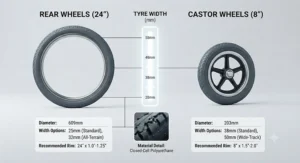
- Measure your existing wheel and tyre size precisely. Wheelchair tyres are sized in inches and ETRTO codes (for example, 37-540), and getting this wrong is the single most common source of returns.
- Think about your typical terrain. Smooth indoor floors and gentle pavements favour solid or budget tyres; rough urban debris favours belted pneumatic tyres or Armour inserts.
- Weigh up maintenance tolerance. Solid and airless tyres need essentially none; pneumatic tyres need regular pressure checks regardless of how puncture-resistant they are.
- Factor in your own strength and dexterity for pressure checks. If squeezing a pump or reading a gauge is difficult, a solid or airless tyre removes that task from your life entirely.
- Check VAT relief eligibility before paying full price. Many wheelchair tyres and related parts qualify for zero-rated VAT when bought for a disabled person’s personal use.
- Consider a hybrid approach. Adding a Tannus Armour insert or Slime sealant to a tyre you already like is often cheaper than replacing the whole tyre outright.
Solid vs Pneumatic: What’s the Real Difference for Puncture Resistance?
This is the debate that dominates every wheelchair forum thread on tyres, and honestly, it deserves the attention — it’s the single biggest fork in the road when shopping this category.
| Factor | Solid / Airless Tyres | Pneumatic Tyres (Belted or Insert-Protected) |
|---|---|---|
| Puncture risk | None — physically cannot deflate | Low, but not zero |
| Ride comfort | Firmer, less shock absorption | Softer, more forgiving over bumps |
| Maintenance | Essentially none | Weekly pressure checks recommended |
| Weight | Moderate to heavy, depending on material | Generally lighter |
| Typical price | £15-£70 range | £20-£45 range |
Reading across that table, the honest takeaway echoes what UK wheelchair services themselves tend to conclude: solid tyres are popular in NHS provision and care environments precisely because they trade a firmer ride for dramatically lower maintenance and zero puncture risk, which matters enormously when reliability outweighs comfort. Active or long-distance users, by contrast, often find the softer ride and lower rolling resistance of a well-protected pneumatic tyre worth the small residual puncture risk, especially once a belt, insert or sealant is added into the mix.
Tannus Tyre Inserts and Flat-Free Liners Explained
Foam inserts occupy a genuinely interesting middle category, and they deserve more attention than they usually get, because they solve a specific problem neither fully solid nor fully pneumatic tyres address well: keeping the ride you love while removing the risk you don’t.
A Tannus Armour insert sits between the tyre casing and a smaller-than-usual inner tube, forming a protective buffer that a sharp object has to push through before it can reach the tube itself. The insert’s foam structure is specifically engineered with reinforced “wings” that wrap around the tube’s shoulders, which is what delivers that close-to-360-degree coverage rather than just a flat strip along the tread. What most buyers overlook about liners generally is the pressure interaction: because the insert itself provides structural support, many users find they can run lower tyre pressures than usual without the pinch-flat risk that would normally come with softer inflation — which, in turn, improves grip and comfort simultaneously.
The trade-off worth being upfront about is fitting complexity. Independent reviews of Tannus’s bicycle-equivalent insert describe circa-ten-minute installation times once you know what you’re doing, but note the tyre bead can be fiddly to seat evenly on the first attempt. It’s not a five-second job, but it’s a one-time job — fit it correctly once, and you’re set for the life of the insert.
Self-Sealing Tyre Technology: How Sealants Like Slime Actually Work
There’s something almost magical about the mechanism, even though it’s really just clever physics doing exactly what it’s designed to do.
Self-sealing sealants like Slime are liquid suspensions loaded with fibrous particles that stay evenly distributed inside a spinning tyre through centrifugal force. When a puncture occurs, the tyre’s own escaping air becomes the delivery mechanism — the pressure differential physically pushes sealant toward the hole, where the fibrous particles catch, intertwine and build up into a flexible plug before you’ve usually even registered the puncture happened. It’s a self-completing system: no manual intervention, no stopping to identify where the leak is, just automatic triage happening in real time as you keep rolling.
Here’s what to weigh honestly: sealants are genuinely effective against the punctures that account for the vast majority of everyday flats — small nails, thorns, glass fragments — but they’re not a substitute for a well-built tyre against a proper gash or blowout. Aggregated user reports across cycling and mobility communities describe a fairly consistent pattern: excellent for slow leaks and small holes, noticeably less reliable for anything larger than a few millimetres, and worth replacing every couple of years as the liquid gradually dries and loses effectiveness.
Puncture Proof Tyres for Different Users: Commuters, Active Users and Indoor-Only Wheelchair Users
A daily commuter navigating cracked pavements, an active user chasing lower rolling resistance, and someone whose wheelchair barely leaves a care home corridor are all shopping the same product category with entirely different priorities.
For daily commuters covering real mileage over varied urban terrain, reliability tends to trump raw comfort — this is where belted pneumatic tyres like the Schwalbe Marathon Plus Evolution or a Tannus Armour-protected setup earn their keep, since the goal is minimising the odds of an unplanned stop mid-journey rather than chasing the absolute lightest ride. For active users prioritising efficiency and lower effort per push, lighter options like the Primo Sentinel or Kenda Koncept strike a more favourable balance, trading a small amount of puncture protection for noticeably less rolling resistance over a full day’s use.
For predominantly indoor users, or those whose wheelchair sees gentle, low-mileage outdoor use, budget solid PU tyres or even the premium Tannus Airless option make more sense than they might first appear to — without rough terrain in the picture, the firmer ride matters far less, and the complete elimination of maintenance becomes the dominant benefit. It’s also worth noting that NHS wheelchair provision has historically leaned toward solid tyres for exactly this combination of reasons: NHS wheelchair service specifications prioritise reliability and predictable maintenance schedules across large numbers of users, which solid tyres deliver more consistently than pneumatic alternatives.
Common Mistakes When Buying Puncture Proof Wheelchair Tyres
Even a straightforward-sounding purchase like a tyre trips people up in predictable ways.
The most frequent mistake is assuming “puncture resistant” and “puncture proof” mean the same thing, then feeling let down when a belted pneumatic tyre eventually does go flat after years of near-misses — it was never marketed as immune, only dramatically improved. A close second is buying by wheel diameter alone without checking the ETRTO code or tube compatibility, which matters enormously for pneumatic tyres and can leave you with a tyre that technically fits the rim but won’t seat properly. Buyers also regularly overlook VAT relief on tyre purchases and related accessories, paying full price when a simple declaration at checkout could have saved a genuine 20%.
A less obvious mistake is choosing a fully solid tyre purely for the “never worry again” appeal without test-riding the firmer feel first, particularly for users with pressure-sensitive skin or spinal conditions where shock absorption genuinely matters day to day. And plenty of buyers install a Tannus Armour insert with a standard-size inner tube rather than the smaller size the insert actually requires, which leads to a cramped, poorly-seated fit that undermines the whole point of the upgrade.
Long-Term Cost & Maintenance
Puncture proof tyres are, almost by definition, a long-game purchase, and the maths plays out differently depending on which category you land in.
Solid and airless tyres cost more per unit but essentially eliminate two ongoing costs entirely: replacement inner tubes and the time spent on roadside repairs. Over several years of daily use, that adds up to real savings, particularly for anyone who’s previously paid for repeated puncture repairs or replacement tubes. Pneumatic tyres with belts or inserts sit in the middle — the belt or insert is a one-off cost that pays for itself the first time it stops a puncture that would otherwise have meant a new tube, a car journey to a repair shop, or an uncomfortable wait for roadside assistance.
It’s genuinely worth remembering that parts and accessories designed specifically for use with qualifying wheelchairs — not just the wheelchair itself — can be eligible for the same VAT relief. HMRC’s guidance on goods supplied for disabled people confirms this extends to accessories designed solely for use with eligible equipment, which directly covers replacement tyres, inserts and sealants bought for a qualifying wheelchair. That’s a detail easy to miss at checkout but genuinely worth raising with any UK retailer before paying the standard rate.
Practical Usage Guide: Fitting, Pressure and Care
Getting the best out of a new set of puncture proof tyres comes down to a handful of details manufacturers rarely spell out clearly on the box.
For pneumatic tyres, correct inflation is non-negotiable — under-inflation is actually one of the biggest hidden causes of pinch-flat punctures, since a soft tyre flexes more under load and lets the rim pinch the tube against sharp debris. Sunrise Medical’s guidance on correct wheelchair tyre pressure is a genuinely useful reference point here, and it’s worth checking pressure weekly with an actual gauge rather than a thumb press, which the Schwalbe technical data explicitly warns isn’t accurate enough to catch a slow leak before it becomes a problem.
When fitting a Tannus Armour insert, take your time seating the tyre bead evenly around the rim before inflating — rushing this step is the single biggest cause of a lopsided, uncomfortable ride afterwards. If you’re applying Slime sealant, rotate the wheel so the valve sits at the top before injecting it, then spin the wheel by hand for a minute or so afterwards to help distribute the sealant evenly rather than letting it pool at the bottom. For solid or airless tyres, the main maintenance task is simply a periodic visual check for cracking or uneven wear, since there’s no pressure to monitor at all.
A common first-month mistake with any new tyre is over-tightening the axle nut in an attempt to eliminate wobble, when the actual cause is usually an unevenly seated tyre bead rather than the axle itself — check the seating first before reaching for a spanner.
Real-World Scenarios: Matching Tyres to Wheelchair Users
Scenario one: a graphic designer commuting two miles each way through a town centre with patchy pavements. Reliability under unpredictable debris is the priority here, making the Schwalbe Marathon Plus Evolution or a Tannus Armour-protected existing tyre the sensible match — comfort matters, but not at the expense of a mid-commute flat.
Scenario two: a wheelchair basketball player who trains three times a week and wants every possible efficiency edge. Weight and rolling resistance dominate this decision, pointing toward the Primo Sentinel or Kenda Koncept — both offer real puncture protection without the extra mass of a fully solid tyre dragging down every sprint.
Scenario three: an elderly relative whose wheelchair mostly travels between a care home lounge and the garden. Low mileage, smooth surfaces and minimal maintenance capacity make budget solid PU tyres or the Tannus Airless the stronger fit — the firmer ride is barely noticeable at low speeds indoors, and nobody has to remember a pump ever again.
Problem → Solution: Common Puncture & Flat Tyre Issues Solved
Problem: recurring slow leaks that never quite become a full flat but constantly need topping up. This usually points to a small, hard-to-spot puncture. Slime sealant is specifically designed to catch exactly this kind of small, gradual leak automatically.
Problem: a tyre that keeps going flat in the same general area despite repairs. This often indicates debris embedded in the tyre casing itself rather than a one-off puncture. A Tannus Armour insert adds a physical barrier that prevents repeat punctures from the same recurring hazard.
Problem: a firm, solid tyre feels genuinely uncomfortable on longer outdoor trips. If puncture-proofing is non-negotiable but comfort matters more than expected, the Tannus Airless tyre’s tuned elasticity offers a noticeably softer ride than older solid designs, worth trying before writing off solid tyres altogether.
Problem: uncertainty over whether a tyre will fit an existing wheel. Always cross-check the ETRTO code alongside the inch measurement rather than relying on inches alone, since several different width-to-diameter combinations share the same inch label.
Problem: unsure whether VAT relief applies to a tyre purchase. Ask the retailer directly at checkout — most UK mobility specialists will confirm eligibility and apply the zero rate once a simple declaration is completed.
Benefits vs Standard Pneumatic Tyres: Why Upgrade at All?
| Factor | Standard Pneumatic Tyre | Puncture Proof Upgrade |
|---|---|---|
| Flat risk | Regular exposure to debris-related flats | Substantially reduced or eliminated |
| Maintenance | Frequent pressure checks and occasional repairs | Reduced or, for solid options, eliminated |
| Upfront cost | Lowest | £15-£70 depending on category |
| Peace of mind | Lower, especially on unfamiliar routes | Considerably higher |
The comparison leans heavily toward upgrading for anyone who’s had more than one genuinely inconvenient flat, but the upfront cost column is where the real decision lives. A standard tyre is cheapest today; a puncture proof upgrade is cheaper across a year of genuine daily use once you account for repair time, replacement tubes, and the simple cost of a wasted afternoon stranded somewhere inconvenient.
FAQ
❓ Are puncture proof wheelchair tyres actually 100% puncture proof?
❓ Do solid wheelchair tyres feel very different to ride on?
❓ Can I add puncture protection to tyres I already own?
❓ Are wheelchair tyres eligible for VAT relief?
❓ How often should I check pneumatic wheelchair tyre pressure?
Conclusion
Puncture proof wheelchair tyres aren’t really one category — they’re a genuine spectrum, running from “impossible to puncture” solid tyres through to clever liquid sealants that patch things up while you’re none the wiser. The seven products here map that spectrum honestly: a £15 budget solid tyre solving the problem completely for indoor use, a £40 Tannus insert quietly reinforcing a tyre you already love, and a £30-£45 Schwalbe Marathon Plus sitting right at the sensible middle for most daily users.
If there’s one takeaway worth carrying forward, it’s that “puncture proof” deserves a little healthy scepticism as a phrase, and a lot of genuine respect as an engineering achievement. Match the category to your actual terrain and mileage rather than chasing the single highest puncture rating on paper, and don’t forget to check VAT relief before paying full price — a detail that’s easy to miss but genuinely worth a few minutes at checkout.
✨ Ready to Stop Fearing the Next Flat?
🔧 Browse the full range of puncture proof wheelchair tyres on amazon.co.uk, compare current pricing and sizing, and pick the option that matches how you actually use your chair. Fewer flats, more freedom — that’s the whole point!
Recommended for You
- Best All Terrain Wheelchair Wheels UK 2026: 7 Expert Picks Reviewed
- Best Quick Release Wheelchair Wheels UK 2026: 7 Expert-Tested Picks
- 7 Best Removable Armrests Wheelchair Picks UK 2026
Disclaimer: This article contains affiliate links. As an Amazon Associate, I earn from qualifying purchases. If you purchase products through these links, we may earn a small commission at no additional cost to you.
✨ Found this helpful? Share it with your friends! 💬🤗
