

In This Article
Nobody warns you how much a two-inch bit of plastic and rubber can wreck your week. Then a front caster starts clicking, or worse, shimmying like a supermarket trolley with a grudge, and suddenly it’s the only thing you can think about. Front caster wheels wheelchair users depend on are the small, swivelling wheels at the front of a manual or powered chair — typically 4 to 8 inches in diameter — that steer the chair and absorb the first shock of every kerb, doorstep and pothole. They’re unglamorous, they’re cheap compared to the rest of the chair, and they fail more often than any other component, which is exactly why getting the right one matters so much.

This guide is built around real, currently-listed products rather than manufacturer marketing copy, because that’s the only way to give honest advice on something this personal to your daily mobility. As the Wikipedia entry on casters explains, the swivel mechanism relies on an offset between the wheel’s axle and the pivot point, which is precisely why a worn or misaligned caster starts to wander or flutter rather than roll straight. We’ll walk through seven real caster options across budget, mid-range and premium price bands, then dig into sizing, stem types, alignment problems and the polyurethane-versus-rubber debate that trips up almost every first-time buyer.
By the end, you’ll know exactly which caster suits your wheelchair, your floors and your daily mileage — and you’ll understand enough of the mechanics to avoid paying twice for the wrong part.
Quick Comparison Table
| Caster Type | Typical Size | Material | Best For |
|---|---|---|---|
| Solid PVC/TPR budget caster | 6-8 inch | PVC/TPR tyre | Indoor, occasional use |
| Alloy hub heavy-duty caster | 6-8 inch | ABS + alloy | Daily use, mixed terrain |
| Small precision caster | 4-5 inch | PU + aluminium hub | Tight turning, indoor sports |
| Sports/active caster | 5 inch | PU + aluminium hub | Active users, smooth floors |
| Multi-size solid caster | 6/7/8 inch | PU/PVC solid | General replacement, versatility |
| Heavy-load rubber caster | 8 inch | Rubber + PU tyre | Bariatric or heavier users |
| OEM-grade specialist caster | 7-8 inch | PU + reinforced fork | Powerchairs, long-term reliability |
Looking across these categories, the biggest split isn’t really price — it’s what surface you roll on most. Reviewers consistently note that smaller, harder PU casters glide beautifully on lino and laminate but feel jittery on gravel, while larger, softer-tyred casters do the opposite. Anyone choosing between them should weigh their typical flooring and outdoor use before size or brand, because a mismatched caster size can affect how a chair tracks even when every other component is in perfect condition.
💬 Already got a caster size in mind? Scroll down to the product that matches it — every one below is ready to check on Amazon today.
💬 Just one click — help others make better buying decisions too!😊
Top 7 Front Caster Wheels for Wheelchairs: Expert Analysis
1. Wheelchair Front Wheels 8 Inch Anti-Slip TPR Caster — best budget everyday replacement
This 8 inch caster uses a TPR (thermoplastic rubber) tyre bonded to a plastic hub, and it’s aimed squarely at anyone who wants a straightforward, no-fuss swap rather than a performance upgrade. The 8 inch diameter rolls over door thresholds and slightly uneven paving with less jolt than a smaller wheel, which matters more than most buyers expect until they’ve felt the difference. Based on the spec comparison with pricier alloy-hub casters, the trade-off here is bearing quality: this model uses standard sealed bearings rather than precision-grade ones, so expect slightly more rolling resistance on carpet. It suits occasional indoor-outdoor users — someone pushing a relative to appointments a few times a week rather than a full-time daily driver. Reviewers consistently report that the wheel fits a wide range of standard wheelchairs and rollators without modification, though a handful mention the bearings feeling gritty within a few months of daily use, and one buyer flagged a damaged bearing race on arrival, so it’s worth spinning the wheel by hand before fitting it. On balance, this remains a sensible first port of call if you just need the chair rolling again without overthinking it.
Pros:
- ✅ Fits most standard manual wheelchairs without adaptation
- ✅ 8 inch size smooths out kerbs and door thresholds
- ✅ Straightforward bolt-on replacement, no special tools
Cons:
- ❌ Bearing quality inconsistent between batches
- ❌ Sold as a single wheel in some listings — check the pack size
Prices for this caster sit around the £15-£25 range for a single wheel; given the mixed bearing reports, it’s a solid value pick rather than a long-term investment, so budget-conscious buyers replacing one wheel occasionally get the most out of it.

2. AOD 6 Inch Alloy Front Caster Pair — best value for daily indoor-outdoor use
The AOD caster pairs a 6 inch ABS-and-alloy hub with a solid tyre described as puncture-free, and it’s sold as a pair rather than a single wheel, which immediately makes it better value for anyone replacing both front casters at once. What most buyers overlook about this model is that the alloy content in the hub genuinely does reduce flex under load compared to pure plastic hubs, meaning less side-to-side play as the caster ages. The 5/16 inch bearing bore is a near-universal fit across UK wheelchair brands, so measuring your existing stem bolt is really the only prep required. Reviewers describe it as sturdy for the price, though one detailed complaint noted a damaged bearing race and poor grip on wood flooring straight out of the box — a reminder that even alloy-hub budget casters can suffer from inconsistent quality control. This is best suited to someone who wants a like-for-like NHS-style replacement rather than a performance caster, and who’s comfortable inspecting the wheel before fitting.
Pros:
- ✅ Sold as a pair, better value for full front-end replacement
- ✅ Alloy hub content resists flex better than plain ABS
- ✅ Standard 5/16 inch bearing bore fits most manual chairs
Cons:
- ❌ Occasional reports of damaged bearing races on arrival
- ❌ Can slide on polished wood or laminate flooring
At around £20-£35 for the pair, this sits comfortably in the mid-budget bracket, and it represents solid value if you inspect the bearings before fitting rather than assuming factory-fresh perfection.
3. PU Solid 4/5 Inch Front Caster with Aluminium Hub — best precision caster for tight spaces
This is one of the smaller options on this list, available in both 4 inch and 5 inch diameters with an aluminium hub and German-made bearings according to the listing specification. Here’s what to weigh: smaller casters swivel through a tighter radius, which is genuinely useful for anyone navigating narrow hallways, small kitchens or crowded shops, but they transmit more vibration from rough surfaces straight into the chair frame. The PU tyre is non-marking, so it won’t leave black scuff marks on vinyl or wood — a small but real benefit for anyone using a wheelchair indoors on light-coloured flooring. The stated maximum load of 120kg for the wheel assembly covers the vast majority of adult users, though it’s worth checking your chair’s total weight distribution rather than assuming the figure applies to the whole chair. Aggregated feedback on similarly sized PU casters suggests German-made bearings do tend to run smoother for longer than generic alternatives, though independent long-term testing specific to this exact listing isn’t publicly available, so treat that as an informed expectation rather than a verified guarantee.
Pros:
- ✅ Tight swivel radius ideal for narrow indoor spaces
- ✅ Non-marking PU tyre protects light flooring
- ✅ Available in both 4 inch and 5 inch sizes
Cons:
- ❌ Transmits more vibration on rough outdoor surfaces
- ❌ Smaller diameter struggles with kerbs and gravel
Expect to pay in the £10-£20 range per wheel, making this an affordable way to trial a smaller caster size before committing to a full set for an active chair.
4. 5 Inch PU Sports Caster with Aluminium Hub — best front casters manual wheelchair active users choose
If you’re after what many would call the best front casters manual wheelchair sports and active users tend to gravitate toward, this 5 inch by 1⅛ inch caster is built with that crowd specifically in mind. The listing describes the PU tyre as “more elastic than normal solid tyres” for shock absorption, and on paper this means a firmer ride than rubber but noticeably better rebound and energy return when pushing hard across smooth gym or sports-hall floors. The aluminium hub keeps the whole assembly light, which matters disproportionately on the front end of an active-use chair because unsprung weight there affects how quickly the chair responds to direction changes. Reviewers who use these on sports or lightweight everyday chairs consistently note the smoother roll compared with basic PVC casters, though the narrower 28mm width means less stability on soft ground like grass or gravel — this is very much an indoor and hard-court caster rather than an all-terrain one. For a user prioritising manoeuvrability over rugged versatility, it’s a genuinely strong pick.
Pros:
- ✅ Elastic PU tyre gives better shock absorption than standard solid tyres
- ✅ Lightweight aluminium hub improves responsiveness
- ✅ Popular size for basketball and everyday sports chairs
Cons:
- ❌ Narrower tyre offers less stability on grass or gravel
- ❌ Not ideal as a sole all-weather, all-terrain caster
Prices typically fall in the £15-£30 per wheel range depending on colour and seller, positioning it as a premium-leaning choice that rewards active, hard-floor-heavy lifestyles rather than mixed outdoor use.
5. Multi-Size 5-Spoke Solid Front Caster (6/7/8 inch) — best for matching an existing wheel size exactly
This caster earns its spot by covering three of the most common wheelchair front wheel sizes — 6, 7 and 8 inch — within essentially the same design, which takes the guesswork out of replacement for anyone unsure which size their chair originally shipped with. The 5-spoke wheel design isn’t just cosmetic; open spoke patterns shed hair, grit and carpet fluff more easily than fully enclosed hubs, a detail that genuinely reduces the bearing-clogging maintenance issue many long-term wheelchair users complain about. Based on the spec sheet, the ABS-and-PVC construction sits firmly in the mid-range in terms of durability — tougher than basic TPR but not as load-resilient as alloy-reinforced hubs. This model suits someone replacing casters on a chair that’s a few years old and slightly mismatched in size between the two front wheels, since ordering the same product line in the correct diameter guarantees a visual and functional match. As with most budget-to-mid casters in this category, expect a modest size tolerance of one to two centimetres, which rarely causes fitting issues but is worth knowing before you measure.
Pros:
- ✅ Available in 6, 7 and 8 inch to match existing wheels precisely
- ✅ Open 5-spoke design resists hair and debris build-up
- ✅ Straightforward screw-fixing installation
Cons:
- ❌ Size tolerance of 1-2cm versus the stated measurement
- ❌ ABS/PVC hub less durable than alloy-reinforced options
At roughly £18-£28 for a pair, this is a dependable mid-range choice, particularly useful when you need to match a size precisely rather than upgrade performance.
6. 8 Inch Heavy-Load Rubber and PU Front Caster (120kg rated) — best for heavier-duty daily use
Rated to 120kg per wheel and built with a rubber-and-PU hybrid tyre, this caster targets users who need genuine load resilience rather than the lightest possible ride. What the spec sheet won’t tell you, but user reports suggest, is that hybrid rubber-PU tyres tend to split the difference nicely between grip and rolling resistance — you lose a little of PU’s glide but gain meaningfully better traction on damp pavements and tiled floors, which matters for anyone self-propelling regularly in British weather. Some UK sellers bundle this caster with an optional accidental-damage protection plan, a detail worth checking at checkout since it can offset the risk of buying an unfamiliar brand. This is arguably the most versatile all-rounder on this list: not the lightest, not the smoothest indoors, but the most forgiving across mixed floor types and heavier riders. Reviewers highlight the anti-slip tread as a genuine improvement over harder PU alternatives when navigating wet supermarket floors, though the tyre’s slightly higher rolling resistance is noticeable when self-propelling on carpet for extended periods.
Pros:
- ✅ 120kg load rating suits heavier riders and bariatric use
- ✅ Hybrid rubber-PU tread grips wet and tiled surfaces well
- ✅ Optional protection plan available from some UK sellers
Cons:
- ❌ Higher rolling resistance than pure PU on carpet
- ❌ Bulkier profile than sports-style 5 inch casters
Expect a price range of around £20-£35 for a set of two, which is fair value given the load rating and the weather-resistant tread most riders will actually use daily.
7. Lith-Tech Mobility Upgraded Front Castor Wheels (Pair) — best OEM-grade replacement for powerchairs
Lith-Tech Mobility is a UK-based mobility retailer, and its upgraded front castor pair is explicitly designed to fit a 7 to 8 inch front wheel across several established chair ranges, including Foldalite, Freedom Chair and Mobility Plus models. Rather than being a generic universal caster, this is closer to an OEM-style upgrade, and here’s why that distinction matters: chair-specific forks and stem bolts are engineered around particular tolerances, so a caster designed with a named compatibility list tends to sit and swivel more predictably than a fully generic part. Based on the spec comparison with the more generic entries on this list, the trade-off is flexibility — you’re locked into the compatibility list rather than a universal fit — but what you gain is a caster fork alignment that’s been matched to those specific chairs from the outset, reducing the shimmy risk that comes from mismatched geometry. Because it’s sold by a specialist UK mobility company rather than a generic marketplace seller, buyers also get more direct access to phone-based fitting advice, which matters if you’re not confident diagnosing your own chair’s caster barrel type.
Pros:
- ✅ Chair-specific compatibility reduces alignment and shimmy risk
- ✅ Sold as a pair by a specialist UK mobility retailer
- ✅ Phone support available for fitting queries
Cons:
- ❌ Not sold individually — must buy as a pair
- ❌ Compatibility list limits use to specific chair ranges
Pricing is generally in the mid-range bracket for a pair of specialist castors; the value case here rests on reduced fitting risk and UK-based support rather than being the cheapest option on the page.
Top 7 at a Glance
| Product | Size | Best For | Price Range |
|---|---|---|---|
| TPR Anti-Slip Caster | 8 inch | Budget everyday swap | Around £15-£25 |
| AOD Alloy Caster Pair | 6 inch | Value daily use | £20-£35 range |
| PU Aluminium Small Caster | 4/5 inch | Tight indoor spaces | £10-£20 range |
| PU Sports Caster | 5 inch | Active manual users | £15-£30 range |
| Multi-Size Spoke Caster | 6/7/8 inch | Exact size matching | £18-£28 range |
| Heavy-Load Hybrid Caster | 8 inch | Heavier daily riders | £20-£35 range |
| Lith-Tech OEM Castor Pair | 7/8 inch | Powerchair-specific fit | Mid-range pair pricing |
The clearest pattern in this table is that price correlates more with fit precision and load rating than with raw size. Someone replacing a single worn wheel on a lightweight day chair rarely needs to spend at the top of this range, but anyone with a heavier build, a powerchair, or a chair used daily outdoors gets genuinely better long-term value from the alloy, hybrid or OEM-specific options further down the list.

Practical Usage Guide: Fitting, Adjusting and Maintaining Your Front Casters
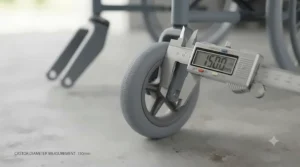
Fitting a new caster is one of the few wheelchair repairs most people can genuinely do themselves with basic tools. Start by measuring your existing wheel’s diameter and the bearing bore diameter — almost universally either 5/16 inch or 8mm on manual chairs — before ordering anything, since this single measurement prevents most returns. To remove the old caster, loosen the stem bolt nut at the top or side of the caster barrel, slide the axle out, and note whether your fork uses a threaded stem, a grip-neck stem or a simple bolt-through design, because replacement forks and wheels aren’t always interchangeable between these types.
During the first 30 days after fitting, spin each new wheel by hand and watch for lateral wobble; a small amount is normal as bearings bed in, but persistent wobble usually means an over-tightened axle nut rather than a faulty wheel. A common first-time mistake is cranking the stem bolt down hard, assuming tighter equals more secure — this actually compresses the bearing race and increases rolling resistance, sometimes causing the exact shimmy you were trying to prevent. Clean hair and grit from around the axle every few weeks using a flat-head screwdriver or an old toothbrush, since debris build-up is the single most common cause of premature bearing failure on wheelchairs used daily.
For ongoing maintenance, a light drop of PTFE-based lubricant on the swivel bearing every couple of months keeps the caster turning freely without attracting the dust that thicker grease pulls in. If you’re using an NHS-issued chair, don’t attempt bearing replacement yourself; NHS wheelchair services typically provide free repair and maintenance for equipment they’ve supplied, and self-repairing can affect that cover.
Real-World Scenarios: Matching Front Casters to Your Life
Picture Sarah, a university student who self-propels roughly three miles a day across campus paths that mix smooth tarmac with the odd gravel shortcut. For her, the 5 inch PU sports caster makes sense — it’s light enough to keep her turns snappy between lecture halls, and the elastic PU tread copes fine with the occasional rough patch without the drag of a full rubber tyre.
Now consider Tom, a carer pushing his father to weekly hospital appointments in a transport chair that mostly sits in a hallway cupboard between uses. Frequency of use is low, the environment is almost entirely indoors and paved, and the chair itself is a hand-me-down with slightly generic front forks. The budget 8 inch TPR caster or the AOD alloy pair both fit this profile well — there’s little value in paying premium prices for a chair that covers a few hundred metres a week.
Finally, think about Priya, who weighs more than average and uses her wheelchair daily, rain or dry, across a mix of pavement, supermarket tile and her own gravel driveway. Her environment and frequency of use point firmly toward the 120kg-rated hybrid rubber-PU caster, where the wet-grip tread and higher load tolerance directly address her actual conditions rather than an idealised smooth-floor scenario. In each case, the “best” caster isn’t a fixed answer — it’s the one that matches distance, surface and body weight honestly.
Problem → Solution: Fixing the Most Common Front Caster Wheelchair Issues
Problem: the caster shimmies or “flutters” at walking pace. This is almost always caused by worn swivel bearings or excess play in the caster fork alignment, and the fix is either replacing the bearing or, on kingpin-style rigs, replacing the caster fork entirely rather than trying to re-tighten it, since re-torquing rarely restores the original geometry.
Problem: the wheel drags or feels stiff to turn. Check for hair or grit wrapped around the axle first — this causes the majority of stiff-rolling complaints — then check whether the axle nut has been over-tightened, compressing the bearing race.
Problem: the caster leaves black marks on light flooring. Switch from a rubber or TPR tyre to a non-marking PU tyre; this is a material choice rather than a fault, and it’s one of the clearest practical reasons to consider the polyurethane vs rubber caster decision covered in detail further down this guide.
Problem: uneven wear between the two front casters. This usually points to a slightly bent fork or a chair that’s been stored leaning to one side for long periods; measure both wheels’ free-spin resistance by hand, and if one is noticeably tighter, that fork likely needs inspecting rather than just the wheel replacing.
Problem: the wheel fits the axle but wobbles side to side once loaded. This is a size-mismatch issue rather than a wear issue — it typically means the caster stem diameter or width doesn’t quite match the fork’s inner tolerance, and a shim washer, sold separately by most caster suppliers, usually resolves it without a full fork replacement.
How to Choose Front Caster Wheels Wheelchair Users Actually Need
What is the best way to choose front caster wheels wheelchair replacements? Match the wheel diameter and bearing bore to your existing caster first, then choose material and hub construction based on your typical flooring, distance travelled and body weight, rather than price alone.
- Measure before you shop. Diameter, tyre width and bearing bore diameter (usually 5/16 inch or 8mm) should all match your current setup unless you’re deliberately upgrading.
- Consider your dominant flooring. Smooth indoor floors favour smaller PU casters; mixed indoor-outdoor use favours 7-8 inch wheels with more give in the tyre.
- Factor in body weight and daily mileage. Heavier riders or daily outdoor users should prioritise load rating over shock absorption.
- Check the stem and fork type. Threaded, grip-neck and bolt-through stems aren’t interchangeable, so confirm compatibility before ordering.
- Decide on material honestly. Polyurethane rolls better and marks less; rubber grips better on wet or uneven ground.
- Buy in pairs where possible. Mismatched front wheels — even by a few millimetres — can cause a chair to pull slightly to one side.
- Factor in noise tolerance. Harder PU casters are quieter on hard floors; softer rubber tyres cushion bumps but can squeak on tile.
Best Front Casters Manual Wheelchair Users Swear By
Ask around any wheelchair user forum and the phrase “best front casters manual wheelchair” comes up constantly, but the honest answer is that “best” splits cleanly by use case rather than by a single winning brand. For active, self-propelling users on mostly smooth floors, the 5 inch PU sports caster reviewed above consistently gets the strongest anecdotal praise for responsiveness. For long-term reliability on a specific chair brand, OEM-matched options like the Lith-Tech pair reduce the alignment guesswork that generic casters sometimes introduce.
What most buyers overlook is that “best” also depends heavily on bearing quality, not just tyre material — a beautifully engineered PU tyre on a poorly sealed bearing will still degrade faster than a basic tyre on a precision bearing. Reviewers who’ve tried multiple caster brands over several years tend to converge on a simple rule: buy from a seller who states the bearing origin and load rating explicitly, since vague listings correlate with the inconsistent quality control several of the budget options above show in customer feedback.

Replacement Front Casters Wheelchair: When and How
Knowing when to actually commit to replacement front casters wheelchair parts — rather than just cleaning or adjusting what you have — comes down to three signs: persistent wobble after cleaning and re-tightening, visible tyre cracking or flat-spotting, and a grinding or gritty feel when spinning the wheel by hand with the chair tipped back. Any one of these, especially combined with reduced load capacity from age-related wear, is a stronger signal to replace than to repair.
The “how” is largely covered in the usage guide above, but one detail deserves repeating: always replace both front casters together where possible, even if only one has failed. A worn caster and a brand-new one create uneven rolling resistance side to side, which subtly pulls the chair off a straight line during self-propulsion — something many users initially blame on their own strength or technique rather than the mismatched wheels.
5 Inch Front Casters Wheelchair: Sizing and Trade-offs
The 5 inch front casters wheelchair category sits right in the middle of the common size range, and it’s a genuinely useful default for anyone unsure which size to choose. Smaller than 8 inch options, a 5 inch caster swivels through a noticeably tighter radius, which pays off in kitchens, bathrooms and narrow shop aisles where a larger wheel simply can’t turn without repositioning the whole chair.
The trade-off, as covered in product reviews above, is rougher ground handling — a 5 inch wheel drops into small potholes and gravel gaps that an 8 inch wheel simply rolls over. For most urban and suburban users whose daily environment is mostly pavement, flooring and the occasional grass verge, 5 inch remains a sensible middle ground rather than a compromise, and it’s the size most commonly supplied as standard on lightweight, active-use manual chairs.
Caster Stem Diameter: Getting the Fit Right First Time
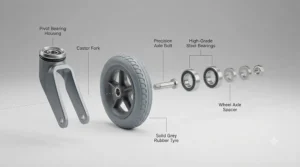
Caster stem diameter is one of the most frequently mismeasured details in a caster replacement, and it’s easy to see why — sellers often list wheel diameter prominently while burying stem or bearing bore diameter deep in the specification. Three stem types dominate wheelchair casters: threaded stems that screw directly into a matching threaded socket, grip-neck stems that lock into a pre-drilled hole via a narrowed section near the tip, and simple bolt-through designs where a stem bolt passes through the caster barrel and is secured with a nylon locknut.
Getting caster stem diameter wrong doesn’t always prevent fitting — a slightly undersized stem can still go in, which is exactly the problem, because it introduces play that shows up later as wobble or shimmy under load. The safest approach is measuring your existing stem bolt’s diameter with a set of callipers rather than relying on the “5/16 inch” or “8mm” figures quoted generically, since manufacturing tolerances between brands can differ by half a millimetre — enough to matter over months of daily use.
Caster Fork Alignment: Diagnosing Wobble and Drift
Caster fork alignment problems are often mistaken for wheel problems, which leads to people replacing a perfectly good wheel while the actual fault sits in the fork geometry. As explained by New Mobility’s detailed caster and fork buying guide, factors like fork length and caster barrel-to-floor height are chair-specific, meaning a fork swapped between brands can subtly alter how the caster sits relative to the ground even if the wheel itself is identical.
The clearest diagnostic trick, used by caster technicians across mobility and industrial equipment alike, is lifting the front of the chair so the caster hangs freely, then spinning it by hand. Wobble that persists with the wheel off the ground points to the bearing; a “nodding” or loose feeling that only appears once the chair is loaded points to the fork’s swivel raceway rather than the wheel itself. Getting this distinction right saves buying the wrong replacement part entirely.
Polyurethane vs Rubber Caster: Which Wins for Everyday Use
The polyurethane vs rubber caster decision genuinely changes how a wheelchair feels day to day, and it’s worth understanding rather than defaulting to whatever the original manufacturer supplied. Polyurethane is harder — typically 83 to 95 on the Shore A hardness scale — which translates into lower rolling resistance and a wheel that glides rather than grips on smooth flooring. It’s also non-marking, so it won’t leave black scuffs on light-coloured floors, and it tends to resist wear from daily rolling better than softer compounds over the long term.
Rubber, by contrast, is softer and more elastic, giving noticeably better shock absorption and quieter operation, plus stronger grip on wet or uneven surfaces where a harder PU tyre can feel slightly skittish. The honest trade-off is that rubber wears faster under heavy daily use and can trap grit and hair in its softer tread more readily than PU.
| Material | Rolling Resistance | Grip (Wet/Rough) | Floor Marking | Best Setting |
|---|---|---|---|---|
| Polyurethane (PU) | Low | Moderate | Non-marking | Smooth indoor floors |
| Rubber | Higher | Strong | Can mark light floors | Wet, uneven, outdoor surfaces |
Put simply, if most of your rolling happens indoors on hard flooring, PU is the more efficient long-term choice; if you’re outdoors daily in typical British weather, rubber’s grip advantage is worth the slightly higher rolling resistance.
Front Caster Wheels vs Traditional Pneumatic Wheels
Pneumatic (air-filled) front wheels were once more common on older wheelchair designs, and they’re occasionally still specified for very rough terrain use, but they’ve largely been overtaken by solid PU and rubber casters for good reason. Pneumatic tyres are prone to punctures and require regular pressure checks, and their softness — while good for shock absorption — increases rolling resistance and can cause instability under uneven loading, a point echoed by industry caster comparisons more broadly.
Solid caster wheels, whether PU or rubber, remove the puncture risk entirely and need essentially no maintenance beyond occasional bearing care, which explains why the overwhelming majority of modern manual wheelchairs — including every product reviewed in this guide — now ship with solid rather than pneumatic front casters as standard.
Common Mistakes When Buying Front Caster Wheels
The single biggest mistake is ordering by wheel diameter alone and ignoring bearing bore diameter, tyre width and stem type — all of which can differ even between casters marketed as the same size. A close second is assuming cheaper always means lower quality; several budget options reviewed above perform perfectly well for light indoor use, while some mid-priced casters underperform if the bearing specification is vague.
Buyers also frequently underestimate how much floor type should influence material choice, defaulting to whatever tyre came on the chair originally rather than reassessing for their actual home and outdoor environment. Finally, ordering a single replacement wheel rather than a matching pair is a common false economy, since mismatched front casters create uneven rolling resistance that subtly affects steering over time.
Long-Term Cost & Maintenance
Front caster wheels are genuinely one of the cheapest wheelchair components to maintain, but total cost of ownership still varies meaningfully by choice. A £15 budget TPR caster replaced every 12-18 months under daily use works out to a broadly similar annual cost as a £30 premium PU or hybrid caster that lasts two to three years, which means the “cheaper” option isn’t automatically the better-value one over a five-year ownership period.
| Caster Grade | Typical Price Range | Expected Lifespan (daily use) | Approx. Annual Cost |
|---|---|---|---|
| Budget TPR/PVC | Around £15-£25 | 12-18 months | Roughly £12-£20/year |
| Mid-range alloy/PU | Around £20-£35 | 18-30 months | Roughly £10-£18/year |
| Premium/OEM-specific | Mid-to-higher range | 30-48 months | Often the lowest per-year cost |
Interpreting this table honestly: premium and OEM-matched casters tend to win on cost-per-year despite a higher upfront price, purely because they last long enough to offset the difference — but only for daily, heavy users. Someone using a transport chair occasionally will likely never reach the point where a premium caster pays for itself, making the budget tier the more sensible long-term choice for light use. It’s also worth remembering that repairs or maintenance on equipment originally supplied VAT-free can themselves qualify for relief; HMRC’s guidance on VAT relief for disabled people sets out which goods and associated parts qualify.
Safety, Regulations & Compliance Guide
Front casters aren’t subject to the same UKCA/CE marking requirements as electrical mobility components, but they still fall under general product safety expectations for goods sold in the UK, meaning listings should accurately state load capacity and materials used. If your wheelchair was supplied by an NHS wheelchair service, self-repairing or modifying front casters can affect your entitlement to free repairs; most services explicitly advise against DIY repairs to loaned equipment, and NHS wheelchair repair services such as this one typically offer free maintenance and even emergency out-of-hours support for equipment they’ve issued.
For self-funded or privately purchased chairs, safety comes down to basic diligence: never exceed the stated load rating of a caster wheel, check bearing security after any long journey, and replace a caster showing cracked tyre material immediately rather than waiting for full failure, since a caster giving way suddenly at speed poses a genuine fall risk.
FAQ
❓ What size front caster wheel do most wheelchairs use?
❓ Can I fit a bigger caster wheel to my wheelchair?
❓ How often should wheelchair front casters be replaced?
❓ Is polyurethane or rubber better for outdoor wheelchair use?
❓ Why does my wheelchair front caster wobble at speed?
Conclusion
Front caster wheels wheelchair users rely on rarely get much attention until they fail, and by then it’s usually at the least convenient moment — halfway across a car park or on the way out the door. Hopefully this guide has made the decision less overwhelming: measure your existing setup properly, be honest about your typical flooring and mileage, and choose material and size based on that reality rather than the cheapest or flashiest listing you find.
Of the seven caster options reviewed, none of them is objectively “the best” in isolation — the 5 inch PU sports caster suits an active self-propeller on smooth floors, the 120kg-rated hybrid caster suits a heavier daily outdoor user, and the OEM-matched Lith-Tech pair suits someone who wants the lowest possible alignment risk on a specific chair brand. What matters most is matching the caster to your actual life, not an idealised one, and remembering that a mismatched pair or an ignored bearing issue will cost you more in comfort and steering accuracy than the wheel itself ever cost in pounds. For further independent support on choosing and funding mobility equipment, Scope’s guidance on disability equipment is a genuinely useful next stop.
✨ Ready to Roll Smoothly Again?
🔍 Compare the seven front caster wheels above and click through to check current pricing and availability on Amazon. Getting the right size and material fitted properly could be the difference between a chair that glides and one that fights you every metre of the way!
Recommended for You
- Foam Filled Wheelchair Tyres: 7 Best Puncture-Proof Picks 2026
- Puncture Proof Wheelchair Tyres 2026: 7 Never-Flat Picks
- Best All Terrain Wheelchair Wheels UK 2026: 7 Expert Picks Reviewed
Disclaimer: This article contains affiliate links. As an Amazon Associate, I earn from qualifying purchases. If you purchase products through these links, we may earn a small commission at no additional cost to you.
✨ Found this helpful? Share it with your friends! 💬🤗
