
In This Article
Here’s something the glossy brochures rarely say out loud: the armrest is the most underrated part of a wheelchair. People obsess over weight, wheel size, fold mechanisms. Then they buy a chair with fixed arms, try to shuffle sideways onto a sofa, and discover they’ve essentially installed a fence between themselves and the rest of the room.
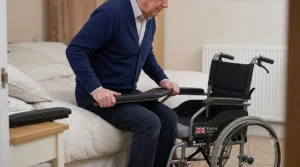
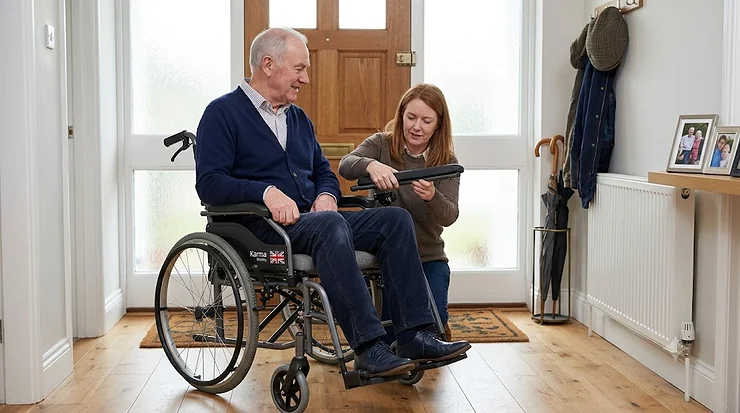
A removable armrests wheelchair fixes that. The arms either lift up and swing back, detach entirely, or flip out of the way — clearing a flat, unobstructed path from the seat to a bed, a car, a loo, or the good armchair by the telly. It sounds like a small thing. It is not. For anyone managing a transfer several times a day, that clear path is the difference between independence and waiting for help.
So what is a removable armrests wheelchair? In plain terms: a manual wheelchair whose armrests can be flipped back, swung away, or fully detached to allow side-on transfers and closer access to tables. The NHS routinely assesses people for exactly this feature during a local wheelchair service assessment, which you can be referred to by a GP, physiotherapist, occupational therapist or hospital staff.
This guide walks through seven models worth a look on Amazon.co.uk and from UK mobility specialists, plus the bits the spec sheets won’t tell you — like how British damp wrecks a cheap hinge, and why VAT relief might quietly knock 20% off your bill.
As an Amazon Associate, I earn from qualifying purchases.
Quick Comparison: The Seven at a Glance
| Model | Arm Type | Frame | Approx. Weight | Best For |
|---|---|---|---|---|
| Drive DeVilbiss Steel Self-Propelled | Flip-up padded | Steel | ~18 kg | Reliable everyday use, tight budgets |
| Aidapt Deluxe Self-Propelled Transit | Flip-up PVC padded | Steel | ~16 kg | Occasional outings, holidays |
| Days Escape Lite | Full-length, detachable | Aluminium | ~15 kg | Frequent car transport |
| Z-Tec T-Line Aluminium | Height-adjustable, swing-away | Aluminium | ~16 kg | Posture and comfort priorities |
| Karma Ergo Lite 2 | Flip-back, ergonomic | Aluminium | ~11 kg | Active users, easy lifting |
| Drive DeVilbiss XS2 | Detachable | Aluminium | ~14 kg | Compact storage, flats |
| Invamed 1050 Self-Propelled | Detachable padded | Steel | ~18 kg | Budget self-propellers |
From the table, a clear split emerges. If money is tight and the chair lives mostly indoors, the steel options (Drive, Aidapt, Invamed) give you flip-up arms and dependable build for the least outlay — though you’ll feel every kilo when lifting them into a boot. Spend more and the aluminium chairs (Days, Karma, Z-Tec) reward you with lighter handling and, in the Z-Tec’s case, height-adjustable arms that genuinely matter for anyone who sits for hours. The Karma Ergo Lite 2 is the outlier: noticeably pricier, but at roughly 11 kg it’s the one your back will thank you for.
💬 Just one click — help others make better buying decisions too! 😊
✨ Don’t Miss These Exclusive Deals!
🔍 Take your search to the next level with the carefully selected chairs below. Click any highlighted item to check current pricing and availability on Amazon.co.uk — these picks cover budget to premium, so there’s something for most needs.
The Top 7 Removable Armrests Wheelchairs: Expert Analysis
1. Drive DeVilbiss Steel Self-Propelled Wheelchair — the dependable workhorse
Drive DeVilbiss (the brand formerly trading as Drive Medical) is the Ford Fiesta of UK mobility — everywhere, well understood, easy to get parts for. Drive DeVilbiss Healthcare is one of the UK’s leading mobility brands, and many of its chairs are crash tested and feature flip-up armrests and folding frames.
The flip-up padded arms lift cleanly for side transfers, and the steel frame shrugs off daily knocks. Two specs matter here in practice. The 24-inch self-propel rear wheels mean you can push yourself, not just be pushed — handy for keeping a bit of arm strength and dignity. And the folding back drops down for storage, which counts for a lot in a terraced house with no spare cupboard.
What most buyers overlook: steel is heavy. Lovely indoors, less lovely when you’re hauling it over a kerb into a Corsa. This is a chair that suits a fairly settled routine — home, garden, the local shops — rather than constant travel.
✅ Pros: robust, widely stocked, good value, self-propel option
❌ Cons: heavy to lift, basic comfort padding
Customer feedback skews positive on durability, with several UK reviewers noting it’s sturdier than the price suggests, if not the lightest. Price range: typically the £100–£160 range on Amazon.co.uk. A solid first chair.
2. Aidapt Deluxe Self-Propelled Transit Chair — the holiday all-rounder
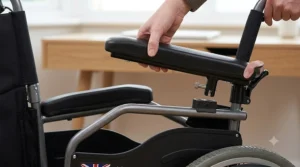
Aidapt is a British mobility staple, and this transit chair earns its keep on day trips. It comes with padded nylon upholstery, flip-up PVC padded armrests for easier side transfers, and adjustable detachable swing-away footrests, plus a lap strap and leg strap. The flip-up arms and swing-away footrests together clear a proper transfer path — exactly what you want when moving from chair to a restaurant bench or a car seat.
It folds readily for the boot, and the puncture-proof solid tyres mean no faffing with a pump on a rainy seafront in Llandudno. Worth knowing for British conditions: solid tyres ride a touch harder over cobbles and gravel than pneumatic ones, a fair trade for never getting a flat.
A quick caution borne out by buyer Q&As: not every Aidapt model has removable arms versus flip-up arms, so confirm the variant before ordering. The Deluxe Transit is the one with the flip-up PVC arms.
✅ Pros: light-ish steel, colour choices, no punctures, good safety straps
❌ Cons: firmer ride on rough ground, basic cushioning
UK reviewers repeatedly praise the value for occasional use — several mention it costing roughly a week’s hire. Price range: around the £120–£170 range. A sensible buy if the chair’s main job is days out.
3. Days Escape Lite Self-Propelled Wheelchair — the boot-friendly favourite
If your chair spends half its life in a car, weight is everything. The Escape Lite is built for precisely that. It’s an ultra-lightweight aluminium chair suitable for indoors and outdoors, with full-length armrests, padded upholstery, detachable swing-away footrests and quick-release MAG wheels, carrying a 1-year product and 2-year mainframe warranty.
The aluminium frame and quick-release wheels mean you can break it down and lift the pieces separately — a small mercy for carers with dodgy backs. The full-length armrests give more forearm support than desk-length arms, which suits anyone who tires easily or needs to push up to stand.
The Escape Lite leans on a genuine point: the World Health Organization recognises wheelchairs as essential for mobility, dignity and general wellbeing. For a fuller picture of how to get the right chair through the NHS, the NHS wheelchair and mobility guide is the place to start.
✅ Pros: genuinely light, quick-release wheels, decent warranty
❌ Cons: full-length arms restrict close table access, mid-range price
Price range: commonly the £200–£280 range, sometimes lower VAT-free. Excellent for frequent transport.
4. Z-Tec T-Line Aluminium Self-Propelled Wheelchair — the comfort specialist
Here’s the model for people who actually live in their chair. The Z-Tec T-Line offers height-adjustable armrests, attendant brakes plus user-operated parking brakes, a fitted lap belt, removable swing-away footrests with calf straps, a folding back, puncture-proof tyres front and rear, and quick-release rear wheels. It supports users up to 120 kg.
Height-adjustable arms are the unsung hero here. Get the armrest height wrong and you’ll round your shoulders for hours; get it right and posture sorts itself out. As one UK mobility guide puts it, the arm height should leave your elbows bent at roughly 90 degrees — measured from elbow to seat with the arm raised. The T-Line lets you dial that in rather than living with whatever the factory chose.
The dual braking — attendant and user — is a thoughtful touch for British pavements, where a steep, wet slope down to the chemist’s is a genuinely common hazard.
✅ Pros: adjustable arms, dual brakes, puncture-proof, quick-release wheels
❌ Cons: more setup, heavier than the Karma
Price range: around the £180–£250 range. The pick if comfort over long sittings is the priority.
5. Karma Mobility Ergo Lite 2 — the featherweight
At roughly 11 kg, the Ergo Lite 2 is the one that makes everyone else look chunky. Karma builds ergonomic aluminium chairs aimed at active users, and the flip-back arms make transfers brisk and tidy. The S-shaped ergonomic seat is the talking point — it’s designed to distribute pressure better than a flat sling seat, which matters if you’re sitting most of the day.
In practice, the low weight transforms what’s possible. A carer who couldn’t manage an 18 kg steel chair into a boot can often handle this one solo. That single fact can extend someone’s independence by years.
The trade-off is predictable: you pay for the engineering, and the slim aluminium frame is built for lighter, more active users rather than heavy-duty all-day bariatric needs.
✅ Pros: exceptionally light, ergonomic seat, easy transfers
❌ Cons: premium price, lower weight capacity than steel chairs
Price range: typically the £300–£450 range. Worth it if lifting the chair is the real obstacle.

6. Drive DeVilbiss XS2 Wheelchair — the small-space solution
Flats, narrow halls, no storage — the British housing special. The XS2 is built around it. It features a simple folding mechanism, a half-folding back, detachable arms and quick-release footrests, allowing it to pack down compactly.
Detachable arms (rather than just flip-up) shave width and bulk when stored, and the half-folding back means it tucks behind a door or into a hall cupboard. For anyone in a terraced house or a first-floor flat where every cubic metre is spoken for, that compactness is the whole point.
The detachable-arm design also helps with the narrowest transfers — pull the arm off entirely and there’s genuinely nothing in the way.
✅ Pros: compact fold, detachable arms, light aluminium
❌ Cons: keep track of detached parts, firmer seat
Price range: roughly the £150–£230 range. Ideal where storage space is the binding constraint.
7. Invamed 1050 Self-Propelled Wheelchair — the budget self-propeller
Rounding out the list, the Invamed 1050 covers the value end without feeling flimsy. It folds for storage, runs 60 cm puncture-proof self-propelling rear wheels and 20 cm front castors, with flame-retardant nylon upholstery, padded armrests, and swing-away detachable footrests with heel loops, plus a 12-month warranty.
The combination of self-propel wheels and detachable footrests at this price is the draw. The arms are padded and removable for transfers, and the flame-retardant upholstery is a quiet nod to British furniture safety norms.
It’s steel, so the weight caveat applies again — fine for a fairly fixed home routine, less ideal for constant car trips.
✅ Pros: affordable, self-propel, puncture-proof, decent warranty
❌ Cons: heavier steel frame, basic comfort
Price range: typically the £110–£160 range. A genuine budget option that doesn’t cut the important corners.
How to Choose a Removable Armrests Wheelchair in the UK
A quick, snippet-friendly framework. Run through these in order:
- Decide flip-up, swing-away, or fully detachable. Flip-up is quickest for daily transfers; detachable wins for storage and the narrowest gaps. Swing-away footrests pair with either.
- Match the arm height to the user. Aim for elbows at roughly 90 degrees when seated. Height-adjustable arms (like the Z-Tec) earn their keep for long sitters.
- Weigh the weight. Steel is cheaper and tougher; aluminium is kinder to the carer’s back and the car boot. Be honest about who’s lifting it.
- Check the user weight limit. Most chairs here sit around 120 kg; bariatric models go higher but cost more.
- Confirm self-propel vs transit. Self-propel keeps independence and arm strength; transit chairs are lighter but need a pusher.
- Verify the Amazon.co.uk variant. Many ranges share a name across flip-up and fixed-arm versions — read the spec, not just the title.
- Factor in VAT relief (more on that below — it can cut the price by a fifth).
Real-World Scenarios: Matching the Chair to the Person
The Sheffield commuter who self-propels. Sarah, recovering from a stroke, wants to keep her arm strength and get to the corner shop herself. A self-propeller with flip-up arms — the Drive DeVilbiss or Invamed 1050 — lets her transfer onto the bus’s priority seat and push herself the rest of the way. Budget: under £160.
The Devon couple who drive everywhere. Their chair lives in the boot of a small hatchback and comes out at garden centres and the coast. Weight is the enemy. The Days Escape Lite or Karma Ergo Lite 2, both aluminium with quick-release wheels, break down for easy lifting. Budget: £200–£450.
The first-floor flat in Glasgow. Limited storage, a narrow hall, frequent transfers to a riser-recliner. The Drive XS2’s detachable arms and half-folding back tuck away behind the door, and the removable arms clear a flat path to the chair. Budget: around £200.
The pattern is clear: there’s no single best chair, only the best chair for a specific home, body and routine.
Transfers Made Safer: A Practical Usage Guide
Removable arms only help if the transfer itself is done well. A few field-tested pointers:
Always lock both brakes before moving — obvious, routinely forgotten, and the cause of a great many avoidable falls. Position the chair at a slight angle to the destination, not square-on, so the gap to cross is shorter.
For side transfers, flip or remove the arm on the transfer side only, leaving the other for support. If there’s any height difference between surfaces, a lateral transfer board bridges the gap — these feature a smooth surface with a non-slip base to let someone transfer between a bed, wheelchair, toilet or car without being fully lifted.
In British weather, dry the chair before transferring — a wet armrest or seat is a slip waiting to happen, and damp seeps into hinges. A monthly wipe of the flip mechanism with a little dry lubricant keeps the arms swinging freely through six months of drizzle. Store the chair somewhere ventilated; a perpetually damp shed will rust steel frames and seize moving parts faster than you’d think.
One genuinely important point: if you’re caring for someone and unsure of safe technique, ask the local wheelchair service or an occupational therapist to show you in person. A botched transfer hurts two people, not one.
Problem → Solution: Common UK Buyer Headaches
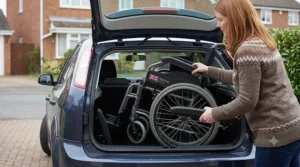
“It’s too heavy to get in the car.” Switch from steel to aluminium and choose quick-release rear wheels (Days Escape Lite, Karma Ergo Lite 2). You lift three lighter pieces instead of one heavy lump.
“The arms wobble after a few months.” Cheap hinges and British damp are a bad pairing. Buy from a brand with UK parts support (Drive, Days, Karma) so a worn arm latch is a £15 fix, not a new chair.
“I can’t get close enough to the table.” You want desk-length arms, not full-length — they’re shorter at the front, letting the chair tuck under a table or worktop.
“The footrests get in the way of transfers.” Choose swing-away detachable footrests, standard on most chairs here. Swing them aside or pull them off entirely to clear the front.
“Is it even certified for the UK?” Look for chairs tested to British and European manual-wheelchair standards (BS EN 12183). The Aidapt steel range, for instance, is advertised as tested to British Standards with a multi-year frame warranty.
VAT Relief: The 20% Most Buyers Miss
This is the bit that pays for your reading time. If you’re chronically sick or disabled, you can buy an eligible wheelchair VAT-free — a straight 20% saving.
Under HMRC rules, you won’t pay VAT on goods designed solely for use by disabled people, where the manufacturer’s original intention was to meet the needs of people with a disability. Wheelchairs qualify squarely. The mechanism is simple: you don’t need to be registered disabled or receiving benefits, and at checkout you complete a short declaration confirming your condition, with no medical proof usually required.
A crucial caveat worth repeating: this does not cover someone who is only temporarily disabled, such as with a broken limb, nor age-related frailty alone. Falsely claiming is against the law.
The official detail lives in the government’s guidance on VAT relief for disabled people and the fuller VAT Notice 701/7. One quirk to note when comparing prices: Amazon.co.uk listings include 20% VAT by default, whereas a specialist mobility retailer may show the VAT-free price once you declare — so a chair that looks dearer at the specialist might actually be cheaper after relief.
✨Compare Before You Commit
🔍Prices shift constantly, and VAT relief changes the maths. Click through to check the current Amazon.co.uk price and the VAT-free price at a specialist before deciding.
Features That Actually Matter (And Those That Don’t)
Matters: arm removability type, total weight, user weight limit, puncture-proof tyres, quick-release wheels, warranty length, UK parts availability.
Matters less than the marketing suggests: frame colour (lovely, irrelevant to function), cup holders and trays (easily added later), and “ultra-premium” upholstery on a chair used an hour a day.
The single spec people under-weight is serviceability. A slightly heavier chair from a brand with a UK parts network beats a featherweight import you can never repair. When a flip-back latch eventually wears — and it will — you want a £12 part on next-day delivery, not a skip.

Frequently Asked Questions
❓ Are removable armrests wheelchairs available on Amazon.co.uk?
❓ What's the difference between flip-back and detachable armrests?
❓ Can I get a removable armrests wheelchair VAT-free in the UK?
❓ Are these wheelchairs suitable for British weather?
❓ Can the NHS provide a wheelchair with removable arms?
The Bottom Line
A removable armrests wheelchair isn’t a luxury feature — it’s the part that decides whether someone transfers independently or waits for help. The choice comes down to a few honest questions: who’s lifting it, where does it live, and how often does it travel?
For settled home use on a budget, the steel Drive DeVilbiss or Invamed 1050 do the job without drama. For frequent car trips, the aluminium Days Escape Lite or Karma Ergo Lite 2 save your back. For all-day comfort, the height-adjustable Z-Tec T-Line; for tight spaces, the compact Drive XS2; for value with self-propel, the Aidapt Deluxe.
Whichever you choose, check the variant’s arm type, weigh up VAT relief, and buy from a brand you can get parts for. Get those three right and the chair will earn its place for years.
✨ Ready to choose?
🔍 Click any model above to check live Amazon.co.uk pricing and availability, and remember to compare the VAT-free price at a specialist before you commit.
Recommended for You
- Desk Length Armrests Wheelchair: 7 Best UK Picks in 2026
- Adjustable Height Armrests Wheelchair: 7 Best UK Picks for 2026
- 7 Best Wheelchair Armrest Pads UK 2026: Comfort Without the Ouch
Disclaimer: This article contains affiliate links. As an Amazon Associate, I earn from qualifying purchases. If you purchase products through these links, we may earn a small commission at no additional cost to you. Prices and availability are accurate at the time of research and may vary — always check current details on Amazon.co.uk.
✨ Found this helpful? Share it with your mates! 💬🤗
