
In This Article
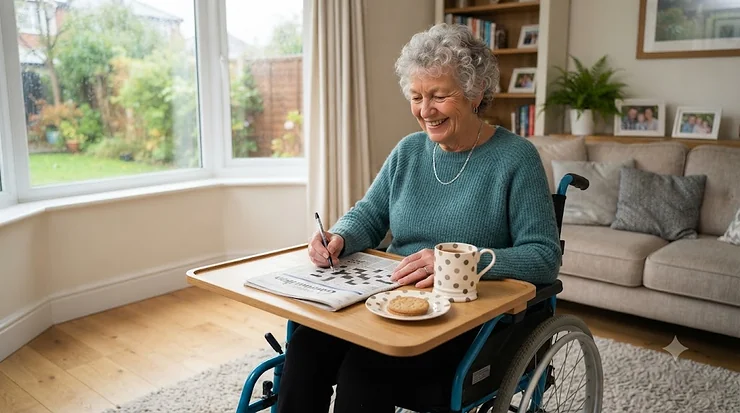
Ask anyone who spends their day in a wheelchair what genuinely changes daily life, and a good lap tray usually ranks somewhere above half the “assistive tech” on the market. A wheelchair lap tray is a portable, wheelchair-mounted or lap-worn surface — padded, wooden or rigid — that gives a stable, level base for eating, working, reading or resting an iPad, without needing a table nearby. It sounds almost too simple to matter. Then you watch someone eat soup one-handed off their knees because nothing else fits under their chair, and the penny drops.
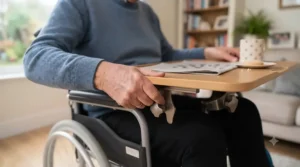
This guide digs into seven genuinely available, real-world products on amazon.co.uk, from bean bag bag-hybrids to no-nonsense wooden boards, and works through the practical questions that actually decide whether a tray earns its keep: does it wobble, does it fit your armrests, can you get it on and off without a carer, and does it double as anything else. We’ll also cover VAT relief, which under current HMRC rules can shave 20% off many mobility products for eligible buyers — the gov.uk guidance on VAT relief for disability equipment sets out exactly who qualifies and how to claim it at checkout.
Whether you’re after a padded lap tray wheelchair users can wear comfortably for hours, a bean bag base lap tray that moulds to an unusual seating position, or a straightforward lap desk for wheelchair use at a laptop, there’s a genuine option below rather than a generic listing dressed up as advice. Prices shift constantly on Amazon, so every figure here is a working range rather than a snapshot that’ll be wrong by the time you read it.
Quick Comparison Table
| Product | Type | Price Range | Best For |
|---|---|---|---|
| Trabasack Curve | Bean bag bag-tray | £75–£95 | Everyday all-rounder, on/off ease |
| Trabasack Max | Bean bag bag-tray (large) | £70–£90 | Laptop users, 15″ screens |
| Trabasack Mini Connect | Bean bag bag-tray (compact) | £45–£65 | Lightweight, tablet-sized tasks |
| Blue Badge Co Bean Bag Lap Tray | Padded bean bag tray | £30–£45 | Comfort, home dining, TV meals |
| Homecraft Beanbag Stay Tray | Clinical bean bag tray | £30–£40 | Care settings, stability |
| NRS Healthcare Wheelchair Tray with Bean Bag | Bean bag tray + Dycem mat | £35–£50 | Mealtime spill prevention |
| Universal Removable Wooden Wheelchair Tray | Rigid wood tray with handles | £20–£35 | Budget, writing, hard surface |
A glance down that “Best For” column tells its own story: this isn’t a single product category with seven near-identical clones, it’s three genuinely different design philosophies. The Trabasack range treats the tray as one half of a bag — you’re paying for versatility and portability. The Blue Badge Co, Homecraft and NRS Healthcare trays treat comfort and stability as the whole point, with bean bag bases that mould to your lap rather than balance on it. The Universal Removable Wooden Wheelchair Tray sits at the opposite end entirely: no bean bag, no bag, just a hard, flat, cheap writing surface. None of these is objectively “best” — the right pick depends almost entirely on what you’re doing with it and how often it needs to come off again.
💬 Just one click — help others make better buying decisions too!😊
Top 7 Wheelchair Lap Trays: Expert Analysis
1. Trabasack Curve — bean bag base doubles as a carry bag
The standout here is that the Trabasack Curve isn’t really “a tray with a bag attached” — it’s a rucksack, satchel or bum-bag that unfolds into a lap tray, and that dual identity is the whole reason people rave about it. Inside is a removable bean bag insert filled with polystyrene beads that moulds around your legs, armrests or the gap between them, so it sits level even on wheelchairs with unusual seat contours. The shell is a wipe-clean, shower-resistant fabric, and long or short straps let it clip onto armrests, be worn round the waist, or be slung over a shoulder when you’re not using it as a tray at all.
Because it’s designed by a wheelchair user for wheelchair users, the on/off mechanism is genuinely one-handed friendly — a detail that rigid trays with awkward Velcro straps consistently get wrong. Reviewers writing about the Trabasack Curve describe swapping out a wooden lap board specifically because they kept catching corners and spilling drinks, and consistently mention that the bean bag base solves the “my wheelchair arms are the wrong distance apart” problem that plagues fixed-width trays. If you eat, work and travel from your chair in roughly equal measure, this is the model built around exactly that pattern.
Pros:
- ✅ Bean bag base adapts to almost any wheelchair shape
- ✅ Doubles as a bag — nothing extra to carry
- ✅ One-handed straps, easy on and off
Cons:
- ❌ Soft base flexes slightly under heavy weight
- ❌ Costs more than a basic rigid tray
Expect a working price in the £75–£95 range at the time of research; check current price on Amazon, as stock and sellers shift. Given it replaces both a bag and a tray, the value case stacks up well against buying the two separately.
2. Trabasack Max — laptop-ready lap desk and satchel
The Trabasack Max is the largest tray in the range, built specifically around fitting a 15.6-inch laptop screen alongside a mouse, charger and notebook without anything hanging off the edge. At roughly 43 × 33cm, it’s noticeably bigger than the Curve, with a sturdy carry handle and shoulder strap that make it function as a proper briefcase when you’re not using the lap-desk side.
What most buyers overlook about a tray this size is that bulk cuts both ways: it’s brilliant the moment you need real working space, but it’s genuinely awkward to store folded down the side of a narrower wheelchair. Reviewers who use the Trabasack Max for remote work consistently frame it as a “desk replacement” rather than a snack tray — several note it’s just as useful for someone without a disability who wants a stable lap surface for a laptop on a train or sofa, which says something about how far this has moved beyond a niche mobility product.
Pros:
- ✅ Comfortably fits a 15″ laptop plus accessories
- ✅ Doubles as a genuine work briefcase
- ✅ Bean bag base keeps heat off your legs
Cons:
- ❌ Bulkier to store than smaller Trabasack models
- ❌ Overkill if you only need a small surface
Price sits around the £70–£90 range; at the time of research this positions the Max close to the Curve, so the deciding factor is really surface size rather than budget.
3. Trabasack Mini Connect — lightest bag-tray hybrid
Weighing around 510g, the Trabasack Mini Connect is built for people who want the bag-tray concept without the bulk — a tablet, phone, wallet and cup, not a full laptop setup. The “Connect” surface is a soft, Velcro-receptive pad, meaning compatible accessories (and a growing range of third-party grip-tape mounts) attach directly to the tray itself, which is a genuinely clever way to stop a phone or tablet sliding off a lap that’s in constant motion.
Based on the spec comparison with its bigger siblings, the trade-off is straightforward: less surface area for less weight and a lower price. That makes it the natural choice for anyone whose main use case is reading, browsing or a coffee cup rather than working. User reviews describe it as ideal paired with a folding tablet stand, since the Velcro tray keeps the stand from sliding under the pressure of typing or tapping — a small detail that a flat, non-adhesive surface simply can’t replicate.
Pros:
- ✅ Lightest Trabasack model, easy to carry all day
- ✅ Velcro “Connect” surface secures tablets and stands
- ✅ Compact enough for narrow wheelchairs
Cons:
- ❌ Too small for full meals or a laptop
- ❌ Bean bag base offers less cushioning than larger models
Typical pricing runs £45–£65, making it the most accessible entry point into the Trabasack range without sacrificing the design’s core advantage.
4. Blue Badge Co Bean Bag Lap Tray — handmade UK padded classic
Handmade in a Bristol studio, the Blue Badge Co Bean Bag Lap Tray is the archetypal padded lap tray wheelchair and armchair users have relied on for years — a laminated wooden tray top on a generously filled bean bag base, available in dozens of fabric patterns rather than clinical grey or black. The poly-bead filling is dense enough to hold a plate and mug steady, and the coordinating wooden frame around the tray edge stops cutlery and small items rolling off.
The real-world meaning of “moulds to your lap” is worth spelling out: because the bean bag settles under body weight rather than resting flat, it copes far better than a rigid board with wheelchairs where the seat tilts slightly or the user’s thighs aren’t perfectly level — a common scenario that specification sheets for hard trays never mention. Aggregated customer feedback consistently praises the wipe-clean surface and the fact it works equally well in bed, on a sofa or on a wheelchair, though a handful of reviewers note the bean bag needs an occasional shake to redistribute the beads after months of daily use.
Pros:
- ✅ Wide choice of UK-made fabric designs
- ✅ Bean bag base copes well with uneven seating
- ✅ Wipe-clean laminate surface, easy to maintain
Cons:
- ❌ Not wheelchair-specific — no straps or clips
- ❌ Beads can need occasional redistribution
Expect a price in the £30–£45 range, and note that some sellers list Blue Badge Co items with VAT already removed for eligible disabled buyers, so it’s worth checking the listing carefully rather than assuming the displayed figure includes tax.
5. Homecraft Beanbag Stay Tray — clinical-grade non-slip stability
Where the Blue Badge Co tray leans decorative, the Homecraft Beanbag Stay Tray leans clinical — it’s the kind of product you’ll spot in care homes and hospital day rooms precisely because it prioritises function over flair. It combines a bean bag cushion base with a bonded non-slip mat on the tray surface itself, designed to stop crockery sliding during transfers or sudden movement, and it’s built to be used equally in bed or in a wheelchair.
For anyone managing tremor, spasticity or reduced grip strength, that non-slip surface lap desk detail isn’t cosmetic — it’s the difference between a cup staying put and a lap full of tea. Occupational therapists commonly recommend bean bag trays with a grip surface for exactly this reason, since the combination addresses both the levelling problem and the sliding problem in one product rather than requiring a separate non-slip mat purchased and positioned separately.
Pros:
- ✅ Bonded non-slip mat reduces spills and slides
- ✅ Bean bag base works in bed or wheelchair
- ✅ Simple, durable clinical-grade construction
Cons:
- ❌ Limited design choice compared with Blue Badge Co
- ❌ No straps for direct wheelchair attachment
Pricing typically falls around £30–£40; on a pure cost-per-use basis against dedicated mealtime aids, this compares well given its dual bed/wheelchair use.
6. NRS Healthcare Wheelchair Tray with Bean Bag — Dycem mat mealtime safety
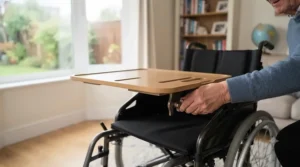
The NRS Healthcare Wheelchair Tray with Bean Bag is aimed squarely at one job: safe, spill-minimised eating from a wheelchair. Its detachable bean bag base lies across the user’s lap for a level, stable surface, and it’s supplied with a genuine Dycem mat — a specialist non-slip material widely used in occupational therapy — rather than a generic rubber sheet, which matters more than it sounds since Dycem’s grip holds even when wet.
What the spec sheet won’t tell you, but occupational therapists and carers consistently note, is how much this reduces the “watching and waiting” burden during mealtimes for people supporting someone with limited hand control. The bean bag cover is machine washable and the tray itself wipes clean, which matters given how often a mealtime tray needs cleaning versus a general-purpose lap desk. This is squarely a wheelchair lap board eating tray rather than a multi-purpose surface, and it performs that narrower job very well.
Pros:
- ✅ Genuine Dycem non-slip mat included
- ✅ Machine-washable bean bag cover
- ✅ Purpose-built for safer mealtimes
Cons:
- ❌ Less suited to laptops or heavier work tasks
- ❌ Narrower size range than fabric-choice competitors
Price generally sits in the £35–£50 range. For anyone whose main daily challenge is eating safely rather than working or travelling, the value case here is arguably the strongest of the seven.
7. Universal Removable Wooden Wheelchair Tray — budget rigid tray with handles
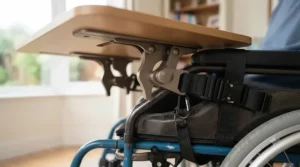
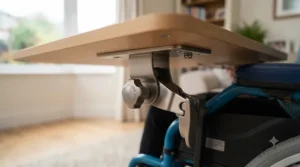
Sometimes the honest answer is that you just need a flat board, and the Universal Removable Wooden Wheelchair Tray is that answer at the lowest price point in this list. It’s a natural wood tray designed to sit on wheelchairs with steel tube armrest support, secured with straps, and — unlike most of the bean bag options above — several listings in this style include a lap tray with handles design, which genuinely helps when lifting it on and off isn’t something you can do with a delicate grip.
The trade-off for that low price and rigid stability is exactly what you’d expect: no bean bag give, so if your wheelchair arms aren’t quite standard width or your seat tilts, the tray can rock slightly rather than settling flat. Reviewers who buy this style tend to be after a hard, stable surface for writing, crafts or a keyboard rather than a plate of food, and value the fact that a hard edge contains dropped items better than a soft-framed bean bag tray does. It’s not glamorous, but for a straightforward lap desk for wheelchair use on a tight budget, it does exactly what’s promised.
Pros:
- ✅ Lowest price point of the seven
- ✅ Side handles make lifting easier
- ✅ Rigid surface suits writing and craft work
Cons:
- ❌ No cushioning — can rock on uneven arms
- ❌ Straps need periodic re-tightening
Typical pricing runs £20–£35 range, making it the clear pick for anyone prioritising cost over cushioning.
Setting Up and Using Your Wheelchair Lap Tray: A Practical Guide
Getting a new lap tray home is the easy part — getting genuine daily use out of it depends on a handful of setup details that Amazon listings rarely spell out. Start by measuring the gap between your wheelchair’s armrests before ordering anything with fixed straps; most rigid trays and Dycem-mat trays are designed for a specific width range (commonly 16–20 inches), and a tray that’s even 2cm too narrow will bow under any real weight. Bean bag models like the Trabasack Curve sidestep this almost entirely, which is precisely why they’re recommended so often for unusual or older wheelchair models.
Once fitted, spend the first week paying attention to where the tray sits relative to your chin and elbows — a tray positioned too high forces your shoulders up, and one too low means leaning forward repeatedly, both of which cause fatigue over a full day. For bean bag trays, redistribute the beads by hand every few weeks; letting them settle unevenly is the single most common complaint in aggregated reviews across every bean bag model in this guide. A common first-30-days mistake is over-tightening Velcro or buckle straps to stop wobble, which actually accelerates wear on the stitching — a snugger-but-not-maximal fit combined with the tray’s own weight is usually enough.
Maintenance is genuinely low-effort: wipe hard surfaces after each meal with a damp cloth, and machine wash removable bean bag covers on a cool cycle roughly monthly, or weekly in care settings with heavier daily use. Trays with a Dycem mat, like the NRS Healthcare Wheelchair Tray with Bean Bag, should have that mat rinsed rather than scrubbed with abrasive sponges, since aggressive cleaning gradually wears down the micro-texture that gives Dycem its grip.
Real Wheelchair Users, Real Solutions: Matching Trays to Lifestyles
Picture a university student who self-propels between lectures, works from a laptop in the library most afternoons, and eats lunch on campus rather than heading home. For that pattern — frequent movement, genuine laptop use, and food on the move — the Trabasack Max or Trabasack Curve solves three problems at once: it’s a bag between classes, a laptop desk during study, and a stable eating surface at lunch, without three separate items rattling around a backpack.
Now picture someone in a care home setting, supported by rotating staff, who needs a safe and consistent mealtime surface three times a day and occasional use for jigsaw puzzles or reading in the afternoon. Here, the calculus flips: portability matters far less than reliability and hygiene, so the NRS Healthcare Wheelchair Tray with Bean Bag or the Homecraft Beanbag Stay Tray — both easy to wipe down, both built around a non-slip surface — make more sense than anything designed to be worn as a bag.
Finally, consider a retired wheelchair user living independently, whose main use is breakfast in front of the news and the occasional crossword, on a fixed budget. The Blue Badge Co Bean Bag Lap Tray hits that brief precisely: genuinely comfortable, available in a pattern that suits their taste rather than looking clinical, and priced well below the bag-hybrid options — while the Universal Removable Wooden Wheelchair Tray covers the same budget bracket for anyone who’d rather have a hard surface for writing letters or doing the crossword in pen.
How to Choose the Best Lap Tray for Wheelchair Users
Finding the best lap tray wheelchair users will actually reach for daily comes down to seven practical questions, roughly in order of importance:
- Measure your armrest gap first. Fixed-strap and rigid trays are sized to a range (typically 16–20 inches); a bean bag tray sidesteps this entirely if your wheelchair falls outside standard sizing.
- Decide bean bag versus rigid. Bean bag bases mould to uneven seating and tilt, while rigid boards give a firmer surface for writing or craft work but can rock on non-standard arms.
- Weigh portability against surface size. A laptop-sized tray like the Trabasack Max is brilliant for work but bulkier to store than a compact model.
- Check for a non-slip surface if hand control is a factor. Trays with a Dycem or bonded grip mat, like the NRS Healthcare option, meaningfully cut spillage risk during mealtimes.
- Consider who’s fitting and removing it. One-handed strap systems and lap tray with handles designs matter more than they sound if grip strength or dexterity is limited.
- Factor in cleaning routine. Machine-washable bean bag covers suit daily use; wipe-clean laminate suits lighter, less frequent use.
- Check VAT eligibility before paying. Many lap trays qualify for VAT relief for disabled buyers — worth confirming at checkout rather than after.
Padded vs Rigid: Bean Bag Base Lap Trays Compared
The padded-versus-rigid decision is really a levelling problem in disguise. A bean bag base lap tray — used across the Trabasack range, the Blue Badge Co tray, the Homecraft Beanbag Stay Tray and the NRS Healthcare model — works by deforming under weight until it finds a level plane, which means it copes with tilted seats, asymmetric posture and non-standard armrest widths without any adjustment from the user. That’s precisely why bean bag models dominate the wheelchair-specific end of this market rather than the general “lap desk” category.
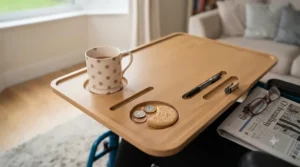
A rigid tray like the Universal Removable Wooden Wheelchair Tray, by contrast, offers a genuinely flat, firm surface that won’t flex under a pen, a rolling pin or a keyboard — useful for anyone doing craft work, writing or typing where the surface itself needs to resist pressure rather than absorb it. The trade-off is that a rigid board can only be as level as the armrests it’s strapped to; on a wheelchair with any tilt or asymmetry, expect a very slight but noticeable slope. For most day-to-day eating, reading and tablet use, the padded bean bag route wins on comfort and adaptability; for detailed hands-on tasks, rigid still has the edge.
Wheelchair Lap Board Eating Trays: Mealtime Safety and Non-Slip Surfaces
Eating is arguably the single highest-stakes use case for any wheelchair lap tray, because a spilled bowl isn’t just an inconvenience — for someone with limited mobility, it can mean a scald, a change of clothes, or simply a loss of dignity at the table. This is where a genuinely non-slip surface lap desk earns its higher price tag over a plain laminate board. Dycem, the material supplied with the NRS Healthcare Wheelchair Tray with Bean Bag, is specifically engineered to grip crockery even when damp, which is precisely the condition most likely to cause a slide.
The Homecraft Beanbag Stay Tray takes a similar approach with a bonded non-slip mat rather than a loose Dycem sheet, which some users prefer since there’s nothing separate to lose or reposition. Either way, the practical advice from occupational therapy guidance on seating is consistent: a stable, level base combined with a grip surface addresses both halves of the spill problem — the tray staying still, and the plate staying still on the tray. If mealtime safety is your primary concern rather than portability or work use, prioritise this feature above almost everything else on this list.
Common Mistakes When Buying a Wheelchair Lap Tray
The single most common buying mistake is ordering by wheelchair “type” rather than measuring the actual armrest gap — a standard adult manual chair and a bariatric or paediatric model can differ by several inches, and a tray sized for the wrong gap either won’t fit the straps or will sit loosely enough to tip. A close second is assuming a decorative padded tray, designed primarily for sofa or bed use, will survive daily wheelchair transfers; general-purpose bean bag trays without reinforced straps can migrate or slip during a transfer in a way that wheelchair-specific designs are built to resist.
Buyers also frequently overlook cleaning requirements until after purchase — a fabric-covered bean bag tray used for every meal needs washing far more often than its listing implies, and not every cover is genuinely machine washable at anything above a cool cycle. Finally, many people pay full VAT unnecessarily; because eligibility for VAT relief on disability equipment is based on a simple self-declaration rather than proof of registration, it’s worth checking every listing for a VAT-exempt price option before completing a purchase, as outlined in the gov.uk guidance on VAT relief for disability equipment.
✨ Don’t Miss These Exclusive Deals!
🔍 Take your search for the right lap tray further with these carefully selected options. Click through to check current pricing and availability, and find the surface that actually fits your daily routine.
Wheelchair Lap Tray vs Over-Bed Table: Which Wins?
Over-bed and over-chair tables — height-adjustable, wheeled units that slide across a bed or wheelchair — solve a related but distinct problem, and it’s worth being honest about when they beat a lap tray rather than assuming one replaces the other. An over-bed table offers a larger, perfectly level surface and doesn’t need to be strapped on or removed, which suits fixed locations like a bedside or a favourite armchair spot. What it can’t do is travel with you: it’s furniture, not an accessory, and it’s genuinely unwieldy the moment you need a stable surface outdoors, in a car, or moving between rooms.
A wheelchair lap tray wins decisively on portability and independence — nothing to wheel into position, no risk of a table catching on a doorway, and (with a bag-hybrid like the Trabasack Curve) the ability to carry your own dining or working surface wherever you go. The sensible conclusion most occupational therapy guidance on seating and positioning arrives at isn’t “pick one,” but “use both for what each is good at” — an over-bed table for a fixed spot at home, and a lap tray for everywhere else.
What to Expect: Real-World Performance
Specifications on a listing page rarely translate directly into how a tray behaves in daily use, so it’s worth setting honest expectations. Bean bag trays typically take a few days of use to “break in,” during which the beads redistribute to your specific sitting position — expect a slightly lumpy feel initially that smooths out with regular use. Rigid wooden trays, by contrast, perform identically from day one, but many users report a faint wobble on wheelchairs where the armrests aren’t perfectly matched in height, something spec sheets never mention because it depends entirely on your specific chair.
For eating, reviewers across every bean bag model in this guide consistently describe a noticeable reduction in “near-miss” spills compared with balancing a plate on their knees or an ill-fitting board, though none claim spill-proof performance — a genuinely full bowl of soup still demands care regardless of tray. For laptop and tablet use, the larger Trabasack models perform close to a real desk for typing and browsing, though users note that intensive mouse use benefits from a small non-slip mat placed on the tray surface, since fabric-topped bean bag trays offer slightly less grip for a moving mouse than a hard desk would.
Safety, Regulations and VAT Relief for Wheelchair Lap Trays
Wheelchair accessories sold in the UK, including after-market lap trays, fall under general product safety law rather than being classed as medical devices in most cases, though buyers with complex postural needs are generally advised to check compatibility with their specific wheelchair model before fitting anything with rigid clamps or fixed straps. The British Healthcare Trades Association’s Code of Practice is a useful reference point here — retailers who display BHTA membership have committed to a Trading Standards-approved code covering honest product claims and fair selling practices, which is a reasonable proxy for reliability when comparing unfamiliar brands.
On the financial side, most genuinely wheelchair-specific lap trays qualify for VAT relief, since HMRC’s rules zero-rate goods designed solely for use by disabled people when supplied to an eligible buyer for personal use — general-purpose “lap trays” marketed at everyone, rather than wheelchair users specifically, are less likely to qualify, so it’s worth checking each listing individually. Beyond the tray itself, good positioning matters for comfort over long periods; NHS guidance on posture and seating consistently emphasises that any lap surface should sit at a height that doesn’t force the shoulders up or require sustained forward leaning, a principle echoed in NHS trust guidance on posture for wheelchair users and reinforced by Oxford Health NHS Foundation Trust’s resources on 24-hour posture management, both of which stress that supportive positioning should be maintained consistently rather than only during specific activities.
Long-Term Cost & Maintenance
Judged purely on upfront price, the Universal Removable Wooden Wheelchair Tray wins easily at the £20–£35 range, but total cost of ownership tells a slightly different story once you account for lifespan and versatility. A bag-hybrid like the Trabasack Curve, at £75–£95, effectively replaces both a bag and a tray — comparing it against buying a decent wheelchair bag (commonly £30–£50) and a separate tray (£20–£40) narrows the price gap considerably, and in some cases makes the hybrid the cheaper overall option.
Maintenance costs are genuinely low across the board: bean bag covers are typically sold as spare parts by Trabasack and Blue Badge Co for around £15–£25 if a cover wears out before the tray itself, while rigid wooden trays have essentially nothing to replace short of the straps. Where cost-per-use analysis really favours the bean bag and Dycem-mat options is spill reduction — a single ruined laptop or set of trousers from a slipped meal easily costs more than the price difference between a basic board and a proper non-slip tray, which is worth weighing before defaulting to the cheapest option on the page.
Frequently Asked Questions
❓ What size wheelchair lap tray do I need?
❓ Can I claim VAT relief on a wheelchair lap tray?
❓ Are bean bag lap trays better than wooden ones?
❓ How do I attach a lap tray to my wheelchair?
❓ Can a wheelchair lap tray be used for eating and working?
Conclusion
There’s no single “best” wheelchair lap tray, and any article claiming otherwise is skipping the part where your wheelchair, your daily routine and your budget actually differ from the next person’s. What the research does show clearly is that bean bag base lap trays consistently outperform rigid boards for comfort and fit across uneven or non-standard seating, that a genuine non-slip surface meaningfully reduces spill risk at mealtimes, and that the bag-hybrid Trabasack range earns its higher price by replacing two purchases with one for anyone who’s frequently on the move.
If you take one thing from this guide, let it be this: measure your armrests before you buy anything, check whether the listing qualifies for VAT relief, and pick based on what you’ll actually be doing with the tray most days — eating, working, or simply having a stable surface for a cup of tea and the crossword — rather than which product has the most five-star reviews in the abstract. Get that match right, and a lap tray genuinely earns the “life-changing” label some reviewers reach for; get it wrong, and it’s another item gathering dust behind the wheelchair.
Recommended for You
- Walking Stick Holder for Wheelchair: 7 Best Picks for 2026
- Wheelchair Phone Holder Pouch: 7 Best Picks Tested for 2026
- Waterproof Bag for Wheelchair: 7 Brilliant Picks for 2026
Disclaimer: This article contains affiliate links. As an Amazon Associate, I earn from qualifying purchases. If you purchase products through these links, we may earn a small commission at no additional cost to you.
✨ Found this helpful? Share it with your friends! 💬🤗
