
In This Article
Picture this: It’s 7am, and your elderly mum is staring at the bathroom door with genuine anxiety. What should be a simple morning routine—a quick shower, a trip to the loo—has become an obstacle course filled with slippery surfaces and awkward transfers. Sound familiar? You’re not alone. The NHS reports that one in three adults over 65 will experience a fall each year, with the bathroom topping the list for injury locations.
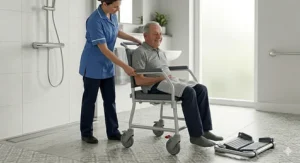
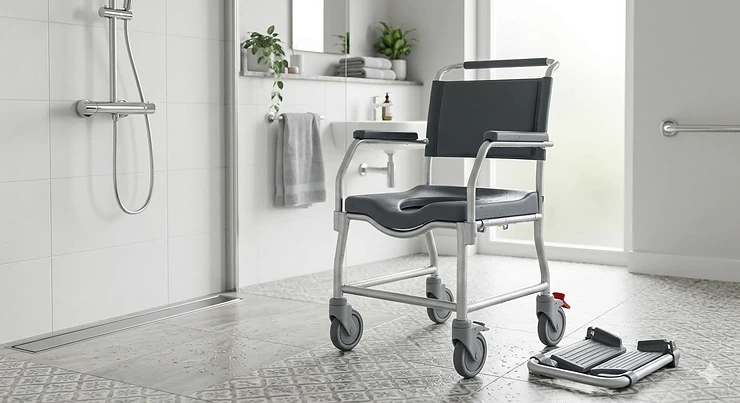
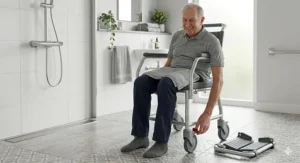
This is precisely where a wheeled shower commode chair transforms lives. These ingenious devices combine the functionality of a shower chair, wheelchair, and commode into one versatile solution. Instead of multiple transfers between different aids, users can move seamlessly from bedroom to bathroom to shower—all whilst seated comfortably and safely.
A wheeled shower commode chair is a multi-purpose mobility aid designed for bathroom use, featuring waterproof construction, locking castors, and the ability to function as both a shower seat and commode. These chairs eliminate dangerous transfers and provide dignified, independent bathroom access for elderly or disabled individuals.
Whether you’re caring for an aging parent, recovering from surgery, or managing a long-term mobility condition, finding the right wheeled shower commode chair can restore independence and peace of mind. But with prices ranging from £110 to over £300, and dozens of models claiming to be “the best,” how do you actually choose?
I’ve spent weeks researching every wheeled shower commode chair available on Amazon.co.uk in 2026, comparing specifications, analysing real customer reviews from UK buyers, and consulting with occupational therapists. This guide cuts through the marketing fluff to help you find the perfect chair for your specific needs—whether that’s a budget-friendly option under £150, a premium rust-resistant model, or something in between.
Quick Comparison Table
| Product | Price (£) | Weight Capacity | Key Features | Best For | Rating |
|---|---|---|---|---|---|
| NRS Healthcare M66119 | £139.99 | 160kg (25st) | Height adjustable, swing-away footrests, OT recommended | Budget-conscious families | 4.3/5 ⭐ |
| HOMCOM 3-in-1 Grey | £132.99-£139.99 | 136kg (21st) | Lightweight aluminium, padded seat, compact design | First-time buyers | 4.4/5 ⭐ |
| Aidapt Bewl Self-Propelled | £274.99 | 190kg (30st) | 600mm wheels, rust-free alloy, 25-year frame warranty | Independent users | 4.5/5 ⭐ |
| Etac Clean Fixed Height | £250-£300 | 160kg (25st) | No welding seams, Red Dot award winner, premium hygiene | Care home environments | 4.7/5 ⭐ |
| Aidapt Lightweight | £180-£220 | 127kg (20st) | Polymer coating, 7.5L potty, foldaway footrest | Smaller bathrooms | 4.2/5 ⭐ |
| NRS Shower Commode M66856 | £159.99 | 190kg (30st) | White coated steel, removable PU padding, 125mm castors | Wet room users | 4.4/5 ⭐ |
| Aidapt Bewl Attendant | £274.99-£309.99 | 190kg (30st) | Padded hinged arms, height adjustable, detachable back | Carer-assisted use | 4.6/5 ⭐ |
💬 Just one click – help others make better buying decisions too! 😊
Top 7 Wheeled Shower Commode Chairs: Expert Analysis
1. NRS Healthcare M66119 Wheeled Commode Chair – Best Budget Option
The NRS Healthcare M66119 has earned its Amazon’s Choice badge for good reason—it delivers solid functionality without breaking the bank. This height-adjustable commode features a chrome-plated steel frame combined with blow-moulded ABS plastic components that genuinely stand up to daily bathroom use.
Key Specifications:
- Height range: 46-53.5cm (18-21 inches)
- 8-litre potty capacity
- Four independently braked castors
UK buyers consistently praise its value proposition. One reviewer from Manchester noted: “Easy to put together and clean, height adjustable, sturdy—great for the price!” The OT Recommended seal confirms that occupational therapists have rigorously tested this chair for functionality and safety.
The swing-away footrests make transfers remarkably straightforward, particularly useful if you’re moving from a wheelchair. The padded seat and backrest provide decent comfort, though some users recommend adding an extra cushion for extended sitting.
Pros:
✅ Excellent value at £139.99
✅ Height adjustability suits various users
✅ OT Recommended seal provides confidence
Cons:
❌ 160kg weight limit may not suit bariatric users
❌ Basic padding might need supplementing
This NRS Healthcare M66119 chair typically costs £139.99 on Amazon.co.uk with free delivery for Prime members, making it an accessible entry point for families new to mobility aids.
2. HOMCOM 3-in-1 Shower Commode Wheelchair – Best All-Rounder
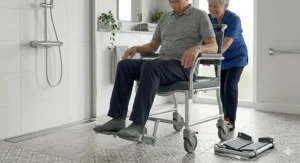
The HOMCOM 3-in-1 strikes that sweet spot between affordability and functionality. This aluminium-framed beauty weighs significantly less than steel alternatives whilst maintaining impressive structural integrity. The waterproof design genuinely lives up to its billing—UK customers report using it daily in showers for months without any rust or deterioration.
Key Specifications:
- Overall dimensions: 53W x 97D x 97H cm
- 8L removable bucket
- Four lockable wheels with 100mm diameter
What sets the HOMCOM apart is its thoughtful design details. The PVC seat with padded backrest offers genuine comfort during longer bathroom routines. The flip-away footrests fold and rotate, making standing or sitting transitions smooth rather than awkward.
One Sussex-based carer shared: “My father uses this daily for showering. The wheels lock securely, and the arms provide excellent support. It’s transformed his morning routine from stressful to manageable.”
The detachable bucket features a secure lid, addressing hygiene concerns many users initially have about wheeled commodes. Clean-up is straightforward—just slide it out from the rear.
Pros:
✅ Lightweight aluminium construction (easy to manoeuvre)
✅ Waterproof materials throughout
✅ Competitive pricing around £132.99-£139.99
Cons:
❌ 136kg weight capacity lower than some alternatives
❌ Seat width of 39cm might feel snug for larger users
3. Aidapt Bewl Self-Propelled Shower Commode – Best for Independent Users
If independence matters most to you or your loved one, the Aidapt Bewl Self-Propelled model is worth every penny of its premium price tag. Those 600mm puncture-proof rear wheels aren’t just for show—they genuinely enable self-propulsion through standard doorways and around tight bathroom corners.
Key Specifications:
- Rust-free alloy frame with 25-year limited warranty
- Two-in-one detachable horseshoe seat
- 125mm front castors plus 600mm rear wheels
The seamless PU foam construction addresses a critical issue with cheaper models: bacterial build-up in welded seams. This chair can be thoroughly cleaned without worrying about hidden crevices harbouring germs. The padded hinged arm supports swing away completely, facilitating those crucial side transfers.
UK occupational therapists particularly recommend this model for users transitioning from full independence to needing occasional support. The ability to self-propel maintains dignity and autonomy during that adjustment period.
Pros:
✅ True self-propulsion capability
✅ 25-year frame warranty demonstrates confidence
✅ 190kg weight capacity suits most users
Cons:
❌ Premium pricing around £274.99
❌ Larger footprint requires adequate bathroom space
Available on Amazon.co.uk typically between £270-£280, this Aidapt Bewl represents a significant investment in long-term bathroom safety.
4. Etac Clean Wheeled Shower Commode Chair – Premium Choice
The Etac Clean represents Scandinavian design excellence applied to mobility aids. Winner of both the Red Dot and Excellent Swedish Design awards, this chair solves problems you didn’t even know existed. The absence of welding seams or holes dramatically reduces corrosion risk—crucial in perpetually damp bathroom environments.
Key Specifications:
- Fixed height options: 49cm or 54cm
- Four lockable 125mm castors
- Unique footrest slides under seat when not used
What genuinely impresses about the Etac Clean is the rear-opening seat design. Unlike front-opening alternatives, this facilitates intimate hygiene tasks more effectively for both users and carers. The upright push handle means the chair fits perfectly over wall-mounted toilets—a feature that’s surprisingly rare.
The ergonomic foot support features soft side protection and a curved surface. When you don’t need it, simply push it underneath the seat rather than removing it entirely. This small detail prevents lost components and simplifies transfers.
UK care homes favour this model for its durability. One Hampshire facility manager reported: “We’ve had six Etac Clean chairs in constant use for four years. Still operating perfectly with minimal maintenance required.”
Pros:
✅ Award-winning design proven in professional care settings
✅ No welding seams means superior hygiene
✅ 5-year warranty and 10-year service life
Cons:
❌ Premium price point £250-£300
❌ Fixed height may not suit all users
5. Aidapt Lightweight Shower Commode Chair – Best Compact Option
Don’t let the “lightweight” label fool you—the Aidapt Lightweight Shower Commode delivers robust performance whilst maintaining manoeuvrability. The aluminium frame with tough polymer coating offers genuine rust resistance whilst keeping the overall weight at a manageable 16.1kg.
Key Specifications:
- Adjustable seat height: 525-575mm
- Seat dimensions: 435mm x 435mm
- 7.5-litre potty with lid
The compact footprint (600mm depth) makes this chair ideal for smaller UK bathrooms or ensuite facilities. The four 125mm castors with individual brakes provide stability without the bulk of larger models.
UK buyers particularly appreciate the fold-away footrest—it tucks away neatly during transfers without requiring complete removal. The well-padded seat and backrest receive consistent praise for comfort during extended sitting.
Pros:
✅ Manageable 16.1kg weight for easier manoeuvring
✅ Compact design suits smaller bathrooms
✅ Height adjustability from 525-575mm
Cons:
❌ 127kg (20st) weight limit more restrictive
❌ Smaller seat may not suit all body types
Typically priced between £180-£220 on UK retailers, this Aidapt Lightweight model balances compact design with practical functionality.
6. NRS Healthcare Shower Commode Chair M66856 – Best for Wet Rooms
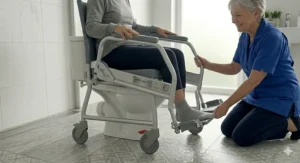
The NRS Healthcare M66856 was specifically engineered for wet room environments. That white plastic-coated steel frame isn’t just aesthetically pleasing—it provides genuine waterproof protection that stands up to daily shower use without deteriorating.
Key Specifications:
- Seat height: 527mm (aperture) or 547mm (padded)
- Overall footprint: 640mm wide x 880mm deep
- 190kg maximum user weight
The removable grey PU padded components (seat, backrest, armrests) address a common complaint with shower commodes: cleaning difficulty. Simply detach them after use for thorough washing, dramatically reducing cross-infection risks. The adjustable footrest accommodates various leg lengths comfortably.
Those 125mm castors with four-wheel locking provide excellent stability on wet surfaces. UK buyers using this in level-access showers report feeling secure even on slippery tiles.
Pros:
✅ Purpose-built for wet room environments
✅ Completely removable padding for superior hygiene
✅ 190kg weight capacity
Cons:
❌ Larger footprint may not suit compact bathrooms
❌ Assembly required
The NRS M66856 typically retails around £159.99, positioning it as an affordable option for wet room users.
7. Aidapt Bewl Attendant Propelled Shower Chair – Best for Carer Use
The Aidapt Bewl Attendant Propelled model recognises that many users require assistance rather than complete independence. The attendant-focused design includes thoughtful features that make carers’ jobs genuinely easier whilst maintaining user comfort and dignity.
Key Specifications:
- Height adjustable: 460-535mm seat height
- Rust-free alloy frame with 25-year warranty
- Detachable padded back assembly
The padded hinged arm supports aren’t merely comfortable—they’re strategically designed to facilitate side transfers. Carers can swing them away completely during transitions, then lock them securely in place for shower use. The detachable back assembly means you can customise positioning based on individual user needs.
This model fits comfortably over standard WCs and standard-height Clos-o-Mats (specialist disability toilets common in UK care settings). The swing-away footrests can be adjusted to various heights, accommodating different leg lengths without compromising support.
UK carers particularly value the larger overall footprint, which provides increased stability during transfers and reduces tip-over risk during vigorous washing movements.
Pros:
✅ Carer-friendly design features throughout
✅ Height adjustability suits multiple users
✅ 25-year frame warranty demonstrates quality
Cons:
❌ Premium pricing £274.99-£309.99
❌ Attendant-propelled only (not self-propelling)
How to Choose Your Perfect Wheeled Shower Commode Chair
Understanding Weight Capacity: More Than Just Numbers
Weight capacity isn’t simply about whether the chair will collapse—it’s about long-term structural integrity and user confidence. Most wheeled shower commode chairs sold in the UK range from 127kg (20 stone) to 190kg (30 stone). However, occupational therapists recommend selecting a chair rated at least 15-20kg above your actual weight to ensure comfortable, safe long-term use.
Why the buffer? Bathroom mobility aids experience significant dynamic loading. Sitting down heavily after losing balance, shifting weight whilst washing, or leaning to reach products all create forces exceeding static body weight. That safety margin prevents premature wear and maintains stability over years of use. According to research on bathroom safety, proper equipment selection significantly reduces fall risks in wet environments.
For bariatric users (over 30 stone), specialist options exist with 250kg+ capacities. These feature reinforced frames and wider seats specifically engineered for larger body types. Standard chairs simply cannot safely accommodate higher weights regardless of what some sellers claim.
Wheel Configuration: Castors vs Self-Propelling Wheels
The fundamental choice between castor-only models and self-propelling designs dramatically affects independence levels. Four-castor models (typically 100-125mm diameter) offer excellent manoeuvrability in tight spaces. Carers can pivot and position them easily around corners and through narrow doorways. However, users cannot move themselves independently.
Self-propelling models feature large rear wheels (usually 600mm diameter) with hand rims, plus smaller front castors. These enable wheelchair-like independent movement but require adequate upper body strength and cognitive ability to operate safely. They also occupy more space and won’t fit through very narrow doorways.
Consider your bathroom layout carefully. A standard UK internal door measures 762mm wide. Self-propelling models with 600mm wheels plus armrests often measure 600-650mm across—manageable but tight. If doorways, hallways, or shower entrances are narrower than standard, castor-only models provide better access.
Height Adjustability vs Fixed Height Models
Height adjustability adds versatility but also increases complexity and potential failure points. Fixed-height models offer simplicity and reliability—there’s simply less that can go wrong mechanically. They work brilliantly when one person will use the chair exclusively.
Adjustable models become essential in several scenarios: multiple users sharing one chair, uncertain about optimal height before purchasing, or anticipating changing needs over time. The best adjustable models use quick-release clips or tool-free mechanisms. Avoid designs requiring Allen keys for adjustment—they’re impractical when wet hands are fumbling in a steamy bathroom.
Optimal seat height positions the user’s feet flat on the floor (or footrests) with knees bent at roughly 90 degrees. For toilet use, the seat should align closely with your existing WC height to minimise awkward positioning. Measure your current toilet seat height before shopping—this simple step prevents costly mismatches.
Material Matters: Rust Resistance in Bathroom Environments
Not all “rust-resistant” claims equal genuine waterproof performance. Chrome-plated steel frames look attractive initially but the plating chips over time, exposing vulnerable steel underneath. Once water penetrates, rust spreads rapidly beneath the chrome surface.
Powder-coated steel offers better protection than chrome plating. The coating bonds chemically to the metal, creating a more durable barrier. However, scratches and chips still compromise protection, particularly around joints and welds where moisture accumulates.
Aluminium alloy frames represent the premium solution. They cannot rust because aluminium oxidises differently than steel—forming a protective layer rather than corrosive rust. The Aidapt Bewl range exemplifies this approach with their rust-free alloy construction backed by 25-year warranties.
Stainless steel occupies middle ground: more rust-resistant than standard steel but heavier and pricier than aluminium. It’s less common in consumer-grade commodes, appearing mainly in clinical equipment.
Seat Design: Horseshoe vs Closed Seats
The seat aperture design significantly impacts hygiene and comfort during intimate care tasks. Horseshoe (U-shaped) seats open at the front, providing access for toileting and washing. They’re standard on most wheeled shower commodes because they facilitate independent personal hygiene.
Closed seats with rear openings (like the Etac Clean) better serve users requiring carer assistance with washing. The carer accesses from behind whilst the user enjoys more comprehensive seat support and coverage. This design prevents awkward leaning forwards during assisted care.
Some advanced models (including the Aidapt Bewl) offer convertible options: a horseshoe seat with a solid insert that can be removed when needed. This flexibility accommodates changing needs or multiple users with different requirements.
Seat padding affects comfort significantly during extended sitting. Seamless PU (polyurethane) padding offers the best balance of comfort and hygiene. Vinyl-covered foam padding is cheaper but seams and stitching create bacterial harbourage points. Some users add their own cushions, though ensure any addition is waterproof and won’t interfere with the seat aperture.

Bathroom Safety Beyond the Chair: Creating a Holistic Solution
Essential Accessories to Maximise Safety
Even the finest wheeled shower commode chair operates within a broader bathroom safety ecosystem. NHS recommendations for bathroom aids emphasise multiple complementary measures that work together to prevent falls and injuries.
✨ Transform Your Bathroom Safety Today!
🛡️ Ready to create a safer bathroom environment? These wheeled shower commode chairs integrate seamlessly with grab rails, non-slip mats, and proper lighting to deliver comprehensive protection. Click any highlighted product name above to check current Amazon.co.uk availability and customer reviews. Your loved one’s safety deserves the best!
Grab Rails: Position grab rails strategically beside the shower commode parking spot and near the toilet. The safest configurations include both horizontal rails for pulling up and vertical rails for steadying balance. Install them at heights matching the user’s natural hand position when seated—typically 850-900mm from floor level. Ensure rails can support at least 125kg static load.
Non-Slip Flooring: Wet bathroom floors represent the primary fall hazard. Non-slip tiles (rated R10 or higher) provide excellent traction even when soaked. If replacing flooring isn’t feasible, strategically placed non-slip bath mats with suction cups offer immediate improvement. Position them where users transfer on/off the commode chair and exit the shower.
Adequate Lighting: Many bathroom accidents occur due to poor visibility, particularly during night-time toilet visits. Install motion-activated LED nightlights that illuminate automatically without requiring switches. Position them low on walls to avoid glaring in users’ eyes whilst providing sufficient floor visibility.
Wet Room Considerations for Wheeled Commodes
Wet rooms eliminate the awkward and dangerous step-over barrier of traditional shower trays. They’re increasingly popular in UK homes with mobility-impaired residents for good reason—wheeled commode chairs can roll directly into the shower area with zero threshold to navigate.
However, wet room drainage requires careful consideration. The floor gradient must slope towards drains without creating uneven surfaces that destabilise wheeled chairs. Most UK building regulations recommend a 1:80 gradient for accessible wet rooms—enough to drain water effectively without affecting chair stability.
Linear drains positioned along the wall (rather than centre drains) work best with wheeled commodes. They reduce the floor slope variation where the chair parks, providing more level positioning during showering. Channel drains also process higher water volumes faster, preventing pooling around chair wheels.
Waterproofing extends beyond just the shower area in proper wet room installations. The entire floor and walls up to 1800mm height require tanking (waterproof membrane) to prevent moisture damage. Skimping on this causes expensive problems within months—damp, mould, and structural issues that ultimately cost far more than doing it properly initially.
Understanding UK Regulations and Funding Options
VAT Relief for Disabled Individuals
Most wheeled shower commode chairs qualify for VAT relief when purchased for personal use by chronically sick or disabled individuals. This 20% saving represents substantial money—on a £300 chair, that’s £60 back in your pocket. Amazon.co.uk and most specialist retailers process VAT relief, though you must complete a declaration form confirming eligibility.
Eligibility criteria are straightforward: the product must be for personal or domestic use, designed solely or mainly for disabled people, and purchased by or for a disabled person. HMRC Notice 701/7 provides comprehensive guidance on what qualifies and how to claim relief effectively.
💷 Don’t Pay Full Price!
📋 VAT Relief Tip: Remember to claim your 20% VAT relief on eligible purchases! That’s up to £60 savings on a £300 chair. Check the product pages above for VAT relief options—most sellers on Amazon.co.uk make this process simple with online declaration forms.
The declaration process varies by retailer. Some handle it entirely online during checkout, whilst others require emailing a completed form. Keep records—HMRC occasionally audits VAT relief claims, so documentation demonstrating genuine need (such as GP letters or occupational therapy assessments) protects you.
Disabled Facilities Grants (DFG)
Local councils in England and Wales administer Disabled Facilities Grants up to £30,000 for major bathroom adaptations. Whilst wheeled commode chairs themselves might not qualify individually, associated bathroom modifications (installing a wet room, widening doorways, or adding accessible facilities) definitely do.
The assessment process begins with contacting your local council’s adult social care department. They’ll arrange an occupational therapist home visit to evaluate needs and recommend appropriate modifications. DFG applications can take 3-6 months to process, so start early if bathroom modifications are anticipated.
Scotland operates a different system through Care and Repair schemes, whilst Northern Ireland handles this through Health and Social Care Trusts. Each has unique application procedures and funding limits, so contact your local authority directly for specifics.
NHS Equipment Loan Services
NHS community equipment services across the UK loan certain mobility aids including basic commode chairs. However, availability varies dramatically by region, and wheeled shower commodes might not be included in standard loan stock due to hygiene concerns with shared bathing equipment.
Contact your GP or district nurse to request an occupational therapy assessment. If the OT determines a wheeled shower commode is essential for your care needs, they may either loan equipment or provide a “prescription” that you take to specified suppliers. Some regions operate voucher schemes contributing towards purchases of equipment exceeding NHS loan specifications.
Waiting times for NHS equipment can extend to several weeks, particularly in underfunded areas. If immediate needs are urgent (post-hospital discharge, for example), purchasing privately whilst awaiting NHS provision ensures safety isn’t compromised by bureaucratic delays.
Maintenance and Hygiene: Maximising Longevity
Daily Cleaning Protocols
Bathroom environments breed bacteria remarkably quickly. Effective daily cleaning prevents microbial buildup that causes odours, infections, and premature material deterioration. According to NHS infection control guidelines, shared bathroom equipment requires particular attention to hygiene protocols. Immediately after each use, rinse the commode bucket thoroughly with hot water. Weekly cleaning with mild disinfectant (pH 5-9) maintains hygiene without damaging materials.
Avoid harsh chemical cleaners on chrome-plated or powder-coated finishes. Bleach, ammonia, and abrasive cleaners strip protective coatings, accelerating corrosion. A simple solution of warm water and washing-up liquid removes most soiling effectively. For stubborn residue, white vinegar works wonders without harming finishes.
Pay particular attention to seat apertures, armrest undersides, and footrest mechanisms—areas where moisture and residue accumulate unnoticed. A soft brush (like an old toothbrush) accesses tight spaces around joints and hinges. Dry thoroughly after cleaning, particularly around metal components and upholstery seams.
Brake and Wheel Maintenance
Castor brakes experience significant wear in bathroom environments. Monthly inspection prevents sudden failures that compromise safety. Test each brake individually—the wheel should lock completely, not merely becoming harder to push. If brakes feel spongy or wheels still rotate when locked, replacement is necessary before someone gets injured.
Hair, soap residue, and lime scale accumulate around wheel axles, causing squeaking and stiffness. Remove wheels periodically (most designs allow tool-free removal) and clean axles thoroughly. A small amount of silicone lubricant on axle points maintains smooth rotation. Avoid oil-based lubricants that attract more dirt.
Check wheel bearings for play by attempting to wobble wheels side-to-side. Any significant movement indicates worn bearings requiring replacement. Most UK suppliers stock spare wheels and castors for major brands—keep contact details handy so replacement parts can be ordered quickly when needed.
Padding and Upholstery Care
Vinyl and PU padding requires different care approaches. Vinyl-covered foam should never be submerged—water penetrates seams and stitching, creating mould growth within the foam. Surface wipe-down with antibacterial solution suffices for routine cleaning.
Seamless PU padding (found on premium models) can often be removed and washed more thoroughly. Check manufacturer guidelines—some tolerate machine washing on gentle cycles, whilst others require hand washing only. Air dry completely before reinstalling to prevent mildew formation.
Replace padding showing significant wear, cracking, or persistent odours. Degraded upholstery harbours bacteria that cleaning cannot eliminate. Most manufacturers sell replacement padding separately, costing significantly less than replacing entire chairs. Factor this into long-term cost calculations—a £300 chair with £40 replacement padding every 2 years still represents better value than a £150 chair requiring complete replacement annually.
Common Mistakes to Avoid When Buying
Mistake 1: Choosing Based Solely on Price
The cheapest option rarely proves most economical long-term. I’ve seen countless families purchase bargain £80-£100 wheeled commodes that rust within months, requiring replacement. That “saving” disappears quickly when you’re buying chairs repeatedly.
Calculate total cost of ownership over expected usage period. A £270 Aidapt Bewl with a 25-year frame warranty and minimal maintenance costs substantially less annually than a £120 basic model requiring replacement every 18 months. Factor in potential injury costs from equipment failure—medical bills and loss of independence carry heavy financial and emotional tolls.
Quality indicators to assess: thick-gauge frame tubing, substantial castor wheels (100mm+ diameter), seamless or welded padding construction, and comprehensive warranties. Manufacturer reputation matters too—established brands like NRS Healthcare, Aidapt, and Etac maintain extensive spare parts inventories and customer support infrastructure.
Mistake 2: Not Measuring Bathroom Spaces
One of the most heartbreaking scenarios I encounter involves families purchasing excellent chairs that simply won’t fit through their bathroom doors. A friend recently spent £280 on a self-propelling model only to discover his Victorian-era bathroom doorway measured just 680mm—too narrow for the 720mm-wide chair.
Essential measurements before purchasing:
- Bathroom doorway width (internal measurement)
- Hallway width between bedroom and bathroom
- Shower entrance width (if separate from main bathroom door)
- Distance between toilet and walls/fixtures
- Turning circle space available within bathroom
Add 50mm clearance to chair width for comfortable passage through doorways. Self-propelling models require significantly more space than castor-only designs. If measurements are borderline, visit a showroom to physically assess manoeuvrability with similar-sized demonstration models.
Mistake 3: Ignoring User Cognitive Ability
Self-propelling wheeled shower commodes demand reasonable cognitive function and upper body coordination. Users must remember to engage brakes before transfers, operate wheel locks correctly, and navigate safely through confined spaces whilst seated. These tasks challenge individuals with dementia, stroke effects, or significant cognitive impairment.
Realistic assessment of cognitive abilities prevents frustration and safety issues. If brake operation or wheel control seem questionable, carer-assisted models provide better outcomes. There’s no shame in acknowledging limitations—selecting appropriate equipment ensures safety and maintains dignity better than struggling with unsuitable devices.
Some families attempt to “future-proof” by purchasing self-propelling models anticipating declining abilities. However, this often results in underused expensive equipment. It’s generally better to match current needs precisely, accepting that equipment may need upgrading as situations change.
Mistake 4: Overlooking Supplier After-Sales Support
Equipment failures rarely happen conveniently. A broken castor brake on Friday evening when you need the chair for weekend care creates genuine crises. Suppliers offering comprehensive after-sales support, spare parts availability, and technical guidance prove invaluable during such situations.
Before purchasing, verify:
- Spare parts availability and lead times
- Technical support access (phone numbers, email, chat)
- Warranty claim procedures
- Return/exchange policies if equipment proves unsuitable
Amazon.co.uk generally excels at returns and refunds, but specialist mobility retailers often provide superior technical support and long-term parts availability. Weigh these factors against price differences—saving £30 but sacrificing reliable support rarely proves worthwhile.
Real User Experiences: What UK Buyers Say
Case Study: Margaret’s Journey to Bathroom Independence
Margaret, a 78-year-old from Cornwall with arthritis and reduced mobility, struggled with bathroom safety for months before her daughter Sarah researched wheeled shower commodes. “Mum refused to admit she needed help,” Sarah explains, “but I found her on the bathroom floor twice in one week. Something had to change.”
They selected the NRS Healthcare M66119 based on recommendations from Margaret’s occupational therapist. “The OT Recommended seal gave me confidence,” Sarah notes. “We needed reliability, not just the cheapest option.”
Installation proved straightforward. “We assembled it in 20 minutes, adjusted the height, and Mum was using it that same afternoon,” Sarah recalls. The results transformed not just Margaret’s physical safety but her emotional wellbeing too.
“I can shower by myself again,” Margaret says. “The arms help me stand up safely, the wheels mean I don’t have to walk on wet floors, and I feel secure knowing the brakes work properly. It’s given me back my independence.”
Six months later, the chair remains in daily use. “We’ve had no issues whatsoever,” Sarah confirms. “It’s worth every penny of that £140.”
Case Study: David’s Recovery After Hip Replacement
David, 62, from Edinburgh faced an eight-week recovery period following hip replacement surgery. His physiotherapist strongly recommended a wheeled shower commode to prevent dangerous weight-bearing during healing.
“I was reluctant initially—felt like giving in to disability,” David admits. “But my wife researched thoroughly and convinced me the HOMCOM 3-in-1 would help recovery rather than hinder it.”
The lightweight aluminium construction proved crucial. “I could move it around myself with minimal effort,” David explains. “That independence mattered psychologically—I wasn’t completely dependent on others.”
The waterproof design allowed daily showering without concerns about wet-transfer risks. “Standing in the shower wasn’t an option for weeks after surgery. This chair meant I could maintain hygiene and dignity simultaneously.”
Three months post-surgery, David has recovered fully but keeps the chair. “My elderly mother visits regularly, and she uses it when she stays. It’s become a permanent fixture that provides peace of mind for various situations.”
Case Study: Care Home Implementation
The Willows Care Home in Hampshire purchased six Etac Clean shower commodes in 2022 for their 40-bed facility. Manager Janet Peterson explains their decision-making process: “We needed reliable, hygienic equipment that would withstand intensive daily use by multiple residents.”
The no-weld construction and comprehensive warranty justified the premium investment. “After four years of constant use—sometimes 3-4 times daily per chair—they’re still functioning perfectly,” Janet reports. “Basic chairs we tried initially lasted barely 12 months before rusting or mechanical failures.”
Staff particularly appreciate the rear-opening seat design. “It makes assisted washing far easier and more dignified for residents,” Janet notes. “The time saved during care routines is substantial.”
Infection control proves equally important. “The seamless PU construction means we can thoroughly disinfect after each use without worrying about bacteria hiding in welded seams. That’s critical for vulnerable residents’ health.”
Janet’s advice for families purchasing home equipment? “Don’t skimp on quality if long-term use is anticipated. Calculate annual costs, not just purchase prices. Our Etac chairs cost £300 each but they’ll last a decade. The £120 chairs lasted less than two years. Do the mathematics.”
Frequently Asked Questions
❓ How much weight can a wheeled shower commode chair safely support?
❓ Can wheeled shower commode chairs be used over standard UK toilets?
❓ How do I clean and maintain a wheeled shower commode chair properly?
❓ Are wheeled shower commode chairs eligible for VAT relief in the UK?
❓ What's the difference between self-propelling and attendant-propelled wheeled shower commodes?
Conclusion: Finding Your Perfect Bathroom Companion
Selecting the right wheeled shower commode chair represents far more than a purchasing decision—it’s an investment in independence, dignity, and safety. Throughout this comprehensive guide, we’ve examined seven exceptional options available on Amazon.co.uk in 2026, each excelling in different scenarios and price points.
For budget-conscious families seeking reliable performance without premium pricing, the NRS Healthcare M66119 at £139.99 delivers solid functionality backed by occupational therapist recommendations. Its height adjustability and practical features suit most standard requirements admirably.
Independent users prioritising autonomy benefit enormously from the Aidapt Bewl Self-Propelled model. Yes, it costs £274.99, but that 25-year frame warranty and genuine self-propulsion capability preserve dignity during mobility transitions. Sometimes, maintaining independence justifies premium investment.
Care home environments or families seeking absolute reliability should seriously consider the Etac Clean. The Red Dot award-winning design, seamless construction, and decade-long service life prove that Scandinavian engineering excellence applies equally to mobility aids as to furniture.
Remember that the “best” chair varies dramatically based on individual circumstances. Bathroom dimensions, user weight and cognitive abilities, carer availability, and budget constraints all influence optimal choices. Take time measuring spaces, assessing needs honestly, and reading real user reviews from UK buyers before committing.
Don’t hesitate to contact occupational therapists for professional assessments—their expertise often identifies needs you haven’t considered. Many local authorities provide free home assessments that result in invaluable guidance and potentially access NHS equipment loan schemes or Disabled Facilities Grant funding.
Whatever you choose, prioritise safety and long-term value over initial purchase price. A wheeled shower commode chair that prevents just one fall pays for itself many times over in avoided injury, medical costs, and preserved quality of life. Your bathroom should be a place of comfort and hygiene, not anxiety and risk. The right equipment transforms it back to exactly that.
Recommended for You
- 7 Best Wheelchair for Preventing Bed Sores UK 2026 Guide
- 7 Best Reclining Wheelchair with Elevating Legrests UK 2026
- 7 Expandable Wheelchair Grows With Child UK 2026 Guide
Disclaimer: This article contains affiliate links to products on Amazon.co.uk. If you purchase through these links, we may earn a small commission at no additional cost to you. Product availability and specifications can change. Always verify current pricing and features on retailer websites before purchasing. This guide provides general information only and should not replace professional medical or occupational therapy advice. Consult qualified healthcare professionals regarding your specific mobility and safety needs.
✨ Found this helpful? Share it with your mates! 💬🤗
