
In This Article
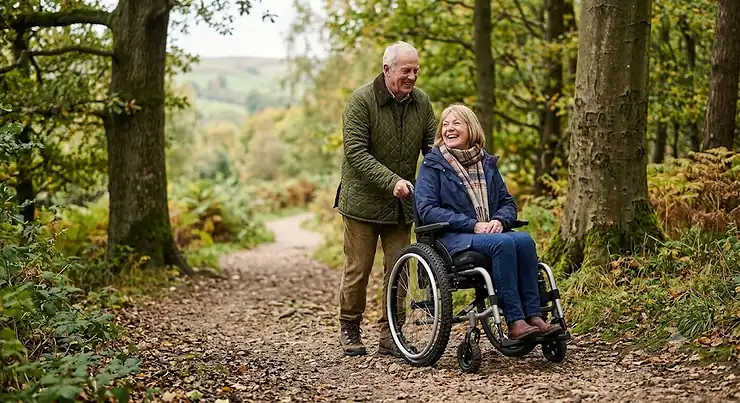
Picture this: a breezy Saturday morning, the Peak District stretching out ahead, muddy footpath winding between heather and limestone — and your standard wheelchair wheels sinking, spinning, absolutely going nowhere. It’s a scenario that plays out far too often for UK wheelchair users, and honestly, it’s entirely avoidable. The right set of all terrain wheelchair wheels transforms that frustration into genuine freedom.
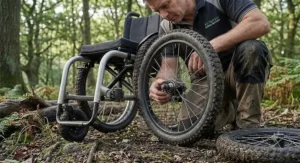
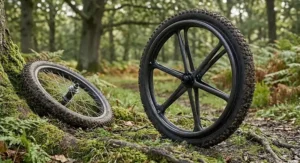
So, what exactly are all terrain wheelchair wheels? Put simply, they’re rear drive wheels — and sometimes complete wheel-and-tyre assemblies — engineered with wider tyres, deeper knobby tread patterns, reinforced spokes, and robust hubs designed to roll confidently over grass, gravel, cobbles, mud, and rough ground that would stop a standard wheelchair dead in its tracks. The tyre width typically starts at 25mm and goes considerably wider, while the tread pattern does the serious work of gripping unpredictable surfaces.
Britain’s climate rather demands this. We get an average of 133 rainy days per year — more than you’d think for a temperate island — which means parks, pathways, and countryside get reliably muddy from October through to April. Standard narrow tyres with smooth tread essentially become ice skates on wet grass. All terrain rear wheels for manual wheelchairs change that equation entirely.
In this guide, I’ve reviewed seven genuine options currently available on Amazon.co.uk, covering everything from budget-friendly replacement wheel sets you bolt onto your existing chair, to complete all-terrain wheelchair packages with mountain-bike-grade pneumatic tyres. There’s something here for every budget and every adventure.
Quick Comparison: All Terrain Wheelchair Wheels at a Glance
| Product | Tyre Type | Tyre Width | Tread | Best For | Price Range |
|---|---|---|---|---|---|
| MobiQuip All Terrain (24″ Pneumatic) | Pneumatic | 24″ mountain bike | Deep knobby | Active self-propellers | £400–£550 |
| Free to Be Mobility Off Road Wheelchair | Pneumatic bike tyre | 24″ chunky | Mountain bike | Budget outdoor users | £150–£250 |
| ELLENS 24″ Sport Rear Wheels | Pneumatic | 24×1 | Non-slip | Replacement upgrade | £50–£90 |
| XFAK 24″ Solid Nylon Rear Wheels | Solid nylon | 24″ | Anti-skid texture | Zero-maintenance users | £40–£70 |
| 24″ Pneumatic Aluminium Hub Wheels | Pneumatic rubber | 24×1 | Moderate knobby | Budget replacement | £40–£80 |
| ZMTGLTG 24×1 3/8″ Solid PU Wheels | Solid polyurethane | 24×1 3/8″ | Textured | Flat-free reliability | £35–£65 |
| Esteem Adventurer All Terrain Wheelchair | Pneumatic mountain bike | 24″ | Chunky knobby | Countryside explorers | £300–£450 |
The table above reveals something worth noting immediately: the choice between pneumatic and solid tyres is arguably more important than any other decision you’ll make. Pneumatic wheels give you genuine shock absorption and traction — crucial in wet, muddy British conditions — but require occasional pressure checks. Solid options eliminate puncture anxiety entirely at the cost of a bumpier ride and slightly less grip on slick surfaces. If you’re mostly on gravel paths and dry grass, solid can work brilliantly. If your adventures involve wet woodland trails or soggy National Trust gardens, pneumatic wins every time.
💬 Just one click — help others make better buying decisions too! 😊
✨ Don’t Miss These Exclusive Deals!
🔍 Take your outdoor mobility to the next level with these carefully selected products. Click on any highlighted item to check current pricing and availability on Amazon.co.uk. These picks will help you find exactly the right wheels for your adventures!
Top 7 All Terrain Wheelchair Wheels: Expert Analysis
1. MobiQuip All Terrain Adult Wheelchair — 24″ Pneumatic Mountain Bike Tyres
The MobiQuip All Terrain is the one that keeps coming up in UK community forums, and once you understand what’s in those wheels, the enthusiasm makes complete sense. The 24-inch mountain-bike-style pneumatic tyres run at 40 psi and feature genuinely deep tread — not the token tread you find on entry-level chairs, but the sort of aggressive grip profile that handles cobbled city streets in Bristol, gravel drives in Surrey, and muddy paths in the Lake District without complaint. The air-filled design also means each tyre acts as a natural suspension system, absorbing the kind of uneven ground that would otherwise rattle your teeth.
The aluminium frame weighs just 12.5 kg, which matters enormously when you’re lifting it into a car boot. Quick-release axles mean the wheels pop off in seconds for smaller boots — handy for the ubiquitous hatchbacks most British families actually drive. The anti-tip mechanism and rear steppers add real confidence on kerbs and uneven terrain.
UK users consistently praise the versatility, with several reviewers noting successful trips to National Trust properties and RSPB reserves. One Midlands user mentioned completing a full day at Chatsworth without once needing assistance on the gravel estate paths. That’s the real-world test that matters. Best for self-propelling wheelchair users who spend significant time outdoors and refuse to trade independence for good weather.
✅ 24″ mountain bike pneumatic tyres with aggressive tread
✅ 12.5 kg aluminium frame, quick-release wheels
✅ Anti-tip mechanism and rear steppers for kerb confidence
❌ Pneumatic tyres require occasional pressure checks
❌ Premium price compared to basic solid-tyre options
Price range: £400–£550 — excellent value for a purpose-built all-terrain package.

2. Free to Be Mobility Heavy Duty Off Road Wheelchair — Chunky Rear Pneumatic Wheels
Here’s the budget contender that genuinely punches well above its weight class. The Free to Be Mobility off-road wheelchair takes standard mobility chair geometry and bolts on chunky rear pneumatic bicycle-style tyres that would look at home on a hybrid city bike. These aren’t the narrow, fragile tyres you’d find on a hospital-corridor wheelchair — they’re wide, grippy, and visually dramatic in the best possible way.
The aluminium frame supports up to 120 kg and the assembled weight sits around 14.5 kg, which is honest — not feather-light, but manageable. The six-position adjustable armrests are a thoughtful touch for users who self-propel across varying terrain types. Attendant brakes provide security on descents. The quick-release rear wheels mean swapping between your all-terrain and everyday indoor setup (if you run two configurations) takes under a minute.
UK buyers on a tighter budget have responded warmly. The chunky tyres handle grass at summer garden parties and gravel driveways with equal confidence. Where it loses a step is on seriously challenging terrain — deep mud or steep sustained gradients — where the frame geometry isn’t quite as purpose-engineered as the MobiQuip. For occasional adventures rather than daily off-road use, though, this is a remarkably capable option.
✅ Chunky pneumatic rear tyres for genuine outdoor traction
✅ Quick-release wheels; supports up to 120 kg
✅ Budget-accessible price point
❌ Heavier than premium aluminium rivals
❌ Less optimised for very challenging terrain
Price range: £150–£250 — outstanding value for outdoor-capable wheels at this tier.
3. ELLENS 24 Inch Sport Rear Wheels for Manual Wheelchairs — Pneumatic Replacement Set
This is the option for users who already have a decent manual wheelchair and simply want to upgrade the wheels themselves. The ELLENS 24×1 pneumatic replacement wheels come as a pair with aluminium alloy hubs, aluminium spokes, an aluminium push rim included, and 1/2″ (12.7 mm) bearings. The pneumatic rubber tyres feature an anti-slip surface texture — a meaningful upgrade over the smooth polyurethane found on standard indoor-oriented rear wheels.
The key practical point: the 47 mm axle width means these slot into most standard manual wheelchairs without modification, though I’d always recommend measuring your axle spacing before ordering. The high-speed, low-damping bearings make self-propulsion noticeably lighter — one of those improvements you only appreciate once you’ve experienced it on a sustained uphill path. The shock-absorbing pneumatic construction gives a significantly softer ride over gravel and cobblestones compared to solid alternatives.
Available in red, black, and orange — which sounds frivolous until you realise how much a sportier aesthetic matters for users who use their chair as an extension of their identity, not just a medical device.
✅ Full replacement set with push rims and bearings included
✅ Pneumatic shock absorption; anti-slip tread texture
✅ Fits most standard manual wheelchairs
❌ Check availability — stock levels fluctuate on Amazon.co.uk
❌ Pneumatic tyres require inner tube maintenance
Price range: £50–£90 — cost-effective route to meaningful outdoor performance improvement.
4. XFAK 24 Inch Solid Nylon Rear Wheelchair Wheels — Zero-Maintenance Outdoor Option
There’s a strong argument for solid tyres that the pneumatic camp tends to understate: if you genuinely cannot manage or access tyre inflation maintenance — whether due to mobility limitations, limited support network, or simply the logistics of storage in a compact flat — a well-designed solid tyre is the better real-world choice. The XFAK 24-inch solid nylon wheels make this case effectively.
The nylon construction gives these wheels a better load-bearing capacity than cheaper polyurethane solid alternatives, and the anti-skid print texture on the tyre surface provides meaningful grip on mixed surfaces. High-precision metal ball bearings keep rolling resistance acceptably low. The threaded rod mounting mechanism makes installation genuinely straightforward — no specialist tools required, which matters when you’re fitting wheels in a narrow hallway or small garage.
Where solid tyres always compromise is cushioning. On smooth tarmac or hard floors, the difference is negligible. On rough gravel or cobblestones, you’ll feel more vibration transmitted through the frame and push rims than with pneumatic alternatives. For urban users who occasionally venture onto garden paths, light gravel, and grass — rather than proper off-road terrain — these represent a reliable, genuinely low-maintenance solution.
✅ Zero maintenance — no inflation, no puncture risk
✅ Strong nylon construction for higher load capacity
✅ Easy DIY installation; threaded rod mechanism
❌ Less shock absorption than pneumatic on rough ground
❌ Reduced grip on wet surfaces compared to pneumatic
Price range: £40–£70 — sensible choice for low-maintenance outdoor use.
5. 24″ Pneumatic Sport Wheelchair Rear Wheels with Aluminium Hub — Budget Pneumatic Upgrade
If the ELLENS wheels are unavailable, this style of generic 24×1 pneumatic replacement wheel — available from multiple sellers on Amazon.co.uk — offers broadly similar specification at a competitive price. The aluminium alloy hub, rim, spokes, and push rim combination keeps weight reasonable, while the rubber pneumatic tyre delivers the cushioning and traction benefits that matter for outdoor use on rough ground.
The specification is straightforward: 24-inch outer diameter, 12.7 mm bearing inner diameter, 47 mm axle width. These dimensions align with the vast majority of standard manual wheelchairs sold in the UK, though as always, verify your specific chair’s axle diameter and spacing before purchase. The 1/2-inch bearings are the same standard used across most mainstream UK manual wheelchair brands.
What distinguishes a good budget pneumatic wheel from a poor one is bearing quality — and the high-speed low-damping bearings in this category do make a noticeable difference in propulsion effort over time. On rough, wet outdoor surfaces (of which Britain has an inexhaustible supply), pneumatic tyres consistently outperform solid alternatives for traction. Worth noting: prices across this category vary considerably between sellers, so check current pricing carefully.
✅ Pneumatic tyre for outdoor shock absorption and traction
✅ Complete set with aluminium hub and push rim
✅ Compatible with most standard UK manual wheelchairs
❌ Generic branding — quality control can vary between sellers
❌ Requires inner tube maintenance
Price range: £40–£80 — entry-level outdoor upgrade with meaningful performance gains.
6. ZMTGLTG 24×1 3/8″ Solid Polyurethane Wheelchair Rear Wheels — Quiet, Flat-Free Reliability
The 24×1 3/8-inch size is the most common rear wheel dimension on standard UK manual wheelchairs — wider than the 24×1 sport configuration — and the ZMTGLTG solid polyurethane version targets users who want improved outdoor durability without ever worrying about punctures or tyre pressure. The PU construction is considerably lighter than nylon solid alternatives, while the silent bearings are genuinely appreciated by users who self-propel indoors and outdoors.
For context on why “silent” matters: standard wheelchair bearings on worn or poorly maintained wheels create a constant hum on hard floors. In hospital corridors or quiet home environments, this is more disruptive than it sounds. The ZMTGLTG’s low-noise design is a quality-of-life improvement that solid pneumatic alternatives rarely match.
The anti-skid texture provides reasonable grip on dry outdoor surfaces. On wet grass or muddy paths, solid PU tyres — regardless of brand — are simply more prone to slipping than pneumatic alternatives. If your outdoor adventures are limited to dry conditions or relatively firm surfaces (packed gravel, dry grass, tarmac paths), this is a practical, genuinely hassle-free option. For wet British winter conditions, pair with careful route selection.
✅ Flat-free, zero inflation maintenance required
✅ Lighter than nylon solid; silent bearing design
✅ Available in 22-inch, 24-inch sizes for compatibility
❌ Less outdoor traction than pneumatic on wet surfaces
❌ Less cushioning than air-filled alternatives
Price range: £35–£65 — strong value for flat-free daily use.
7. Esteem Adventurer All Terrain Off Road Lightweight Folding Wheelchair — Mountain Bike Tyres
The Esteem Adventurer occupies a particular niche: it’s designed for attendant-pushed use on proper off-road terrain, with chunky knobby mountain bike-style tyres that handle beaches, forest paths, and rough countryside tracks with credible capability. The folding aluminium frame keeps weight manageable for loading into car boots, while the attendant brake system gives companions confident control on descents.
The knobby tread pattern on the rear tyres is the distinguishing feature. Unlike smoother hybrid treads, a proper knobby pattern bites into soft ground — wet grass, loose gravel, compacted mud — and maintains traction where smoother tyres spin uselessly. This is the tyre pattern to look for when your adventures genuinely take you off the beaten path, rather than just slightly away from the pavement.
UK wheelchair retailers have noted the Esteem Adventurer’s particular suitability for National Park visits, coastal path exploration, and outdoor events on grass — settings where standard chairs struggle and purpose-built all-terrain models come into their own. The folding frame makes post-adventure car loading straightforward, which in practice matters as much as on-terrain performance.
✅ Genuine knobby mountain bike tyre tread for off-road grip
✅ Lightweight folding aluminium frame; attendant brakes
✅ Purpose-built for countryside and beach terrain
❌ Attendant-pushed rather than self-propelled
❌ Knobby tyres create more rolling resistance on smooth surfaces
Price range: £300–£450 — well-priced for a purpose-built off-road solution.
How to Choose All Terrain Wheelchair Wheels in the UK: 5 Key Criteria
Britain’s terrain throws particular challenges at wheelchair wheel selection that generic buying guides — usually written for drier American climates — tend to overlook. Here’s how to think through the decision properly.
1. Tyre type: pneumatic vs. solid Pneumatic tyres win on traction and cushioning, especially on wet surfaces (which, again, Britain specialises in). Solid tyres win on maintenance-free reliability. The correct answer depends on your support situation: if managing tyre pressure isn’t practical for you, solid PU tyres on firm outdoor surfaces are perfectly reasonable. For serious off-road use or wet ground, pneumatic is meaningfully better.
2. Tyre width and tread depth Wider tyres distribute weight across a larger footprint, which reduces sinking into soft ground like grass or loose gravel. A 25 mm tyre width is fine for dry paths. For genuinely soft surfaces — wet grass, damp earth, sand — 47–50 mm or wider makes a material difference. Deeper knobby tread provides grip on those surfaces; shallower hybrid tread offers a better balance for mixed pavement and light outdoor use.
3. Spoke count and tension More spokes generally means a stronger, more rigid wheel. All-terrain use puts considerably more lateral stress on spokes than indoor use, particularly when navigating cambered terrain or uneven surfaces. Stainless steel spokes resist rust — important in Britain’s damp climate. If you’re buying replacement wheels, check the spoke material as well as count.
4. Hub width and bearing compatibility This is where upgrade wheels go wrong if you skip the homework. Measure your existing axle width and bearing inner diameter before purchasing any replacement wheel set. The most common standards are 1/2-inch (12.7 mm) bearings with 47 mm hub width, but variances exist. A mismatch means the wheels won’t fit, and returning items to Amazon.co.uk — while straightforward under the Consumer Contracts Regulations 14-day right to cancel — is an avoidable inconvenience.
5. Weight and portability The wheelset is typically the heaviest component of a manual wheelchair. For UK users who regularly load chairs into car boots (often unassisted), every kilogram matters. Aluminium alloy hubs and rims are the right call for outdoor wheels: strong enough for rough terrain, light enough to remain manageable.

Real-World UK User Profiles: Matching Wheels to Lives
Choosing all terrain wheelchair wheels in the abstract is useful. Choosing them for your actual life is better. Three realistic UK scenarios.
The active self-propeller in Sheffield. Sarah, 34, self-propels a lightweight aluminium manual chair around Sheffield’s genuinely hilly streets — arguably one of Britain’s more demanding urban environments for wheelchair users. She wants wheels that handle the wet tarmac of winter commutes, the occasional greenway trail, and weekend Peak District excursions without swapping wheels between uses. For Sarah, the MobiQuip All Terrain’s 24-inch mountain-bike pneumatic tyres at 40 psi offer the right balance: enough tread depth for unpaved surfaces, smooth enough rolling on wet pavement. Budget: £400–£550 range.
The countryside grandparent visit, rural Devon. The Williams family has a grandmother who uses an attendant-pushed wheelchair and visits regularly. Her son pushes her along the farm track to reach the village, down a gravelled lane, across the lawn. The standard transit chair they own can’t cope. The Esteem Adventurer’s knobby mountain bike rear tyres solve this exactly — it folds into the family estate car, handles the rough lane confidently with the attendant brakes providing reassurance on slopes, and costs considerably less than a purpose-built all-terrain powerchair. Budget: £300–£450 range.
The urban flat-dweller who goes to the park. Marcus, 58, lives in a ground-floor flat in Lewisham and uses his standard manual chair daily. His main outdoor frustration is the soft grass of his local park, where his smooth 24×1 tyres sink and spin embarrassingly on anything but the tarmac path. He doesn’t need a new chair — just better wheels. The ZMTGLTG solid PU 24×1 3/8-inch replacements give him flat-free confidence on dry park grass without requiring tyre-pressure maintenance he can’t conveniently do in his flat. Budget: £35–£65.
Maintaining Your All Terrain Wheels in British Conditions
British weather is, to put it diplomatically, persistent. Six months of damp, occasional actual mud, and the kind of grinding drizzle that gets into everything — including wheel bearings if you’re not careful. Here’s the practical maintenance schedule that actually matters.
After wet outdoor use: Rinse the tyres and rims with clean water to remove mud, salt, and grit. These are surprisingly abrasive to bearing seals over time, and the UK’s road-salt gritting season runs roughly October to March. A quick rinse after every muddy or winter outing adds months to your wheel life.
Monthly tyre pressure check (pneumatic only): Pneumatic tyres lose approximately 1–2 psi per week through natural permeation — faster in cold weather. Running underinflated pneumatic tyres dramatically increases rolling resistance (making self-propulsion exhausting) and increases puncture risk from pinch flats. A simple bicycle pressure gauge and hand pump kept by the door makes this a 60-second monthly task rather than a hassle.
Spoke tension every six months: All-terrain use puts lateral stress on spokes that indoor use doesn’t. Loose spokes eventually cause rim warping, which accelerates unevenly. Run a finger along the spokes — they should ring with a similar pitch when plucked. Significantly looser spokes need re-tensioning; any local bicycle repair shop can do this quickly and cheaply (typically under £15), and they’re often more accessible than specialist wheelchair repair services.
Bearing replacement annually (heavy outdoor use): If you’re genuinely using your all-terrain wheels on rough ground regularly, bearing replacement every 12–18 months is sensible preventive maintenance. Replacement bearings are inexpensive — typically £5–£15 for a quality set from a bicycle supplier — and the difference in rolling smoothness is immediately noticeable.
Storing wet wheels in a small flat or garage? A wall-mounted bike hook (around £8–£15 from most DIY retailers) is ideal: keeps the wheels off the damp floor, protects both the tyres and your floor covering, and takes up negligible space in the kind of compact British homes where storage is always at a premium.
All Terrain Wheelchair Wheels vs. Standard Indoor Wheels: The Real Comparison
| Feature | Standard Indoor Wheels | All Terrain Wheels |
|---|---|---|
| Tyre width | 24×1 (25 mm) narrow | 24×1.75–2.0 (44–50 mm) wide |
| Tread pattern | Smooth or lightly textured | Deep knobby or hybrid tread |
| Shock absorption | Minimal (solid PU common) | Good (pneumatic) or moderate (solid) |
| Rolling resistance on pavement | Very low | Moderate to higher |
| Grass traction | Poor — sinks and slips | Good to excellent |
| Gravel traction | Moderate | Good |
| Wet surface grip | Adequate on smooth tarmac | Significantly better |
| Puncture risk (pneumatic) | Lower (less off-road use) | Higher (managed with tyre choice) |
| Weight | Lighter | Moderately heavier |
| Maintenance | Minimal | Moderate (pneumatic) / low (solid) |
The comparison above highlights the fundamental trade-off plainly: standard indoor wheels are optimised for smooth, dry, indoor surfaces where rolling resistance matters most. All terrain wheels accept slightly higher rolling resistance on smooth surfaces in exchange for meaningfully better performance everywhere else. For UK users who regularly navigate anything other than polished hospital corridors, the trade-off is worth it. According to Disability Rights UK’s access guidance, outdoor accessibility remains one of the most significant barriers to participation in community and leisure activities — and wheel choice is one of the most practical levers wheelchair users control directly.
The rolling resistance point is worth dwelling on briefly. On a smooth pavement, a 50 mm knobby tyre does require more propulsion effort than a 25 mm smooth tyre. Over a full day of indoor use, that adds up. This is why many active wheelchair users maintain two sets of wheels: everyday smooth tyres for indoor and urban use, all-terrain tyres for weekend and countryside use. Quick-release axles — standard on most quality manual wheelchairs — make this swap a 60-second operation.
✨ Don’t Miss These Exclusive Deals!
🔍 Ready to upgrade your outdoor mobility? Click on any highlighted product above to check current pricing and availability on Amazon.co.uk. Prime members enjoy next-day delivery on eligible items — perfect when your weekend adventure is already planned.
Common Mistakes When Buying All Terrain Wheelchair Wheels
Not checking hub width before ordering replacement wheels. This is the single most common and most avoidable mistake. A 12.7 mm bearing inner diameter and 47 mm hub width fits most standard UK manual wheelchairs — but not all. Measure twice, order once.
Choosing knobby tyres for primarily urban use. Aggressive knobby tread is genuinely brilliant on mud and loose terrain. On smooth tarmac, it creates unnecessary rolling resistance and makes self-propulsion harder. If 80% of your use is urban with occasional park excursions, a hybrid tread (moderate depth, not aggressively knobby) gives you the best of both worlds.
Ignoring wet weather performance when buying solid tyres. Britain is wet. Solid polyurethane tyres, while zero-maintenance and attractive in principle, can be notably less grippy than pneumatic tyres on wet grass and damp surfaces. If autumn and winter outdoor use matters to you, this is worth thinking about before dismissing pneumatics as too much bother.
Underestimating spoke quality. Budget replacement wheels sometimes save money on spoke material — using cheaper mild steel rather than stainless steel. In dry conditions this barely matters. In Britain’s persistently damp climate, mild steel spokes rust visibly within a season of regular outdoor use. Stainless steel spokes are worth paying a small premium for.
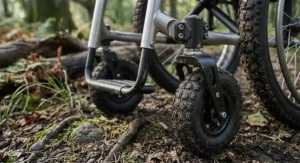
Forgetting the front castors. All terrain rear wheels make an enormous difference. But if your front castors are small, hard, and narrow — the type common on indoor chairs — they’ll still dig into soft ground and create resistance that undermines everything your new rear wheels accomplish. Larger, wider front castors (typically 150–200 mm) complete the all-terrain setup properly. The NHS wheelchair services framework advises considering the chair as a complete system for outdoor use — and the castors are part of that system.
Tyre Width and Knobby Tread: What the Specs Actually Mean
The wheelchair accessories market is genuinely prone to describing tyre features without explaining what they mean in practice. Let me do that properly.
25 mm tyre width (24×1 inch): Standard sport wheelchair dimension. Fast and efficient on smooth surfaces. Sinks readily into grass and loose ground. Best for: tarmac paths, smooth gravel, indoor use.
35–40 mm tyre width (24×1 3/8 inch): The most common size on standard UK manual wheelchairs. A meaningful improvement on grass compared to narrow tyres, though still limited on very soft ground. Best for: light outdoor use, mixed surfaces, general everyday use.
47–50 mm tyre width (24×1.75 to 24×2 inch): The mountain-bike territory. These distribute weight over a much larger ground contact patch, which is what prevents sinking into soft surfaces. Knobby tread at this width provides excellent traction on grass, gravel, and light mud. Best for: genuine all-terrain outdoor use.
Spoke tension and count: More spokes mean more lateral rigidity — important when navigating cambers and uneven surfaces that push sideways forces through the wheel. Stainless steel spokes resist corrosion in damp outdoor conditions. For serious all-terrain use, 36 spokes in stainless steel is the configuration to look for. For lighter outdoor use, the 24–32 spoke aluminium configurations common in replacement wheel sets are adequate.
Tread pattern matters differently in British conditions than in drier climates. In wet grass, a deep knobby tread with widely spaced lugs doesn’t just provide grip — it also self-clears mud between lugs, preventing the mud buildup that can make even aggressively treaded tyres lose traction. This “self-cleaning” property is why mountain bike tyres — designed for exactly these conditions — perform so well as all-terrain wheelchair tyres.
FAQ: All Terrain Wheelchair Wheels UK
❓ Can I fit all terrain wheelchair wheels to my existing manual chair?
❓ Will wider all terrain tyres fit through standard UK doorways?
❓ Are all terrain wheelchair wheels VAT exempt in the UK?
❓ How often should I check tyre pressure on pneumatic all terrain wheelchair wheels?
❓ Can all terrain wheelchair wheels handle the Coastal Access paths in England?
Conclusion: The Right Wheels Open the Right Doors
Britain is, beneath its drizzly reputation, a remarkable place to explore. The Jurassic Coast. The Cairngorms. The Pembrokeshire paths. The National Trust estates with their sprawling grounds and carefully raked gravel. Every single one of these places becomes more accessible — genuinely, practically accessible — with the right set of all terrain wheelchair wheels underneath you. The difference between narrow smooth indoor tyres and wide pneumatic knobby treads isn’t a marginal performance upgrade. It’s the difference between watching outdoor Britain from a car park and actually being in it.
The seven options reviewed here cover the full realistic spectrum for UK buyers in 2026: from complete purpose-built all-terrain wheelchairs to budget replacement wheel sets that transform an existing chair. The MobiQuip All Terrain remains the standout complete package for active self-propellers. The Esteem Adventurer leads for attendant-pushed outdoor adventure. For replacement wheels alone, the 24-inch pneumatic sets offer the best outdoor traction; solid PU wheels deliver maintenance-free reliability for lighter use.
Whatever your budget or adventure scale, get outside. The terrain is more manageable than you think — with the right wheels.
✨ Don’t Miss These Exclusive Deals!
🔍 Ready to explore Britain on your terms? Click any highlighted product to check current pricing and availability on Amazon.co.uk. Prime members get free next-day delivery on eligible items — your next adventure is closer than you think!
Recommended for You
- Best Quick Release Wheelchair Wheels UK 2026: 7 Expert-Tested Picks
- 7 Best Removable Armrests Wheelchair Picks UK 2026
- Desk Length Armrests Wheelchair: 7 Best UK Picks in 2026
Disclaimer: This article contains affiliate links. As an Amazon Associate, I earn from qualifying purchases. If you purchase products through these links, we may earn a small commission at no additional cost to you.
✨ Found this helpful? Share it with your mates! 💬🤗
