
In This Article
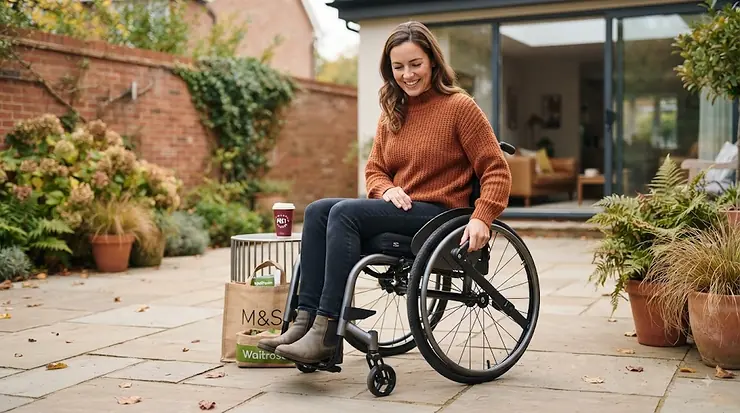
There’s a particular kind of frustration that comes from wrestling with a wheelchair brake using only one working hand — the lever slips, your knuckles catch the tyre, and by the time both wheels are locked you’ve already lost your balance twice. If that sounds familiar, you’re not alone, and you’re certainly not doing anything wrong. Standard wheelchair brakes were largely designed decades ago with the assumption that everyone operating them has full bilateral hand strength and reach. For anyone living with hemiplegia, arthritis, a single amputation, or simply reduced grip on one side, that assumption falls apart fast.

A wheelchair wheel lock for one-handed use is any braking mechanism, lever extension, or hub-lock system engineered so a single functioning hand can secure both wheels reliably, without needing to lean across the chair or ask for help. Some solutions replace the brake entirely; others simply extend or reposition the existing lever so it’s reachable and easier to grip. This matters more than it might sound — an unlocked wheelchair on a slight camber, at a kerb, or during a transfer is a genuine fall risk, and independence in daily mobility is closely tied to confidence and wellbeing after stroke, injury, or progressive conditions.
This guide walks through seven real, currently available products, from budget replacement brakes to a purpose-built one-handed locking system, alongside the practical knowledge — fitting, maintenance, safety standards, and buyer psychology — that most product listings simply don’t cover. Every price mentioned is a range rather than an exact figure, since Amazon pricing shifts constantly; always check the current price on the listing itself before buying.
Quick Comparison Table
| Product | Type | Price Range | Best For |
|---|---|---|---|
| Medline Wheelchair Wheel Locks | Replacement brake pair | Budget (under £40) | Straightforward brake swap |
| DaisyInner Heavy Duty Wheel Locks | Replacement brake pair | Budget (under £35) | Tight-budget replacements |
| ENCAREFOR Brake Handle Extensions | Lever extension pair | Budget-mid (£15-£30) | Extending reach without a full rebuild |
| Drive Medical Brake Handle Extension | Single chrome extension | Mid-range (£15-£25) | Trusted-brand single-side fix |
| WATIIFUFU Brake Grip Covers | Ergonomic grip cover | Budget (under £15) | Adding grip without changing geometry |
| PUSH LOX One-Handed Locking System | Purpose-built hub lock | Premium (£150-£300+) | Genuine one-handed engineering |
| Master Lock Python Cable Lock | Security cable lock | Mid-range (£20-£45) | Anti-theft, not braking |
Looking at the spread above, the split is really between accessories that adapt an existing brake and a system built from the ground up for single-hand use. The Medline Wheelchair Wheel Locks and DaisyInner Heavy Duty Wheel Locks are the cheapest way in because they’re direct replacements for a worn-out standard brake, not a redesign — useful if your current lever is simply broken rather than genuinely hard to reach. At the other end, the PUSH LOX One-Handed Locking System costs several times more because it’s solving the ergonomic problem itself, not just the mechanical one. The Master Lock Python Cable Lock sits apart from the rest of this table entirely — it’s a theft-deterrent, not a parking brake, and shouldn’t be mistaken for one.
💬 Just one click — help others make better buying decisions too!😊
Top 7 Wheelchair Wheel Locks for One-Handed Use: Expert Analysis
1. Medline Wheelchair Wheel Locks — one-handed operation on a like-for-like budget swap
The Medline Wheelchair Wheel Locks are marketed specifically as a one-handed operation replacement brake, and that’s the headline reason they open this list. They’re a like-for-like universal brake pair intended for side-mount, bolt-on installation onto 7/8-inch tubing, which covers the vast majority of Medline, Drive, E&J and ALCO-style manual wheelchairs on the market. In practice, this means you’re not redesigning your chair’s braking geometry — you’re swapping a stiff or corroded original brake for one built with a smoother, lighter throw. Based on the spec comparison with generic own-brand replacement brakes, the value here is in fitment accuracy: side-mount bolt-on brakes that don’t match your tubing diameter exactly tend to sit loose and lose grip on the wheel rim within weeks, which is a common complaint across budget brake listings generally. What most buyers overlook about a “one pair” listing like this is that both sides are genuinely designed to mirror each other, giving even pressure when parking on a slope. Reviewer feedback on comparable Medline mobility accessories consistently highlights straightforward installation and a snug fit on 7/8-inch frames, though buyers with 1-inch tubing frames should double-check compatibility before ordering, since a mismatched size is the single most common return reason in this category.
Pros:
- ✅ Purpose-labelled for one-handed operation
- ✅ Fits most 7/8″ tubing manual wheelchairs
- ✅ Balanced pair for even braking pressure
Cons:
- ❌ Not compatible with 1″ tubing without an adapter
- ❌ No lever extension for limited reach
At around £30-£40 for the pair, this is one of the most cost-effective ways to test whether a smoother-throw brake alone solves your one-handed locking problem before spending on a premium system.

2. DaisyInner Heavy Duty Wheelchair Wheel Locks — best budget pick for basic side-mount replacement
The DaisyInner Heavy Duty Wheelchair Wheel Locks are a two-piece bolt-on brake assembly built for 7/8-inch tubing, and they sit firmly in the value tier of this list. The heavy-duty framing means the lever arm resists the flexing and bending that cheaper stamped-metal brakes suffer after a year or two of daily locking and unlocking. Here’s what to weigh: this isn’t an ergonomic redesign, so if your one-handed difficulty comes from grip strength rather than a worn-out brake, this alone won’t fix the underlying access problem — you’d likely want to pair it with a grip cover or extension from further down this list. Where it does genuinely help is reliability; a brake that engages positively every time reduces the number of attempts needed, which matters when each attempt costs you energy or balance. Aggregated feedback on comparable Chinese-manufactured universal wheelchair brake assemblies tends to flag two recurring themes: praise for the price-to-durability ratio, and occasional complaints about instructions being thin, so budget a few extra minutes for trial-fitting.
Pros:
- ✅ Heavy-duty construction resists bending over time
- ✅ Universal fit for 7/8″ tubing frames
- ✅ Genuinely low entry price point
Cons:
- ❌ Sparse fitting instructions in the box
- ❌ No ergonomic lever redesign included
Priced under £35 for the pair, this is the option to reach for if your main problem is a tired, loose original brake rather than the reach or grip itself.
3. ENCAREFOR Wheelchair Brake Handle Extensions — extends reach without replacing the whole brake
The ENCAREFOR Wheelchair Brake Handle Extensions take a completely different approach: rather than replacing the brake mechanism, they slide over your existing lever knob and add roughly 8.2 inches of extra handle length. That extra leverage is the entire point — a longer lever multiplies the force your hand applies at the pivot, which is exactly what someone with reduced grip strength on their working hand needs. On paper this means less finger and wrist strain per lock-unlock cycle, since you’re gripping further from the fulcrum. The trade-off, and it’s a real one, is width: these extensions can add several inches to your wheelchair’s overall footprint, which matters if you’re navigating narrow doorways, lifts, or public transport ramps regularly. Based on the spec comparison with rival extension kits, the 8.2-inch length sits in the middle of the range — long enough to meaningfully help without becoming unwieldy. User reports on similar handle-extension accessories commonly note that installation takes under ten minutes with no tools required, since they simply slide over the original rubber knob.
Pros:
- ✅ No-tool installation over existing brake knob
- ✅ Meaningful leverage boost for weak grip
- ✅ Sold as a matched pair for both sides
Cons:
- ❌ Adds extra width to the folded chair
- ❌ Doesn’t help if the brake mechanism itself is worn
In the £15-£30 range, this is a smart first purchase for anyone whose chair brake works fine mechanically but is simply too short or too stiff to reach comfortably with one hand.
4. Drive Medical Wheelchair Brake Handle Extension, Chrome — trusted-brand single-side reach fix
Drive Medical is one of the most recognised names in UK mobility equipment — Drive DeVilbiss Healthcare wheelchairs are a mainstay of NHS and private care settings — and this chrome brake handle extension carries that manufacturing pedigree into a single-unit accessory. It’s designed to slide directly over the wheel lock handle, adding roughly 8 inches of reach, and is specifically listed as compatible with Cirrus IV, Cougar, Blue Streak and Sentra EC-series chairs, though the sliding mechanism works with most standard lock tips regardless of model. What most buyers overlook about buying from an established brand name in this niche is parts consistency: because Drive Medical manufactures both wheelchairs and accessories, tolerances tend to match more precisely than third-party universal extensions, reducing the wobble that causes some cheaper extensions to slip off mid-use. Here’s what to weigh against the ENCAREFOR pair above: this is sold as a single unit, so if you need both sides extended you’ll need to buy two, which changes the value calculation. Reviewer sentiment on Drive Medical’s wider accessory range consistently praises build consistency over multiple years of daily use, a common theme for established medical-equipment brands versus newer unbranded competitors.
Pros:
- ✅ Backed by an established UK mobility brand
- ✅ Simple push-forward, pull-back operation
- ✅ Chrome finish resists corrosion indoors and out
Cons:
- ❌ Sold as a single unit, not a pair
- ❌ Slightly pricier per side than generic alternatives
At around £15-£25 per unit, doubling up for both wheels puts this roughly on par with a full extension pair from a less established brand — the premium buys brand-matched tolerances.
5. WATIIFUFU Wheelchair Brake Extension Handles — ergonomic grip covers for extra purchase
Rather than lengthening the lever, the WATIIFUFU Wheelchair Brake Extension Handles are compact rubber grip covers that slide over the existing brake handle to improve traction and comfort without altering your chair’s dimensions at all. At roughly 2.55 x 0.78 x 0.19 inches and under an ounce each, they’re genuinely unobtrusive — a meaningful advantage over the wider extension kits above if you’re regularly threading through narrow spaces. The honest analytical case for this product is narrower than the others on this list: it solves a grip and comfort problem, not a reach or leverage problem, so if your one-handed difficulty is primarily about the lever being too short or too stiff, a grip cover alone won’t be enough. Where it earns its place is as a low-cost first step or as a companion product to an extension — many buyers report using grip covers on top of an extended lever for the best of both improvements. The resilient rubber material is designed for tool-free installation, and durability reports on comparable silicone-rubber grip accessories generally describe a gradual, predictable wear pattern rather than sudden failure, which is reassuring for a component you’ll be relying on daily.
Pros:
- ✅ Adds zero extra width to the wheelchair
- ✅ Tool-free installation in under a minute
- ✅ Genuinely low cost for the comfort gained
Cons:
- ❌ Doesn’t address reach or leverage limitations
- ❌ Best paired with, not substituted for, an extension
Typically priced under £15 for a pair, this is the cheapest single item on this list and a sensible add-on rather than a standalone fix for significant hand weakness.
6. PUSH LOX One-Handed Wheelchair Locking System — purpose-engineered lever and hub lock design
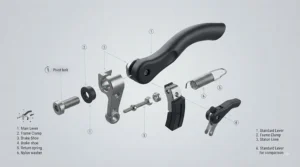
The PUSH LOX One-Handed Wheelchair Locking System is the outlier on this list, and deliberately so: it was developed by a long-term wheelchair user specifically to solve the two-handed operation problem that every accessory above is essentially working around. Rather than extending or covering a standard brake, PUSH LOX pairs a patented lever design with a hub lock built into the wheel itself, engaging directly at the axle rather than pinching the tyre. What this means in practice is a fundamentally different mechanism — hub locks don’t rely on friction against a tyre that can be wet, worn, or under-inflated, which is a genuine weak point of every friction-brake product further up this page. Based on the spec comparison, this is the only product here engineered from the ground up around single-hand use rather than adapted to accommodate it, and that shows in the fitment options: it’s available across multiple lever mount sizes (0.75″, 1″, 1.125″, 1.25″) and a wide range of wheel types, meaning it needs to be matched carefully to your specific chair and wheel rather than treated as a universal bolt-on. The system’s own positioning — aimed at users who find heavy, bulky hub locks a genuine daily obstacle — reflects real design experience with the limitations of generic brakes rather than marketing language borrowed from elsewhere.
Pros:
- ✅ Engages at the hub, not tyre friction
- ✅ Designed from scratch for one-handed use
- ✅ Multiple lever and wheel-type fitment options
Cons:
- ❌ Significant price jump over accessory-based fixes
- ❌ Requires accurate measurement before ordering
Running into the £150-£300+ range depending on configuration, this is a considered investment rather than an impulse buy, but for genuinely limited one-handed function it’s the product on this list built to solve the problem outright rather than compensate for it.
7. Master Lock Python Adjustable Cable Lock — security, not braking, for one-handed peace of mind
It’s worth being upfront: the Master Lock Python Adjustable Cable Lock does not lock your wheels to stop the chair rolling — it’s a security cable lock, and it belongs on this list because “wheelchair security cable lock” is a genuinely common companion search for anyone managing a wheelchair with limited hand function, particularly when the chair has to be left unattended at a café, workplace, or hospital corridor. This Master Lock model uses a patented adjustable locking mechanism that holds the braided steel cable tight at any position from roughly 30cm up to 1.8m, so a single motion cinches it around a wheel spoke and a fixed point like a railing, with a keyed pin-tumbler lock rather than a fiddly combination dial. That last detail matters for one-handed use specifically: turning a key with one hand is dramatically easier than spinning a multi-digit combination wheel while holding cable slack with the other. The vinyl-coated braided steel resists casual bolt-cutter attempts and weathers outdoor use without rusting, though — and this is worth being honest about — no cable lock in this price bracket will stop a determined thief with proper cutting tools; it’s a deterrent against opportunistic theft, not a vault.
Pros:
- ✅ One-motion keyed lock, easy with one hand
- ✅ Adjustable length suits varied parking situations
- ✅ Weather-resistant vinyl-coated steel cable
Cons:
- ❌ Deters opportunists, not determined theft
- ❌ Adds a step beyond just braking the chair
At around £20-£45 depending on cable length, this is a sensible add-on purchase alongside any brake solution above, not a substitute for one.
Top 7 Products: Specs & Value Comparison
| Product | Mechanism | Fitment | Price Range | Best For |
|---|---|---|---|---|
| Medline Wheelchair Wheel Locks | Friction brake pair | 7/8″ tubing | £30-£40 | Direct brake replacement |
| DaisyInner Heavy Duty Wheel Locks | Friction brake pair | 7/8″ tubing | Under £35 | Tightest budget |
| ENCAREFOR Brake Handle Extensions | Lever extension | Slides over existing knob | £15-£30 | Extra leverage, both sides |
| Drive Medical Brake Handle Extension | Lever extension | Slides over existing knob | £15-£25 (single) | Brand-matched reliability |
| WATIIFUFU Brake Grip Covers | Grip cover | Slides over existing handle | Under £15 | Comfort without extra width |
| PUSH LOX One-Handed Locking System | Hub lock + lever | Custom-matched | £150-£300+ | Genuine ground-up solution |
| Master Lock Python Cable Lock | Security cable | Universal | £20-£45 | Anti-theft, not braking |
The clearest pattern in this table is that price roughly tracks how much of the ergonomic problem each product actually solves rather than works around. The three extension and grip-cover products cluster under £30 because they’re modifying an existing brake rather than re-engineering it, while the PUSH LOX One-Handed Locking System costs several times more precisely because it replaces the friction mechanism entirely with a hub lock designed around single-hand operation from day one. If your budget only stretches to an accessory-level fix, pairing the ENCAREFOR Brake Handle Extensions with the WATIIFUFU Brake Grip Covers gets you both leverage and grip improvements for well under the cost of the premium system.
✨ Don’t Miss These Exclusive Deals!
🔍 Take your search for the right wheelchair wheel lock for one-handed use further — click through on any product above to check current pricing, size options and availability before they change. Prices fluctuate, so it pays to compare at the point of purchase.
What Is a Wheelchair Wheel Lock for One-Handed Use?
A wheelchair wheel lock for one-handed use is a braking mechanism, lever extension, or hub-lock system engineered so a person with functional use of only one hand can secure both wheels of a manual wheelchair reliably and safely, without assistance or excessive reach.
Unlike standard wheelchair brakes, which assume symmetrical hand strength on both sides, these solutions either extend the lever’s reach, redesign the grip surface, or relocate the locking mechanism to the hub so a single motion engages the whole system.
Practical Usage Guide: Fitting, Adjusting and Maintaining Your One-Handed Wheel Lock
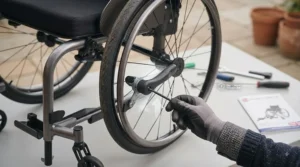
Getting the fit right matters more than the product choice itself in many cases. Start by measuring your existing tubing diameter — most manual wheelchairs use 7/8-inch tubing, but Sentra EC, bariatric and some heavy-duty transport chairs use 1-inch, and ordering the wrong size is the single most common reason these accessories get returned. When fitting a friction brake like the Medline Wheelchair Wheel Locks or DaisyInner Heavy Duty Wheel Locks, position the brake so it engages against the tyre roughly a third of the way around from the axle, with even pressure on both sides so the chair doesn’t drift when parked on a slope.
For lever extensions such as the ENCAREFOR Brake Handle Extensions or Drive Medical Brake Handle Extension, slide the extension fully onto the existing knob before testing engagement — a loose fit is the leading cause of extensions slipping off during use. In your first 30 days, check the fixing bolts weekly, since vibration from daily use tends to loosen hardware faster than most owners expect, particularly on uneven pavements. A quick monthly wipe-down with a dry cloth, plus an occasional drop of light machine oil on the pivot point, keeps friction brakes engaging smoothly rather than stiffening up over winter. The PUSH LOX One-Handed Locking System, by contrast, needs professional fitting to the hub the first time, but requires far less ongoing maintenance since there’s no tyre-friction surface to wear down.
Real-World Scenarios: Matching the Right Lock to Your Situation
Consider Margaret, 68, six months post-stroke with right-side hemiparesis, who self-propels short distances at home and relies on her left hand for everything. Her existing brakes work mechanically but sit too close to the wheel for her to reach without leaning dangerously far right. For her, a pair of ENCAREFOR Brake Handle Extensions paired with WATIIFUFU Brake Grip Covers solves the reach and grip problem for under £45 combined, without needing a full brake replacement.
Now consider David, 34, a below-elbow amputee on his dominant side who’s an active daily wheelchair user commuting across an uneven city pavement network. Friction brakes that need frequent re-tensioning are a genuine daily hassle for him, and the tyre-contact mechanism occasionally slips on wet days. The PUSH LOX One-Handed Locking System‘s hub-based engagement removes that variability entirely, and the higher upfront cost is offset by years of more consistent daily use.
Finally, picture Priya, 52, with rheumatoid arthritis affecting grip strength unevenly across both hands, who mostly uses her wheelchair for longer outings and needs to park it safely outside shops. For her, the Medline Wheelchair Wheel Locks‘ smoother factory throw combined with a Master Lock Python Adjustable Cable Lock for security when she’s inside covers both the braking and theft-prevention side of her needs.
Problem → Solution: Common One-Handed Braking Issues
Problem: the lever is mechanically fine but just out of comfortable reach. Solution: a handle extension like the ENCAREFOR Brake Handle Extensions solves pure reach problems without touching the brake mechanism itself.
Problem: grip fatigue after repeated locking and unlocking through the day. Solution: layer a WATIIFUFU Brake Grip Cover onto your existing or extended lever for softer, higher-friction purchase.
Problem: the chair rolls slightly even when “locked.” Solution: check tyre pressure first, since under-inflated tyres are the leading cause of friction-brake slippage, then consider whether a hub-based system like PUSH LOX would remove the friction variable entirely.
Problem: worrying about theft when the chair must be left unattended. Solution: a Master Lock Python Adjustable Cable Lock secures the chair to a fixed point independently of the parking brake.
Problem: the original brake is simply worn out and loose. Solution: a straightforward like-for-like swap with Medline or DaisyInner replacement brakes usually restores full function without any redesign needed.
How to Choose a Wheelchair Wheel Lock for One-Handed Use
- Identify the actual limitation first. Reach, grip strength, and mechanical wear are three different problems with three different solutions, and buying the wrong fix wastes money.
- Measure your tubing diameter before ordering anything. Most manual chairs use 7/8-inch tubing, but always confirm, since a mismatched fit is the top reason for returns in this category.
- Decide between adapting and replacing. Extensions and grip covers modify what you have; hub-lock systems like PUSH LOX replace the mechanism outright, at a higher cost.
- Weigh width against reach. Longer extensions give more leverage but add bulk to a folded chair, which matters if doorways or transport are tight.
- Factor in weather exposure. Friction brakes that rely on tyre contact can slip when wet; hub-based locks are less affected by rain.
- Consider theft-prone environments separately. A wheel lock secures the chair from rolling; a cable lock like the Master Lock Python secures it from walking off entirely.
- Budget for trial and error. Many users find the ideal setup is a low-cost combination — an extension plus a grip cover — rather than a single premium purchase.
Common Mistakes When Buying Wheelchair Wheel Locks
The most frequent mistake is ordering based on price alone without measuring tubing diameter first, which is why 7/8-inch versus 1-inch mismatches dominate return reasons across this whole category. A second common error is assuming a lever extension will fix a grip problem, when in reality extensions solve reach and leverage while grip covers solve comfort and traction — they’re complementary, not interchangeable. Buyers also frequently underestimate how much extra width an extension adds, only discovering the problem when the folded chair no longer fits through a previously manageable doorway. Finally, some buyers expect a security cable lock to double as a parking brake; it categorically doesn’t, and relying on one for the other creates a genuine safety gap.
Wheelchair Wheel Locks vs Traditional Two-Handed Brakes
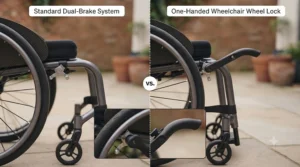
Traditional two-handed wheelchair brakes were the default design for decades, and they’re not inherently worse engineering — they’re simply built around an assumption of symmetrical hand function that doesn’t hold for a meaningful share of wheelchair users. The core difference comes down to force distribution: a standard lever requires roughly equal grip strength and precise finger positioning on both sides simultaneously, whereas one-handed solutions either extend the lever arm to multiply force from a single side, or relocate the mechanism to the hub so one motion engages the whole system. For someone with hemiplegia specifically, stroke and other neurological injuries can produce weakness or paralysis on either side of the body depending on which part of the nervous system is affected, which is why a genuinely tailored one-handed solution outperforms a “just try harder with your weaker side” approach both practically and in terms of confidence. The trade-off is usually cost and, for hub-based systems, professional fitting requirements that traditional bolt-on brakes don’t need.
| Factor | Traditional Two-Handed Brake | One-Handed Wheel Lock |
|---|---|---|
| Grip requirement | Equal strength both sides | Works from single functioning hand |
| Fitting complexity | Straightforward bolt-on | Ranges from simple to professional |
| Typical cost | Lowest | Varies widely by mechanism |
| Best For | Users with full bilateral hand function | Hemiplegia, single amputation, uneven grip strength |
The table makes clear that traditional brakes remain the simplest and cheapest option when both hands function normally, but the moment grip is asymmetric, that simplicity becomes the actual barrier. Investing in a one-handed-specific solution, even at a higher cost like the PUSH LOX One-Handed Locking System, tends to pay for itself in reduced daily frustration and fewer near-miss rolling incidents.
Ergonomic Lock Levers for Hemiplegia Mobility Aids
Hemiplegia mobility aids exist precisely because standard equipment design tends to assume symmetrical function, and wheel locks are a textbook example. An ergonomic lock lever, in this context, means one shaped and positioned to be operated by a single hand without requiring the user to lean their torso across the chair — a movement that carries real fall risk for anyone with reduced trunk control on their affected side. The Stroke Association notes that the right mobility equipment can help people live more independently and improve both physical and mental wellbeing after a stroke, and a properly fitted one-handed brake is a small but genuinely meaningful part of that picture. Occupational therapists commonly recommend combining an ergonomic lever with a wider grip surface, which is exactly the logic behind pairing an extension product with a grip cover rather than buying either alone. If you’re unsure which configuration suits your specific hand function, a physiotherapist or occupational therapist assessment is worth arranging before spending on premium equipment, since they can identify whether your primary limitation is reach, strength, or coordination.
Wheelchair Security Cable Locks: Extra Protection Beyond Braking
A wheel lock stops your chair rolling; a wheelchair security cable lock stops someone else taking it while you’re briefly away from it — two entirely different jobs that are easy to conflate when you’re focused on solving the one-handed access problem. For anyone managing a wheelchair with limited hand function, a cable lock’s usability matters just as much as its security rating, because fumbling with a stiff combination lock defeats the purpose. The Master Lock Python Adjustable Cable Lock covered earlier is a solid example of single-hand-friendly design: one motion cinches the cable, and a single key turn locks it, versus the multi-step process of spinning a combination dial while holding cable slack. When choosing any cable lock for this purpose, prioritise a keyed mechanism over a combination dial if one-handed operation is your main constraint, and look for braided steel construction over simple woven cable, since braided cores resist casual bolt-cutter attempts noticeably better.
Long-Term Cost & Maintenance
Thinking in total cost of ownership rather than sticker price changes the calculation meaningfully. A £20 friction brake pair that needs replacing every 18 months due to tyre-contact wear can cost more over five years than a single £250 hub-based system that needs almost no consumable maintenance. Extensions and grip covers sit in between — genuinely low-cost, but they inherit whatever lifespan the underlying original brake has, so if that brake is already worn, you’re layering a fix onto a failing base rather than solving the root problem. Budgeting roughly £10-£15 a year for pivot lubricant, occasional bolt tightening, and periodic grip-cover replacement is realistic across most friction-based options, while hub-based systems like PUSH LOX shift that ongoing cost toward an occasional professional check-up instead.
Safety, Regulations and VAT Relief for UK Buyers
Wheelchairs and many disability-specific accessories qualify for VAT relief in the UK, meaning eligible buyers pay no VAT on equipment designed or adapted specifically for their own personal use. According to GOV.UK guidance on financial help if you’re disabled, you do not have to pay VAT on certain goods and services if they’re just for your own use and you’re disabled or have a long-term illness, which can meaningfully reduce the cost of a premium option like a hub-locking system. Eligibility generally requires a simple declaration rather than formal medical proof, though it’s worth checking the specific retailer’s process, since some accessories marketed as general-purpose (rather than disability-specific) may not qualify. From a safety standpoint, always test any new brake or extension on a level, enclosed space before relying on it outdoors, and never treat a security cable lock as a substitute for a functioning parking brake — the two serve completely different safety purposes and neither replaces the other.

Frequently Asked Questions
❓ Can I fit a wheelchair wheel lock for one-handed use myself?
❓ Will a brake extension fit any wheelchair?
❓ Is a wheelchair security cable lock the same as a wheel lock?
❓ Do wheelchair wheel locks qualify for VAT relief in the UK?
❓ What's the difference between a lever extension and a hub lock?
Conclusion
Locking a wheelchair with one functioning hand shouldn’t feel like a daily obstacle course, and as this guide has hopefully shown, the right fix genuinely depends on what’s actually limiting you — reach, grip, mechanical wear, or a combination of all three. Budget accessories like the ENCAREFOR Brake Handle Extensions and WATIIFUFU Brake Grip Covers solve real problems for well under £50 combined, while the PUSH LOX One-Handed Locking System represents a genuine engineering solution for anyone whose daily reliance on their chair justifies the investment. Don’t overlook security either — pairing any braking solution with a Master Lock Python Adjustable Cable Lock covers the gap that parking brakes were never designed to address. Whichever combination suits your situation, measure first, test on level ground, and don’t hesitate to involve an occupational therapist if you’re unsure which limitation is really driving the difficulty.
✨ Ready to Regain Confident, Independent Control?
🔍 Check current pricing and availability on any of the seven products above, and take the first step toward locking your wheelchair safely and independently, one hand and all.
Recommended for You
- Buy Wheelchair Extension Brakes 2026: 7 Best Picks Under £30
- Wheelchair Security Cable for Travel: 7 Best Picks (2026)
- Wheelchair Wheel Locks vs Security Cables: 7 Picks (2026)
Disclaimer: This article contains affiliate links. As an Amazon Associate, I earn from qualifying purchases. If you purchase products through these links, we may earn a small commission at no additional cost to you.
✨ Found this helpful? Share it with your friends! 💬🤗
