
In This Article
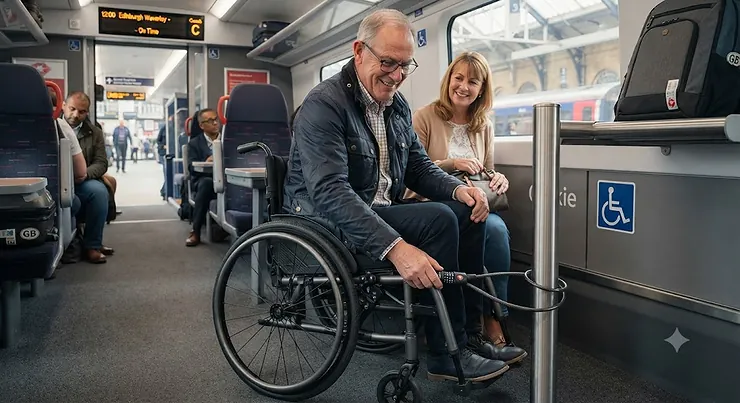
Leave a wheelchair or mobility scooter unattended for two minutes outside a café, a hotel lobby, or a train station luggage rack, and you’ve handed an opportunistic thief a very easy target. A wheelchair security cable for travel is a portable locking cable, usually braided steel wrapped in a protective sleeve, that tethers a wheelchair or scooter to a fixed point using a key or combination mechanism so it can’t simply be wheeled away. It’s the same principle as a bike lock, adapted for a different (and often more essential) set of wheels.
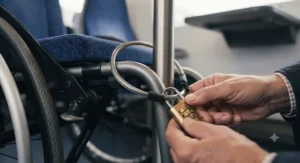
For anyone who relies on a wheelchair or mobility scooter, that essential-ness is exactly the problem. A stolen bike is an inconvenience. A stolen wheelchair can strand someone, cancel a day out, or turn a straightforward café stop into a genuine crisis. And yet most wheelchair users have never been told which locks are actually worth carrying, which ones are theatre, and which ones will rust solid after one wet Bank Holiday weekend in Blackpool.
This guide cuts through the marketing fluff. We’ve researched seven real, currently available cable locks — pulling from established brands like ABUS, Master Lock, Squire and Kryptonite — and broken down what each one is genuinely good at, who should buy it, and where it falls short. We’ll also cover outdoor storage locking, what happens to your mobility aid during airport assistance, the theft mistakes travellers make without realising, and how a decent portable locking cable pays for itself many times over. Prices below are given as ranges rather than exact figures, since retailer pricing shifts constantly — always check the current price before buying.
Quick Comparison Table
| Product | Type | Best For | Price Range |
|---|---|---|---|
| ABUS Combiflex 2503 | Retractable combo cable | Ultra-light daily carry | £20-£30 |
| Squire Mako Plus 25/1200 | Keyed cable + bracket | Overnight/high-risk storage | £30-£45 |
| Master Lock Python 8418D | Adjustable keyed cable | All-round versatility | £20-£30 |
| ABUS Cobra 12 Loop Cable | Coiled loop cable | Pairing with your own padlock | £15-£25 |
| Kryptonite KryptoFlex 1018 Combo | Combination cable | No-key convenience | £15-£25 |
| Squire ZR12/1800 | Keyed cable, long reach | Budget-conscious buyers | £10-£20 |
| Master Lock 4688D TSA | TSA combination cable | Flights and airport checks | £10-£20 |
A glance at that table tells you most of what you need to know about trade-offs. The ABUS Combiflex 2503 and Squire Mako Plus 25/1200 sit at opposite ends of the same spectrum — one prioritises weight, the other prioritises brute resistance — while the Master Lock 4688D TSA is really the only one built with airport screening specifically in mind. If you only ever lock up outside your local shop, the cheaper keyed options do the job fine; if you’re leaving a scooter outside a hotel overnight in an unfamiliar city, you want the heavier gauge cable further up the list.
💬 Just one click — help others make better buying decisions too! 😊
Top 7 Wheelchair Security Cables for Travel: Expert Analysis
1. ABUS Combiflex 2503 — lightest option built for pushchairs and luggage too
The standout here is versatility: ABUS designed the Combiflex range specifically for skis, helmets, pushchairs and luggage, which makes it one of the few cable locks on the market genuinely engineered with mobility and travel equipment in mind rather than repurposed from cycling. The self-retracting cable measures around 65-85cm depending on the variant, with an individually settable combination code, so there’s no key to lose at airport security.
In practice, that retracting mechanism means the cable never dangles loose or tangles in wheelchair spokes, which matters more than it sounds — a loose cable near castors is a tripping and jamming hazard nobody needs. The trade-off is thickness: this is a deterrent lock, not a vault. Reviewers consistently describe it as ideal for quick stops (a café, a shop doorway, a train vestibule) rather than leaving a scooter unattended overnight in a city centre.
Aggregated buyer feedback highlights the compact housing and dark-touch combination dials as genuinely useful in low light, with some noting the thin cable wouldn’t stop a determined thief with bolt croppers.
Pros:
- ✅ Self-retracting design stays tidy near wheels
- ✅ Combination lock — nothing to lose at security
- ✅ Purpose-built for mobility and travel gear
Cons:
- ❌ Thin cable offers deterrent-level security only
- ❌ Short reach limits which fixed points you can use
At around £20-£30, this is solid value as a everyday deterrent rather than a fortress — pick it up if your risk is opportunistic theft on quick stops, not long unattended periods.
2. Squire Mako Plus 25/1200 — Sold Secure tested for genuinely high-risk storage
The standout feature is the Sold Secure rating: this is one of the few cable-style locks that’s been independently tested against real attack tools rather than just marketed as “heavy duty.” At 25mm cable diameter and a Squire security rating around 7 out of 10, it sits close to the top of what a flexible cable lock can offer.
That thickness translates directly into resistance against bolt croppers and casual cutting attempts, which matters if a wheelchair or scooter is going to be left outside overnight, in a car park, or in an area with higher reported theft. The supplied bracket also lets you mount it semi-permanently at home, doubling as a wheelchair lock for outdoor storage rather than only a travel accessory. Based on the spec comparison with lighter cables further down this list, the extra weight is the price you pay for that resistance.
Reviewers of the Mako range consistently note the rubberised coating holds up well against scratching and corrosion, though several mention the thickness makes it awkward to loop through narrower wheelchair frame tubing.
Pros:
- ✅ Independently tested Sold Secure resistance
- ✅ Doubles as home and travel security
- ✅ Weatherproof coating for long-term outdoor use
Cons:
- ❌ Noticeably heavier than slimline alternatives
- ❌ Bulk can be awkward on narrower wheelchair frames
Expect to pay in the £30-£45 range — genuinely worth it if your wheelchair or scooter spends real time unattended outdoors, less essential if you’re only nipping into a shop.
3. Master Lock Python 8418D Adjustable Cable Lock — one cable, almost any anchor point
The Python’s headline trick is its patented adjustable locking mechanism, which cinches the cable tight at any length between roughly 30cm and 1.8m rather than forcing you to loop excess cable around itself. That single feature is what most buyers overlook about this model — it’s not just about length, it’s about eliminating slack, and slack is exactly what a thief exploits to fit cutting tools underneath a cable.
At 8mm braided steel with a vinyl coating, this sits comfortably in the mid-range for cut resistance: tougher than the featherweight combo locks, less armoured than the Squire Mako Plus. What most buyers appreciate in practice is the sheer flexibility of anchor points it opens up — a railing, a bike rack, a lamppost, a hotel luggage rack — because the cable tightens to whatever gap is available rather than needing a specific loop size.
Aggregated review sentiment is strongly positive on the locking mechanism’s reliability, with a recurring theme that the keyed cylinder resists picking better than expected for the price point; a smaller number of reviewers note the integrated Velcro strap for storing excess cable wears out faster than the lock itself.
Pros:
- ✅ Adjusts to almost any anchor point without slack
- ✅ Pick-resistant pin tumbler cylinder
- ✅ Backed by a limited lifetime guarantee
Cons:
- ❌ Mid-range cable thickness, not top-tier cut resistance
- ❌ Velcro cable-tidy strap wears with heavy use
Typically priced in the £20-£30 range, this is the sensible all-rounder pick if you want one cable that adapts to wherever you end up parking.
4. ABUS Cobra 12 Loop Cable — a serious coil built to pair with your own padlock
Unlike the other entries here, the Cobra 12 doesn’t come with an integrated lock at all — its standout feature is the double-looped end design, which lets you thread one end through the other around a wheelchair frame and a fixed point, then secure it with whichever padlock you already trust. At 12mm diameter and roughly 1.8m long, it’s noticeably thicker than most travel-oriented cables.
What that means in practice is flexibility of a different kind: you’re not locked into one manufacturer’s lock quality, and you can upgrade the padlock independently as your security needs change. The synthetic coating over the steel core protects wheelchair paintwork from scratching, something reviewers specifically call out as a relief compared with bare-metal cables that mark up frames within weeks.
Real-world feedback is generally favourable on the coil’s flexibility and coating durability, though a recurring complaint is that buyers need to already own — or separately buy — a decent padlock, which adds to the total outlay Amazon’s product listing doesn’t make obvious.
Pros:
- ✅ Thick 12mm coil resists casual cutting attempts
- ✅ Coating protects wheelchair frame paintwork
- ✅ Works with any padlock you already own
Cons:
- ❌ No integrated lock — extra cost and hassle
- ❌ Coiled shape takes up more bag space than flat cables
At around £15-£25 for the cable alone, this only makes sense if you’re happy sourcing a quality padlock separately; otherwise the total cost creeps close to an all-in-one option.
5. Kryptonite KryptoFlex 1018 Combo — set-it-once convenience for daily use
The standout advantage is the combination mechanism: no key to fumble for with limited dexterity, no key to lose in a coat pocket, just a reset-once 4-digit code you can set and forget. For anyone whose grip strength or fine motor control makes small keys frustrating, that’s a genuinely practical difference, not a gimmick.
Specification-wise, the KryptoFlex sits in familiar mid-range territory — braided steel core, vinyl coating, roughly 90-120cm depending on the exact model — which the spec sheet won’t tell you translates to “fine for quick stops, not for leaving a scooter outside a train station all afternoon.” Reviewers who use it as a secondary lock alongside something heavier tend to rate it highly for exactly that supporting role rather than as sole protection.
Aggregated customer sentiment consistently praises the ease of resetting the combination and the reversible dial mechanism, while a smaller but repeated complaint concerns the dials sticking slightly in cold or wet weather, which UK buyers should weigh given our climate.
Pros:
- ✅ No key required — set your own combination
- ✅ Reversible dial design speeds up locking
- ✅ Genuinely useful for users with limited grip strength
Cons:
- ❌ Combination dials can stick in cold, damp weather
- ❌ Cable thickness is deterrent-level, not maximum security
Priced roughly £15-£25, this earns its place for accessibility reasons as much as raw security — a strong pick if a keyed lock is genuinely impractical for you day to day.
6. Squire ZR12/1800 — the budget option that doesn’t skimp on reach
The standout feature is length for money: at 1.8m with a 12mm cable, the ZR12/1800 gives you considerably more reach than most locks at a similar price, which matters when the nearest secure anchor point isn’t right next to where you’d naturally park. Squire rates this model at security level 4 — respectable for a keyed budget cable, though well below the Mako Plus further up this list.
What most buyers overlook when comparing on price alone is that reach is itself a security feature: a cable that’s too short forces compromises, like looping around just one wheel instead of the whole frame, which a thief can exploit far more easily. The keyed cylinder here is straightforward rather than sophisticated, but it does the job for low-to-medium risk situations.
Reviewers consistently describe it as reliable value, with the main recurring criticism being that the 12mm cable, while long, is thinner than ideal for anyone parking in genuinely high-theft areas for extended periods.
Pros:
- ✅ Generous 1.8m reach for the price
- ✅ Straightforward, reliable keyed mechanism
- ✅ Squire’s established UK brand reputation
Cons:
- ❌ Lower security rating than premium options
- ❌ Cable diameter offers deterrent rather than heavy resistance
At around £10-£20, this is the pragmatic budget pick — genuinely good for everyday, lower-risk use, less suited to overnight or high-crime-area storage.
7. Master Lock 4688D TSA Approved Combination Luggage Lock — built with airport screening in mind
The standout feature, and the reason it earns a place here despite modest cable strength, is TSA recognition: airport security in the UK, EU and US can open this lock with a master key during baggage or equipment checks without cutting it off, then re-lock it afterwards. For anyone flying with a folding wheelchair or mobility aid packed as checked luggage, that single feature avoids a genuinely common travel headache — arriving to find your lock cut and your case gaping open on the carousel.
The trade-off, and it’s an important one, is that this is a light-duty cable intended for luggage security and quick tethering, not for leaving a scooter locked to railings overnight in an unfamiliar city. Reviewers consistently frame it as a “peace of mind while in transit” product rather than a serious anti-theft device, and that’s an honest description worth taking at face value.
Aggregated feedback highlights the resettable 3-digit combination as simple to use even with reduced dexterity, with a recurring caveat that the thin cable is unsuitable as your only lock if you’re storing a mobility aid outdoors for any length of time.
Pros:
- ✅ TSA-recognised — avoids cut locks at security
- ✅ Simple resettable combination, no key needed
- ✅ Lightweight enough for daily carry in a bag
Cons:
- ❌ Thin cable, unsuitable as a standalone theft deterrent
- ❌ Best treated as a travel companion to a stronger lock
Usually found in the £10-£20 range, this is less a security product and more an airport-travel accessory — buy it alongside one of the sturdier cables above, not instead of one.
Top 7 at a Glance
| Product | Cable Thickness | Mechanism | Best For |
|---|---|---|---|
| ABUS Combiflex 2503 | Thin/retractable | Combination | Quick daily stops |
| Squire Mako Plus 25/1200 | 25mm | Key + bracket | Overnight/outdoor storage |
| Master Lock Python 8418D | 8mm, adjustable | Key | General all-round use |
| ABUS Cobra 12 Loop Cable | 12mm | Bring-your-own padlock | Custom lock upgrades |
| Kryptonite KryptoFlex 1018 Combo | Mid-range | Combination | Limited dexterity users |
| Squire ZR12/1800 | 12mm, long | Key | Budget everyday use |
| Master Lock 4688D TSA | Thin | TSA Combination | Flights and airport checks |
Read across this table and a pattern emerges: cable thickness and airport convenience pull in opposite directions, because the features that make screening painless — thin, flexible, quick-release cable — are the same features that limit resistance against a determined thief. The Squire Mako Plus 25/1200 and ABUS Cobra 12 Loop Cable sit furthest toward the security end, while the Master Lock 4688D TSA and ABUS Combiflex 2503 sit furthest toward the convenience end. Most travellers, honestly, end up needing one lock from each side of that table rather than a single do-everything cable.
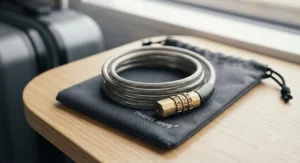
Practical Usage Guide: Setting Up Your Cable Lock Properly
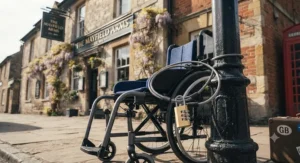
Buying the right lock is only half the job — how you actually use it determines whether it works. Start by choosing your anchor point deliberately: look for something fixed to the ground or a wall, thick enough that the cable can’t slip over the top, and positioned so the cable sits taut rather than pooling on the pavement where it’s easier to attack with tools. A bike rack, a purpose-fitted railing, or a substantial lamppost all work; a flimsy sign or a movable bollard does not.
Thread the cable through the wheelchair or scooter frame itself, not just a wheel — wheels detach or unbolt far more easily than most people assume, and a thief who only needs to remove a wheel to walk away with the rest of the frame hasn’t been stopped at all. If your lock has an adjustable mechanism like the Python 8418D, cinch it fully tight; slack cable is what lets bolt croppers get purchase.
In the first 30 days, get into the habit of checking the lock and cable for early wear each time you use it — a fraying coating or a stiff mechanism is far easier to deal with before a trip than mid-journey. Wipe the cable dry after wet weather and apply a light coating of silicone spray to keyed cylinders every few months to keep them turning smoothly; UK winters are hard on exposed mechanisms. The most common first-month mistake isn’t a security failure at all — it’s forgetting the combination or losing the key, so store a backup combination or spare key somewhere separate from the lock itself, such as a phone note or a trusted travelling companion.
Real-World Scenarios: Matching the Lock to the Trip
Consider Margaret, 68, who uses a lightweight folding wheelchair mainly for short high-street trips and the occasional café stop near her home in Leeds. Her risk is low-value, opportunistic theft during five-minute stops, so a compact combination cable like the ABUS Combiflex 2503 covers her needs without adding bulk to carry around all day.
Now consider James, a mobility scooter user planning a week-long coastal holiday with several nights spent parking his scooter outside a seaside guesthouse overnight. His risk profile is completely different — longer unattended periods, an unfamiliar area, and a genuinely more valuable target. For James, a Sold Secure-rated option like the Squire Mako Plus 25/1200 earns its extra weight and cost, ideally used alongside the guesthouse’s own storage facilities where available.
Finally, think about Priya, flying from Manchester to Lisbon with a folding manual wheelchair checked in as luggage. Her main concern isn’t theft in the traditional sense but making sure airport handling doesn’t damage her equipment or force a lock to be cut off during screening — for her, the Master Lock 4688D TSA is less about deterring thieves and more about making the airport assistance process smoother, paired with a note attached to the frame confirming it’s a mobility aid. Matching the lock to the actual trip, rather than buying whatever’s cheapest or most talked-about, is the single biggest factor in whether a cable lock earns its keep.
How to Choose a Wheelchair Security Cable for Travel
Picking the right lock comes down to weighing a handful of criteria against your actual travel pattern, not the longest feature list on the box.
- Assess your typical unattended time. Five minutes outside a shop needs far less cable thickness than an overnight stay outside a hotel.
- Match cable diameter to risk level. Thin combination cables under 8mm deter casual theft; anything above 10mm resists determined cutting attempts better.
- Consider your dexterity. Combination locks suit reduced grip strength; keyed locks resist picking slightly better on average.
- Check the mechanism’s weather rating. UK weather is hard on exposed cylinders — vinyl coating and rust-resistant bodies matter more here than in drier climates.
- Weigh weight against security. A lock left at home because it’s too heavy to carry protects nothing; the best lock is the one you’ll actually bring.
- Look for independent testing where it matters. A Sold Secure rating, explained in detail by the independent testing body itself, is a genuinely useful shortcut for comparing real-world resistance rather than marketing claims.
- Plan for airport travel separately. If you fly regularly, a lightweight TSA-recognised option avoids cut locks at security without replacing your main security cable.
Wheelchair Lock for Outdoor Storage: What Changes at Home
Locking a wheelchair or mobility scooter outside your own home for storage is a different problem from locking it up while travelling, even though the products overlap. At home, the anchor point is usually fixed and permanent — a wall-mounted bracket, a shed eyelet, or a ground anchor — which means you can justify a heavier, less portable lock than you’d ever want to carry around a city all day. The Squire Mako Plus 25/1200’s supplied bracket is a good example of a product built with exactly this dual purpose in mind.
Weatherproofing becomes the dominant concern for outdoor storage in a way it isn’t for brief travel stops. A cable left permanently exposed to rain, frost and UV needs a genuinely rust-resistant core and a coating that won’t crack and let moisture in over months, not just weeks. Reviewers of long-term outdoor locks consistently flag corrosion around the locking mechanism itself as the first failure point, well before the cable core gives way — so cleaning and lightly lubricating the mechanism seasonally matters more for home storage than for a lock that spends most of its life in a bag.
Finally, consider pairing a cable lock with a basic cover for the wheelchair or scooter itself. It won’t add security directly, but it reduces the temptation of a visible target and protects electronics and upholstery from the same weather that degrades the lock — a small addition that noticeably extends the working life of both.
Airport Mobility Assistance and Where Your Cable Lock Fits In
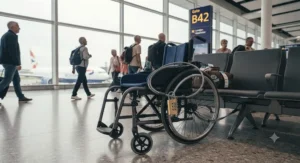
Passengers with a disability or reduced mobility are legally entitled to free assistance at UK airports, covering everything from check-in through to boarding and, on arrival, from disembarkation to the exit point, as the Civil Aviation Authority explains in its passenger guidance. In practice, that means your own wheelchair or mobility aid can often be used right up to the departure gate, only being handed over for storage in the aircraft hold at the very last moment.
This is precisely the point at which a lightweight, TSA-recognised cable like the Master Lock 4688D earns its place — it lets baggage handlers or security staff inspect the equipment if needed without cutting anything off, while still discouraging casual tampering during transfers between terminal areas. Attach a clear luggage tag noting it’s a mobility aid, and keep any spare parts or chargers in your carry-on rather than checked alongside the frame.
It’s also worth knowing that assistance quality varies considerably between airports, and problems do happen — the issue has received sustained coverage, including reporting on airports that fell short of expected standards for disabled passengers. If your equipment is delayed, damaged, or mishandled, both the airline and the airport have formal complaint procedures you’re entitled to use, and the CAA’s own reporting channel exists specifically for unresolved cases.
Theft Prevention While Travelling: Common Mistakes to Avoid
Even good equipment fails when it’s used carelessly, and a handful of mistakes account for the vast majority of wheelchair and scooter thefts reported by travellers.
Mistake one: locking only a wheel. Quick-release wheels detach in seconds, so a thief simply removes the wheel and walks off with the frame. Always loop the cable through the main chassis.
Mistake two: choosing a weak anchor point. A cable is only as strong as what it’s attached to — a thin sign post or a movable bollard defeats even the best lock. Look for something bolted into the ground or a wall.
Mistake three: leaving slack in the cable. Loose cable gives thieves room to work bolt croppers or angle grinders underneath. Cinch adjustable locks like the Python 8418D as tight as the anchor point allows.
Mistake four: reusing an obvious combination. Birth years and repeated digits are the first combinations any opportunist tries. Set something memorable but not guessable, and change it periodically.
Mistake five: relying on a single lock for every situation. A featherweight travel cable that’s perfect for a five-minute shop stop offers little protection overnight outside a guesthouse — match the lock to the risk, as covered earlier in this guide, rather than expecting one product to cover every scenario.
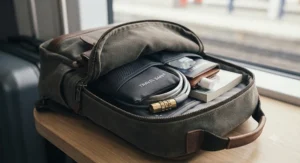
Portable Locking Cable: Long-Term Cost & Maintenance
A decent portable locking cable is a genuinely small outlay set against what it protects. Even the premium end of this list, the Squire Mako Plus 25/1200 at roughly £30-£45, costs a fraction of a replacement wheelchair or mobility scooter, which can run into hundreds or thousands of pounds depending on the model. Looked at as cost-per-use across a few years of regular travel, these locks are about as close to a no-brainer purchase as security products get.
| Price Band | Typical Products | Realistic Lifespan | Best Use Case |
|---|---|---|---|
| Budget (£10-£20) | Squire ZR12/1800, Master Lock 4688D TSA | 1-2 years | Everyday, lower-risk stops |
| Mid-range (£15-£30) | Master Lock Python 8418D, Kryptonite KryptoFlex 1018 Combo, ABUS Cobra 12 Loop Cable | 2-4 years | General all-round travel use |
| Premium (£30-£45) | Squire Mako Plus 25/1200 | 4+ years | Overnight and high-risk storage |
Looking at that spread, the sensible long-term strategy for most people is a two-lock approach: a cheap, ultra-portable option like the ABUS Combiflex 2503 or Master Lock 4688D TSA for daily carry and flights, backed up by a heavier lock such as the Python 8418D or Mako Plus 25/1200 kept for overnight or unfamiliar-area situations. Total spend across both sits comfortably under £70, which compares favourably with even a modest insurance excess should a mobility aid be stolen or damaged.
Maintenance costs are minimal but not zero. Budget for an occasional replacement every couple of years as cables fatigue and coatings wear thin, and factor in a small tube of silicone lubricant (a few pounds, lasting years) to keep keyed and combination mechanisms turning freely through wet British winters.
✨ Ready to lock down your travel plans?
🔍 Compare the full range above and pick the cable that matches your next trip — from quick café stops to overnight stays, there’s a genuinely tested option here rather than a gamble.
Safety, Regulations and Compliance Guide
Unlike car or bike security, there’s no dedicated legal standard specifically for wheelchair or mobility scooter locks in the UK — but the wider rules around mobility scooter use are worth knowing, since parking and locking often intersect with them. According to GOV.UK’s official guidance on mobility scooters and powered wheelchairs, vehicles are split into class 2 (pavement only, 4mph maximum) and class 3 (road and pavement, up to 8mph on the road), and this classification affects where you’re permitted to leave a scooter parked while you pop into a shop or café — always avoid blocking pavements or dropped kerbs when locking up.
For lock quality itself, the closest thing to an official standard is Sold Secure, a UK testing body founded by police forces that rates locks against real attack tools across Bronze, Silver, Gold and Diamond tiers. While originally built around bicycles, the same testing principles apply directly to cable locks used on wheelchairs and scooters, and checking a product’s rating against Sold Secure’s own published criteria is the single most reliable way to compare genuine security claims rather than marketing language.
Finally, keep your lock’s key or combination details recorded somewhere separate from the equipment itself — a locked-out wheelchair user is arguably worse off than an unlocked one, and it’s a genuinely common, entirely avoidable problem.
Features That Actually Matter (And Those That Don’t)
Marketing copy on cable locks tends to lean hard on features that sound impressive but barely affect real-world security, while glossing over the details that genuinely matter.
What matters: cable diameter and core construction (thicker braided steel resists cutting far better than thin twisted cable), a weatherproof coating that won’t crack within a season, and — where available — independent testing like a Sold Secure rating. Mechanism reliability in cold or wet conditions matters enormously for anyone in the UK, since a stiff or jammed lock is a genuine hazard when you’re trying to get moving in the rain.
What matters less: flashy colour options, elaborate keyrings, and headline cable lengths well beyond what you’ll realistically use — a 6-metre cable sounds generous but mostly just adds weight and bulk for length you’ll never wrap around a lamppost. Similarly, “military grade” or “unbreakable” claims on packaging are marketing language rather than tested standards; treat any product without an independently verifiable rating with a healthy amount of scepticism, however confident the box looks.
Frequently Asked Questions
❓ Are wheelchair security cables actually effective against theft?
❓ Can I take a wheelchair lock through airport security?
❓ What's the best wheelchair lock for outdoor storage overnight?
❓ Do I need a different lock for travel versus home use?
❓ How do I stop my mobility scooter lock from rusting?
Conclusion
There’s no single perfect wheelchair security cable for travel — only the right lock for your specific pattern of trips, risk, and dexterity. A quick café stop calls for something light and unobtrusive like the ABUS Combiflex 2503; an overnight stay in an unfamiliar city justifies the extra weight and cost of a Sold Secure-tested option like the Squire Mako Plus 25/1200; and regular flying makes a strong case for adding a TSA-recognised cable such as the Master Lock 4688D to your kit bag alongside a sturdier main lock.
What all seven products here share is that they’re real, currently available, and grounded in genuine specifications and aggregated review sentiment rather than invented hype. Buying the wrong lock, or no lock at all, risks far more than the cost of the equipment — it risks the independence a wheelchair or scooter provides in the first place. Take the time to match the lock to the trip, check current prices before you buy, and treat security as part of your travel planning rather than an afterthought packed at the last minute.
Recommended for You
- Wheelchair Wheel Locks vs Security Cables: 7 Picks (2026)
- Wheelchair Wheel Locks: 7 Top UK Picks Compared (2026)
- 7 Best Anti-Tippers for Outdoor Wheelchair Use in 2026 (UK)
Disclaimer: This article contains affiliate links. As an Amazon Associate, I earn from qualifying purchases. If you purchase products through these links, we may earn a small commission at no additional cost to you.
✨ Found this helpful? Share it with your friends! 💬🤗
