
In This Article
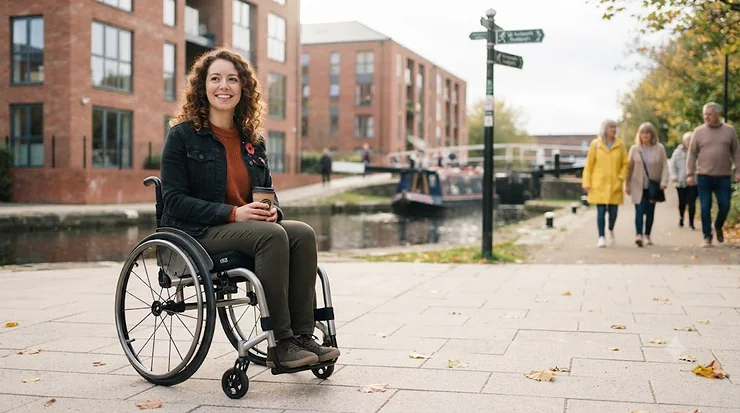
Nobody warns you about this bit. You get the wheelchair sorted, the cushion sorted, maybe even the ramp at the front door sorted — and then one day you’re outside a café, chair parked by the window, and a small voice in your head asks: is anyone going to walk off with this thing while I’m paying for a flat white? That’s the exact moment most people start Googling wheelchair wheel locks vs security cables, usually with a mild sense of panic. Here’s the short answer: wheel locks, sometimes called wheelchair brakes, hold your chair still so you can transfer safely, while security cables are a separate anti-theft layer that stops someone else wheeling it away entirely. They solve different problems, and honestly, most wheelchair users need to think about both.
This guide pulls apart wheelchair wheel locks vs security cables properly — what each one actually does, where the confusion comes from (the word “lock” is doing a lot of heavy lifting in both terms), and which real products on amazon.co.uk are worth your money in 2026. We’ll cover seven genuine options spanning budget brake extensions right up to premium anti-theft hardware, plus practical guidance on cable lock materials, public transport security, and the wheelchair extension brake accessories that make daily locking less of a wrestling match. If you’ve ever fumbled a stiff brake lever with cold fingers, or wondered whether that flimsy-looking cable would actually stop anyone, you’re in the right place.
Quick Comparison Table
Before the deep dive, here’s the fast version. If you’re standing in the accessibility aisle with your phone out, this table alone should get you 80% of the way to a decision — the analysis underneath fills in the rest.
| Product | Category | Price Range | Best For |
|---|---|---|---|
| Vive Health Wheelchair Brake Handle Extenders | Wheel lock extension | Under £25 | Limited grip strength or reach |
| Drive Medical STDS801 Chrome Brake Handle Extension | Wheel lock extension | £20-£30 | Daily heavy-use durability |
| Hiplok Lite Coiled Cable Lock | Security cable | Under £25 | Quick café stops, everyday carrying |
| Squire 275 Combination Cable Lock | Security cable | £15-£30 | No-key convenience, budget theft deterrence |
| Kryptonite KryptoFlex 1018 Combo Cable | Security cable | £20-£35 | Pairing with a primary lock |
| ABUS Bordo 6000 Folding Lock | Security lock (folding) | £70-£110 | Portable high-security parking |
| Kryptonite Evolution Mini-7 U-Lock | Security lock (U-lock) | £90-£130 | Overnight or high-risk locations |
Notice the split down the middle of that table. The first two entries are mobility aids — they help you operate the brakes your wheelchair already has. Everything from row three downward is imported, sensibly, from the world of bicycle security, because that’s genuinely where the best-engineered anti-theft cables and locks come from. What most buyers overlook is that these two categories aren’t competing products; they’re complementary ones, and a fully “locked” wheelchair on a night out often means both a brake extension for control and a security cable for peace of mind.
💬 Just one click — help others make better buying decisions too!😊
Top 7 Wheelchair Wheel Locks and Security Cables: Expert Analysis
We’ve grouped these honestly rather than padding out a false “top 7 identical products” list — because wheelchair wheel locks vs security cables genuinely calls for different hardware depending on what you’re solving for. Budget, mid-range and premium options are marked as we go.
1. Vive Health Wheelchair Brake Handle Extenders — easiest reach for limited grip
The standout feature here is simple: these clip over your existing brake lever and roughly double its length, which means less force is needed to engage the wheel lock. If your hands ache by mid-afternoon, that’s not a small thing.
Vive is a well-established US medical accessories brand that’s widely stocked through UK resellers and Amazon, and this pair is built from moulded plastic with a metal core, designed to slide over standard push-to-lock brake levers on most manual wheelchairs and transport chairs. The extension roughly doubles the lever arm, which in practical terms means the same locking force needs noticeably less hand strength — useful for anyone with arthritis, reduced grip, or recovering from a hand injury. Based on the spec comparison with own-brand extensions, Vive’s tend to have a slightly firmer clip fit, which matters because a loose extension that slips off mid-transfer defeats the entire purpose.
This is squarely a product for carers and wheelchair users managing dexterity or strength limitations, rather than anyone chasing raw durability — reviewers commonly report that the plastic housing, while functional, isn’t rated for the kind of daily bariatric-level force that chrome alternatives handle. A common theme in aggregated user feedback is praise for the “one thing that finally made brakes usable again” effect, alongside occasional notes that sizing needs checking carefully against your specific lever shape before buying.
Pros:
- ✅ Genuinely reduces the force needed to engage brakes
- ✅ Simple tool-free installation over most levers
- ✅ Affordable way to test if extensions help before upgrading
Cons:
- ❌ Plastic construction wears faster under heavy daily use
- ❌ Not universally compatible with every lever shape
Sitting comfortably under £25, this is the sensible starting point if you’re not sure yet whether a wheelchair extension brake will actually help — it’s a low-cost way to find out before committing to sturdier hardware.
2. Drive Medical STDS801 Chrome Brake Handle Extension — sturdiest chrome build for daily use
Where the Vive leans budget, the standout here is the chrome-plated metal construction, engineered specifically for transport chairs and heavier-duty manual wheelchairs that see daily use.
Drive Medical (sold in the UK as Drive DeVilbiss Healthcare) is one of the more established names in mobility equipment, and the STDS801 is an 8-inch extension designed for models including the Cirrus IV, Cougar, Blue Streak and Sentra EC ranges, though in practice it fits most standard push-to-lock brake levers of similar dimension. The chrome finish isn’t just cosmetic — it resists the corrosion that plastic alternatives can develop indoors near damp coats and outdoors in British drizzle, and the metal core means it can handle repeated, forceful engagement without flexing.
Here’s what to weigh: this is the extension for someone who locks and unlocks their brakes multiple times a day, every day, rather than an occasional user. Reviewers consistently note that the rigid metal build feels noticeably more reassuring under hand than moulded plastic equivalents, particularly when reaching awkwardly from a low seated position. The trade-off is a slightly fiddlier initial fit — a few users report needing to gently widen the clamp before it slides over their specific lever style.
Pros:
- ✅ Chrome metal resists wear far better than plastic
- ✅ Compatible with a wide range of transport chair brands
- ✅ Handles frequent daily locking without loosening
Cons:
- ❌ Initial fit can need light adjustment on some levers
- ❌ Costs more than basic plastic extensions
Priced in the £20-£30 range, this is the wheelchair extension brake accessory worth the extra few pounds if reliability matters more than saving pennies — and for anyone locking brakes several times daily, it usually does.
3. Hiplok Lite Coiled Cable Lock — lightest wearable deterrent
The clever bit is right there in the name: this British-designed cable coils into a compact loop light enough to wear around your waist, wrist, or wheelchair frame without weighing down your day.
At roughly 150g and available in lengths around 90cm, the Hiplok Lite uses a braided steel cable inside a protective plastic coating, closed with a combination or key-based lock depending on the variant. On paper this means it’s not designed to defeat an angle grinder or bolt croppers — nothing this light is — but that’s not really its job. Its job is deterring the opportunist thief who fancies an unattended chair outside a shop for two minutes.
What most buyers overlook about “lite” security is that it’s a category, not a compromise — cafe stops, accessible toilets, and quick pharmacy visits are exactly the scenarios where a fast, wearable deterrent beats a heavier lock left in a bag. Aggregated review sentiment for Hiplok’s coiled range is consistently positive on the wearability front, with users regularly commenting on how the coil design stops it dangling and catching on wheels or castors, something looped cables are notorious for.
Pros:
- ✅ Wearable design means it’s always with you, not left behind
- ✅ Lightweight enough to ignore once clipped on
- ✅ Coiled shape resists tangling in wheels or castors
Cons:
- ❌ Thin cable offers minimal resistance to bolt cutters
- ❌ Not suitable as your only lock in higher-risk areas
At under £25, treat this as a first line of defence rather than a vault door — brilliant for the quick stop, not the overnight leave.
4. Squire 275 Combination Cable Lock — no-key convenience for quick stops
The headline feature is the resettable 4-digit combination dial, meaning there’s no key to lose, forget, or fumble for with cold hands.
Squire is a genuinely UK-based lock manufacturer with decades of history making security hardware, and the 275 model is a braided steel cable, typically around 10mm thick and available in various lengths, wrapped in a protective vinyl sleeve to avoid scratching paintwork or upholstery. Because it’s combination-based rather than key-based, there’s a real practical upside for wheelchair users who already juggle enough small objects during transfers — one less key to drop.
Based on the spec comparison against thinner budget cables, the 275’s braided core gives it a step up in cut-resistance without adding much bulk, though — and this matters — Squire itself, like every UK lock brand, is upfront that combination cables of this thickness sit toward the lighter end of the security spectrum. Reviewers on retailer sites and forums frequently mention appreciating the “no key, no drama” simplicity, with a recurring minor gripe being that the combination dial can be slightly stiff when brand new until it beds in.
Pros:
- ✅ Combination lock removes the risk of a lost key
- ✅ Braided steel construction from an established UK brand
- ✅ Vinyl coating protects frame and wheel finishes
Cons:
- ❌ Combination dial needs a short bedding-in period
- ❌ Cable alone won’t deter a determined, tooled-up thief
Typically priced £15-£30 depending on length, this is a sensible mid-tier choice if convenience genuinely outweighs maximum security for your situation.
5. Kryptonite KryptoFlex 1018 Combo Cable — best secondary lock for pairing
The standout advantage is versatility: this is designed from the outset to be a second lock, looping through a wheel or frame while a stronger primary lock does the heavy lifting elsewhere.
Kryptonite is one of the most recognised names in lock security worldwide, and the KryptoFlex 1018 is a roughly 10mm braided steel cable around 180cm long, finished with an integrated combination lock. What the spec sheet won’t tell you, but security guides consistently note, is that cable locks like this one are explicitly rated by independent testers as a supplementary product rather than standalone protection — they’re brilliant at stopping a wheel being lifted off while your primary lock secures the frame, but comparatively easy to cut on their own.
For a wheelchair or mobility scooter, that translates neatly: use the KryptoFlex to loop through a spare wheel or accessory rack while a proper lock (see products six and seven) handles the main frame. Aggregated reviews for Kryptonite’s cable range routinely praise the brand’s build consistency and the reassuring weight of the lock housing itself, with the honest caveat — echoed across owner feedback — that nobody should rely on a cable of this gauge as their only line of defence in a higher-risk area.
Pros:
- ✅ Reliable Kryptonite build quality and lock mechanism
- ✅ Ideal length for looping through wheels and frames
- ✅ Genuinely useful as a second layer, not just filler
Cons:
- ❌ Not intended as a sole security solution
- ❌ Combination style rather than higher-security key cylinder
Sitting around £20-£35, this earns its place as the pairing cable in a two-lock strategy rather than the star of the show.
6. ABUS Bordo 6000 Folding Lock — toughest portable folding security
The defining feature is the folding link design — hardened steel plates that concertina flat for carrying, then lock rigid into a shape a cable simply can’t replicate.
ABUS is a German security manufacturer with a long track record in independently tested locks, and the Bordo 6000 series uses hardened steel folding bars connected by rivets, opening into a rectangular frame that can be threaded through a wheel and around a fixed point like railings or a bike stand. On paper this means significantly more resistance to bolt croppers and leverage attacks than any cable, because there’s no single thin strand to cut — a thief would need to work through several hardened joints individually.
Here’s the honest trade-off: this is heavier and pricier than anything else on this list, which matters if you’re mounting it on a wheelchair rather than a bike frame with a dedicated bracket. What most buyers overlook is that ABUS folding locks are frequently cited in independent security round-ups as offering some of the best protection-to-portability ratio available, precisely because the folded shape stows flat in a bag or under-seat pouch rather than dangling awkwardly like a rigid U-lock. Review sentiment across cycling and mobility forums consistently flags the reassuring “thunk” of the locking mechanism and the confidence that comes with genuinely tested hardware, alongside fair warnings about the extra weight for anyone very sensitive to added chair load.
Pros:
- ✅ Folding steel design resists cutting far better than cable
- ✅ Compact folded shape for under-seat or bag storage
- ✅ Backed by independent security testing reputation
Cons:
- ❌ Noticeably heavier than any cable option here
- ❌ Higher price point than budget or mid-range picks
At roughly £70-£110, this is the premium pick for anyone regularly leaving a wheelchair or mobility scooter unattended in busier public areas.
7. Kryptonite Evolution Mini-7 U-Lock — gold-rated protection for high-risk parking
The stand-out here is the solid U-shaped hardened steel shackle — the gold standard, quite literally, in independent lock security testing.
The Evolution Mini-7 uses a 13mm hardened steel shackle in a compact U-lock shape, small enough to loop through a wheel and a fixed anchor point without excessive bulk, and it typically carries a strong independent security rating from UK testing bodies that assess resistance to bolt croppers, leverage, and drilling attacks. Based on the spec comparison with folding locks, a solid U-shackle generally offers marginally better resistance to leverage attacks than jointed folding bars, at the cost of being less flexible to fit around irregular shapes.
This is the lock for genuinely high-risk situations — overnight parking, city centres, or anywhere theft rates run higher than the sleepy market town average. What most buyers overlook is that U-locks are rigid by design, so fitting one neatly onto a wheelchair frame (rather than a bike’s triangular frame) sometimes needs a bit of creative thinking about mounting points; a small bungee pouch or under-seat bag usually solves it. Aggregated owner feedback is strongly positive on the confidence factor, with users repeatedly describing the peace of mind of a rated lock over an unrated cable, tempered by consistent notes that it’s the heaviest single item on this list.
Pros:
- ✅ Independently rated for strong theft resistance
- ✅ Compact U-shape despite hardened 13mm shackle
- ✅ Trusted brand with long-standing security reputation
Cons:
- ❌ Rigid shape can be awkward to mount on some frames
- ❌ Heaviest and priciest option on this list
Around £90-£130, this is the one to buy once you’ve decided theft risk genuinely outweighs the extra weight and cost — for many wheelchair users in cities, it does.
Practical Usage Guide: Fitting, Testing and Maintaining Your Locks
Buying the hardware is the easy part. Here’s where most people go wrong in the first month: they fit a wheelchair extension brake or a new cable lock once, never test it under real conditions, and only discover a problem when it actually matters. Start by fitting brake extensions with the chair on a flat, stable surface — never mid-transfer — and test the lock engages fully before trusting your weight to it. A properly engaged wheel lock should stop the wheel rotating even under firm hand pressure; if it slips, the extension isn’t seated correctly or the underlying brake needs adjusting first, since no extension fixes a worn brake mechanism underneath it.
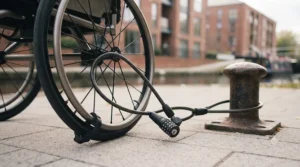
For security cables and locks, the biggest rookie mistake is looping the cable through something flimsy — a plastic bollard, a wobbly sign post — rather than a genuinely fixed, solid anchor. Always thread the lock through the wheel and the frame together where possible, not just the wheel alone, since a wheel-only lock still lets someone carry the rest away. Check your lock monthly for stiffness or grit in the mechanism; a light silicone spray (never oil, which attracts dust) keeps combination dials and key cylinders smooth. The NHS wheelchair user safety guidance also recommends routinely testing wheel locks before every transfer as a core safety habit, not an occasional check, which is worth building into your morning routine alongside tyre pressure and caster checks. In the first 30 days, the most common mistake is over-tightening a new brake extension clip, which can crack plastic housings — a firm, snug fit is all that’s needed.
Real-World Scenarios: Which Setup Fits Your Life
Consider Priya, a 24-year-old university student who commutes 3 miles to campus and locks her chair’s wheels briefly outside lecture halls between classes. For her, a lightweight Hiplok Lite Coiled Cable Lock worn on the frame is genuinely proportionate — she’s rarely away from the chair for more than an hour, and a heavier lock would be dead weight she carries all day for marginal extra protection.
Now picture David, in his 70s, with arthritis in both hands, who uses his manual wheelchair daily and struggles with the stiff factory brake levers. His priority isn’t theft at all — it’s simply engaging the wheel lock safely during transfers. The Drive Medical STDS801 Chrome Brake Handle Extension solves his actual problem, and a security cable barely features in his decision.
Then there’s Michael, who commutes into a major city centre for work and leaves his powered wheelchair’s manual backup chair locked outside a busy train station for eight hours a day. His risk profile is entirely different — busy, anonymous, high footfall, exactly the environment opportunist thieves favour. For him, pairing the Kryptonite Evolution Mini-7 U-Lock through frame and wheel, rather than relying on any cable alone, is the proportionate response to genuinely elevated risk.
Wheelchair Wheel Locks vs Security Cables: What Each Actually Protects
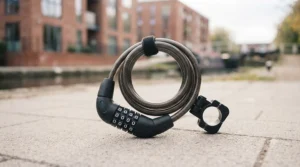
This is worth spelling out plainly, because the naming genuinely trips people up. A wheel lock (or wheelchair brake) is a safety feature built into the chair itself, designed to stop the wheels rotating so you can transfer in and out without the chair rolling away underneath you — it protects you from a fall, not your chair from a thief. A security cable, by contrast, is an aftermarket anti-theft accessory with zero involvement in day-to-day safety; its entire purpose is stopping someone else wheeling your equipment away while you’re not holding onto it.
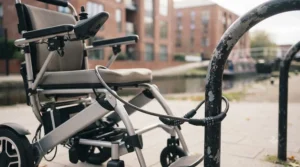
Here’s what most buyers overlook: neither one substitutes for the other. A wheelchair with perfectly functioning wheel locks offers essentially no theft resistance whatsoever — anyone can simply pick the whole thing up or release the same lever you use. Meanwhile, the sturdiest security cable does nothing to stop the chair rolling during a transfer. Reviewers and occupational therapists alike consistently frame these as a two-part system: brakes (and their extensions, where needed) for safety, cables or locks for security, used together rather than as alternatives.
Common Mistakes When Buying Anti-Theft Mobility Aids
The single biggest mistake buyers make with anti-theft mobility aids is assuming “any lock is better than no lock” without checking whether it’s proportionate to where they actually live and travel. A £15 thin cable is perfectly sensible for a quiet suburban high street; the same cable outside a big-city train station is barely a speed bump for a determined thief with bolt croppers. The second common error is buying based on weight alone — the lightest lock always looks most appealing when you’re already managing a wheelchair’s overall load, but the lightest options are, almost without exception, the least resistant to cutting.
A third mistake, oddly specific but genuinely common, is forgetting that wheels held on with a quick-release mechanism can simply be lifted off in seconds if the lock only loops around the tyre and not the frame too — always thread through both. Buyers also frequently overlook how the lock will actually attach to a wheelchair frame rather than a bicycle frame — rigid U-locks in particular can be awkward without a proper mounting bracket or bag. Finally, people frequently overlook maintenance entirely: a top-rated lock left to seize up with grit and rain is no better than a cheap one, so factor a monthly wipe-down and occasional silicone spray into the decision, not just the purchase price.
Cable Lock Materials Explained: What Actually Stops a Thief
Not all steel cable is created equal, and this is where cable lock materials genuinely earn a dedicated look. Thin, single-strand steel cables — the kind bundled free with cheap bike accessories — can often be cut with basic household cutters in seconds; they’re a visual deterrent more than a physical one. Braided steel cables, like those used in the Squire 275 Combination Cable Lock and Kryptonite KryptoFlex 1018 Combo Cable, interweave multiple steel strands, which meaningfully increases the effort needed to cut through, since bolt croppers have to bite through several strands simultaneously rather than one clean wire.
Hardened steel, used in folding locks like the ABUS Bordo 6000 Folding Lock and shackle locks like the Kryptonite Evolution Mini-7 U-Lock, is a different category entirely — heat-treated to resist the shearing action of croppers and the twisting force of leverage attacks. Independent testing through schemes like Sold Secure’s official rating system gives a genuinely useful shortcut here: rather than guessing from marketing copy, you can check whether a specific product has been tested and rated against real bolt croppers, angle grinders, and picks, with cable locks typically landing in the lower Bronze to Silver bands and hardened shackle or folding locks reaching Gold and above. If security is a real priority rather than a token gesture, checking for an actual rating beats trusting cable thickness described in millimetres alone.
Keeping Your Wheelchair Secure on Public Transport
Public transport security throws up a slightly different set of problems than locking outside a shop. On UK buses and coaches covered by accessibility regulations, wheelchair users are entitled to use the designated wheelchair space, and drivers have specific duties to assist with boarding and to prioritise that space when needed — worth knowing if you ever need to assert it. But regulation covers safe carriage, not theft prevention; once you’re seated, your wheelchair effectively becomes hand luggage in terms of security, and there’s no built-in mechanism stopping anyone tampering with an unattended folded chair in a luggage area on longer coach or rail journeys.
The practical takeaway is straightforward: for train and coach journeys where your wheelchair might be stored separately from you, even briefly, a compact cable like the Hiplok Lite Coiled Cable Lock looped through a fixed rail or luggage rack anchor adds a genuine layer of reassurance for minimal weight. For local buses and shorter hops where you stay with your chair throughout, this matters far less — your presence is the security. Government guidance on the rights of disabled passengers on transport confirms drivers’ assistance duties but is silent on theft, which is precisely the gap a small cable is designed to fill.
Long-Term Cost & Maintenance
Thinking in total cost of ownership rather than sticker price changes the maths considerably. A £15 budget cable that gets cut or corrodes within a year and needs replacing annually can end up costing more over five years than a single £90 hardened lock bought once and maintained properly. Brake extensions, similarly, rarely need replacing if you buy the sturdier chrome option upfront rather than cycling through cheaper plastic versions every time one cracks under daily force.
Maintenance costs are genuinely minimal across this category — a monthly wipe-down, occasional silicone spray on moving parts, and checking cables for fraying takes minutes and costs nothing beyond a small tin of spray lasting years. The real long-term cost driver isn’t the lock itself but replacement frequency, which is exactly why the analysis above weighs durability so heavily rather than just upfront price.
What to Expect: Real-World Performance
Specs on a page rarely match the lived experience, so here’s the translation. A “13mm hardened shackle” in real terms means you can loop the Kryptonite Evolution Mini-7 U-Lock through a wheel and a solid railing and genuinely forget about it for hours without that nagging worry — the kind of forgetting that’s actually the point of buying security in the first place. A “150g coiled cable” like the Hiplok Lite Coiled Cable Lock in real terms means clipping it on in the morning and not noticing its weight at all by lunchtime, which matters enormously if every extra gram on a chair you’re pushing yourself genuinely counts.
On the brake side, an “8-inch extension” on the Drive Medical STDS801 Chrome Brake Handle Extension in real terms means the difference between needing two hands and a wince to lock your wheels, versus a single confident push. These are the details that don’t show up in a spec sheet but show up every single day you use the product.
Buyer’s Decision Framework
If reaching or engaging your existing brake lever is the actual problem, choose a wheel lock extension — a security cable does nothing for this. If you regularly leave your chair briefly in low-risk, quiet areas, choose a lightweight cable like the Hiplok Lite Coiled Cable Lock or Squire 275 Combination Cable Lock for proportionate, low-hassle deterrence. If you leave your chair unattended for hours in busy town or city centres, choose a hardened lock — either the ABUS Bordo 6000 Folding Lock for portability or the Kryptonite Evolution Mini-7 U-Lock for maximum resistance — rather than relying on cable alone. And if you’re genuinely unsure of your risk level, a simple priority checklist helps: how long is the chair left alone, how busy is the area, and how easily could it be carried rather than wheeled away? Higher answers on all three point firmly toward hardened locks over cables every time.
FAQ
❓ Do wheelchair wheel locks stop theft?
❓ What's the strongest lock for a mobility scooter or wheelchair?
❓ Can I use a bike cable lock on my wheelchair?
❓ How do I make my wheelchair brakes easier to use?
❓ Is a thin cable lock enough to protect a wheelchair?
Conclusion
Weighing up wheelchair wheel locks vs security cables ultimately comes down to recognising they’re solving entirely different problems dressed in confusingly similar names. Wheel locks and their extensions are about your safety during everyday transfers — get the reach and grip right, and the rest of your day gets easier. Security cables and hardened locks are about protecting the equipment itself from opportunist or determined thieves, and the right choice there scales with genuine risk: a light cable for quiet, brief stops, hardened steel for busy cities and longer absences. Across the seven products covered here, from the accessible Vive Health Wheelchair Brake Handle Extenders through to the robust Kryptonite Evolution Mini-7 U-Lock, the honest advice is rarely “buy the most expensive option” — it’s “buy what matches how and where you actually use your chair.”
✨ Don’t Miss These Exclusive Deals!
🔍 Take your wheelchair security setup to the next level with the picks covered above. Click through to check current pricing and availability, and give yourself one less thing to worry about on your next outing.
Recommended for You
- Wheelchair Wheel Locks: 7 Top UK Picks Compared (2026)
- 7 Best Anti-Tippers for Outdoor Wheelchair Use in 2026 (UK)
- Anti-Tip Wheelchair Kit Under £30: 7 Best Value Picks 2026
Disclaimer: This article contains affiliate links. As an Amazon Associate, I earn from qualifying purchases. If you purchase products through these links, we may earn a small commission at no additional cost to you.
✨ Found this helpful? Share it with your friends! 💬🤗
