

In This Article
Anyone who cares for a wheelchair user, or uses a wheelchair themselves, knows the moment: dinner’s ready, or it’s time for a puzzle, a laptop, a cup of tea — and there’s simply nowhere stable to put it. A full lap tray wheelchair attachment solves that gap in one go, turning an armrest-to-armrest span into a genuine, usable surface. It sounds like a small thing until you don’t have one, and then it becomes obvious how much daily independence rides on it.

Unlike a half lap tray, which clips onto just one armrest and leaves the rest of the lap open, a full lap tray wheelchair accessory spans the entire width between both armrests, giving a much larger, steadier surface for eating, writing, resting the arms, or supporting an activity board. That extra width matters enormously for anyone with limited trunk control, tremor, or reduced arm strength, since a bigger surface means less chance of a cup, plate, or tablet sliding into a lap.
This guide covers seven genuinely available full lap trays — clear acrylic, wood, padded, and storage-equipped — based on real specifications and aggregated review sentiment rather than marketing blurb. According to NHS guidance on wheelchairs and mobility equipment, equipment like trays and seating accessories should be assessed against the individual’s actual needs, not bought on size or price alone, and that’s the approach taken throughout this guide.
What Is a Full Lap Tray Wheelchair Accessory?
A full lap tray wheelchair accessory is a rigid or semi-rigid surface that fits across both armrests, rather than just one, creating a full width wheelchair tray for eating, resting the arms, or supporting activities like reading, writing, or tablet use. It typically attaches via hook-and-loop straps, a slide-on bracket, or a clip-on mounting system, and can usually be removed for transfers.
Quick Comparison Table
| Product | Material | Mounting | Best For |
|---|---|---|---|
| DMI Clear Acrylic Wheelchair Lap Tray | Clear acrylic | Hook-and-loop straps | All-round clear full tray |
| Rehabilitation Advantage Slide-On Polycarbonate Tray | Clear polycarbonate | Slide-on/clip-on bracket | Secure clip-on full tray |
| NRS Healthcare Adjustable Tray | Wipe-clean laminate | Strap-fit | Lightweight UK budget buy |
| PEPE Mobility Wheelchair Tray | ABS plastic | Hook-and-loop straps | Easy daily fit and removal |
| Homecraft Beanbag Stay Tray | Padded top, beanbag base | Freestanding (no straps) | Stability without armrest fitting |
| GLDDFDG Storage Wheelchair Tray | ABS plastic | Hook-and-loop straps | Large tray for eating and storage |
| TYYIHUA Bamboo Wood Tray | Bamboo wood | Hook-and-loop straps | Premium eating and activity surface |
Reading across the table, the split isn’t really about quality — it’s about fitting method and finish. The Rehabilitation Advantage Slide-On Polycarbonate Tray and clip-on brackets generally hold more securely for active users who shift and lean, while strap-fit options like the NRS Healthcare Adjustable Tray and PEPE Mobility Wheelchair Tray are quicker to fit and remove for carers managing several transfers a day. The Homecraft Beanbag Stay Tray stands apart by skipping armrest attachment altogether, which is worth knowing if a chair’s armrests aren’t a suitable mounting point.
💬 Just one click — help others make better buying decisions too!😊
Top 7 Full Lap Trays for Wheelchairs: Expert Analysis
The picks below span budget, mid-range, and premium options, along with genuine variation in material, mounting method, and extra features like storage and cup holders.
1. DMI Clear Acrylic Wheelchair Lap Tray — best all-round clear full tray
The DMI Clear Acrylic Wheelchair Lap Tray is one of the most established clear acrylic full trays on the market, measuring roughly 23 by 19 inches with a contoured semi-circle cutout that fits comfortably against the body. What most buyers overlook about clear acrylic construction is the visibility benefit — being able to see down onto your own lap and legs matters for users monitoring posture, clothing, or a catheter bag, something a solid wood or padded tray simply can’t offer.
The raised strip along the tray’s edge is a small but genuinely useful detail, catching cups, cutlery, and craft items before they roll off during a wobble or an uneven push over carpet. Hook-and-loop straps secure it around the armrests, and manufacturer guidance notes that due to its size and weight, it’s best fitted and removed by a carer rather than the user alone — worth factoring in for anyone without regular support nearby.
Aggregated review sentiment consistently praises the tray for eating, reading, and craft activities, with the clear surface repeatedly singled out as easier to keep visibly clean than opaque alternatives, since spills and crumbs show up immediately rather than hiding on a solid-coloured top.
Pros:
- ✅ Full clear visibility down to lap and legs
- ✅ Raised edge strip stops items rolling off
- ✅ Easy to spot spills and keep genuinely clean
Cons:
- ❌ Best fitted by a carer due to size and weight
- ❌ No storage or cup holder built in
At around £35-£45, the DMI Clear Acrylic Wheelchair Lap Tray sits in accessible mid-range territory and remains a dependable, no-frills starting point for most standard wheelchairs.

2. Rehabilitation Advantage Slide-On Clear Polycarbonate Wheelchair Lap Tray — best clip-on full tray with slide-on bracket
For users who shift their weight, lean forward, or push against the tray during transfers, the Rehabilitation Advantage Slide-On Clear Polycarbonate Wheelchair Lap Tray offers a genuinely more secure alternative to strap mounting. Its slide-on, clip-on bracket system locks onto the armrest tubes directly, which based on the spec comparison with strap-fit trays, resists the sideways slip that can happen when a hook-and-loop strap gradually loosens over a long day.
Polycarbonate is worth flagging as a distinct material from standard acrylic — it’s significantly more impact-resistant, which matters for households with more than one wheelchair user, active children, or anyone prone to knocking the tray against door frames and furniture. Reviewers consistently note that the clip-on full tray wheelchair design makes fitting a one-handed job once the brackets are correctly positioned, a genuine time-saver for carers managing multiple daily transfers.
What the spec sheet won’t tell you, but user reports suggest, is that the bracket system needs to be correctly sized to the specific armrest tube diameter first time, or fitting becomes fiddlier than the strap alternatives — it’s worth measuring the armrest before ordering rather than guessing.
Pros:
- ✅ Slide-on bracket resists slipping better than straps
- ✅ Polycarbonate is more impact-resistant than standard acrylic
- ✅ One-handed fitting once brackets are positioned
Cons:
- ❌ Requires correct armrest tube measurement before ordering
- ❌ Pricier than most strap-fit alternatives
Expect to pay in the £45-£65 range, positioning this as a premium pick best suited to households prioritising security of fit over lowest cost.
3. NRS Healthcare Adjustable Tray — best lightweight UK budget buy
British mobility brand NRS Healthcare has built a strong reputation among UK carers, and the NRS Healthcare Adjustable Tray reflects that with a genuinely lightweight, wipe-clean design that doesn’t demand much storage space when removed. Aggregated customer sentiment is mixed on outright sturdiness — some reviewers describe it as strong and stable, others as flimsy under heavier use — so it’s worth setting expectations around light-duty tasks like reading, colouring, or resting a drink rather than heavy dining use.
Based on the spec comparison with pricier trays on this list, the wipe-clean laminate surface is a genuine strength for hygiene-conscious households or care settings needing quick turnaround between users. The adjustable fit is designed to accommodate a reasonable range of armrest widths without needing a precise measurement first, which reduces the risk of an expensive mis-fit.
A common theme in feedback is praise for value for money relative to bulkier medical-grade alternatives, with several reviewers specifically noting it as good enough for occasional use, such as visiting family members or short daily sessions, rather than constant heavy-duty dining.
Pros:
- ✅ Genuinely lightweight and easy to store
- ✅ Wipe-clean surface suits hygiene-conscious use
- ✅ Strong value relative to medical-grade alternatives
Cons:
- ❌ Mixed reviews on sturdiness under heavier use
- ❌ Less suited to constant, daily dining use
Priced around £20-£30, the NRS Healthcare Adjustable Tray is one of the more affordable full lap trays here, making it a sensible entry point for occasional or lighter-duty needs.
4. PEPE Mobility Wheelchair Tray with Cup Holder — best easy-fit tray for daily use
The PEPE Mobility Wheelchair Tray with Cup Holder appears consistently among Amazon UK’s most gifted wheelchair tray accessories, and the reason isn’t hard to see — it’s a straightforward, easy-to-fit tray with a built-in cup holder that removes the single biggest daily annoyance with flat trays: a drink sliding around every time the chair moves.
Reviewers consistently highlight how quickly this tray goes on and off, an important factor for carers managing multiple transfers between wheelchair, bed, and other seating throughout the day. Based on the spec comparison with pricier clip-on systems, the hook-and-loop strap fitting won’t match the Rehabilitation Advantage tray for absolute security, but for users who aren’t leaning heavily on the tray, it’s genuinely sufficient for day-to-day use.
The black finish is a small practical plus too — it hides everyday marks and scuffs noticeably better than the clear acrylic options, which is worth considering for households prioritising low-maintenance appearance over visibility.
Pros:
- ✅ Built-in cup holder stops drinks sliding around
- ✅ Genuinely quick to fit and remove
- ✅ Dark finish hides everyday marks well
Cons:
- ❌ Strap fitting less secure than clip-on brackets
- ❌ No storage compartment for smaller items
At roughly £20-£30, the PEPE Mobility Wheelchair Tray with Cup Holder offers strong everyday value for anyone whose main priority is quick daily fitting rather than maximum load-bearing security.
5. Homecraft Beanbag Stay Tray — best stability without armrest fitting
Not every wheelchair has armrests suited to strap or clip mounting, and that’s exactly where the Homecraft Beanbag Stay Tray earns its place. Rather than attaching to the chair at all, it uses a weighted beanbag base that moulds to the lap and stays put through its own stability, paired with a non-slip mat on the tray surface to stop plates and cups shifting.
Based on the spec comparison with strap and clip trays, this design sidesteps armrest compatibility issues entirely, making it a genuinely useful option for narrow, low, or unusually shaped armrests that standard trays struggle to grip. Reviewers consistently note the beanbag base as comfortable against the legs for extended sitting, avoiding the pressure-point feel that a rigid, strapped-on tray can create over a long meal or activity session.
The trade-off, on paper, is that a freestanding tray offers less resistance against a determined push or lean than a securely clipped-on full tray, so it suits users with reasonable trunk stability rather than those who might push hard against the tray edge.
Pros:
- ✅ No armrest fitting needed — works on almost any chair
- ✅ Beanbag base is comfortable for extended sitting
- ✅ Non-slip mat keeps items steady
Cons:
- ❌ Less resistant to a hard push or lean than clipped trays
- ❌ Bulkier to store than a flat tray when not in use
Priced around £25-£35, the Homecraft Beanbag Stay Tray is a smart mid-range solution specifically for chairs where conventional mounting isn’t straightforward.

6. GLDDFDG Storage Wheelchair Tray — best large tray for eating and storage
For users who want more than just a flat surface, the GLDDFDG Storage Wheelchair Tray adds a phone and card slot, a cup holder, and a storage drawer to a genuinely large wheelchair tray footprint, fitting armrests roughly 18 to 21 inches apart. This is the pick on this list most clearly built around the large wheelchair tray eating use case, since the extra compartments keep cutlery, glasses, or a phone within easy reach without needing a side table.
What most buyers overlook about built-in storage trays is how much they reduce the number of times a carer needs to reach across the room mid-meal or mid-activity — everything genuinely needed sits within arm’s reach on the tray itself. The hook-and-loop strap fitting threads through the tray’s winged arms and wraps around the wheelchair arm, a slightly fiddlier process than a simple flat strap but one that reviewers report holds securely once set.
Aggregated feedback is positive overall on functionality, though a recurring theme is that the storage drawer, while a genuine convenience, adds width and depth that some narrower wheelchairs may struggle to accommodate without slight overhang.
Pros:
- ✅ Storage drawer, phone slot and cup holder in one tray
- ✅ Genuinely large surface for full meals and activities
- ✅ Secure strap-through-wing fitting once set
Cons:
- ❌ Slightly fiddlier to fit than simple flat-strap trays
- ❌ Added width may overhang narrower wheelchairs
At around £20-£30, the GLDDFDG Storage Wheelchair Tray delivers strong functional value for anyone wanting an eating tray that doubles as light storage.
7. TYYIHUA Bamboo Wood Foldable Wheelchair Tray — best premium wood eating tray
Where most full lap trays lean clinical, the TYYIHUA Bamboo Wood Foldable Wheelchair Tray takes a different approach entirely, using a genuine bamboo wood surface with built-in cup holders for a warmer, more homely look and feel. Reviewers consistently note the natural wood finish makes it feel less like medical equipment and more like a genuine piece of furniture, a detail that carries real emotional weight for long-term wheelchair users and their families.
Based on the spec comparison with plastic and acrylic alternatives, bamboo is naturally more resistant to scratching from cutlery than softer plastics, while remaining considerably lighter than a solid hardwood tray of the same size. The foldable design is a practical bonus, allowing the tray to be flattened for easier storage against a wall or in a cupboard when not in use, rather than needing dedicated floor or table space.
The trade-off worth flagging honestly: wood, even sealed bamboo, needs slightly more care around spills than acrylic or ABS plastic, since prolonged moisture exposure can affect the finish over time in a way it simply doesn’t for a wipe-and-forget plastic tray.
Pros:
- ✅ Warm, homely finish rather than clinical look
- ✅ Naturally scratch-resistant and lightweight
- ✅ Folds flat for easier storage
Cons:
- ❌ Needs more careful spill management than plastic or acrylic
- ❌ Not the best choice for heavy, frequent wet use
At around £30-£40, the TYYIHUA Bamboo Wood Foldable Wheelchair Tray is a genuinely appealing premium pick for households wanting a tray that looks as good as it functions.
| Product | Price Range | Rating Sentiment | Best For |
|---|---|---|---|
| DMI Clear Acrylic Wheelchair Lap Tray | £35-£45 | Strongly positive on clarity/hygiene | All-round eating and crafts |
| Rehabilitation Advantage Slide-On Polycarbonate Tray | £45-£65 | Positive on secure fit | Active users, frequent transfers |
| NRS Healthcare Adjustable Tray | £20-£30 | Mixed on sturdiness, positive on value | Light, occasional use |
| PEPE Mobility Wheelchair Tray | £20-£30 | Positive on ease of fitting | Daily quick-fit needs |
| Homecraft Beanbag Stay Tray | £25-£35 | Positive on comfort and stability | Chairs unsuited to strap mounting |
| GLDDFDG Storage Wheelchair Tray | £20-£30 | Positive on functionality | Eating plus on-tray storage |
| TYYIHUA Bamboo Wood Tray | £30-£40 | Positive on look and feel | Premium homely eating surface |
Set side by side, the pricing pattern is fairly logical: added security (clip-on brackets) and added function (storage, beanbag stability) both push the price up, while simple flat strap-fit trays like the NRS Healthcare Adjustable Tray and PEPE Mobility Wheelchair Tray keep costs down for lighter needs. For most households, the DMI Clear Acrylic Wheelchair Lap Tray remains the most broadly sensible middle ground between price, visibility, and everyday practicality.
Practical Fitting & Setup Guide
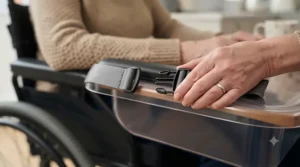
Getting a new full lap tray wheelchair accessory properly fitted from day one avoids most of the common complaints reviewers raise. Start by measuring the distance between armrests accurately, front to back and side to side, before ordering — a tray that’s even a few centimetres too narrow will gap at the sides, while one too wide risks pressing uncomfortably against the body. For clip-on and slide-on brackets, like the one on the Rehabilitation Advantage Slide-On Polycarbonate Tray, always check the armrest tube diameter against the manufacturer’s stated range first.
When fitting hook-and-loop strap trays, pull the straps snug but not fully taut — over-tightening can pull the armrest padding out of shape over time, particularly on softer, older upholstery. A common mistake in the first month of ownership is leaving the tray attached during transfers; nearly every manufacturer recommends removing a full tray before moving the user in or out of the chair, both for safety and to avoid unnecessary strain on the straps or bracket.
Finally, establish a simple cleaning routine early — acrylic and polycarbonate trays wipe clean with a soft cloth and mild soapy water, while wood trays like the TYYIHUA Bamboo Wood Foldable Wheelchair Tray should be dried promptly after any spill rather than left to air-dry naturally, which helps protect the sealed finish over years of use.
Real-World Scenarios: Matching the Tray to the User
Consider Margaret, 78, who spends most of her day in her wheelchair at home and wants a stable surface for meals and her crossword. For her, the DMI Clear Acrylic Wheelchair Lap Tray or NRS Healthcare Adjustable Tray make good sense — both are light enough for a family carer to fit and remove daily, without needing specialist tools.
Now picture James, a more active wheelchair user who wheels himself around a busy household and leans on his tray while reaching for things. The Rehabilitation Advantage Slide-On Polycarbonate Tray suits him far better than a strap-fit option, since the clip-on bracket resists the sideways movement his activity level creates.
Finally, think of a care home setting supporting several residents with varying armrest types and mobility needs. The Homecraft Beanbag Stay Tray solves the awkward cases — chairs with unusual or narrow armrests — without needing a different tray purchased for every chair type, while the GLDDFDG Storage Wheelchair Tray works well for residents who want their glasses, phone, and drink all within reach during longer periods of sitting.
Problem → Solution: Common Full Lap Tray Issues
Problem: tray slides or shifts during use. This is almost always a strap-tension issue on flat-strap trays. Re-tighten straps snugly, or move to a clip-on bracket system like the Rehabilitation Advantage Slide-On Polycarbonate Tray for a firmer hold.
Problem: tray doesn’t fit the armrests properly. Usually down to measuring armrest width rather than the actual tube diameter or gap needed. Always measure before ordering, and check the manufacturer’s stated fitting range rather than assuming “universal” trays fit every chair.
Problem: items slide around on the tray surface. A flat, smooth tray with no lip or non-slip surface is the usual cause. Trays with a raised edge, like the DMI Clear Acrylic Wheelchair Lap Tray, or a non-slip mat, like the Homecraft Beanbag Stay Tray, solve this directly.
Problem: tray feels clinical or institutional. This is a genuine and valid concern for long-term home use. The TYYIHUA Bamboo Wood Foldable Wheelchair Tray addresses it directly with a warmer, furniture-like finish.
Problem: nowhere to store items during activities. Flat trays with no compartments mean phones, glasses, or cutlery constantly need fetching. The GLDDFDG Storage Wheelchair Tray resolves this with a built-in drawer and slots.
How to Choose a Full Lap Tray Wheelchair Accessory
- Measure armrest width and depth accurately. This single step prevents most fitting disappointments, regardless of tray type.
- Decide between strap, clip-on, or freestanding mounting. Match this to the user’s activity level and how often the tray needs removing.
- Choose a material suited to the main use. Clear acrylic suits eating and crafts; wood suits comfort-focused daily use; ABS plastic suits low-maintenance, heavy daily wear.
- Check for a raised edge or non-slip surface. Especially important for users with tremor or limited fine motor control.
- Consider built-in storage or cup holders if relevant. These genuinely reduce how often a carer needs to leave the room mid-activity.
- Factor in who fits and removes it. Heavier trays may need a carer’s help; lighter trays support more independence.
- Set a realistic budget. As this list shows, a genuinely functional full lap tray is available from around £20, with premium features pushing costs higher.
Clear Acrylic Full Tray vs Wood vs Padded: Choosing Your Material
Material choice affects far more than looks. A clear acrylic full tray, like the DMI Clear Acrylic Wheelchair Lap Tray, offers full visibility of the lap and legs below, which matters for posture checks, clothing management, or catheter monitoring — something no opaque tray can replicate. Reviewers consistently note that clear trays also make spills and crumbs immediately visible, encouraging quicker cleanup than an opaque surface might.
Wood trays, such as the TYYIHUA Bamboo Wood Foldable Wheelchair Tray, prioritise warmth and a domestic feel over clinical practicality, and on paper this means better emotional comfort for long-term home users, at the cost of slightly more careful spill management. Padded or beanbag-based trays, like the Homecraft Beanbag Stay Tray, prioritise physical comfort against the body over rigidity, which suits users who rest their forearms on the tray for extended periods rather than pushing hard against its edge.
Clip-On vs Strap-On: How Full Tray Mounting Brackets Work
A full tray mounting bracket, as used on the Rehabilitation Advantage Slide-On Polycarbonate Tray, clips or slides directly onto the armrest tube, creating a mechanically locked connection that resists sideways slip far better than fabric straps. The trade-off is precision — bracket systems generally need the correct armrest tube diameter specified before ordering, whereas strap systems are more forgiving of minor sizing variation.
Hook-and-loop strap mounting, used on the NRS Healthcare Adjustable Tray, PEPE Mobility Wheelchair Tray, and GLDDFDG Storage Wheelchair Tray, wins on speed and simplicity — genuinely useful for carers managing several fittings and removals a day, since no tools or precise measurements are needed at the point of use. Based on the spec comparison across both systems, the right choice depends less on which is objectively “better” and more on how often the tray needs to come on and off, and how much lateral force it needs to resist.
Large Wheelchair Tray for Eating: What Actually Matters
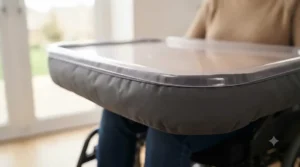
A large wheelchair tray for eating needs to do more than simply be big — surface area matters less than a stable, contained space that keeps a plate, cup, and cutlery from sliding during normal chair movement. The GLDDFDG Storage Wheelchair Tray demonstrates this well, pairing genuine size with a cup holder and compartments that keep individual items in their own defined space rather than sliding freely across an open surface.
Reviewers consistently note that raised edges, recessed cup holders, and non-slip surfacing matter more for eating specifically than overall tray dimensions, since a larger flat surface without containment features can actually make spills worse, not better, by giving items more room to travel before hitting an edge. For anyone prioritising eating specifically, checking for these containment details is more useful than comparing tray dimensions alone.
Wheelchair Activity Board vs Full Tray Board: What’s the Difference
A wheelchair activity board and a full tray board for wheelchair activity often get used interchangeably, but there’s a genuine distinction worth understanding. An activity board is typically designed with a slightly textured or gridded surface, sometimes with raised borders on all sides, specifically to contain small items like puzzle pieces, craft supplies, or sensory objects during structured activities. A standard full lap tray, by contrast, is generally flatter and smoother, optimised for eating and general resting rather than containing small, mobile objects.
In practice, several of the trays on this list cross over reasonably well between the two uses — the DMI Clear Acrylic Wheelchair Lap Tray‘s raised edge strip, for instance, does a genuinely good job containing craft materials as well as food, even though it isn’t marketed specifically as an activity board. For households or care settings running frequent structured activities, it’s worth checking edge height specifically, since a shallow lip suited to stopping a cup sliding may not be enough to contain smaller items like beads or puzzle pieces.
Common Mistakes When Buying a Full Lap Tray Wheelchair Accessory
The most frequent mistake is ordering by wheelchair “size” rather than actually measuring the specific armrest gap, since two chairs both described as “standard adult” can vary meaningfully in armrest width and depth. A close second is choosing a clip-on bracket tray without checking armrest tube compatibility first, leading to a tray that simply won’t attach securely.
Buyers also often overlook maintenance requirements until after purchase — a beautiful wood tray bought without considering daily spill exposure, for example, can end up needing more careful handling than a household realistically has time for. Finally, it’s easy to underestimate how often a tray needs removing for transfers; a heavy or fiddly-to-remove tray that seemed fine in the product photos can become a genuine daily friction point once it’s actually in use multiple times a day.
Safety, Positioning and Regulations Guide
There’s no single UK regulation specific to wheelchair lap trays, but general postural care guidance is directly relevant. Government guidance on postural care notes that appropriately personalised equipment can lead to genuine physical and functional benefits, reinforcing why a properly fitted tray — not just any tray — matters for comfort and function, not just convenience.
Maintenance matters for safety too. NHS England’s wheelchair quality framework highlights the importance of regular equipment reviews and maintenance contact, a principle worth applying to trays and other accessories as much as the wheelchair itself — a loose bracket or frayed strap should be addressed promptly rather than left until it fails.
Prolonged sitting also raises pressure-related risks that a tray can indirectly help manage. The British Healthcare Trades Association’s guide to pressure ulcer prevention in sitting explains that regular position changes are key to prevention, and a securely fitted, comfortable tray that doesn’t need constant readjustment can support a settled, well-positioned sitting posture rather than working against it. Always remove a full tray before any transfer, and check strap or bracket condition periodically rather than assuming it will last indefinitely without inspection.
Frequently Asked Questions
❓ What's the difference between a full lap tray and a half lap tray for a wheelchair?
❓ How do I measure my wheelchair for a full lap tray?
❓ Can a full lap tray be used for eating and activities?
❓ Are clip-on full trays more secure than strap-on trays?
❓ Should a wheelchair tray be removed before a transfer?
Conclusion
Choosing the right full lap tray wheelchair accessory comes down to matching mounting method, material, and features to how the tray will actually be used day to day. For general eating, reading, and crafts, the DMI Clear Acrylic Wheelchair Lap Tray remains a dependable, well-reviewed middle ground. For active users who need genuine security against sideways movement, the Rehabilitation Advantage Slide-On Polycarbonate Tray‘s clip-on bracket earns its higher price. And for chairs with unusual armrests, or households wanting a warmer, more homely feel, the Homecraft Beanbag Stay Tray and TYYIHUA Bamboo Wood Foldable Wheelchair Tray each solve a genuine, specific need.
There’s no single “best” tray here — only the one that fits a particular chair, user, and daily routine properly. Taking the time to measure accurately and match mounting style to activity level, as covered throughout this guide, makes the difference between a tray that gets used every day and one that ends up gathering dust in a cupboard.
✨ Don’t Miss These Exclusive Deals!
🔍 Ready to find the right full lap tray for your wheelchair? Click through to check current pricing on today’s featured picks and choose the surface that fits your daily routine best!
Recommended for You
- Cup Holder Tray Wheelchair: 7 Best Picks for 2026 (UK)
- Wheelchair Lap Tray: 7 Best Padded & Bean Bag Picks (2026)
- Walking Stick Holder for Wheelchair: 7 Best Picks for 2026
Disclaimer: This article contains affiliate links. As an Amazon Associate, I earn from qualifying purchases. If you purchase products through these links, we may earn a small commission at no additional cost to you.
✨ Found this helpful? Share it with your friends! 💬🤗
