
In This Article
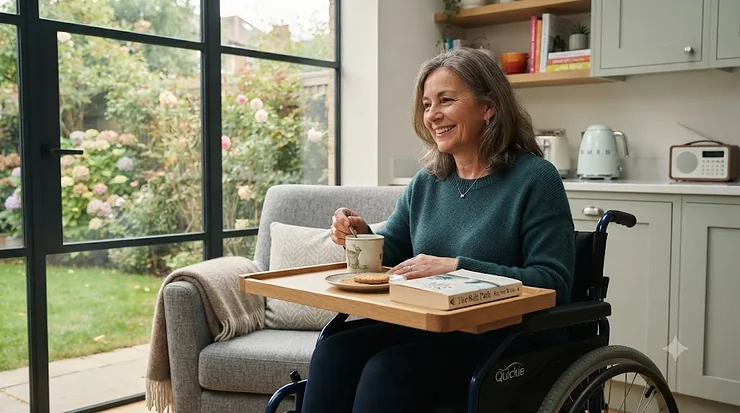
A half tray for wheelchair use solves a very specific problem that a full lap tray often gets wrong: it supports one arm, one side, one need, without boxing the user in or blocking a transfer. For anyone living with hemiplegia after a stroke, or supporting a family member through rehabilitation, that difference matters enormously. A full-width tray can feel restrictive and make getting in and out of the chair harder than it needs to be. A well-chosen half tray does the opposite — it protects a weaker arm, prevents it slipping or catching on doorways, and still flips out of the way in seconds when it’s time to move.
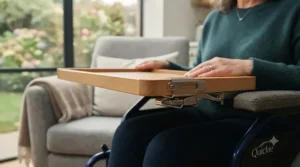
What is a half tray for wheelchair users? It’s a triangular or curved support surface that attaches to a single wheelchair armrest, giving one arm a stable, cushioned resting place while leaving the opposite side completely free for propulsion, transfers or independent movement.
This guide compares seven genuinely available half trays spanning budget, mid-range and premium options, drawing on real product specifications and the aggregated feedback of carers, occupational therapists and wheelchair users rather than marketing copy. According to the NHS’s guidance on recovering from a stroke, getting the right equipment and support in place at home is a core part of rehabilitation — and a correctly fitted half tray is one of the simplest, most affordable pieces of that puzzle to get right.
Quick Comparison Table
| Product | Type | Best For | Price Range |
|---|---|---|---|
| NRS Healthcare Flip-Away Half Lap Tray | Rigid plastic, flip-up | Budget-conscious first purchase | around £25-£35 |
| Aftermarket Group Black Padded Vinyl Half Lap Tray | Padded vinyl, flip-up | Everyday elbow and forearm comfort | around £45-£65 |
| Aftermarket Group Clear Acrylic Half Lap Tray | Clear rigid acrylic, flip-up | Visibility during transfers and mobility | around £45-£65 |
| Skil-Care 14″ Vinyl Lap Tray with Straps | Strap-secured positioning tray | Postural alignment, therapist-guided use | around £50-£70 |
| Sammons Preston Premium Flip-Away Half Lap Tray | Premium padded/clear flip-up | Long-term daily use, clinical settings | around £75-£100 |
| iGuerburn Lateral Arm Trough Support | Padded arm trough with straps | Hemiplegic and paralysed arm support | around £25-£40 |
| Vive Health Wheelchair Tray Table with Cup Holder | Lightweight removable tray | Occasional one-handed use, light tasks | around £20-£35 |
Reading across this table, the split between “half lap tray” and “arm trough” designs is the single most important distinction to grasp before choosing. Half lap trays like the NRS Healthcare Flip-Away Half Lap Tray give a flat working surface for resting the arm, eating or reading, while the iGuerburn Lateral Arm Trough Support cradles the arm on three sides for genuine paralysis or high fall risk. Neither is objectively “better” — the right choice depends entirely on how much support the affected arm actually needs, which is exactly what the sections below unpack.
💬 Just one click — help others make better buying decisions too!😊
Top 7 Half Trays for Wheelchairs: Expert Analysis
1. NRS Healthcare Flip-Away Half Lap Tray — best budget option for a first purchase
The NRS Healthcare Flip-Away Half Lap Tray is the tray most UK families reach for first, largely because NRS Healthcare is one of the most recognised and trusted mobility brands sold through UK retailers. It’s a triangular-shaped rigid plastic tray that slides onto a single wheelchair armrest, flips up for storage or transfers, and comes in translucent or opaque finishes with left- or right-hand specific versions.
What most first-time buyers overlook is how much the flip-up hinge mechanism matters day to day. A tray that has to be fully unclipped and removed for every transfer becomes a chore nobody bothers with after a fortnight; one that simply lifts and folds back gets used properly, every single time. This tray fits both full-length and desk-style upholstered armrests, which covers the vast majority of standard NHS-issue and self-purchased wheelchairs in the UK.
Reviewer sentiment consistently describes this as reliable, simple, and good value, with the main criticism being that the unpadded plastic surface isn’t ideal for anyone who rests their forearm or elbow on it for extended periods.
Pros:
- ✅ Genuinely affordable entry point from a trusted UK brand
- ✅ Flip-up hinge makes transfers quick and fuss-free
- ✅ Fits both full-length and desk-style armrests
Cons:
- ❌ Unpadded surface isn’t ideal for prolonged forearm contact
- ❌ Basic plastic construction lacks premium finishing
Priced around £25-£35, this is the tray to start with if you’re not yet sure how much use it will get, or if the budget for a first assessment period is genuinely tight.

2. Aftermarket Group Black Padded Vinyl Half Lap Tray — best for everyday elbow and forearm comfort
The Aftermarket Group Black Padded Vinyl Half Lap Tray takes the same flip-up half tray concept and adds a genuinely useful layer of cushioning across the whole surface. The rigid insert is covered in high-resiliency foam beneath a wipe-clean vinyl cover, which changes the daily experience considerably for anyone resting a weaker arm on the tray for hours at a time.
Based on the spec comparison with unpadded trays, the practical benefit here isn’t just comfort — it’s pressure distribution. A hard plastic surface concentrates weight on the point of the elbow and the bony parts of the forearm, which over a full day can contribute to skin irritation, particularly for anyone with reduced sensation on the affected side. The padded vinyl spreads that contact pressure far more evenly. Attachment uses an interlock system for quick fitting to full-length or desk-style arms, with a slide-on version also available for even faster on-and-off use.
Aggregated feedback from carers and mobility retailers repeatedly highlights the padding as the standout feature over cheaper unpadded alternatives, while a smaller number of reviewers note the vinyl cover needs regular wiping to stay hygienic with daily use.
Pros:
- ✅ High-resiliency foam padding reduces pressure on elbow and forearm
- ✅ Wipe-clean vinyl surface suits daily practical use
- ✅ Interlock or slide-on fitting for quick attachment
Cons:
- ❌ Vinyl surface needs regular cleaning with frequent use
- ❌ Costs noticeably more than the unpadded plastic equivalent
At around £45-£65, this is a sensible mid-range upgrade for anyone who has already confirmed a half tray suits them and now wants genuine daily comfort rather than a basic first-try option.
3. Aftermarket Group Clear Acrylic Half Lap Tray — best for visibility during transfers and mobility
The Aftermarket Group Clear Acrylic Half Lap Tray solves a problem that padded and opaque trays simply can’t: line of sight. Made from clear, rigid acrylic rather than solid vinyl or plastic, it lets the user and any carer see the wheelchair wheel, the floor and the lower body clearly at all times, rather than that view being blocked by an opaque panel.
Here’s what to weigh with a clear tray specifically — for anyone who self-propels, even partially, being able to see the wheel and hand position underneath the tray genuinely improves confidence and safety during manoeuvring. It’s equally valuable for carers assisting with transfers, since a clear tray removes the guesswork about foot and leg position beneath it. The flip-up hardware and fitting system mirror the padded version, so the choice between the two really comes down to visibility needs versus cushioning needs rather than any difference in mounting quality.
Reviewer sentiment among carers and occupational therapists tends to favour the clear option specifically for users with any degree of visual field loss following a stroke, where maintaining awareness of the affected side is part of the rehabilitation goal.
Pros:
- ✅ Clear acrylic keeps the wheel and floor visible at all times
- ✅ Particularly useful for users with visual field changes
- ✅ Same reliable flip-up fitting as the padded version
Cons:
- ❌ No padding, so less comfortable for prolonged forearm rest
- ❌ Acrylic can show scratches over time with heavy use
Around £45-£65, this is the tray worth choosing over the padded version specifically when visibility and self-propulsion confidence matter more than cushioned comfort.
4. Skil-Care 14″ Vinyl Lap Tray with Straps — best for postural alignment and positioning
The Skil-Care 14″ Vinyl Lap Tray with Straps is built with a different priority to the flip-up trays above: proper body alignment and balance rather than a simple resting surface. It secures directly to the wheelchair using hook-and-loop straps with an easy-release closure, giving it a noticeably more stable, locked-in feel than a tray that simply slides onto an armrest.
What most buyers overlook about strap-secured trays is that they’re generally specified by occupational therapists precisely because they don’t shift position during the day the way a slide-on tray occasionally can. On paper this means slightly less convenience for quick transfers — you’re unclipping straps rather than flipping a hinge — but in practice it means more consistent positioning for someone whose therapy goals specifically involve keeping the affected arm in a fixed, supported location for set periods.
Aggregated sentiment from clinical and home-care settings consistently describes this tray as a “prescribed-feel” product, favoured where positioning accuracy genuinely outweighs the convenience of a flip-away design.
Pros:
- ✅ Strap fitting gives noticeably more stable positioning
- ✅ Wipe-clean vinyl surface suits daily hygiene needs
- ✅ Favoured in therapist-guided positioning programmes
Cons:
- ❌ Less convenient than flip-up designs for quick transfers
- ❌ Strap fitting takes longer to put on and remove
At around £50-£70, this is worth prioritising if a physiotherapist or occupational therapist has specifically recommended consistent, strap-secured positioning over a flip-away tray.
5. Sammons Preston Premium Flip-Away Half Lap Tray — best for long-term daily and clinical use
The Sammons Preston Premium Flip-Away Half Lap Tray, sold through Performance Health, sits at the top of this comparison for good reason. It’s built specifically to create space for safe wheelchair transfers without interfering with the wheel, and it’s offered with genuine configuration choices — padded for comfort and upper-limb support, or clear acrylic for unobstructed visibility during transfers, depending on what the user actually needs.
The tray measures roughly 22 inches by 14 inches at its widest point, tapering to around 3 inches where it crosses the armrest, and is designed specifically to protect the forearm, elbow and wrist rather than simply providing a flat surface. Reviewers in clinical and long-term care settings consistently note that the flip-up mechanism holds up well to repeated daily use, which matters considerably more here than on a tray used only occasionally.
Based on the spec comparison with the budget and mid-range options above, this is the tray that most closely resembles what you’d be issued through an NHS wheelchair service assessment, which explains why it’s a common choice among occupational therapists recommending private purchases.
Pros:
- ✅ Genuine choice between padded comfort or clear visibility
- ✅ Purpose-built to protect forearm, elbow and wrist
- ✅ Holds up reliably to repeated daily clinical-grade use
Cons:
- ❌ Highest price point among the flip-away trays in this guide
- ❌ Overspecified for occasional or short-term use
Around £75-£100, this is the tray to choose for long-term daily use, particularly where a clinician has been involved in the wider positioning plan.
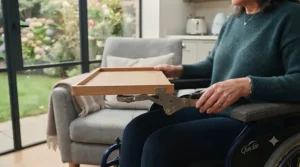
6. iGuerburn Lateral Arm Trough Support — best for genuinely paralysed or high-fall-risk arms
The iGuerburn Lateral Arm Trough Support is a fundamentally different product to the flat trays above, and it’s worth understanding that distinction clearly before buying. Rather than a flat surface the arm rests on top of, this is a trough that cradles the arm on three sides, secured in place with a double-strap design, specifically marketed towards hemiplegia, Parkinson’s and stroke-related arm weakness.
What the spec sheet won’t tell you, but the design makes obvious, is that a flat tray relies on the user (or gravity) to keep the arm in position, while a trough physically contains it. For an arm with genuinely no active movement or significant tone changes, that containment meaningfully reduces the risk of the limb slipping off the armrest and catching in a wheel spoke or door frame — a real and commonly reported injury risk for hemiplegic wheelchair users. The easy-clean leather-effect cover wipes down quickly, and the trough is available for left or right fitting on most standard and powered wheelchairs.
Reviewer sentiment, largely from family carers purchasing on behalf of a relative, consistently praises the peace of mind the double-strap containment provides, while a smaller number note that the trough style is less useful as a surface for eating or writing compared with a flat tray.
Pros:
- ✅ Three-sided trough genuinely contains a paralysed arm
- ✅ Double-strap design adds a real extra safety margin
- ✅ Easy-clean cover suits daily hygiene needs
Cons:
- ❌ Not designed as a flat surface for eating or tasks
- ❌ Less versatile than a tray for general daily activities
At around £25-£40, this is the product to choose over a standard half tray specifically when the priority is containing and protecting a genuinely weak or paralysed arm, rather than giving it a surface to rest on.
7. Vive Health Wheelchair Tray Table with Cup Holder — best lightweight option for occasional use
The Vive Health Wheelchair Tray Table with Cup Holder takes a more general-purpose approach than the clinically-focused trays above, and that’s precisely its appeal for a specific group of buyers. It’s a lightweight, removable tray table that fits wheelchair arms roughly 16 to 20 inches apart, with a built-in cup holder and a construction light enough for a carer or the user’s stronger arm to fit and remove single-handedly.
Here’s what to weigh with a general-purpose tray like this one: it isn’t purpose-built for hemiplegic arm support in the way the iGuerburn trough or the clinical Sammons Preston tray are, but for someone who mainly needs a stable surface for a drink, a snack or a book — and can manage the fitting themselves with their unaffected hand — the sheer ease of one-handed attachment and removal is genuinely valuable day to day.
Aggregated feedback describes this as good value for light, occasional use, with reviewers noting it’s easy to take on and off for outings, though a handful mention the lightweight construction feels less sturdy than the dedicated clinical trays under heavier use.
Pros:
- ✅ Genuinely easy to fit and remove one-handed
- ✅ Built-in cup holder adds everyday practicality
- ✅ Lightweight and simple to transport for outings
Cons:
- ❌ Less sturdy than clinical-grade positioning trays
- ❌ Not designed specifically for hemiplegic arm support
Around £20-£35, this suits occasional, lighter use rather than all-day positioning support for a genuinely weak or paralysed arm.
Fitting and Adjusting Your Half Tray for Wheelchair Correctly
Buying the right tray solves half the problem; fitting it correctly solves the rest. Most complaints about trays being “useless” or “uncomfortable” actually trace back to poor fitting rather than a fault with the product itself. Start by checking the tray is genuinely designed for your specific armrest style — full-length arms and desk-style arms often need slightly different fitting hardware, and a tray that’s a loose, wobbly fit on the wrong armrest type will never feel secure no matter how good the product is.
For flip-up trays, test the hinge mechanism before relying on it for a real transfer — it should lift smoothly and lock cleanly out of the way without needing excessive force. For strap-secured trays like the Skil-Care 14″ Vinyl Lap Tray with Straps, take time to position the arm correctly before tightening, following any positioning guidance from an occupational therapist rather than guessing at what feels comfortable in the moment, since correct alignment matters more for long-term skin and joint health than immediate comfort.
A common early mistake is over-tightening trough-style supports like the iGuerburn Lateral Arm Trough Support in an attempt to feel “extra safe” — this can restrict circulation rather than adding genuine protection. Check the skin under the elbow and forearm regularly in the first few weeks of use, particularly on the affected side where reduced sensation may mean the user can’t reliably feel developing pressure areas themselves.
Which Half Tray Suits Your Situation? Real-World Scenarios
The stroke survivor early in rehabilitation with a flaccid arm: if the affected arm currently has little or no active movement and tends to slip off the armrest, containment matters more than a flat surface. The iGuerburn Lateral Arm Trough Support is built specifically for this stage, keeping the limb safely positioned rather than relying on the user to manage it themselves.
The wheelchair user managing daily meals, reading and light tasks: once positioning is more established and the priority shifts to independence and daily function, a flat working surface becomes genuinely useful. The Aftermarket Group Black Padded Vinyl Half Lap Tray or the Sammons Preston Premium Flip-Away Half Lap Tray both give a comfortable, practical surface without restricting movement on the stronger side.
The family member buying for occasional outings: if the need is mainly for short trips out — a coffee, a snack, somewhere to rest a drink — rather than all-day clinical positioning, the Vive Health Wheelchair Tray Table with Cup Holder offers genuine practicality without the cost or bulk of a clinical-grade tray, and it’s simple enough to fit and remove without help.

Positioning Your Arm Correctly: A One-Sided Arm Support Tray Guide
A one-sided arm support tray only does its job properly if the arm is positioned correctly on it, and this is genuinely one of the most commonly overlooked details in home use. Clinical positioning guidance consistently recommends supporting the affected arm well forward, with the elbow relatively straight rather than tucked tightly into the body, since a dropped or unsupported shoulder on the weaker side is a well-documented contributor to shoulder pain and subluxation after a stroke.
Padding placement matters more than most buyers expect. A tray with even, full-surface padding — like the Aftermarket Group Black Padded Vinyl Half Lap Tray or the padded configuration of the Sammons Preston Premium Flip-Away Half Lap Tray — distributes pressure across the whole forearm rather than concentrating it at the elbow, which is particularly important for anyone with reduced sensation who can’t reliably feel a developing pressure point forming.
Common problems and practical solutions worth knowing: if the arm keeps sliding forward off a flat tray, a trough-style support like the iGuerburn Lateral Arm Trough Support solves this far more reliably than adding padding to a flat tray. If the tray interferes with self-propulsion on the unaffected side, check that it’s fitted specifically to the affected arm only — a genuinely half tray should never extend across to the stronger side. And if skin redness appears under the elbow after use, that’s a signal to review positioning with a healthcare professional rather than simply adding more padding as a workaround.
✨ Ready to Improve Daily Comfort and Positioning?
🔍 Compare current prices and availability on the trays above — the right fit today can genuinely reduce daily discomfort and support better long-term positioning.
How to Choose a Half Tray for Wheelchair Users
Choosing well starts with an honest assessment of the arm’s current function rather than guessing at what “should” work. Here’s the reasoning we’d apply, step by step:
- Assess current arm function first. A flaccid or genuinely paralysed arm needs containment (a trough); an arm with some function but poor endurance usually does better with a flat, padded tray.
- Check armrest compatibility before buying. Full-length and desk-style arms often need different fitting hardware — measure or check the wheelchair’s specification before ordering.
- Decide between flip-up and strap-secured fitting. Flip-up trays suit frequent transfers; strap-secured trays suit consistent, therapist-guided positioning where stability matters more than quick removal.
- Prioritise padding for prolonged daily use. Anyone spending several hours a day with their arm on the tray will benefit from cushioning far more than someone using it occasionally.
- Consider visibility needs. Clear acrylic trays genuinely help users with visual field changes following a stroke, and help carers assisting with transfers see clearly.
- Involve an occupational therapist where possible. If a therapist is already involved in rehabilitation, ask whether they have a specific recommendation before purchasing privately — it can save money and ensure the right fit for the individual’s needs.
- Check for VAT relief eligibility before paying full price. Many mobility aids, including wheelchair trays, qualify for VAT relief when bought for personal use by someone chronically sick or disabled.
A common mistake worth flagging separately: buying a general-purpose tray table when genuine arm containment is what’s actually needed, or vice versa. The two product types solve different problems, and matching the wrong one to the situation rarely gets fixed by simply adding padding or straps afterwards.
Hemiplegic Wheelchair Half Tray: What Makes the Right Hemi Wheelchair Tray
A hemiplegic wheelchair half tray needs to do more than just sit on the armrest — it needs to actively support a specific rehabilitation goal, which is why the right hemi wheelchair tray often looks quite different from a general mobility accessory. Hemiplegia means paralysis affecting one side of the body, and the tray’s job is to protect that affected side from injury while supporting whatever positioning plan a clinical team has recommended.
What most buyers overlook about hemiplegic-specific trays is that containment and visibility usually matter more than surface area. The iGuerburn Lateral Arm Trough Support is explicitly marketed towards hemiplegia and stroke-related weakness precisely because a flat surface alone doesn’t stop an arm with no active tone from sliding off during a turn or a bump in the pavement. For hemiplegic users with some retained movement or improving function, a padded flat tray like the Aftermarket Group Black Padded Vinyl Half Lap Tray may be entirely sufficient and considerably more versatile for daily tasks.
Reviewer sentiment among carers of hemiplegic stroke survivors consistently points to one practical detail above all others: a tray that’s genuinely quick and easy to remove one-handed is used correctly and consistently, while a fiddly one gets left off “just for this trip” — which is exactly when an unsupported arm is most likely to be injured.
One Arm Wheelchair Tray vs Full Lap Tray
The choice between a one arm wheelchair tray and a full-width lap tray comes down almost entirely to how much independent function remains on the stronger side. A full lap tray spans both armrests and genuinely does box the user in — useful for certain seating and safety needs, but restrictive for anyone who self-propels or wants to reach freely with their unaffected hand.
Based on the spec comparison, every product in this guide is specifically a half tray, and that’s a deliberate design choice for hemiplegic and one-sided support needs. The unaffected arm stays completely free to propel the chair, operate a joystick, eat independently or simply rest naturally, while the affected side gets the support it actually needs. Reviewers consistently note that switching from a full tray to a correctly fitted half tray noticeably improves a user’s sense of independence, since it removes a physical barrier that was never actually needed on the stronger side in the first place.
The main scenario where a full lap tray still makes sense is when positioning needs affect both sides, or when the tray is being used primarily as a safety barrier rather than for one-sided arm support — a decision best made with input from an occupational therapist rather than guesswork.
Single Side Wheelchair Tray: Left vs Right and Padded vs Clear
Every genuine single side wheelchair tray needs to be ordered for the correct side, and this is one of the most common ordering mistakes buyers make. Left-hand and right-hand versions aren’t interchangeable — a tray designed to fit a right armrest generally won’t sit correctly, or securely, on a left one, so always check which side the affected arm is on before ordering, not which side feels more “natural” to assume.
Beyond left-versus-right, the padded-versus-clear decision genuinely changes daily usability. Padded surfaces, as used on the Aftermarket Group Black Padded Vinyl Half Lap Tray, prioritise comfort for prolonged contact; clear acrylic surfaces, as used on the Aftermarket Group Clear Acrylic Half Lap Tray, prioritise visibility and awareness of the lower body and wheel. Neither is universally “better” — reviewers with visual field loss following a stroke consistently favour clear trays, while those focused purely on comfort for extended daily wear favour padded ones.
If genuinely unsure which matters more for a specific situation, the Sammons Preston Premium Flip-Away Half Lap Tray sidesteps the dilemma by offering both configurations from the same base design, letting the choice come down to the individual’s actual needs rather than a single fixed product decision.
Half Lap Tray Wheelchair vs Arm Trough: Which Type of Support Do You Need?
| Support Type | Best For | Containment Level | Everyday Versatility |
|---|---|---|---|
| Half Lap Tray | Some arm function, daily tasks, eating/reading | Low-medium (flat surface) | High |
| Arm Trough | Flaccid or paralysed arm, high slip risk | High (three-sided containment) | Low-medium |
| Full Lap Tray | Bilateral positioning or safety barrier needs | Medium (both sides) | Medium |
Interpreting the comparison above, the decision genuinely comes down to how much the arm can do for itself. A half lap tray wheelchair accessory works well as a flat surface for an arm with some retained tone and movement, giving a stable base for tasks without over-restricting it. An arm trough, by contrast, exists specifically because a flat surface isn’t enough when there’s no active muscle control keeping the limb in place — the three-sided containment does the job gravity and voluntary movement can no longer do.
For most hemiplegic wheelchair users, the right choice shifts over the course of rehabilitation — starting with more containment while function is minimal, and moving towards a flatter, more versatile tray as movement and control improve. Reviewing this with an occupational therapist periodically, rather than sticking with the first product bought, tends to give the best long-term outcome.
Price Range, VAT Relief and Value: What You’re Really Paying For
| Price Band | What You Typically Get | Example |
|---|---|---|
| Under £40 | Basic rigid trays, arm troughs | NRS Healthcare Flip-Away Half Lap Tray, iGuerburn Lateral Arm Trough Support |
| £40-£70 | Padded or clear vinyl/acrylic, strap options | Aftermarket Group trays, Skil-Care 14″ Vinyl Lap Tray with Straps |
| £70+ | Clinical-grade, configurable, long-term use | Sammons Preston Premium Flip-Away Half Lap Tray |
Interpreting this table honestly, the jump from “under £40” to the £40-£70 band buys genuinely useful comfort and visibility features — padding, clear acrylic, or strap-secured positioning — that matter considerably for daily, all-day use. The step up to £70-plus buys configuration flexibility and clinical-grade durability more than a fundamentally different product.
One detail worth checking before paying full price either way: many wheelchair trays qualify for VAT relief when bought for the personal use of someone who is chronically sick or disabled, which can meaningfully reduce the cost. According to GOV.UK’s guidance on financial help if you’re disabled, eligible buyers don’t pay VAT on certain goods and services designed for their own use, and most UK mobility retailers will provide a simple eligibility declaration to complete at checkout — it’s a genuinely easy step that’s worth taking the extra minute for.
Stroke Rehabilitation Tray Use: Safety, Skin Checks and Clinical Guidance
Using a stroke rehabilitation tray safely involves more than simply fitting it correctly once. The Stroke Association’s guidance on equipment for stroke survivors at home notes that a huge range of equipment exists to make daily life easier after a stroke, and recommends contacting a few different suppliers to compare options and get advice on what genuinely suits an individual’s needs, rather than assuming one product fits everyone with a similar diagnosis.
Regular skin checks matter more with wheelchair trays than most buyers initially realise, particularly where the affected arm has reduced sensation. Check the skin under the elbow and along the forearm for redness or marking after the first few uses of any new tray, and again periodically afterwards, since a genuinely well-fitted tray shouldn’t leave lasting marks after normal use. If it does, that’s a sign to review the fit, padding, or positioning — ideally with input from an occupational therapist or physiotherapist rather than adjusting by trial and error alone.
Hemiplegia, as described on Wikipedia’s overview of hemiplegia, refers to paralysis affecting one side of the body, and understanding the basic mechanism helps explain why one-sided support products like these exist at all rather than assuming a standard, symmetrical wheelchair accessory will do the job. If a stroke rehabilitation tray is part of a wider positioning or therapy plan, always check with the treating clinical team before switching product types, since containment needs can change meaningfully as recovery progresses.
Frequently Asked Questions
❓ What is a half tray for wheelchair users?
❓ Do I need a half tray or a full arm trough for hemiplegia?
❓ Can I claim VAT relief on a wheelchair tray?
❓ How do I know if my half tray is fitted correctly?
❓ Will a half tray restrict independent wheelchair use?
Conclusion
Choosing a half tray for wheelchair use ultimately comes down to matching the level of support to how much the affected arm can genuinely do for itself, not simply picking the most popular or most padded option available. For a first purchase or a tight budget, the NRS Healthcare Flip-Away Half Lap Tray is a genuinely sensible, low-risk starting point; for daily comfort once a tray’s usefulness is confirmed, the Aftermarket Group Black Padded Vinyl Half Lap Tray or Sammons Preston Premium Flip-Away Half Lap Tray offer real, lasting comfort; and for a genuinely paralysed or high-slip-risk arm, the iGuerburn Lateral Arm Trough Support provides the containment a flat surface simply can’t.
Fit, positioning, and matching product type to actual need matter more than any single spec in this guide — a correctly fitted tray, checked regularly for comfort and skin health, should become a piece of equipment that genuinely supports independence rather than one more restriction to work around. Involve an occupational therapist where possible, check VAT relief eligibility before paying full price, and choose the product that matches today’s needs, knowing it may be worth revisiting as recovery progresses.
✨ Found the Right Tray for Your Needs?
🔍 Check current pricing and availability on the trays above — the right fit today can genuinely improve daily comfort, safety and independence.
Recommended for You
- Full Lap Tray Wheelchair: 7 Best Picks for 2026, Compared
- Cup Holder Tray Wheelchair: 7 Best Picks for 2026 (UK)
- Wheelchair Lap Tray: 7 Best Padded & Bean Bag Picks (2026)
Disclaimer: This article contains affiliate links. As an Amazon Associate, I earn from qualifying purchases. If you purchase products through these links, we may earn a small commission at no additional cost to you. This article is for general informational purposes only and is not a substitute for individual advice from an occupational therapist, physiotherapist or other healthcare professional.
✨ Found this helpful? Share it with your friends! 💬🤗
