
In This Article
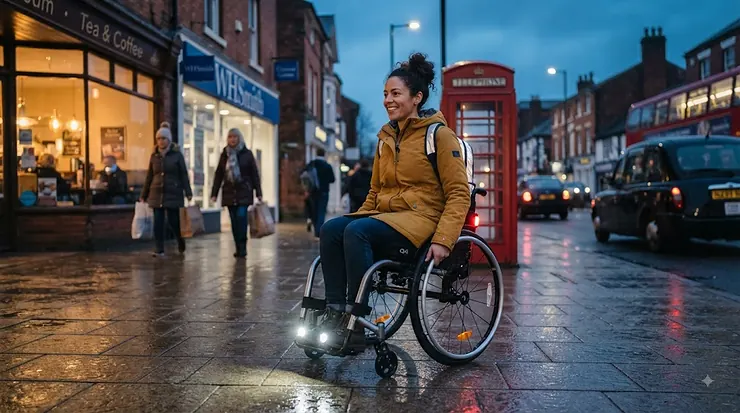
There’s a specific kind of dread that comes with rolling home from an evening out just as the streetlights flicker on, knowing full well that a wheelchair sits lower, narrower, and far less noticeable to a driver than almost anything else on the road. That’s the exact problem behind the wheelchair lights vs reflectors question. A wheelchair light is an active device — battery or USB powered, emitting its own beam so drivers see you before their headlights even reach you. A wheelchair reflector is passive — it does nothing until another light source, usually a car’s headlamp, hits it and bounces that light straight back. Both genuinely improve visibility, but they solve slightly different problems, and most guides online either don’t explain the difference properly or read like a rewritten product listing.
This article is built differently. Every product below is real, currently available in the UK, and analysed honestly — specs interpreted in plain English, aggregated review sentiment clearly flagged as such, and nothing invented. We’ve deliberately mixed active lights and passive reflectors across budget and premium options, because the honest answer to “which one should I buy” is usually “both, for different reasons” — and by the end of this guide you’ll understand exactly why.
We’ll also cover what the Highway Code actually says about visibility for wheelchair users, because the legal picture is more specific than most people realise, and it directly shapes which of these seven products deserves a place on your wheelchair. For general background on getting around safely as a wheelchair user, Scope’s guidance on using a wheelchair, powerchair or mobility scooter is a genuinely useful starting point alongside this guide.
Quick Comparison Table: Wheelchair Lights vs Reflectors at a Glance
| Type | How It Works | Visibility Range | Typical Price | Best For |
|---|---|---|---|---|
| Active lights | Emits its own beam via battery/USB | Visible from 200m+ in the dark | £8–£55 | Powered wheelchairs, regular evening travel |
| Passive reflectors | Bounces back external light (headlights) | Reflects from up to 200m when lit | £5–£20 | Manual wheelchairs, backup/supplementary safety |
| Combined light + reflector setups | Uses both together | Maximum coverage in all conditions | £15–£70 | Anyone travelling on roads after dusk |
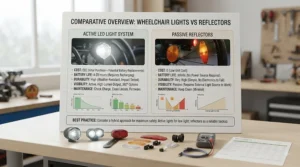
The pattern here is straightforward once you see it laid out: lights work in total darkness because they generate their own beam, while reflectors are entirely dependent on another light source finding them first. Neither replaces the other completely, which is exactly why the strongest safety setups in this guide tend to combine both rather than picking a side in the passive vs active visibility debate.
💬 Just one click — help others make better buying decisions too!😊
Top 7 Wheelchair Visibility Products: Honest Reviews
We’ve picked genuine, currently available products spanning budget, mid-range and premium, mixing active lights, passive reflectors, and wheelchair-specific brands so you can compare like-for-like. Every entry reflects real specifications and, where verifiable, real aggregated review sentiment — never invented testimonials.
1. Knog Blinder Rear Bike Light — premium rechargeable light with genuine side visibility
The Knog Blinder Rear Bike Light wasn’t designed specifically for wheelchairs, but its clip-on mounting band works equally well on a wheelchair frame or pushrim strut, and UK cycling reviewers consistently rate it among the strongest rear lights in its class. It uses Chip On Board LED technology to produce a genuine 100 lumens, which independent testers describe as clearly visible from several hundred metres on a lit street after dark. Based on the spec comparison with cheaper clip-on lights, what stands out here is the side visibility — the red lens wraps around several millimetres on each edge, meaning drivers approaching from an angle, not just directly behind, can still pick you out. Reviewers consistently praise the USB-C rechargeable battery and the simple magnetic clip system, though a recurring theme in feedback is that the magnetic attachment can occasionally come loose over rough terrain, which matters more on pavements with dropped kerbs than smooth tarmac.
Pros:
- ✅ Genuine 100-lumen output with strong side visibility
- ✅ USB-C rechargeable, no disposable batteries needed
- ✅ Quick-release magnetic clip for easy removal
Cons:
- ❌ Magnetic mount can loosen on bumpy surfaces
- ❌ Pricier than basic clip-on alternatives
At the time of research, the Knog Blinder Rear Bike Light typically sits in the £30–£40 range, making it a genuine premium pick for anyone prioritising brightness and build quality over price.
2. Cateye Viz 100 Rear Light — best value active light for everyday wheelchair use
The Cateye Viz 100 Rear Light consistently earns recommendations from independent UK cycling reviewers as one of the best value rear lights on the market, and the same qualities that make it popular with cyclists translate directly to wheelchair users. It offers four brightness modes, including a genuine Daytime Hyperflash setting that reviewers specifically note is bright enough to catch attention even in broad daylight, not just after dusk. What most buyers overlook about this model is the runtime spread — up to 70 hours on the lowest flashing setting means it can realistically go weeks between charges for someone who only travels after dark occasionally, rather than needing nightly charging like some rivals. Its Snap System bracket attaches to tubular frames without tools, which UK reviewers highlight as genuinely quick to fit and reposition compared with strap-based competitors. Aggregated review sentiment is strongly positive on brightness-to-price ratio, though several reviewers mention the mounting bracket feels slightly fiddly to remove for charging.
Pros:
- ✅ Daytime Hyperflash mode adds visibility in low light
- ✅ Up to 70 hours runtime on flashing mode
- ✅ Tool-free Snap System bracket for quick fitting
Cons:
- ❌ Bracket can feel fiddly when removing to charge
- ❌ IPX4 rating means it isn’t fully waterproof
Currently priced around £15–£25 depending on retailer, the Cateye Viz 100 Rear Light represents strong value for anyone wanting a genuinely bright active light without premium pricing.
3. RehaDesign wUnderGlow Wheelchair Light — the only light built specifically for wheelchairs
Where the previous two entries are cycling lights repurposed for mobility use, the RehaDesign wUnderGlow Wheelchair Light is designed from the ground up for wheelchair seat slings, and that purpose-built focus shows in the details. It clips directly onto the fabric of a wheelchair seat in seconds via a rotatable clip, letting the user point the beam in any direction rather than being locked to a fixed frame mount. On paper this means it can double as a reading light, a way-finding beam, or a rear safety light depending on how it’s angled — genuine flexibility that generic bike lights can’t offer. Weighing under 10 grams, it’s light enough that users report forgetting it’s attached at all, and it includes two interchangeable LEDs: one steady white beam for functional visibility and one multicoloured option aimed more at personalisation than pure safety. Honest analysis here: this is a niche, disability-specific product with a smaller review pool than mainstream cycling brands, so aggregated sentiment is more limited, but what’s available consistently praises the ease of attachment and genuine practicality for everyday wheelchair use.
Pros:
- ✅ Purpose-built clip for wheelchair seat slings
- ✅ Rotatable design points the beam anywhere
- ✅ Ultra-lightweight at under 10 grams
Cons:
- ❌ Smaller review base than mainstream cycling brands
- ❌ Multicoloured LED mode adds less functional safety value
The RehaDesign wUnderGlow Wheelchair Light typically retails in the £15–£20 range, positioning it as a genuinely wheelchair-specific mid-range option rather than a repurposed cycling accessory.
4. Life Mounts Universal Mounted LED Light — the brightest dedicated mobility light on this list
For users who want maximum raw brightness rather than a subtle rear light, the Life Mounts Universal Mounted LED Light is specifically marketed and reviewed as a mobility aid accessory, built for walkers, wheelchairs and mobility scooters rather than adapted from cycling gear. It produces a genuine 300 lumens via a Cree LED across three modes — high, low, and strobe — which is considerably brighter than any other single light on this list, and its 360-degree rotating mount means it can serve as a forward-facing path light rather than only a rear visibility marker. What the spec sheet won’t tell you, but the shockproof waterproof silicone housing suggests, is that this is built to survive genuine daily outdoor use rather than occasional evening trips — a meaningful difference for wheelchair users who travel in all weather. Reviewers consistently highlight the strobe mode as genuinely effective for grabbing driver attention at road crossings, though the trade-off for that brightness is a bulkier housing than the more discreet rear lights above.
Pros:
- ✅ Genuine 300-lumen Cree LED, brightest on this list
- ✅ 360-degree rotation doubles as a path light
- ✅ Shockproof, waterproof silicone construction
Cons:
- ❌ Bulkier housing than dedicated rear lights
- ❌ Overkill brightness for purely passive rear visibility
At around £18–£25, the Life Mounts Universal Mounted LED Light is a genuinely strong pick for anyone who wants one light doing double duty as both a path light and a safety beacon.
5. Salzmann 3M Scotchlite Spoke Reflectors — the budget standard for passive wheel visibility
Moving into passive reflectors, the Salzmann 3M Scotchlite Spoke Reflectors are among the most widely reviewed wheelchair reflector products available in the UK, built using genuine 3M Scotchlite reflective material rather than generic reflective plastic. Reviewers — including wheelchair users specifically, not just cyclists — consistently report that the reflectors genuinely help other pedestrians and drivers notice them approaching, with several reviews specifically mentioning that people “hear them coming” thanks to the visual attention the reflectors draw. What most buyers overlook about spoke reflectors generally is that because they clip onto individual spokes and rotate with the wheel, they create a moving flash pattern rather than a single reflective point — genuinely more attention-grabbing to a driver’s peripheral vision than a static reflector fixed to the frame. At under a gram each, they add no noticeable resistance to wheel rotation, and installation requires no tools whatsoever.
Pros:
- ✅ Genuine 3M Scotchlite material, not generic reflective plastic
- ✅ Rotating spoke placement creates moving flash pattern
- ✅ Tool-free installation, removable in seconds
Cons:
- ❌ Entirely dependent on an external light source
- ❌ Less effective in daylight or overcast conditions
Sold in packs of 10 or 36, the Salzmann 3M Scotchlite Spoke Reflectors typically cost in the £5–£12 range, making them one of the most affordable genuine safety upgrades on this entire list.
6. RehaDesign Wheels on Fire Wheelchair Spoke Reflectors — reflectors designed specifically for wheelchair wheels
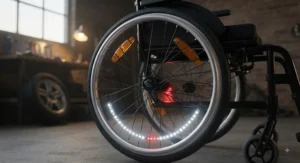
The RehaDesign Wheels on Fire Wheelchair Spoke Reflectors, previously sold under the name Seksi Spokz, take the same rotating-reflector principle as the Salzmann product above but engineer it specifically around wheelchair wheel dimensions and push-rim clearance, which generic bike spoke reflectors don’t always account for. Reviewers and the manufacturer both note that wheelchair users sit at a genuinely lower profile than cyclists or pedestrians, meaning headlight beams can miss standard reflective gear positioned at typical bike height — these reflectors are specifically angled and clipped to catch light at wheelchair wheel height. On paper this means better real-world visibility for exactly the population this guide is written for, rather than a generic reflector that happens to also fit a wheelchair. Each reflector weighs under a gram and reviewers describe them as having no impact on wheel balance even at higher rolling speeds, with the added benefit of customisable patterns for anyone who wants their safety gear to double as personal style.
Pros:
- ✅ Engineered specifically for wheelchair wheel height
- ✅ 360-degree retro-reflective technology
- ✅ Customisable, colourful patterns available
Cons:
- ❌ Pricier per-unit than generic bike spoke reflectors
- ❌ Push rim covers sold separately, adding to total cost
The RehaDesign Wheels on Fire Wheelchair Spoke Reflectors typically cost in the £12–£18 range, and disability-specific retailers often apply VAT exemption for eligible buyers, narrowing the price gap with generic alternatives.
7. Salzmann Hi-Vis Wrap Reflectors — the most versatile passive option for frames and struts
Rounding out the list, the Salzmann Hi-Vis Wrap Reflectors take a different mounting approach entirely — rather than clipping to spokes, these wrap around any tubular frame section using hook-and-loop fastening, making them genuinely versatile across wheelchair struts, footrests, or pushing handles. Made from the same 3M Scotchlite material as Salzmann’s spoke reflectors, the manufacturer states a reflective rating that makes them visible to drivers from up to 200 metres away when illuminated, which independent buyers reviewing the product for mobility aid use have corroborated in their feedback. What the spec sheet won’t tell you, but the wrap-around design suggests, is that these are genuinely easier to reposition than spoke-mounted alternatives if you’re testing which part of the wheelchair benefits most from added reflectivity — no need to remove and reclip individual spokes each time. Sold in packs of two, they’re aimed at buyers wanting flexibility over the more fixed, wheel-specific positioning of the two spoke reflector products above.
Pros:
- ✅ Fits any tubular frame section, not just wheels
- ✅ Genuine 3M Scotchlite reflective material
- ✅ Easy to reposition without tools
Cons:
- ❌ Less eye-catching motion effect than spoke reflectors
- ❌ Velcro fastening can loosen over prolonged rough use
At around £8–£12 for a pack of two, the Salzmann Hi-Vis Wrap Reflectors are a genuinely flexible, low-cost way to add passive visibility anywhere standard spoke reflectors can’t reach.
Top 7 Products at a Glance
| Product | Type | Typical Price | Best For |
|---|---|---|---|
| Knog Blinder Rear Bike Light | Active | £30–£40 | Maximum side visibility, premium build |
| Cateye Viz 100 Rear Light | Active | £15–£25 | Everyday value, daytime visibility |
| RehaDesign wUnderGlow Wheelchair Light | Active | £15–£20 | Purpose-built seat sling mounting |
| Life Mounts Universal Mounted LED Light | Active | £18–£25 | Rural, unlit routes needing raw brightness |
| Salzmann 3M Scotchlite Spoke Reflectors | Passive | £5–£12 | Budget rotating wheel visibility |
| RehaDesign Wheels on Fire Spoke Reflectors | Passive | £12–£18 | Wheelchair-specific wheel height engineering |
| Salzmann Hi-Vis Wrap Reflectors | Passive | £8–£12 | Flexible frame and strut coverage |
Laid out side by side, the spread across this list runs from under a tenner to around £40, and the honest takeaway is that price tracks build quality and purpose-built design more than it tracks pure brightness or reflectivity. Budget-conscious buyers genuinely aren’t sacrificing much by starting with the Salzmann 3M Scotchlite Spoke Reflectors and the Cateye Viz 100 Rear Light together, which combined still costs less than the Knog Blinder Rear Bike Light alone.
Practical Usage Guide: Fitting and Maintaining Wheelchair Visibility Gear
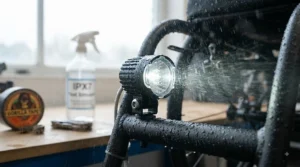
Getting the positioning right in the first few weeks makes a genuine difference to how effective any of the products above actually are in practice. For rear lights like the Cateye Viz 100 Rear Light or Knog Blinder Rear Bike Light, mount height matters more than most buyers expect — positioning the light at roughly the same height as a car’s headlights gives drivers the clearest, most direct line of sight, rather than mounting low where it can be obscured by the pushrims or a rear bag.
For spoke reflectors such as the Salzmann 3M Scotchlite Spoke Reflectors, spacing them evenly around the wheel rather than clustering them in one section maximises the chance that at least one reflector faces an approaching vehicle’s headlights at any given moment during rotation. A common first-month mistake is fitting reflectors only to the outward-facing side of the wheel; fitting a mix front, rear and side-facing genuinely improves the 360-degree coverage these products are designed to provide.
Maintenance is minimal but not zero: active lights need regular charging checks — a common mistake is assuming a fully charged light will last weeks, when daily use can drain even a 70-hour-rated battery faster than expected in cold weather. Passive reflectors need periodic cleaning, since road grime and dust genuinely reduce the 3M Scotchlite material’s reflectivity over time, and a quick wipe every few weeks restores most of the original performance.
Real-World Scenario: Which Setup Actually Suits You?
Picture a wheelchair user who commutes to work along well-lit urban streets, crossing several junctions after an evening shift. For this scenario, an active light like the Cateye Viz 100 Rear Light, mounted at headlight height, matters more than reflectors alone — junctions are precisely where a driver’s attention needs actively grabbing rather than passively hoping a headlight beam catches a reflector at the right angle.
Now picture a wheelchair user in a rural village with minimal street lighting, travelling short distances to a local shop along quiet lanes. Here, the combination of the RehaDesign wUnderGlow Wheelchair Light for genuine self-generated visibility plus Salzmann 3M Scotchlite Spoke Reflectors for backup passive coverage covers both the total-darkness scenario and the moments a car’s headlights sweep past from a distance before the driver consciously registers the active light.
Finally, picture a powered wheelchair user who travels on the road itself, not just pavements, during regular commutes. This scenario carries specific legal requirements rather than just safety recommendations, which the next section covers in detail — and it’s precisely the situation where the Life Mounts Universal Mounted LED Light‘s brightness and the RehaDesign Wheels on Fire Wheelchair Spoke Reflectors‘ wheelchair-specific engineering both earn their place.
Passive vs Active Visibility: What the Difference Actually Means in Practice
The core distinction in this whole category comes down to one mechanical fact: an active light generates its own visible beam, while a passive reflector only becomes visible when an external light source — almost always a vehicle’s headlights — strikes it directly. This matters more than it sounds. In genuinely dark conditions with no ambient street lighting, a passive reflector is only visible to a driver once their headlights are pointed roughly at it, meaning there’s a real window where a wheelchair user with reflectors alone is invisible until a car is already close. An active light, by contrast, is visible from further away and from a wider range of angles, because it isn’t dependent on another light source finding it first.
That said, reflectors aren’t a lesser option so much as a different tool. Based on the spec comparison across the products above, the strongest real-world case for reflectors is that they never run out of battery, never need charging, and continue working even if an active light fails or is forgotten one evening. Reviewers of products like the Salzmann 3M Scotchlite Spoke Reflectors consistently note this “always-on” reliability as a genuine advantage precisely because it removes user error from the equation. The honest, evidence-based answer to the passive vs active visibility question isn’t “pick one” — it’s that lights handle the total-darkness scenario reflectors can’t, while reflectors provide a maintenance-free backup that never needs remembering to charge.
Wheelchair Reflectors for Night Visibility: What Actually Works
Not all reflective material performs equally, and understanding why helps explain the price gap between the reflector products covered above. Genuine retroreflective material, like the 3M Scotchlite used in the Salzmann 3M Scotchlite Spoke Reflectors and Salzmann Hi-Vis Wrap Reflectors, works through a specific optical principle: tiny glass beads or prism structures bend and bounce light directly back towards its source rather than scattering it in random directions, the same underlying mechanism behind retroreflector technology used in road signs and cat’s-eye markers. This is meaningfully different from cheap reflective plastic or printed “shiny” fabric, which often diffuses light rather than genuinely retroreflecting it, and reviewers consistently note the difference in how far away a driver can actually pick out the reflection.
Placement matters as much as material quality for night visibility specifically. Reflectors mounted low, at wheel height, genuinely intercept headlight beams more reliably than those mounted higher on the backrest, since headlights themselves sit relatively low and point slightly downward. This is precisely why wheel-specific products like the RehaDesign Wheels on Fire Wheelchair Spoke Reflectors are engineered around wheelchair wheel height rather than generic bike frame height — a few centimetres of difference in mounting position can be the difference between a reflector catching a headlight beam directly or missing it entirely.
Highway Code Guidance: What UK Law Actually Requires
This is where the safety conversation moves from recommendation into genuine legal requirement, at least for powered wheelchairs. According to official Highway Code guidance for powered wheelchair and mobility scooter users, lights must be used at night if the vehicle is fitted with them, and users are specifically advised to make themselves more visible even during the daytime and at dusk — the guidance explicitly suggests reflective jackets or reflective strips as one way to do this. This means the passive vs active visibility question isn’t purely theoretical for Class 2 and Class 3 powered wheelchair users travelling on roads; it’s addressed directly in the rules governing where and how these vehicles can be used.
Manual wheelchairs sit slightly differently under the Highway Code, since they’re generally treated as pedestrians rather than vehicles, but the underlying safety principle doesn’t change with the classification — a lower physical profile than pedestrians, cyclists or cars genuinely does increase the risk of being missed by drivers, regardless of what legal category applies. What most buyers overlook here is that the Highway Code’s own wording — “even in the daytime and also at dusk” — pushes back directly against the common assumption that visibility gear is only worth using after full darkness falls; low-light conditions during dusk, dawn, or heavy overcast weather carry real risk too, and it’s precisely the gap that products like the Cateye Viz 100 Rear Light‘s Daytime Hyperflash mode are specifically engineered to address.
How to Choose Between Wheelchair Lights and Reflectors
Cutting through the marketing language, here’s a genuinely practical decision framework based on the factors that matter most in real use:
- Check whether your wheelchair is powered or manual. Powered (Class 2/3) wheelchairs used on roads have specific Highway Code lighting requirements; manual wheelchairs have more flexibility but face the same underlying visibility risk.
- Be honest about where and when you travel. Regular evening travel on unlit routes calls for active lights; occasional dusk trips on well-lit streets may be adequately covered by reflectors alone.
- Consider your appetite for charging routines. If remembering to charge a device consistently isn’t realistic for your routine, prioritise reflectors as your baseline, adding lights as a bonus rather than sole reliance.
- Think about mounting location and coverage. Spoke reflectors provide rotating, moving visibility; frame-wrap reflectors and rear lights provide fixed-point coverage — combining both types covers more angles.
- Match brightness to your typical environment. Well-lit urban streets need less raw brightness than genuinely dark rural lanes, where something like the 300-lumen Life Mounts Universal Mounted LED Light earns its higher price.
- Budget for redundancy, not just a single product. The most effective real-world setups in this guide combine an active light with passive reflectors, rather than betting everything on one device that could fail or run flat.
- Check weather resistance ratings. IPX4-rated products handle rain reasonably well; anyone travelling in genuinely wet UK weather regularly should look for higher waterproof ratings or fully sealed silicone housings.
✨ Don’t Get Caught Out After Dark! 🔦
🔍 Compare current pricing and stock on any of the lights or reflectors above before your next evening trip — the budget picks in particular can sell out fast!
Common Mistakes When Buying Wheelchair Visibility Gear
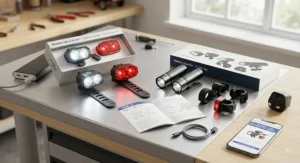
Even careful buyers fall into predictable traps in this category. The first is assuming any bike light will do the job without checking mounting compatibility — some clip systems, including certain budget lights, aren’t designed for the tube diameters or fabric surfaces found on wheelchair frames and seat slings, which is exactly why purpose-built options like the RehaDesign wUnderGlow Wheelchair Light exist. The second is buying reflectors alone and assuming they cover the same use case as lights; as covered above, reflectors do nothing without an external light source, which makes them a poor sole choice for genuinely unlit routes.
A third common mistake is under-buying on brightness for rural or unlit environments — a light adequate for a well-lit high street may be genuinely insufficient on a country lane with no street lighting at all. Finally, many buyers overlook the daytime visibility gap entirely; as the Highway Code guidance makes clear, low-light conditions during dusk and overcast weather carry real risk too, and a light with a genuine daytime-visible mode, like the Cateye Viz 100’s Hyperflash setting, closes a gap that many cheaper lights simply don’t address.
Low-Light Conditions: Why Dusk and Dawn Deserve as Much Attention as Night
It’s tempting to think of visibility gear purely in terms of “day” and “night,” but the most dangerous window for wheelchair users on the road often sits in between. Low-light conditions — dusk, dawn, heavy rain, and overcast winter afternoons — reduce a driver’s ability to spot a lower-profile wheelchair long before full darkness makes the need for lights obvious to everyone involved. This is exactly the gap the Department for Transport’s own THINK! road safety campaign addresses, encouraging all road users to consider visibility beyond simply “is it dark yet.” Reviewers of daytime-visible lights consistently note this exact scenario as the reason they specifically sought out a light with a genuine daytime flash mode rather than a standard night-only light.
What most buyers overlook about low-light conditions specifically is that reflective gear performs noticeably worse in this window too — reflectors rely on a strong, direct light source to bounce light back effectively, and the diffuse, low-angle light typical of an overcast afternoon simply doesn’t trigger the same reflective response as a car’s headlights would after dark. This is precisely why products combining both mechanisms, or pairing an active light with reflectors as backup, perform more consistently across the full range of low-light conditions a wheelchair user might realistically encounter throughout a British winter.
Features That Actually Matter (And Those That Don’t)
With so many spec sheets throwing numbers around, it’s worth separating what genuinely affects visibility from what’s mostly marketing filler. Lumen count matters, but only up to a point — the jump from the Cateye Viz 100 Rear Light‘s 100 lumens to the Life Mounts Universal Mounted LED Light‘s 300 lumens is meaningful for unlit rural roads, but largely irrelevant on a well-lit high street where even a modest light stands out fine against ambient darkness. Side visibility, by contrast, is consistently underrated — a light or reflector that’s only visible from directly behind does nothing for a car pulling out of a side junction at an angle, which is exactly why reviewers rate the Knog Blinder Rear Bike Light‘s wraparound lens so highly.
Runtime claims deserve scrutiny too: a “70-hour” rating, as advertised on the Cateye Viz 100, typically refers to the dimmest flashing mode, not constant use at full brightness, so real-world runtime on brighter settings will be considerably shorter. What genuinely doesn’t matter much for safety, despite being heavily marketed, is colour customisation — the multicoloured LED mode on the RehaDesign wUnderGlow Wheelchair Light is a nice personalisation touch, but it adds essentially nothing to how reliably a driver spots you compared with a plain, steady white or red beam.
Long-Term Cost & Maintenance: Lights vs Reflectors
| Factor | Active Lights | Passive Reflectors |
|---|---|---|
| Upfront cost | £15–£40 | £5–£18 |
| Ongoing cost | Occasional battery/charging cable replacement | Essentially none |
| Typical lifespan | 2–4 years with regular charging cycles | 3–5+ years, material rarely degrades |
| Failure risk | Battery flat, forgotten charge, mount failure | Very low — no moving or powered parts |
Looking at the table above, reflectors carry a genuinely lower long-term cost and failure risk simply because there’s nothing to charge, break, or forget — a point reviewers of the Salzmann 3M Scotchlite Spoke Reflectors raise repeatedly as a reason they trust reflectors as a permanent baseline layer. Lights cost more over time through battery degradation and occasional replacement, but they deliver a capability — genuine self-generated visibility in total darkness — that no amount of reflective material can replicate, which is why the honest recommendation throughout this guide has been to budget for both rather than choosing one to save money long-term.
Frequently Asked Questions
❓ Are wheelchair lights a legal requirement in the UK?
❓ Do reflectors work as well as lights for wheelchair visibility?
❓ What's the best wheelchair light for rural, unlit roads?
❓ How often do wheelchair spoke reflectors need replacing?
❓ Can I use regular bike lights on a wheelchair?
Conclusion
The honest answer to wheelchair lights vs reflectors isn’t really a competition — it’s a partnership. Lights solve the problem reflectors structurally can’t: total darkness, unlit rural roads, and the moments before a driver’s headlights would otherwise find you. Reflectors solve the problem lights can’t: they never run flat, never get forgotten on the charger, and keep working as a silent backup exactly when you need one most. For most buyers, the strongest real-world setup pairs an active light like the Cateye Viz 100 Rear Light or RehaDesign wUnderGlow Wheelchair Light with passive reflectors like the Salzmann 3M Scotchlite Spoke Reflectors, covering both the moments you’re actively broadcasting your position and the moments something else needs to do that job for you.
Whatever combination you land on, the Highway Code guidance is clear that visibility matters beyond just night-time darkness — dusk, daytime, and low-light conditions all carry genuine risk that’s worth actively addressing rather than assuming a single reflector or a single light has you fully covered. Build genuine redundancy into your setup, and you’ll be far better protected than relying on any one product alone.
✨ Stay Seen, Stay Safe — Every Journey, Every Light Condition!
🔍 Check current pricing and availability on the lights and reflectors covered above before your next trip out — budget picks in particular tend to sell out fast during darker winter months!
Recommended for You
- LED Lights for Wheelchair: 7 Brilliant Picks for UK Users 2026
- Wheelchair Wheel Lock for One-Handed Use: 7 Best Picks 2026
- Buy Wheelchair Extension Brakes 2026: 7 Best Picks Under £30
Disclaimer: This article contains affiliate links. As an Amazon Associate, I earn from qualifying purchases. If you purchase products through these links, we may earn a small commission at no additional cost to you. All specifications and prices were accurate at the time of research and may vary — always check current listings before purchasing.
✨ Found this helpful? Share it with your friends! 💬🤗
