
In This Article
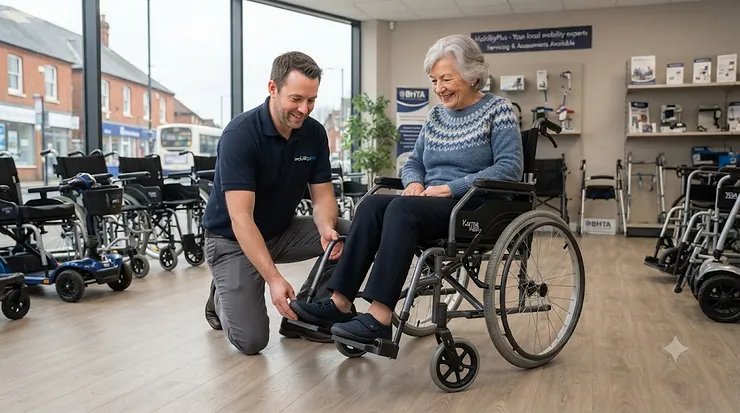
Here’s a little secret the wheelchair brochures never quite admit: the part that decides whether your day runs smoothly is rarely the frame, the wheels or the upholstery. It’s the bit at the front, and the swing-away vs elevating footrests question sits right at the heart of it. Those unglamorous hangers and plates decide whether you can slide onto a bed without clipping a shin, whether your ankles balloon by teatime, and whether the car boot closes on a folded chair or a fight. 🚗
So the debate over swing-away vs elevating footrests matters far more than its dull name suggests. One camp swears by simplicity: a fixed-angle plate that pivots aside in a second. The other camp needs the leg rest to rise, because of a cast, a swollen ankle, a stiff knee or a clinician’s instruction. And here’s the twist. Plenty of modern hangers do both, which is precisely where the confusion starts.
This guide is written for UK buyers who want straight answers. We’ll look at how swing-away footrests for manual wheelchairs behave in daily life, what genuinely changes for side transfers when you pick one design over another, how far leg elevation for circulation can be trusted from a wheelchair seat, and why footrest locking mechanisms deserve far more attention than they usually get. As the Karma Mobility UK guide to choosing a wheelchair leg rest explains, the wrong leg support can lead to discomfort, back strain and even pressure problems, so this is not a cosmetic decision.
A quick word on method. Everything below is grounded in manufacturer specifications, published guidance and retailer listings. I haven’t tested any of these products myself, and I’ll say so plainly whenever a detail couldn’t be verified. Where I’m reasoning from the spec sheet rather than reporting a fact, you’ll see phrases like “on paper”. Right, let’s start with the cheat sheet. ⚡
What Is the Difference Between Swing-Away vs Elevating Footrests?
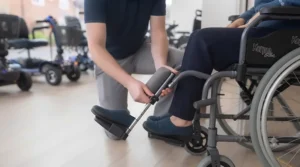
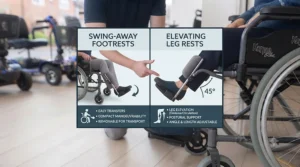
The short answer: swing-away footrests are fixed-angle leg supports that pivot sideways or detach so the front of the seat is completely clear. Elevating footrests, usually called leg rests, add an adjustable hinge and a calf pad so the legs can be raised from bent to nearly straight. Many models combine both features, swinging away and elevating.
That’s the textbook version. In daily life, the split is really about what you need your legs to do. A plain footrest consists of a hanger and a footplate; a leg rest adds calf support and an adjustable angle. According to MobilityBasics, standard footrests come in 60, 70 and 90 degree angles, while leg rests can be set at any angle between about 70 degrees and fully level with the seat, with calf pads to support the lower leg when raised.
Quick Comparison Table: Swing-Away vs Elevating Footrests at a Glance
Availability on amazon.co.uk changes constantly, and several of these are sold through third-party sellers, so treat the table as a shortlist rather than a shop window. Price tiers are indicative only; please check current price before you commit.
| Product | Type | Swings Away? | Elevates? | Price Tier | Best For |
|---|---|---|---|---|---|
| Drive Medical Swing-Away Footrests | Fixed 90° | Yes | No | Budget | Everyday use, daily transfers |
| Invacare T93HCP Hemi Footrest | Fixed, hemi | Yes | No | Budget to mid | Lower-seat Invacare chairs |
| Drive Medical LK3JELR Swing-Away Elevating Leg Rests | Elevating | Yes | Yes | Mid-range | Drive chairs with occasional swelling |
| Invacare T94HCP Elevating Legrests | Elevating, 17″–21″ | Yes | Yes | Mid to premium | Regular elevation on Invacare chairs |
| Invacare Hemi Smartleg AHL4A | Articulating, 17″–25″ | Yes | Yes, self-lengthening | Premium | Taller users, stiff knees |
| Vive Elevating Wheelchair Footrests | Elevating, 2-pack | Check listing | Yes | Mid-range | Padded calf support on a budget |
| OZTYSGXM Universal Elevating Leg Rest | Universal, 90°–180° | Check listing | Yes | Budget | Standard chairs, cost-conscious buyers |
Looking at the comparison above, the two fixed models are the simplest answer if your legs never need lifting, while the Invacare Hemi Smartleg AHL4A is the specialist pick for anyone whose legs simply don’t fit a conventional length. The OZTYSGXM Universal Elevating Leg Rest and the Vive Elevating Wheelchair Footrests tempt with flexibility, but universal parts put the burden of checking fit squarely on you. Notice, too, that every branded model here swings away, so “elevating” and “swing-away” are not opposites, they’re two separate features that often arrive in the same package.
💬 Just one click — help others make better buying decisions too!😊
Top 7 Swing-Away vs Elevating Footrests for Manual Wheelchairs: Expert Analysis
Before we start, a caution that applies to every entry. Footrests attach to a wheelchair through hinge brackets with a specific spacing, and a part that doesn’t match will never lock properly. I’ve flagged each model’s compatibility notes where the manufacturer states them. Review sentiment is reported only where I could verify it; otherwise I tell you what to look for instead.
1. Drive Medical Swing-Away Footrests — no-frills workhorse for daily transfers
The Drive Medical Swing-Away Footrests (model STDS3J24SF) are what most people picture when they hear “wheelchair footrest”: fixed, sturdy and pleasantly boring.
Key specs matter here. These are fixed at 90 degrees, made with aluminium hangers, plastic footplates and heel loops, and the height is adjustable to fit different leg lengths. In practice, a 90 degree hanger keeps your feet tucked directly beneath your knees, which is the most compact footprint for turning in narrow hallways. MobilityBasics notes that 90 degree footrests are optimal for turning radius. Drive lists compatibility with the Blue Streak, Silver Sport 1 and 2, Cruiser III, Cirrus IV and Viper series, so check your model before ordering.
On paper, this is the sensible default for anyone who transfers daily and doesn’t need elevation. The absence of a calf pad means your lower legs get no support, so it suits shorter outings better than all-day sitting. If your GP or therapist has suggested raising your legs, look further down the list.
On reviews, I couldn’t verify a large enough UK-specific pool to summarise fairly. My advice is to scan the reviews on your listing for fitment comments, since those matter more than the star average with replacement parts.
Pros:
- ✅ Fixed 90° keeps the chair compact
- ✅ Aluminium build with height adjustment
- ✅ Heel loops stop feet sliding backwards
Cons:
- ❌ No elevation for swelling or casts
- ❌ Fitment limited to listed Drive models
Budget tier, so good value if you only need swing-away footrests for manual wheelchairs and nothing fancy. Check current price.
2. Invacare T93HCP Hemi Footrest — composite plates for lower-seat chairs
The Invacare T93HCP Hemi Footrest trades plain plastic for a composite footplate, and that small choice quietly matters.
The listing describes a hemi footrest with a composite footplate and heel loop, sold as a pair. “Hemi” refers to the bracket spacing and hanger geometry designed for lower-seat-height chairs, which means your feet sit closer to the floor than on a standard setup. That’s handy if you propel with your feet or have shorter legs, but it also means less ground clearance over kerbs and door thresholds. Invacare’s related T94 family targets Tracer and 9000 Series chairs, so verify T93 fitment on your exact model rather than assuming.
My analysis: this is the tidy choice if you already own a compatible Invacare and want a like-for-like replacement, not a redesign. Composite footplates typically wipe clean easily, which helps anyone dealing with muddy pavements or accidental tea spills.
On reviews, I couldn’t verify enough independent UK feedback to summarise, so I won’t guess. Check the reviews for comments about heel loop durability and hinge stiffness, the two spots where fixed footrests usually wear first.
Pros:
- ✅ Composite footplate wipes clean easily
- ✅ Heel loop keeps feet secure
- ✅ Hemi geometry suits lower seats
Cons:
- ❌ Reduced ground clearance on rough surfaces
- ❌ No calf support or elevation
Budget to mid tier. It’s fair value as a direct replacement, less so if you’ll later need elevation. Check current price.
3. Drive Medical LK3JELR Swing-Away Elevating Leg Rests — elevation without losing quick-release simplicity
The Drive Medical LK3JELR Swing-Away Elevating Leg Rests are the classic “do both” compromise: they swing aside for transfers and lift when your legs need a rest.
Retailer descriptions highlight a textured non-skid plastic footplate and nylon calf pads, with compatibility across Drive’s Blue Streak, Silver Sport, Chrome Sport, Cruiser III, Cirrus IV and Viper ranges. The calf pad is the important bit, because it spreads the load along your lower leg instead of concentrating it at the heel. One trade-off worth knowing: elevating leg rests tend to be heavier than standard footrests, which matters when you’re lifting a folded chair into a car.
Here’s what to weigh. If you live with intermittent swelling or a recovering injury, having elevation on demand beats permanently living with a fixed angle. If you never actually raise the rests, you’re hauling extra weight for nothing.
On reviews, I couldn’t verify enough recent UK feedback to report a pattern. Look for comments on lever stiffness and whether the calf pads keep their shape.
Pros:
- ✅ Elevates and swings away in one part
- ✅ Padded calf support for longer sitting
- ✅ Non-skid footplate surface
Cons:
- ❌ Heavier than fixed footrests
- ❌ Compatibility limited to listed Drive chairs
Mid-range tier. Reasonable value if you’ll genuinely use the elevation. Check current price.
4. Invacare T94HCP Elevating Legrests — tool-free, adjustable, and well documented
The Invacare T94HCP Elevating Legrests win points for something rare in this category: a proper user manual.
Specs first. These come as a left and right pair with composite footplates, padded vinyl calf pads and a length range of roughly 17 to 21 inches, adjustable without tools. The 1.5 inch spacing between swing-away hinge brackets suits Invacare chairs including the Tracer EX2, SX5 and several 9000 Series models. In practice, the tool-free length adjustment means you can fine-tune leg length in seconds, which helps when different family members share a chair.
The manual also states you should push the legrest firmly until the locking mechanism engages, and suggests silicone lubricant on stiff pivot points. That level of maintenance guidance is exactly what makes footrest locking mechanisms less mysterious.
On paper, this is a strong pick for regular elevation on an Invacare chair. The catch is that the manufacturer says compatibility with other brands isn’t guaranteed. Reviews weren’t verifiable in enough volume for a fair summary, so read the fit-related ones closely.
Pros:
- ✅ Tool-free length adjustment (17″–21″)
- ✅ Clear manual and maintenance advice
- ✅ Swings away for transfers or standing
Cons:
- ❌ Fit guaranteed only for Invacare chairs
- ❌ Vinyl calf pads can feel warm
Mid to premium tier. Good value if it matches your chair, poor value if it doesn’t. Check current price.
5. Invacare Hemi Smartleg AHL4A — the leg rest that grows as it rises
The Invacare Hemi Smartleg AHL4A solves a problem most buyers don’t realise they have until they raise a conventional leg rest and feel their heels dangling.
It’s an articulating design with aluminium footplates and padded calf pads, and it lengthens automatically as it elevates, with an extension range of roughly 17 to 25 inches. The physics explains why. As MobilityBasics points out, when your knee straightens, the leg length from spine to sole actually increases, so a rest set correctly while lowered ends up too short when raised. Articulating designs compensate automatically.
My take: if you’re tall, have a stiff knee or plan to elevate for long periods, this is the technically correct answer to leg elevation for circulation rather than a compromise. If you’ll only ever lift your legs briefly, the extra sophistication is overkill.
I couldn’t verify reliable UK review data, so I’m not reporting any. Check reviews for comments about smoothness of movement and whether the length compensation matches taller users.
Pros:
- ✅ Lengthens automatically as it elevates
- ✅ Wide 17″–25″ extension range
- ✅ Swings away for transfers
Cons:
- ❌ Highest cost of the seven
- ❌ Compatibility centred on Invacare Tracer and 9000 Series
Premium tier, and justified for tall users and long elevation sessions. Check current price.
6. Vive Elevating Wheelchair Footrests — padded calf support in a value 2-pack
The Vive Elevating Wheelchair Footrests are sold as a two-pack with padded calf pads, positioned as a replacement part for wheelchairs.
I want to be upfront: the listing information I could verify is thin on dimensions, weight limits and hanger spacing. What’s clear is the padded calf support and the elevating design. Since replacement parts live or die on bracket fit, your first job is to measure your chair’s hinge spacing and compare it with the listing. Several universal-style listings elsewhere quote around 1.46 inch spacing and exclude heavy-duty chairs, so don’t assume yours is compatible.
Based on the spec comparison, this suits someone with a standard manual chair who wants elevation and calf support without paying for a branded set. It’s less suited to bariatric users or anyone needing documented, chair-specific compatibility.
Reviews couldn’t be verified in enough quantity for a fair summary. Read the recent ones for mentions of lock security and calf-pad slippage.
Pros:
- ✅ Padded calf pads for longer sitting
- ✅ Elevating design for swelling or casts
- ✅ Value-oriented two-pack format
Cons:
- ❌ Thin verified specs on fit and weight limits
- ❌ You must confirm bracket spacing yourself
Mid-range tier. Fair value only after you’ve confirmed it fits. Check current price.
7. OZTYSGXM Universal Elevating Leg Rest — widest angle range at a budget price
The OZTYSGXM Universal Elevating Leg Rest stands out for its stated adjustable angle of 90 to 180 degrees, which covers everything from seated-normal to legs fully extended.
The listing also mentions a padded footrest, easy-clean materials and compatibility with most standard wheelchairs, sold as a pair. That angle range is broader than many fixed-angle designs, so you can tune elevation to a cast, a sore knee or a simple need to stretch. What the marketing won’t tell you is that full extension changes the wheelchair’s overall length dramatically, which affects turning space in older UK homes with narrow doorways.
The analytical view: a sensible experimental purchase for standard chairs where the cost of an official branded set is a barrier. The trade-off is fewer guarantees. Universal parts require you to check hinge spacing, weight limits and whether the part swings away smoothly on your chair.
I couldn’t verify a reliable review pool, so I’m not summarising one. Look for feedback on lock reliability at higher angles, because that’s where cheap mechanisms show their limits.
Pros:
- ✅ Wide 90°–180° adjustable range
- ✅ Padded footrest with easy-clean finish
- ✅ Budget-friendly universal design
Cons:
- ❌ Fit and lock quality need checking
- ❌ Extended legs lengthen the chair significantly
Budget tier. Good value if it fits, wasted money if it doesn’t. Check current price.
How to Choose Between Swing-Away vs Elevating Footrests
Picking between swing-away vs elevating footrests is easier as a sequence of questions than a leap of faith. Work through these seven steps in order.
- Ask what your legs need. If your legs are healthy and you never elevate, a fixed swing-away hanger is usually enough. If a clinician has mentioned swelling, a cast or limited knee movement, elevation moves up the list.
- Match the angle to your space. 90 degree hangers keep the chair short. 60 degree hangers push your feet forward, which helps with long legs and rough ground clearance but lengthens the chair, as MobilityBasics explains.
- Check the bracket spacing. Hemi spacing and standard spacing are not interchangeable. Measure before you order.
- Consider transfer frequency. If you transfer five times a day, a quick-release, one-handed swing-away mechanism is worth more than an extra ten degrees of elevation.
- Weigh the weight. Elevating leg rests tend to be heavier than fixed ones, so factor in how often you lift the chair.
- Think about length range. Taller users should look for extension ranges like the 17 to 25 inch spread on articulating models.
- Involve a professional. An occupational therapist or wheelchair services assessor can confirm what’s clinically appropriate, especially if pressure care is involved.
Here’s the honest shortcut: if you can answer “no” to steps 1 and 6, choose fixed swing-away. If you answer “yes” to both, look at articulating designs. Everyone in between should compare the standard elevating models.
Swing-Away vs Elevating Footrests for Side Transfers
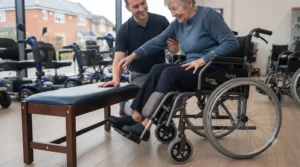
Nothing tests footrests quite like a bed, a toilet or a car seat. Every wheelchair transfer guide I found says the same thing in slightly different words: lock the brakes, then swing away or remove the footrests on the side you’re transferring to, so your feet don’t become tangled in the pivot path.
What changes for side transfers
Fixed swing-away footrests are typically light, quick to release and easy to operate with one hand, so they make side transfers straightforward. Elevating versions swing away too, but their extra length and weight mean a slower, more deliberate release. GTK’s UK-facing guidance on power chairs notes that swing-away legrests can be easier for a user to release independently than centre-mount designs, so the mechanism matters as much as the label.
Which one wins?
For frequent, independent transfers, the lighter fixed swing-away wins on speed and simplicity. For assisted transfers where a carer is helping, elevating models are perfectly workable because someone else handles the release.
| Feature | Fixed Swing-Away | Elevating (Swing-Away) |
|---|---|---|
| Release speed | Fast, one hand | Slower, heavier |
| Weight | Lighter | Heavier |
| Circulation support | None | Adjustable |
| Chair length | Short | Longer when raised |
| Best For | Daily independent side transfers | Swelling, casts, assisted care |
In this comparison, the fixed models take the crown for independent users, but the gap narrows a lot with a well-designed mechanism. If your transfers are assisted and your legs need lifting, the elevating column wins outright. The real mistake is assuming heavier means safer; a stiff release that you dread using invites shortcuts.
Leg Elevation for Circulation: What Elevating Footrests Can and Can’t Do
Let’s separate marketing from physiology. Retailers often claim that elevating the legs reduces inflammation and promotes blood flow. That’s reasonable as far as it goes, and the British Heart Foundation does recommend raising the legs above the level of the heart to help fluid drain from swollen ankles and feet. But there’s a wrinkle wheelchair users deserve to know about.
The height problem
To reach heart level from a seated position, your legs need to rise a long way, and a standard elevating leg rest on an upright chair usually won’t get there. A vascular clinic blog makes a related point: if your knees are bent and your ankles sit below them, the benefit is limited to the knee and above. So on paper, a leg rest raised to horizontal helps, but it isn’t equivalent to lying down with your feet on pillows.
Practical guidance
Use elevating leg rests as one tool in a broader plan, alongside movement, position changes and any compression advice from your clinician. Keep the leg straight only if it’s comfortable, because a fully locked-out knee can create its own strain. Persistent, sudden or one-sided swelling deserves medical attention, and the BHF notes it can sometimes signal a heart, kidney or circulatory problem.
This is where articulating designs earn their keep: by lengthening as they rise, they avoid the awkward hanging heel that pulls on your knee and undermines the whole exercise. Talk to your GP or therapist before relying on any product for a medical purpose.
Footrest Locking Mechanisms Explained
Footrest locking mechanisms are the unsung heroes of this whole category. A footrest that pivots freely is a footrest that will eventually swing into your shin or your doorframe.
The three mechanisms you’ll meet
Hanger pin and bracket. The swing-away hanger drops onto a pin in the frame and is held by a latch. On Drive-style parts, the latch often sits on the top tube. Invacare’s manual tells users to push firmly until the locking mechanism engages, which is your audible or tactile confirmation that it’s secured.
Elevation lever or ratchet. Elevating leg rests use a lever, ratchet or clamp to fix the angle. This is the mechanism to scrutinise, because it’s carrying your leg weight at angles that put leverage on the joint.
Height-adjustment collars. Push buttons or clamps adjust length. Loose ones cause the footplate to slowly creep downwards over a day.
How to test any lock
Give the footrest a firm sideways shove with the latch engaged. It shouldn’t move. Then lift it slightly; it shouldn’t rise off its pin. Finally, raise the elevating leg rest to your preferred angle and press down gently on the calf pad. If it creeps, stop using it. According to the Invacare guidance, stiff pivots can be treated with a little silicone-based lubricant, which is a cheap fix compared with a replacement.
✨ Don’t Miss These Exclusive Deals!
🔍 Take your footrest upgrade to the next level with these carefully selected products. Click on any highlighted item to check current pricing and availability. These parts will help you create a safer, more comfortable seating setup your whole household will appreciate!
Practical Guide: Fitting, Adjusting and Maintaining Your Footrests
This is the transformation section Amazon listings never give you. Treat it as a first-month checklist.
Setup in six steps
- Measure first. Note your hinge bracket spacing, seat-to-footplate distance and knee-to-heel length before ordering.
- Attach and confirm. Seat the footrest and push until it locks. Check both sides.
- Set the length. Your knees and hips should sit at roughly the same level, as manufacturer instruction booklets advise, with the footplate supporting the weight of your foot and lower leg.
- Test the swing. Swing each footrest away and back ten times. It should return to the same position every time.
- Test the lock. Apply the sideways shove test described above.
- Never stand on them. Manufacturer guidance is clear that footrests aren’t designed for standing.
Maintenance schedule
Weekly: wipe footplates and calf pads with a damp cloth and mild soap. Monthly: check for loose bolts, worn heel loops and stiff pivots. Every few months: apply silicone lubricant to pivot points if they stiffen. Store spare parts dry and clean.
Common mistakes in the first 30 days
Over-tightening height collars, forgetting to re-check the lock after transporting the chair, and using a wet cloth on electrical or foam parts. Also, don’t mix universal parts on heavy-duty chairs. The Mobility Shop UK guide to safe wheelchair transfers has a useful reminder that footrests should be out of the way before any transfer begins, which is a habit worth building from day one.
Real-World Scenarios: Which Footrests Fit Which Life?
Let’s put the theory to work with three profiles.
Scenario 1: The independent commuter
Imagine someone who self-propels, transfers between chair, car and desk chair six times daily, and lifts a folded chair into a boot. Every kilo and every second counts. The Drive Medical Swing-Away Footrests or Invacare T93HCP Hemi Footrest are the logical pair, depending on the chair brand, because they’re light, fast and compact.
Scenario 2: The post-operative recovery
Now picture someone recovering from ankle surgery for six to eight weeks, being pushed by a family member, told to keep the leg elevated. Assisted transfers mean the extra weight isn’t a problem. The Drive Medical LK3JELR Swing-Away Elevating Leg Rests or Invacare T94HCP Elevating Legrests make sense, with the article’s earlier caveat that a leg rest alone won’t reach heart height.
Scenario 3: The tall long-term user with knee stiffness
A tall user who elevates daily and has a stiff knee is exactly who the Invacare Hemi Smartleg AHL4A was designed for. The self-lengthening action avoids constant readjustment, and the 17 to 25 inch range covers taller leg lengths. A budget alternative like the OZTYSGXM Universal Elevating Leg Rest is tempting, but the stiff-knee scenario makes lock reliability at wide angles too important to gamble on.
Common Mistakes When Buying Swing-Away vs Elevating Footrests
These pitfalls show up over and over in guidance from suppliers and therapists.
- Assuming universal means universal. Many listings state that compatibility with other brands isn’t guaranteed. Check the bracket spacing.
- Buying elevation “just in case”. The extra weight is a daily cost. If you’ll never raise your legs, a fixed swing-away is the smarter purchase.
- Ignoring leg length changes. A rest set for a bent knee will be too short once the leg straightens. Articulating designs fix this.
- Overlooking the weight limit. Universal listings often exclude heavy-duty and bariatric chairs.
- Choosing on looks. A sleek footplate that’s slippery in the rain is worse than a plain one with a textured surface.
- Skipping professional advice. Karma’s UK guidance warns that the wrong leg support can contribute to pressure problems and secondary injury.
Long-Term Cost & Maintenance: Price Range and Value Analysis
Let’s talk money without pretending to know tomorrow’s prices. The bands below are indicative, based on how these parts are typically positioned, and you should check current price on the listing.
| Product | Indicative Band | Ongoing Upkeep | Best For |
|---|---|---|---|
| Drive Medical Swing-Away Footrests | Budget, roughly under £60 | Low: wipe, check loops | Daily transfers |
| Invacare T93HCP Hemi Footrest | Budget to mid, roughly £40–£100 | Low: clean composite plates | Lower-seat Invacare users |
| Drive Medical LK3JELR Swing-Away Elevating Leg Rests | Mid, roughly £70–£150 | Medium: lever and calf pads | Occasional elevation |
| Invacare T94HCP Elevating Legrests | Mid to premium, roughly £100–£200 | Medium: lubricate pivots | Regular elevation |
| Invacare Hemi Smartleg AHL4A | Premium, roughly £150–£300 | Medium: check articulation | Tall users |
| Vive Elevating Wheelchair Footrests | Mid, roughly £60–£140 | Medium: check calf pads | Padded budget elevation |
| OZTYSGXM Universal Elevating Leg Rest | Budget, roughly under £80 | Medium: check locks often | Standard chairs |
The value story is about cost per useful day. A budget fixed pair that you use daily for years is cheaper per use than a premium articulating set you only raise twice a month. Conversely, if your legs need daily elevation, paying more for the Invacare Hemi Smartleg AHL4A or Invacare T94HCP Elevating Legrests buys comfort and documentation. Buyers of the OZTYSGXM Universal Elevating Leg Rest or Vive Elevating Wheelchair Footrests should budget a little extra time for fit-checking, which is its own kind of cost.
Safety, Regulations and Compliance in the UK
Wheelchairs and their components are medical devices in the UK, and reputable products carry UKCA or CE marking in line with the relevant regulations. That doesn’t guarantee a random universal replacement part will suit your chair, so treat compliance markings as a starting point, not a substitute for fit-checking.
Practical safety habits
- Always lock the brakes before any transfer, and swing away the footrests on the transfer side.
- Wear non-slip footwear during transfers, because socks on hard floors are a recipe for falls.
- Use manufacturer parts where possible, particularly if your chair is on loan from NHS wheelchair services. Changing components on a loaned chair may need approval, so ask your service first.
- If pressure care is a concern, involve an occupational therapist rather than self-diagnosing.
When to ask for help
If you have limited sensation, existing pressure damage, fluctuating tone or complex postural needs, a professional assessment is worth far more than any buying guide, this one included. Nothing here is medical advice.
FAQ
❓ Can I fit elevating footrests to any manual wheelchair?
❓ Are elevating footrests heavier than swing-away footrests?
❓ How high should I raise my legs for swelling?
❓ Why won't my swing-away footrest lock into place?
❓ Can I remove wheelchair footrests for car travel?
Conclusion
So, swing-away vs elevating footrests: which wins? Neither, and both. If your legs behave themselves and transfers fill your day, a fixed swing-away like the Drive Medical Swing-Away Footrests or Invacare T93HCP Hemi Footrest is light, quick and quietly brilliant. If swelling, a cast or knee stiffness enters the picture, the elevating models step up: the Drive Medical LK3JELR Swing-Away Elevating Leg Rests and Invacare T94HCP Elevating Legrests for regular use, and the Invacare Hemi Smartleg AHL4A for tall users who need the rest to grow as it rises. The Vive Elevating Wheelchair Footrests and OZTYSGXM Universal Elevating Leg Rest offer budget flexibility, provided you do the fit-checking homework.
Remember the three lessons that matter most. First, side transfers reward light, fast release. Second, leg elevation for circulation is helpful but rarely equals lying down. Third, footrest locking mechanisms deserve a proper test every time you refit them. Everything else is detail.
Before buying, measure your brackets, check compatibility, and ask a professional if your needs are complex. Then choose the setup that fits your body and your day, not the one with the loudest listing.
Recommended for You
- Best Wheelchair Footrests: 7 Proven UK Picks for 2026
- Wheelchair Umbrella for Wind Resistance: 7 Best Picks (2026)
- Hands-Free Wheelchair Umbrella: 7 Best Picks for UK Weather (2026)
Disclaimer: This article contains affiliate links. As an Amazon Associate, I earn from qualifying purchases. If you purchase products through these links, we may earn a small commission at no additional cost to you.
✨ Found this helpful? Share it with your friends! 💬🤗
