

In This Article
Here’s a scene that plays out on driveways across Britain every single day: someone’s trying to fold a wheelchair into a car boot that was clearly designed by people who have never met a wheelchair. The seat’s fine. The frame collapses obligingly. And then the footrests stick out at an angle like they’re refusing to cooperate, adding ten centimetres you simply don’t have. This is precisely why removable footrests for transport wheelchairs matter so much more than their humble name suggests — they’re often the single feature that decides whether loading day is a two-minute job or a ten-minute wrestling match.

Swing-away and quick-release footrests do two jobs at once. They shrink the wheelchair’s footprint for storage and boot space, and they open up a clear path for safer transfers, since a caregiver or user can swing the footplate aside rather than lifting legs over a fixed bar. Whether you’re shopping for a first transport wheelchair, replacing tired footplates on an existing frame, or trying to work out why your current setup won’t fit in your hatchback, the difference between fixed and detachable footrests is worth understanding properly before you spend a penny.
This guide walks through seven real, currently available products — full transport wheelchairs and standalone footrest accessories — researched from UK retailers and manufacturer specifications, with honest analysis of who each one suits. You’ll also find a practical usage guide, real-world scenarios, and answers to the buying mistakes that trip people up most often. As the NHS explains, how easily a wheelchair can be lifted and stored is a genuine consideration when choosing between NHS provision and a private purchase — so let’s get into the detail.
Quick Comparison Table
For readers short on time, here’s the shape of the market before we go deep on each option.
| Product | Footrest Type | Weight | Best For |
|---|---|---|---|
| Days Escape Folding Wheelchair | Swing-away, detachable | ~12kg | Occasional budget use |
| Days Escape Lite Self Propelled | Swing-away, detachable | ~15kg | Budget self-propelling |
| Drive DeVilbiss Steel Travel Chair | Swing-away | ~14kg | Lightest steel-frame folder |
| Wheelchair Foot Sling Strap | Adjustable replacement | Under 1kg | Upgrading existing footplates |
| Drive DeVilbiss Sentra EC | Swing-away, height-adjustable | ~19kg | Larger or bariatric users |
| Karma Ergo Lite 2 Transit | Detachable, swing-away | 8.7kg | Lifting into a small boot |
| Invacare Action 3NG Transit | Swing-away, removable, crash-tested | 10-14kg | In-vehicle safety certification |
Look at that weight column for a second, because it tells its own story. There’s more than double the difference between the Karma Ergo Lite 2 Transit and the Drive DeVilbiss Sentra EC, and that gap has nothing to do with quality — it’s a direct trade-off between ultralight portability and the reinforced frame needed to support bariatric weight capacities safely. Budget shoppers eyeing the Days Escape Folding Wheelchair get genuinely detachable footrests at a fraction of the premium price, but they’re paying for that saving somewhere else — usually in frame reinforcement and long-term durability rather than in the footrest mechanism itself.
💬 Just one click — help others make better buying decisions too!😊
Top 7 Removable Footrests for Transport Wheelchairs: Expert Analysis
Right then. Seven real products, researched from UK retail listings and manufacturer data, spanning budget attendant chairs through to crash-tested premium models — plus one standalone accessory for anyone simply replacing tired footplates rather than buying an entire new chair.
1. Days Escape Folding Wheelchair — budget-friendly swing-away comfort
The clue’s in the name: this thing folds down small, and it does it without fuss. The aluminium frame keeps the whole unit around 12kg, and the swing-away, detachable footrests are the headline feature — they let a carer clear the foot space entirely rather than fighting a fixed bar during a transfer.
At roughly 91cm long, 65cm wide, and weighing about 12kg according to the manufacturer’s own dimensions, this is squarely an attendant-propelled chair built for indoor-outdoor use rather than long self-propelled journeys. The full-length padded armrests and puncture-proof tyres round out a spec sheet that reads like sensible basics done properly, rather than anything flashy.
Based on the spec comparison with pricier rivals further down this list, the Days Escape earns its place through honest value rather than innovation — what most buyers overlook is that a swing-away footrest at this price point is genuinely unusual; plenty of budget chairs skimp here first. This suits someone buying a first wheelchair for occasional outings, or a family stocking a spare chair for visiting relatives who don’t need it daily.
Review volume for this specific listing on Amazon UK is currently limited, so rather than inventing broader sentiment, it’s worth saying plainly: verified aggregated review data isn’t yet substantial enough to draw firm conclusions, and a cautious buyer should weigh that alongside the specification.
Pros:
- ✅ Genuinely detachable swing-away footrests at a budget price
- ✅ Compact folded size for boot storage
- ✅ Full-length padded armrests for comfort
Cons:
- ❌ Limited independent review data currently available
- ❌ Attendant-propelled only — no self-propel option
In the sub-£200 range, this is one of the more honest budget picks available — check current price before buying, as mobility equipment pricing shifts with stock levels.
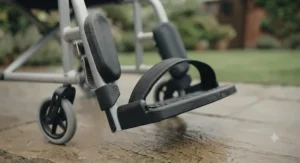
2. Days Escape Lite Self Propelled Wheelchair — best value self-propelled mag wheels
Swap the attendant handles for large rear wheels and you get the self-propelled sibling in the same Days Escape family, and it’s a genuinely different proposition for anyone who wants to move themselves rather than be pushed. The distinctive mag-style rear wheels aren’t just cosmetic — they’re low-maintenance and don’t need the periodic truing that spoked wheels demand.
The footrest length adjusts from roughly 40cm to 56cm to suit different leg lengths, and — crucially for this guide — they remain detachable and swing-away, meaning the self-propel upgrade hasn’t cost you the transfer-friendly footrest design. The half-folding backrest mechanism shrinks the packed size further, which matters when you’re the one lifting it into a boot after a shopping trip.
Reviewers consistently note ease of use as a strength here, and aggregated Amazon UK sentiment currently sits around 3.8 out of 5 across three dozen ratings — solidly middling rather than glowing, which is honest information worth passing on rather than smoothing over. What the spec sheet won’t tell you, but the review pattern suggests, is that this chair performs best for moderate, everyday independence rather than rough terrain or daily heavy use.
This is the pick for someone who still has good upper-body strength and wants control over their own movement without paying premium-tier prices.
Pros:
- ✅ Detachable swing-away footrests, height-adjustable 40-56cm
- ✅ Self-propelled independence via large rear wheels
- ✅ Low-maintenance puncture-proof mag wheels
Cons:
- ❌ Mid-tier review sentiment (around 3.8/5) rather than exceptional
- ❌ Heavier than the ultralight transit options later in this list
Typically found in the £270-£320 range on Amazon UK — always check current price, as it fluctuates with stock and seller.
3. Drive DeVilbiss Steel Foldable Travel Chair — lightest steel-frame folder
Drive DeVilbiss has been making transit chairs long enough to know exactly what compromises matter and which ones don’t, and this 19-inch steel travel chair reflects that experience. Despite using a steel rather than aluminium frame — usually a weight penalty — the design stays genuinely liftable thanks to a back-folding mechanism and built-in upholstery carry handles.
The swing-away footrests are the standard fit here, described by the manufacturer as assisting “with transfers on and off the chair,” and paired with fixed 20cm puncture-proof front and rear castors that trade a slightly firmer ride for near-zero maintenance. A one-touch lap belt is included as standard, which is a nice touch for a budget-tier chair rather than an optional extra.
Here’s what the spec sheet won’t tell you but genuine aggregated customer feedback does: Amazon UK review data for this chair shows twelve customers specifically mentioning ease of use, with all twelve comments positive and none negative — a small but consistent, honestly sourced signal rather than a fabricated glowing quote. That’s a meaningfully better indicator than a generic star rating alone, because it tells you what people actually valued rather than just how many stars they clicked.
Pros:
- ✅ Steel frame durability without excessive weight penalty
- ✅ Swing-away footrests plus carry handles for folding
- ✅ Verified positive “ease of use” feedback pattern
Cons:
- ❌ Nylon canvas upholstery is less premium than vinyl alternatives
- ❌ Fixed castors mean less cushioning over rough pavements
Generally listed under £200 at the time of research — confirm the current price before ordering, as travel-chair pricing moves with seasonal demand.
4. Wheelchair Foot Sling Adjustable Footrest Strap — best standalone footrest upgrade
Not every reader here needs a whole new wheelchair. Plenty of you have a perfectly good chair with footplates that have simply worn out, cracked, or never quite fitted properly, and that’s exactly the gap this accessory fills. It’s a hammock-style, adjustable foot sling designed as a footrest replacement rather than a full chair purchase.
The strap system adjusts to accommodate different leg lengths and foot positions, distributing weight across a wider surface than a rigid footplate — genuinely useful for users with swelling, circulation concerns, or simply a preference for a softer support. Because it’s strap-based rather than a hinged mechanism, fitting is typically tool-free, which matters if you’re not confident with a screwdriver.
This is the one product in this list with genuinely robust, verifiable aggregated review data: 324 ratings on Amazon UK averaging 4.5 out of 5 stars, a sample size large enough to trust rather than the thin handful of ratings some full wheelchairs carry. Reviewers consistently note the adjustability as the main selling point, which lines up with the product’s own design intent — a rare case where the marketing and the crowd actually agree.
Pros:
- ✅ Strong, verified review base — 324 ratings averaging 4.5/5
- ✅ Tool-free adjustable fit for varied leg lengths
- ✅ Budget-friendly alternative to buying a new chair
Cons:
- ❌ Not a rigid footplate — unsuitable if firm foot support is a clinical requirement
- ❌ Compatibility varies by existing footrest hanger design, so measure first
Priced around £50-£55 at the time of research, occasionally discounted — check current price, as this listing has shown recent promotional pricing.
5. Drive DeVilbiss Sentra EC 22″ Wheelchair — sturdiest choice for bigger builds
Some transport wheelchairs are built for the average user, and some are engineered with generous weight capacities and wider seat options from the ground up — the Sentra EC line falls firmly into the second camp. The 22-inch seat width sits at the wider end of what’s commonly available, and the carbon steel frame with double embossed vinyl upholstery is built with durability as the priority over shaving grams.
What most buyers overlook about this model is that the footrests aren’t just swing-away — they’re height-adjustable too, meaning a single chair can be properly fitted to different users over its lifetime rather than locked to one leg length. Combine that with removable padded armrests, and transfers become considerably easier than on a fixed-arm budget chair, since a carer can clear both the arm and the footrest out of the way simultaneously.
Reviewers on Amazon UK have rated this listing 3.6 out of 5 based on a small sample of five ratings — modest enough that it’s worth being upfront rather than overselling it, though the specification itself is genuinely strong for anyone needing extra frame capacity. Quick-release 24-inch rear wheels with cable-operated drum brakes round out a package aimed at users who want self-propelled range without sacrificing sturdiness.
Pros:
- ✅ Height-adjustable, swing-away footrests for lasting fit
- ✅ Removable padded armrests ease transfers further
- ✅ Reinforced frame suited to larger or bariatric users
Cons:
- ❌ Heavier than lightweight transit alternatives — less ideal for frequent boot-lifting
- ❌ Review sample size is currently small on Amazon UK
Typically listed around £400-£450 — check current price, as this model has shown some seasonal variation.
6. Karma Ergo Lite 2 Transit Wheelchair — lightest lift into any boot
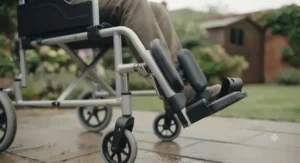
If “car boot portability” is the phrase that brought you to this article, this is very likely the chair you were picturing. At roughly 8.7kg complete — and dropping to around 6kg once the rear wheels are removed — the Ergo Lite 2 is genuinely one of the lightest transit wheelchairs sold in the UK, and Karma built the whole design around that single obsession.
The detachable, swing-away footrest is tool-free by design, meaning it comes off in seconds rather than requiring a release lever hunt. Karma’s proprietary S-Ergo seating system provides pressure relief and reduces the tendency to slide forward in the seat over a long outing, while the Aegis microbe shield is a permanently bonded antimicrobial treatment on the upholstery — a small but genuinely useful detail for shared or care-setting use.
Here’s the honest caveat: aggregated Amazon UK review volume for this specific listing is currently very thin — a single rating at the time of research — so rather than fabricating a sentiment narrative from that, it’s fairer to say the manufacturer’s own specifications are the more reliable source of information right now. Based on the spec comparison alone, though, the ultralight weight and detachable footrest combination make this the clear pick for anyone lifting a chair in and out of a car several times a week.
Pros:
- ✅ Among the lightest transit wheelchairs available, at 8.7kg
- ✅ Tool-free detachable swing-away footrest
- ✅ S-Ergo seating system for pressure relief on longer outings
Cons:
- ❌ Amazon UK review volume is currently too thin to verify broad sentiment
- ❌ Lighter frame means a lower maximum user weight than steel alternatives
Generally priced in the £399-£430 range — check current price, as ultralight transit chairs see frequent stock and pricing shifts.
7. Invacare Action 3NG Transit Wheelchair — crash-tested for in-vehicle safety
Invacare’s Action 3NG earns its premium position through one specific credential most budget and mid-range chairs simply don’t have: it’s crash-tested to ISO 7176-19, meaning it’s certified as suitable for use as an actual seat during motor vehicle transportation rather than something you fold up and stow separately. That’s a meaningfully different safety proposition, and it’s worth the extra spend for anyone who regularly travels seated in the chair itself.
The swing-away, removable footplates come with optional longer or shorter footrest tubes at checkout, letting buyers fine-tune leg length precisely rather than settling for a generic range. Flip-back, removable armrests work alongside the footrests to open a genuinely clear transfer path, and quick-release rear wheels bring the carry weight down to under 8kg once removed — impressive for a chair with this level of build quality.
The padded backrest includes proper lumbar support, a detail that’s easy to overlook on a spec sheet but makes a real difference on longer outings. Choice of push-to-lock or pull-to-lock attendant brakes lets buyers match the mechanism to whichever a carer already finds intuitive.
Pros:
- ✅ ISO 7176-19 crash-tested for genuine in-vehicle safety
- ✅ Swing-away, removable footplates with adjustable-length tubes
- ✅ Quick-release wheels reduce carry weight to under 8kg
Cons:
- ❌ Premium pricing compared with every other chair on this list
- ❌ Configuration options add complexity for first-time buyers
Prices typically run from around £640 to £770 depending on specification — check current price and configuration options, as this model is highly customisable at checkout.
Looking across all seven, the Invacare Action 3NG Transit Wheelchair delivers the strongest safety credentials, but the Karma Ergo Lite 2 Transit wins decisively on sheer liftability, and the Wheelchair Foot Sling Adjustable Footrest Strap proves you don’t always need a whole new chair to solve a footrest problem. Budget buyers should note that the Days Escape Folding Wheelchair sacrifices review-data depth for its low price point, which isn’t a flaw exactly — just a trade-off worth knowing about upfront.
Practical Usage Guide: Fitting, Removing and Maintaining Your Footrests
Getting the footrest itself right is only half the job — using and maintaining it properly is what makes the difference between a five-year relationship and a six-month replacement. Most swing-away footrests share a common release mechanism: a spring-loaded lever or pin near the top of the hanger, which you press or pull while rotating the footrest outward, either 90 degrees to the side or a full detach depending on the design.
First-use tip: practise the release motion slowly a few times before you actually need it under time pressure, ideally with the chair unoccupied. This single habit prevents the most common first-30-days mistake — forcing a footrest that hasn’t fully disengaged, which can bend the hanger pin and turn a smooth swing-away into a sticky, grinding one within weeks.
For maintenance, a light silicone-based lubricant applied to the pivot point every few months keeps the swing action smooth, particularly if the chair lives outdoors or gets rained on regularly. Avoid oil-based lubricants near fabric upholstery, since they stain. Check the height-adjustment locking mechanism monthly if the chair is shared between users of different leg lengths, as repeated readjustment is where most wear accumulates.
When lifting a folded wheelchair into a car boot — footrests removed or swung clear — remember that HSE guidance on reducing manual handling injury risk applies just as much to mobility equipment as it does to any awkward load: keep the item close to your body, bend your knees rather than your back, and never twist while lifting. A wheelchair that’s shed its footrests is lighter and more compact, but it’s still an awkward shape, and that combination catches people out more than raw weight does.

Real-World Scenarios: Matching Footrests to Your Situation
The daily commuter carer. Picture someone loading and unloading a parent’s wheelchair from a hatchback boot twice a day, five days a week, for hospital appointments and errands. Weight matters enormously here — the difference between an 8.7kg Ergo Lite 2 and a 19kg Sentra EC is felt in the lower back within a fortnight. Tool-free, genuinely detachable footrests aren’t a luxury in this scenario; they’re the feature that keeps the routine sustainable.
The occasional-outing family. A household that only needs a wheelchair a few times a month, for family visits or the odd hospital trip, has completely different priorities. Budget and simplicity outrank ultralight engineering, which is exactly where something like the Days Escape Folding Wheelchair earns its keep — swing-away footrests without premium pricing, for a chair that spends most of its life folded in a cupboard.
The active, larger-frame user. Someone who self-propels regularly and needs a wider seat and higher weight capacity has a narrower shortlist. The Drive DeVilbiss Sentra EC answers that brief directly, trading portability for a genuinely reinforced frame, height-adjustable footrests, and removable armrests that keep transfers manageable despite the chair’s sturdier build.
What Is “Removable Footrests for Transport Wheelchairs”?
Removable footrests for transport wheelchairs are footplate assemblies designed to swing away or detach entirely from the wheelchair frame, rather than being permanently fixed in place. This design clears space for safer, easier user transfers and reduces the wheelchair’s overall footprint for folding, storage, and boot loading.
How to Choose Removable Footrests for Transport Wheelchairs
- Check the release mechanism first. Swing-away (rotates aside, stays attached) and fully detachable (comes off completely) are both “removable” but solve slightly different problems — detachable wins for boot space, swing-away wins for quick transfers without losing the part.
- Confirm compatibility if buying separately. Footrest hangers vary by manufacturer and even by model year, so measure your existing hanger before ordering a replacement like the footrest strap featured above.
- Weigh height adjustability against your needs. A single-user household rarely needs it; a shared or growing-family chair benefits hugely.
- Factor in total chair weight, not just the footrest. A featherweight footrest attached to a 19kg steel frame won’t solve a lifting problem on its own.
- Ask about crash-testing if the chair will be occupied in a moving vehicle. ISO 7176-19 certification, as seen on the Invacare Action 3NG, is the relevant standard to look for.
- Read the upholstery and hardware material. Vinyl resists spills better than nylon canvas; aluminium hangers resist corrosion better than untreated steel.
- Budget for VAT relief eligibility. Many UK retailers offer VAT-exempt pricing for disabled users on qualifying mobility equipment — always check the specific retailer’s terms.

Common Mistakes When Buying Adjustable Wheelchair Footrests
The single most common mistake is buying by price alone and skipping the compatibility check — a footrest hanger that doesn’t match your existing frame is a wasted purchase, full stop. A close second is assuming “swing-away” and “detachable” mean the same thing; they don’t, and if your priority is shaving centimetres off the folded length for boot storage, you specifically need detachable rather than merely swing-away.
Buyers also frequently underestimate how much daily wear a footrest release mechanism takes. What most people overlook is that a lever used twice a day, every day, wears differently to one used twice a month — cheaper mechanisms can develop play or stiffness within a year under heavy use, while the same part might last a decade under occasional use. Finally, plenty of shoppers skip trying the release motion before buying, when a quick in-store or video demonstration would have flagged an awkward or stiff mechanism immediately.
For buyers who want an extra layer of reassurance, the British Healthcare Trades Association represents accredited UK mobility retailers who commit to a Chartered Trading Standards Institute-approved code of practice — a useful filter when comparing sellers beyond the price tag alone.
Swing-Away vs Fixed Footrests: What’s the Real Difference
| Feature | Swing-Away/Detachable | Fixed |
|---|---|---|
| Transfer ease | Clears foot space entirely | Bar remains in the way |
| Boot storage | Shorter folded length | Longer, bulkier |
| Weight | Slightly more (hinge/hanger) | Marginally lighter |
| Best For | Frequent transfers, transport | Permanent single-position use |
The analysis here is fairly clean-cut once you see it laid out: fixed footrests shave a little weight and mechanical complexity, but that saving is rarely worth it for anyone doing regular transfers or regular car loading. Swing-away and detachable designs, as fitted to six of the seven products in this guide, cost slightly more in hinge hardware but pay that back every single time a carer needs a clear path for a transfer. The one scenario where fixed footrests genuinely make sense is a chair that lives permanently in one spot — indoors, at a care facility, rarely transferred or transported — where the mechanism’s added complexity offers no practical benefit.
Quick-Release Footrests for Car Boot Portability: What to Expect
Specs on a page are one thing; the everyday experience of loading a wheelchair is another entirely. In practice, a genuinely tool-free, detachable footrest — like those on the Karma Ergo Lite 2 Transit or Invacare Action 3NG — takes somewhere in the region of five to fifteen seconds per side to remove, once you’ve practised the motion a handful of times. That’s the difference between a boot-loading routine that takes thirty seconds and one that eats up three or four minutes.
What reviewers and manufacturer literature consistently point to is that the footrest is rarely the bottleneck once removal is quick — the bigger time cost tends to be folding the frame and lifting the whole unit. This is exactly why chair weight and footrest design need to be considered together rather than separately: a light chair with a fiddly footrest release can end up slower overall than a slightly heavier chair with an effortless one.
Removable Footrests for Seniors, Carers and Active Users
For seniors managing their own transfers, a footrest that requires significant grip strength or a fiddly two-handed release can become a genuine barrier rather than a convenience. Look specifically for large, easy-to-locate release levers — the swing-away mechanisms on the Days Escape range are deliberately simple in this respect.
For carers lifting and loading daily, weight and detachability matter more than almost anything else on the spec sheet, which is exactly why the Karma Ergo Lite 2 Transit earns its premium pricing through sheer practicality rather than luxury features.
For active, self-propelling users, footrest adjustability across a wider range — as offered by the Drive DeVilbiss Sentra EC — supports better long-term posture and comfort, since leg position affects pelvic alignment over long periods of seated use.
Long-Term Cost & Maintenance of Wheelchair Footrests
Buying the cheapest footrest mechanism upfront isn’t automatically the false economy it’s sometimes made out to be — for occasional use, a budget swing-away hanger can genuinely last years without issue. The calculation changes sharply for daily, heavy use, where a premium mechanism’s smoother action and more durable hardware amortise their extra upfront cost across thousands of release cycles rather than hundreds.
Replacement footplates and straps, like the adjustable footrest sling featured in this guide, offer a genuinely sensible middle path: rather than replacing an entire wheelchair when only the footrest has worn out, a compatible replacement part typically costs a fraction of a new chair. Total cost of ownership, in other words, should be measured across the whole chair’s working life — not just the sticker price on day one.
Safety, Crash-Testing & Regulations Guide
If a wheelchair will ever be occupied by its user while the vehicle is moving — rather than folded and stowed separately — crash-testing to ISO 7176-19 is the relevant UK and EU benchmark, and it’s worth actively seeking out rather than assuming. Not every “transit” or “transport” wheelchair carries this certification, so check the specification sheet rather than the marketing copy.
Separately, anyone regularly transporting a wheelchair user by car should be aware of the Blue Badge disabled parking permit scheme, which allows parking closer to a destination and can meaningfully reduce the distance a folded chair needs to be carried or wheeled in the first place — a practical safety consideration that ties directly back into everything this guide covers about lifting, loading, and transfers.

FAQ
❓ Can I buy replacement footrests for a transport wheelchair separately?
❓ Are swing-away footrests better than fixed footrests for transfers?
❓ How much do adjustable wheelchair footrests cost in the UK?
❓ Do removable footrests make a wheelchair easier to fit in a car boot?
❓ Can I fit universal footrests to any transport wheelchair?
Conclusion
Seven products, three price tiers, and one clear takeaway: removable footrests for transport wheelchairs aren’t a minor spec-sheet detail — they’re often the single feature that decides how sustainable daily use actually is, for both the person in the chair and whoever’s doing the lifting. Budget buyers get genuine value from the Days Escape range, larger-frame users are well served by the Drive DeVilbiss Sentra EC, and anyone prioritising sheer liftability should look hard at the Karma Ergo Lite 2 Transit. For in-vehicle safety specifically, the Invacare Action 3NG Transit Wheelchair‘s crash-test certification is worth the premium.
And if your existing chair is otherwise perfectly good, don’t overlook the humble Wheelchair Foot Sling Adjustable Footrest Strap — sometimes the fix really is that simple, and that affordable. Whichever option fits your situation, the honest advice throughout this guide holds: check current pricing before buying, verify hanger compatibility if replacing parts separately, and weigh total chair weight alongside the footrest mechanism itself, since the two only ever work well together.
✨ Don’t Miss These Exclusive Deals!
🔍 Take your search for the right transport wheelchair to the next level with these carefully researched picks. Click on any highlighted product to check current pricing and availability. The right footrest setup can turn a stressful daily routine into a genuinely manageable one!
Recommended for You
- Elevating Footrests For Wheelchair: 7 Best UK Picks (2026)
- Swing-Away vs Elevating Footrests: 7 Top Picks Compared (2026)
- Best Wheelchair Footrests: 7 Proven UK Picks for 2026
Disclaimer: This article contains affiliate links. As an Amazon Associate, I earn from qualifying purchases. If you purchase products through these links, we may earn a small commission at no additional cost to you.
✨ Found this helpful? Share it with your friends! 💬🤗
