
In This Article
A disassembling boot scooter for small cars is a pavement-legal, 4mph mobility scooter that splits into a handful of lighter pieces, usually seat, battery, basket, front and rear sections. Each piece can then be lifted into a supermini boot, instead of you wrestling one bulky machine through the tailgate.

Here’s the problem. A small car’s boot is a puzzle with a fixed number of pieces. A full-size scooter doesn’t solve it, however much you push, and a folding scooter only helps if you can lift the whole folded lump. A scooter that comes apart changes the sum: five or six awkward-but-manageable lifts instead of one impossible one.
The rules are simple. These are class 2 mobility scooters in the Department for Transport’s terms: built for pavements, capped at 4mph, with no registration required. That keeps them light, and lightness is what makes them boot-friendly.
I’ve compared seven real UK models using published manufacturer and retailer specifications, and used the numbers to answer one practical question: which of them will you actually be able to lift? Below you’ll find a quick comparison, a full analysis of each model, boot-measuring advice, a tiller removal walkthrough and the costs that don’t appear on the price tag.
Quick Comparison: Disassembling Boot Scooter for Small Cars at a Glance
| Model | Heaviest piece | Pieces | Listed range | Max user weight | Best For |
|---|---|---|---|---|---|
| Motion Healthcare Alumina | ~10kg | 7 | ~15 miles | 115kg | Easiest lifting, lone loaders |
| TGA Zest | ~12kg | 5 | 8-14 miles (battery-dependent) | 133-135kg | Comfort with suspension |
| ST1 Strider Micro | ~14kg | 2 or 5 | ~6 miles | 115kg | Tight budgets, short trips |
| Pride Apex Lite | ~15kg | 5 | ~8-10 miles | 136kg | Entry-level, tiller charging |
| Pride Go-Go Elite Traveller Plus | ~16kg | 5 | Varies by listing | 147kg | Heavier riders |
| Venture Boot Scooter | ~16kg | 5 | 12-13 miles | 130kg | Range and braking safety |
| I-Go Vertex Sport | ~14-20.7kg (listings differ) | 5 | ~15.5 miles | 130kg | Longer outings |
The table gives a clear lifting hierarchy. The Motion Healthcare Alumina and TGA Zest sit at the light end, with a 10-12kg heaviest piece. The Pride Go-Go Elite Traveller Plus and Venture Boot Scooter ask for 16kg in one hand-over-hand lift.
Range shows the usual trade-off. The scooters with the lightest pieces rarely have the biggest batteries, with the I-Go Vertex Sport and Venture Boot Scooter at the long-range end. Decide which constraint is harder for you, your back or your route, and the shortlist shrinks quickly.
💬 Just one click — help others make better buying decisions too!😊
Top 7 Disassembling Boot Scooter for Small Cars: Expert Analysis
Every figure below comes from manufacturer or retailer listings at the time of research. Where listings disagree, I say so rather than pick a favourite.
1. Motion Healthcare Alumina — lightest heaviest piece here
The aluminium chassis is the whole story. It brings the heaviest piece down to about 10kg, where several rivals ask for 15kg or more.
The scooter splits into seven pieces, weighs about 33kg in total, and measures roughly 900mm by 500mm. That’s noticeably shorter than the 1,000-1,080mm bodies of most competitors, which helps in tight boots and narrow hallways. Full front and rear suspension softens broken paving, and the rotating seat and adjustable armrests make transfers easier.
Based on the spec comparison, this is the model for anyone who loads alone or has shoulder or back problems. Seven pieces mean more steps, but each step is easier. The limit is the 115kg maximum user weight, the lowest in this group, so heavier riders should look elsewhere.
Independent customer-review volume is thin for this model. Retailer pages mostly repeat manufacturer data, so treat it as proven on paper but not yet on sentiment, and try before you buy if you can.
Pros:
- ✅ Lowest heaviest-piece weight in the group
- ✅ Full front and rear suspension
- ✅ Compact footprint for small boots
Cons:
- ❌ Lowest user weight limit at 115kg
- ❌ Seven pieces mean longer assembly
Price: around £2,200-£2,700 depending on VAT relief. It’s premium, and justified if lifting is your bottleneck.

2. TGA Zest — suspension in a boot scooter
Most boot scooters trade comfort for lightness. The TGA Zest keeps front and rear suspension on a frame that still splits into five pieces.
It measures about 1,050mm by 550mm and weighs roughly 50kg in total, with a listed heaviest piece of 12kg. The capacity is about 133-135kg. A rotating seat, curved delta handlebars and a headlight come as standard.
One detail the spec sheet buries: the long-range 22Ah battery box is about 4kg heavier than the 12Ah option, and range jumps from roughly 8 to 14 miles. Check which battery the “12kg” figure refers to before you buy. If you choose the big battery, budget for a heavier lift.
Reviewers on retail sites weren’t easy to verify here, so the case rests on the specifications. On paper, this is the sensible choice for pavements with cracks and kerb drops. A larger Zest Plus exists, but at around 74kg total it’s a different class of lifting.
Pros:
- ✅ Full suspension for rougher pavements
- ✅ Rotating seat eases transfers
- ✅ Choice of battery sizes and six colours
Cons:
- ❌ Larger battery adds noticeable lifting weight
- ❌ Heaviest-piece figure depends on battery choice
Price: around £1,200-£1,500. Good value for the comfort.
3. ST1 Strider Micro — cheapest way into boot scooting
If your budget is tight, the ST1 Strider Micro is the entry ticket. It splits into two large parts or five smaller ones, with the heaviest piece about 14kg and a total weight of around 40kg.
The 6-mile range is the headline compromise. That covers a town centre or a National Trust garden but not a long afternoon out. Puncture-proof tyres, anti-rollback and anti-tip systems cover the safety basics, and a three-height seat and adjustable delta tiller cover fit.
The caveats matter. One retailer’s listing for the Drive-branded version shows no suspension and no lights, and notes it as discontinued, so confirm stock and specification with your seller. Ground clearance is only about 30mm, so kerb drops need a gentle approach. The 115kg limit also rules out heavier riders.
Review data wasn’t easy to verify for this model, so judge it on what the spec sheet says: simple, lightweight and short-range.
Pros:
- ✅ Lowest entry price in this comparison
- ✅ Splits into two or five pieces
- ✅ Puncture-proof tyres, no flat-tyre worries
Cons:
- ❌ Only around 6 miles of range
- ❌ Low ground clearance, limited extras
Price: around £700-£900. Fine for short trips, but check availability.
4. Pride Apex Lite — charging point on the tiller
The Pride Apex Lite solves a problem most spec sheets ignore: charging. The socket sits on the tiller, so you don’t have to bend to a low plug point. The battery box also comes off, so the scooter can stay in the boot while the battery charges indoors.
It splits into five pieces, with the heaviest around 15kg. The scooter weighs about 36.9kg without batteries, and each 12Ah battery adds roughly 9kg. The capacity is 136kg, the body is about 1,020mm by 490mm, and the folding padded seat has a backrest pocket.
Listings disagree on range: some say 8-10 miles, others closer to 8.2. Take the lower figure as your planning number.
Taken together, this is a solid entry-level scooter for users who want a conventional layout and a familiar brand. Independent review volume was hard to verify, so the case rests on the practical design details.
Pros:
- ✅ Tiller-mounted charging socket saves bending
- ✅ 136kg capacity for the price
- ✅ Detachable battery for indoor charging
Cons:
- ❌ Modest range of roughly 8-10 miles
- ❌ No suspension listed
Price: around £800-£1,000. Strong value for a first boot scooter.
5. Pride Go-Go Elite Traveller Plus — highest weight capacity here
Where most boot scooters top out at 115-136kg, the Pride Go-Go Elite Traveller Plus supports 147kg (about 23 stone). Pride built it slightly longer and wider than the standard Go-Go Elite, and added a wraparound delta tiller for riders with limited grip or dexterity.
It comes apart into five pieces, with the heaviest around 16kg. The scooter weighs roughly 39kg with two 18Ah batteries included, and measures about 1,023mm by 540mm. The extra width gives a more stable ride, but it’s a little wider than rivals with 480-505mm bodies, so measure your boot opening.
Pride’s feather-touch disassembly is designed to be one-handed, and a front basket plus interchangeable red and blue panels come with it. Range varies between listings, so ask the retailer for the figure that matches the battery supplied.
Based on the specs, this is the right model for larger riders or anyone who needs the wraparound tiller. Independent reviews were hard to verify, so rely on the published figures.
Pros:
- ✅ Highest user weight capacity in the group
- ✅ Wraparound delta tiller for limited dexterity
- ✅ One-handed disassembly design
Cons:
- ❌ Slightly wider body than rivals
- ❌ Heaviest piece is 16kg
Price: around £1,100-£1,300. Worth it if you need the capacity.

6. Venture Boot Scooter — range and braking, with ratings to match
The Venture Boot Scooter (also sold under the Drive Scout Venture name) pairs long range with a thoughtful safety package: anti-tip rear wheels, anti-rollback and an automatic electromagnetic brake. For a small-car owner, the last one is the feature that stops a scooter running away if it’s left on a slope.
It splits into five pieces, with the heaviest around 16kg. It carries two 20Ah batteries, supports 130kg, and has a listed range of 12-13 miles. Ground clearance is about 63mm, noticeably better than the ST1 Strider Micro. Listings disagree on total weight (about 43kg to 49kg), so confirm with the seller before you plan your lifts.
The swivel seat turns a full 360 degrees, the armrests adjust, and the basket is removable. At the time of research, Argos showed a 4.75 out of 5 rating from 12 reviews. That’s a small sample, but encouraging.
Pros:
- ✅ 12-13 mile range for a boot scooter
- ✅ Automatic electromagnetic braking
- ✅ Better ground clearance than budget rivals
Cons:
- ❌ Listings disagree on total weight
- ❌ Heaviest piece is 16kg
Price: around £900-£1,000. Good value for the range.
7. I-Go Vertex Sport — hybrid pavement-and-boot comfort
The I-Go Vertex Sport sits between a boot scooter and a small pavement scooter. It splits into five pieces and offers all-round suspension, 8-inch wheels, a 20Ah battery and a listed range of around 15.5 miles.
The catch is weight. Listings quote a total of about 57.5-58kg, and the heaviest piece is quoted anywhere from about 14kg to just over 20kg depending on the source. That’s a big gap, so ask the retailer to confirm in writing before you commit. A wraparound delta tiller with paddle controls, an LED light and under-seat storage round out the package.
A retailer listing summarises a magazine review praising smooth, controlled indoor handling and good back support, though the magazine isn’t named. For riders who want more range and comfort and have a roomier boot, it’s a compelling option.
Pros:
- ✅ Longest listed range at about 15.5 miles
- ✅ All-round suspension and LED light
- ✅ Wraparound delta tiller with paddle controls
Cons:
- ❌ Heaviest-piece figure varies widely by listing
- ❌ Heaviest total weight in the group
Price: around £1,000-£1,250. Verify the heaviest piece before buying.
✨ Don’t Miss These Exclusive Deals!
🔍 Take your search for a disassembling boot scooter for small cars to the next level with these carefully selected models. Click on any highlighted product to check current pricing and availability. These scooters will help you keep your independence on every trip.
How to Choose a Disassembling Boot Scooter for Small Cars
The best choice depends on three things: what you can lift, what your boot can hold and how far you need to go. Work through these steps in order.
- Find your lifting limit first. Age Space’s buying advice points out that the heaviest piece is usually the battery, and that lighter batteries tend to mean shorter range. Be honest about the heaviest thing you can lift to boot height.
- Measure the boot, not just its litres. Opening width, floor depth and loading lip matter more than volume (see the next section).
- Match range to your routes. Add up your typical round trip and add a safety margin. Never plan around the manufacturer’s maximum figure.
- Check the user weight limit. Capacity runs from 115kg to 147kg in this group, and riding near the limit shortens range.
- Think about comfort. Suspension, tiller adjustability and seat height matter on a long outing, and less so for a five-minute shop run.
- Look at charging. Off-board charging or a tiller socket (as on the Pride Apex Lite) saves bending and lets you leave the frame in the car.

Car Boot Dimensions: Will It Fit a Small Car?
Car boot dimensions are where good intentions meet geometry. Litres tell you volume, not shape, and a scooter piece needs a specific footprint.
For context, carwow’s boot-space roundup lists the Renault Clio at 391 litres (non-hybrid), against 351 litres for the Volkswagen Polo, 335 for the Audi A1 and 311 for the Peugeot 208. Hybrids can lose space to the battery. The Clio E-Tech, for example, drops to 301 litres, according to CarGurus.
Those figures confirm that all these cars are small, but not that your scooter fits. Take a tape measure and record these five numbers:
- Width between the wheel arches
- Floor depth, from seat back to tailgate
- Height under the parcel shelf
- Opening width of the tailgate aperture
- Height of the loading lip
Compare them with the dimensions on the listing. The scooters here range from about 900mm (Motion Healthcare Alumina) to 1,080mm (Venture Boot Scooter and I-Go Vertex Sport) when assembled. Pieces are shorter, but the front section is usually the bulkiest. If you can, ask the retailer for the individual piece dimensions, and bring your own boot measurements to a demo.
Modular Boot Scooter for Compact Cars: A Boot Scooter That Splits Into Sections
A modular boot scooter for compact cars isn’t just a scooter with a few clips. The frame is engineered in sections, so the connections between them are the key design feature.
What “modular” really means
Retail guides typically describe the pieces as seat, battery, basket, front deck and rear section. Piece counts vary from five to seven in this group, and the ST1 Strider Micro goes further with a two-piece option. Pride’s feather-touch designs use an auto-connecting cable between front and rear, so there’s nothing to plug in by hand.
How a boot scooter that splits into sections spreads the load
More sections generally means lighter individual lifts. The Motion Healthcare Alumina uses seven pieces to hold its heaviest piece to about 10kg. The trade-off is time and effort: more connections to line up, more bits to keep track of and more things to load in the right order.
Consider the whole loading routine, not just the heaviest piece. If you load daily, an extra minute of assembly adds up. If you load weekly, a lighter heaviest piece is almost certainly worth it.
Separable Chassis vs Folding Scooters vs Hoists
A separable chassis is the defining feature of a boot scooter. The frame comes apart permanently into pieces, instead of folding on a hinge.
| Option | Lift effort | Boot footprint | Comfort | Best For |
|---|---|---|---|---|
| Separable chassis boot scooter | Several light lifts | Pieces stack flexibly | Moderate, some with suspension | TGA Zest and Motion Healthcare Alumina buyers |
| Folding scooter | One heavier lift | One compact block | Often basic | Short-term lifters with strong arms |
| Full-size scooter with hoist | No lifting, but needs fitting | Large, fixed | Highest | Larger boots, higher budgets |
The table makes the trade-off visible. A separable chassis wins on lift effort per piece and boot flexibility. Folding designs win on speed, but one heavier lift is a different challenge. A hoist removes lifting altogether but needs a large boot and professional fitting.
Age Space’s advice adds a useful warning: boot scooters are often a little less comfortable than larger machines with proper suspension and bigger wheels. That’s why suspension models like the TGA Zest and I-Go Vertex Sport deserve a close look.
Tiller Removal and Reassembly: A Practical Usage Guide
Tiller removal is the step most new owners fumble. Methods vary by model: some tillers fold down, some lift out, and some stay attached. Always follow your manual, and treat the sequence below as a general routine rather than a model-specific instruction.
Before you start
Switch off and take out the key. Park on level ground. Lay a blanket in the boot to protect both the car and the scooter.
A general sequence
- Remove the basket and any bags.
- Lift off the seat.
- Release the battery pack. Many models allow this to be charged separately.
- Fold or remove the tiller, as your manual directs.
- Separate the front and rear sections.
The Venture Boot Scooter is described as having a fold-down tiller with removable seat and armrests. Pride’s feather-touch designs aim for one-handed separation.
Loading order
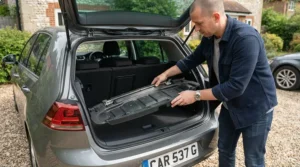
Load the heaviest piece first, low and against the back of the rear seats. Stack lighter pieces on top and keep the battery upright and secured. Strap everything so nothing slides on a corner.
Mistakes in the first 30 days
Common slips include forgetting to switch off, mis-seating the battery and dropping a piece on the loading lip. Practise the sequence at home first, and keep the manual in the glovebox.
Real-World Scenarios: Three Buyers, Three Boots
The solo loader with a supermini
If you’re a retired driver loading alone into a Polo-sized boot, every kilo counts. The Motion Healthcare Alumina (10kg heaviest piece) or TGA Zest (12kg) reduce each lift. Budget for the higher price of the Motion Healthcare Alumina, or choose the 12Ah TGA Zest battery to keep the lift lighter.
The carer on a budget
If you’re a family carer taking a relative to the shops twice a week, the ST1 Strider Micro (about 6 miles, 14kg) or Pride Apex Lite (8-10 miles, 15kg) are the practical picks. Both are affordable, and the Pride Apex Lite tiller socket helps if bending is hard.
The heavier rider with longer routes
If you need up to 147kg capacity and use the scooter for longer outings, the Pride Go-Go Elite Traveller Plus gives the highest weight limit. For longer range with a user limit of 130kg, the Venture Boot Scooter and I-Go Vertex Sport are the candidates, provided your boot can take the heavier pieces.
Common Mistakes When Buying a Disassembling Boot Scooter for Small Cars
Trusting litres over measurements. A 391-litre boot with an awkward opening can be harder to load than a smaller, squarer one.
Ignoring the battery. The heaviest piece is often the battery, and larger batteries add range and weight together. Check which battery size the quoted weight refers to.
Buying on range alone. The longest listed range often comes with the heaviest total weight. A scooter you can’t lift is a scooter you can’t use.
Skipping a demo. Disassembly is a physical skill. Try it before you buy and ask the retailer to confirm piece weights in writing, especially for models with conflicting listings.
Forgetting storage at home. A scooter in five pieces is easy to stow in a cupboard or shed, but that only helps if you’ve planned where it goes.
Long-Term Cost & Maintenance
The purchase price is only part of the cost. Over several years, the battery is the main running expense, and replacement costs vary by size and chemistry. Ask your retailer about battery replacement cost and warranty length before you buy.
VAT matters too. Under HMRC’s VAT Notice 701/7, some mobility scooters can be supplied without VAT to eligible disabled customers. Most retailers will ask you to complete a short declaration. Ask whether a particular model qualifies, and remember that the relief doesn’t usually extend to delivery.
| Model | Price range (check current price) | Max user weight | Value verdict |
|---|---|---|---|
| ST1 Strider Micro | £700-£900 | 115kg | Cheapest entry, short range |
| Pride Apex Lite | £800-£1,000 | 136kg | Best entry-level balance |
| Venture Boot Scooter | £900-£1,000 | 130kg | Strong range for the money |
| I-Go Vertex Sport | £1,000-£1,250 | 130kg | Comfort and range, heavier |
| Pride Go-Go Elite Traveller Plus | £1,100-£1,300 | 147kg | Best for heavier riders |
| TGA Zest | £1,200-£1,500 | 133-135kg | Comfort per pound |
| Motion Healthcare Alumina | £2,200-£2,700 | 115kg | Premium for lightest lifts |
The table shows a clear value ladder. The Pride Apex Lite and Venture Boot Scooter sit at the sweet spot for most buyers. The Motion Healthcare Alumina costs roughly double the mid-range options, which only makes sense if lifting weight is your deciding factor. Prices vary by retailer and VAT status.
For maintenance, keep tyres inflated or checked, charge batteries regularly and wipe connectors clean. Store in a dry place.
Safety, Rules and Compliance Guide
These scooters fall under class 2 rules. According to the Department for Transport guidance, class 2 vehicles are limited to 4mph, are intended for pavements, and don’t need registering. You should use the road only where there’s no pavement, or to cross.
Practical points to keep in mind:
- Slow down around pedestrians. The 4mph pavement limit applies whether it’s busy or not.
- Painted cycle lanes are part of the carriageway and aren’t open to class 2 scooters, though shared cycle tracks generally are. Check local signage.
- Insurance isn’t a legal requirement for class 2, but it’s worth considering for theft, damage and third-party liability.
- Lights aren’t mandatory on class 2, but a headlight (as on the TGA Zest and I-Go Vertex Sport) helps in dim conditions.
Rules can change, so check current guidance before you ride.
Features That Actually Matter (And Those That Don’t)
What matters:
- Heaviest piece and battery weight. This decides whether you can use the scooter at all.
- Off-board charging. It saves you carrying the whole machine indoors.
- Ground clearance. The Venture Boot Scooter (about 63mm) copes with kerb drops better than the ST1 Strider Micro (about 30mm).
- Tiller adjustability. A wraparound delta tiller, as on the Pride Go-Go Elite Traveller Plus, helps with limited grip.
- Suspension. It matters on cracked pavements, less so on smooth shopping centre floors.
What doesn’t:
- Colour panels. Nice, but they don’t change how it performs.
- Top-line range. Real-world range falls with rider weight, hills and cold batteries.
- Top speed. The legal pavement limit is 4mph on every model here.
FAQ
❓ Will a boot scooter fit in a supermini like a Polo or Clio?
❓ How long does it take to take a boot scooter apart?
❓ Do I need to register or insure a boot scooter?
❓ Are boot scooters comfortable on uneven pavements?
❓ Can I charge the battery away from the scooter?
Conclusion
Choosing a disassembling boot scooter for small cars comes down to an honest answer to one question: what can you lift? Everything else, range, comfort and price, follows from that.
If lifting is the priority, the Motion Healthcare Alumina (about 10kg heaviest piece) and TGA Zest (about 12kg) lead the field. For a sensible all-rounder at a fair price, the Pride Apex Lite and Venture Boot Scooter deliver. If you’re on a tight budget and your trips are short, the ST1 Strider Micro does the basics. For heavier riders, the Pride Go-Go Elite Traveller Plus has the highest weight limit, and the I-Go Vertex Sport adds comfort and range for those with a roomier boot.
Before you buy, measure your boot, confirm piece weights in writing, and try the disassembly yourself. Prices change, so check current price and availability on the retailer’s page.
✨ Ready to find your perfect fit?
🚗 Click through to the models above, compare the latest prices and take the next step towards easier, independent travel!
Recommended for You
- Boot Scooter For People With Limited Upper Body Strength: 7 Best 2026
- Amputee Wheelchair Leg Supports: 7 Best Picks & Honest Guide (2026)
- Buy Wheelchair Calf Pads: 7 Best Picks For UK Users (2026)
Disclaimer: This article contains affiliate links. As an Amazon Associate, I earn from qualifying purchases. If you purchase products through these links, we may earn a small commission at no additional cost to you.
✨ Found this helpful? Share it with your friends! 💬🤗
