
In This Article
Footplates for wide wheelchairs are the flat platforms that carry the feet on a wider-than-standard frame, keeping them clear of the floor and castors. Because a wide frame changes the spacing around the legs, the right plate needs suitable width, depth, mounting and ground clearance, not just a “universal” label.

Here’s the awkward truth from my research: almost nothing on Amazon UK is written with wide chairs in mind. Search for footplates for wide wheelchairs and you’ll scroll past page after page of listings that say “universal”, quote a seven-inch plate, and quietly assume you’re sitting in a standard frame. The widest generic plate I could verify measured 8.27 inches across. The widest purpose-built option came from a clinical-seating manufacturer, and it needed a drill.
That gap is why this guide exists. I haven’t used any of these products, and I won’t pretend otherwise. What I did was compare listed specifications, star ratings and rating counts as they appeared at the time of research, plus published fitting guidance. Then I turned it into plain English: what each footplate is good for, where it’s likely to disappoint, and how to dodge the classic “it arrived and doesn’t fit” moment. Budget hunters will find a wheelchair footplate under £30 section. Fussier fitters get a step-by-step approach to wide-frame wheelchair fitting and advice on custom fit accessories.
Still choosing the chair itself? Scope’s wheelchair guide explains NHS assessments and personal wheelchair budgets clearly, and it’s worth reading before you spend anything on add-ons.
Footplates for Wide Wheelchairs at a Glance: Quick Comparison
Prices are ranges, ratings are what listings showed at the time of research, and “not stated” means the listing didn’t say.
| Product | Size as listed | Price range | Rating seen | Best For |
|---|---|---|---|---|
| Etac Add-On Extended Foot Plates | Large: 200 x 225 mm per plate | Not published; check | None verified | Compatible chairs, splayed feet |
| PU Leather Foot Rest Extender Pad | 16 x 20 x 1 in | £35-£45 | Not verified | Extra resting surface |
| Composite Footplate Elevating Legrests | Not stated | £35-£45 | 4.5/5 (237) | Swing-away hangers on a budget |
| Swivel Replacement Footrests | Not stated | £50-£55 | 4.6/5 (97) | Easier transfers |
| Harilla Footrest | Not stated | £14-£18 | 3.7/5 (23) | Replacing one worn plate |
| Gurtt Footplate 2-Pack | Not stated | £10-£15 | Not verified | Cheapest spares |
| WRITWAA Foot Plate | 8.27 x 6.1 x 1.77 in | £10-£15 | 2.0/5 (1) | Widest budget plate, with caution |
Only the Swivel Replacement Footrests and Composite Footplate Elevating Legrests have enough ratings to take seriously. The WRITWAA Foot Plate is the widest budget plate, but its evidence rests on a single rating. If you want real extra width rather than a like-for-like swap, only the Etac Add-On Extended Foot Plates and the PU Leather Foot Rest Extender Pad meaningfully change the surface area under your feet.
💬 Just one click — help others make better buying decisions too!😊
Top 7 Footplates for Wide Wheelchairs: Expert Analysis
Each entry covers what the specs mean in practice, who it suits, and what the evidence can and can’t tell us. Where I couldn’t verify review text, I say so rather than guess.
1. Etac Add-On Extended Foot Plates — widest platform for 50–55 cm seats
If every other plate here is a stepping stone, the Etac Add-On Extended Foot Plates are the paving slab. The manufacturer’s UK page lists a one-piece Small (250 x 225 mm), plus left-and-right Medium (150 x 225 mm) and Large (200 x 225 mm) plates. They can be used singly, in pairs or linked into one platform.
The Large pair is matched to seat widths of 50–55 cm on one Etac model and 50–52.5 cm on another, so it’s the only product here sized explicitly around a broad seat. Its 225 mm depth is just under 9 inches, deeper than the 6.1 inches listed for the WRITWAA Foot Plate, so heels stay supported as well as toes. The kit includes screws, bolts, 30 cm of anti-slip tape and a drill template. Translation: this is a permanent modification, not a quick swap, and the manufacturer warns you to use the widened castor housing to avoid collisions.
Based on the spec comparison, it suits owners of a compatible chair whose feet drift outwards. If your chair is NHS-issued, talk to the wheelchair service before drilling anything, because NHS-provided chairs remain NHS property. I couldn’t find verifiable customer reviews, so I won’t characterise any.
Pros:
- ✅ Linkable plates can span both feet
- ✅ Anti-slip tape and drill template included
- ✅ Sizes matched to specific seat widths
Cons:
- ❌ Drilling makes the change permanent
- ❌ Compatibility looks limited to certain chairs
Price wasn’t published on the page I read, and I couldn’t confirm an Amazon UK listing, so check availability first. For owners of a compatible chair, it’s the most purpose-built answer here.
2. PU Leather Foot Rest Extender Pad — biggest listed surface at 16 x 20 inches
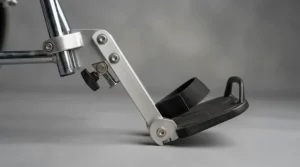
Not every wide-feet problem needs a new plate. Sometimes it needs a bigger landing zone. The PU Leather Foot Rest Extender Pad is listed at 16 x 20 x 1 inches (roughly 41 x 51 cm), in PU leather with cotton filling. It’s described as a cushioned leg-rest pad that supports the lower legs in an elevated position.
That footprint dwarfs every rigid plate on this list. On paper, feet that splay or tilt get room to rest without hanging over an edge. The catch is the word “pad”: it adds cushioning and surface, not structure, and I couldn’t confirm from the listing how it attaches. Check that before buying, because a pad that shifts underfoot is a transfer hazard, not a comfort upgrade.
Here’s what to weigh. This suits someone with a sound footplate who wants more comfort or a larger resting surface, and it pairs sensibly with a plate rather than replacing one. Because it raises the lower legs, mention it to your therapist if you have circulation or swelling concerns. I couldn’t verify any customer reviews for this listing, so I can’t summarise sentiment.
Pros:
- ✅ Largest resting surface of the seven
- ✅ PU leather surface should wipe clean
- ✅ Adds surface without replacing the plate
Cons:
- ❌ Attachment method not verified from the listing
- ❌ Cushion, not a rigid footplate
Expect to pay around £35-£45. It’s reasonable as a comfort add-on, but it won’t fix a damaged plate.
3. Composite Footplate Elevating Legrests — most-rated option I could verify
With 237 ratings averaging 4.5 stars at the time of research, the Composite Footplate Elevating Legrests have the largest verified evidence base on this list. The listing describes a pair of elevating legrests with composite footplates and non-padded calf supports, aimed at standard wheelchairs.
Elevating means the lower leg can be raised, which some users find comfortable. Whether it’s right for you is a clinical question. Composite plates tend to be lighter and quieter than metal, and skipping calf padding trims weight and cost. The “standard wheelchairs” wording is the catch for our topic: it describes the hanger fit, and I couldn’t verify that it suits wide frames. Match your hanger mounting, not your seat width.
My read is that this suits users whose wide chair has a conventional front-rigging mount and who want swing-away hangers without paying for a branded set. Only the average and count were verifiable. A 4.5 from 237 ratings suggests broad satisfaction, but nothing tells us how many buyers owned wide chairs.
Pros:
- ✅ Largest verified rating base
- ✅ Lightweight composite footplates
- ✅ Elevating leg-rest design
Cons:
- ❌ Listing targets standard chairs
- ❌ No calf padding
Expect around £35-£45. It’s good value if you’ve confirmed the fit.
4. Swivel Replacement Footrests — swing-away convenience for easier transfers
The Swivel Replacement Footrests (sold as a black pair) earn their keep the moment you stand up or slide across to a bed or car seat. Swivel the plates aside and the floor is yours. At the time of research the listing showed 4.6 stars from 97 ratings.
On paper, clearing both footrests gives the most unobstructed approach to a transfer surface, and that matters if your frame is broad and your manoeuvring space is tight. The listing targets standard wheelchairs and doesn’t state plate dimensions, so the same mounting caution applies as with the Composite Footplate Elevating Legrests. Measure the hanger fixing first, then the plate against your feet.
The spec sheet won’t tell you this, but a high average still can’t reveal whether reviewers had wide chairs. That 4.6 from 97 ratings is encouraging for build and general satisfaction, and silent on wide-frame fit. This suits people for whom transfers are the daily headache.
Pros:
- ✅ Swing-away action clears floor space
- ✅ Highest verified average among the generics
- ✅ Sold as a pair
Cons:
- ❌ Priciest of the generic options
- ❌ Plate dimensions not stated
Expect roughly £50-£55. Pay it only if transfers justify it.
5. Harilla Footrest — simplest like-for-like replacement plate
The Harilla Footrest is listed as a scratch-proof, easy-to-install plastic footplate with a support pole, aimed at Drive wheelchairs and “universal” use. At the time of research it showed 3.7 stars from 23 ratings.
A single plate with a pole means you can replace one worn or cracked side without buying a whole hanger. Plastic won’t corrode and keeps weight down, though it flexes more than metal. The listing doesn’t state plate dimensions, so you’ll need to compare its size against your foot width and your existing tube diameter. Universal-style plates commonly quote a 7/8 inch (about 22 mm) tube mount, so check that figure on the page.
A 3.7 average from a small sample reads as decent-but-mixed. Before buying, read the lower-rated reviews specifically for fit complaints, because compatibility is where “universal” products usually come unstuck.
Pros:
- ✅ Cheap enough to keep as a spare
- ✅ Described as easy to install
- ✅ Plastic won’t corrode
Cons:
- ❌ Middling 3.7 average
- ❌ Dimensions missing from the listing
Expect around £14-£18. It’s a fair stop-gap and sits comfortably under £30.

6. Gurtt Footplate 2-Pack — lowest cost per plate
The Gurtt Footplate 2-Pack is listed as a pair of universal replacement footrest pedals, for roughly £10-£15 in total. That works out at about £5-£7 per plate, which is hard to argue with when a broken plate is leaving someone’s foot dangling.
The two-pack format covers both sides at once, or gives you one fitted plate and one spare. As with every universal-style listing, the detail that matters is the mount size. I couldn’t verify dimensions or a rating from the data I had, so this is an unknown quantity on evidence. Check the listing for tube diameter and plate size before ordering, and don’t assume.
This suits someone with a standard-style hanger who needs a quick, low-risk repair. It’s less suited to anyone whose problem is width, since nothing here promises more of it.
Pros:
- ✅ Lowest cost per plate
- ✅ Covers both sides in one order
- ✅ Easy to keep a spare
Cons:
- ❌ No verified dimensions or rating
- ❌ “Universal” is a claim to test, not trust
Expect £10-£15. It’s the best bargain, provided you verify the mount first.
7. WRITWAA Foot Plate — widest generic plate at 8.27 inches
The WRITWAA Foot Plate is the widest generic plate I could verify. The listing gives 8.27 x 6.1 x 1.77 inches (about 21 x 15.5 x 4.5 cm), with a support pole and “various wheelchair models” compatibility. That’s about an inch wider than the 7- to 7.87-inch plates it competes with.
An extra inch helps wider or splayed feet, but it isn’t transformative. If your feet genuinely overhang a standard plate by several centimetres, you’re looking at the Etac Add-On Extended Foot Plates or the PU Leather Foot Rest Extender Pad instead. The rating is 2.0 stars from a single review, which tells you almost nothing in either direction.
This one is a measured gamble. It suits someone who has already confirmed the tube mount and wants slightly more width cheaply, and who can return it if it disappoints.
Pros:
- ✅ Widest budget plate I could verify
- ✅ Dimensions clearly listed
- ✅ Very low cost
Cons:
- ❌ Only one rating, at 2.0 stars
- ❌ “Various models” fit unverified
Expect £10-£15. Buy it only with easy returns in mind.
Wide-Frame Wheelchair Fitting: A Step-by-Step Guide
Fitting a plate to a wide frame is less about muscle and more about measurement. Work through this sequence before you click buy.
- Measure across both feet in the shoes normally worn. Clinical seating guidance treats this as the starting point for footrest width.
- Measure lower leg length from the back of the knee to the heel, again in usual footwear. It dictates footplate height.
- Protect ground clearance. A clinical seating resource from the NSW Agency for Clinical Innovation recommends at least 50 mm (2 inches) between footplate and ground.
- Identify your mounting. Universal listings often quote a 7/8 inch tube mount, while hanger-and-plate sets are chair-specific. Measure rather than assume. One UK spares supplier quotes a 35 mm gap between locating brackets for an aluminium model’s legrests, a figure “universal” titles never mention.
- Check castor clearance. Wider plates swing closer to the front wheels, and the maker of the Etac Add-On Extended Foot Plates explicitly warns about collisions.
- Trial-fit with the user seated, then tighten fixings and re-check them after the first week and again after the first month.
The classic first-30-days mistakes are tightening before checking the angle, forgetting to retest transfers, and ignoring a new creak. A creak is the chair telling you something is loose.

Footplate Width Adjustment: Fine-Tuning Without Starting Again
Think of footplate width adjustment as three dials: plate width, plate position, and edge control. You can often turn one without replacing everything.
Width. Seating guidance warns that a footrest set too tight can stop the feet pivoting during transfers, while one set too loose gives poor foot positioning. The Etac Add-On Extended Foot Plates let you configure this directly, since the left and right plates can be used separately or linked into a single platform.
Position. Height, depth and angle matter as much as width. Swing-away hangers often advertise tool-free length adjustment, and some premium chairs offer footplates that move forward, backward and tilt. Remember the 50 mm ground-clearance rule whenever you raise or lower anything.
Edge control. Slipping feet are often an edge problem rather than a width problem. Anti-slip tape (included with the Etac Add-On Extended Foot Plates), raised edge lips and heel loops all help. A REMAP volunteer project, which I cover below, fitted a plastic lip to a bespoke widened plate for exactly this reason.
A practical order of operations: fix the edges first, adjust position second, and change width last. It’s cheaper and reversible, and it often solves the problem without a new plate.
Real-World Scenarios: Matching Footplates to Real Lives
These are composite, illustrative profiles rather than real people, but they show how the same shortlist plays out differently.
Scenario 1: the budget-conscious carer. Daily indoor use, a snapped plate, and a hard ceiling of £30. The Gurtt Footplate 2-Pack or the Harilla Footrest fit the brief once you’ve measured tube diameter and plate width. Treat the WRITWAA Foot Plate as a gamble worth taking only if width is the whole problem.
Scenario 2: the outdoor everyday user with splayed feet. Feet drift outwards on kerbs and cobbles, the chair is a compatible Etac model, and the budget is flexible. Here the Etac Add-On Extended Foot Plates make sense, ideally with a therapist’s input, because a platform that catches both feet is a posture decision as much as an accessory.
Scenario 3: the occasional user with frequent transfers. Hospital appointments, car journeys and a budget around £50. The Swivel Replacement Footrests put swing-away convenience first. The Composite Footplate Elevating Legrests (about £40) make sense if elevation has been recommended. If comfort rather than structure is the issue, add the PU Leather Foot Rest Extender Pad once you’ve confirmed it attaches securely.
The pattern is simple: don’t buy the widest thing, buy the thing that fixes the specific failure, whether that’s a snapped plate, drifting feet or awkward transfers.
How to Choose Footplates for Wide Wheelchairs
Choosing the right plate comes down to six checks, in this order.
- Start with the foot, not the seat. Measure across both feet in usual shoes. A 50 cm seat doesn’t tell you how wide the plate needs to be.
- Confirm the mounting. Tube diameter and hanger type decide whether anything fits at all. Look for the mount size stated on the listing, not just “universal”.
- Decide what you’re doing. A like-for-like swap, a cushioned extender or a drilled-on platform are three different projects with different risks.
- Weigh the evidence. A 4.5 from 237 ratings means more than a 5.0 from one. Treat very small samples as unknowns.
- Check ownership and approval. If the chair is NHS-owned, speak to the wheelchair service before modifying it.
- Plan for returns. For anything not tested on the chair, confirm easy returns before ordering.
Wheelchair Footplate Under £30: What Your Money Actually Buys
A wheelchair footplate under £30 is genuinely achievable, but it buys you a plain plate rather than a solution. Three of the seven products here sit comfortably under that line, and none of them is purpose-built for wide chairs.
| Price tier | Products | What you get | Best For |
|---|---|---|---|
| Under £30 | Harilla Footrest, Gurtt Footplate 2-Pack, WRITWAA Foot Plate | Plain plates; widest listed is 8.27 in | Stop-gap spares, tight budgets |
| £30-£60 | Composite Footplate Elevating Legrests, PU Leather Foot Rest Extender Pad, Swivel Replacement Footrests | Swing-away hangers or a cushioned surface; more rating evidence | Transfers, comfort, longer-term use |
| Quote-based | Etac Add-On Extended Foot Plates | Purpose-built wide platform; drilling needed | Compatible chairs, splayed feet |
Context helps here. A UK specialist retailer lists branded footplate-and-hanger sets for specific Drive chairs in roughly the £30s to £50s range, with a VAT-relief option at checkout. Generic plates cost about a third of that, so the saving is real but comes with fit risk. Spread over a year of daily use, even a £50-ish pair works out at around 14p a day. The real cost-of-ownership question is whether it fits first time, because a returned plate costs you time and a delayed fix.

Custom Fit Accessories: When Off-the-Shelf Falls Short
Sometimes no listing matches the foot, and custom fit accessories are the honest answer. A REMAP case from Essex South shows what that can look like. Following several strokes, a client’s feet had become splayed and no longer sat comfortably in a small, centred footplate. Volunteers kept the existing fittings and hinges but made a wider, contoured plate to fit between the wheels. It still folded away, and they added a raised lip at the rear and sides to stop the feet slipping off.
That’s a one-off, clinically sensible solution from volunteer engineers, not a weekend hack to copy. Still, the principles transfer neatly to shop-bought kit:
- Keep the existing fittings if they work, and change only the surface.
- Add edge control (lips, tape or heel loops) before adding width.
- Make sure any wider plate still folds or swings clear for transfers.
If an off-the-shelf option comes close, such as the Etac Add-On Extended Foot Plates with their included anti-slip tape or the PU Leather Foot Rest Extender Pad as a cushioning layer, start there. If nothing does, ask your wheelchair service or occupational therapist about a bespoke solution before experimenting yourself.
Standard Footplates vs Wider Alternatives: Which Route Wins?
A standard plate, an extender pad and an add-on platform solve different problems, so the question isn’t which is best but which fits yours.
| Option | Width gain | Effort | Best For |
|---|---|---|---|
| Standard plate, such as the WRITWAA Foot Plate | Modest; about 8.27 in at best | Low | Straight swaps |
| Cushioned extender, the PU Leather Foot Rest Extender Pad | Large surface, no rigid structure | Low to medium; check attachment | Comfort, resting surface |
| Add-on platform, the Etac Add-On Extended Foot Plates | Largest; plates link together | High: drilling and castor check | Compatible chairs, drifting feet |
| Bespoke one-off | Tailored to the foot | Referral and waiting time | Unusual foot positions |
The table makes the trade-off plain: the more width you gain, the more effort and commitment you pay for it. A standard plate like the WRITWAA Foot Plate is fast and cheap but only nudges width. The Etac Add-On Extended Foot Plates transform the platform and also transform your risk, since a mis-drilled hole can’t be undone. For most people with an ordinary wide chair, a well-fitted standard plate plus edge control is the sensible first step.
Common Mistakes When Buying Footplates for Wide Wheelchairs
Most returns trace back to a handful of avoidable errors.
Trusting “universal”. It’s a marketing word, not a measurement. Universal listings commonly specify a 7/8 inch tube mount, but chair-specific hangers vary, so verify.
Measuring the seat instead of the feet. Seat width describes your hips. Footplate width should reflect your feet in shoes, and the two aren’t the same.
Ignoring ground clearance. A deeper, lower plate is no bargain if it catches on thresholds. Hold to at least 50 mm.
Overbuying width. A plate wide enough to clip the castors creates a new hazard. The maker of the Etac Add-On Extended Foot Plates warns about this directly.
Modifying an NHS chair unasked. NHS-provided chairs remain NHS property, so ask first.
Over-reading thin ratings. The WRITWAA Foot Plate shows 2.0 stars from one rating, and the Harilla Footrest shows 3.7 from 23. Neither is proof, in either direction. Weigh them against the Composite Footplate Elevating Legrests at 4.5 from 237, and treat small samples as questions, not answers.
Safety, Regulations and VAT Relief for Footplates
Footplates carry weight and take knocks, so treat them as safety components rather than trim. The budget listings I reviewed didn’t state weight limits in the data I could see, so check each page for one. Wheelchair parts can fall under medical-device rules in the UK, so look for UKCA or CE marking and a clear compatibility statement. I couldn’t verify marking on the budget listings. If your chair has a crash-test rating, ask the manufacturer whether third-party changes affect it.
On cost, GOV.UK’s guidance on VAT relief says you won’t be charged VAT on spare parts or accessories for products that qualify, provided your own disability qualifies too. It doesn’t apply if you’re elderly but not disabled, or only temporarily disabled. Goods designed for disabled and non-disabled people alike generally don’t qualify, and the supplier decides, so ask before you order. Several UK specialist retailers display a VAT-relief option at checkout, while marketplace sellers may not.
FAQ
❓ Can I fit wider footplates to a standard wheelchair?
❓ What is the difference between a footplate and a footrest?
❓ Are budget wheelchair footplates from Amazon safe to use?
❓ Can I claim VAT relief on wheelchair footplates in the UK?
❓ Can the NHS wheelchair service change my footplates?
Conclusion
Footplates for wide wheelchairs are a small part with an outsized effect on comfort, posture and safe transfers, and the honest finding of this research is that the market is thin. Most generic listings top out around 8.27 inches, and the only genuinely wide, purpose-built option I could verify, the Etac Add-On Extended Foot Plates, needs drilling and a compatible chair.
For most readers the sensible path is staged. If a plate has simply failed, the Gurtt Footplate 2-Pack or the Harilla Footrest fix it cheaply, once you’ve confirmed the mount. If transfers are the pain point, the Swivel Replacement Footrests and Composite Footplate Elevating Legrests are the most-rated options I could verify, though neither is proven for wide frames. If you need more surface, the PU Leather Foot Rest Extender Pad adds comfort, and the WRITWAA Foot Plate adds an inch for very little money. Measure the feet first, protect 50 mm of clearance, and ask your wheelchair service before modifying anything on an NHS chair.
Recommended for You
- Buy Folding Wheelchair Footplates: 7 Proven Picks For UK Users (2026)
- Large Footplates For Bariatric Wheelchairs: 7 Proven Picks (2026)
- Folding vs One-Piece Footplates: 7 Proven Picks For UK (2026)
Disclaimer: This article contains affiliate links. As an Amazon Associate, I earn from qualifying purchases. If you purchase products through these links, we may earn a small commission at no additional cost to you.
✨ Found this helpful? Share it with your friends! 💬🤗
