
In This Article
Here’s a question that gets asked in NHS seating clinics, care homes, and family living rooms across Britain every single week: “What’s the difference between a tilt in space and a reclining wheelchair, and which one does my mum actually need?” It sounds straightforward. It really isn’t.

The tilt in space vs reclining wheelchair debate is one of those topics that sits right at the intersection of medical science, daily comfort, and frankly quite significant expense. Get it right, and you’re investing in someone’s quality of life — reduced pressure sores, better posture, improved circulation, and the simple dignity of sitting comfortably for hours on end. Get it wrong, and you may find yourself with a chair that accelerates the very skin problems it was supposed to prevent.
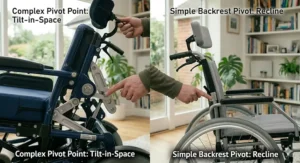
Here’s the short version: a tilt in space wheelchair tips the entire seat-and-backrest unit backwards as one rigid unit, so the hip angle stays constant and body weight shifts away from the tailbone towards the back. A reclining wheelchair, by contrast, opens the angle between seat and backrest — the seat stays flat while the back reclines, much like an armchair. Both redistribute pressure. Both improve comfort. But they do it in fundamentally different ways, with fundamentally different consequences for the person sitting in them.
This guide covers everything: the clinical science behind each type, who benefits from tilt versus recline, a detailed look at the best options currently available to UK buyers, and the kind of practical advice your occupational therapist might share if you had an extra hour with them. Whether you’re buying for yourself, a family member, or a care setting — read this first.
Disclaimer: Always consult a qualified occupational therapist or seating specialist before purchasing a wheelchair for complex medical needs. This article provides general guidance only.
Quick Comparison: Tilt in Space vs Reclining Wheelchair at a Glance
| Feature | Tilt in Space | Reclining |
|---|---|---|
| Hip angle change | Maintained (no change) | Opens (back extends away from seat) |
| Shear force risk | Very low | Higher (especially during transition) |
| Pressure relief | Excellent (redistributes to back/head) | Good (reduces load on sitting bones) |
| Postural support | Superior — keeps user in correct alignment | Moderate — risk of forward sliding |
| Best for | High pressure injury risk, neurological conditions, poor trunk control | Occasional reclining, catheter management, spasm management |
| Typical NHS prescription | Complex seating users, full-time wheelchair users | Part-time or transitional users |
| Typical price range (UK) | £400–£3,500+ | £200–£1,800+ |
| Amazon.co.uk availability | Limited specialist range | Wider consumer range |
The table makes it look clean and simple. Real life is messier. The key insight — and the one that trips up most buyers — is the shear force issue. When a standard reclining chair opens its backrest angle, the user’s hips tend to slide forward along the seat. That sliding motion creates shear: a lateral force dragging across the skin at the buttocks. Shear is genuinely nasty; it can cause deeper tissue damage than simple pressure alone, and it happens in seconds. A tilt system avoids this almost entirely, because the whole body moves as one unit — there’s nothing to slide against.
More on the science shortly. First, the products.
💬 Just one click — help others make better buying decisions too! 😊
✨ Don’t Miss These Exclusive Deals!
🔍 Take your wheelchair search to the next level with these carefully selected picks. Click any highlighted product to check current pricing and availability on Amazon.co.uk. Your perfect chair is closer than you think.
Top 7 Tilt in Space and Reclining Wheelchairs: Expert UK Analysis
1. U-GO Esteem Tilt in Space Transit Wheelchair (16″)
The U-GO Esteem is perhaps the most accessible entry point into genuine tilt in space technology for UK buyers, and it earns its place at the top of this list. The gas strut-controlled tilt range runs from 98° to 134° — which in plain English means you can tip the entire seating unit back by roughly 35°, keeping the hip angle locked throughout. That’s important. It’s not just reclining with different branding; it’s a mechanically distinct system.
Key specs: the chair weighs around 15–17 kg fully loaded, folds for boot (and most UK car boots will take it, though tighter hatches may require removing the headrest), and accommodates users up to around 100 kg. The aluminium frame keeps things manageable for carers, and the swing-away elevating leg rests mean transfers aren’t the wrestling match they can be with fixed-leg designs. U-GO is BHTA-approved and supplies NHS trusts across the UK — not a household name, but it has serious institutional credentials.
The padded, height-adjustable headrest is genuinely useful and not an afterthought, providing reliable support when the chair is tilted back — precisely the moment you need it most. UK reviewers note that assembly is straightforward and that the gas strut mechanism feels smooth rather than jerky.
Who is this for? A full-time transit wheelchair user with moderate pressure injury risk, cared for by a family member or support worker who needs a chair that’s manageable in the car, in a lift, and through the narrower doorways typical of British terraced houses and older care homes. It’s not a clinical powerchair — it’s a sensible, practical, well-made solution for everyday tilt needs.
Pros:
✅ True tilt-in-space mechanism (not just recline)
✅ NHS and BHTA approved
✅ Compact fold for UK car boots
Cons:
❌ Transit only (attendant-propelled)
❌ Not suitable for heavier users above ~100 kg
Available on Amazon.co.uk; check current price (typically in the mid-to-upper £hundreds range).

2. U-GO Esteem Tilt in Space Transit Wheelchair (18″)
Everything that makes the 16″ version appealing applies here — the same gas strut tilt system, the same BHTA credentials, the same fold-for-the-car practicality — but with a 46 cm (18″) seat width that opens the door to a wider range of users. The weight capacity steps up to approximately 130 kg (around 20 stone), which covers a significant proportion of British adults who currently find standard 16″ transit chairs uncomfortable or outright unsuitable.
What most buyers overlook about this model is that the wider seat doesn’t just mean more room. It means better lateral positioning for users with hip abduction tendencies — a common issue with neurological conditions like multiple sclerosis and cerebral palsy, where the hips want to drift outwards. A correctly sized seat with a tilt function keeps everything where it should be, working with the body rather than against it.
The 18″ version is marginally heavier — expect around 18–19 kg — which matters if your carer has their own back issues (and carers’ back injuries are a significant and underappreciated problem across UK care settings). Worth discussing with your GP if manual handling is a concern.
UK carers using this model in residential settings report that the headrest and tilt mechanism make meal assistance considerably easier, since the user can be repositioned without any manual lifting.
Pros:
✅ Higher weight capacity, suitable for more users
✅ Improved lateral support
✅ Aids carer-assisted positioning
Cons:
❌ Slightly heavier than the 16″ version
❌ Wider footprint may challenge very narrow Victorian doorframes
Check current price and availability on Amazon.co.uk.
3. U-GO Esteem Deluxe Reclining Self Propelled Wheelchair (18″)
Now we cross the line into reclining territory, and the Esteem Deluxe makes a compelling case for why recline still has its place. The distinguishing feature here is self-propulsion: 51 cm (20″) quick-release rear wheels let users push themselves independently, which matters enormously for autonomy and dignity. The backrest reclines up to 70° from the upright position — substantial but not infinite — and the padded removable headrest picks up the slack for neck and upper back support in the reclined position.
The 18″ seat accommodates up to 130 kg, and the flip-up armrests make lateral transfers significantly less fraught. Weighing around 19–20 kg with all components attached but dropping to approximately 12–13 kg with wheels, headrest, and footrests removed, this chair is transportable by most adults — important for the reality of British life, where getting in and out of a family car with a wheelchair happens multiple times a week.
Here’s the honest clinical commentary: a 70° recline is excellent for users who need to change position periodically, manage a urinary catheter, or take medication lying back. It is not, however, a substitute for tilt-in-space for full-time users with high pressure injury risk. If the person using this chair can reposition themselves to some degree and spends time both in and out of the wheelchair, the Esteem Deluxe recline is a superb choice. If they’re in the chair all day with no active repositioning ability, a tilt system will serve them better.
Pros:
✅ Self-propulsion for independence
✅ Good recline range for comfort and catheter management
✅ Excellent fold dimensions for UK car boots
Cons:
❌ Recline creates shear risk during repositioning
❌ Not a clinical tilt-in-space system
4. U-GO Esteem Deluxe Reclining Transit Wheelchair (16″)
The compact sibling of the self-propelled Esteem Deluxe, this is the transit (attendant-propelled) version with a 41 cm (16″) seat width — and it’s the one to consider when the priority is a lighter, more manoeuvrable chair for a smaller user who needs attendant care. The fold width drops to an impressive 36 cm, which makes it genuinely viable for tighter British spaces: the boot of a smaller hatchback, a flat hallway, a community minibus.
At around 12–13 kg stripped back (without leg rests, headrest, and wheels), this is one of the more manageable manual reclining chairs on the UK market. The reclining action remains smooth to 70°, the leg rests elevate to keep circulation moving, and the whole thing has the reassuring feel of a chair that’s been used in NHS settings rather than designed purely for e-commerce photography.
For elderly users in sheltered housing or care home residents who spend a portion of each day in their wheelchair and need periodic repositioning, this ticks most boxes. The 100 kg weight limit is more restrictive than the 18″ version, so do check measurements before ordering — the Consumer Contracts Regulations give you a 14-day cooling-off period for online purchases in the UK if the fit isn’t right.
Pros:
✅ Very compact fold (36 cm width)
✅ Lightweight for attendant use
✅ Practical for smaller UK living spaces
Cons:
❌ 100 kg weight limit rules out many users
❌ Recline-only (no tilt mechanism)
5. Foldable Reclining Electric Wheelchair (250W × 2 Brushless Motor)
This is a different beast entirely: a powered chair with a dual 250W brushless motor setup, a 12V 20Ah lithium-ion battery, and a full adjustable backrest that reclines from upright to well beyond a comfortable rest position. The joystick controller can be configured for left or right hand, which matters for users with unilateral weakness — a thoughtful detail that distinguishes more serious rehab chairs from their purely consumer-grade counterparts.
The range sits at around 20–25 km per charge on flat ground, which is respectable for a folding powerchair and comfortably covers a full day of indoor/outdoor use without needing a mid-day charge. On inclines — and British towns being British towns, inclines are inevitable — expect a modest reduction in range. The chair handles gentle slopes without difficulty; it’s not designed for Hay Bluff or anything involving a gradient steeper than roughly 10–13°.
The reclining function offers genuine utility for users who spend extended periods in the chair and need to shift pressure periodically. That said, this is electric reclining, not tilt-in-space — the backrest opens rather than the whole unit tilting, and the shear risk discussion earlier in this guide still applies. For users with moderate pressure risk who need the independence that powered propulsion provides, it’s a sound choice at a reasonable price point in the low-to-mid £thousands. Check Amazon.co.uk for current pricing and Prime delivery eligibility.
Pros:
✅ Powered propulsion for full independence
✅ Dual-motor stability on varied surfaces
✅ Joystick adaptable for left/right hand
Cons:
❌ Reclining (not tilt-in-space) mechanism
❌ Heavier than manual options — transfers require planning

6. Karman VIP2 Tilt-in-Space & Reclining Transport Wheelchair
The Karman VIP2 is the combination chair that occupational therapists in the UK most commonly reference when a user needs both tilt and recline functionality in a single, portable package. With a 0–35° tilt range combined with a 0–30° reclining backrest, it allows you to use tilt first (to correctly position the hips) and then open the recline to achieve a more horizontal resting position — which is precisely the sequence recommended by clinical guidelines for minimising both shear force and peak interface pressure simultaneously.
The aircraft-grade T6 aluminium frame keeps weight down to around 16–17 kg, which is impressive given the dual-function engineering involved. Flip-back armrests, breathable anti-microbial upholstery, and an 18″ × 18″ seat make this a genuinely clinical-grade chair in a form factor that will still fit in a standard car boot.
Important note for UK buyers: the Karman VIP2 is not consistently listed on Amazon.co.uk at the time of writing, but it is available through UK mobility specialists including MobilityCo.co.uk and similar retailers who ship across mainland Britain. Pricing typically falls in the £400–£700 range, and given the dual functionality, that represents solid value against the alternative of purchasing a separate tilt chair and recline chair for different scenarios.
Pros:
✅ True combined tilt + recline functionality
✅ Clinical-grade pressure redistribution
✅ Lightweight for a dual-function chair
Cons:
❌ Not always available directly on Amazon.co.uk
❌ Requires careful setup to use tilt-before-recline correctly
7. YDoo Full Reclining Commode Wheelchair
The YDoo offers something the other chairs on this list don’t: a built-in commode function alongside high-back reclining capability, making it a pragmatic, multi-purpose solution for users who need assistance with personal care as well as comfortable seating. It’s an unromantic but entirely real part of many people’s daily care requirements, and a chair that combines both functions elegantly saves significant time and distress for both user and carer.
The backrest reclines to near-horizontal, the footrests elevate, and the overall build is solid enough for daily residential use. This isn’t the most sophisticated positioning chair on the list — it lacks a tilt-in-space mechanism entirely — but for palliative care settings, post-operative recovery, or users who require regular incontinence management, the practical utility is considerable.
Available on Amazon.co.uk; pricing sits in the mid-£hundreds. Prime delivery is typically available, which matters when a chair is needed quickly following a hospital discharge — a scenario that plays out with frustrating frequency across UK care pathways.
Pros:
✅ Integrated commode function
✅ Full recline for complex care needs
✅ Amazon.co.uk Prime eligible
Cons:
❌ No tilt-in-space mechanism
❌ Not suitable for independent users
Real-World UK Scenarios: Finding the Right Match
Margaret, 78 — Suburban Birmingham, MS Diagnosis
Margaret has had multiple sclerosis for twelve years and now uses a wheelchair full-time. She has reasonable trunk control but struggles with fatigue and develops redness on her sacrum after more than two hours in an upright position. Her occupational therapist’s recommendation was unambiguous: tilt-in-space. The U-GO Esteem Tilt in Space (18″) fits her build, her daughter can operate the tilt mechanism from behind, and — crucially — the chair folds into the back of a Ford Kuga without drama. The tilt shifts Margaret’s weight to her upper back every couple of hours, the redness has resolved, and the 18″ seat accommodates the slight hip abduction that her MS produces.
James, 52 — Central London, Spinal Injury Rehabilitation
James is three months post-injury from an incomplete T6 spinal cord lesion and is building capacity for independent mobility. He has some trunk control and can self-propel for short distances. His priority is returning to work as a solicitor in the City — managing the Tube, Overground, and the frenetic corridors of a modern London law firm. His OT prescribed a self-propelled reclining chair for home use (the Esteem Deluxe recline handles his catheter management needs) with a separate lightweight active chair for work. The reclining chair is a home comfort and care tool, not a daily mobility solution.
Dorothy, 91 — Care Home in County Durham, Frailty & Dementia
Dorothy is largely non-ambulant, has tissue viability concerns, and requires full carer assistance. A tilt-in-space transit chair with a combination tilt-recline system — the Karman VIP2 type — was recommended by the care home’s tissue viability nurse. The tilt is used for pressure relief every 90 minutes; the recline is used during lunch to manage her dysphagia safely. Two functions. One chair. The clinical logic is compelling.
These three scenarios illustrate something the comparison table can’t fully capture: the right answer depends entirely on the person, their condition, their living environment, and how they interact with their carer or support worker. Which is exactly why — and this bears repeating — an assessment with an occupational therapist is worth every minute.
Practical Guide: Getting the Most from Your Tilt or Reclining Wheelchair in the UK
Tilt-in-Space: Using It Properly
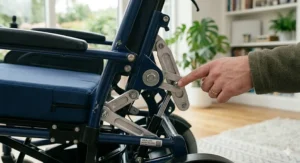
The most common mistake is infrequent use of the tilt function. Research suggests that a minimum of 25° of tilt is required to produce meaningful pressure redistribution — a gentle 5° barely makes any difference. Build a repositioning schedule: roughly 15–20 minutes of tilt every 90 minutes for users at moderate pressure risk, more frequently for high-risk individuals. Set a phone alarm. It sounds regimented, but it becomes habit.
For UK weather considerations: if you’re storing the chair in a garage or outbuilding, British damp is the enemy of gas strut mechanisms. A light application of silicone spray on the strut body (not the rod) during winter months will prevent corrosion and keep the tilt action smooth. Nothing worse than a sticking tilt mechanism at 7am.
Reclining: Avoiding the Shear Problem
Always recline slowly and in stages. Whipping the backrest to fully horizontal in one rapid movement is the most reliable way to generate shear on the sacral skin. Two or three paused stages, allowing the user to settle at each angle, dramatically reduces the risk. If the user tends to slide forward during recline, a V-shaped or contoured seat cushion provides meaningful resistance — worth discussing with a tissue viability nurse.
Both Types: UK Storage and Transport
British homes are small. The average UK living room is approximately a third smaller than its American counterpart, and Victorian terraces with their narrow hallways are utterly indifferent to modern wheelchair dimensions. Folded width is the critical measurement — aim for under 37 cm for hallway storage without removing wheels. All the U-GO models covered here achieve this. For car transport, the quick-release rear wheels on self-propelled models are invaluable: they drop the weight to a manageable 12–13 kg for lifting into a boot.
✨ Don’t Miss These Exclusive Deals!
🔍 Finding the right wheelchair significantly improves day-to-day quality of life. Click on any highlighted product above to check current pricing, customer reviews, and delivery options on Amazon.co.uk. Many are Prime-eligible for next-day delivery.
The Science of Shear Force: Why Your OT Is Right About Tilt-First
This section is worth reading carefully, because it’s the piece of clinical evidence that most fundamentally distinguishes tilt from recline — and most product listings won’t mention it.
Shear force occurs when two surfaces slide against each other: specifically, when the user’s skin is dragged across the seat surface. Unlike simple compression pressure — which damages tissue from above — shear operates horizontally, stretching and tearing the delicate layers beneath the skin surface. It can cause a pressure wound without any visible skin redness, which makes it both dangerous and easily missed.
Research published in Applied Sciences (2022) found that 10° of tilt-in-space produced a significant reduction in combined shear force compared to other tested positions. Critically, the same study found that using recline in isolation actually increased shear forces at the sacrum — because as the backrest opens, the user’s pelvis tilts posteriorly and the hips slide forward along the seat. It’s counterintuitive: the position meant to relieve pressure can worsen shear if used carelessly.
The International Pressure Injury Guideline is explicit on this point: “Use tilt-in-space before activating recline. Using the recline feature in isolation can increase shear forces.” In other words, the correct sequence for combination tilt-recline chairs like the Karman VIP2 is tilt first, then recline — not the reverse.
For users with intact sensation, this matters because shear is painful and they’ll tell you. For users with impaired sensation due to spinal cord injury, stroke, or severe neuropathy, the risk is higher still because the warning signal is absent. This is the clinical argument for tilt-in-space in complex cases, and it’s a compelling one.
How to Choose Between Tilt in Space and Reclining in 2026
The decision framework your OT uses isn’t mysterious. It follows a logical progression:
1. Assess pressure injury risk. Is the user at high risk of pressure sores — either existing wounds, fragile tissue, or inability to reposition independently? If yes, tilt-in-space is the stronger clinical choice. The National Institute for Health and Care Excellence (NICE) guidelines support dynamic seating for high-risk groups.
2. Consider time in the wheelchair. Full-time users (8+ hours per day) need tilt far more than part-time users who transfer in and out regularly. For someone using a wheelchair for hospital outpatient appointments twice a week, a reclining chair may be entirely adequate.
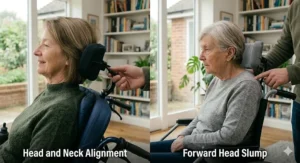
3. Evaluate trunk and postural control. Poor trunk control — common in progressive neurological conditions, cerebral palsy, and following significant stroke — favours tilt-in-space because the system maintains the user in a consistent, supportive position regardless of the tilt angle. Recline, by contrast, can allow postural collapse if trunk support is inadequate.
4. Think about care tasks. Catheter changes, personal care, and medication administration in a reclined position favour a reclining chair. The reclined angle provides access that tilt alone cannot.
5. Consider the environment. A chair used primarily indoors in a care home needs to navigate tight corridors and lift doors. One used outdoors on British pavements (cracked, uneven, occasionally optimistic about the definition of “accessible”) needs robust castors and a stable tipping geometry. All tilt chairs change their centre of gravity — check the rear anti-tip specification before buying.
6. Budget and funding. Tilt-in-space chairs cost more. If an NHS wheelchair service assessment is possible, pursue it — complex seating needs may qualify for NHS provision, particularly in England and Wales. NHS wheelchair services vary by locality, but the process starts with a GP or community occupational therapist referral.
7. Get an OT assessment. Not a footnote — the first real step. This guide informs you; an occupational therapist assesses you.
Common Mistakes When Buying a Tilt or Reclining Wheelchair in the UK
Assuming “tilt” and “recline” mean the same thing. They don’t — and now you know why. The key difference is whether the hip angle is maintained (tilt) or changed (recline).
Buying on price alone. A £180 reclining chair from a general catalogue might look similar to a £700 tilt-in-space model. The mechanisms are not equivalent. Cheaper chairs often have recline systems that produce significant shear during transitions, defeating the purpose.
Ignoring carer ergonomics. The person pushing the chair matters too. A tilt-in-space chair operated from behind by a family carer over several years places real demands on backs and shoulders. Check handle height adjustability and consider a powered tilt mechanism if manual operation will be frequent.
Overlooking UK-specific factors. Cobblestones in Cambridge, granite kerbs in Edinburgh, the relentless damp of a November in Cardiff — these matter. Choose castors rated for outdoor use if the chair will leave the house. Sealed bearings resist moisture better than open-ball designs.
Skipping the OT referral because “we just want something for now.” Temporary solutions have a habit of becoming permanent, especially when the user habituates to a suboptimal seating position. Short-term thinking on wheelchair seating can mean long-term consequences for skin, posture, and musculoskeletal health.
Buying a US-spec model. A surprising number of wheelchair listings on general marketplaces are US models shipped to UK buyers. Check for UK plug compatibility (if powered), 230V rating for any electrical components, and — importantly — whether the manufacturer has UK-based warranty and parts support. Returning a powerchair to an American fulfilment centre under the Consumer Contracts Regulations is theoretically possible but practically miserable.
Features That Actually Matter (And Those That Don’t)
Worth paying for:
- A genuine tilt mechanism with clearly specified degrees of tilt (20° minimum for meaningful pressure relief; 35°+ for clinical effect)
- Anti-shear features — contoured seat cushions, pelvic positioning belts, and correct footrest height
- Sealed gas struts rather than simple mechanical recline pins — smoother, safer, and less likely to fail in damp conditions
- Quick-release rear wheels — transforms a 19 kg chair into a 12 kg lifting job
Marketing features that matter less than you’d think:
- Fold-flat to “suitcase size” claims — check the actual folded dimensions in centimetres, not the marketing photography
- “Aircraft-grade aluminium” — virtually every mid-to-upper range chair now uses aluminium. It’s the baseline, not a premium feature
- Exact weight capacity numbers — a chair rated for 130 kg and one rated for 125 kg are functionally identical; the number is less important than the frame geometry and seat pan construction
- Colour options — it will get scuffed. It will have a wheelchair bag hanging off the back. The colour is the least of your concerns
Long-Term Costs and NHS Funding in the UK
The sticker price of a tilt-in-space wheelchair is often where the conversation ends and the regret begins. A chair in the £600–£1,200 range feels expensive — until you consider the cost of treating a grade 3 pressure ulcer in a hospital setting, which the NHS estimates can run to £10,000 or more per episode, to say nothing of the patient’s suffering and the time off work for their carer.
Beyond the initial purchase, factor in:
- Cushion replacement: a decent pressure-redistributing cushion (ROHO, Jay, or similar) adds £200–£600 and typically needs replacing every 18–24 months
- Service and parts: ask the retailer whether UK spare parts are stocked locally before buying. Some cheaper imported chairs require parts shipped from overseas, with delivery times measured in weeks
- Postural assessment reviews: NHS wheelchair services offer reassessment; private OT assessments typically cost £150–£300 per session but are tax-deductible as a disability-related expense in some circumstances
NHS wheelchair services in England and Wales use the NHS England Wheelchair Service Transformation Programme to assess and supply complex wheelchairs to eligible users. Scotland’s NHS Wheelchair Service operates similarly through regional health boards. Northern Ireland’s provision is managed by the HSC Trusts. If you or your relative qualifies — typically based on clinical need rather than financial means — it is always worth pursuing, because a properly assessed and fitted NHS chair includes ongoing clinical support that a retail purchase cannot replicate.
Frequently Asked Questions
❓ What is the main difference between a tilt in space and a reclining wheelchair?
❓ Which is better for pressure sore prevention — tilt or recline?
❓ Can I get a tilt in space wheelchair through the NHS in the UK?
❓ Are tilt in space wheelchairs available on Amazon.co.uk with fast UK delivery?
❓ What tilt angle is needed to effectively relieve pressure in a wheelchair?
Conclusion
The tilt in space vs reclining wheelchair debate doesn’t have a single universal winner — but it does have a clear clinical hierarchy. For full-time wheelchair users, those at high pressure injury risk, and people with poor trunk control or complex neurological conditions, tilt-in-space is almost always the wiser long-term investment. The shear force evidence is compelling, the postural benefits are well-documented, and the difference in outcomes between a correctly prescribed tilt chair and an inappropriate recline-only option can be profound.
For part-time users, those who manage their own repositioning to some degree, or those who need the specific practical benefits of a reclining angle — catheter access, comfort during long journeys, or sleeping position management — a quality reclining chair serves its purpose well. The U-GO Esteem Deluxe range represents genuinely good value in this category for UK buyers, with Amazon.co.uk availability and respectable clinical credentials through the NHS and care home supply chain.
Whatever direction you’re leaning (no pun intended), don’t skip the OT assessment. A chair is an investment in someone’s daily life, their skin integrity, their dignity, and — quietly but significantly — the physical wellbeing of whoever cares for them. It deserves more thought than a late-night Amazon browse, however good the reviews.
✨ Ready to Choose? Start Here.
🔍 Click the highlighted products above to check current prices, stock levels, and delivery options on Amazon.co.uk. These picks represent the best of what’s available to UK buyers in 2026 — whatever your budget, there’s a starting point here.
Recommended for You
- Best Reclining Electric Wheelchair UK 2026: Top 7 Picks
- NHS Powerchair for Children: 7 Best Options & UK Guide 2026
- 7 Best Junior Powerchair Options UK 2026
Disclaimer: This article contains affiliate links. As an Amazon Associate, I earn from qualifying purchases. If you purchase products through these links, we may earn a small commission at no additional cost to you. Always consult a qualified occupational therapist or healthcare professional before purchasing mobility equipment for medical use.
✨ Found this helpful? Share it with your mates! 💬🤗
