
In This Article
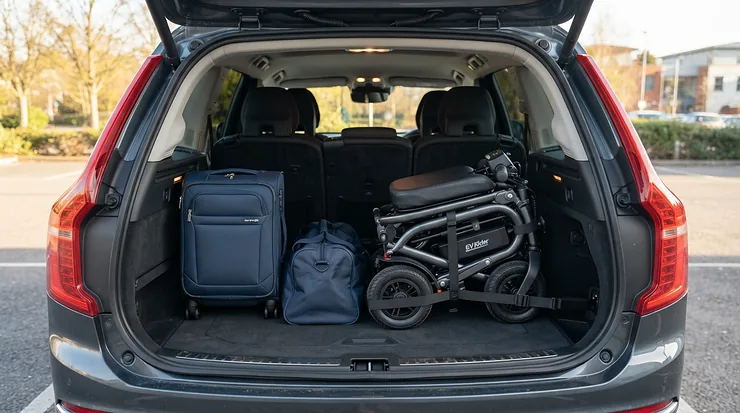
A folding mobility scooter for small car boot use is a Class 2, 4 mph scooter that collapses on a hinge, latch or powered mechanism into a compact block. It is light enough to lift and narrow enough to slide across a hatchback boot floor. It trades range and ruggedness for portability and a small folded footprint.

Here’s the catch. Most buyers fixate on the headline weight, but the number that decides whether you’ll actually use the thing is the weight of its heaviest piece. A scooter that is “29 kg” in total but splits into a 22 kg frame and a 1.6 kg battery behaves very differently from a one-piece 27 kg chassis. The shape matters too: a block that’s 84 cm long and 54 cm wide will sit across a supermini’s boot, while a taller, narrower fold may not clear the parcel shelf.
If you’re new to the category, a mobility scooter is simply an electric personal transporter used as a mobility aid. Folding versions are the smallest, lightest branch of the family. They are Class 2 vehicles, so they are limited to 4 mph and meant for pavements.
This guide compares seven real models using published specifications, dealer listings and independent testing information. Availability shifts between retailers, so check the live listing before you commit to any of them. You’ll also find a compact folding scooter for city cars section, a foldable scooter for compact hatchbacks section, and practical guides for your first 30 days. Every price below is a range, never an exact figure.
Quick Comparison: Seven Boot-Friendly Scooters at a Glance
Specs come from manufacturer and UK dealer listings. Where listings disagreed, I’ve given the more conservative figure.
| Model | Fold type | Approx. total weight | Approx. range | Best For |
|---|---|---|---|---|
| Kymco K-Lite F | Manual (foot pedal) | ~29.5 kg (heaviest part ~22 kg) | ~9.3 miles | Lifting with the seat and battery removed |
| TGA Minimo | Manual (lever) | ~28 kg | ~10 miles | All-round value and a proven fold |
| TGA Minimo Autofold | Powered (button/fob) | ~27.5–32 kg (listings vary) | ~10 miles | Anyone who dreads the fold itself |
| Monarch Smarti | Powered (remote) | ~27 kg | See dealer listing | Rougher pavements (rear suspension) |
| Monarch Air Plus | Manual | ~15.7 kg | See dealer listing | The lightest possible lift |
| Monarch Genie | Powered (remote) | ~17.5 kg without battery | See dealer listing | Light weight plus a powered fold |
| Luggie Elite | Manual, rolls like luggage | ~24 kg without battery | Roughly 11–13 miles (US listings) | Larger riders and very tight boots |
The weights split into three tiers. The Kymco K-Lite F, TGA Minimo and TGA Minimo Autofold sit in the high-20s of kilograms. The Monarch Air Plus and Monarch Genie are in the mid-teens. If lifting is your limiting factor, the second tier changes everything, though you pay for it. Range figures are manufacturers’ best-case numbers, so treat them as a ceiling rather than a promise.
💬 Just one click — help others make better buying decisions too!😊
Top 7 Folding Mobility Scooter for Small Car Boot Picks: Expert Analysis
1. Kymco K-Lite F — easiest single lift once stripped down
The Kymco K-Lite F has a clever party trick: the heaviest single component is roughly 22 kg, and the seat and a battery of about 1.6 kg come off separately.
The aluminium frame totals around 29.5 kg with its lithium battery, and the manual fold is a foot pedal rather than a button. One UK dealer lists the folded size at roughly 90 × 48 × 50 cm. That’s long for a very small boot, so measure first. Maximum user weight is 120 kg (19 stone), and the quoted range is about 9.3 miles. In practice that suits local shopping trips, not day-long outings. The tamper-resistant lock on the fold is a thoughtful touch if you have grandchildren who like levers.
On paper, this suits someone who can lift 20-odd kilograms but not 30. A retailer’s staff review of the powered K-Lite FE sibling praised its sturdy ride, but that’s a seller’s opinion rather than aggregated buyer feedback, so I can’t verify wider review themes here. Which? does list the K-Lite F among its tested Class 2 folders, though the scores sit behind its members’ paywall.
Pros:
- ✅ Seat and battery detach to cut the lift
- ✅ Lightweight lithium battery charges off the scooter
- ✅ Foot-pedal fold with a child-safe lock
Cons:
- ❌ Folded length is long for tiny boots
- ❌ Range is modest at roughly 9 miles
Expect around £1,600-£2,000, depending on the seller. It’s solid value if the stripped-down lift is your priority.
2. TGA Minimo — the benchmark single-lever fold
The TGA Minimo earns its reputation through simplicity: one lever pull and it’s down, with no parts to remove.
Dealer listings put the folded size around 44.5 × 84 × 54 cm and the total weight near 28 kg, including a battery of roughly 2.8 kg. That folded footprint is shorter and squarer than the K-Lite F’s, which is exactly what a hatchback boot floor rewards. It carries up to 115 kg (18 stone), reaches 4 mph and manages about 10 miles on the 14.5Ah battery. The smaller 11.5Ah pack is the one to pick for air travel, at the cost of range.
Here’s what the spec sheet won’t tell you: because the folded block can be pulled along on its wheels, a lot of the lifting is replaced by tilting and rolling. That matters for the final hoist into the boot. For a household with one capable lifter, it’s among the most sensible folding mobility scooter for small car boot setups on the list.
Which? includes it among its tested Class 2 scooters, and you can read the Which? mobility scooter guide for the headline ranking. I couldn’t verify aggregated owner reviews for this exact variant, so check recent buyer comments on the listing you choose.
Pros:
- ✅ Compact, squarish folded footprint
- ✅ Single-lever fold with no loose parts
- ✅ Choice of battery sizes, including airline-friendly
Cons:
- ❌ Solid-feeling but not the lightest lift
- ❌ Ride is firmer than suspended rivals
Expect roughly £1,750-£2,150 depending on retailer. It’s strong value for a proven design.
3. TGA Minimo Autofold — one-touch powered folding
The TGA Minimo Autofold swaps the lever for a button: press the foot pedal, swipe the control panel (or use the fob) and it folds itself.
Listings give the folded size as about 47 × 84 × 54 cm, nearly identical to the manual Minimo. Total weight is quoted between about 27.5 kg and 32 kg depending on the seller, so confirm the figure before you buy. It’s a four-wheel design with pneumatic tyres, a padded seat and an airline-compliant lithium battery. Range is up to about 10 miles, and maximum user weight is 115 kg (18 stone).
The analytical question is whether powered folding is worth it. It removes the bending and hauling of the fold itself, which is the hardest part for anyone with a weak grip or a painful back. But it does not remove the lift into the boot, and the motor adds weight and a failure point. If your pain point is the fold, this helps enormously. If it’s the lift, look at the Monarch Genie or Monarch Air Plus instead.
I couldn’t verify a meaningful pool of owner reviews for this specific model, so treat sentiment as unproven and ask the seller about warranty and servicing.
Pros:
- ✅ Powered fold at the touch of a button
- ✅ Pneumatic tyres soften pavement joins
- ✅ Same compact folded footprint as the Minimo
Cons:
- ❌ Heavier than manual-fold rivals
- ❌ Motor adds cost and a possible fault point
Expect a clear premium over the manual TGA Minimo; check current price. It’s worth paying only if the fold itself is your barrier.
4. Monarch Smarti — auto-fold with rear suspension
The Monarch Smarti is one of the few auto-folding scooters with rear suspension, which makes a real difference over uneven paving.
It uses a remote-controlled electric fold and an ultra-light lithium-ion battery. Dealer figures put the total at about 27 kg with battery and the folded size at roughly 46 × 46 × 63 cm. Notice the shape: it’s tall and nearly square, not long and flat. That compact base is superb for a narrow boot, but the 63 cm height needs checking against your parcel shelf. Maximum user weight is 136 kg (21 stone), higher than most rivals here, and top speed is 4 mph.
Based on the spec comparison, this suits larger riders or anyone whose pavements are patchy. The suspension is a comfort feature that matters more over a 20-minute ride than a spec sheet suggests. A higher-spec Smarti Plus Deluxe also exists, listed by one UK dealer at around the high-£2,000s.
I couldn’t verify aggregated owner reviews for the Smarti line, so rely on current buyer comments and a dealer demonstration.
Pros:
- ✅ Rear suspension smooths rough pavements
- ✅ Tall, narrow fold suits slim boots
- ✅ Higher 21-stone user capacity
Cons:
- ❌ Folded height may foul a parcel shelf
- ❌ Not the lightest powered option
Expect upper-£2,000s for the Plus Deluxe; check current price for the standard model. It’s good value for comfort-first buyers.
5. Monarch Air Plus — the lightest lift on the list
The Monarch Air Plus is built around one idea: be lighter than everything else.
It weighs about 15.7 kg, roughly half the weight of the Minimo family. The Air family uses a magnesium alloy frame, and the earlier Monarch Air is described by a UK dealer as the world’s lightest four-wheel folding scooter. The folded size is listed at about 81 cm long and roughly 46 cm tall; the listing’s other dimension is garbled, so verify the width before you buy. Maximum user weight is 19 stone (125 kg). The tiller adjusts back and forth, and the folded scooter can be pulled along.
Here’s what to weigh: a 15.7 kg lift is manageable for far more people, including many who couldn’t lift a Kymco K-Lite F. The trade-off is usually range, ruggedness and a firmer ride. Ultralight scooters tend to feel more like a travel aid than an everyday workhorse, so match it to short, smooth trips. This is the most obvious fit for a foldable scooter for compact hatchbacks where one person loads alone.
I couldn’t verify a meaningful pool of owner reviews for this exact variant. Ask the seller about warranty terms and spare-battery pricing.
Pros:
- ✅ Roughly half the weight of rivals
- ✅ Magnesium-alloy frame, easy single lift
- ✅ Adjustable tiller and pull-along fold
Cons:
- ❌ Likely firmer ride on rough ground
- ❌ Range and robustness need checking
A dealer advertises sale pricing, but check current price. It’s the best-value pick for anyone whose limit is lifting.
6. Monarch Genie — light weight with a powered fold
The Monarch Genie is the interesting hybrid: a powered fold and a very low weight.
A UK dealer describes it as a magnesium and carbon-alloy frame weighing about 17.5 kg without the battery, with remote-controlled automatic folding. Crucially for this guide, it has dual lifting handles, and a lightweight battery that’s airline-friendly and charges off the scooter. Retail listings cite support for up to 19 stone. Folded size wasn’t clearly published in the sources I checked, so request the exact dimensions in writing.
Why the handles matter: a lifting point on each side lets two hands share the load symmetrically, which is easier on the wrists and lower back than hugging an awkward frame. It’s the one model here that combines a powered fold with a sub-20 kg frame, which neatly removes both the bending and most of the heft. Suitability goes to riders and carers who want effortless loading in a small boot.
I couldn’t verify aggregated owner reviews for the Genie, so treat it as promising on paper rather than proven.
Pros:
- ✅ Powered fold plus a very light frame
- ✅ Dual lifting handles for balanced loading
- ✅ Off-board charging for airline-friendly battery
Cons:
- ❌ Folded dimensions not clearly published
- ❌ Premium price for a newer design
Expect roughly £2,300 at a specialist dealer; check current price. It earns that premium if you want ease at both ends.
7. Luggie Elite — the rolling suitcase for bigger riders
The Luggie Elite is the veteran of the category, and its party trick is that it rolls like a suitcase once folded.
Retailer listings quote a weight of around 24 kg without the battery (52 lb on US listings), with a battery of around 1.8 kg. User capacity is 21 stone (133 kg) on UK hire listings and up to 145 kg on some distributor sites, so confirm the figure for your version. It’s a four-wheel design with rear-wheel drive and a turning radius of around 90 cm. One UK review site notes the Luggie folds in several ways, which helps in boots as small as a Smart car’s. A ramp-style loading feature is also described, which can help you slide it in rather than lift it.
Here’s the practical insight: for heavier riders, most ultralight scooters run out of weight capacity. The Luggie Elite keeps a folding format and a higher limit, which is rare. The price of that is a heavier frame than the Monarch Air Plus.
I couldn’t verify aggregated owner reviews for current UK stock, so check recent comments and the warranty.
Pros:
- ✅ Higher user capacity than most folders
- ✅ Multiple fold options for tiny boots
- ✅ Rolls along like luggage once folded
Cons:
- ❌ Noticeably heavier than the ultralights
- ❌ UK pricing varies widely; verify before buying
I couldn’t verify a stable UK retail range, so check current price. It’s good value if capacity is your priority.
Side-by-Side: Weight, Footprint and Fit
| Model | Folded footprint (approx.) | Lift strategy | Independent test status | Best For |
|---|---|---|---|---|
| Kymco K-Lite F | ~90 × 48 × 50 cm | Remove seat and battery; heaviest part ~22 kg | Listed by Which? as a tested Class 2 folder | Careful lifters with a roomy boot |
| TGA Minimo | ~84 × 54 × 45 cm | Tilt and roll, then lift | Listed by Which? as a tested Class 2 folder | Everyday value |
| TGA Minimo Autofold | ~84 × 54 × 47 cm | Powered fold, then lift | Not verified | Fold-averse users |
| Monarch Smarti | ~46 × 46 × 63 cm | Remote fold, tall compact block | Not verified | Rough pavements |
| Monarch Air Plus | ~81 cm long, ~46 cm tall | Light single lift | Not verified | Solo loaders |
| Monarch Genie | Confirm with dealer | Two lifting handles | Not verified | Powered fold plus light frame |
| Luggie Elite | Confirm with dealer | Roll, ramp or multi-fold | Not verified | Larger riders |
Look at the pattern: the manual Minimo and the Smarti have wildly different shapes despite similar weights. One is a long low slab and the other a tall near-cube, so the right choice depends on your boot’s opening and depth, not on kilograms alone. If you remember one thing from this table, make it that the Monarch Air Plus and Monarch Genie solve weight, while the Monarch Smarti solves shape.
✨ Don’t Miss These Exclusive Deals!
🔍 Take your search for a folding mobility scooter for small car boot use to the next level with these carefully selected models. Click on any highlighted product name to check current pricing and availability. These choices will help you regain the independence you and your family value!
How to Choose a Folding Mobility Scooter for Small Car Boot
Choosing well means working backwards from your boot, not forwards from a brochure. Use these steps in order.
- Measure your boot opening and floor. Take the width, depth and the height under the parcel shelf with the rear seats up. Most failures happen here, because a scooter that “fits a hatchback” in marketing may not fit yours.
- Identify your heaviest comfortable lift. Be honest. A 22 kg component is a very different proposition from a 15 kg one. If you can’t lift it comfortably, a hoist is the alternative.
- Check the folded footprint against the boot. Compare length, width and height separately. A tall, narrow fold and a long, low fold can have identical volume yet fit very different boots.
- Match user weight to the scooter’s rating. Leave margin for clothing and shopping, since the figures in this guide range from 115 kg to 136 kg and beyond.
- Decide manual versus powered fold. Powered folding saves bending but adds weight and complexity.
- Be realistic about range. Manufacturers quote best-case figures of roughly 9-10 miles for many of these models, so plan for less.
- Try before you buy. Specialist dealers often offer a demonstration, and that’s the best way to judge the fold latch mechanism and balance on the spot.
For deeper comparisons across tested models, the Which? scooter guide linked earlier is a useful companion. Treat it as a starting point rather than a verdict, because boot fit is intensely personal.

Folded Footprint: The Number That Decides Everything
The folded footprint is the length, width and height of the scooter once collapsed, and it is the single best predictor of boot success. Weight tells you whether you can lift it. The folded footprint tells you whether it goes in at all.
Look at the spread across these seven. The TGA Minimo and TGA Minimo Autofold share a folded footprint of roughly 84 cm long, 54 cm wide and mid-40s cm tall. The Monarch Smarti is around 46 × 46 × 63 cm. The Kymco K-Lite F is longer, at roughly 90 cm. Same job, completely different geometry.
Here’s a simple trick. Cut a cardboard template to the quoted folded footprint and try it in your boot with the seats up. It sounds crude, but it settles the question in two minutes and costs nothing. Also check the orientation: some scooters are happiest on their side, some upright, and a few will roll in on their wheels.
Don’t forget clearance for the lift. You need room to swing the scooter in without catching the bumper, and many boots have a high loading lip. A scooter that technically fits can still be unusable if you can’t get it past the lip. That’s why a lower, more compact folded footprint often beats a slightly lighter but awkward shape.
Fold Latch Mechanism: Manual Pedal vs Powered Button
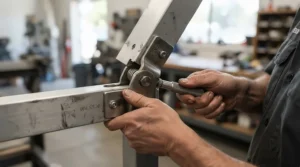
The fold latch mechanism is the part of the scooter you’ll touch every single outing, so it deserves more attention than most buyers give it.
Manual designs fall into two camps. The Kymco K-Lite F uses a foot pedal, so your hands stay free to steady the frame. The TGA Minimo uses a lever pull. Both are simple, with few things to break, and both include safety locks that stop accidental folding. The K-Lite range also advertises a tamper-resistant lock and unlock function, which is reassuring if the scooter lives where children or visitors might meddle.
Powered designs, like the TGA Minimo Autofold, Monarch Smarti and Monarch Genie, fold at a button press or via a remote. The benefit is obvious for anyone with limited grip strength or a bad back. The downsides are extra weight, a battery dependency and a more complex repair if something fails. Ask what happens if the motor fails in the middle of a fold, and whether the scooter can be folded manually in an emergency.
One practical check: before you buy, have the dealer fold and unfold the scooter ten times in a row while you watch. A good fold latch mechanism should feel positive and repeatable, with a clear click or lock. Anything that needs fiddling or a second attempt will become a daily irritation.
Carry Handle: The Small Feature You’ll Use Daily
A carry handle looks like a trivial detail until you’re standing at an open boot with 20-odd kilograms in your hands. Where the handle sits and how it feels can decide whether you load the scooter once a week or never.
The Monarch Genie stands out here, with dual lifting handles that let two hands share the load evenly. That’s a genuinely helpful design, because a balanced lift is easier on wrists and back than gripping an awkward frame. By contrast, scooters that rely on you grabbing the seat post or a frame tube can feel unbalanced.
When you assess a carry handle, check four things. Is it positioned near the centre of gravity? Is it wide enough for a full grip, including with arthritic hands? Does it stay out of the way when riding? And can a second person take the other end? These questions matter more than the number of handles.
Remember that a carry handle only helps if the weight is bearable. The Monarch Air Plus is light enough to lift almost anywhere, while the Kymco K-Lite F relies on you splitting the load by removing the seat and battery. Whatever you pick, practise the lift with the dealer present.
Compact Folding Scooter for City Cars: Supermini Reality Check
A compact folding scooter for city cars faces the hardest test: tiny boots, high loading lips and rear seats that may not fold flat. The good news is that the category was designed for exactly this.
Start with shape rather than size. A tall, near-square fold like the Monarch Smarti‘s sits neatly behind the rear seats of many small cars, while a long, flat fold like the TGA Minimo‘s suits a boot with a wide, shallow floor. The Luggie Elite is reported to fold in several ways, which gives you options if your boot is an unusual shape. A review site noted that it can fit even a Smart car boot.
Think about two-step loading. Many city drivers park on the street, with traffic passing close by. A scooter that can be rolled to the car and lifted straight in, like the TGA Minimo family, is safer than one that needs lots of juggling. Lighter models like the Monarch Air Plus reduce the time you spend with the boot open.
Finally, consider where it lives at home. A small footprint is just as valuable in a hallway or flat as it is in a boot, and the same dimensions that help in the car help indoors.
Foldable Scooter for Compact Hatchbacks: Boot Layouts That Help
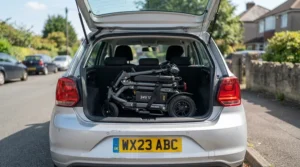
A foldable scooter for compact hatchbacks has slightly more room than a city car, but hatchback boots come with their own quirks: a parcel shelf, a sloping tailgate and a raised sill.
Check whether your rear seats fold flat. A flat load floor gives you far more flexibility, and a scooter with a long fold, like the Kymco K-Lite F, becomes a realistic option. If the seats don’t fold, a compact, tall block like the Monarch Smarti may work better, provided the folded height clears the shelf. Remove the parcel shelf if you can, because it often adds 10 cm or more of headroom.
Think about the sill, too. A high lip means lifting rather than sliding, so the lighter options earn their premium. The Monarch Genie and Monarch Air Plus are the easiest to lift over a sill, while heavier models may need a boot ramp or hoist. A UK dealer mentions boot hoists as an option for people who can’t lift, which is worth knowing if you love a heavier model.
Finally, leave room for the battery and seat. If they travel separately, they need a safe spot where they won’t roll around or get crushed.
Folding Scooters vs Dismantling Boot Scooters
There are two main ways to get a scooter into a car: fold it or take it apart. A UK dealer’s guide divides them neatly, and the choice affects everything from lifting weight to ride quality.
| Factor | Folding scooter | Dismantling boot scooter | Best For |
|---|---|---|---|
| Loading effort | Fold once, lift one block | Separate into 3-5 pieces | Folding: speed. Dismantling: lighter individual parts |
| Folded footprint | Compact block | Several smaller components | Folding: simple storage |
| Ride quality | Usually firmer, lighter build | Often larger and more stable | Dismantling: bigger outings |
| Range | Typically ~9-10 miles | Often longer | Dismantling: longer trips |
| Example models | TGA Minimo, Monarch Genie | Larger boot scooters (not covered here) | Match to trip length |
The table shows a trade-off rather than a winner. Folding scooters like the TGA Minimo and the Monarch Genie prioritise speed and a tidy folded footprint, while dismantling scooters typically offer a bigger, more stable ride. For short local journeys and a small boot, folding wins. For longer outings and rougher ground, a dismantling model may justify the extra faff.
The dealer’s guide suggests small hatchbacks and limited lifting strength usually suit a lightweight auto-folding scooter best. That’s consistent with the logic above: if your boot is small and your strength is limited, prioritise light weight and a compact fold over range.
Practical Usage Guide: Your First 30 Days
Buying the right scooter is half the job. The other half is building habits that keep the fold, the lift and the battery trouble-free.
Week 1: Practise in the driveway. Fold and unfold ten times before your first outing. Learn where the latch sits, how the safety lock engages and where your fingers should go. Load it into the boot with someone present, and note which orientation works best.
Week 2: Short, flat trips. Try a familiar route of a mile or two. Check the battery gauge, notice how the scooter feels over kerbs and joins, and see how much range you actually use. Manufacturers’ best-case figures (around 9-10 miles for several models here) assume ideal conditions.
Week 3: Test the whole routine. Do a full cycle: ride, fold, lift, drive, unload, unfold. Time it. If it feels like a chore, adjust: remove the seat earlier, carry the battery separately, or consider a hoist.
Week 4: Establish maintenance habits. Charge the battery after outings rather than waiting for it to run flat, and wipe down the frame and wheels. If your model has pneumatic tyres, such as the TGA Minimo Autofold, check pressures regularly. Keep the fold latch mechanism clean and free of grit, and follow the manufacturer’s manual for anything beyond that.
Common mistakes in the first 30 days include folding on a slope, forgetting to switch off before folding, and leaving the battery in a hot or freezing car for long periods. Check the manual for storage guidance.
Real-World Scenarios: Three Buyers, Three Picks
These are illustrative profiles, built from the specifications above, to show how the reasoning works.
The solo loader with a supermini. Imagine a retiree with a small city car, a modest budget of around £2,000, and weekly trips to the high street. The priority is a light lift and a small folded footprint. The Monarch Air Plus is the logical starting point, because roughly 15.7 kg is manageable alone. If the lift is fine but she wants less fiddling, the Monarch Genie adds a powered fold.
The couple with a hatchback. Picture two people sharing a compact hatchback with seats that fold flat, using the scooter two or three times a week for longer outings. One partner can lift the frame. The TGA Minimo offers a proven fold and a manageable lift, while the Kymco K-Lite F works if they remove the seat and battery first. Because train travel is on their wish list, it’s worth knowing that, according to DfT guidance for mobility vehicle users, train operators generally accept lightweight folded scooters; the DfT mobility vehicle guidance is worth reading before you travel.
The larger rider on uneven pavements. A heavier user in a town with patchy paving needs capacity and comfort. The Monarch Smarti offers a 21-stone rating and rear suspension, and the Luggie Elite offers a high capacity and a rolling fold. Weight is less of a concern than stability here.
Problem → Solution Guide
Even a well-chosen folding scooter has quirks. Here are five common problems with specific fixes.
It won’t fit the boot at the angle I tried. Rotate it. Many scooters fit on their side or upright, but not flat. Remove the parcel shelf and, if possible, the seat. If it still doesn’t fit, recheck the quoted folded footprint against your measurements.
It’s too heavy to lift. Remove the seat and battery, since the Kymco K-Lite F‘s heaviest part is only around 22 kg once stripped. If that’s still too much, consider the Monarch Air Plus or Monarch Genie, or ask a dealer about a boot hoist.
The fold latch sticks. Check for grit, a seat or tiller that isn’t fully seated, or a safety lock that hasn’t released. Don’t force it. If the problem persists, contact the seller.
Range anxiety. Carry a spare battery if your model supports it. A retailer notes the K-Lite FE has a spare battery compartment, and batteries that remove easily can be charged in the house or car.
Bumpy pavements shake me. Prioritise suspension or pneumatic tyres. The Monarch Smarti adds rear suspension, and the TGA Minimo Autofold uses pneumatic tyres that soften kerbs and joins.
Long-Term Cost & Maintenance
The purchase price is only part of the story. Over several years, batteries, tyres, servicing and insurance all add up, and ultralight designs can cost more to repair.
Insurance isn’t a legal requirement for these scooters, according to a police-run safety video, but third-party cover is recommended in case of accidents, theft or fire. Budget for it. Batteries are the biggest consumable: lithium packs are light and convenient, but eventually need replacing, so ask for the replacement price before you buy.
| Model | Indicative price range | Fold type | Value verdict | Best For |
|---|---|---|---|---|
| Kymco K-Lite F | ~£1,600-£2,000 | Manual | Good value if you lift in two stages | Careful lifters |
| TGA Minimo | ~£1,750-£2,150 | Manual | Strong all-rounder | Everyday users |
| TGA Minimo Autofold | Check current price | Powered | Worth it for fold-averse users | Limited grip |
| Monarch Smarti | Plus Deluxe in the high-£2,000s | Powered | Comfort premium | Rough pavements |
| Monarch Air Plus | Check current price | Manual | Strong if lifting is the limit | Solo loaders |
| Monarch Genie | ~£2,300 | Powered | Premium for ease | Powered fold, light frame |
| Luggie Elite | Check current price | Manual | Good for capacity | Larger riders |
The value logic is simple. Manual folders cost less and have fewer parts to fail, which usually means cheaper ownership. Powered models cost more up front and may cost more to repair. Over five years, a less expensive manual model with a reliable fold latch mechanism can easily beat a premium powered one on total cost, unless the powered fold is what keeps you using the scooter at all.
Safety, Rules and Regulations
Every scooter in this guide is a Class 2 model with a 4 mph maximum. In plain terms, that means pavements and pedestrian areas, not general road use. The Highway Code’s rules for powered wheelchairs and mobility scooters state that Class 2 vehicles are limited to 4 mph and that pavements should be used when available. Class 3 vehicles can reach 8 mph on the road and must be registered, but folding travel scooters are almost always Class 2.
Practical safety tips: give pedestrians priority, take extra care around people with hearing or visual impairments, and don’t leave the scooter where it blocks the pavement. You don’t need a driving licence, and Class 2 scooters don’t need registering.
Add some common-sense checks of your own. Make sure the fold latch mechanism is fully locked before every ride, confirm the seat is secure, and keep the lights and reflectors clean if your model has them. For transport, check airline and coach policies in advance, as battery rules vary. Specialist dealers can advise you on which models are airline-approved.

FAQ
❓ Can a folding mobility scooter fit in a very small car like a Smart?
❓ Do I need insurance for a Class 2 folding scooter?
❓ How much does a lightweight folding scooter cost in the UK?
❓ Can I take a folding scooter on a train?
❓ Do I need to register a folding scooter with the DVLA?
Conclusion
Choosing a folding mobility scooter for small car boot use comes down to three questions. Will it fit, can you lift it, and will you actually enjoy folding it every time?
If lifting is your limit, the Monarch Air Plus and Monarch Genie are the clear leaders, with the Genie adding a powered fold and dual lifting handles. If you want a proven, simple design with a compact folded footprint, the TGA Minimo is the sensible all-rounder, and the TGA Minimo Autofold adds powered folding for those who struggle with the latch. The Kymco K-Lite F works well when you can split the load, the Monarch Smarti suits rough pavements and tall, narrow boots, and the Luggie Elite serves larger riders.
Whatever you choose, measure your boot, check the heaviest piece, and try the fold before you commit. Specifications vary between listings, so confirm every figure with the seller.
✨ Ready to find your perfect fit?
🔍 Click any highlighted product name above to check current pricing and availability, and take the first step toward easier, freer outings.
Recommended for You
- Disassembling Boot Scooter For Small Cars: 7 Proven Picks (2026)
- Boot Scooter For People With Limited Upper Body Strength: 7 Best 2026
- Amputee Wheelchair Leg Supports: 7 Best Picks & Honest Guide (2026)
Disclaimer: This article contains affiliate links. As an Amazon Associate, I earn from qualifying purchases. If you purchase products through these links, we may earn a small commission at no additional cost to you.
✨ Found this helpful? Share it with your friends! 💬🤗
