
In This Article
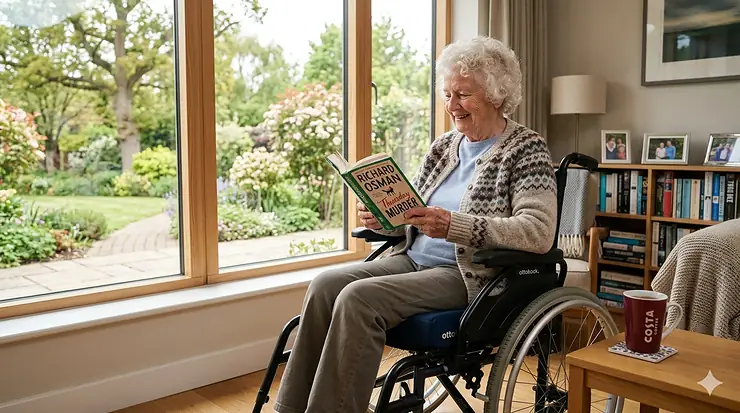
Sitting for eight, ten, twelve hours a day in a wheelchair is not the same as sitting at a desk nursing a slightly sore back. The pressure is real — quite literally. Sustained bodyweight concentrated on the ischial tuberosities (those bony protrusions you can feel if you sit on a hard floor) can, over time, cause pressure injuries that range from uncomfortable to genuinely dangerous. That is why finding the right gel seat cushion for wheelchair users is less of a lifestyle upgrade and more of a genuine health necessity.
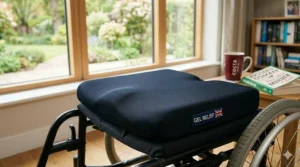
So what exactly is a gel seat cushion for wheelchair users? In simple terms, it is a specially engineered support pad — typically combining viscoelastic gel with memory foam or honeycomb polymer structures — designed to redistribute bodyweight away from pressure points, reduce tissue shear, and (crucially) dissipate heat so you are not effectively slow-roasting yourself through a British summer. Or, more relevantly, through a stuffy NHS waiting room in February.
The UK market has exploded with options in recent years, from budget-friendly honeycomb gel pads hovering below £30 to medical-grade dual-layer constructions that will make a considerably larger dent in your wallet. Not all of them are worth your attention. Some are excellent. Some are clever marketing on a thin slab of material that will flatten like a pancake within a fortnight.
This guide cuts through the noise. I’ve researched the best options currently available on Amazon.co.uk, tested the claims against real-world wheelchair use, and factored in everything that actually matters for UK buyers: durability in damp conditions, compatibility with standard NHS wheelchair seat widths, VAT relief eligibility, and the quiet but important matter of washing instructions when you live in a British flat with limited drying space.
Let’s get into it.
Quick Comparison Table: Best Gel Seat Cushions for Wheelchair Users UK 2026
| Product | Type | Size | Best For | Price Range |
|---|---|---|---|---|
| Aidapt Gel Cushion with Fleece Cover | Gel + Memory Foam | 45 × 38.5 × 7 cm | Elderly users, NHS compatibility | £25–£40 |
| AUVON Gel Wheelchair Seat Cushion | Gel + Memory Foam | 45.7 × 40.6 × 7.6 cm | Daily full-time users, cooling priority | £35–£55 |
| Everlasting Comfort Gel Memory Foam Cushion | Hybrid Gel-Foam | 45 × 40 × 10 cm | Heavy-duty use, seniors | £40–£60 |
| JML Soft Sitter Honeycomb Cushion | Honeycomb Gel Polymer | 40 × 34 × 3.5 cm | Occasional users, travel, lightweight | £15–£25 |
| PEPE Mobility Wheelchair Cushion 16.5″ | Viscoelastic Foam | 42 × 40 × 10 cm | Pressure sore prevention, clinical use | £45–£70 |
| Rewoalzx 2025 Upgraded Cooling Gel Seat Cushion | Honeycomb Gel | 50 × 50 × 5 cm | Larger build users, summer comfort | £25–£40 |
| RaMokey Gel Seat Cushion | Gel + Foam Hybrid | 42 × 35 × 4 cm | Budget buyers, part-time wheelchair users | £20–£35 |
The table above reveals something interesting: price does not always equal performance in this category. The JML, sitting comfortably under £25, outperforms several pricier options for occasional users, while the PEPE Mobility cushion — made in Europe and clinically oriented — justifies its higher price bracket specifically for users at genuine risk of pressure ulcers. Budget buyers should note that thicker does not automatically mean better; the Rewoalzx at 5 cm outperforms many 4 cm rivals purely because of its superior honeycomb airflow architecture.
💬 Just one click — help others make better buying decisions too! 😊
✨ Don’t Miss These Exclusive Deals!
🔍 Ready to upgrade your comfort? Click any highlighted product name below to check the latest pricing and availability on Amazon.co.uk. Prime members enjoy free next-day delivery on most of these picks.
Top 7 Gel Seat Cushions for Wheelchair Users: Expert Analysis
1. Aidapt Gel Cushion with Removable Fleece Cover
Aidapt is one of those quietly excellent British mobility brands that doesn’t shout about itself much — which is very on-brand, frankly. The Aidapt Gel Cushion with Removable Fleece Cover is a dual-layer construction featuring a removable gel insert sitting atop a generously filled foam base with a memory foam top layer. At 45 cm × 38.5 cm × 7 cm, it fits the majority of standard NHS-issue and privately purchased wheelchairs without any faffing about.
What makes this stand out is something most buyers miss entirely: it is eligible for VAT relief in the UK, which means disabled or chronically sick individuals can claim 20% back on the purchase — effectively making it cheaper than its listed price. That alone puts it ahead of many competitors for UK buyers on a fixed income. The fleece cover is machine washable at low temperature, which sounds minor until you realise you live in a flat with a small drying rack and no tumble dryer.
The gel insert moulds to your body shape over repeated use, providing progressively better pressure distribution the more you use it. It won’t transform itself instantly like memory foam, but the personalisation effect is genuinely useful for long-term wheelchair users. UK reviewers specifically note it works well over damp British winters — the fleece cover doesn’t absorb moisture the way cheaper fabric covers do.
The main limitation is that it’s relatively modest in depth compared to some rivals, meaning users over about 100 kg may find they need a thicker option. It’s also best suited to use indoors rather than outdoor powered chairs, where the fleece cover could pick up grime from rougher environments.
✅ VAT relief eligible — significant saving for UK buyers
✅ Machine washable cover, British brand with UK-based customer support
✅ Memory foam layer provides adaptive, personalised comfort
❌ May compress too readily for heavier users
❌ Fleece cover not ideal for outdoor or wet conditions
Price range: around £25–£40 on Amazon.co.uk. Exceptional value once VAT relief is applied. Sold and dispatched by Amazon directly.
2. AUVON Gel Wheelchair Seat Cushion
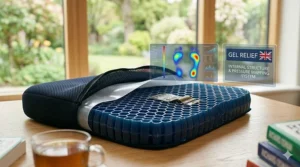
AUVON has become a genuinely dominant name in the wheelchair cushion market, and the AUVON Gel Wheelchair Seat Cushion — sized at 45.7 cm × 40.6 cm × 7.6 cm — is the model that best illustrates why. The standout feature is the gel coverage area: it extends across 41.7 cm × 37.8 cm of surface, significantly larger than competitors at a similar price point. In practice, this means the gel is actually doing its job across the full contact area of your seating position rather than leaving the edges to cope on their own.
The “ice silk” waterproof fabric cover is the detail I find most compelling. During warm months — and yes, Britain does occasionally have warm months — the surface stays noticeably cooler to the touch than standard polyester covers. For users prone to heat-related skin discomfort after prolonged sitting, this is not a trivial difference. The waterproof membrane underneath is a practical necessity: it protects the gel-foam core from sweat and, for users managing incontinence, provides a genuine layer of hygiene protection without making the seat feel clinical.
A detachable strap system keeps the cushion firmly in place on the wheelchair frame, which matters more than people realise. A cushion that shifts even 2–3 cm out of position negates most of its pressure-relief benefit, and on UK pavements — with their enthusiastic pothole population — a cushion without a secure fixing will migrate constantly.
UK buyers should note this is Prime eligible on Amazon.co.uk, meaning next-day delivery is available in most postcodes.
✅ Industry-leading gel coverage area
✅ Waterproof ice-silk cover — cooling and hygienic
✅ Secure strap system prevents cushion migration
❌ Heavier than honeycomb-only alternatives
❌ Cover can feel slightly stiff until broken in
Price range: £35–£55. Best mid-range option for full-time daily wheelchair users.
3. Everlasting Comfort Gel Memory Foam Cushion
The Everlasting Comfort Gel Memory Foam Cushion takes a different philosophical approach: rather than a thin gel topper over standard foam, it uses a more substantial ventilated gel design throughout a deeper (approximately 10 cm) overall profile. This depth is meaningful. Thinner cushions can “bottom out” under heavier users — meaning you effectively end up sitting on the wheelchair seat itself, which defeats the whole purpose entirely.
At roughly 45 cm × 40 cm, it fits most adult wheelchair seat widths comfortably. The ventilated construction is designed to prevent the heat build-up that plagues solid gel cushions in warmer conditions — and while Britain is not Dubai, a sustained afternoon in a care home with the central heating cranked up can get surprisingly stifling. The non-slip rubberised base keeps it stable across different surface types, from the polished floors of NHS facilities to the slightly sticky carpets of, well, most British living rooms.
UK reviewers particularly appreciate that the cover is both removable and durable — it handles frequent washing without the fabric pilling or losing its shape, which is a common complaint with cheaper alternatives. The sustainability certifications (noted on the Amazon.co.uk listing) are a bonus for buyers making eco-conscious purchasing decisions.
This is the cushion I’d most readily recommend to older adults using wheelchairs full-time, particularly those in care settings where the cushion will see intensive daily use and regular laundering.
✅ Greater depth (approx. 10 cm) — resists bottoming out
✅ Ventilated design maintains airflow during extended use
✅ Robust, frequently washable cover
❌ Bulkier and heavier — less ideal for active manual chair users
❌ Higher price point puts it out of reach for tighter budgets
Price range: £40–£60. A solid investment for full-time, heavy-duty use.
4. JML Soft Sitter Honeycomb Cushion
The JML Soft Sitter Honeycomb Cushion is the outlier in this list — and deliberately so. JML is a household name in the UK (you’ll recognise it from late-night television adverts), and this honeycomb gel cushion occupies a genuinely different niche from the medical-grade options around it. At roughly 40 cm × 34 cm × 3.5 cm and weighing under 500 g, it is the lightest option here by a meaningful margin.
The honeycomb gel polymer structure — an interconnected grid of air-filled gel cells — distributes weight across a large contact area without relying on material density alone. Each cell collapses independently under pressure and springs back when load is removed. The result is a cushion that feels almost nothing like sitting on a conventional pad, and everything like sitting on a firm but yielding surface that somehow adapts itself constantly. It’s a slightly uncanny sensation at first, honestly.
What it is not is a clinical pressure-sore-prevention device. The depth is simply insufficient for high-risk users. But for someone who uses a wheelchair part-time — perhaps for longer outings, hospital visits, or periods of reduced mobility — and wants something lightweight that packs flat into a bag without complaint, this is genuinely excellent. It’s also machine washable, available in multiple colours, and available at a price point that won’t cause existential reflection. Prime eligible on Amazon.co.uk.
✅ Exceptionally lightweight — easy to carry and transfer
✅ True honeycomb polymer — good airflow and bounce-back
✅ Affordable; available in multiple colour options
❌ Not suitable for full-time or high-risk pressure sore prevention
❌ Thinner depth — may not suit users over 90 kg
Price range: £15–£25. The budget star. Superb for occasional and light-duty use.
5. PEPE Mobility Wheelchair Cushion 16.5″
The PEPE Mobility Wheelchair Cushion 16.5″ is the most clinically oriented option in this roundup, and it wears that distinction with confidence. Made in Europe and designed specifically for wheelchair users at elevated risk of pressure injuries, it uses a viscoelastic (slow-rebound) foam construction with a waterproof, removable zip cover. Measuring approximately 42 cm × 40 cm × 10 cm, it’s among the deeper cushions tested here.
Viscoelastic gel — the material class that makes memory foam behave the way it does — responds to both pressure and temperature. As it warms to body heat, it softens and conforms more precisely to the user’s contours. The effect is progressive: the cushion gets better at its job the longer you sit on it. For users with existing pressure injuries, post-surgical wounds, or conditions that significantly increase pressure sore risk (such as spinal cord injury or advanced diabetes), this slow-conforming quality is precisely what the clinician ordered — sometimes quite literally.
The waterproof zip cover is worth a specific mention. Unlike waterproof coatings applied over fabric (which crack and peel after repeated washing), a zip-off waterproof cover can be cleaned separately and maintained properly. UK buyers in care settings, or managing incontinence, will find this considerably more practical than alternatives.
Being European-made means slightly higher pricing than the Asian-manufactured competitors, but post-Brexit import considerations are already factored into the listed Amazon.co.uk price — so there are no unexpected duty surprises at checkout.
✅ Viscoelastic foam — clinically appropriate for pressure injury prevention
✅ Waterproof ZIP cover — hygienic, removable, durable
✅ European-made quality with UK consumer law protection
❌ Higher price reflects clinical specification — overkill for casual users
❌ Heavier and less portable than lighter alternatives
Price range: £45–£70. The clinical choice. Worth every penny for high-risk users.
6. Rewoalzx 2025 Upgraded Cooling Gel Seat Cushion
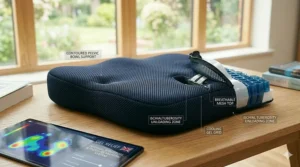
The Rewoalzx 2025 Upgraded Cooling Gel Seat Cushion arrives with something of a point to prove. At 50 cm × 50 cm × 5 cm, it is simply larger than most cushions on this list — and that extra surface area is not just cosmetic padding on the spec sheet. For users with a broader build, or those whose wheelchair seat is on the wider side, standard 40 cm cushions leave the outer thighs unsupported, creating new pressure points at the very edges where they sit. The Rewoalzx sidesteps this problem entirely.
The honeycomb gel structure across this extended surface is legitimately impressive. Each hexagonal cell compresses independently, which means the cushion distributes weight dynamically rather than statically — adapting with each small shift in posture rather than committing to one fixed support profile. The heat dissipation cushion properties are well above average for this price bracket; even after extended summer sitting, the surface temperature remains noticeably lower than comparable foam-only alternatives.
The 2025 upgrade (as advertised) focused on the washable cover’s machine wash performance — the previous iteration apparently shrunk slightly after hot-cycle washing, which the manufacturer has since addressed. UK buyers should note it is machine washable at 30°C maximum and hang to dry rather than tumble. Given it’s 50 cm across, you’ll want a decent drying arrangement — not ideal if your flat drying rack is already fighting a losing battle with your jeans.
✅ Larger footprint (50 × 50 cm) — excellent for broader builds
✅ Superior heat dissipation for long summer sitting sessions
✅ Machine washable; updated cover shrink-resistant
❌ Large size makes it impractical for smaller or transport wheelchairs
❌ Thinner at 5 cm — heavier users may prefer a deeper option
Price range: £25–£40. Outstanding value for larger-build users prioritising cooling comfort.
7. RaMokey Gel Seat Cushion for Long Sitting
The RaMokey Gel Seat Cushion for Long Sitting is the sensible, no-drama entry-level choice — and there’s absolutely nothing wrong with that. At approximately 42 cm × 35 cm × 4 cm, it covers standard wheelchair dimensions without ambition in either direction. The dual-layer gel foam hybrid construction offers a gel cooling layer on top and a foam support base beneath — a logical arrangement that separates the comfort function (gel) from the structural support function (foam) rather than asking one material to do both jobs simultaneously.
The non-slip base keeps it in position during normal use, and the cloth cover zips off for machine washing. Customer reviews on Amazon.co.uk are notably positive about the cover’s durability after repeated washing, which is a genuinely important practical consideration for wheelchair users who need to launder their cushion regularly. Compared to foam-only seat cushions, UK reviewers consistently note the gel layer meaningfully reduces the warm, stuffy feeling associated with prolonged sitting — particularly relevant for users who struggle with temperature regulation.
It’s not the choice for anyone using a wheelchair twelve hours a day with clinically elevated pressure-sore risk. But for the part-time user, the new wheelchair user still finding their feet (so to speak), or anyone working to a tight budget who simply needs something better than the bare wheelchair seat they’re currently tolerating — the RaMokey delivers quietly excellent value.
✅ Budget-friendly without sacrificing basic gel functionality
✅ Durable washable zip cover; good customer feedback on longevity
✅ Dual-layer construction logically separates cooling and support
❌ Entry-level depth — not for full-time high-dependency users
❌ Smaller gel coverage area than premium alternatives
Price range: £20–£35. The sensible starting point for new or part-time wheelchair users.
How to Choose the Right Gel Seat Cushion for Wheelchair Users in the UK
Choosing a gel seat cushion for wheelchair users is not simply a matter of picking the most expensive option and hoping for the best. Here is a practical, prioritised framework for making the right decision:
1. Assess your pressure risk level first. This is the most important factor and the one most buyers skip. If you’re a full-time wheelchair user with any history of pressure sores, skin breakdown, or clinically identified risk factors (spinal cord injury, diabetes, peripheral vascular disease, reduced sensation), you should be looking at clinically designed options like the PEPE Mobility or AUVON Gel — and ideally discussing your needs with an occupational therapist or district nurse before purchasing. VAT relief is available for qualifying individuals, which reduces the financial barrier considerably.
2. Get the sizing right. Measure your wheelchair seat width before ordering. A cushion that overhangs the sides creates instability; one that’s too narrow leaves pressure points uncovered. Most UK adult wheelchairs have seat widths between 40 cm and 48 cm (approximately 16–19 inches). Standard NHS-issue chairs typically run 17–18 inches wide.
3. Consider your daily use duration. Using a wheelchair for two hours a day is fundamentally different from using one for ten. Light users can comfortably manage with honeycomb gel options like the JML Soft Sitter. Full-time users need deeper, denser dual-layer gel-foam constructions — minimum 7 cm depth, ideally with a waterproof cover.
4. Factor in the British climate. This might sound frivolous, but it matters. If you’re frequently moving between outdoors (cool, damp) and indoors (centrally heated), you want a cushion that regulates temperature in both directions. Honeycomb and ventilated gel structures do this better than solid gel slabs, which can feel uncomfortably cold when first sat upon in winter.
5. Prioritise cover washability. Wheelchair cushion covers need laundering. Regularly. Check whether the cover is removable, whether it’s machine washable (and at what temperature), and whether the material holds up after frequent washing. A cover that disintegrates after three months defeats the purpose of the cushion beneath it.
6. Check VAT relief eligibility. Many cushions on Amazon.co.uk — particularly those listed under Health & Personal Care — qualify for VAT relief for disabled individuals. This is a 20% saving you should never leave unclaimed. Look for the “VAT relief” option on the product listing page.
7. Consider weight if you transfer frequently. If you lift your cushion off the wheelchair regularly — getting in and out of cars, for instance — weight matters. The JML honeycomb cushion at under 500 g is dramatically easier to handle than a 10 cm memory foam block approaching 2 kg.
Real-World Scenarios: Which Cushion for Which UK User?
The right gel seat cushion for wheelchair users is rarely universal. Let me walk through three realistic UK user profiles and match them to the appropriate pick from this list.
Profile 1 — Margaret, 74, Bristol. Margaret had a hip replacement eight months ago and now uses a manual wheelchair for longer outings — shopping trips, hospital appointments, family visits. She’s at home in her flat the rest of the time. She needs something comfortable for two to four hours of sitting, easy to clean (she lives alone and has a small washing machine), and ideally within a modest budget. VAT relief eligible.
Best match: Aidapt Gel Cushion with Removable Fleece Cover. Familiar UK brand, machine washable fleece cover, VAT relief applicable, appropriate depth for part-time use. The gel insert provides progressive contouring that suits occasional rather than continuous use. Dispatched by Amazon — no prolonged waits.
Profile 2 — James, 38, Manchester. James has a spinal cord injury (T6 complete) and uses a manual wheelchair full-time — roughly ten to twelve hours daily. He manages his own skin checks and has had one Stage 1 pressure injury in the past eighteen months. He prioritises pressure distribution and hygiene above all else.
Best match: PEPE Mobility Wheelchair Cushion 16.5″. The viscoelastic construction, clinical depth (10 cm), and zip-off waterproof cover are precisely aligned to James’s needs. This is the one cushion in this list I’d specifically direct toward full-time users with documented pressure sore history. Yes, it costs more. No, it’s not excessive given what it’s protecting against.
Profile 3 — Priya, 29, London. Priya has a progressive joint condition and uses her wheelchair primarily in summer and during flare-ups — perhaps four to six hours at a stretch. She commutes by bus and underground, and she gets warm very easily. Cooling is her primary concern. She wants something lightweight enough to carry in her bag.
Best match: JML Soft Sitter Honeycomb Cushion for daily carry (it weighs almost nothing), supplemented by the Rewoalzx 2025 Cooling Gel Cushion for home use when extended sitting is required. The combination gives Priya portability for transit and proper heat dissipation gel cushion performance when she needs it most.

Common Mistakes When Buying a Gel Seat Cushion for Wheelchair Users
This is a category full of marketing noise and genuine misunderstanding. Here are the mistakes I see most frequently — and how to avoid them.
Mistake 1: Buying by thickness alone. A 10 cm cushion is not automatically better than a 5 cm one. Depth matters only in relation to material density and your body weight. A 10 cm low-density foam cushion will bottom out under a 90 kg user and provide worse pressure relief than a 7 cm high-density gel-foam hybrid. Always check the weight capacity alongside the depth specification.
Mistake 2: Ignoring the cover material. The gel core is the headline, but the cover is what you actually live with daily. A hot, non-breathable cover will negate the cooling benefits of the best gel layer underneath it. Look for covers described as “breathable,” “ventilated,” or made from moisture-wicking fabrics. Ice-silk covers (as used in the AUVON) genuinely do feel cooler — it’s not just marketing copy.
Mistake 3: Skipping the strap or fixation check. A cushion that slides sideways on a UK pavement is doing more harm than good. Always check whether the cushion includes a non-slip base, a securing strap, or both. The AUVON’s detachable strap system is the gold standard here.
Mistake 4: Assuming all gel cushions suit all body types. Honeycomb gel polymer cushions (JML-style) suit users under approximately 90 kg and moderate duration sitting. Dual-layer gel-foam hybrids (AUVON, Everlasting Comfort) are appropriate for heavier users and longer durations. Medical-grade viscoelastic constructions (PEPE Mobility) are for clinically elevated pressure risk. Matching product to user is not optional — it’s the whole exercise.
Mistake 5: Buying from non-UK stock without checking returns. UK consumer rights under the Consumer Rights Act 2015 and Consumer Contracts Regulations give you a 14-day cooling-off period for online purchases. However, some Amazon.co.uk third-party sellers ship from non-UK fulfilment centres, which can complicate returns. Buying from products “Sold and Dispatched by Amazon” simplifies this considerably.
Gel Seat Cushion vs Traditional Foam: What British Buyers Need to Know
How Do They Compare?
| Feature | Gel Seat Cushion | Standard Foam Cushion |
|---|---|---|
| Pressure distribution | Excellent — dynamic, adapts to movement | Moderate — static support profile |
| Heat management | Good to excellent (especially honeycomb) | Poor — traps body heat readily |
| Weight | Heavier (especially gel-foam hybrids) | Lighter |
| Durability | Gel core very durable; cover varies | Foam degrades faster under heavy use |
| Price range (GBP) | £15–£70 | £10–£45 |
| Best for | Full-time or medically-motivated use | Light, short-duration use |
| VAT relief (UK) | Often eligible under Health & Personal Care | Also often eligible |
The comparison above makes one thing immediately clear: gel cushions do cost more than basic foam alternatives, but the gap is not as large as people assume once VAT relief is factored in. More importantly, for wheelchair users sitting for six or more hours daily, the heat management difference is the decisive factor. Standard foam cushions trap body heat relentlessly — the kind of trapped heat that, over several hours, contributes to moisture build-up and skin maceration, raising pressure injury risk significantly. The NHS guidance on pressure ulcer prevention consistently emphasises skin temperature and moisture control as key risk factors. A gel seat cushion addresses both more effectively than foam alone — which is why the extra expenditure is genuinely warranted rather than aspirational.
Long-Term Value and Maintenance: Making Your Cushion Last in the UK
Gel cushions, properly maintained, should last two to three years before the gel layer loses meaningful structural integrity. Here is how to protect that investment.
Washing the cover — do it regularly, do it right. Most covers on this list are machine washable at 30–40°C. Never tumble dry — the heat damages waterproof membranes and can distort the fabric structure. In a British flat with limited drying space, hang the cover over a clothes horse overnight; it will be dry by morning in a normally heated home. Aim to wash the cover at minimum fortnightly under normal use.
Cleaning the gel core itself. Don’t submerge it. A damp cloth with mild soapy water, wiped over the surface, then left to air dry completely before replacing the cover, is sufficient. Never use bleach-based cleaners on gel — they degrade the polymer over time.
Storage during periods of non-use. If the cushion won’t be used for extended periods, store it flat rather than rolled or folded. Gel has memory of prolonged deformation — a cushion stored folded in half for three months will have a crease in it that takes weeks to fully recover, if it recovers at all.
When to replace. The honest indicator is simple: if you sit on the cushion and feel as though you’re making contact with the hard wheelchair base beneath, the gel or foam has compressed beyond its effective range. No amount of maintenance recovers that. Consider replacement at that point — and remember that some NHS community equipment services will contribute toward replacement cushions for eligible users. Your GP or occupational therapist can advise on this.
Winter considerations. British winters are damp and cold, and gel cushions left in unheated garages or car boots overnight can become remarkably firm until they warm to body temperature. This is normal and not a sign of damage, but worth knowing — bring the cushion indoors overnight if possible, or allow ten minutes’ warm-up time before use. Cold gel is less effective at the conforming, pressure-distributing function that justifies the purchase in the first place.
What Do UK Buyers Ask Most? (FAQ)
❓ Is a gel seat cushion for wheelchair users available with VAT relief on Amazon.co.uk?
❓ What size gel cushion fits a standard NHS wheelchair?
❓ How long does a gel seat cushion for wheelchair users typically last?
❓ Can a cooling gel wheelchair cushion help prevent pressure sores?
❓ Are gel wheelchair cushions suitable for outdoor use in UK weather?
Conclusion: The Right Gel Seat Cushion Makes a Measurable Difference
Here is what it comes down to. Sitting in a wheelchair without adequate cushioning is not just uncomfortable — for full-time users, it carries genuine clinical risk. The right gel seat cushion for wheelchair users addresses that risk while making daily life meaningfully more comfortable. That is not a small thing.
For most UK buyers, the choice is fairly clear once you match product to use case. Occasional users who want something lightweight and affordable will be well served by the JML Soft Sitter. Full-time daily users who need proper cooling and secure fixation should look at the AUVON Gel Cushion. Anyone with clinical risk factors — existing pressure injuries, reduced sensation, prolonged immobility — should invest in the PEPE Mobility or take the Aidapt to their occupational therapist and ask for a professional assessment.
Whatever you choose, check the VAT relief eligibility, measure your wheelchair seat first, and read the cover washing instructions before you assume anything. These are small steps that make an outsized difference to your experience and the cushion’s longevity.
The products above are all currently available on Amazon.co.uk. Prime members will find most eligible for next-day delivery — which, given how immediately this kind of purchase tends to be needed, is rather convenient.
✨ Don’t Miss These Exclusive Deals!
🔍 Click any highlighted product name in this guide to check current pricing and availability on Amazon.co.uk. Most are Prime eligible — check for free delivery on orders over £25 if you’re not a Prime member.
Recommended for You
- Best Pressure Relief Cushion for Wheelchair: Top 7 UK Picks (2026)
- Best Electric Wheelchair for Spinal Cord Injury: 7 Top UK Picks 2026
- Best Electric Wheelchair for Cerebral Palsy UK 2026: Top 7 Picks
Disclaimer: This article contains affiliate links. As an Amazon Associate, I earn from qualifying purchases. If you purchase products through these links, we may earn a small commission at no additional cost to you.
✨ Found this helpful? Share it with your mates! 💬🤗
