
In This Article
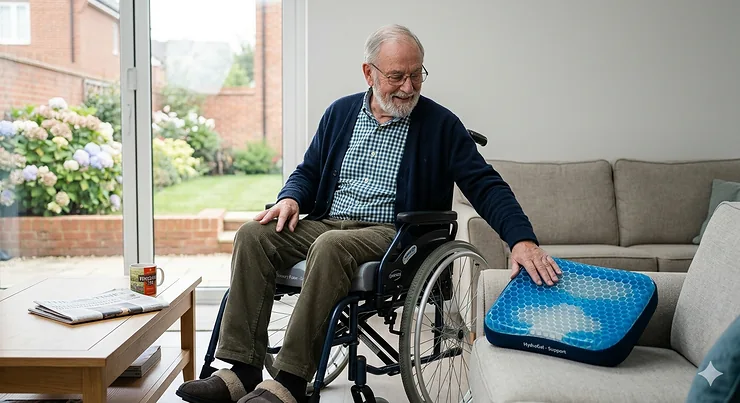
You wouldn’t think a seat cushion could be controversial. And yet, ask any long-term wheelchair user — or their occupational therapist — which is better, memory foam or gel, and you’ll spark a debate that puts Brexit discussions to shame.
Here’s the honest truth: both types work. Both have real, measurable benefits. But they work in different ways, for different people, in different circumstances. And getting it wrong isn’t just uncomfortable — it can contribute to pressure sores, poor posture, and the kind of chronic lower back pain that follows you home from every appointment. According to the NHS guidance on pressure ulcer prevention, prolonged sitting without adequate pressure relief is one of the leading causes of skin breakdown in wheelchair users, making cushion choice a genuine clinical concern, not merely a lifestyle preference.
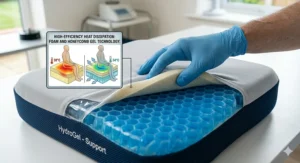
So what exactly is the memory foam vs gel wheelchair cushion debate about? In short: memory foam contours slowly to your body’s shape using heat-responsive technology, distributing weight across the full surface area. Gel cushions, by contrast, use a soft polymer or gel-infused foam layer to spread pressure immediately — and typically run cooler under the body. The difference matters enormously when you’re sitting for four, six, or eight hours a day.
In this guide, we’ve done the research so you don’t have to. We’ve identified seven cushions currently available on Amazon.co.uk — from budget-friendly memory foam pads under £20 to premium hybrid options — tested each against real-world UK use cases, and laid out exactly who should buy what. Whether you’re managing a spinal injury, supporting a parent with limited mobility, or simply replacing an aging seat pad on your everyday wheelchair, there’s a right answer here. Let’s find yours.
Quick Comparison: Memory Foam vs Gel Wheelchair Cushion at a Glance
| Feature | Memory Foam | Gel / Gel-Infused |
|---|---|---|
| Pressure relief | Excellent (slow-contouring) | Excellent (immediate displacement) |
| Temperature | Retains heat — can feel warm | Cooler — gel dissipates heat |
| Body contouring | Moulds over time (slow-recovery) | Conforms quickly, resets faster |
| Weight | Lighter | Slightly heavier |
| Durability | 2–4 years typical | 3–5 years typical |
| Best for | Posture, bony prominences, long sits | Hot climates, active users, mixed-use |
| Price range (Amazon.co.uk) | £15–£45 | £20–£55 |
| UK climate suitability | ⭐⭐⭐ (warm in cool British settings) | ⭐⭐⭐⭐ (cooler, handles indoor heating) |
What the table above doesn’t quite capture is feel. Memory foam has that gradual, sinking-in quality — like the cushion is learning your body. Gel sits more immediately under you, spreading outward like a supportive liquid. Neither is wrong. But if you’re spending all day in a centrally heated flat in Manchester, or commuting via adapted vehicle on rainy British motorways, those temperature and contouring differences become very real, very quickly.
💬 Just one click — help others make better buying decisions too! 😊
✨ Don’t Miss These Exclusive Deals!
🔍 Take your wheelchair comfort to the next level with these carefully selected cushions. Click on any highlighted product to check current pricing and availability on Amazon.co.uk. These picks will help you find exactly what you need!
Top 7 Wheelchair Cushions on Amazon.co.uk: Expert Analysis
1. Everlasting Comfort Gel Memory Foam Wheelchair Cushion
The Everlasting Comfort cushion is the rare product that genuinely earns its name. Built as a hybrid — gel-infused memory foam throughout — it bridges the gap between the two camps in this debate rather elegantly.
Key specs: 46 × 43 × 8 cm, ventilated with strategically placed air holes, non-slip base, heat-responsive foam core. At 8 cm thick, this is one of the chunkier options available on Amazon.co.uk, which matters more than the marketing suggests. Depth of cushioning directly correlates to how well your ischial tuberosities (the bony bits you actually sit on) float above the rigid seat beneath — a crucial factor in pressure sore prevention.
The gel infusion is the clever bit. Pure memory foam notoriously retains body heat, which in British winters isn’t terrible, but in centrally heated homes and care facilities can become genuinely sticky and uncomfortable. The gel works to offset this, dissipating heat upward while the foam does the contouring work below. It’s not a perfect cooling solution, but it’s meaningfully better than foam alone.
Who is this for? Wheelchair users who sit for extended periods — four or more hours daily — and who want the pressure-distributing benefits of memory foam without cooking in their own warmth. UK reviewers note it fits standard transit and self-propelled wheelchair frames without modification. Prime-eligible for next-day delivery.
✅ Excellent depth at 8 cm for genuine pressure relief
✅ Hybrid gel-foam design — best of both materials
✅ Non-slip base stays put on smooth indoor surfaces
❌ Heavier than pure foam alternatives
❌ Sizing may be snug on narrower UK wheelchair seats
Priced in the £25–£40 range — solid mid-range value for a cushion with this level of specification.
2. AUVON Wheelchair Seat Cushion (Memory Foam)
AUVON has quietly become one of the most trusted names in the wheelchair accessory space on Amazon.co.uk, and for good reason: their cushions are designed by people who’ve clearly thought about wheelchair-specific ergonomics, not just repurposed office chair pads.
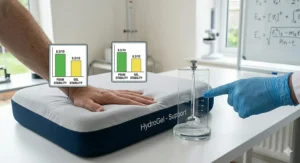
This model — 46 × 41 × 8 cm (available in the 18″ × 16″ × 3″ variant on Amazon.co.uk) — uses high-quality low-resilience memory foam: the proper slow-recovery type, not the cheaper fast-bounce foam that merely pretends to be memory foam. The distinction matters. True low-resilience foam takes 3–5 seconds to return to shape after compression, meaning it forms a custom cradle around your specific body contours. That’s your pressure points being properly supported, not just padded.
The detachable safety strap is a genuinely useful addition — it prevents the cushion shifting when you transfer in and out, which anyone who’s had a cushion slide out from under them mid-transfer will appreciate enormously. The waterproof membrane cover protects the foam from moisture (relevant in a care context) and removes for machine washing.
Best suited for: full-time or near-full-time wheelchair users with bony prominences or history of pressure sores who need reliable, consistent contouring support. Also excellent for sciatica sufferers, where that slow-recovery foam provides sustained lumbar decompression.
UK reviewers praise the strap system specifically — several note it’s the first cushion that hasn’t moved during transfers. Prime delivery available.
✅ True low-resilience slow-recovery foam
✅ Detachable waterproof cover — machine washable
✅ Safety strap system for transfer stability
❌ Retains warmth in heated indoor environments
❌ May feel quite firm initially before breaking in
Available in the £20–£35 range — excellent value for clinical-grade memory foam.
3. Aidapt Gel Cushion with Removable Fleece Cover
Aidapt is a British brand — with manufacturing split between the UK and the Far East — and it shows in the design choices. The fleece-lined removable cover isn’t an accident; it’s a recognition that British homes are draughty, British care facilities are often chilly, and a cold gel cushion in January is nobody’s idea of comfort.
The construction here is layered: a gel insert sits above a generously filled foam core, which is itself topped with a thin memory foam layer. Dimensions of 385 mm × 450 mm × 70 mm make it compatible with the vast majority of standard UK wheelchair frames. The reversible cover — soft fleece on one side, easy-clean black polyester on the other — is a practical touch that those who’ve dealt with daily cleaning routines will immediately appreciate.
Crucially, this product is eligible for VAT relief in the UK for disabled users or those with chronic illness who purchase it for personal use. At 20% VAT, that’s a meaningful saving — worth checking the HMRC VAT relief guidance for disabled people before purchasing.
Who benefits most? Older wheelchair users, those in care settings, and anyone for whom ease of maintenance is as important as comfort. The fleece side is also considerably warmer, making this a seasonally versatile choice in the British climate.
✅ VAT relief eligible — real financial saving for qualifying UK buyers
✅ Reversible cover — fleece for winter, polyester for easy cleaning
✅ British brand with UK-focused design choices
❌ Gel insert can feel firm until body-warmed
❌ At 70 mm depth, slightly less thick than competitors
Priced in the £20–£30 range — particularly good value once VAT relief is factored in.
4. PEPE Mobility Wheelchair Cushion (Viscoelastic Foam, 16.5″)
Made in Europe and available on Amazon.co.uk, the PEPE Mobility cushion occupies an interesting middle ground — it uses viscoelastic foam (essentially another name for high-grade memory foam) rather than a gel-infused composite, but the European manufacturing standards mean the foam quality is notably consistent.
The 16.5″ size (approximately 42 cm) targets the significant portion of UK wheelchair users on narrower transit chairs — standard NHS-issued wheelchairs and folding transit models typically run 16″–18″ wide, and PEPE’s sizing hits that sweet spot for users who find wider cushions create uncomfortable lateral pressure on the seat frame.
The waterproof removable ZIP cover is particularly practical in a clinical or care context — it can be changed and washed during the day without disturbing the foam insert. This matters for carers managing multiple transfers or for users who are more prone to incontinence. European manufacturing also means the viscoelastic foam density is consistent batch-to-batch — a detail that may seem trivial until you’ve bought a foam cushion that started soft and turned into a board within three months.
This is the pick for: users on NHS-standard transit chairs, anyone who prioritises cover hygiene, and buyers who want European manufacturing quality assurance without the post-Brexit import complexity (it ships from Amazon.co.uk UK stock).
✅ Made in Europe — consistent foam density quality
✅ Zippered waterproof cover — easy clinical cleaning
✅ 16.5″ size suits narrower UK transit chairs
❌ Pure viscoelastic foam — no gel cooling layer
❌ Less depth than some competitors
In the £30–£45 range — a premium worth paying for consistent European foam quality.
5. Shikra Deep Pressure Relief Memory Foam Wheelchair Cushion
The Shikra cushion takes an unapologetically straightforward approach: thick, dense memory foam, waterproof cover, done. At 16″ × 18″ × 4″ (approximately 41 × 46 × 10 cm), this is one of the deepest memory foam cushions currently on Amazon.co.uk — and that depth is the entire point.
Standard memory foam cushions in the 3″–3.5″ range are adequate for moderate daily use. But for users with significant pressure sore risk — those with reduced sensation, limited ability to perform pressure relief lifts, or existing skin integrity issues — that extra centimetre or two of depth is the difference between staying ahead of the problem and chasing it. The foam needs to be thick enough that your weight never bottoms out onto the rigid seat beneath, which is exactly what happens with thin cushions after a few hours.
The spec sheet doesn’t mention the foam density, which is the one gap in the product’s transparency — foam density (measured in kg/m³) determines how long the cushion will maintain its pressure-relief performance before it compresses permanently. That said, UK reviewers consistently report sustained performance over many months, which suggests the density is adequate.
Best for: users with elevated pressure sore risk, those with paraplegia or significant reduced mobility, and users who sit for longer than six hours daily. The waterproof cover also makes it practical for outdoor use — including those navigating the famously unpredictable British weather on manual chairs outdoors.
✅ 10 cm depth — genuine bottoming-out protection
✅ Waterproof cover — outdoor and all-weather suitable
✅ Wide 18″ footprint fits most UK self-propelled chairs
❌ Foam density not specified by manufacturer
❌ Heavier than average — affects portability
Priced in the £15–£25 range — outstanding value for the depth offered.
6. SKYNY Gel Wheelchair Seat Cushion
SKYNY’s cushion is the cooling specialist of this list — its gel-infused memory foam is specifically engineered to manage heat, with a non-slip base and washable cover that make it one of the more practically minded options available on Amazon.co.uk.
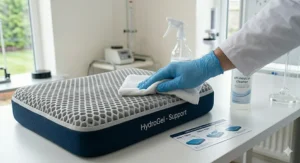
The cooling aspect deserves more attention than it typically gets in product listings. Anyone who uses a wheelchair indoors in a centrally heated British flat or care home knows that a non-cooling cushion can become genuinely uncomfortable by mid-afternoon. The SKYNY’s gel layer continuously draws heat away from the contact surface — it’s not dramatic air conditioning, but it’s a meaningful improvement on pure foam. Think of it as the difference between a wool jumper and a merino blend: the end result is similar but the experience throughout the day is noticeably better.
The ergonomic shape provides coccyx relief — important for users with tailbone sensitivity, sciatica, or postoperative hip pain. The non-slip base performs well on the range of fabric seat materials found across UK wheelchair models, including the slightly textured vinyl found on many NHS-issue transit chairs.
This is the cushion for: indoor-primary wheelchair users who run warm, users in care facilities with central heating, and anyone recovering from hip or spinal surgery where heat buildup exacerbates discomfort. Also suits users who want a single cushion that transitions smoothly between wheelchair, car seat, and home chair.
✅ Gel infusion specifically designed for heat management
✅ Ergonomic coccyx cutout — excellent for tailbone pain
✅ Washable cover — straightforward daily maintenance
❌ Not the deepest option — less suitable for high-risk pressure sore users
❌ Gel can feel initially cool in winter months
In the £20–£30 range — very good value for the cooling comfort on offer.
7. Molten Creek® Wheelchair Memory Foam Cushion
The Molten Creek cushion earns its place on this list through sheer practicality: it is, frankly, a no-fuss, no-nonsense memory foam cushion that does exactly what it says without charging you a premium for brand cachet.
At 18″ × 16″ × 3″ (approximately 46 × 41 × 8 cm), it fits the majority of standard UK wheelchair seat widths. The waterproof orthopedic cover zips off for washing, the memory foam core provides decent slow-recovery contouring, and the non-slip base keeps it in position across different seat surfaces. Nothing revolutionary. Everything functional.
What most UK buyers overlook about this model is that its 3″ depth, while modest on paper, is perfectly adequate for part-time wheelchair users — those who sit for two to four hours rather than all day. Carers and family members purchasing a first cushion for a parent or relative who has recently started using a wheelchair, or for use during outings and appointments, will find this hits a sensible balance between comfort, cost, and practicality.
The orthopaedic positioning encourages proper spinal alignment, which matters even for shorter sitting sessions. UK reviewers note it fits standard folding transit wheelchairs — the most common type used for outings and hospital visits — without overhang or slippage.
Best for: budget-conscious buyers, part-time wheelchair users, family carers equipping a chair for occasional use, and anyone who wants a reliable memory foam cushion without spending over £25.
✅ Practical sizing for standard UK transit/self-propelled frames
✅ Waterproof removable cover — easy maintenance
✅ Excellent value — solid performance at an accessible price point
❌ 3″ depth not ideal for high-risk or full-time users
❌ No gel layer — runs warmer than hybrid alternatives
Priced in the £15–£25 range — the budget-conscious pick without compromise on the fundamentals.
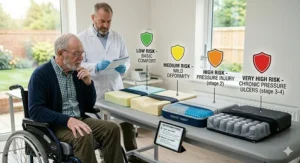
How to Use Your Wheelchair Cushion for Maximum Benefit: A Practical Guide
Buying the right cushion is step one. Using it correctly is, rather annoyingly, step two that most guides skip entirely.
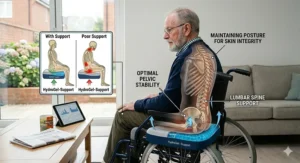
Positioning. A memory foam or gel cushion should sit flush with the back of the wheelchair seat, not pushed forward. The user’s knees should be at approximately 90 degrees — if the hips are higher than the knees, the cushion is too thick or the footrests need adjusting. Getting this wrong means transferring pressure to the wrong areas entirely.
Break-in period. Memory foam, in particular, takes 2–4 weeks to reach its optimal contouring performance. New foam is stiffer than settled foam — don’t judge the cushion in week one. If it still feels too firm after a month, then it’s genuinely too firm.
UK climate tip — damp and condensation. British homes and care facilities can be surprisingly damp, particularly in older housing stock. Moisture trapped beneath a non-breathable cushion accelerates foam degradation and creates hygiene problems. Always allow air circulation underneath by removing the cushion periodically, or choose a cover with a breathable mesh panel. A quick daily airing — even just propping the cushion upright while the user takes a break — extends lifespan significantly.
Cleaning schedule. Covers should be washed weekly in care settings, or every two weeks for home use. The foam insert itself should be spot-cleaned only — machine washing destroys the cell structure and permanently reduces its pressure-relief performance. Never wring memory foam; press gently and allow to dry naturally away from direct heat.
Pressure relief lifts. Even the best cushion is not a substitute for regular pressure relief. The Spinal Injuries Association recommends a pressure lift or lean every 15–30 minutes for full-time wheelchair users — your cushion should support this practice, not replace it.
Winter vs summer adjustment. Memory foam stiffens in cold temperatures, meaning a cushion that feels perfect in a heated home may feel noticeably firmer in a cold car or outdoor environment. If you spend significant time outdoors in winter, a gel-infused hybrid is more temperature-stable than pure memory foam.
Real-World Scenarios: Which Cushion for Which UK User?
Wheelchair users are not a monolith. A retired gentleman in a care facility in Bath has almost nothing in common — from a seating perspective — with a 35-year-old manual wheelchair user commuting to work in Leeds. Here’s how the choice plays out in practice.
🏘️ Margaret, 74, care home resident in Bristol. Margaret uses her wheelchair for six to eight hours daily, rarely goes outdoors, and her care team changes her position every two hours. Her primary concerns are warmth, ease of cover cleaning, and pressure ulcer prevention. The Aidapt Gel Cushion suits her perfectly — the fleece cover provides warmth in the care home’s occasionally draughty corridors, the easy-clean reverse is practical for the care team, and VAT relief reduces the cost for a purchase made on medical grounds.
🏙️ Kieran, 38, full-time manual wheelchair user in Manchester. Kieran works in an office, transfers independently, and runs warm in his centrally heated workplace. He needs a cushion that stays cool across a full working day and doesn’t shift during active transfers. The SKYNY Gel Wheelchair Seat Cushion is his best match — the gel cooling layer handles the office heating, and the non-slip base stays put through repeated transfers. He pairs it with a thin coccyx relief cushion for the 40-minute car journey to work.
🌿 Diane, 61, part-time wheelchair user recovering from hip surgery in rural Shropshire. Diane is in her third month of recovery, using a folding transit chair primarily for outings. She needs something affordable, easy to fit to a standard transit chair, and comfortable for two to three hours at a time. The Molten Creek Memory Foam Cushion fits neatly: the standard 18″ × 16″ footprint works on her NHS-issue transit chair, the orthopedic positioning helps her posture during outpatient appointments, and the price point doesn’t strain her household budget.
👦 James, 19, powered wheelchair user with spinal cord injury in Glasgow. James is at high pressure sore risk, sits for ten or more hours daily, and has reduced sensation below the waist. For him, depth and consistent foam quality are non-negotiable. The Shikra Deep Pressure Relief cushion (at 10 cm) or the PEPE Mobility viscoelastic foam are his strongest options — ideally recommended in consultation with his occupational therapist or physiotherapist, who may also assess whether an air cushion or custom-moulded system would be more appropriate.
How to Choose the Right Wheelchair Cushion in the UK: 7 Criteria That Actually Matter
The spec sheet won’t tell you half of what you need to know. Here’s the framework that separates a good purchase from a costly mistake.
1. Assess your daily sitting hours first. Under four hours: 3″ depth memory foam is typically adequate. Four to eight hours: go to 4″ minimum, preferably gel-infused hybrid. Over eight hours: consult an occupational therapist; standard retail cushions may be insufficient for high-risk users.
2. Factor in UK temperature realities. British winters are cold; British care homes and offices are often overheated. Memory foam stiffens in cold environments and retains heat in warm ones. If your user spends significant time in both — outdoors and indoors — a gel-infused hybrid is more adaptable.
3. Measure the seat, not the body. The cushion should match the wheelchair seat width closely. Too narrow and the foam edges compress unevenly; too wide and the cushion overhangs the frame, creating pressure points on the lateral thighs. Most UK transit chairs are 16″–18″ wide; self-propelled chairs often run 18″–20″.
4. Consider carer workload. If someone else is cleaning and repositioning the cushion, removable zip-off covers are not optional. A beautifully effective cushion that requires twenty minutes to clean is one that will stop being cleaned properly. Opt for machine-washable covers, waterproof membranes, and reversible fabrics where possible.
5. Check for VAT relief eligibility. As noted above, disabled UK buyers or those with chronic illness purchasing cushions for personal use may claim VAT exemption — reducing the price by 20%. This applies to most of the products on this list. See HMRC’s guidance on VAT relief for disabled people for details.
6. Think beyond the wheelchair. Most good wheelchair cushions double on car seats, office chairs, and home seating. If the user transfers between several seated environments throughout the day, a lightweight cushion with a carry handle becomes meaningfully more practical.
7. Don’t ignore the foam density question. Marketing language about “premium memory foam” is largely meaningless without a density figure. The higher the density (aim for 50 kg/m³ or above for full-time use), the longer the cushion maintains its pressure-relief performance. If a product doesn’t state its foam density, ask the seller directly before purchasing.
Common Mistakes When Buying a Wheelchair Cushion (And How to Avoid Them)
Even experienced buyers get this wrong. Here are the most frequent errors — several of them specific to the UK market.
Buying by thickness alone. “Thicker equals better” is a comfortable fiction. A 10 cm cushion of poor-density foam will bottom out faster than a 7 cm cushion of high-density foam. Depth matters, but density matters just as much. Ask for the kg/m³ figure when it isn’t listed.
Ignoring the cover material. Many cheap cushions come with covers that aren’t waterproof, aren’t removable, or aren’t machine washable. For wheelchair use — particularly in care settings — this is a fundamental oversight, not a minor inconvenience.
Assuming UK and US product specs are identical. Some products listed on Amazon.co.uk are fulfilled from UK warehouses but are technically the same product as a US variant, with size in inches that doesn’t correspond exactly to UK wheelchair standards. Always verify the centimetre dimensions against your actual seat measurement before purchasing.
Neglecting medical advice for high-risk users. A retail cushion is appropriate for moderate daily use. Users with significant pressure ulcer risk, history of skin breakdown, or limited sensation should be assessed by an occupational therapist or physiotherapist. Many NHS wheelchair services can provide cushion recommendations — and in some cases, prescription cushions — as part of a seating assessment. The NHS wheelchair service is the appropriate first port of call.
Buying purely on price. A £12 cushion for a full-time wheelchair user is a false economy. Even modest pressure sore treatment is far costlier in time, discomfort, and NHS resources than the difference between a budget and a mid-range cushion. Spend appropriately for the level of use.
Memory Foam vs Gel: Features That Actually Matter (And Those That Don’t)
Let’s cut through the marketing noise.
Features that genuinely matter:
- Foam density and slow-recovery time (determines real-world pressure relief performance)
- Cover waterproofing and wash cycle compatibility (determines practical longevity)
- Non-slip base material (determines safety during transfers)
- Cushion depth relative to body weight and sitting hours (determines whether bottoming-out occurs)
- Gel infusion quality (cheap gel infusions don’t distribute heat properly — look for products with verified customer feedback over extended use)
Features that are mostly marketing:
- “Orthopaedic design” — almost every cushion on the market uses this term; it has no specific regulatory meaning
- Vague references to “premium memory foam” without foam density data
- Temperature claims for gel that don’t specify a measurable cooling performance
- “Universal fit” claims — always check your specific wheelchair’s seat dimensions
The one feature most buyers don’t check: whether the foam’s slow-recovery time matches the user’s transfer pattern. Fast-transfer users (those who move in and out of their chair frequently throughout the day) benefit from slightly faster-recovery foam that repositions without delay. Users who sit continuously benefit from slower-recovery foam that maintains its contouring shape. Both types are available; neither is universally superior.
FAQ
❓ Is a gel cushion better than memory foam for preventing pressure sores in the UK?
❓ Can I claim VAT relief on a wheelchair cushion purchased on Amazon.co.uk?
❓ How long does a memory foam wheelchair cushion last before it needs replacing?
❓ What size wheelchair cushion fits a standard NHS transit wheelchair?
❓ Are Amazon.co.uk wheelchair cushions suitable for outdoor use in the UK?
Conclusion: The Right Cushion Changes Everything
Here’s a sentence that sounds obvious but rarely gets said plainly: the wrong wheelchair cushion is a health risk. Not a discomfort. Not an inconvenience. A genuine risk to skin integrity, posture, circulation, and daily quality of life. Getting this right matters.
The memory foam vs gel wheelchair cushion debate, after everything in this guide, largely resolves to a question of your circumstances. If you run warm, live in a centrally heated home, or want immediate pressure displacement, lean towards gel-infused options like the SKYNY or the Everlasting Comfort hybrid. If you need deep, sustained contouring for longer sitting sessions, want European manufacturing quality, or are managing bony prominences, memory foam — particularly the AUVON or PEPE Mobility — is likely the better call. And if budget and practicality are the primary drivers, the Molten Creek and Shikra punch well above their price points.
All seven products listed above are currently available on Amazon.co.uk, most with Prime next-day delivery. Check current pricing, as it changes regularly, and don’t forget to check whether you qualify for VAT relief — it’s a meaningful saving that’s too often overlooked.
✨ Don’t Miss These Exclusive Deals!
🔍 Ready to find the perfect wheelchair cushion? Click on any highlighted product in this guide to check current pricing and availability on Amazon.co.uk — these are our hand-picked best options for UK buyers in 2026, chosen for comfort, durability, and real-world value.
Recommended for You
- Best Gel Seat Cushion for Wheelchair Users UK 2026 (Top 7 Picks)
- Best Pressure Relief Cushion for Wheelchair: Top 7 UK Picks (2026)
- Best Electric Wheelchair for Spinal Cord Injury: 7 Top UK Picks 2026
Disclaimer: This article contains affiliate links. As an Amazon Associate, I earn from qualifying purchases. If you purchase products through these links, we may earn a small commission at no additional cost to you.
✨ Found this helpful? Share it with your mates! 💬🤗
