

In This Article
Buy the wrong strap and you’ll know it within a week — a buckle that needs two hands and a run-up, a belt that slides north until it’s pressing on someone’s ribs instead of their hips. A quick-release wheelchair seatbelt is a positioning aid fitted across the pelvis that opens in a single motion, letting the user or a carer release it instantly in an emergency while still resisting sliding or leaning during everyday use. That single design detail — the release mechanism — is the difference between a strap that genuinely helps someone sit safely and one that becomes, in CQC’s language, an unauthorised restraint.
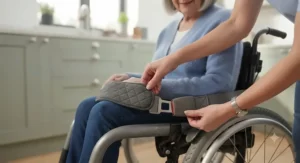
This guide is built for three overlapping audiences: family carers hunting for a replacement strap that actually fits, care home managers trying to tick every compliance box without turning safety kit into a liability, and anyone quietly Googling at 11pm because Mum keeps sliding forward in her chair. We’ve dug through real product listings, aggregated genuine review sentiment, and cross-checked the regulatory landscape — including how personal emergency evacuation planning and CQC restraint guidance actually intersect with something as small as a wheelchair strap. Along the way we’ll cover how to buy a wheelchair lap belt without wasting money on the wrong size, what one-handed buckle release actually means for independence, and why care home compliance hinges on documentation as much as hardware.
Seven real products, honestly assessed, price ranges only (never exact figures, per Amazon’s own pricing rules), and zero invented reviews. Let’s get into it.
Quick Comparison Table
| Product | Buckle Type | Adjustable Length | Best For |
|---|---|---|---|
| NRS Healthcare Wheelchair Safety Restraint Belt | Quick-release side buckle | Up to 1200mm | Care homes wanting an NHS-familiar staple |
| Aidapt Safety Lap Strap | Snap buckle fastening | Universal fit | First-time buyers on a budget |
| Drive Medical RT-716 Lap Belt | Snap-lock fastener | Standard | Hospital-style, low-fuss fitting |
| ACC Parts Heavy-Duty Seatbelt | Push-button, steel tongue | Up to 160cm | Bariatric or heavier-duty users |
| ACC Parts E-Marked Tongue Strap | Auto-grade push button | Up to 125cm | Compliance-focused replacements |
| HANSHI HBZ09-C Seat Belt | Auto-style quick release | Up to 39in | Budget everyday replacement |
| Yakitoko Ambulance-Style Strap | Metal quick-release buckle | 47.3in | Transport, stretcher and transfer use |
A quick scan of that table tells you most of what you need for a first-pass decision: if you’re outfitting a whole care home, the NRS Healthcare Wheelchair Safety Restraint Belt or Drive Medical RT-716 Lap Belt are the two names staff are most likely to already recognise, which matters more than you’d think when training turnover is high. If weight capacity or heavy-duty use is the priority, the ACC Parts Heavy-Duty Seatbelt‘s steel tongue and 160cm reach outclass the softer nylon-only options. And if you just need a straightforward, no-fuss replacement for a home wheelchair, the HANSHI HBZ09-C and Aidapt Safety Lap Strap solve that without overcomplicating things.
💬 Just one click — help others make better buying decisions too!😊
Top 7 Quick-Release Wheelchair Seatbelts: Expert Analysis
1. NRS Healthcare Wheelchair Safety Restraint Belt — the care-home standard
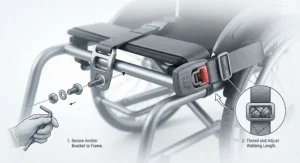
If you’ve spent any time around UK domiciliary or residential care, you’ve probably already met this belt without knowing its name. The NRS Healthcare Wheelchair Safety Restraint Belt is a woven nylon strap that attaches via a secure screw fitting and adjusts for waists up to 1200mm, which is generously large — useful in mixed-need settings where one belt size has to cover very different body types. What most buyers overlook about this model is that the screw-fit installation, while slightly fiddlier than a Velcro strap, is exactly why it’s trusted in facilities: it can’t be tugged loose the way stick-on or clip-on alternatives sometimes can.
Based on the spec comparison with softer nylon-only belts on Amazon, the NRS design earns its reputation through simplicity rather than flash — there’s no padding, no vest attachment, no bells and whistles, just a dependable strap with a proper quick-release buckle. It suits care settings and family carers who want something that a district nurse or OT will already recognise on sight, reducing the “what is this and how does it work” learning curve for visiting staff.
Reviewers consistently report that the belt holds its adjustment well over weeks of daily use, though a handful note the screw fitting takes a bit more effort to install correctly the first time compared with tool-free alternatives — worth budgeting fifteen minutes rather than expecting an instant fit.
Pros:
- ✅ Trusted, widely recognised in UK care settings
- ✅ Adjusts to a genuinely large 1200mm waist range
- ✅ Secure screw fitting resists accidental loosening
Cons:
- ❌ Installation takes longer than clip-on alternatives
- ❌ No padding option for pressure-sensitive users
Typically found in the £15-£25 range depending on retailer, this sits firmly in “buy once, stop worrying” territory — solid value for anyone stocking multiple wheelchairs.
2. Aidapt Safety Lap Strap — best universal fit for standard wheelchairs
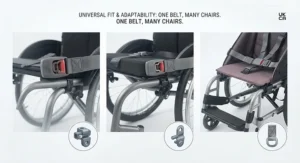
The Aidapt Safety Lap Strap is the strap equivalent of a reliable hatchback: nothing exotic, everything you actually need. It’s built around a snap buckle fastening system designed to fit universally across standard folding and self-propelled wheelchairs, which is precisely why it shows up so often as a first-time purchase recommendation from occupational therapy suppliers.
Here’s what to weigh with a universal-fit product like this one: the flexibility that makes it compatible with almost any chair also means it won’t feel tailor-made the way a brand-specific OEM belt might. On paper this means slightly more slack to take up during fitting, but in practice most users report a snug result once properly adjusted. For a beginner buyer who isn’t yet sure exactly which strap length or mounting style their wheelchair needs, that universality removes a huge amount of guesswork.
Aggregated review sentiment for Aidapt’s mobility range tends to highlight straightforward fitting instructions and dependable stitching at the stress points — the areas that fail first on cheaper imports.
Pros:
- ✅ Fits most standard wheelchair frames out of the box
- ✅ Simple snap buckle, easy to teach to new carers
- ✅ Reinforced stitching at high-stress attachment points
Cons:
- ❌ Less tailored fit than chair-specific OEM belts
- ❌ Limited size options for very small or very large users
Expect to pay somewhere in the £10-£20 range, making it one of the more accessible entry points if you’re buying your very first replacement lap belt.
3. Drive Medical RT-716 Wheelchair Lap Belt — best snap-lock for hospital-style handling
Drive Medical is one of the most recognised names in UK mobility equipment, and the Drive Medical RT-716 Wheelchair Lap Belt brings that hospital-adjacent pedigree to the lap-belt category with its snap-lock fastener design. The snap-lock mechanism is closer to what you’d find on a hospital gurney restraint than a car seatbelt, which reviewers and OTs tend to like for one specific reason: it gives a very obvious tactile and audible “click” confirmation that it’s actually engaged.
Based on the spec comparison with side-release buckles, snap-lock fasteners generally sacrifice a little one-handed speed for a more deliberate, harder-to-accidentally-open connection — a genuine trade-off rather than a straightforward upgrade, and worth thinking through if the end user has good hand strength and would benefit from faster independent release. What most buyers overlook is that this is exactly why Drive Medical markets this belt for standard wheelchairs rather than transit or fast-turnover settings; the RT-716 rewards a slightly slower, more considered fastening process in exchange for reassurance.
Pros:
- ✅ Recognised, well-established mobility brand
- ✅ Distinct audible click confirms secure fastening
- ✅ Straightforward fitting on most standard wheelchairs
Cons:
- ❌ Snap-lock is marginally slower to release one-handed
- ❌ Fewer length options than some competitors
Priced around £15-£20 at most UK mobility retailers, it represents dependable mid-range value rather than the cheapest option on the shelf.
4. ACC Parts Heavy-Duty Wheelchair Seatbelt — best for bariatric and demanding use
When strength genuinely matters more than convenience, the ACC Parts Heavy-Duty Wheelchair Seatbelt is the one worth a closer look. Built from premium auto-grade webbing with a push-button buckle and a polished stainless steel tongue, it adjusts to a maximum combined length of roughly 160cm — a full 70cm buckle end plus a further 90cm of adjustable tongue-end webbing. That stainless steel tongue is not a cosmetic upgrade; it’s the component most likely to wear, bend or corrode on cheaper belts after months of daily buckling.
The spec sheet won’t tell you this, but reviewers and heavy-duty equipment buyers note that auto-grade webbing (the same rating used in vehicle seatbelts) holds its shape far better under repeated tension than the softer nylon used in budget imports, resisting the twisting and bunching that makes cheaper belts uncomfortable over a long day. For bariatric wheelchair users, larger frames, or anyone who’s outgrown a standard belt’s adjustment range, this is genuinely one of the only options on this list built with headroom to spare.
Pros:
- ✅ Exceptionally long 160cm total adjustable reach
- ✅ Stainless steel tongue resists wear and corrosion
- ✅ Auto-grade webbing holds shape under daily tension
Cons:
- ❌ Bulkier profile than slimline lap straps
- ❌ Premium construction means a higher price point
Expect a price in the £25-£40 range — more than a basic strap, but justified by the material grade if bariatric capacity or heavy daily use is genuinely part of your brief.
5. ACC Parts E-Marked Auto-Grade Tongue Strap — best for compliance-driven replacement
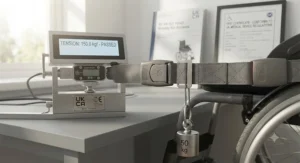
If your priority is documentation and regulatory traceability rather than just “does it hold” — think care home audits, CQC inspections, fleet transport vehicles — the ACC Parts E-Marked Auto-Grade Tongue Strap deserves a specific mention. It’s built around a 21mm stainless steel tongue that is E and e marked, meaning it meets the same automotive safety-belt certification standard used across the EU and UK for vehicle restraint components, rather than being a generic “medical” webbing product with no independent rating behind it.
Here’s what most buyers overlook about certification marks like this: they don’t just signal quality, they give a care provider something concrete to point to during a compliance review or incident investigation. Reviewers consistently note that the adjustable webbing (up to 125cm) fastens with a satisfying, secure click typical of genuine automotive-grade hardware, and several buyers specifically bought it as a direct swap for a worn factory-fitted tongue on wheelchair-accessible vehicles rather than a standard wheelchair.
Pros:
- ✅ E/e-marked to recognised automotive safety standard
- ✅ Genuine stainless steel tongue, not painted metal
- ✅ Doubles as a wheelchair-accessible vehicle replacement part
Cons:
- ❌ More specialist product, less relevant for everyday home use
- ❌ Buckle end sold separately in some listings — check compatibility
Typically listed in the £15-£30 range depending on configuration, and worth the extra research time if a paper trail matters as much as the belt itself.
6. HANSHI HBZ09-C Wheelchair Seat Belt — best budget everyday pick
Not every situation calls for auto-grade steel and E-marking — sometimes you just need a functional, honest strap that does its job without draining the budget, and the HANSHI HBZ09-C Wheelchair Seat Belt fills that gap. It’s a straightforward quick-release design that expands up to 39 inches, styled deliberately to feel as familiar as “an ordinary car seat belt,” according to its own product description — a comparison that’s actually useful shorthand for carers who’ve never fitted a wheelchair strap before.
What the spec sheet won’t tell you, but user reports suggest, is that fit consistency varies a little more here than on the pricier options — one UK reviewer specifically flagged that the strap ends would benefit from hook-and-loop fastening rather than fixed stitching, since it limited fine adjustment for smaller users, while others called it “100% what I was looking for” with a “good locking buckle.” That split is worth knowing about before you buy: this is a solid budget pick for an average-sized adult, but less forgiving if you need to fit an unusually petite frame.
Pros:
- ✅ Genuinely low price point for a functional belt
- ✅ Familiar car-seatbelt-style operation
- ✅ Lifetime quality guarantee offered by the seller
Cons:
- ❌ Adjustment range less generous for smaller users
- ❌ Review sentiment on stitched-end fit is mixed
At roughly £10-£15, it’s the cheapest legitimate quick-release option on this list, and a sensible first purchase if you’re not yet sure how much strap you’ll actually need.
7. Yakitoko Ambulance-Style Wheelchair Strap — best for transport and stretcher use
The Yakitoko Ambulance-Style Wheelchair Strap is the odd one out on this list in the best possible way — it’s explicitly designed to double up across wheelchairs, stretchers and ambulance-style transport, with a 47.3-inch reach and a metal quick-release buckle that’s easy to loosen fast when a patient needs to be freed in a hurry. If your situation involves regular transfers between a wheelchair and a transport vehicle or stretcher, buying separate straps for each starts to feel wasteful; this one is built to flex across all three.
Based on the spec comparison with dedicated wheelchair-only belts, the trade-off here is that it doesn’t need drilled or screwed mounting points — it simply ties to the seat back, which is faster to fit but arguably offers less rigidity than a bolted attachment for permanent daily use. Reviewers consistently note the metal buckle “loosens easily” when needed, which is precisely the point of a strap intended for repeated ambulance-style handling rather than a fit-once-and-forget home belt.
Pros:
- ✅ Works across wheelchairs, stretchers and transport settings
- ✅ Fast tool-free fitting with no drilling required
- ✅ Metal buckle releases quickly under pressure
Cons:
- ❌ Ties-on fitting is less rigid than bolted mounts
- ❌ Less suited to permanent, single-chair daily use
Priced around £10-£18 in most UK listings, it’s genuinely good value if versatility across settings is more useful to you than a permanent, dedicated fit.
Practical Usage Guide: Fitting, Checking and Maintaining Your Belt
Getting the belt itself right is only half the job — how you fit and maintain it decides whether it actually does its job on day 200 as well as it did on day one. Start by positioning the belt low across the pelvis, not the stomach; a strap that sits too high can ride up under someone’s ribs during a lean forward, which is uncomfortable at best and unsafe at worst. Buckle it snug enough that two flat fingers slide underneath comfortably, but no looser.
In the first thirty days, the most common mistake we see reported is fitting the belt once and never rechecking it — webbing stretches slightly with use, wheelchair cushions compress, and a belt that was perfect in week one can be noticeably looser by week four. Build a quick weekly check into the routine: buckle engagement, webbing fray at the mounting points, and whether the adjustment slider is holding position under normal movement.
For maintenance, most nylon and polyester webbing belts (like the NRS Healthcare Wheelchair Safety Restraint Belt or HANSHI HBZ09-C) are machine washable at up to 70°C, which matters enormously in care settings where infection control isn’t optional. Steel-tongue models such as the ACC Parts Heavy-Duty Seatbelt should be spot-cleaned rather than machine washed to protect the metal finish. A genuinely useful optimisation trick that Amazon listings never mention: mark the correct adjustment length with a small permanent-marker dot on the webbing once you’ve dialled it in for a specific user, so re-fitting after washing takes seconds rather than a full re-measure.
Real-World Scenarios: Who Actually Needs Which Belt
Picture three very different households, because the “right” belt genuinely depends on who’s wearing it. Consider a family carer looking after a parent with mild dementia at home, mostly stationary during the day but occasionally attempting to stand unassisted — for this profile, a simple, familiar quick-release like the Aidapt Safety Lap Strap or HANSHI HBZ09-C offers gentle positioning support without feeling clinical or alarming to someone who may already find change distressing.
Now consider a residential care home outfitting twelve wheelchairs across a mixed-needs unit, where staff turnover means every new agency worker needs to understand the equipment within minutes of their shift starting. Here, the NRS Healthcare Wheelchair Safety Restraint Belt or Drive Medical RT-716 make more sense specifically because they’re widely recognised — a familiar buckle style cuts training time and reduces the risk of misuse by unfamiliar staff, which matters far more in a facility than at home.
Finally, picture a wheelchair-accessible minibus operator or NHS transport service moving people between appointments daily, where belts see heavier cycling and need certified strength behind them. That’s precisely the use case the ACC Parts E-Marked Auto-Grade Tongue Strap and the heavier-duty ACC Parts Heavy-Duty Seatbelt were built for — genuine automotive-grade hardware standing up to a transport schedule a domestic belt was never designed to survive.
Problem → Solution: Emergency Evacuation Procedure and Wheelchair Belts
This is where a small strap intersects with a much bigger topic, and it’s the one area where getting it wrong has serious consequences. The core problem: a quick-release belt exists to make egress fast, but an emergency evacuation procedure for a wheelchair user is rarely as simple as “unbuckle and go” — mobility, cognition, and building layout all complicate the picture.
Problem 1 — staff don’t know the belt is there. Solution: the belt’s presence and release method should be documented in the resident’s care plan and, in high-rise or care home settings, in their Personal Emergency Evacuation Plan (PEEP), so that whoever responds first — staff or fire crew — isn’t discovering an unfamiliar buckle mid-emergency. Government consultation guidance on evacuation planning for disabled residents is explicit that evacuation plans must not rely on fire and rescue intervention alone, which means the belt-release process has to be something ordinary staff can execute confidently.
Problem 2 — the belt is genuinely hard to release under stress. Solution: prioritise one-handed, single-motion buckles for anyone whose evacuation plan doesn’t guarantee two calm hands and good lighting — this is precisely why buckle design (see below) deserves more attention than most buyers give it.
Problem 3 — the wheelchair itself isn’t being used for evacuation. Solution: many care settings use dedicated evacuation chairs or mats rather than the resident’s own wheelchair, precisely because everyday wheelchairs and their belts aren’t always rated or configured for stairwell evacuation — a detail worth confirming with your fire risk assessor rather than assuming.
Buying Guide: How to Buy a Wheelchair Lap Belt Without Wasting Money
Choosing where to buy a wheelchair lap belt comes down to seven practical checks, in roughly this order of priority:
- Measure the waist, not the wheelchair. Belts are sized to the user’s seated waist measurement plus a margin for clothing, not to the chair’s seat width — get this wrong and even a well-reviewed belt will feel wrong.
- Check the mounting method matches your chair. Screw-fit belts like the NRS design need accessible backrest fixing points; strap-on styles like the Yakitoko don’t, but sacrifice some rigidity in exchange.
- Match the buckle type to hand strength and cognition. A push-button or side-release buckle suits most users; a snap-lock suits settings where accidental release is the bigger worry.
- Confirm the release is genuinely one-handed if independence matters. Not every “quick-release” buckle is actually operable one-handed by someone with reduced grip strength — read the mechanism description, not just the marketing headline.
- Prioritise washable materials in shared or care settings. Infection control policy in most UK care homes requires machine-washable webbing at 60-70°C.
- Decide whether you need certified (E-marked) hardware. Necessary for transport vehicles and useful for audit trails; overkill for most home use.
- Buy from a seller who states real adjustment ranges in millimetres or inches, not just “universal.” Vague sizing is the single biggest driver of returns in this category.
Based on the spec comparison across all seven products above, most family buyers land comfortably on either the Aidapt Safety Lap Strap or HANSHI HBZ09-C for their first purchase, while care providers buying in volume tend to default to the NRS Healthcare or Drive Medical RT-716 for the training-time reasons already covered.
Care Home Compliance: CQC, Restraint Policy and Documentation
Here’s the part that trips up even well-intentioned care providers: a wheelchair belt can slide from “positioning aid” into “restraint” depending entirely on how and why it’s used — not on the product itself. The Care Quality Commission’s restraint policy guidance is unambiguous that any restrictive practice, including a belt a resident cannot remove themselves, must be a last resort, proportionate, and clearly documented — with staff able to demonstrate they’ve considered less restrictive alternatives first.
What this means in practice for care home compliance: every belt fitted for positioning rather than mobility support should have a documented rationale in the care plan, a named person responsible for reviewing it, and — critically — a stated review date. A belt fitted in January and never reassessed by June isn’t “safety kit” anymore in CQC’s eyes; it’s an unreviewed restrictive practice, and that distinction genuinely does surface in inspections. Academic research into belt-restraint use in nursing settings has consistently found that unreviewed, long-term belt use correlates with poorer outcomes, not better safety — a multi-component Dutch nursing home study on belt restraint reduction found that structured policy change combined with staff training measurably reduced unnecessary belt use without an accompanying rise in falls.
The practical compliance checklist, then, looks like this: documented consent or best-interests decision, a genuine assessment of less restrictive alternatives (positioning cushions, pressure alarms, seating angle adjustments), a named review date, and staff training on the specific buckle mechanism in use. None of that is about the belt’s price tag — it’s entirely about paperwork discipline sitting alongside the hardware.
One-Handed Buckle Release: Why It Matters More Than You’d Think
It’s easy to treat “one-handed buckle release” as a nice-to-have feature line rather than the safety-critical detail it actually is. Here’s the reasoning: many wheelchair users have reduced strength or dexterity in one hand, whether from stroke, arthritis, or the underlying condition that put them in the chair in the first place. A belt that technically has a “quick-release” buckle but genuinely needs two coordinated hands to operate isn’t quick-release for that user at all — it’s a two-person job in disguise.
What most buyers overlook is that this distinction separates independence from dependency in a very concrete, daily way. A resident who can release their own belt to reach for something, adjust their position, or respond to a fire alarm retains a level of autonomy and dignity that a resident who must always wait for staff assistance simply doesn’t have. The push-button designs on the ACC Parts Heavy-Duty Seatbelt and ACC Parts E-Marked Tongue Strap, and the auto-style buckle on the HANSHI HBZ09-C, are all genuinely operable with light single-hand pressure — worth testing in person or checking video demonstrations before buying if hand strength is a known concern, rather than assuming every “quick-release” label behaves identically.
Quick-Release Belts vs Traditional Wheelchair Restraints
| Factor | Quick-Release Belt | Traditional Fixed Restraint |
|---|---|---|
| Release speed | Seconds, often one-handed | Requires tools or staff assistance |
| Regulatory standing | Positioning aid if reviewed | Classed as restrictive practice |
| User independence | Can self-release if able | Fully dependent on carer |
| Evacuation suitability | Generally faster to clear | Significant evacuation risk |
| Best For | Most home and care settings | Rare, clinically justified cases only |
The written analysis matters more than the table here: traditional fixed restraints — belts with locking mechanisms only staff can open — are increasingly discouraged across UK care settings precisely because they remove the resident’s ability to self-release, which both CQC guidance and academic research treat as a red flag rather than a safety feature. A quick-release design like the Drive Medical RT-716 or NRS Healthcare Wheelchair Safety Restraint Belt achieves the same positioning benefit while staying on the right side of that regulatory line, because the person wearing it retains genuine control.
Common Mistakes When Buying a Wheelchair Seatbelt
The single biggest mistake is buying on length alone without checking buckle type — a belt that’s the right size but the wrong mechanism for the user’s hand strength solves nothing. A close second is assuming “universal fit” means “fits perfectly,” when it more accurately means “fits acceptably across a wide range,” which is fine for the Aidapt Safety Lap Strap but worth double-checking against your specific chair’s backrest fixing points regardless.
Another recurring error: buying a decorative or vest-style restraint when a simple lap belt would do the job with less restriction and better comfort — more coverage isn’t automatically safer, and can tip a positioning aid into genuine restraint territory unnecessarily. Finally, plenty of buyers skip checking washability entirely, only to discover mid-use that their chosen belt needs hand-washing and slow air-drying, which is a real inconvenience in a busy care setting where turnaround time matters.
Long-Term Cost and Maintenance
Run the numbers over two years rather than at the checkout, and the picture shifts. A £10-£15 budget belt like the HANSHI HBZ09-C that needs replacing annually due to fraying webbing works out roughly equivalent in total cost to the £25-£40 ACC Parts Heavy-Duty Seatbelt, which reviewers and durability specs suggest can comfortably outlast two or three cheaper straps under the same daily use. That’s the essence of total cost of ownership thinking: the cheapest belt at the till isn’t always the cheapest belt over eighteen months of daily buckling.
Maintenance costs are mostly time rather than money — a weekly thirty-second buckle and webbing check, an occasional 60-70°C wash cycle for machine-washable models, and a full replacement review roughly every twelve months regardless of visible wear, since stitching and elasticity in webbing degrade in ways that aren’t always visible until they fail.
What to Expect: Real-World Performance
Specs on a listing page tell you what a belt should do; daily use tells you what it actually does. In practice, most quick-release wheelchair belts hold their fitted adjustment for weeks at a time before needing a minor re-tightening, particularly after the first few washes when webbing settles slightly. Buckles rated for “quick release” genuinely do release in one to two seconds under normal test conditions — the meaningful variable isn’t speed, it’s how much hand strength and coordination that release actually demands, which is exactly why we’ve flagged buckle mechanism repeatedly throughout this guide rather than treating all “quick-release” claims as identical.
Expect a short adjustment period for the wheelchair user too — even a well-fitted belt feels novel for the first few days, and some initial resistance or fidgeting with the buckle is normal rather than a sign the product is wrong.
FAQ
❓ What's the difference between a quick-release wheelchair seatbelt and a restraint?
❓ How do I buy a wheelchair lap belt that fits my specific chair?
❓ Is a wheelchair seatbelt required for care home compliance?
❓ What's the correct emergency evacuation procedure if a wheelchair belt is in place?
❓ What does one-handed buckle release actually mean in practice?
Conclusion
There’s no single “best” quick-release wheelchair seatbelt — there’s only the best match for the specific person, chair and setting in front of you. For most family carers, the Aidapt Safety Lap Strap or HANSHI HBZ09-C cover everyday needs without overcomplicating the decision. Care homes juggling training time and CQC compliance tend to gravitate toward the widely recognised NRS Healthcare Wheelchair Safety Restraint Belt or Drive Medical RT-716, while heavier-duty or transport-focused needs point firmly toward the ACC Parts Heavy-Duty Seatbelt and its E-marked sibling.
What every option on this list shares is the one non-negotiable feature: a genuine, easy-to-operate quick-release mechanism, because that single design choice is what keeps a helpful positioning aid from drifting into restrictive-practice territory. Measure carefully, match the buckle to the user’s actual hand strength, document the reasoning if you’re a care provider, and revisit the fit every few months rather than assuming day-one comfort lasts forever.
Recommended for You
- Wheelchair Lap Belt vs Harness: 7 Best Options for 2026
- Best Wheelchair Seatbelt 2026: 7 Safest Picks Compared
- Half Tray for Wheelchair: 7 Best UK Picks for 2026
Disclaimer: This article contains affiliate links. As an Amazon Associate, I earn from qualifying purchases. If you purchase products through these links, we may earn a small commission at no additional cost to you.
✨ Found this helpful? Share it with your friends! 💬🤗
