
In This Article
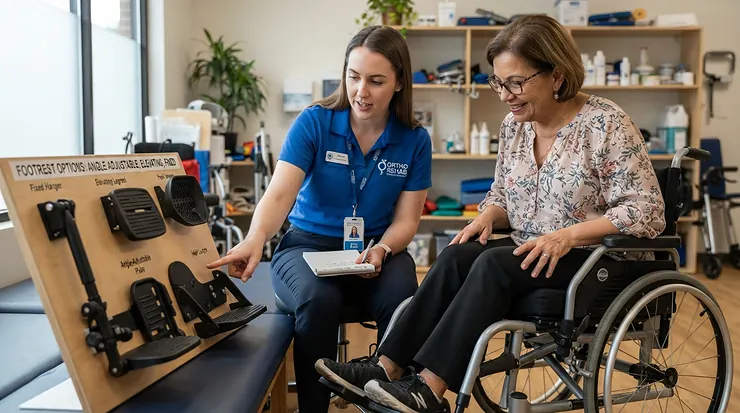
Footplates are the least glamorous part of a wheelchair, right up until the moment they ruin your afternoon. A boot lid won’t close because the footrests stick out. A heel slides into the gap between two plates. A transfer turns into an obstacle course at shin height. The question of folding vs one-piece footplates sounds like workshop trivia, but it quietly shapes how your chair folds, how it carries your weight and how much scrubbing it needs after a muddy Sunday.
Here’s the short version. Folding footplates are the flip-up pair on most everyday UK chairs. They trade a little rigidity for convenience, tucking away for transfers and letting the chair collapse into a car boot. A one-piece footplate does the opposite. It gives you one broad, stiff platform that resists sagging and suits unusual foot positions, but it asks more of you at transfer time and in transport.
This guide compares both designs on the three things buyers argue about most: transport folding mechanisms, stability under weight and ease of cleaning. You’ll also get seven real products, from budget steel transit chairs to a carbon rigid, analysed from their specs and the review evidence I could verify. Prices are ranges only because they move constantly, so check current price before buying. If you’re choosing for clinical reasons, use this as a briefing for your therapist conversation, not a replacement for it.
Quick Comparison: Folding vs One-Piece Footplates at a Glance
Here’s the whole debate on one screen before we go deep.
| Factor | Folding footplates | One-piece footplate | Best For |
|---|---|---|---|
| Transfers | Plates flip up and hangers swing away, so the path is clear | One board; flip-up versions exist but it’s a bigger obstacle | Folding: Days Escape Lite |
| Transport | Chair collapses and footrests detach | Board usually stays on, so the folded chair is longer | Folding: Drive DeVilbiss Enigma XS |
| Stability under weight | Two plates with hinges; can sag inward over time | Rigid single surface that spreads load | One-piece: RMS One-Piece Clip-on Footboard |
| Ease of cleaning | More joints and crevices, but plates come off | Fewer crevices, one surface to wipe | One-piece: RMS One-Piece Clip-on Footboard |
| Weight | Lighter per plate, more hardware overall | Can be heavier, though carbon changes this | Lowest overall: Quickie Helium |
Looking at the comparison above, folding footplates win on convenience: transfers, boot space and the daily practicalities. One-piece designs win on rigidity, foot support and fewer places for grit to hide. If you lift your chair into a car every week, start with folding, as in the Drive DeVilbiss Enigma XS. If your priority is a stable, wipe-clean platform, a one-piece board such as the RMS One-Piece Clip-on Footboard deserves a serious look.
💬 Just one click — help others make better buying decisions too!😊
What Are Folding vs One-Piece Footplates?
Folding vs one-piece footplates describes two ways of supporting your feet on a manual wheelchair. Folding footplates are two separate plates that flip upwards or swing away with the leg rests, so the chair can collapse and transfers are easier. A one-piece footplate is a single continuous platform spanning both feet, prioritising rigidity and consistent foot positioning.
Why both designs exist
Wikipedia’s wheelchair overview explains that everyday manual chairs come in two major varieties, folding or rigid, and that welded joints rather than folding ones reduce overall weight. Footplates follow the same logic. Rigid frames usually pair with a single fixed plate, and one source on standard components notes this can add to the frame’s stiffness. Folding frames, by contrast, rely on plates that move out of the way.
History helps too. One patent filing describes older chairs with a solid, non-removable footplate that made getting out difficult. Fold-up footplates fixed that and let manufacturers build collapsible, easy-to-transport chairs.
Clinical suppliers still reach for the one-piece option when separate plates fall short. Seating Dynamics, a US seating specialist, says a footboard gives a wider surface for unique foot placements, won’t sag inwards the way standard plates tend to over time, and stops feet dropping into the gap between plates. Those are real advantages, but you pay for them in portability.
Top 7 Picks for Folding vs One-Piece Footplates: Expert Analysis
I’ve split these across both camps: four folding chairs, then two one-piece boards and one rigid chair. Three of the seven are specialist-supplier products, so Amazon UK availability varies. Where I couldn’t verify a current price or a meaningful review pool, I say so rather than guess.
1. Drive DeVilbiss Enigma XS — best all-round folding setup
The headline feature is the footrest itself: quick-release, swing-in and swing-out leg rests with full height and footplate angle adjustment. That’s more tuning than most folding chairs in this class offer.
Drive quotes roughly 17kg all-in, a 115kg user limit, a 26cm closed width and about 8.3kg in carry format with wheels, footrests and cushions off. In practice, the footrests are the first thing you unclip and the half-folding back is the second saving, which leaves a manageable parcel for the boot. The angle adjustment matters more than it sounds. Plates set too flat let heels drift forward, and plates set too steep tire the ankles on longer outings.
Based on the spec comparison, this is the one I’d shortlist for someone who transfers regularly and loads a car weekly. It’s less suited to anyone whose feet need a single wide surface, because two plates always leave a gap.
Retailer reviews and Amazon Q&A answers consistently describe quick-release wheels, a frame that folds in half and footrests that come off easily. I couldn’t verify a large, recent review pool, so skim the newest ones for any mention of footplate wobble.
Pros:
- ✅ Footrest height and plate angle both adjust
- ✅ Footrests detach quickly for boot loading
- ✅ Narrow 26cm closed width
Cons:
- ❌ Two plates leave a gap between the feet
- ❌ Listed weights vary between sources, so verify
The Amazon UK listing showed no featured offer at the time of research, so I can’t give a verified range; check current price. Value verdict: strong if car transport is your daily reality.

2. Days Escape Lite Self Propelled — flip-up plates with heel cups
The standout here is the combination of detachable swing-away footrests with flip-up plastic footplates and heel cups, a sensible trio for a chair aimed at occasional-to-regular use.
Days lists the chair at around 15kg with footrests, shaving a kilo or two when they come off, with a folded width of about 31cm and a half-folding back. Maximum user weight runs from roughly 100kg to 120kg depending on seat width, so check the listing for your size. Those heel cups matter because they keep feet from sliding backwards on rougher ground, a common complaint with bare plates.
Plastic plates are light, quiet and cheap to replace. The trade-off is flex: repeated heavy loading can make them sag over time, which is exactly the problem a rigid board solves. One UK retailer’s spec sheet also lists the chair as not crash tested, which matters if you plan to travel seated in a vehicle.
The review evidence I could verify is thin and generally positive without much detail. Search recent reviews for “footrest” before buying.
Pros:
- ✅ Flip-up plates clear the way for transfers
- ✅ Heel cups help keep feet in place
- ✅ Folds to roughly 31cm wide
Cons:
- ❌ One UK retailer lists it as not crash tested
- ❌ Plastic plates may flex under heavy loading
I couldn’t verify a stable live price, so check current price. Value verdict: good for occasional use if your feet are lightweight on the plates.
3. Days Swift Self Propelled — lightest folding chair of the trio
The Swift’s party trick is weight: about 12.5kg with footrests and 11.2kg without, which makes it the easiest folding option here to lift.
Days quotes a 115kg user limit, a 28cm folded width, seat widths of 41cm or 46cm and a footrest length range of 44cm to 54cm. That last figure is the useful one for fitting. It means plates can be set to your leg length rather than your height on a good day. The frame dismantles without tools and has a half-folding back, so the transport folding mechanisms are straightforward.
The listed fixed arms are the catch. With no flip-back armrests, side transfers are off the table, so front transfers depend entirely on footplates that flip up and get out of the way. Based on that, the Swift suits occasional use with a helper rather than daily independent transfers. Days itself positions it for occasional indoor and outdoor use.
I couldn’t verify a meaningful review pool for the current Amazon listing, so treat the specs as the evidence here.
Pros:
- ✅ About 12.5kg with footrests fitted
- ✅ Tool-free dismantling for transport
- ✅ Footrest length range suits many leg lengths
Cons:
- ❌ Fixed arms limit side transfers
- ❌ Positioned for occasional rather than daily use
The Amazon UK listing sat in the £150-£200 range at the time of research. Value verdict: a smart buy if lifting weight is your main pain point.
4. Aidapt Deluxe Self Propelled Steel Transit Chair — budget steel with wipe-clean upholstery
The standout is practicality: powder-coated steel, wipe-clean padded upholstery and detachable footrests with a leg strap, all at the budget end of the market.
Aidapt’s standard 18-inch model lists roughly 17.6kg including footrests (about 16kg without), a 115kg limit, a 26cm collapsed width, anti-tip bars and a lap strap. Amazon also lists a 20-inch version with a lower 110kg limit, so check which one you’re ordering. The leg strap is the unsung hero for footplate security, since it stops a tired leg drifting backwards off the plate.
Steel is forgiving and cheap to build with, but it’s the heaviest option on this list. That weight shows up in the boot, in kerb handling and in how long a helper can comfortably lift it. For ease of cleaning, though, a powder-coated frame and wipe-down upholstery are hard to beat at this price.
I couldn’t verify a trustworthy review pool, so I won’t characterise customer sentiment here. Read recent verified-purchase reviews, searching for “footrest” and “weight”.
Pros:
- ✅ Wipe-clean upholstery and coated steel frame
- ✅ Leg strap and lap strap included
- ✅ Anti-tip bars fitted as standard
Cons:
- ❌ Heaviest folding chair in this list
- ❌ Steel adds effort when loading a boot
I couldn’t verify a stable live price. The NHS quotes manual wheelchairs from around £150, so check current price against that benchmark. Value verdict: best for a household chair that lives in a hall cupboard.
5. Gel Ovations Gel Single Piece Footplate Protector — gel-topped single platform
This is the one-piece footplate for manual wheelchair users who need pressure care, built around a soft gel top over a wooden back.
The supplier lists it at 280mm x 230mm x 38mm and about 1.43kg, supplied with six 16mm socket head bolts. It’s marketed for one-piece footplate scenarios such as the Sunrise Salsa or Invacare TDX, which are powerchair setups. Using it on a manual chair means checking that your hangers can take the bolt pattern, ideally with a therapist’s input.
The weight is the honest drawback. 1.43kg on a footplate is noticeable when you self-propel or lift the chair, so this suits attendant-pushed or pressure-sensitive users more than active ones. The upside is a rigid platform that will not sag, plus gel cushioning for feet at risk of pressure problems.
I couldn’t find independent reviews, so the supplier’s description is all I can confirm.
Pros:
- ✅ Gel top helps with pressure-prone feet
- ✅ Rigid backing won’t sag
- ✅ One platform replaces two plates and the gap
Cons:
- ❌ About 1.43kg adds noticeable weight
- ❌ Mounting needs compatible hangers
Priced just under £100 at the time of research, it’s typically sold through specialist suppliers rather than Amazon, so check current price and availability. Value verdict: justified for pressure care, hard to justify for casual use.

6. RMS One-Piece Clip-on Footboard — try one-piece without replacing hangers
The clever bit here is the clip-on design with depth adjustment and a turn-lock anti-tip fixing, so you can test a one-piece surface on your existing footrests.
It’s made from 12mm polypropylene, with mounting brackets that fit both plastic and die-cast footplates. The listing offers widths of 31cm or 36cm and depths of 20cm to 30cm. That range is the clever part, because foot length varies far more than seat width.
A smooth polypropylene board should wipe down easily, which helps ease of cleaning, but a board spanning both plates can’t flip up one side at a time. Whether it suits your transfers depends on how far the whole assembly swings. Measure your plates and feet carefully before ordering.
I couldn’t verify independent reviews, so the product page is my only source.
Pros:
- ✅ Clips over existing plates
- ✅ Depth adjusts to foot length
- ✅ Smooth surface should wipe clean quickly
Cons:
- ❌ Premium price for a plastic board
- ❌ Sizing needs careful measuring
Pricing started around £190-£200 at the time of research, with VAT relief for eligible buyers. Specialist supplier rather than Amazon, so check current price. Value verdict: the cheapest low-risk way to try one-piece.
7. Quickie Helium — rigid ultralight benchmark with carbon footplate
The standout is weight: the supplier quotes a 6.8kg starting weight, helped by a carbon fibre axle tube and footplate.
The frame is hydroformed aerospace-grade aluminium with a shorter, more compact profile and 12-spoke Spinergy wheels. Rigid frames avoid the cross-brace fold entirely, so there are fewer moving parts to wear. One source notes that folding mechanisms have moving parts that can wear or need adjustment. Transport means removing the wheels and folding the backrest, not collapsing the frame. Footplate configurations vary, so confirm yours at ordering.
This isn’t a chair for an attendant or for frequent stand transfers. It’s for an active user who wants every push to count and a footplate tucked close to the frame. Reviews I could verify were limited to supplier text, so treat the performance claims as manufacturer-reported.
Pros:
- ✅ 6.8kg starting weight
- ✅ Compact frame brings feet in close
- ✅ No cross-brace to wear
Cons:
- ❌ A different price league from folding chairs
- ❌ Poorly suited to attendant pushing
Pricing started from around £2,500 at the time of research, typically through specialist dealers. Value verdict: serious money for serious daily use, and only worthwhile if you self-propel a lot.
Top 7 Comparison
| Product | Footplate type | Approx. weight | Price range | Best For |
|---|---|---|---|---|
| Drive DeVilbiss Enigma XS | Folding swing-in/out | About 17kg | Check current price | Weekly car-boot users |
| Days Escape Lite Self Propelled | Folding flip-up plastic | About 15kg | Check current price | Heel-cup security |
| Days Swift Self Propelled | Folding | About 12.5kg | £150-£200 range | Easiest lift |
| Aidapt Deluxe Self Propelled Steel Transit Chair | Folding, steel | About 17.6kg | Check current price | Household use |
| Gel Ovations Gel Single Piece Footplate Protector | One-piece accessory | About 1.43kg (plate only) | Just under £100 | Pressure care |
| RMS One-Piece Clip-on Footboard | One-piece clip-on | Not stated | From around £190 | Trying one-piece |
| Quickie Helium | Rigid with carbon footplate | From 6.8kg | From around £2,500 | Active daily users |
The Days Swift is the sensible winner on weight among folding chairs, while the Aidapt Deluxe Self Propelled Steel Transit Chair wins on easy-clean practicality at the cost of kilos. If you only want to experiment with one-piece support, the RMS One-Piece Clip-on Footboard is the lower-risk entry than a full rigid chair like the Quickie Helium. And weigh the Gel Ovations Gel Single Piece Footplate Protector purely on pressure-care need, not on general convenience.
How to Choose Between Folding vs One-Piece Footplates
Choosing between folding vs one-piece footplates comes down to seven decisions, in this order:
- Start with transfers. If you stand or slide across regularly, you want plates that flip away. A fixed board in the way turns every transfer into a negotiation.
- Count your car journeys. Weekly boot loading favours folding designs, because transport folding mechanisms depend on footrests that detach or fold vertically.
- Weigh the load. Think about stability under weight: how much force your legs put through the plates, not just your total body weight.
- Check your foot position. Contractures, foot drop or inward sagging point towards a one-piece surface.
- Plan your cleaning routine. If ease of cleaning is a priority, fewer crevices help, though removable plates also clean well.
- Measure ground clearance. NHS Wales guidance suggests roughly 10cm between plate and floor, and no less than 5cm, so kerbs don’t catch you out.
- Get assessed. The NHS social care guide says to ask a GP, physiotherapist, occupational therapist or hospital staff to refer you to your local wheelchair service, and notes that you may be eligible for a personal wheelchair budget.
Transport Folding Mechanisms: What Happens in the Boot
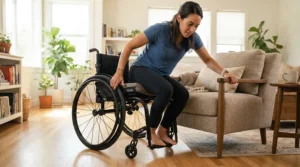
Transport folding mechanisms are where the folding camp earns its reputation. A cross-brace chair collapses sideways, but only once the footrests are out of the way, which is why guidance from Cardiff and Vale University Health Board says to check the footrests are locked forward with the footplates folded vertical, or to remove the footrests altogether. Its booklet also warns against lifting a chair by its armrests or leg rests.
With a one-piece footplate for manual wheelchair use, the board usually stays attached. That makes the folded chair longer and bulkier, so measure your boot rather than trusting a “compact” label. Rigid frames like the Quickie Helium sidestep the issue by dropping the cross-brace entirely: remove the wheels, fold the backrest and the frame stays one piece.
Quick-release wheels are the other half of the transport story. The same booklet advises refitting wheels to the side they came from and giving each a gentle rock to confirm it’s locked. The Days Swift and Drive DeVilbiss Enigma XS both use quick-release rear wheels, so these checks apply to them directly.
Travelling seated in a vehicle is a different matter. The booklet advises that a secured wheelchair does not offer the same safety as a vehicle seat, and that tie-downs belong on the frame, not on footrests or other accessories. Footrest design matters less than the restraint system, so never improvise with a footplate as an anchor.
Stability Under Weight: Where Each Footplate Design Wins
Stability under weight is more nuanced than “heavier user, stiffer plate”. The chair’s rated limit, such as 115kg on the Drive DeVilbiss Enigma XS or the Days Swift, describes the whole chair. Your footplates take a smaller, more concentrated load, especially if you extend your knees or push off them.
That’s the clinical point behind one-piece boards. Seating Dynamics notes that users who extend strongly at the knees, or who have a history of equipment breakage, may need more robust footrests, and says its one-piece footboard resists inward sagging. A rigid board like the RMS One-Piece Clip-on Footboard spreads that load across a single surface, while two plastic plates on a budget chair can bend or tilt over time.
Folding plates aren’t unstable by default. Properly set and tightened, they hold up well for typical everyday use, particularly on chairs rated for 115kg. But two small plates concentrate force and can drift inward, which is why heavier or more forceful users should test before committing.
Don’t ignore clearance either. The Cardiff and Vale guidance says never to stand on the footplates during transfers, and to keep anti-tipper wheels about 50mm off the ground. Plate height affects castor clearance and kerb handling, as the Aidapt Deluxe Self Propelled Steel Transit Chair and its anti-tip bars illustrate.
Ease of Cleaning: A Practical Guide for Footplates
Ease of cleaning is where the two designs differ in subtler ways. One-piece boards have fewer crevices, but folding plates detach more easily from the chair, so both can be kept hygienic with the right routine.
Hygiene guidance separates cleaning from disinfection. Cleaning removes dirt with soap and water, while disinfection kills germs afterwards. Cleaning comes first, and care-home checklists flag footrests as a frequently missed area. Here’s a routine that works for both footplate types:
- Detach where possible. Remove folding footrests so you can reach hinges and undersides. A one-piece board such as the RMS One-Piece Clip-on Footboard may unclip as a single piece.
- Wash first. Warm soapy water and a soft brush shift grit from hinges and tread.
- Disinfect second. Use a product suited to the surface and respect its contact time.
- Dry fully. Trapped moisture causes stiffness and odour in hinges.
- Inspect. Look for cracks, loose fixings and worn tread before refitting.
Weekly is a sensible baseline, plus after muddy or wet outings. For anyone prioritising ease of cleaning above all, the wipe-clean upholstery and coated frame on the Aidapt Deluxe Self Propelled Steel Transit Chair are a good starting point, while gel-topped surfaces like the Gel Ovations Gel Single Piece Footplate Protector deserve a check of the supplier’s care instructions before you choose a cleaner.
One-Piece Footplate for Manual Wheelchair: Who Really Needs One?
A one-piece footplate for manual wheelchair use is a specialist choice, not a default upgrade. It solves particular problems well and creates new ones if you don’t have those problems.
It makes sense if your feet slide into the gap between separate plates, if your plates sag inward, or if your range of motion means standard plate positions don’t match your feet. Seating Dynamics describes exactly these scenarios for its footboard. It also suits active users on rigid frames, where a single plate tucks close and keeps the chair compact, as on the Quickie Helium.
It makes less sense if you transfer by standing, lift your chair into a car boot daily, or need to flip one side clear. In those cases a folding pair such as the Days Escape Lite Self Propelled remains more practical.
If you’re unsure, the RMS One-Piece Clip-on Footboard gives you a lower-commitment trial, though your therapist should confirm it suits your posture and transfers. Honest summary: choose a one-piece footplate for manual wheelchair use because of a need, not because rigid sounds sturdier.
Folding vs One-Piece Footplates vs Clip-On Boards: Which Wins?
There’s a third option many buyers miss: the clip-on board. It sits between the two camps.
| Criterion | Folding footplates | Fixed one-piece | Clip-on board |
|---|---|---|---|
| Transport | Easiest | Bulkiest | Moderate |
| Transfers | Easiest | Hardest | Moderate |
| Stability under weight | Adequate | Strongest | Strong |
| Ease of cleaning | Good (removable) | Very good | Very good |
| Typical cost | Included | Higher | Mid-to-high |
| Best For | Drive DeVilbiss Enigma XS | Quickie Helium | RMS One-Piece Clip-on Footboard |
Reading across, the clip-on board is the compromise candidate. It borrows rigidity from the one-piece design while keeping your existing hangers, though it can’t match the pure convenience of folding plates. A fixed one-piece plate such as the Quickie Helium‘s is best reserved for active users who rarely need to clear their feet. Folding stays the default for most households, with the Days Swift and Drive DeVilbiss Enigma XS as the obvious examples.
Real-World Scenarios: Three User Profiles
Specs are abstract, so here are three profiles with budgets, environments and frequency of use.
The occasional-outing retiree. Budget under £250, one or two car trips a week, a partner doing the lifting. The Days Swift is the logical pick: about 12.5kg, folds to roughly 28cm and handles shops and restaurants. The Aidapt Deluxe Self Propelled Steel Transit Chair is the budget alternative if weight matters less than wipe-clean surfaces.
The daily self-propeller. If you’re a young adult commuting several miles every day, weight and push efficiency dominate. A rigid chair like the Quickie Helium earns its price here, because the frame has no fold mechanism to flex and the carbon footplate keeps feet close. Budget is higher, around £2,500 and up, and the chair lives on pavements and in lecture halls.
The pressure-care case. Someone with sensitive feet, medial plate sag or an unusual foot position needs a different answer. A clip-on board like the RMS One-Piece Clip-on Footboard or the gel-topped Gel Ovations Gel Single Piece Footplate Protector may help, but this is a therapist-led decision. Budget £100-£200 for the board and expect to accept some weight and transport compromises.
Problem → Solution Guide: Fixing Common Footplate Headaches
Problem: heels slide between the plates. Fit a one-piece board such as the RMS One-Piece Clip-on Footboard, or add heel loops and a calf strap, as supplied with the Aidapt Deluxe Self Propelled Steel Transit Chair.
Problem: plates sag inward over time. Check fixings first, then consider a rigid board. Seating Dynamics identifies inward sag as a typical failing of standard plates under force.
Problem: the chair won’t fit the boot. Detach footrests before folding, as NHS Wales guidance recommends, and favour a compact folder like the Drive DeVilbiss Enigma XS.
Problem: plates catch on kerbs. Re-measure clearance. Aim for roughly 10cm, with 5cm as the minimum.
Problem: grit in the hinges. Detach, wash, dry and inspect weekly. If hinge grime is constant, a smooth one-piece surface helps ease of cleaning.
Long-Term Cost & Maintenance
Over several years, folding plates are the cheap-to-fix option. One UK spares supplier lists plastic Invacare Action footplates at around £9 and pairs of steel leg rests at around £30. That’s a small bill for a worn pair, though Action parts only fit Action chairs, so check compatibility.
One-piece boards cost more up front, with the RMS One-Piece Clip-on Footboard starting around £190 and the Gel Ovations Gel Single Piece Footplate Protector just under £100. The payoff is longevity and fewer replacements, assuming your board suits your hangers. A rigid chair like the Quickie Helium carries the largest outlay, but it avoids the wear points of a cross-brace fold.
Funding matters too. Scope’s wheelchair guide explains that personal wheelchair budgets may let you top up for a different chair, and a local NHS leaflet notes that when the NHS owns the chair it won’t repair features you’ve added yourself. That’s a good reason to discuss any footplate modification with your wheelchair service first.
Common Mistakes When Buying
- Buying on headline weight alone. The Days Swift is light, but fixed arms limit side transfers.
- Ignoring crash-test status. If you plan to travel seated, check it, rather than assuming.
- Skipping measurements. Footplate depth, foot length and clearance all matter.
- Choosing rigid because it sounds sturdier. Folding plates are fine for most people.
- Fitting boards without checking compatibility. Hanger type and bolt pattern vary.
Safety, Regulations & Transport Compliance (UK)
Wheelchairs sold in Great Britain are regulated as medical devices, so look for UKCA or CE marking and keep the manufacturer’s manual. Never stand on the footplates during transfers, and keep wheel locks applied.
For vehicle travel, tie-downs belong on the frame, and a lap belt does not replace a proper restraint system. Standards exist for wheelchairs used as seats in vehicles, and ISO 7176-19 is the usual reference, so ask the supplier for evidence rather than relying on a listing’s wording. Remove detachable accessories and store them in the luggage area. If you’re eligible, many UK suppliers also offer VAT relief on mobility equipment bought for personal use.
FAQ
❓ Can I swap folding footplates for a one-piece board on my existing chair?
❓ Is a one-piece footplate for manual wheelchair use heavier than folding plates?
❓ What is the easiest way to clean flip-up footplates?
❓ Are wheelchair footplates VAT exempt in the UK?
❓ Can I fold a wheelchair for car travel with the footplates fitted?
Conclusion
So, folding vs one-piece footplates: which wins? For most households, folding. It gives you easy transfers, a boot-friendly chair and cheap, replaceable parts, all of which the Drive DeVilbiss Enigma XS, Days Escape Lite Self Propelled and Days Swift Self Propelled deliver in different weight classes. The Aidapt Deluxe Self Propelled Steel Transit Chair adds easy-clean practicality at a budget price, in exchange for kilos.
One-piece designs earn their place when you have a real need. That means feet that slide into gaps, plates that sag, pressure risks or an active rigid-frame lifestyle. The RMS One-Piece Clip-on Footboard is the low-risk trial, the Gel Ovations Gel Single Piece Footplate Protector is the pressure-care specialist, and the Quickie Helium is the premium rigid benchmark.
Whichever way you lean, weigh your decision against the three tests we’ve covered: transport folding mechanisms, stability under weight and ease of cleaning. Then get a professional assessment if your needs are clinical.
✨ Don’t Miss These Exclusive Deals!
🔍 Take your wheelchair setup to the next level with these carefully selected products. Click on any highlighted item to check current pricing and availability. These options will help you find a footplate solution that genuinely fits your day-to-day life!
Recommended for You
- Best Wheelchair Footplates: 7 Proven UK Picks (2026)
- Footrests For Wheelchair Users With Oedema: 7 Picks (2026)
- Removable Footrests For Transport Wheelchairs: 7 Best Picks (2026)
Disclaimer: This article contains affiliate links. As an Amazon Associate, I earn from qualifying purchases. If you purchase products through these links, we may earn a small commission at no additional cost to you.
✨ Found this helpful? Share it with your friends! 💬🤗
